

Key Takeaways
Do not mistake a blameless sufferer's pain for God's punishment.
Job is not secretly guilty. The story introduces him as a man of integrity who reveres God and avoids evil. Then he loses his wealth, his children, and his health. The reader learns from a heavenly scene that Satan causes the calamities with God's permission, not because Job is being punished for some hidden offense. Job himself never sees that scene, so he suffers without the explanation available to the reader.
The frame matters. Job's suffering is not a puzzle solved by discovering the sin that caused it. The book establishes that a person can live faithfully and still endure devastating, undeserved loss. It does not explain why this particular permission is given, or make every sufferer's experience identical to Job's.
The story resists a familiar human reflex: treating good fortune as proof of virtue and disaster as proof of fault. That reflex can make suffering doubly painful, since people already in distress may begin accusing themselves. Job's case interrupts that inference without denying that some consequences do follow from harmful choices. The distinction is crucial: a specific action may cause a specific harm, but hardship alone cannot serve as a moral diagnosis.
Let grief speak plainly; despair does not cancel a believer's faith.
Job's lament is part of the story. After first responding to loss with worship, Job curses the day he was born and longs for death. He cannot imagine a future, feels abandoned, and asks why he remains alive. The book does not treat this despair as proof that he has stopped believing or that an undisclosed sin explains his condition.
The losses isolate him. His friends initially sit with him, but eventually their words deepen his loneliness. Ash also recalls the Christian poet William Cowper, whose severe and recurring depression persisted despite his Christian faith. Such stories complicate easy demands to cheer up or interpret every low mood as spiritual failure. Job's poetry takes suffering seriously enough not to hurry it toward a neat lesson.
This is a valuable corrective to communities that confuse hope with visible cheerfulness. Grief can narrow a person's sense of the future and make ordinary reassurances feel like pressure to perform recovery. Sitting with someone, listening, and allowing silence can be more humane than explaining the loss. Spiritual care should also avoid treating a biblical lament as a substitute for appropriate medical or psychological support. Faith and serious distress can coexist.
Refuse explanations that turn pain into evidence against the sufferer.
The friends mistake a pattern for a rule. Eliphaz, Bildad, and Zophar reason that God is just, so good people must prosper and sufferers must have done wrong. They urge Job to repent, and Bildad even implies that Job's dead children must have deserved their fate. Their theology contains truths: wrongdoing can bring harm, and God is just. Their error is assuming that justice always appears immediately in each person's circumstances.
Their certainty harms Job. They ignore the book's opening, where Job is called blameless, and they refuse to engage honestly with the world Job describes, where the wicked can thrive. They also leave out spiritual evil, delayed judgment, and the possibility of innocent suffering. At the end, God rejects their account of him.
The friends show how a tidy theory can protect its owner from uncertainty by assigning blame to someone else. This resembles just-world thinking, the tendency to assume that people generally get what they deserve. Such a belief can feel morally orderly, yet it becomes cruel when applied to a grieving person without evidence. The better discipline is to distinguish what is known about a person's choices from what observers merely infer from the fact that suffering occurred.
Bring protest to God instead of confusing anger with unbelief.
Job argues because the relationship matters. He accuses God of treating him unfairly, yet keeps longing to speak with God and to have his case heard. He wants an arbiter, a witness, and finally a Redeemer who will vindicate him. His anger and his dependence are not opposites: he cannot understand God's treatment of him, but he cannot stop turning toward God.
The book honors this struggle. Job's friends prefer settled explanations; Job insists on taking his pain to the living God. His protest is not presented as a polished doctrine, and some of his accusations go too far. But his refusal to settle for an abstract system keeps the relationship alive. His speeches show that prayer can include anguish, accusation, and yearning, not only calm acceptance.
Lament gives protest a direction. Rather than treating anger as the opposite of faith, it can be understood as a demand that a relationship meet the standards it claims to uphold. This does not make every accusation true, or make anger automatically wise. It does make room for honest speech before judgment is passed. At the same time, a person's quietness or emotional restraint should not be treated as evidence of shallow faith; people express distress differently.
Seek God's presence when the reason for suffering stays hidden.
Job's mining poem changes the question. In chapter 28, miners risk danger and hardship to uncover precious metals, yet the poem says that divine Wisdom, the deep order underlying creation, cannot be mined by human effort. God alone knows its place. The closing distinction is between grasping the whole design and living wisely: reverence for God and turning from evil are within the human calling, even when the reasons for pain remain unknown.
Elihu offers a limited possibility. He argues that God may sometimes use suffering to warn or redirect a person. That can be true in particular cases, but Job's story prevents it from becoming a universal diagnosis: Job's calamity is not punishment for a specific sin. The book points readers toward God without handing them a complete explanation.
The poem distinguishes explanation from orientation. A person may not be able to reconstruct why a disaster occurred and still choose a way to live amid uncertainty. That is not an argument against asking hard questions; the poem itself takes the search seriously. It is a warning against assuming that human beings can see the whole causal structure of a world. Claims that suffering teaches a lesson should therefore be offered cautiously, especially when made about someone else's pain.
Treat evil as real, but never as a power beyond God's restraint.
The book gives evil an agent. In the opening scenes, Satan is a real adversary who can act, but must ask permission and remain within limits set by God. In the final speeches, the Lord describes Leviathan, a terrifying monster associated with cosmic evil. Job cannot tame it; God can. The image does not make evil harmless. It makes evil powerful, frightening, and subordinate rather than an equal rival to God.
This answers one fear, not every question. Job learns that the forces behind destruction are not beyond God's control, but he is not given a detailed explanation for why God permits his particular suffering. The book holds divine sovereignty and the reality of evil together without making the tension disappear.
The image of a restrained monster offers a claim about limits, not a complete account of responsibility. That distinction matters: saying that evil is bounded may comfort a sufferer, but it does not make the permission of suffering easy to understand. The book refuses both a universe where evil is imaginary and one where it has equal power with God. Its answer is less a formula than a stance of trust in the face of an unresolved moral problem.
Read Job's hope through the innocent sufferer who is raised.
Job longs for vindication beyond the grave. In chapter 19, surrounded by isolation and convinced that God has turned against him, he nevertheless trusts that a living Redeemer will stand for him. He hopes to see God and have his case made right, even if that happens after death. His confidence is striking because it emerges not after his circumstances improve, but while he is still in pain.
Ash reads Job through Jesus. In the Christian reading developed in the book, Job anticipates the blameless Jesus, who suffers unjustly, dies, and is vindicated in the resurrection. That resurrection gives Christians grounds for treating Job's hope as more than wishful thinking. The connection does not erase Job's agony; it says that the Christian answer to suffering centers on a God who enters it.
The Christian interpretation does more than attach a hopeful ending to an ancient story. It locates hope in a person who experiences suffering and death, rather than in a theory that makes suffering look acceptable. That can offer solidarity as well as future vindication. It remains a specifically Christian claim, grounded in belief in Jesus' resurrection, and should be presented honestly as such rather than assumed to settle every philosophical objection to evil.
Measure righteousness by care for the vulnerable, not status.
Job's remembered prosperity had a moral shape. In chapter 29, he recalls using his influence to help the poor, the orphan, the widow, and people with disabilities. He defended those in danger and sought justice for people who lacked power. His former honor was connected not merely to wealth, but to a life that reflected God's care for others.
Integrity is not perfection. Job does not claim never to have sinned; he argues that he has not concealed some grave wrongdoing that explains his suffering. In chapter 31, he reviews ways he could have acted unjustly and challenges God to show where he has done so. The distinction lets the book affirm a real moral life without pretending that a faithful person is sinless.
Job's account challenges a narrow view of righteousness as private belief or personal respectability. In the story, moral credibility appears in how power is used, especially toward people with less of it. That connects worship to public ethics: a person's claims about God are tested by their treatment of neighbors. The text also avoids equating social success with virtue, since Job's past status disappears while his integrity remains central to the dispute.
Expect faithful life to include long waiting before final restoration.
Job's ending comes after a long struggle. The book spends most of its chapters on lament, argument, and unanswered questions, then ends with God correcting the friends, accepting Job, and restoring his fortunes and family. Job's restoration follows his renewed encounter with God; it is not presented as a payment earned by maintaining faith. The story's long poetic middle matters because grief cannot be skipped by jumping from disaster to a happy ending.
The ending is not a daily guarantee. Ash reads Job through the Christian expectation of final vindication and blessing, while acknowledging that life now includes spiritual struggle, prayer, and waiting. Job's restored wealth and family are not a promise that every sufferer will receive equivalent compensation in this life. The point is that present pain does not have the last word.
Narrative closure can sustain hope without functioning as a forecast. Job's recovery gives the story a concrete ending, while its long middle refuses to make that ending quick or easy. Readers should resist turning restoration into a bargain: endure enough, and prosperity will follow. The more durable claim is that injustice and loss are not ultimate in the book's theology, even though their resolution may remain beyond a person's present view.
Analysis
Ash's reading depends on a deliberate gap between what readers know and what Job knows. The opening scenes reveal a heavenly dispute and Satan's bounded role, while Job experiences only loss and apparent divine hostility. That dramatic irony makes the friends' mistake visible: they explain suffering by observing the sufferer, but the reader has already been told that their diagnosis is false. The book's structure therefore trains interpretation, not merely belief. It asks readers to resist conclusions drawn from circumstances alone.
The poetic middle is essential to that training. Job's speeches do not simply report pain; they make readers endure repetition, argument, and emotional contradiction. A summary that offers a clean answer would reproduce the friends' impulse to close the case. The poem in chapter 28 supplies a different limit: the search for the world's full moral architecture is legitimate, but human beings do not possess God's vantage point. Wisdom becomes a practice of reverence rather than mastery.
The account remains theologically demanding. God is supreme, Satan acts only by permission, and Job's suffering is undeserved. Those claims are not reconciled into a causal explanation. The book offers sovereignty and restraint as grounds for trust, while leaving open why this particular permission was given. That tension should not be hidden behind a comforting slogan. It is also why the book's Christian reading matters: Ash sees Jesus' innocent suffering and resurrection as the fullest ground for hope, not as a device that makes suffering painless or self-evidently good.
The ending must be handled with similar care. Job's restored life gives the story real closure, but it cannot be converted into a universal promise of prosperity before death. Its central pastoral correction is more modest and more serious: suffering does not prove guilt, lament does not disqualify faith, and a person may continue to seek God without possessing an explanation. The book's lasting achievement is to turn the reader away from diagnosing the sufferer and toward the difficult work of worship, justice, and patient companionship.
Review Summary
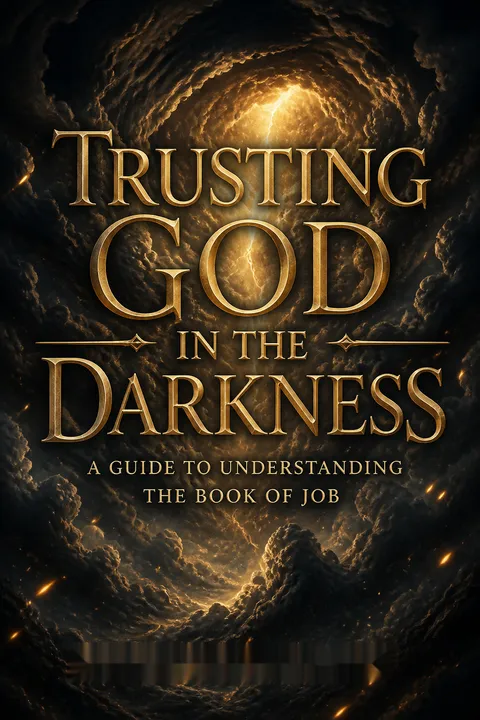
Trusting God in the Darkness receives overwhelmingly positive reviews, averaging 4.53 out of 5. Readers consistently praise its pastoral sensitivity, accessibility, and Christ-centered approach to the book of Job. Many appreciate its concise yet profound exploration of suffering, divine providence, and true worship. Reviewers highlight Ash's ability to connect Job's suffering to Jesus Christ, making it spiritually enriching beyond mere academic study. While some wish for greater depth, most recommend it as an excellent introduction, particularly for those experiencing personal suffering or preparing to study Job.
People Also Read









Glossary
wheelchair questions
questions from lived sufferingAsh's phrase for questions about suffering asked by someone who is personally experiencing pain, or is close to someone who is. It contrasts with detached, theoretical questions asked from safety. The distinction emphasizes that the same question can carry different emotional weight when loss is immediate.
the Satan
the heavenly adversaryIn Ash's reading of Job, Satan is a title meaning adversary or accuser, not simply a personal name. This figure patrols the earth and challenges the genuineness of Job's worship. Satan has real influence, but must seek permission from God and cannot exceed the limits God sets.
Wisdom
the hidden order of creationIn Job 28, Ash uses capitalized Wisdom for the deep structure underlying the created order, including its moral and spiritual dimensions. Human beings can search for it but cannot grasp the whole design; God alone knows it. Human wisdom, by contrast, means revering God and turning from evil.
Leviathan
an image of cosmic evilLeviathan is a monstrous sea creature in biblical poetry. Ash reads it in Job as more than an ordinary animal, as an image of the terrifying power of evil and its chief spiritual adversary. The creature is beyond Job's ability to control, yet remains within God's authority and restraint.
justification
being declared right with GodIn Ash's account, justification is God's acceptance and vindication of a person as belonging to him. Job longs for this recognition because he is treated as guilty despite his integrity. His vindication does not mean he is sinless; it means the friends are wrong to claim his suffering proves hidden wrongdoing.
About the Author



Download PDF
Download EPUB
.epub digital book format is ideal for reading ebooks on phones, tablets, and e-readers.








