

Key Takeaways
Let your values answer the question suffering cannot resolve
Meaning under pressure. After the 2015 Paris attacks, Scott Pelley recognized the same stunned grief he had witnessed after 9/11, Oklahoma City, and Sandy Hook. A letter from Antoine Leiris, whose wife was murdered, described choosing to protect his young son’s happiness rather than inherit the attackers’ hatred. Pelley connects this choice to psychiatrist Viktor Frankl’s account of surviving Nazi concentration camps: people may lose control over events, but retain some choice in how they respond.
The book’s central claim is not that values explain tragedy. They show what a person can still do when explanation fails. Pelley sees meaning in the firefighters, medics, artists, and survivors who act according to their convictions in frightening circumstances.
The distinction between explaining suffering and choosing a response is psychologically important. A sense of agency can help people endure conditions they cannot control, but it should not become a demand that victims display resilience or forgive. Leiris’s refusal to hate is his own moral decision, not a standard others must meet. The stronger lesson is narrower and more humane: circumstances can constrain action without completely determining character. Values become practical when they guide the next available choice, even if that choice cannot repair the loss.
Measure courage by whom it protects, not how fearless it looks
Service made concrete. On September 11, FDNY Chief Peter Ganci and hundreds of firefighters entered the World Trade Center to rescue people trapped above the impact zones. Ganci knew the danger, yet after the South Tower collapsed, he turned toward the wreckage to search for firefighters calling for help. He died when the North Tower fell. In total, 343 FDNY members were killed. Their work also saved lives: an estimated 87 percent of the towers’ occupants evacuated, and 99 percent of those below the impact areas survived.
Pelley finds the same outward focus in Air Force nurse Paulette Schank. When a wounded marine ran out of blood during surgery in Iraq, Schank donated her own. Courage here is not an absence of fear. It is accepting risk for another person.
These accounts make courage relational rather than theatrical. Emergency work depends on trust, training, and coordinated roles, not simply individual nerve. The evacuation figures also complicate any impression that the rescue effort was futile: even amid catastrophic losses, organized action mattered. Still, stories of exceptional sacrifice can unintentionally make preventable danger seem noble. The public lesson is twofold: honor people who accept risk for others, and build systems that do not depend on their willingness to die.
Turn testimony into action without demanding that grief become closure
Voice after violence. Nadia Murad had escaped ISIS captivity after being enslaved and raped. In her first interview with Pelley, she insisted on conditions that let her speak safely, including concealing her face because her family members remained in danger. Her account helped bring attention to ISIS’s persecution of the Yazidis. She became an advocate against sexual violence and human trafficking, and shared the 2018 Nobel Peace Prize.
Parents who lost children at Sandy Hook also turned private grief toward public work. Nicole Hockley and Mark Barden created Sandy Hook Promise, which teaches young people and educators to notice warning signs and reach out to those who seem isolated. Their legislative efforts met defeat in Congress. They continued anyway, while making clear that action does not restore the family they lost.
Testimony can change what institutions recognize, investigate, and prevent. Murad’s account made a targeted community’s experience harder to dismiss, while Sandy Hook Promise translated bereavement into prevention efforts. Yet public admiration for survivors can create a subtle burden: the expectation that pain must produce a campaign, a lesson, or an inspiring outcome. Neither advocacy nor recognition cancels grief. These stories are strongest when understood as choices made by particular people, not as proof that every survivor should turn trauma into public service.
Question official certainty most when war is being sold as inevitable
Skepticism before invasion. Before the 2003 Iraq War, the Bush administration argued that Saddam Hussein possessed weapons of mass destruction and implied links to terrorism. Pelley reports that the weapons were not found, despite searches at more than 600 suspected sites. The intelligence community had made forceful claims from incomplete evidence, while senior officials did not seriously debate whether war was the right choice. Army Chief of Staff Eric Shinseki warned Congress that stabilizing Iraq would require several hundred thousand troops. His estimate was dismissed as excessive.
Pelley calls the failure both governmental and journalistic. He had interviewed an Iraqi general who disputed key claims about chemical and nuclear weapons, but did not pursue the warning as aggressively as he should have. Skepticism, he argues, is not disloyalty. It is a safeguard against costly decisions made on a manufactured sense of certainty.
The case illustrates a basic problem in decision science: groups under threat often reward evidence that confirms the preferred plan and discount information that complicates it. A dissenting estimate is not automatically correct, but it deserves serious testing, especially when the decision is irreversible and the costs fall on soldiers and civilians. Pelley’s admission of his own reporting failure strengthens the argument. The standard should not be reflexive opposition to war. It should be a public record of competing evidence, uncertainty, and plausible consequences before force is used.
Be right before being first, especially when facts are still moving
Verification beats velocity. Pelley describes a 1993 report that a survivor had been found in the World Trade Center bombing rubble. Other outlets were broadcasting the claim, but police and firefighters at the scene knew of no rescue. The supposed survivor had actually been found safe in a bar and had not been in the building. The error grew from an assumption, then spread under pressure to match competitors.
During the 2013 Boston Marathon manhunt, news organizations reported that suspects had been arrested. CBS waited for independent confirmation. The report was false, and an FBI official said it had disrupted the search. Pelley’s newsroom rule was to require two independent sources for breaking news and more for extraordinary claims. He also urges reporters to seek multiple viewpoints, notice concrete details, and rewrite until a deadline stops them.
The examples expose a structural weakness in modern news: speed is visible and countable, while careful verification is often invisible. That creates incentives to publish before uncertainty has been resolved. A two-source rule is useful, though source independence matters more than a raw count: two outlets repeating the same unverified origin do not create corroboration. The deeper discipline is to track how each claim is known, what could disprove it, and what remains uncertain. Accuracy is not merely a professional virtue. In a crisis, it can shape public behavior and the work of responders.
Defend press freedom because citizens cannot judge what they cannot see
A right with consequences. In 1998, Chinese dissident Bao Tong agreed to speak with Pelley in a Beijing park, despite surveillance and the risk of renewed punishment. Bao had been imprisoned after opposing the government’s violent response to the 1989 Tiananmen protests. His interview tested whether China’s written promise of free speech had any force in practice. Pelley contrasts this with the United States, where competing news organizations can criticize government policy without taking instructions from a central propaganda office.
The book argues that a free press is not merely a professional privilege. It helps citizens inspect government decisions, expose abuses, and debate policy. When reporting from the battlefield was restricted during the 1991 Gulf War, Americans received less independent information about what their military was doing. Without reliable information, public consent becomes harder to exercise meaningfully.
This argument treats press freedom as civic infrastructure: a means by which citizens can evaluate power rather than simply trust it. Bao’s courage shows what is at stake when law and lived reality diverge. But a free press is not automatically a trustworthy press. Its legitimacy depends on verification, plural perspectives, and willingness to correct errors. The contrast is therefore not between perfect journalism and censorship. It is between an imperfect system open to challenge and one in which the state controls which facts may enter public life.
Never let a leader’s confidence substitute for evidence or limits
Power reveals character. Pelley presents several failures of judgment rather than one partisan villain. Bill Clinton’s lies under oath about his relationship with Monica Lewinsky damaged public trust and led to impeachment. Donald Trump used sweeping, inaccurate claims about unemployment and infrastructure, then described himself as uniquely able to fix government. George W. Bush showed resolve during the confusion of 9/11, but his administration later discounted military warnings about the scale of the Iraq occupation.
These episodes differ in kind and consequence. Pelley’s connecting concern is the danger of leaders treating confidence as proof and personal authority as a substitute for institutional restraint. The Constitution’s divided powers can slow impulsive action. What looks like gridlock can be a protection when leaders or parties become too certain of their own judgment.
The common thread is not that every leader’s mistake is equivalent. It is that personal conviction becomes dangerous when it weakens accountability, invites deception, or treats disagreement as obstruction. Constitutional checks provide time for scrutiny, but they cannot guarantee wise outcomes; institutions also depend on officials willing to enforce norms and citizens willing to notice breaches. A useful test for leadership is whether confidence is paired with transparent evidence, correction when wrong, and acceptance of limits. Charisma alone answers none of those questions.
Act boldly in a crisis, then account honestly for who bears the cost
A risky rescue. During the 2008 financial crisis, Federal Reserve Chair Ben Bernanke used emergency authority to lend to financial firms beyond the central bank’s customary borrowers. He created new lending programs, lowered interest rates, and helped prevent failures from spreading through a fragile system. The crisis had been fueled by reckless mortgage lending and securities that received top ratings despite their risk. Bernanke had also underestimated the danger before the crisis fully broke.
Pelley reports that the emergency loans were repaid and the Federal Reserve’s mortgage-backed securities recovered value. But the rescue angered the public because taxpayers helped stabilize firms whose decisions had helped create the disaster. Bernanke’s argument was that a collapsing financial system would harm households and businesses far beyond Wall Street. His response shows why crisis leadership sometimes requires unprecedented action, and why such action still needs scrutiny.
The episode captures a real policy dilemma: preventing system-wide collapse can require helping institutions that behaved irresponsibly. In finance, tightly connected firms can transmit losses to people who never chose the risks, much as one burning building can threaten a whole block. Yet rescue without consequences can encourage future risk-taking. The relevant evaluation is not simply whether the intervention worked, but who paid, who benefited, and what rules changed afterward. Emergency discretion is most defensible when it is transparent, temporary, and paired with accountability.
Choose work for the meaning it creates, not the status it brings
Purpose beyond applause. Bruce Springsteen kept touring because performing and writing gave his life meaning, not because he needed another measure of fame. His songs drew on the struggles of his New Jersey childhood and examined the distance between American ideals and American conduct. He also left the successful E Street Band for a time because repeating a winning formula had begun to limit his creative freedom.
Elon Musk offers a different example of purpose-driven work. He started Tesla and SpaceX despite believing they might fail, aiming to accelerate electric transport and make spaceflight more accessible. Both companies nearly ran out of money in 2008, and Musk put his remaining resources into keeping them alive. Pelley also describes Musk’s volatility and overpromising. Ambition can serve a larger purpose, but vision does not make a leader infallible.
Springsteen and Musk reveal two different forms of intrinsic motivation: craft that gives a life shape, and an ambitious project intended to alter the available future. Research on motivation distinguishes doing work for its inherent interest from doing it mainly for external rewards; the former can sustain effort, though it does not guarantee good judgment or social benefit. Musk’s story usefully complicates the celebration of vision. Purpose can make risk worthwhile, but it can also rationalize overconfidence. A meaningful goal still needs feedback, limits, and revision.
Keep all fifty stars inside your definition of America
Pluralism is the work. Pelley closes by arguing that Americans cannot choose only the regions and political identities they prefer. The flag has fifty stars, and the country belongs to people who disagree about policy, culture, and history. In his view, democracy weakens when citizens retreat into media that confirms what they already believe, or treat opponents as enemies rather than fellow participants.
The 2016 election demonstrated how easily confidence can obscure discontent. In Ohio, laid-off steelworkers who had once voted reliably Democratic supported Trump, while many Clinton supporters felt little enthusiasm. Pelley argues that listening across these divides is not an optional gesture of civility. It is how a diverse society discovers what its citizens are experiencing and reaches durable compromises.
Pluralism is more demanding than tolerance because it requires taking other people’s interests seriously enough to negotiate. The book’s flag image gives that obligation a memorable form, while the Ohio reporting shows why national averages can hide local economic loss and political alienation. Still, compromise is not inherently just: some conflicts involve rights that should not be traded away for agreement. The practical challenge is to distinguish negotiable policy from basic protections, then build coalitions without pretending that disagreement has disappeared.
Analysis
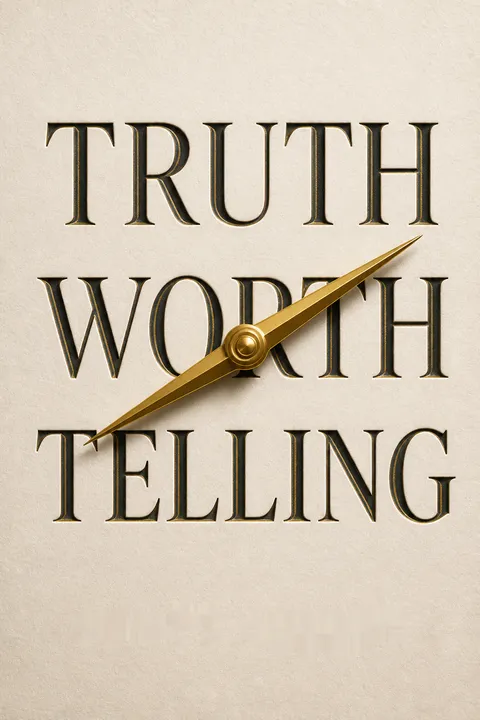
Truth Worth Telling is a reporter’s memoir organized around people whose conduct makes values visible under pressure. Its form is episodic, but the argument accumulates: character matters in private choices, institutions matter when choices scale, and reliable information is necessary for citizens to judge either. The stories move from firefighters and wounded soldiers to artists, politicians, dissidents, and grieving parents. The reporting itself becomes part of the subject. Pelley recounts moments when he got facts wrong, missed the significance of evidence, or had to resist competitive pressure, linking his personal craft to the public function of journalism.
The book’s most powerful distinction is between courage and certainty. The FDNY’s rescue effort, Paulette Schank’s care, and Nadia Murad’s testimony show action grounded in responsibility to others. By contrast, the Iraq invasion and the post-9/11 torture program show how fear and institutional loyalty can make overconfidence seem like resolve. Bernanke’s crisis response complicates the contrast: bold intervention may be necessary, but necessity does not erase questions about fairness, incentives, and accountability.
The memoir is also an argument against treating public life as a contest between heroes and villains. Pelley praises Bush’s decisions on September 11 while condemning major choices on Iraq. He recognizes Clinton’s political ability while showing how deceit damaged his presidency. He describes the failures of journalism alongside its democratic value. This willingness to distinguish acts rather than assign permanent moral identities gives the book much of its credibility.
A limitation follows from its method. Vivid individual stories make large systems emotionally legible, but they can also make systemic problems look solvable through exceptional character. A brave nurse cannot repair a health system, and a courageous reporter cannot alone counter disinformation or policy failure. The book is strongest when personal virtue is connected to institutional safeguards: independent reporting, checks on executive power, civic participation, and prevention efforts. Its enduring claim is not simply that good people exist. It is that societies need structures that let truth be heard and good judgment survive pressure.
People Also Read



Glossary
Rules of Engagement (ROE)
Limits on military actionA classified set of criteria governing when military force may be used. In Pelley’s account of Afghanistan, proposed airstrikes included estimates of civilian risk and required a commander to assess whether the military advantage justified that harm. The rules were meant to limit civilian casualties, although judgment and incomplete information remained central.
Enhanced Interrogation Techniques
Authorized coercive interrogation methodsThe Bush administration’s official label for coercive methods used in CIA detention sites after 9/11. The methods described in the book include waterboarding, sleep deprivation, stress positions, and cramped confinement. Pelley argues that the phrase softened the reality of abuse and that legal authorization did not make the practices consistent with American values or anti-torture law.
Common Peroneal Strike
A disabling thigh blowA technique in which a guard strikes a prisoner’s thigh with enough force to temporarily disable the common peroneal nerve and make the person buckle. Pelley describes it as a method intended for rare self-defense that became routine at the Bagram detention facility. Prosecutors linked the strikes to severe injuries suffered by prisoners.
Mission Oriented Protection Posture (MOPP)
Levels of chemical protectionThe military’s system for specifying protective equipment during a possible nuclear, biological, or chemical threat. Pelley describes MOPP Level 4 as the most restrictive posture, requiring a protective suit, gloves, and gas mask. During the 1991 Gulf War, reporters and troops wore this equipment because Iraq had used chemical weapons in its war with Iran.
Great Firewall of China
China’s internet censorship systemThe combination of state controls used to block websites, filter searches, and suppress online content deemed politically unacceptable by the Chinese government. Pelley connects the system to broader media censorship, including restrictions on reporting about Tiananmen Square. It allows the Communist Party to limit what information reaches the public while using digital technology for surveillance.
13(3)
Emergency Federal Reserve lendingSection 13(3) of the Federal Reserve Act, an emergency authority that allows the Federal Reserve to lend beyond its usual circle of commercial banks under specified conditions. Ben Bernanke invoked it during the financial crisis to provide funding to struggling institutions, accepting mortgage-backed securities as collateral. The power enabled rapid intervention but raised questions about risk and accountability.
Download PDF
Download EPUB
.epub digital book format is ideal for reading ebooks on phones, tablets, and e-readers.








