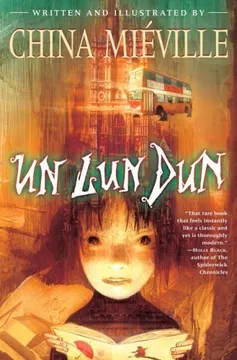


Plot Summary
Prologue
In a hidden laboratory, a researcher works through records and chemical notes until the light dims and smoke seeps beneath the door. He recognizes the danger, tries to climb toward a ventilation shaft, and faces the darkness rather than flee.
The scene ends before the smoke reaches him, leaving the work unfinished and its purpose unexplained. Later, the girls learn that the real Benjamin Unstible died while investigating London’s historic smog, giving this opening the shape of a warning from the past.
The opening makes research a physical act of risk: the researcher’s notes may explain the threat, but knowledge has not made him safe. His attempt to preserve or continue his work foreshadows the struggle over who controls information in UnLondon. It also introduces the Smog not as weather but as an intelligence capable of stalking a person into a locked room. The unfinished scene encourages the reader to connect later evidence without immediately knowing whose story is being interrupted.
The Fox Chooses Zanna
At school, Zanna Moon’s friends watch a fox remain unnaturally still until it bows to her and vanishes. For weeks, other signs have gathered around her: a bus driver has recognized her in a café, her name has appeared high on a bridge, and an unknown sender has delivered a travelcard bearing the strange title Shwazzy.
Zanna’s closest friend, Deeba Resham, believes the pattern matters even when Zanna tries to dismiss it. Then dark smoke rises from street drains, surrounds the girls, and drives Zanna’s father’s car into the confusion. His daughter escapes the collision, but Becks is struck and badly hurt. Zanna realizes the smoke was reaching for her, while their classmates begin to blame her for the accident.
The supernatural attention arrives before Zanna has any language for it, making her distinction between coincidence and evidence a source of genuine tension. Deeba’s loyalty gives Zanna a witness when the community turns suspicious, but it cannot erase the harm to Becks. The episode also establishes the book’s moral complication: Zanna may be singled out for a purpose, yet her presence can bring danger to people who did not choose it.
A Wheel Turns London Off
After the accident, Zanna and Deeba shelter at Deeba’s home, where a battered umbrella crawls across the courtyard and leaves a trail of oily marks. Following it into a basement, Zanna finds a giant iron wheel and turns it despite Deeba’s protests.
The room’s light and the sound of London’s traffic fade; when the girls escape, the familiar estate has become a maze of enormous windowless towers beneath a gray, hollow-centered sun. Their phones display unfamiliar words and cannot call home.
A heap of rubbish comes alive and chases them through the passages. A wiry boy named Hemi drives it back with stones, then tries to explain that they have arrived in UnLondon. Before he can help further, a flamboyantly dressed couturier, Obaday Fing, warns the girls away from him.
Zanna’s instinct opens a door, but it does not give her control over what lies beyond it. Deeba’s protests register a practical fear that the fantasy world cannot simply absorb, while the dead phones make separation immediate rather than symbolic. Hemi’s rescue is followed by a warning about his identity, establishing how quickly unfamiliar people are categorized as threats. The scene’s oddities are not decoration: the city’s discarded objects have become inhabitants with their own lives.
The Bus Takes Flight
Obaday guides Zanna and Deeba toward the Propheseers, the scholars who may know how to send them home. On the way, they meet Conductor Joe Jones, a Londoner who crossed into UnLondon years earlier and now protects passengers on its strange buses.
Jones recognizes Zanna’s travelcard as proof that she is the expected Shwazzy, though she insists she knows nothing about the title. His bus rises over the city beneath a balloon, but a disguised passenger grabs Zanna while armed raiders approach on enormous flies.
Hemi drops through the bus ceiling and disrupts the attacker, giving Jones time to defeat the raiders. With more skyjackers closing in, Jones leaves the girls in Slaterunner territory, where agile roof-dwellers can guide them toward the Pons Absconditus.
The bus turns transportation into a compact model of UnLondon’s obligations: Jones’s work is not merely to move passengers, but to keep them alive when the route becomes hostile. Zanna is treated as a public symbol before she understands her own situation, and the attack shows that the label makes her a target. Hemi’s intervention complicates the warning Obaday gave, while Jones’s choice to separate from the girls replaces certainty with a harder form of trust.
The Prophecy Has a Face
Inessa Badladder and her Slaterunners carry the girls over roofs toward the elusive Pons Absconditus, a bridge that can be reached only by following its changing path.
There, the Propheseers consult a talking book and confirm that Zanna matches their prophecy: she is meant to save UnLondon from the Smog, a thinking pollution-cloud that once attacked London. They also explain that an earlier champion, Benjamin Unstible, crossed into London to learn how the Smog had been defeated.
Before they can answer the girls’ questions, masked stink-junkies storm the bridge and spray poisonous smoke. Zanna tries to fight them, but a blow to her head drops her. A small amount of Smog enters her lungs, leaving the prophecy’s chosen rescuer unconscious and gravely ill.
The prophecy offers Zanna a role but not an informed choice. The Propheseers’ confidence rests on a book whose authority has not yet been tested, while the attack gives the Smog a concrete motive for targeting her. Deeba’s presence matters because she is not included in the prediction, yet she remains the person most invested in Zanna’s safety. The crisis begins to separate official importance from practical responsibility.
Brokkenbroll's Backup Plan
The Unbrellissimo, Mr. Brokkenbroll, arrives with an army of broken umbrellas that can repel the Smog’s attacks. He takes Deeba to a hidden workshop, where the missing Benjamin Unstible is alive and preparing a chemical treatment that will turn the umbrellas into shields for UnLondon’s residents.
Deeba is sent back to London with Zanna, whose lungs are still contaminated, so Brokkenbroll can draw the remaining Smog out of her. At six in the morning, Deeba uses an electric fan to scatter the smoke from Zanna’s room.
Zanna wakes safely, but remembers none of UnLondon or the attack there. Deeba’s parents barely register that she was gone, a consequence of the strange phlegm effect that keeps Londoners from worrying about people who cross over.
The apparent rescue is built from care and compromise: Brokkenbroll’s plan protects the city, while Deeba accepts a return that may cost her friend her memories. The phlegm effect shields their families from panic, but it also makes absence unnervingly easy to overlook. Zanna’s recovered body and missing experience leave Deeba carrying the shared adventure alone. That imbalance becomes the emotional engine of her later decision to go back.
A Dead Man's Record
Back in London, Deeba searches for the history behind UnLondon’s claims. She discovers that the supposed magical Klinneract resembles the real Clean Air Act, and that the Armets may be a garbled version of the Royal Meteorological Society.
When she contacts a scientist who knew Unstible, she learns that he died during his research into the 1952 smog. Deeba decides the man in UnLondon cannot be the real Unstible. A paper glove made from the prophecy book gives her a route back: she climbs her school library shelves until they become a towering book-lined shaft, then emerges above UnLondon in the Wordhoard Pit.
She reaches Wraithtown, where a records search confirms Unstible’s death. Hemi helps her obtain the proof, and the two find Obaday after surviving another Smog attack.
Deeba’s return begins not with a prophecy but with skepticism and research. She tests UnLondon’s grand claims against ordinary records, then takes a physically dangerous route when the evidence demands action. The library becomes both a passage and a method: she climbs through stories rather than accepting their authority at face value. Her alliance with Hemi deepens as she questions the prejudice that has made others treat him as suspect.
The Protector Turns Predator
Deeba brings her evidence to Brokkenbroll, expecting the umbrella commander to help investigate. Instead, he and Murgatroyd, an agent from Minister Rawley’s office, bind Deeba and Hemi and leave them with the supposed Unstible. The creature admits that it is the Smog wearing a human form, and that it has been using Brokkenbroll’s protection plan to prepare a larger attack.
It wants to burn books, people, and buildings, then absorb their knowledge and smoke. When it moves to burn the captives, Hemi forces part of his body through his bonds and attacks it, allowing Deeba to escape with a surviving scrap of the death record. Conductor Jones carries them to the Pons, but the Propheseers trust Brokkenbroll and accuse Hemi of misleading her.
The betrayal works because Brokkenbroll has earned trust through real service, not mere performance. His protective system is useful, which makes its concealed purpose harder to recognize. Deeba’s evidence is dismissed partly because Hemi is already stigmatized and she is not the prophesied figure. The Smog’s desire to consume books turns knowledge into both its appetite and the means by which it might be understood.
A Sidekick Takes the Lead
When Brokkenbroll arrives at the Pons and turns the Propheseers against Hemi, Deeba grabs the talking prophecy book and runs with him. The bridge flickers among destinations as its keepers struggle to control it, and the fugitives tumble out at an unknown crossroads. The book’s index reveals that Deeba has been classed as a funny sidekick to Zanna, not as a hero in her own right.
Angry but unwilling to leave UnLondon to the Smog, Deeba asks what the prophecy says Zanna must collect. The book lists seven treasures, ending with the UnGun, a weapon feared by the Smog. Deeba refuses the dangerous, uncertain sequence of tasks and decides to seek the weapon directly, making her own judgment the basis of the plan.
The index reduces Deeba to a supporting function, but its insult exposes the weakness of the story system that claims to know her. She does not answer by demanding a new prophecy; she acts without one. Her shortcut is not simple recklessness, since the Smog’s threat and the limited time before her family forgets her both press on the choice. The book remains useful, but no longer gets to decide who matters.
Words Escape Their Speaker
To reach the first clue about the treasures, Deeba and Hemi cross Mr. Speaker’s silent Talklands, where unauthorized speech is forbidden. His court captures them, and the ruler demands new words as payment.
Deeba supplies familiar slang, but Mr. Speaker refuses to release them and plans to keep her talking indefinitely. She argues that words do not obey one speaker’s intentions; meanings shift among the people who use them. The utterlings, small creatures made from Mr. Speaker’s spoken words, turn against him and free the prisoners.
Three choose to accompany Deeba: Bling, Diss, and Cauldron. With the book’s guidance, the group reaches a house containing an entire forest and begins searching for the featherkey, the first of the prophesied treasures.
Deeba defeats Mr. Speaker by applying the same principle that guides her wider resistance: authority cannot own meaning simply by declaring it. The utterlings’ rebellion is not a magical weapon delivered from outside the story, but a change in how they understand their own agency. Their decision to travel with Deeba gives her a deliberately assembled community, unlike Zanna’s role, which was assigned before she could consent.
A Key in the Jorest
The group hires Yorick Cavea, a birdcage-headed explorer whose bird can speak with the forest’s animals. He locates Parakeetus Claviger, a magnificent parrot whose raised crest contains the featherkey.
Deeba provokes the bird into displaying it, and Diss and Bling climb through the foliage to seize the key. The contest triggers the toilet cistern that feeds the house’s river. Diss falls into the surging, piranha-filled water, while the others escape with the feather. A Smog-controlled corpse attacks as they reach the stairs.
Cavea draws it into the flooded room, then sends his bird away to lead the pursuing Smog off. Deeba leaves the forest with the first treasure, but also with the loss of Diss and the belief that Cavea has sacrificed himself.
The quest’s cost is not abstract: Deeba’s decision to pursue the key exposes companions to danger, and Diss vanishes in the very moment the group succeeds. Cavea’s method of escape shifts the risk onto himself, forcing the survivors to leave without certainty about his fate. This is where Deeba stops treating the book’s tasks as harmless instructions. A treasure can be obtained and still represent a failure of care.
The Black Window's Bait
At Webminster Abbey, the group finds a vast web inhabited by predatory windows that open onto different rooms and worlds. They build a false window with a gun-shaped object to lure the one containing the UnGun. The trap works, but a separate Black Window snatches Rosa, Jones’s longtime driver, and carries her away.
Deeba enters the captured window’s room, where the real UnGun hangs on a wall, and throws it back to her waiting friends before leaping out herself. The weapon is empty. The group cannot retrieve Rosa or find ammunition, and Deeba faints from exhaustion. What they have gained is a feared weapon with no obvious way to use it, while their search has cost them another trusted companion.
The Black Windows turn entry into a problem of orientation: a familiar room can be a trap if its exit no longer leads home. Deeba succeeds by entering the danger rather than waiting for a safer solution, but the loss of Rosa prevents the victory from feeling clean. The empty UnGun also frustrates the conventional logic of a quest, in which acquiring the named object should complete the task. Here, possession is only the beginning of interpretation.
The Gun Grows a Forest
A Smog assault erupts near the abbey, and Deeba fires the UnGun at the advancing smoglodytes. The shot sends trees and vines surging through the streets, binding the creatures in a sudden green maze and forcing the Smog to retreat. The weapon has made its own ammunition from whatever Deeba placed in its chambers, so the group has a means to resist.
Soon London police arrive in a drilling vehicle with Murgatroyd and offer Deeba protection and a route home. She nearly accepts, until she catches the officers sharing a look with him and realizes the offer is another trap. Her shot raises a house around the police, buying time. Deeba and her friends begin recruiting UnLondoners who no longer trust the official instructions.
The UnGun’s first use converts ordinary debris and life into a defense, but its power remains unpredictable. Deeba’s refusal of the police offer is a psychological turning point: she recognizes that the longing for her family can be manipulated, yet does not pretend the temptation was unreal. The house she raises is both barrier and delay, a practical response that creates time for collective action rather than promising safety.
UnLondon Takes the River
Word of Deeba’s resistance gathers a force of Slaterunners, market traders, ghosts, and other UnLondoners. Lectern leaves the Propheseers and joins them, admitting that Brokkenbroll’s instructions have grown harder to defend.
At the river, the rebels launch boats made from overturned cars and fight off stink-junkies by giving them sudden masses of hair. In the canals, shudderwrack drags Skool, the diving-suited fish collective, beneath the water; Deeba fires the UnGun and turns the canal briefly to seawater, allowing the surviving fish to escape.
Hemi stays behind to direct the ghosts against Smog-controlled corpses at the factory entrance. Deeba enters with Lectern and the others. Inside, they defeat a fruit construct, while Bling and Cauldron persuade the Hex’s attacking words to rebel.
The resistance becomes credible only when it stops being Deeba’s private burden. Each group contributes a different capacity: the Slaterunners move through difficult terrain, the ghosts confront the misuse of the dead, and the conductors organize passage. Yet victory is not costless. Skool is damaged, Hemi separates from Deeba, and the alliance is held together by improvisation rather than a single command structure.
Nothing Swallows the Smog
In the factory, Deeba repairs her torn umbrella and frees it from Brokkenbroll’s control, creating a self-directed rebrella. The Smog’s human-shaped agent reveals that the treated umbrellas are not shields for the final attack: they are meant to ignite when its new chemical rain falls.
Brokkenbroll returns, but the Smog has already used him and moves against him as well. Deeba fires the UnGun’s paper-plane shot, which knocks Brokkenbroll unconscious but cannot stop the Smog from escaping into the sky.
Its clouds gather over UnLondon, ready to rain poison on residents who trust their umbrellas. Remembering the prophecy’s supposed misprint, Deeba fires the final chamber. The UnGun draws the Smog into itself, stripping the sky clean and trapping the threat inside the weapon.
The climax resolves through correction rather than obedience. Deeba repairs an object designed for dependence, recognizes the protective plan as a weapon, and interprets the book’s apparent error differently from the scholars who trusted it. The UnGun succeeds because she acts on the possibility that the wording was not wrong. Her victory is not the fulfillment of a chosen role, but the result of attention, skepticism, and responsibility taken under pressure.
Home, With a Door Open
After the battle, the surviving rebels regroup, and the Propheseers become the Order of Suggesters, accepting that their book cannot dictate what must happen. Deeba seals the UnGun inside a block of concrete and returns to London with Curdle and her rebrella.
Her family initially stares at her as though they cannot place her, but the phlegm effect passes and they recognize her again. Zanna also greets Deeba normally, her lungs healed and her memories still absent. Deeba chooses not to force those memories back.
The epilogue finds her at Minister Rawley’s office, accompanied by Jones, Obaday, Hemi, and a binja. They arrive through a repaired cross-world elevator, interrupting Rawley’s plans and making clear that Deeba intends to confront the people who helped the Smog.
The ending refuses a simple choice between home and adventure. Deeba returns because her family matters, but the altered photograph and her restored place at the table show how precarious belonging has become. She also accepts Zanna’s silence rather than treating memory as something she has a right to demand. The final visit to Rawley carries the conflict across the boundary again: returning home does not mean agreeing to forget what happened elsewhere.
Epilogue
Minister Elizabeth Rawley reviews the success of LURCH, a program that has reduced pollution in London by routing its emissions into UnLondon. She believes the arrangement has made her politically powerful, though contact with her ally has faltered. Deeba arrives at Rawley’s office with Conductor Jones, Obaday Fing, Hemi, and a binja.
A restored elevator connects the two cities, and the visitors swiftly disarm Rawley’s guards and Murgatroyd. Deeba confronts the minister with the consequences of the hidden agreement, opening a new reckoning between London and the city that absorbed its waste.
The epilogue makes the environmental bargain legible: London’s cleaner air has been purchased by exporting pollution and danger to a place its leaders consider disposable. Rawley’s confidence shows how easily a harmful policy can be recast as public success when its costs are hidden from the beneficiaries. Deeba’s return with UnLondon allies refuses that separation. The elevator turns the boundary into a political connection, making responsibility cross the same threshold that pollution crossed in secret.
Analysis
Un Lun Dun tests the idea that a story’s chosen hero is the same thing as the person who can act. Zanna is marked by animals, strangers, and prophecy as the Shwazzy, but the city’s survival ultimately depends on Deeba, whose importance the prophecy book files away as secondary. Deeba’s response is not to reject stories altogether. She reads closely, questions what the book gets wrong, and uses its knowledge without surrendering her judgment to it.
That conflict extends to institutions. The Propheseers possess records but confuse accumulated authority with reliable interpretation. Brokkenbroll offers real protection, then turns that dependence into political leverage. London’s apparent environmental success is likewise built on concealment: pollution is redirected into UnLondon, where its victims have fewer ways to make their suffering visible. The Smog is not simply an external monster but the material and moral consequence of treating waste as someone else’s problem.
The novel’s objects make these arguments concrete. A discarded umbrella can become a living companion; a broken one can be commanded; a repaired one can choose its own actions. The UnGun does not reward Deeba with predictable force, but amplifies what she places inside it, so the final victory depends on observation and interpretation rather than inherited power. Even the book’s error becomes useful once Deeba refuses to assume that authority must be right.
Deeba’s emotional journey is not a clean conversion from fear to fearlessness. She wants her family, is shaken by their temporary inability to remember her, and still chooses to return to a city that needs help. Her final promise to visit again joins the two worlds without pretending their risks have disappeared. The book’s answer to destiny is therefore not that anyone can do anything, but that responsibility can be chosen, shared, and revised as the facts change.
Review Summary
Reviews for Un Lun Dun are largely positive, averaging 3.83/5. Readers praise Miéville's boundless imagination, the richly inventive world of UnLondon, and his clever subversion of fantasy tropes like the "Chosen One" prophecy. Protagonist Deeba is widely celebrated as a strong, resourceful heroine. Common criticisms include pacing issues, an overly heavy-handed environmental message, and comparisons to Gaiman's Neverwhere feeling derivative. Many adults wished they'd read it as children, while some felt the writing was too simplified.
People Also Read

Characters
Deeba Resham
The unchosen problem-solverDeeba is Zanna’s closest friend and the story’s practical, observant center. She uses humor to manage uncertainty, but her jokes do not make her careless; she notices when official explanations fail and follows evidence even when it leads into danger. Her loyalty is active rather than sentimental: she questions authority, protects people who are dismissed, and accepts responsibility without needing a prophecy to authorize her. Deeba’s central psychological tension is between wanting to return to her family and recognizing that others need her where she is. She is not fearless. Her courage grows from repeatedly acting while afraid, especially when the people around her mistake confidence for truth.
Zanna Moon
The expected saviorZanna is a tall, quiet schoolgirl whose unusual name and presence draw attention she would rather avoid. She is thoughtful and often dreamy, but beneath her reserve is an instinctive readiness to meet the strange rather than deny it. Her friendship with Deeba gives her a rare space to admit fear without being reduced to it. Zanna’s role is shaped by other people’s expectations: animals, strangers, and scholars identify her as important before she understands why. That pressure complicates her natural decency, since being treated as a symbol can obscure her actual needs. She values loyalty and is willing to step forward, even when she cannot yet explain what calls her.
Hemi
The half-ghost guideHemi is a sharp-tongued teenager who moves between the living and the dead, with a human body and a ghost’s ability to pass through solid objects. His mixed heritage leaves him vulnerable to suspicion from both communities, so he protects himself with bravado, opportunism, and a refusal to show how much exclusion hurts. He first helps Deeba and Zanna in UnLondon, then becomes Deeba’s guide through places where she has no social standing or local knowledge. His distrust is not indifference: he often risks himself for people who have barely earned his confidence. Hemi’s story exposes how prejudice can make the most useful witness seem least credible.
The Smog
The thinking pollution-cloudThe Smog is a sentient mass formed from London’s accumulated smoke, chemicals, and waste. It can gather and move debris, produce fires and poisonous substances, and control the dead or addict the living through its fumes. Its appetite is not merely territorial: it seeks to absorb the knowledge carried by people, books, and burned things. That desire makes it a grotesque version of preservation, keeping what it destroys by turning it into itself. The Smog also thrives when cities conceal their waste and call the arrangement success. Its most dangerous quality is patience. It can wait while others mistake its quiet for defeat.
The Prophecy Book
The uncertain authorityThe enormous speaking book is the Propheseers’ storehouse of history and predictions. It has a strong personality, enjoys being consulted, and expects its accumulated knowledge to matter. Its confidence becomes less secure as events refuse to match its pages, but it remains capable of helping those who question it. The book represents knowledge that is valuable without being infallible. It can preserve patterns and clues, yet its readers may mistake an index for destiny or a prediction for instruction. Its relationship with Deeba moves from condescension toward a more honest partnership, as she insists that uncertainty is not the same as uselessness.
Obaday Fing
The needle-haired couturierObaday Fing is an eccentric UnLondon designer whose clothes are made from printed pages and whose own head bristles with pins and needles. His restless talk and theatrical pride conceal a genuine instinct to shelter frightened newcomers. He helps guide Deeba and Zanna through a city they do not understand, and his craft makes him a resourceful companion. Obaday is capable of repeating UnLondon’s prejudices, particularly about ghosts, but he can also reconsider them when someone he trusts challenges him. His creativity is practical as well as comic: he makes tools, clothing, and plans out of materials other people overlook.
Joe Jones
The passenger-protecting conductorJoe Jones is a former London bus conductor who crossed into UnLondon and kept the work of guiding passengers. He treats safe passage as a duty, not a job description, and meets danger with calm competence. His knowledge of routes, vehicles, and the city’s history makes him an essential guide for Deeba. Jones’s reserve can disguise his affection, especially when he must leave people in danger because there is no safer choice. He offers a model of authority based on service: he does not demand that passengers trust him, but repeatedly earns it by accepting risk on their behalf.
Mr. Brokkenbroll
The unbrella commanderKnown as the Unbrellissimo, Brokkenbroll commands the broken umbrellas that have crossed into UnLondon. He is composed, strategic, and concerned with building a defense strong enough to protect ordinary residents from the Smog. His authority comes from making practical preparations, and people look to him because he appears to understand dangers that others cannot control. Brokkenbroll is also ambitious and sensitive to challenges against his plans. His mixture of genuine competence and hunger for influence makes him a difficult figure to read: in UnLondon, protection and power can occupy the same hand.
Benjamin Unstible
The missing Smog scholarBenjamin Unstible is a renowned UnLondon researcher who studies the history of the Smog and seeks knowledge of the forces that once opposed it. His reputation rests on intellectual range and relentless curiosity, qualities that make his absence deeply unsettling to the Propheseers. Unstible represents the hope that careful study can produce a defense against a threat too large for ordinary means. Because so much of what others believe about him comes through rumor, memory, and records, his name carries authority even before his work can be independently judged.
Mortar
The senior PropheseerMortar leads the Propheseers and has spent years interpreting the prophecy book alongside Lectern. His long friendship with Unstible makes him loyal, but also makes it difficult for him to separate personal trust from evidence. Mortar’s scholarly confidence is sincere; he wants to protect UnLondon and believes that inherited knowledge can guide it. His weakness is not stupidity but motivated certainty. When a trusted account conflicts with what he wants to believe, he is slow to reconsider. His authority over the bridge and the Propheseers gives that hesitation real consequences.
Lectern
The book's careful bearerLectern is the Propheseers’ bearer of the prophecy book and Mortar’s longtime second. She knows its pages better than almost anyone and takes her role seriously. Her carefulness can become deference when Mortar is certain, making it hard for her to challenge the group’s direction. Yet Lectern pays attention to changes others explain away, and she is capable of revising her position when the evidence becomes impossible to ignore. Her uneasy relationship with authority reflects a common institutional bind: seeing a problem is not the same as feeling entitled to confront it.
Inessa Badladder
The Slaterunner chiefInessa Badladder leads the Slaterunners, a community that lives and travels across UnLondon’s roofs. Athletic, proud, and fiercely protective of her people’s freedom, she views ground-dwellers as needlessly confined. She accepts the risks of helping Zanna and Deeba because she believes the larger threat concerns everyone, even those who have chosen a life apart from the streets below. Inessa’s confidence is earned through skill rather than status. Her leadership asks her people to reconsider their traditions when the crisis makes isolation impossible.
Rosa
The fearless bus driverRosa pilots the balloon-lifted Scrollscrawl bus through UnLondon’s unpredictable streets and skies. She is a skilled driver whose daring maneuvers often give Jones and the passengers room to act. Her competence is quiet and embodied: she reads a route through movement, pressure, and timing rather than explaining it. Rosa shares a deep working bond with Jones, built through years of dangerous travel. She helps show that the city’s conductors are a team whose trust is practiced on every journey.
Skool
The diving-suited protectorSkool appears to be a silent traveler in an old-fashioned diving suit, moving slowly under the weight of heavy boots and a brass helmet. The apparent quiet masks a dependable companion who communicates with gestures and takes on difficult work without needing recognition. Skool’s unusual body and patient manner make the character easy to underestimate, but the group relies on that strength during travel and conflict. Skool’s presence also reflects UnLondon’s social ecology, where a person’s form may conceal a whole community and a history of its own.
Curdle
The loyal milk cartonCurdle is a discarded milk carton that comes alive in UnLondon and attaches itself to Deeba. It communicates through squeaks, air, and energetic movements, often choosing loyalty before it understands the danger involved. Deeba treats Curdle as a companion rather than rubbish, and that small act of care gives the creature a place in the group. Curdle’s persistence makes it a gentle counterpoint to the city’s more imposing magic: even something thrown away can form a bond, make choices, and matter to someone.
Yorick Cavea
The birdcage-headed explorerYorick Cavea is an explorer whose human body is guided by a small bird living in the cage that forms his head. He communicates through birdsong, requiring the prophecy book to translate for others. Cavea is proud of his experience and willing to take paid risks, but his manners remain careful even in dangerous places. His strange arrangement makes him a useful bridge between human travelers and the birds that know UnLondon’s hidden routes. He offers help without demanding that the others understand him first.
Mr. Speaker
The ruler of TalklandsMr. Speaker rules the Talklands through an enormous voice and a strict ban on unauthorized speech. His words become small creatures called utterlings, which serve as both enforcers and living expressions of his power. He is fascinated by language but mistakes fascination for ownership, treating words and speakers as resources to control. His strange court makes the politics of speech literal: who may speak, who must listen, and whether meaning belongs to the speaker alone.
Elizabeth Rawley
The environment ministerElizabeth Rawley is the British minister responsible for the environment and a politician attentive to public results and her own influence. Her office is associated with policies that appear to reduce pollution in London, giving her a respectable public image. Rawley’s decisions show how institutional success can depend on keeping costs out of sight. She is connected to the cross-world negotiations that bring the two cities into contact, but she does not initially understand what those arrangements mean for UnLondon.
Murgatroyd
Rawley's government operativeMurgatroyd works for Rawley and develops a method of crossing between London and UnLondon. Nervous in unfamiliar surroundings, he is nevertheless willing to act decisively when political objectives are at stake. His technical role makes him a link between government policy and the hidden city, while his careful management of information keeps others from seeing the whole arrangement. Murgatroyd represents the bureaucrat who treats a dangerous scheme as a problem of procedure and control.
Bling, Diss, and Cauldron
The rebellious utterlingsBling, Diss, and Cauldron are living words who become independent after rebelling against Mr. Speaker. They communicate through gestures and embody different words in their appearance and behavior. Each brings curiosity and a distinct temperament to Deeba’s group, while their fragile existence keeps their freedom from feeling effortless. Their presence makes language a community rather than a possession: once free, they can choose where to go and whom to help.
Becks
Zanna's injured classmateBecks is one of Zanna and Deeba’s school friends. Her injury in the street accident gives the supernatural events a consequence that classmates cannot ignore. She represents the ordinary social world that has to absorb harm it cannot explain, and her distance from Zanna reflects how fear can harden into blame.
Plot Devices
The Odd and the abcities
A discarded world's doorwayUnLondon is a counterpart to London, populated by objects, creatures, and ideas that have been discarded or forgotten. Crossing between the cities is possible through unstable routes, including the basement wheel, the library’s book-lined shaft, and a specialized elevator. The device gives the novel a material logic for its fantasy: what London throws away can develop another life elsewhere. It also makes pollution and neglect cross-world problems rather than invisible externalities. (Spoiler: Deeba uses several different crossings and returns to London.)
The phlegm effect
A cost of crossing homeThe phlegm effect keeps people in London from worrying about someone who has crossed into UnLondon. They behave as though the missing person was present only moments ago, which prevents panic but makes the traveler’s absence difficult to register. Deeba discovers that the effect does not erase affection, yet it can leave her family unable to remember the length of her absence. It raises the emotional cost of returning and makes communication across worlds a practical necessity.
The prophecy book
A fallible map of fateThe Propheseers consult a vast, speaking book containing UnLondon’s history, geography, and predicted events. Its pages guide Zanna toward the role of Shwazzy and name a sequence of treasures leading to the UnGun. The book’s information is incomplete and sometimes wrong, but it remains useful when treated as evidence rather than command. Deeba’s resistance to its classifications shifts the story from following a prescribed hero’s journey to making choices under uncertainty. (Spoiler: the book’s apparent mistake about the UnGun points toward the solution.)
The UnGun
A weapon of strange answersThe UnGun is a feared antique revolver whose chambers respond to the odd materials placed inside them. Its shots transform the world around the target, producing vines, hair, ants, saltwater, and other consequences from the contents of its chambers. Deeba uses it without knowing exactly what each shot will do, turning improvisation into a form of strategy. The weapon’s final use depends on interpreting a disputed line in the prophecy book rather than finding conventional ammunition. (Spoiler: the UnGun can absorb the Smog.)
Umbrellas and rebrellas
Protection becomes a choiceBroken umbrellas cross into UnLondon as living unbrellas, commanded by Brokkenbroll. A chemical treatment allows them to resist the Smog’s attacks, making them seem like the city’s best defense. Their usefulness also makes people dependent on the commander who controls them. Deeba discovers that repairing a broken umbrella changes its status again, freeing it from that control. The device turns a familiar object into a question about protection, obedience, and whether a tool can become something self-directed. (Spoiler: the Smog intends to make treated umbrellas ignite.)
About the Author
Download PDF
Download EPUB
.epub digital book format is ideal for reading ebooks on phones, tablets, and e-readers.








