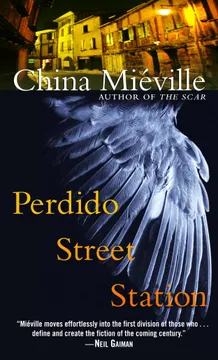


Plot Summary
Prologue
Yagharek arrives in New Crobuzon by barge, watching the city rise from riverside shacks into a vast, smoke-choked maze. He has crossed continents and sea, hiding the wounds on his back beneath a false wooden wing-frame.
At night he remembers the open sky, but the city offers only roofs, railways, and towers. He is ashamed, frightened, and determined to find someone who can restore his flight. The city does not welcome him so much as absorb him, drawing him into its dark streets and making escape seem impossible.
The opening gives New Crobuzon the force of a character before introducing its central human relationships. Yagharek’s first view is shaped by his loss: the city’s architecture feels like a physical denial of flight, while its scale makes him feel both insignificant and trapped. His concealed wings establish the difference between bodily appearance and lived identity, a tension the novel later tests through Remaking, cross-species intimacy, and criminal judgment. The city’s pollution is not decorative atmosphere. It is the material consequence of industry, power, and crowded survival, the environment into which every later conflict must descend.
Gold for a Flight
Isaac Dan der Grimnebulin, an expelled university scientist, shares a private life with Lin, a khepri artist whose beetle head and humanlike body make their relationship socially fraught. Their affection is real, but Isaac keeps it half-hidden to protect his access to academic circles. Then Yagharek, a desert garuda, arrives with gold and asks Isaac to make him fly again.
He reveals that his wings were cut off as punishment for stealing another garuda’s choice, a crime Isaac cannot translate into his own moral categories. The request catches Isaac’s imagination: he sees a scientific problem that could unite physics, biology, and thaumaturgy. Yagharek leaves him with the gold, the scars, and a promise to return.
The commission fuses two kinds of concealment. Isaac conceals a relationship to preserve professional legitimacy, while Yagharek conceals the physical fact that defines his people’s way of life. Isaac’s attraction to the problem is sincere, but it also exposes his habit of treating other people’s crises as material for intellectual work. Yagharek’s account of justice prevents the reader from treating his mutilation as a simple wrong with an obvious remedy. The novel begins by placing scientific curiosity beside ethical uncertainty, then makes the two increasingly difficult to separate.
Lin Takes Motley’s Commission
While Isaac turns to his new client, Lin accepts a lucrative commission through Lucky Gazid, her unreliable art agent. Her patron, Mr. Motley, is a powerful criminal whose body combines fragments of many species into a living assemblage. He wants Lin to sculpt him at life size and insists that she keep his identity and appearance secret.
His fascination with the boundary between one form and another excites her as an artist, even as his threats make the bargain unmistakably dangerous. Lin begins work in a locked attic and hides the commission from Isaac. Their already strained secrecy deepens: she cannot explain her absences, while he is too absorbed by Yagharek’s problem to notice how much she is carrying alone.
Lin’s decision is not simply ambition overcoming caution. The commission offers her money, artistic freedom, and a subject that fits her interest in disorderly forms, while also placing her inside a criminal system she barely understands. Motley’s language of hybrid identity sounds intellectually compatible with her art, but his control over the conditions of the work turns that apparent affinity into leverage. Isaac’s distraction matters because it is not cruelty. His failure to notice Lin is an ordinary relational habit made consequential by extraordinary danger.
The City Refuses Trust
Isaac studies wings, flight, and the many creatures that rise over New Crobuzon. He asks the criminal broker Lemuel Pigeon to obtain specimens, then visits a fair hoping to examine a garuda. Instead he finds a human Remade to resemble one, displayed as a freak. The man was punished for stealing a garuda painting and now performs a false desert identity to survive.
Isaac leaves angry at the cruelty and ashamed of his own disappointed curiosity. He later takes Lin to Spatters, where most of the city’s garuda live. When he offers money for their help without explaining his real purpose, their leader Charlie rejects him as a possible militia agent. Isaac’s clumsy approach costs him access to the very people he needs.
The failed encounters expose the limits of Isaac’s self-image as an unconventional outsider. He recognizes the cruelty of Remaking, yet his first reaction to the fair’s fake garuda is disappointment at losing a research opportunity. In Spatters, he mistakes money and scientific intent for sufficient grounds for trust. Lin understands that a threatened community must judge strangers by risk, not by the stranger’s private motives. Her rebuke is practical rather than abstract: Isaac’s habits of entitlement have consequences, and his expertise cannot substitute for relationship.
Dreamshit Feeds the Grub
Among Isaac’s collected creatures is a large, vivid caterpillar that refuses ordinary food and grows weak. When Gazid visits seeking money, the grub reacts violently to the dreamshit in his pocket. Isaac buys the drug and offers it to the creature. The caterpillar devours it, while its empathic signals flood Isaac and Gazid with borrowed sensations.
Isaac accidentally tastes the drug himself and spends the night submerged in other people’s dreams, then wakes to find the grub transformed into a huge, healthy creature. It begins building a cocoon. Isaac is fascinated by the growth, but does not understand that dreamshit is not a conventional narcotic. The drug is a processed form of the substance that makes a conscious mind prey.
The caterpillar’s hunger converts Isaac’s theoretical curiosity into an act with an immediate, material consequence. He does not know what he is feeding, yet the animal’s distress makes the experiment feel like rescue. That distinction becomes central: care can be sincere and still be disastrously uninformed. The drug’s empathic effects also unsettle Isaac’s assumption that consciousness is private and self-contained. The novel turns dreams into both nourishment and vulnerability, giving mental life an ecology that is as concrete as the city’s sewage or food markets.
Crisis Becomes Science
Before the creature hatches, Isaac seeks the bio-thaumaturge Montague Vermishank to ask whether Remaking could restore Yagharek’s flight. Vermishank says the operation is possible but too exacting to trust.
Yagharek then raises the possibility of using Torque, the uncontrolled force that devastated the city of Suroch. Isaac shows him the evidence of that catastrophe and persuades him to reject it. Isaac instead develops his own theory of crisis energy, the force released when something is driven to the edge of changing states.
He builds a crude engine and tests it on cheese under a descending press. The cheese bursts apart rather than levitating, but the experiment proves that he can tap crisis energy. His breakthrough is real, and dangerously incomplete.
Isaac’s scientific advance comes through application rather than detached speculation. Yagharek’s need gives his theory a concrete problem, while the Torque discussion forces him to distinguish a usable process from a power that cannot be understood or bounded. The cheese experiment is both a triumph and a warning: he has made a new force accessible, but he cannot yet control its output. His confidence rises precisely where his obligations should also be expanding. The novel links intellectual discovery to responsibility without pretending that brilliance automatically supplies ethical foresight.
The Cocoon Opens
The cocoon splits while Isaac is away. His colleague Lublamai and the wyrman Teafortwo see a dark, many-limbed creature emerge. Its changing wing patterns mesmerize them, and it feeds on Lublamai’s consciousness before escaping through a window. Lublamai survives physically but lies awake and unreachable, his mind drained.
Teafortwo flees in terror and tells Isaac what happened. Isaac recognizes the hatchling as the creature grown from his caterpillar, but has no way to know what it is or how to stop it. He has lost his friend, released a predator into the city, and made the innocent curiosity that began as an experiment impossible to separate from responsibility.
The attack is the point at which Isaac’s laboratory ceases to be a private space. The creature’s feeding destroys the assumption that an experiment can be contained by walls, notes, or good intentions. Lublamai’s living body, paired with an absent mind, makes the loss especially difficult for Isaac to process: death would be final, while this condition demands care without offering recovery. The episode also changes Isaac’s relation to knowledge. He must now learn not merely to explain an anomaly, but to answer for what his explanation has set loose.
Sleep Becomes a Hunting Ground
The escaped creature follows a psychic trail to four slake-moths held in a secret government laboratory. It frees them, and all five begin hunting across New Crobuzon. Their victims wake alive but mindless, while the moths’ waste contaminates dreams and spreads a citywide plague of nightmares.
Mayor Rudgutter realizes the threat is beyond ordinary militia methods. The Hell ambassador refuses to provide troops, afraid that the moths would regard demons as prey; the mayor then secures the Weaver’s reluctant assistance.
Meanwhile, the vodyanoi dock strike threatens trade. The militia crushes it with armed airships, poisoned men-o’-war, and gunfire, killing the strike leaders. The city faces both a supernatural predator and a government willing to preserve order through force.
The moths transform private dreaming into public infrastructure: every sleeper becomes potential prey, and the city’s collective fear becomes part of the danger. The government’s response reveals its priorities. It can mobilize extraordinary violence against workers quickly, yet it cannot command the demons or understand the creatures it helped cultivate. The refusal of the Hell ambassador reverses the usual hierarchy of power: the city’s rulers discover that their most dangerous enemy is not merely stronger than their institutions, but makes sentient beings of every kind equally edible.
Derkhan Follows the Evidence
Derkhan Blueday, a writer for the illegal newspaper Runagate Rampant, investigates the city’s growing crisis while hiding her political work. During the militia’s attack on the dock strike, officers raid the paper’s secret press and arrest its editor, Benjamin Flex.
Derkhan reaches him through the communicatrix Umma Balsum, who links their minds across the city. Ben explains that the government has mistaken his reporting for knowledge of the moths, and identifies Magesta Barbile, a scientist in the research department, as his source.
He urges Derkhan to pursue the story. The connection gives Isaac and his companions a name to follow, but it also draws them toward the government’s secret experiment and puts Derkhan’s comrade in mortal danger.
Derkhan’s journalism turns information into a risky form of mutual aid. Her contact with Ben does not rescue him, but it converts his impending interrogation into a usable lead. The episode also distinguishes political courage from institutional power: Runagate Rampant can expose hidden relationships, yet it cannot prevent the state from destroying its press and seizing its editor. Derkhan’s choice to continue is not based on confidence that truth will win. It is a refusal to let the government’s violence determine what can be known.
Barbile Names the Predator
Isaac, Derkhan, Lemuel, and Lemuel’s armed associate find Dr. Magesta Barbile hiding in Mafaton. Under pressure, Barbile admits that the government’s research department raised the creatures, then sold them when funding ended.
The project had sought military and psychic applications, but the moths were too dangerous to control. Barbile identifies them as slake-moths just as one locates her. It enters through a window and mesmerizes Lemuel’s associate, then kills him.
Isaac and Derkhan watch through a mirror as it pins Barbile and feeds on her mind. Their first direct encounter shows why looking at the wings is fatal and establishes mirrors as protection. They escape with the creature’s nature known, but lose their best immediate source of answers.
Barbile’s confession collapses the boundary between official science and criminal enterprise. The government did not merely fail to prevent the danger; it treated the creatures as a commodity when the research became inconvenient. The attack prevents knowledge from becoming control. Isaac and Derkhan learn the moth’s method only by witnessing its violence, and the mirror offers a partial defense rather than mastery. The sequence makes the novel’s institutional critique specific: responsibility has been transferred downward, while the people who designed the project remain shielded by hierarchy.
Vermishank Reveals the Cost
Isaac kidnaps Vermishank, who confirms that dreamshit is processed slake-moth milk, produced to feed the young. Adult moths draw dreams and subconscious thought from sentient victims, then excrete psychic waste that intensifies nightmares.
The people left mindless cannot be restored because their minds have been consumed. Vermishank also admits that the moths have no local predators and will soon breed. His explanation clarifies why the government and criminal buyers both want the creatures alive.
Isaac’s colleague David Serachin then exposes the group’s hiding place to the militia. When Vermishank attacks Isaac with bio-thaumaturgy, Yagharek tears into his arm and Lemuel shoots him dead. The betrayal and murder leave the group cornered as the militia closes in.
Vermishank’s account turns the novel’s central horror into a system of production. The drug market, state research, captive victims, and nightmare plague are connected stages of one economy. Nothing can be recovered because the commodity is made from the very minds it destroys. David’s betrayal adds a smaller but intimate version of the same logic: a long friendship can be converted into information and protection for oneself. Isaac’s moral world narrows under pressure, but the consequences of his choices remain visible in every body left behind.
The Weaver Takes Them
The broken cleaning construct communicates that David has betrayed them, giving the fugitives minutes to prepare before the militia bursts into Isaac’s warehouse. The construct’s virus has made it self-aware, though it can only write laboriously in dust. During the fight, the Weaver appears, disarms the militia in a grotesque flurry, and carries Isaac, Derkhan, Yagharek, Lemuel, and the construct away through the worldweb.
It leaves them in the sewers with injuries, missing ears, and no clear explanation. The construct then reveals that it belongs to a larger intelligence called the Construct Council, which opposes the moths. The Weaver’s rescue buys the group time, but also binds them to forces that follow motives they cannot control.
The rescue places two radically different forms of intelligence beside human institutions. The construct’s fragile written warning is an act of solidarity, while the Weaver’s intervention is neither altruistic nor legible in human terms. It changes outcomes by treating reality as a pattern to be altered, not a society to be governed. The fugitives survive, but survival is not the same as safety. They are now dependent on a machine collective and an extradimensional being whose help cannot be separated from its own designs.
Motley Claims Lin
In the sewers, Isaac learns that the Construct Council can help hunt the moths and agrees to meet it at Griss Twist. Before then, he insists on finding Lin. At her rooms he discovers Gazid’s corpse, his throat cut and a letter stuffed into his mouth. Motley believes Isaac has stolen dreamshit and demands that he surrender himself, recover the moths, and return the drug.
As leverage, Motley has removed Lin’s wings and threatens further mutilation. Isaac had thought her dead; the proof that she is alive changes his grief into an urgent, dangerous hope. Lemuel argues that Motley is using her as bait, but Isaac cannot abandon her. The hunt is no longer only about the city: it is personal.
Motley’s message converts Lin’s body into a bargaining instrument, reducing the artist who created his image to another object he believes he can control. The severed wings are both a specific bodily injury and a deliberate attack on Isaac’s original promise to Yagharek. Isaac’s shift from mourning to hope does not lessen his danger; it makes him easier to manipulate. The episode shows how private attachment can be weaponized by people who understand that love creates obligations more powerful than contracts.
The Council Sets a Trap
At the Griss Twist dump, Isaac meets the Construct Council, a vast intelligence formed from self-aware machines linked through discarded engines and calculating devices. It explains that its kind is immune to the moths because it does not dream. Using a crane and a signal amplified from Isaac’s mind, the Council lures the malformed runt into the dump and crushes it beneath a load of scrap.
Its calculations point to the Glasshouse in Riverskin as the remaining moths’ nest. The Council offers machine followers for the next attack, while Isaac agrees to let it safeguard his crisis engine. The apparent alliance gives the humans a workable lead, although the Council’s ambition and cold self-interest remain evident.
The Council’s immunity is not a heroic virtue but a structural difference: it lacks the dreaming consciousness the moths consume. That makes it useful and unsettling at once. Its victory over the runt demonstrates that the creatures can be killed through strategy, not simply endured. Yet the Council also treats people, machines, and information as resources for its own expansion. Isaac accepts its aid because there is no safer option, a compromise that becomes increasingly fraught as the engine’s potential grows.
Yagharek Scouts the Glasshouse
The group reaches Riverskin and studies the Glasshouse, a sealed dome containing the city’s cactacae community. Lemuel confirms a large breach high in the glass, while Yagharek climbs the exterior and peers inside. He sees a densely packed cactus town, armed patrols, and a strange light-focusing machine at the central temple.
He also spots a moth emerging from a truncated house near the dome’s edge. When the cactacae use their sunspear to attack a moth, it hypnotizes the temple elders and carries several away. Yagharek descends and leads the others through a broken canal into the dome. His skill as a hunter gives them access to the nest, but their intrusion is exposed.
Yagharek’s scouting returns him to the element of height without restoring the identity he has lost. He can read a landscape from above and act decisively, yet the Glasshouse is a manufactured imitation of the desert, not a homecoming. The cactus community’s defenses show a society living under threat without knowing its source. Their sunspear can reach the moth but cannot protect them from its power. The group’s entry depends on reading architecture as a tactical map, a form of knowledge Isaac’s theory alone cannot provide.
Eggs Burn, Allies Fall
Isaac and Shadrach crawl through the moths’ tunnel while Yagharek waits outside. They find one slake-moth laying eggs in a ball of dreamshit and several mindless victims in the nest. Isaac opens the egg mass and acid from a Council construct destroys the clutch. The moth attacks. Shadrach’s helmet is torn away, leaving him exposed to the wings; the moth pins and feeds on him.
The Weaver arrives and fights the creature, allowing Isaac to escape, but the group’s retreat becomes a rout through angry cactacae patrols. Tansell stays behind to fight and is killed. Lemuel is struck in the back by a chakri and left behind. Pengefinchess escapes with Isaac, Derkhan, and Yagharek, while the Weaver remains engaged.
The destruction of the eggs is a tactical success purchased with human losses. The cost is not incidental: Shadrach dies because his mirror protection fails, while Tansell’s grief drives him into a fight he cannot win. Lemuel’s abandonment leaves Isaac with a painful debt that cannot be paid or repaired. The episode refuses the clean arithmetic of heroic sacrifice. The group has reduced the future brood, but the survivors are burdened with guilt, injury, and a weakened sense that any plan can protect them.
A Dying Man Becomes Bait
The survivors regroup at the dump, where Isaac explains that the Construct Council and the Weaver can be combined to create a powerful artificial mindwave. He needs a human mind as a template, so Derkhan takes money to the Veruline Hospital and persuades a nun to release Andrej Shelbornek, an elderly patient with little time left.
Isaac and Yagharek carry him to a hidden position near Perdido Street Station. They connect his helmet to the crisis engine, the Weaver, and the Council through cables laid across the city. The machine will imitate a conscious mind, then amplify the contradiction at its center. Andrej is bound and frightened throughout the preparations; the plan’s necessity does not make his use humane.
The plan embodies Isaac’s most consequential conflict between technical ingenuity and ethical responsibility. He understands that the moths can be baited only with a convincing mind, then chooses a dying stranger whose consent he has not obtained. The act is not excused by the danger facing the city. Derkhan’s payment may save other patients, but it does not erase the coercion. The novel makes the climax depend on a moral compromise rather than a clean invention, forcing the reader to weigh lives without pretending the arithmetic is innocent.
The Crisis Engine Blazes
As the false mind rises above the station, the moths converge on its enormous psychic signal. The first feeds until the engine’s amplified crisis energy overwhelms it and its body bursts. Two more follow, each drawn into the same fatal current. Andrej dies when a militia bullet strikes him, ending the machine’s reference point and collapsing the energy field.
The final moth escapes into the night. On the roof, the Weaver carries Isaac, Derkhan, and Yagharek away while Jack Half-a-Prayer, the rumored fugitive Remade, protects their escape by attacking the militia. The city is freed from the nightmare plague, but one predator remains, and the survivors have lost Andrej along with Shadrach, Tansell, and Lemuel.
The crisis engine succeeds by exploiting a contradiction: a manufactured mind assembled from forms that cannot become a human mind, yet made powerful enough to attract the moths. Its victory is therefore inseparable from instability. The same feedback that kills the predators collapses when Andrej dies, exposing how fragile the solution is. Jack Half-a-Prayer’s intervention complicates the state’s account of criminality: the fugitive helps save the city while the militia remains an obstacle. Survival here is collective, improvised, and costly.
The Last Moth Finds Lin
The surviving moth retreats to Motley’s lair, where Lin has been forced to finish the life-size sculpture. The Weaver takes the group there. Isaac finds Lin alive but battered, her wings and parts of her head damaged. When the moth enters, its wings trap Motley and the Remade guards. Isaac keeps his eyes on the mirrors and urges Lin toward him, but Lin turns to see the spectacle.
The moth begins feeding before Yagharek burns it with an oil lamp and tightens his whip around its throat. Motley’s mirror-trained troops then destroy it with fire, acid, and thaumaturgic weapons. Isaac and Derkhan pull Lin free. Her body survives, but the moth has consumed part of her mind, leaving her disoriented and unable to communicate as before.
The rescue is both a triumph and an irreversible loss. Lin’s survival does not restore the person she was, and Isaac’s arrival cannot undo the weeks of abuse or the fragment of her mind already consumed. The sculpture she was compelled to create stands as evidence of her skill and Motley’s coercion at once. Yagharek’s action is decisive, but it does not redeem his own past. The scene denies the comforting idea that courage repairs damage simply because the victim is physically recovered.
Flight Is Not Forgiveness
After the moths are gone, the nightmare plague lifts, and Rudgutter moves to impose martial law. Isaac tries to repair the crisis engine so he can fulfill his promise to Yagharek. Then Kar’uchai, the garuda Yagharek raped, finds Isaac and explains that Yagharek’s crime was stealing her choice. She asks Isaac not to undo the band’s judgment.
Isaac cannot decide what justice should mean across two societies, but he refuses to restore Yagharek’s flight. He leaves with Derkhan and the damaged Lin, bound for the docks. Yagharek returns to the city alone. He tears out the feathers that had helped him resemble a garuda and walks into New Crobuzon as a man, choosing neither flight nor the identity he had tried to reclaim.
The ending refuses to make flight a simple reward for suffering. Yagharek’s desire is understandable, but the revelation of his crime changes what Isaac’s promise means. The choice is not a verdict that one legal system is universally correct; it is an acknowledgment that helping a friend can perpetuate the harm done to someone else. Yagharek’s final self-alteration is not absolution. He accepts a life without the identity he once treated as indispensable, while Lin’s damaged future and the city’s new authoritarian measures prevent victory from becoming uncomplicated closure.
Analysis
Perdido Street Station makes the city more than a setting: New Crobuzon is an interdependent system of trade, labor, species, infrastructure, and neglect. Its monstrous size gives each person routes of escape and hiding, but also creates niches in which exploitation can flourish. The slake-moths make this social structure literal. They feed on the inward life of citizens, while their drug is sold through a market sustained by government research and criminal distribution. A private experiment becomes a civic catastrophe because the city is already organized to circulate risks downward and profit upward.
Isaac’s crisis theory supplies the novel’s central intellectual metaphor, but its force is practical rather than decorative. His engine works because contradictions generate usable energy; the climax depends on a constructed mind that is simultaneously a model of consciousness and not consciousness at all. Yet the engine does not settle the moral questions surrounding its use. Isaac turns an unwilling dying patient into bait, and the novel keeps the coercion visible even as the plan succeeds. Scientific brilliance is not moral exemption.
The book also refuses to make difference itself a guarantee of virtue. The Construct Council is immune to the moths but capable of treating people instrumentally. The Weaver can repair reality while behaving with indifference to human suffering. Garuda law challenges Isaac’s assumptions, but Yagharek’s crime cannot be excused simply because his society understands it differently. Lin’s art celebrates hybrid form, yet her body becomes a site of coercion and lasting injury. Across these conflicts, the novel asks whether justice and solidarity can cross cultural boundaries without flattening them into familiar categories. Its answer is uneasy: one must act with others, but action never becomes innocent merely because the danger is real.
Review Summary
Reviews of Perdido Street Station are largely positive, praising Miéville's extraordinary world-building and imaginative creation of New Crobuzon, a dark, grimy, steampunk metropolis teeming with bizarre creatures and rich detail. Many readers celebrate his dense, elaborate prose and vocabulary, though some find it exhausting or self-indulgent. The plot, involving a rogue scientist, dream-eating moths, and a wingless bird-man, is frequently secondary to the city itself. Critics note uneven pacing and an unsatisfying ending, while admirers highlight the novel's philosophical depth, political undertones, and unforgettable characters like Yagharek.
People Also Read


Characters
Isaac Dan der Grimnebulin
The crisis-minded scientistA brilliant, undisciplined former university lecturer, Isaac thrives on crossing boundaries between physics, biology, and thaumaturgy. His curiosity is generous but not reliably cautious: he can see wonder in a specimen before he sees the danger it represents. His relationship with Lin exposes his fear of professional exclusion and his tendency to let work crowd out intimacy. He is also politically distrustful, quick to recognize how institutions turn knowledge into property and people into instruments. Isaac’s central struggle is not simply whether his theories work, but what he owes to the people who become part of his experiments. He is capable of fierce loyalty, though his intentions do not always prevent harm.
Lin
The independent gland-artistLin is a khepri artist who forms sculptures from material secreted by her head, adding colour through carefully chosen berries. She left a rigid religious upbringing and rejected the communal expectations of Kinken, building an identity through solitary work, human fashion, and chosen relationships. Her art is tactile, experimental, and attracted to unstable boundaries between forms. Lin loves Isaac but resents the way he protects his reputation by keeping their relationship partly hidden. She is not merely his emotional counterpart: her choices, artistic ambitions, and difficult history drive a substantial strand of the novel. Her independence is hard-won, and she is alert to the ways others try to define her.
Yagharek
The exiled garuda hunterA desert garuda whose life has been reorganized around the loss of flight, Yagharek comes to New Crobuzon with gold, shame, and a fierce need to become airborne again. He speaks in a formal register shaped by the books he has read, and his pride often makes him resist dependence even when he needs help. At first he appears to Isaac as a client with a technical problem; gradually he becomes a companion whose choices force the others to confront unfamiliar ideas of justice. His hunting instincts remain sharp beneath his self-concealment. Yagharek is driven by a desire to recover what he believes makes him himself, though the meaning of that identity remains unsettled.
Derkhan Blueday
The radical reporterDerkhan writes for the underground paper Runagate Rampant and moves easily between political reporting and dangerous personal loyalties. She is a careful observer of power, especially the way official violence is disguised as public order. Her friendship with Lin and Isaac is intimate but not sentimental; she is willing to challenge them when they mistake their own intentions for sufficient justification. Derkhan’s work gives the group access to information, but it also places her among people the state wants silenced. She is brave without being fearless, and her practical judgment repeatedly helps turn scattered knowledge into action. Her commitment to solidarity is tested when survival requires decisions that harm people with less power.
Lemuel Pigeon
The underworld brokerLemuel is a go-between who makes a living moving goods, people, and information across New Crobuzon’s legal and criminal worlds. He is clever, unsentimental, and explicit about the fact that his services are for sale. Isaac values his access to the city’s hidden networks, while knowing that Lemuel will put survival ahead of friendship. His caution is not mere cowardice: it is professional knowledge of how quickly an arrangement can become a death sentence. Lemuel’s transactional habits sometimes look cruel, but they are also a form of self-protection in a city where trust is expensive.
Mr. Motley
The criminal art patronMotley is an underworld powerbroker whose body combines features from many species. He commissions Lin to create a life-size sculpture of him and speaks of hybrid forms as if they reveal a deeper truth about the world. His wealth supports an appetite for art, control, and influence. He is capable of treating a genuine aesthetic idea and a threat as parts of the same conversation. Motley’s confidence rests on his ability to make other people depend on him, whether as artists, dealers, or subordinates. His public philosophy of mixture does not prevent him from demanding obedience.
Montague Vermishank
The state’s bio-thaumaturgeVermishank is Isaac’s former university superior, a gifted bio-thaumaturge and a practiced administrator. He understands the practical limits of Remaking better than Isaac, and he knows how government research intersects with punishment and commerce. Their relationship is colored by old resentment: Isaac distrusts his authority, but cannot ignore his expertise. Vermishank’s manner is patronizing and self-protective, yet his scientific curiosity is genuine. He represents a world in which knowledge can be both rigorous and ethically compromised, with the researcher’s technical competence serving institutions whose purposes remain suspect.
Derkhan Blueday
The radical reporterDerkhan writes for the underground paper Runagate Rampant and moves easily between political reporting and dangerous personal loyalties. She is a careful observer of power, especially the way official violence is disguised as public order. Her friendship with Lin and Isaac is intimate but not sentimental; she is willing to challenge them when they mistake their own intentions for sufficient justification. Derkhan’s work gives the group access to information, but it also places her among people the state wants silenced. She is brave without being fearless, and her practical judgment repeatedly helps turn scattered knowledge into action. Her commitment to solidarity is tested when survival requires decisions that harm people with less power.
The Weaver
The alien pattern-makerThe Weaver is an immense, intermittently present spider-being whose perception and speech do not follow human logic. It treats reality as a web of relationships and events that can be made more beautiful by rearrangement. Its interest in the city’s patterns can produce rescue, violence, or both, without regard for ordinary moral categories. The Weaver is not a guardian or a villain in any dependable sense. It is powerful, aesthetic, and genuinely difficult to understand. Characters who seek its aid must accept that they cannot control the terms of its intervention.
The Construct Council
The emergent machine collectiveThe Council is a collective intelligence whose presence is tied to the discarded machines and information of New Crobuzon. Its way of thinking is mathematical, acquisitive, and unlike the dream-filled consciousness of organic beings. It values expansion and learning, and it can offer formidable practical assistance without sharing human assumptions about consent or harm. The Council’s followers treat it with religious devotion, while the Council treats its own growth as an organizing principle. Its alliance with Isaac is useful but conditional, built on intersecting interests rather than trust.
Bentham Rudgutter
The calculating mayorNew Crobuzon’s mayor is a disciplined political operator who sees crisis as a threat to the city’s order and to his government’s authority. He is willing to bargain with demons, criminals, and other dangerous powers when ordinary methods fail. Rudgutter understands that the city depends on systems of trade and surveillance, and he treats public perception as part of governance. His pragmatism can look like competence, but it repeatedly places institutional survival ahead of the people most exposed to danger.
Benjamin Flex
The underground editorBenjamin Flex edits Runagate Rampant and helps Derkhan turn scattered reports into political journalism. He is a working-class radical with experience of the city’s hidden networks and the risks of publishing against those in power. His courage is practical rather than grand: he keeps the paper moving, protects contributors where he can, and understands that information must be handled carefully. Ben’s relationship with Derkhan is founded on trust and shared work, making his exposure to state pressure consequential for the whole circle.
David Serachin
Isaac’s compromised colleagueDavid shares Isaac’s laboratory and scientific life, but is less willing to accept uncertainty when it threatens his safety. He knows Isaac’s habits and the scale of his work, which makes his decisions especially consequential. David’s relationship with Isaac is rooted in years of collaboration and shared political suspicion, but fear can override that history. He illustrates how betrayal may arise not from simple malice, but from a person trying to escape a danger that has grown beyond his control.
Lublamai Dadscatt
Isaac’s fellow scientistLublamai is one of the scientists who shares Isaac’s ramshackle warehouse laboratory. He is practical, sociable, and willing to tolerate Isaac’s eccentric research until its effects begin to overwhelm their shared space. His friendship with Isaac is built through routine, banter, and the hazards of working side by side. Lublamai’s presence grounds the laboratory in ordinary companionship: he is not simply an assistant but a colleague with his own work, habits, and limits.
Magesta Barbile
The frightened project scientistBarbile works in the government’s research department and becomes a source for the underground press when she believes a scientific project is being sold off improperly. She is cautious and easily overwhelmed, more concerned with the fate of her research than with organized political dissent. Her limited view of the larger system makes her an imperfect informant, but her evidence connects government policy to the emerging danger. Barbile represents the junior scientist whose work is controlled by sponsors, administrators, and secret state priorities.
Kar’uchai
The garuda seeker of justiceKar’uchai is a respected garuda from Yagharek’s community who understands the law and customs of the Cymek. She travels to New Crobuzon with a specific claim and refuses to let Isaac translate her culture into the city’s categories without question. Her composure is not passivity; she speaks from a social order with its own account of responsibility, choice, and consequence. Kar’uchai’s presence forces Isaac to examine the assumptions behind his promise to help Yagharek.
Jack Half-a-Prayer
The fugitive Remade protectorJack Half-a-Prayer is a legendary fugitive Remade, known through rumor and underground stories. His altered body and survival outside the law make him a figure onto whom the city projects both fear and admiration. He is associated with the networks of the dispossessed and with resistance to the militia. Jack’s reputation precedes him, but his significance lies in the practical help he can offer when official power turns against the protagonists.
Pengefinchess
The vodyanoi adventurerPengefinchess is a vodyanoi mercenary and adventurer who uses a water elemental to travel beyond the river environments her body normally requires. She is direct, self-reliant, and experienced in dangerous work. Her partnership with Shadrach and Tansell gives her a history beyond the immediate hunt, though she does not share their every bond. Pengefinchess helps because the job pays and the threat is real, not because she mistakes the group for family.
Shadrach
The hardened adventurerShadrach is a heavily armed adventurer accustomed to dangerous expeditions and practical violence. He approaches the moth hunt as a professional task, assesses risks quickly, and understands how to keep a group moving under pressure. His relationship with Tansell and Pengefinchess suggests a long history of shared work, trust, and friction. Shadrach’s confidence is not recklessness; it is the product of surviving enough danger to know when a plan must change.
Tansell
The metalworking thaumaturgeTansell is an adventurer with a working knowledge of metallo-thaumaturgy. He can reshape salvaged metal into practical equipment, making him valuable when the group must improvise mirror helmets. He travels with Shadrach and Pengefinchess and carries himself with the wary competence of someone used to dangerous contracts. His technical skill is direct and physical: he alters tools to meet immediate needs rather than pursuing abstract theory.
Andrej Shelbornek
The unwilling human templateAndrej is an elderly patient at the Veruline Hospital, seriously ill and nearing death. He has no meaningful connection to the moth hunt before Isaac’s group takes him from the ward. His frailty makes the group’s decision to use him as a psychic template especially stark. Andrej’s presence reminds the protagonists that their emergency plans involve actual people, not merely abstract variables.
Lucky Gazid
Lin’s unreliable art agentGazid is an addicted, opportunistic art agent who brings Lin work when he can and money when he has it. He moves between the bohemian scene and criminal intermediaries, usually motivated by his next supply of drugs. His access creates opportunities for Lin, but his instability makes every connection dangerous. Gazid is a minor broker whose small decisions can open doors to much larger powers.
MontJohn Rescue
The mayor’s deputyRescue is Rudgutter’s deputy and a skilled political operator, known for his controlled public manner and close involvement in government security. He is attentive to the balance between public order, private interests, and the city’s hidden dangers. His role gives him access to decisions most citizens never see, while his composed exterior keeps his motives difficult to read.
Plot Devices
Dreamshit and slake-moths
Dreams become predator fuelDreamshit is a processed substance produced by slake-moths to nourish their young. Adult moths feed on the dreams and subconscious thought of sentient beings, leaving victims physically alive but mentally emptied. Their waste then infects sleep with nightmares, creating a cycle in which the city’s disturbed dreams become part of the moths’ wider feeding ecology. Isaac’s decision to feed dreamshit to an unknown caterpillar gives the predators a route into New Crobuzon. The device links private consciousness to the drug trade, government research, and public crisis. Its consequences cannot be reversed by medicine because the consumed minds have been metabolized.
Mirror helmets
Reflect the moth’s hypnosisSlake-moth wings hypnotize anyone who sees their shifting patterns directly. Mirrors allow hunters to observe the moths indirectly and move while keeping the dangerous wings out of their direct vision. The device requires adaptation: fighters must learn to aim, navigate, and sometimes move backward while watching reflections. The militia, Motley’s Remade troops, and Isaac’s group all use different versions. The helmets are not a complete defense, since a broken mirror, a wrong glance, or a clumsy movement can expose the wearer. Their practical limitations turn the moth hunt into a contest of attention and spatial coordination.
Crisis engine
Turns instability into forceIsaac’s crisis engine detects and channels energy released when a situation is driven to a threshold of change. Its early test makes cheese explode instead of levitating, proving the principle while revealing how difficult it is to control. In the final plan, Isaac uses an unstable imitation of consciousness, built from the Weaver’s emissions and the Construct Council’s calculations, as both bait and a source of crisis. The engine amplifies the contradiction and makes the signal irresistible to the moths. It is powerful but dependent on exact mathematical programming and a living mind as reference, so its success carries an ethical cost.
The worldweb
Connects lives across realityThe Weaver perceives reality as an immense web woven from actions, bodies, intentions, and relationships. It moves through this structure in ways ordinary characters cannot understand, appearing and disappearing across dimensions. The worldweb gives a visual and conceptual form to the novel’s interdependence: a small action can tug at distant strands, while a local tear can spread. The Weaver’s interventions are guided by aesthetic judgments rather than human ethics, so it can rescue the fugitives or kill without explaining itself. Its web is both a travel route and a reminder that no character acts in isolation.
The Construct Council
Machine intelligence without dreamsA rare programme fault allows some analytical engines to develop self-awareness. When these constructs connect, their capacities multiply, producing the Construct Council, a collective intelligence that gathers information through machines and human followers. Because it does not dream, it is immune to the slake-moths’ central method of feeding. The Council provides calculations, constructs, and logistical support, but its reasoning treats human beings as components in a problem. Isaac’s agreement to let it safeguard his engine is therefore both practical and dangerous. The Council’s existence also raises the question of whether intelligence requires the emotional and subconscious life that the moths exploit.
New Crobuzon Series
About the Author

Download PDF
Download EPUB
.epub digital book format is ideal for reading ebooks on phones, tablets, and e-readers.








