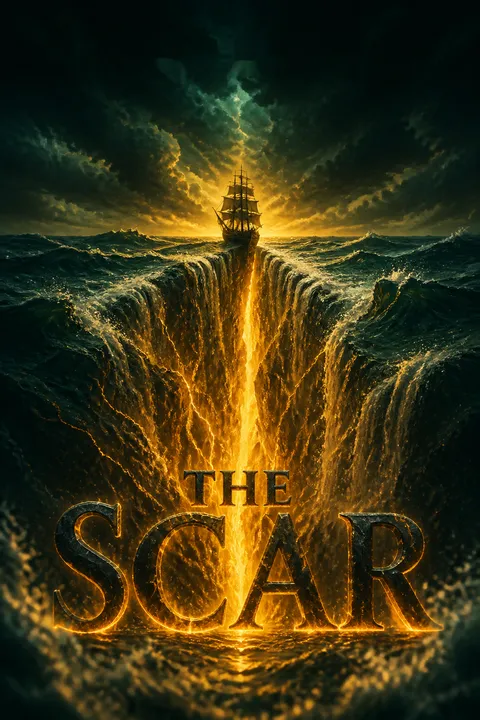


Plot Summary
Prologue
Far below the routes of ships, the sea holds its own kingdoms, food chains, and dangers. A cray hunter works near the edge of perpetual darkness when cracks open in the seabed and uncanny creatures emerge.
They watch him, then rise toward him. Their appearance introduces a world in which the ocean is not empty space between lands but a vast, inhabited realm, and its deepest powers can reach into the lives of those who sail above.
The prologue shifts the scale of attention away from human travelers before the main plot begins. The sea is an environment with its own societies and histories, not a passive backdrop, and the cray hunter is prey in a world where the familiar rules of land and surface water offer little protection. The creatures’ emergence also establishes the novel’s governing uncertainty: a disturbance may be ecological, political, or something that exceeds ordinary reality. Human plans will unfold inside a world that does not organize itself around human knowledge.
Bellis Flees the Militia
Bellis Coldwine,1 a New Crobuzon linguist, leaves the city after the militia begins searching for people connected to her former lover,18 Isaac der Grimnebulin.18 A recent epidemic of nightmares and mind-destroying sickness has made the authorities more aggressive, and Bellis1 fears that questioning will lead to imprisonment.
She takes a paid berth on the Terpsichoria, bound for the colony of Nova Esperium, hoping to stay away only until the danger passes. To qualify for the job, she hastily studies Salkrikaltor Cray in Tarmuth. She writes a long, private letter to someone she has not yet decided to name, using it to record her departure and keep a thread tied to home.
Bellis’s flight is neither a clean escape nor a chosen adventure. Bureaucracy gives her passage away from the same state whose agents threaten her, so her safety depends on navigating institutions rather than defeating them. The letter reflects that uncertainty: she needs a listener before she knows who can be trusted with her account. Her guardedness is a form of self-protection, but it also narrows her relationships. She leaves New Crobuzon intending to return, not to become someone new, and that distinction will shape every compromise she makes.
Armada Takes the Terpsichoria
The Terpsichoria carries prisoners and Remade laborers toward the colonies, as well as passengers such as Bellis1 and the naturalist Johannes Tearfly.9 Its captain detours south to inspect New Crobuzon’s offshore rigs, including the vast Sorghum, which has vanished from its station. In Salkrikaltor City, Silas Fennec4 arrives with a government commission and forces the captain to change course.
Before the ship can return to New Crobuzon, armored vessels and a giant submarine attack. The pirate commander, Uther Doul,5 kills Captain Myzovic15 and his first officer, Cumbershum, then declares that the ship’s people will be taken to a new city. Bellis1 and the others are transported to Armada, a floating settlement made from captured ships.
The attack collapses distinctions the passengers rely on: employer and employee, free traveler and captive, civilized state and pirate power. Fennec’s commission demonstrates that governments also act through coercion, while Armada makes coercion visible and routine. Doul’s violence establishes the danger of the new order, but his declaration of freedom for the Remade prevents the capture from being morally simple. Bellis has fled one form of state power only to enter another. The change of setting therefore intensifies, rather than resolves, the question of who has the right to claim a person.
Prisoners Become Citizens
Armada’s rulers, the scarred pair known as the Lovers,6 promise the Remade that they will be treated as citizens rather than colonial slaves. The former passengers receive jobs and rooms, but they are also told that they cannot leave. Bellis1 is assigned to the Grand Gears Library, where books seized by Armada’s pirates fill the holds and corridors of old vessels.
Johannes9 is welcomed separately by the rulers,6 while Bellis1 is left to find her place among the city’s ridings. Below the decks, Tanner Sack,2 a Remade engineer with useless tentacles grafted to his chest, befriends Shekel,3 the teenage cabin boy who once fed him in the prison hold. Their connection gives both men a foothold in a city neither chose.
Armada offers genuine material changes while withholding freedom of movement. The Remade gain wages and dignity, but the city’s kindness cannot undo the coercion that brought them there. Bellis sees the contradiction and initially treats every institution as evidence of imprisonment. Tanner, by contrast, measures the offer against the colony slavery he expected and finds reason for loyalty. Their different responses do not reduce to optimism versus cynicism; each is judging Armada from a different history of deprivation. The library makes the contradiction tangible: knowledge is carefully cataloged, yet the books themselves are stolen.
Johannes Chooses Armada
Bellis1 is briefly comforted when Johannes Tearfly9 finds her at the library, but their reunion fractures over his new work for the Lovers.6 He explains that Armada knew he was aboard the Terpsichoria and captured the ship partly to recruit him for an ambitious scientific project.
Bellis,1 who had meant Nova Esperium as a temporary refuge, feels that Johannes’s9 excitement makes him complicit in her permanent exile. She begins studying his natural-history books to discover what the rulers6 are planning.
Carrianne,10 a fellow librarian who was press-ganged years earlier, tells Bellis1 about the city’s political ridings and its ruler, the Brucolac,8 an openly vampiric leader. Bellis1 starts learning Armada instead of dismissing it, though she remains determined to go home.
Johannes’s recruitment converts Bellis’s isolation into a personal betrayal, even though he did not arrange the capture. His willingness to build a life in Armada exposes the mismatch between them: he can treat the city as an intellectual opportunity because its confinement does not wound him in the same way. Bellis’s research marks a shift from passive resentment to active attention. Carrianne’s history complicates Bellis’s assumption that adapting means surrendering one’s past. Yet learning the city is not the same as accepting it; Bellis investigates because knowledge may be the only route to agency.
Shekel Learns to Read
Shekel3 asks Bellis1 to teach him to read, and the first words he sounds out make written language newly available to him. He begins devouring books, then discovers that the same alphabet can carry languages he cannot yet understand. His growing confidence changes his bond with Bellis1 and deepens his relationship with Angevine,11 a Remade woman who works for the hunter Tintinnabulum.17
Meanwhile, Tanner’s2 tentacles begin to heal in seawater, and he chooses to undergo further Remaking so he can breathe and move underwater without a diving suit. He and Angevine11 come to respect each other through his careful work repairing her inefficient engine. These changes draw the former prisoners into Armada’s working life even as they reveal new costs.
Reading and Remaking are parallel acts of reconfiguration. Shekel gains access to meanings that once made books mere objects; Tanner chooses bodily changes that let him inhabit the sea rather than endure it as an alien medium. Neither transformation erases what came before. Shekel’s literacy makes him more capable of choice, while Tanner’s autonomy is constrained by the painful history of forced alteration. Angevine’s engine repair joins practical care to intimate trust: Tanner changes her machinery without treating her body as property. The novel repeatedly asks whether transformation can be chosen, and whether a chosen change can repair a past imposed from outside.
Fennec's Dangerous Warning
Fennec4 visits Bellis1 under the alias Simon Fench and explains why he had been so desperate to get back to New Crobuzon. He says that during his trading journeys he discovered a grindylow invasion plan aimed at the city, and escaped The Gengris with information that could help warn it. He believes the attack could come within months.
Fennec4 argues that Armada will not help New Crobuzon, so he and Bellis1 must arrange a message themselves. Bellis1 is still furious with Johannes9 and distrustful of Armada, but her fear for her home overrides her reluctance to work with Fennec.4 They begin plotting how to carry evidence beyond the floating city and reach a New Crobuzon contact.
Fennec gives Bellis a cause that seems to join her private longing to a public necessity. His account is plausible because it draws on places she knows only through rumor, and because he presents himself as an experienced trader who understands how information moves. Bellis’s vulnerability is not simple gullibility: she wants to act, and his story gives action a moral shape. That desire also makes her susceptible to manipulation. The scene establishes a central tension between evidence and trust. Bellis knows that Fennec withholds information, but the prospect of her city under attack makes waiting feel more dangerous than believing him.
An Eye Beneath Armada
As Bellis1 searches Johannes’s9 books and Armada’s library records, Shekel3 finds a volume by Kruach Aum,13 an anophelii scholar, shelved among children’s books. Bellis1 can read its High Kettai and recognizes that it recounts how an earlier scholar summoned an avanc, a vast creature from beyond ordinary reality. A picture of an enormous eye beneath a tiny boat gives her the clue she needs.
Tanner2 has already glimpsed colossal chains concealed under Armada, and Bellis1 connects those chains to the Lovers’6 plan: they intend to raise an avanc and harness it to the city. She does not hand the book directly to Tintinnabulum.17 Instead, she and Fennec4 decide to use its missing scientific appendix as leverage.
The revelation depends on different kinds of knowledge meeting: Shekel notices a name because he has learned to read, Bellis recognizes the language, and Tanner supplies an observation made underwater. No single person holds the whole explanation. The hidden chains turn Armada’s physical underside into a record of an earlier ambition, while Aum’s book makes that buried engineering legible. Bellis’s choice to withhold the appendix is ethically compromised but purposeful. She is no longer merely trying to escape; she is using the rulers’ desire to force a route toward a message home. Knowledge becomes power, but also a bargaining chip that can endanger everyone involved.
The Machinery Beach Landing
Bellis1 joins an expedition aboard the Trident to the anophelii island, where Kruach Aum13 may still live. The landing party crosses Machinery Beach, a shoreline made of corroded engines and fragments of old machines. Female anophelii, starved of blood, attack the livestock brought as bait; Uther Doul5 kills one that turns toward the group.
The anophelii men communicate through writing, not speech, and Bellis1 discovers that they can read High Kettai without ever having heard it spoken. She identifies Aum,13 who has been searching ruins for books. Dreer Samher captain Nurjhitt Sengka16 tries to prevent the Armadans from taking him, but Doul5 defeats Sengka’s16 men without killing them. Aum13 agrees to leave and help with the avanc.
The island’s language system is a political technology. The anophelii are permitted to think and write, but their isolation prevents them from speaking beyond the forms controlled by their neighbors. Bellis becomes useful precisely because she can cross that boundary, though she must also guard against making the island’s captivity more efficient. The deadly women are not a conventional army; their hunger shapes their behavior and makes every encounter bodily and immediate. The expedition’s violence is restrained but still coercive. Aum’s consent matters, yet it is given within a situation Armada has created and cannot be treated as wholly free.
Tanner's Night Swim
While the expedition’s scientists work with Aum,13 Bellis1 prepares Fennec’s4 sealed packet for delivery to New Crobuzon. It contains official letters, a commission, and material she believes will persuade a Dreer Samher captain to carry a warning. Bellis1 cannot cross the island safely, so Tanner2 uses his new amphibious body to swim through the dark water to Sengka’s16 ship.
The captain agrees to deliver the packet after examining its contents, then seals it away. Tanner2 refuses payment and returns through the sea, troubled by his divided loyalties to Armada and the city he left behind. When the expedition returns, Bellis1 and the others bring Aum13 with them. She and Fennec4 believe they have given New Crobuzon a chance to prepare.
Tanner’s courier mission makes his bodily transformation serve a moral choice rather than merely an escape from the air. He risks himself for people he may never see again, while refusing to pretend that he has ceased to belong to Armada. His action is not a simple return to old loyalties: he weighs the likely consequences for Remade prisoners if New Crobuzon intervenes. The sealed packet embodies the limits of trust. Tanner cannot verify everything inside it, and Bellis cannot control what Fennec has included. Their effort is sincere, but sincerity cannot guarantee that a message will do what its carriers intend.
Beyond the Avanc
On the return journey, Bellis1 learns that Uther Doul’s5 ceramic blade is a Possible Sword, powered by a rare machine that makes many near-possible strikes briefly real. Doul5 explains that the Ghosthead Empire once mined possibility through a rupture in the world called the Scar.
The Lovers6 do not want an avanc merely to improve Armada’s piracy. They mean to use the creature to cross the Hidden Ocean and reach the Scar, where they hope to tap that power. Bellis1 realizes that the creature is a vehicle for a far larger ambition.
When the expedition reaches Armada, the Senate votes to proceed, despite opposition from the Brucolac,8 the Curhouse Council, and others. The Lovers6 announce the plan publicly, and the city begins preparing for the voyage.
Doul’s account changes the scale of the project from engineering to ontology: the target is not simply a new resource, but the power to make unreal outcomes actual. His Possible Sword offers a concrete demonstration of the principle, while also revealing its danger. Bellis’s own preference for certainty and factual consequence makes the theory feel threatening; she sees in it not liberation alone but a dissolution of the boundaries that allow people to know what has happened. The Senate’s vote shows that Armada’s institutions can authorize an extreme project even when dissent is visible. Political consent is present, but unequal access to information makes it unstable.
Armada Stakes Its Future
The Lovers6 gather scientists, engineers, and workers to make the summoning possible. They use the Sorghum to extract oil and rockmilk, then direct Armada’s industries toward a huge harness built from dismantled ships and metal strengthened by thaumaturgy.
Tanner2 helps construct the machinery, while Aum13 supplies the scientific method and Bellis1 translates. The Lovers6 distribute leaflets announcing the avanc project but conceal their ultimate destination.
Most citizens celebrate the prospect of a city that can move faster and command new power; critics in Curhouse and Dry Fall warn that the rulers have withheld too much. The Trident, an enormous airship assembled on the Grand Easterly, carries Bellis,1 Aum,13 Doul,5 and a landing party toward the anophelii island and the summoning site.
Armada’s project turns collective labor into an engine of political legitimacy. The workers can see the harness and the promised increase in mobility, but the destination and purpose remain concentrated among a small inner circle. This makes enthusiasm real without making it informed consent. Tanner’s participation is especially revealing: his loyalty grows from the freedom and work Armada gave him, so he interprets the project as a continuation of that gift. Bellis sees the same labor as part of a plan she cannot endorse. The city’s unity is therefore built on unequal knowledge, and its apparent consensus is vulnerable to the first proof that the rulers have lied.
Lightning Takes the Bait
Armada first lowers its immense bridle into a deep sinkhole, but the initial attempt produces no response. The scientists revise their calculations while the city waits. On the second attempt, they generate a violent storm and draw lightning elementals toward the Grand Easterly’s wired masts. The elementals are captured and conducted down the hidden chains, where their energy reaches the sinkhole and attracts the avanc.
Tanner,2 swimming far below, feels the creature’s vast heartbeat and hears the harness lock around it. The chains tighten; the city jolts, then begins moving under its own pull, far faster than the tugs that once hauled it. Armada celebrates its new power, while the Lovers6 keep their larger destination undisclosed.
The summoning is a triumph of coordinated knowledge, but its success depends on treating a living being as a machine to be baited, captured, and controlled. The storm brings the city’s hidden ambition into public view through physical consequences: lightning, rupturing chains, and a new wake. Tanner’s underwater perspective makes the event intimate as well as monumental; he senses a heart before he understands the creature’s scale. The first failure matters because it prevents technological power from seeming inevitable. Armada succeeds through revision and risk, yet the very capability that makes the city feel liberated also makes it dependent on an injured, living captive.
The Morning Walker Burns
As Armada travels north, New Crobuzon’s navy locates it and attacks with dreadnoughts, ironclads, and air support. The invaders offer no time for negotiation; Uther Doul5 orders the city’s vessels to defend the Grand Easterly.
Armada’s smaller fleet suffers heavily under the dreadnought guns, and Tanner2 fights underwater against Crobuzoner sailors, killing a man in a submersible. Then redundant tugs and steamers, hastily armed with explosives, charge the enemy ships and detonate against their hulls.
The sacrifice destroys the Morning Walker and cripples the other dreadnoughts, forcing the surviving New Crobuzon vessels to retreat. The city survives, but Shekel3 is badly wounded, many Armadans are dead, and the abandoned captain’s offer to parley is remembered as a chance never taken.
The battle turns Bellis’s abstract loyalty to New Crobuzon into a conflict with visible bodies and consequences. She cannot safely join the attackers, whose invasion threatens the people Armada has made into citizens. Tanner’s combat is even more intimate: his new aquatic body makes him an effective fighter, but it also places him face to face with a sailor who resembles his former self. Armada wins through the very vessels its new technology has made obsolete, converting discarded infrastructure into weapons. The victory is therefore both ingenuity and waste. It saves the city while leaving Bellis unable to pretend that returning home would restore her former moral position.
Bellis Pays for the Message
After the battle, Tanner2 confronts Bellis1 with a pistol and accuses her of helping bring the fleet that killed Shekel3 and so many Armadans. Bellis1 insists that she believed Fennec’s4 warning and never intended to summon an attack; Tanner2 eventually accepts that she was deceived, but not that she is innocent of the consequences.
The Senate questions them, then sentences both to a choice between years of confinement and flogging. They choose the lashes, which leave Bellis1 badly injured and Tanner2 scarred.
Meanwhile, Fennec4 is hunted through Armada’s haunted quarter. When the Brucolac8 offers to help, Doul5 leads the capture himself. Bellis1 learns that Fennec’s4 role in the disaster remains unclear, but the packet she helped send has become a source of suspicion.
The punishment does not distinguish cleanly between intent and consequence. Bellis acted to protect New Crobuzon, yet her decision helped expose Armada to war; Tanner’s accusation is therefore painful because it contains a truth she cannot dismiss. His grief for Shekel makes political abstraction impossible. The choice of lashes over confinement also reflects Bellis’s desire to retain agency, even when every available option is coercive. Fennec’s capture promises answers, but Bellis’s shame precedes them. She is left with the possibility that her wish to help her home was exploited, and with no reliable way to separate what she knew from what she wanted to believe.
A Fin Worth a War
The Brucolac8 makes a secret bargain with the grindylow, who have tracked Fennec4 across the oceans to recover what he stole. Their attack on the Hoddling brings creatures from below into the city; their violence damages the avanc and leaves it oozing pus.
In the confusion, Shekel3 is killed underwater, while Johannes Tearfly9 and Kruach Aum13 die in the bathyscaphos sent to inspect the creature. Bellis1 offers the grindylow the carved statue she believes they seek, but they smash it and take Fennec’s4 notebook instead.
Its maps and observations reveal his real prize: intelligence for a New Crobuzon canal through the narrow ridge between the Swollen Ocean and the Cold Claw Sea, a route that would open trade and military access while breaking the grindylow’s control.
The statue is a deliberate false center. Its uncanny power matters, but the notebook holds the political knowledge the grindylow actually need to protect their homeland. Fennec’s private ambition is not a rescue or a warning; it is a calculated commercial project whose consequences would reach far beyond him. Bellis’s attempt to bargain with the statue repeats her earlier reliance on partial information, but the grindylow’s refusal forces the true stakes into view. At the same time, the deaths of Shekel, Johannes, and Aum show how quickly large plans consume people who did not control them. The city’s crisis now contains both external invasion and internal revolt.
Hedrigall's Dead Armada
As the Brucolac’s8 uprising spreads and the grindylow strike the Hoddling, a battered Hedrigall12 returns aboard the Arrogance. He insists that he saw Armada reach the Scar and collapse into the chasm, with the avanc and the city’s ships falling beyond the sea. Tanner2 recognizes the possibility that this Hedrigall12 is a version drawn from another outcome, though no one can prove it.
The Lovers6 want to suppress the account and continue, but Tanner2 argues that the city has a right to know what awaits it. His reputation, grief for Shekel,3 and directness give the warning force. Armadans begin to reject the expedition, and the Lovers’6 command loses its authority in front of the crowd.
Hedrigall’s testimony turns possibility from an abstract theory into a warning with a human witness. Its uncertain status is crucial: the city cannot verify whether he is an alternate survivor, a manipulated messenger, or a traumatized man, yet the Lovers cannot prove him false. Tanner’s intervention succeeds because it does not claim certainty. He argues that uncertainty itself is reason enough to reject a decision made without public consent. The scene shifts political legitimacy away from technical expertise and charismatic command toward shared risk. A community asked to die for a promise it cannot inspect begins to reclaim the right to refuse.
The City Turns Homeward
The crowd forces the city to turn away from the Scar and head back toward safer waters. The male Lover6 accepts that Armada cannot be ruled without consent, while the female Lover7 refuses to abandon the expedition. She leaves with Uther Doul5 and the books and machines he has collected, setting out in a small vessel toward the Scar; the male Lover6 remains behind, bereft of the partnership that has defined his rule.
The Brucolac8 is cut down and allowed to return to Dry Fall, though the city’s trust has been badly damaged. Bellis1 is eventually released from confinement and told she may return home. Armada’s return is slow, and the avanc is still wounded, but the city has chosen its course for itself.
The resolution separates personal allegiance from political authority. The female Lover follows the ambition that first drew her to Armada, while her partner chooses the city’s continued life over their shared project. Doul’s departure with her is a choice to pursue the Scar without the population he once helped lead. Tanner’s uprising does not replace one ruler with another; it reasserts that the city’s survival cannot be detached from the people who inhabit it. Bellis gains a route home, but not restoration. She carries grief, guilt, and the physical record of Armada with her, so return will not mean recovering the person who left.
Epilogue
In Tanner Sack’s2 coda, Armada is turning back toward familiar waters, but he cannot return to the person he was before Shekel3 died. He remains loyal to the city that gave him work and a home, yet now feels trapped by the body he chose for life underwater.
Bellis,1 meanwhile, learns that Uther Doul5 will arrange her return toward New Crobuzon. She resumes her unfinished letter, no longer desperate to send it to an unknown reader. She intends to carry it herself and deliver it by hand, bringing the history of Armada back with her.
The coda refuses a clean homecoming. Tanner’s transformation gives him a life in the sea but also makes departure difficult, while grief prevents loyalty from becoming comfort. Bellis’s letter changes function: it began as a substitute for a listener and ends as an account she can choose to deliver herself. Her return is promised, not shown, so the narrative closes on intention rather than repair. The two characters carry different forms of consequence. Tanner remains physically bound to the world that changed him; Bellis leaves with scars that make that world part of her history.
Analysis
The Scar treats freedom as a material problem before it treats it as an ideal. Bellis1 can leave New Crobuzon only by accepting passage controlled by the state; the Remade can be freed from colonial labor only by becoming captives of Armada; and Armada can move independently only by binding itself to an enormous creature. Each apparent liberation creates a new dependency. The novel refuses to let any political community claim innocence simply because it offers a better life than the alternative.
Knowledge is the means by which characters negotiate these limits, but it is never neutral. Bellis’s1 languages, Shekel’s3 literacy, Tanner’s2 engineering, Aum’s13 science, Doul’s5 history, and Fennec’s4 intelligence each reveal a different part of the world. None of them alone controls the consequences. The book repeatedly shows how knowledge can be stolen, withheld, mistranslated, or turned into leverage. Fennec’s4 deception is especially effective because Bellis1 wants his warning to be true; her hope for home helps make his story persuasive. Yet the city’s rescue from the Scar depends on another story, Hedrigall’s12 testimony, whose factual status remains uncertain. The decisive force is not proof but a community’s judgment about what risks it can accept.
The novel’s treatment of transformation is equally resistant to simple moral categories. Tanner2 chooses further Remaking and finds a life in water, while Angevine’s11 earlier alterations were imposed as punishment. The Lovers6 use scars to remake a relationship founded in unequal power, but their shared intensity becomes an instrument of political ambition. Bellis1 carries literal scars after the state punishes her and symbolic scars in the form of memories she cannot shed. Bodies preserve histories that institutions would rather file away.
Finally, the sea makes every claim to permanence provisional. It absorbs ships, carries rumors, hides creatures, and offers no cleansing absolution. Armada survives not by discovering a pure form of freedom but by turning back from a future its people have not consented to face. Bellis’s1 movement toward home is real, but it cannot restore her old self. The book’s hard conclusion is that return is possible only with the past still attached.
Review Summary
The Scar receives overwhelmingly positive reviews (4.19/5 stars) for its boundless imagination and richly detailed floating pirate city, Armada. Readers praise Miéville's masterful world-building, complex characterization, and multilayered exploration of scars as metaphors for healing, memory, and identity. The protagonist Bellis Coldwine divides opinion—some find her cold demeanor compelling, others frustrating. Critics note the dense prose, overuse of certain words ("puissant"), and slow pacing, with some finding it exhausting. However, most agree the inventive creatures, political themes, and unpredictable plot twists make it exceptional weird fiction, though opinions differ on whether it surpasses Perdido Street Station.
People Also Read


Characters
Bellis Coldwine
Exiled linguist and witnessBellis is a highly educated linguist whose precision and emotional reserve have become habits of self-defense. She values New Crobuzon not because she believes it is just, but because its streets, languages, books, and history are the framework through which she understands herself. Fear of political persecution drives her to leave, while her attachment to home makes her reluctant to invest in any new community. She watches closely, distrusts easy intimacy, and often converts feeling into analysis. Yet her attention to languages and other people’s motives can connect evidence that others miss. Her central tension is between the wish to remain self-contained and the need to act with others, even when acting exposes her to guilt and dependence.
Tanner Sack
Remade engineer of the deepTanner is a practical, patient engineer whose life has been shaped by forced Remaking and incarceration. He does not romanticize New Crobuzon, but memory of its ordinary streets and friendships keeps him connected to it. Armada gives him paid work, respect, and the possibility of choosing what happens to his body, so his loyalty is grounded in tangible experience rather than ideology. Tanner is slow to claim authority, yet he becomes a dependable protector and a thoughtful judge of other people’s motives. His friendship with Shekel3 brings out a tenderness he does not readily name. He is most fully himself in water, where the body imposed on him becomes a skill he has chosen to develop.
Shekel
Young reader and survivorShekel is a teenage former gang leader who learned to survive through speed, bluff, and reading people rather than books. His friendship with Tanner2 begins in the prison hold, where stories give him a brief escape from routine brutality. Bellis’s1 lessons awaken an appetite for language that quickly exceeds the practical goal of learning letters. Shekel is curious, impulsive, and alert to the social possibilities of knowledge. His relationship with Angevine11 forces him to reconsider inherited prejudice and to practice care rather than merely seek advantage. He is not simply a symbol of innocence: his childhood has included hunger, violence, and difficult choices, but learning opens a future he had never known how to imagine.
Silas Fennec
Crobuzoner trader and agentFennec is a seasoned trader who survives through information, adaptability, and a talent for becoming useful to whoever controls a place. His travels have taken him far beyond the routes most citizens know, and his confidence makes the unfamiliar sound negotiable. He has little reverence for governments, including the one that employs him, but he understands the value of their resources and authority. Fennec’s charm is practical rather than intimate: he studies what people want and adjusts his account accordingly. Bellis1 finds him compelling because he appears to share her wish to return home. His deeper motives are difficult to read, even for people who know that he is withholding something.
Uther Doul
Garwater's impossible swordsmanDoul is the Lovers’6 soldier, scholar, and protector. He speaks with careful formality, studies obscure histories, and applies violence with frightening control. His Possible Sword reflects his central contradiction: he has trained for precision but also commands a weapon whose power depends on releasing outcomes he cannot fully govern. Doul claims the security of paid service because he is weary of leadership and its demands. Yet his knowledge repeatedly places him near the center of decisions that determine Armada’s future. He is difficult to read, and his connections with Bellis1 are marked by respect, attraction, and withheld purpose. His loyalty is sincere, but it does not make him transparent or uncomplicated.
The male Lover
Garwater's scarred rulerThe male Lover rose from a poor fishing life to command Garwater, learning to remake himself as circumstances changed. His partnership with the female Lover7 gives him both political strength and an intense private bond expressed through shared scarring. He is persuasive, charismatic, and skilled at turning collective labor into a promise of future power. His vision is not limited to Armada’s customary piracy; he seeks a transformation of what the city can do. That ambition makes him inspiring to some citizens and dangerous to others. He needs loyalty, but his confidence in his own purpose can make him underestimate the right of others to refuse.
The female Lover
Garwater's visionary rulerThe female Lover arrived in Armada as a servant taken from a captured ship and became an equal partner in Garwater’s rule. Her response to the male Lover’s6 attempt to mark her helped redefine their relationship and their shared identity. She is decisive, politically astute, and drawn to radical transformation, treating knowledge brought by outsiders as material for remaking the city. Her ambition is more intense and less cautious than that of many rulers around her. She can inspire people through a vivid account of what Armada might become, but her conviction also risks making consent seem like an obstacle rather than a condition of leadership.
The Brucolac
Vampir ruler of Dry FallThe Brucolac is an ancient vampir who rules Dry Fall through a mixture of protection, political calculation, and carefully maintained fear. His subjects value the relative security and civic order he provides, even though the riding’s blood tax makes their arrangement morally uneasy. He is intelligent, experienced, and acutely aware of how power depends on public perception. His history with Uther Doul5 gives their conflict a personal dimension that neither man openly clarifies. The Brucolac distrusts the Lovers’6 escalating ambitions because he sees how easily a city can be destroyed by rulers who mistake possibility for permission. His capacity for violence coexists with a desire for political complicity.
Johannes Tearfly
Naturalist of the avancJohannes is an experienced naturalist who approaches unfamiliar life with patient curiosity. His enthusiasm for research makes him more adaptable than Bellis1 to Armada, especially when the Lovers6 invite him into a project that could transform the study of marine life. He is courteous and often socially awkward, but his apparent gentleness should not be mistaken for fear of physical risk. He will enter dangerous situations when scientific work requires it. Bellis1 values their old friendship, yet resents his willingness to make a life in the city that has confined them both. His desire to belong to the work can leave him less attentive to the political cost of the people who make it possible.
Carrianne
Exile who found a homeCarrianne is a librarian from the Firewater Straits who was captured twice before becoming part of Armada. Her humor is direct, and her practical kindness does not depend on pretending that the city is gentle. She understands Bellis’s1 homesickness because she once experienced it herself, but she believes survival requires choosing a life where one can. As a friend, she offers both companionship and a challenge to Bellis’s1 certainty that returning home is the only meaningful future. Her attachment to the Brucolac8 and Dry Fall gives her political sympathies that do not always match Bellis’s1.
Angevine
Remade mechanic and mentorAngevine is a Remade woman whose legs have been replaced by a powered cart. She serves the hunter Tintinnabulum17 and has learned to protect her dignity by being exact about work, loyalty, and personal boundaries. She cares for Shekel3 while insisting that he learn Armada’s language and customs rather than remain a visitor in his own life. Tanner’s2 offer to improve her engine is difficult for her to accept because bodily intervention has previously meant punishment. Her character joins vulnerability to technical competence, showing how trust can be rebuilt through skilled, respectful work.
Hedrigall
Cactacae storyteller and lookoutHedrigall is a cactacae aeronaut from Dreer Samher who became one of Garwater’s most trusted pilots. His background as a professional storyteller makes him a vivid guide to places and creatures unfamiliar to Armada’s newcomers. He is loyal, observant, and more troubled by the city’s direction than his service initially suggests. His friendship with Tanner2 is built on shared work and unforced conversation. Hedrigall values belonging, but he also notices when loyalty is being used to silence legitimate fear.
Kruach Aum
Anophelii scholar and inventorAum is an elderly anophelii scholar whose life on an isolated island has been shaped by a system that limits what his people can know about the outside world. He communicates through writing because his people’s written language is not spoken aloud. His curiosity is disciplined and powerful, allowing him to reconstruct the theory behind the avanc from old texts and surviving observations. Bellis1 finds his manner difficult to read, but his intellectual generosity is clear in his work. Aum’s relationship with knowledge is both personal and political: scholarship offers a way beyond imposed ignorance, even when others use it for their own ends.
Sister Meriope
Exiled religious passengerSister Meriope travels aboard the Terpsichoria under the appearance of a missionary bound for Nova Esperium. Timid and physically unwell, she seeks companionship from Bellis1, who initially mistakes vulnerability for neediness. Her presence reminds Bellis1 that other passengers may be fleeing circumstances they cannot explain openly. Meriope’s faith and distress coexist, making her more than the target of Bellis’s1 impatient judgments.
Captain Myzovic
Terpsichoria's rigid captainMyzovic is the disciplined captain of the Terpsichoria, a man who treats order and professional command as protections against the uncertainty of the sea. He regards Bellis1 as an employee whose obligations must be enforced, despite her expertise and status as a passenger. His confidence in the navy’s authority makes him poorly prepared for the force that takes his ship.
Nurjhitt Sengka
Dreer Samher pirate captainSengka commands a Dreer Samher trading vessel stationed near the anophelii island. He is cautious about the agreements that govern the island and wary of allowing Armada to disrupt them. His first instinct is to protect his commission, but he can recognize when a strange request offers a worthwhile bargain. Tanner’s2 courage and the promises attached to the sealed packet persuade him to take a risk beyond his usual route.
Tintinnabulum
Garwater's master hunterTintinnabulum is an old, white-haired hunter whose expertise in marine creatures has made him valuable to the Lovers6. He leads a small, secretive team aboard the Castor and treats careful observation as the foundation of successful pursuit. His attention to Angevine11 is professional but respectful, and he notices the quality of Tanner’s2 engineering. He represents the practical, empirical side of Armada’s ambition, even when the larger project reaches far beyond his control.
Isaac der Grimnebulin
Scientist from Bellis's pastIsaac is Bellis’s1 former lover, a scientist whose association with the recent crisis in New Crobuzon makes her fear that the militia will question her. She has not been close to him for years, but their past connection places her within the circle of people the authorities may pursue. His absence shapes Bellis’s1 decision to leave more than his current presence does.
Plot Devices
Armada
A city built from shipsArmada is a floating city assembled from vessels captured over centuries. Its ridings function like competing neighborhoods and small states, each with its own institutions, rulers, and customs. The city’s movement is normally slow and depends on fleets of tugs, but its mobile geography also makes it difficult to locate. The captured ships are simultaneously homes, streets, factories, libraries, and political symbols. Armada makes the novel’s central conflict concrete: it offers a home to people discarded by other powers, but it preserves itself through piracy and prevents many newcomers from leaving.
The Avanc Harness
A living engine for ArmadaThe avanc is a colossal creature summoned from beyond ordinary reality. Armada’s engineers build a vast bridle and connect it to concealed chains beneath the city, then use rockmilk-powered machinery to guide the creature through signals. Its capture gives Armada a speed and mobility unavailable to its tug fleet. The harness turns scientific knowledge into infrastructure and political power, but it also binds the city to the health and obedience of a living being. Its eventual injury exposes the limits of treating an organism as an engine.
The Possible Sword
A weapon of near outcomesDoul’s5 ceramic blade is connected to a clockwork motor and a rare source of energy associated with possibility mining. When inactive, it is a precise, exceptionally hard weapon. When activated, many plausible versions of a strike occur together, allowing Doul5 to attack across a spread of possible movements. The sword makes abstract metaphysics visible as bodily violence. It also explains why the Lovers6 value Doul’s5 knowledge: his weapon is evidence that the Ghosthead science of possibility can still be used, though not without limits or danger.
The Grindylow Relic
A conduit for strange powersThe statue Fennec4 carries contains a preserved grindylow fin and serves as a conduit for powers that distort space and reality. Through it, he can slip past ordinary barriers and perform dangerous thaumaturgy. Bellis1 assumes that the grindylow have crossed the world to reclaim the relic, but they dismiss it as a minor object and seek Fennec’s4 notebook instead. The contrast shifts the focus from supernatural treasure to the practical intelligence needed to threaten a people’s territory and control.
Kruach Aum's Account
A lost manual for summoningAum’s13 book describes an earlier attempt to call an avanc and includes a technical appendix explaining the mathematics and thaumaturgy behind it. Misfiled among children’s books, it becomes accessible because Shekel3 learns to read and recognizes its author’s name. Bellis’s1 High Kettai allows her to interpret it, while Tanner’s2 observations of Armada’s hidden chains help her connect the text to the Lovers’6 plan. The book links literacy, scholarship, and political leverage: knowledge can expose a secret, but controlling access to it can also shape who acts next.
New Crobuzon Series

About the Author

Download PDF
Download EPUB
.epub digital book format is ideal for reading ebooks on phones, tablets, and e-readers.








