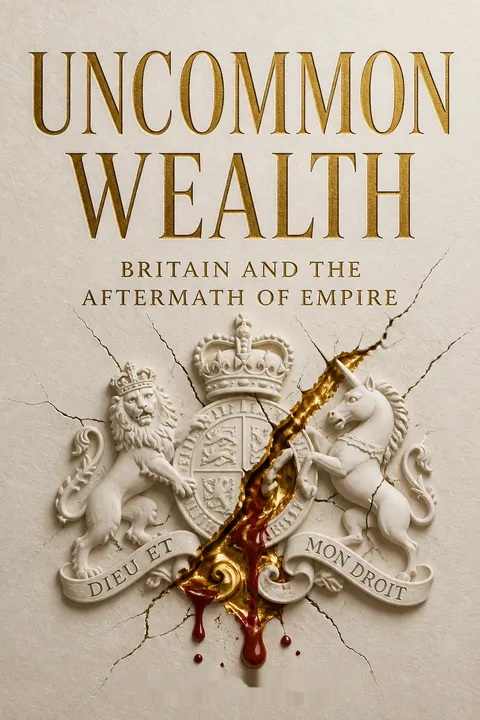


Key Takeaways
Read Britain's present through empire's boomerang, not a ladder of progress.
A childhood question opens the argument. As a boy travelling between Britain and Ghana, Koram asks why the former Gold Coast, rich in gold, is poorer than Britain. His grandfather explains that Ghana is young and needs time to catch up. The book challenges this familiar story of countries moving along one orderly path from backwardness to progress. It argues that the wealth and insecurity visible in both countries are connected to the history of empire and its economic afterlife.
The pattern returns home. Koram borrows the boomerang idea from Aimé Césaire: practices and systems developed in the colonies can later shape life in the imperial centre. Britain’s wealth inequality, precarious work, and strained public services are not proof that history has reversed, but evidence that the supposedly separate worlds were connected all along.
The boomerang is useful because it makes history relational rather than a contest between supposedly advanced and delayed societies. It also challenges the habit of treating Britain as a self-contained case, with other countries serving only as cautionary tales. The metaphor is strongest when the book identifies a specific route of transmission, such as offshore finance or labour deregulation. It can become too broad if every contemporary problem is attributed to empire without tracing that route. The reader’s practical question is therefore not simply whether a problem has colonial roots, but which institutions carried the old arrangements forward.
Winning sovereignty does not guarantee control over a country's wealth.
Iran exposed the limit. In 1951, Iranian prime minister Mohammad Mosaddegh nationalised the oil industry, arguing that oil beneath Iranian land should serve Iran. The Anglo-Iranian Oil Company, whose profits had reached £170 million the previous year, resisted. Britain imposed sanctions and a blockade, then worked with the United States to overthrow Mosaddegh in 1953. The episode showed that a new state could possess formal legal independence while facing powerful external pressure over its resources.
Ghana faced a different version. Kwame Nkrumah won independence and pursued industrial development, but international prices, foreign corporate decisions, and economic pressure constrained his plans. After a 1966 coup, Ghana’s new government reduced taxes on companies, devalued its currency, and sold state assets. The book’s point is not that independence was meaningless, but that political authority alone could not control the economic forces shaping people’s lives.
The distinction between legal sovereignty and practical capacity is central to political economy. A government may have the authority to legislate while lacking the leverage to resist capital flight, market shocks, or the threat of lost investment. This helps explain why formal independence can coexist with constrained choices. Yet sovereignty is not automatically democratic or protective: Nkrumah’s growing authoritarianism shows that control concentrated in a national government can also be used against citizens. The stronger test is whether people can shape the economic rules that govern them, not merely whether a state can act without foreign direction.
Remember that corporations once governed territory, not just traded within it.
Empire used the company form. The modern commercial corporation grew alongside imperial expansion. Its legal structure allowed investors to pool money, keep the enterprise alive beyond its founders, and limit personal liability. Companies such as the East India Company did far more than trade: they held territory, raised armies, collected taxes, and enforced laws. At its height, the East India Company commanded a private army larger than Britain’s army at the time.
Private did not mean separate. Colonial companies operated with state charters and imperial backing, while their directors could also hold public office. The Royal African Company, in which Edward Colston was prominent, profited from the Atlantic slave trade. Its charitable activity helped satisfy the public-benefit requirement attached to its charter. Koram argues that treating such firms as ordinary businesses obscures how corporate power helped build and govern the empire.
The historical company-state complicates the modern distinction between public government and private enterprise. The corporation’s durability and limited liability can support investment and complex coordination, but those same features can separate decision-makers from the consequences of their actions. The book’s account also clarifies why philanthropy cannot simply cancel exploitation: charitable giving and commercial violence could be built into the same institutional arrangement. Modern corporations are not identical to imperial companies, but the comparison raises a valuable accountability question: when private actors perform public functions, who can meaningfully scrutinise or sanction them?
Track outsourced public power, and ask who answers when it fails.
Outsourcing has deep roots. Koram traces Britain’s reliance on private companies back through imperial history, rather than treating it as a reform invented in the 1980s. The state often used companies to extend its power while keeping the work at arm’s length. Today, around a third of UK public spending goes through contracts with private firms.
The pandemic showed the risks. In 2020, the government placed its test-and-trace programme under Baroness Dido Harding and relied heavily on private contractors, including Serco. The system missed targets, while some call handlers reportedly had little work to do. The National Audit Office found serious shortcomings, yet Serco reported higher profits. Koram uses the case to question the assumption that contracting out automatically creates efficiency, especially when public bodies have lost the capacity to provide or oversee services themselves.
Outsourcing creates a problem of divided responsibility: public officials set goals, contractors deliver services, and citizens bear the consequences. In principal-agent terms, the buyer may struggle to observe quality, while the provider can know more about its costs and performance. That gap makes transparent contracts and independent evaluation essential. The book’s critique is strongest when it distinguishes a failed contract from a failed idea of public provision. Private delivery can sometimes work, but efficiency claims need evidence that includes service quality, continuity, and the public cost of rebuilding expertise when a contract goes wrong.
Follow capital's open borders alongside the people states try to stop.
Citizenship narrowed after empire. The 1948 British Nationality Act left many Commonwealth subjects with the right to settle in Britain. Caribbean, West African, and South Asian workers were recruited to help rebuild the country, including its transport system and NHS. Later laws, passed between 1962 and 1981, progressively restricted those rights and tied entry more closely to British ancestry. People who had been subjects of a global empire were reclassified as foreigners in the emerging nation state.
Money moved in the opposite direction. From the 1970s, capital controls were relaxed, making it easier for wealth to move across borders. The contrast is central to the book: governments increasingly restricted people while enabling money and assets to travel. Koram connects that divide to the precarious lives of workers and to the political habit of blaming migrants for pressures produced by broader economic changes.
The contrast between constrained human mobility and liberalised capital is a powerful way to expose which kinds of movement receive political protection. It also prevents immigration from being discussed as if it were disconnected from labour markets, imperial relationships, or corporate decisions. The Windrush story makes clear that legal categories can change faster than people’s sense of home. Still, migration has many causes, and capital mobility alone cannot explain who moves or why. A sound analysis should connect economic structures to individual histories without reducing migrants to effects of those structures.
Treat debt as political leverage, not merely an accounting problem.
Jamaica tested another path. In the 1970s, prime minister Michael Manley pursued social reform at home and a New International Economic Order abroad, a proposal for fairer trade rules and greater control over multinational companies. Oil-price shocks and borrowing left Jamaica exposed to creditors. IMF loans came with conditions that included cuts to public spending and changes to the economy. By 2019, Jamaica had spent 32 of its 57 years of independence under IMF structural-adjustment programmes.
The lesson travelled. Debt became a way to narrow governments’ choices, as repayment obligations were used to justify privatisation and austerity. After the 2008 financial crash, Britain also invoked debt to defend public-service cuts, even as banks received public support. The book does not claim the Jamaican and British crises were identical. It argues that the earlier crisis revealed how debt could reorganise policy and shift power away from voters.
Debt is both a financial claim and a relationship of authority. When repayment is treated as the overriding obligation, governments may present contested policy choices as unavoidable technical necessities. That framing can depoliticise decisions about who pays and which services are protected. The Jamaican case makes the distributional stakes visible, while the comparison with Britain shows how similar arguments can appear in very different economies. Care is needed, however, not to flatten those differences: debt burdens, currency strength, and access to credit vary greatly. The key question is who gets to define the available choices.
Look for empire's afterlife in tax law, not only statues.
The offshore world has a British history. When Jamaica became independent in 1962, the Cayman Islands remained under British sovereignty and developed into a major offshore financial centre. The territory offered companies and investors favourable tax, secrecy, and corporate laws. Its growth was linked to the Eurodollar market, which took shape in London as banks held US dollars outside ordinary controls. The City of London and Britain’s overseas territories became connected parts of a financial network.
The costs reach onshore. The book cites estimates that as much as 10 per cent of global economic output is held in tax havens. Britain’s overseas territories include several prominent tax havens, yet politicians often describe them as remote places beyond national responsibility. Koram argues that offshore wealth is not simply lost in a distant nowhere: British laws, institutions, and political choices helped make the system possible.
Offshore finance is best understood as a legal arrangement, not a faraway island with unusually sunny weather. Its power comes from the interaction of jurisdictions, corporate structures, and rules that allow wealth to be moved or obscured. That perspective makes responsibility harder to outsource: a government cannot credibly treat the system as external if its laws and territories sustain it. Reform is still difficult because capital can shift jurisdictions and because the same financial networks are deeply embedded in trade. The book’s history clarifies the problem, while coordinated enforcement determines whether alternatives can work.
Do not mistake Singapore's managed capitalism for a hands-off free market.
The global city was a strategy. After Singapore was expelled from Malaysia in 1965, its leaders sought prosperity by connecting the city-state to international trade and finance. Sinnathamby Rajaratnam described Singapore as a trading community and later promoted the idea of a global city, a hub linking mobile capital, commerce, and transport. Singapore’s economy grew by an average of more than 7 per cent annually over the three decades after independence.
The state built the conditions. Singapore attracted foreign investment through tax incentives, public companies, state ownership of much land and infrastructure, and restrictions on labour power and dissent. Koram challenges British advocates who present this history as proof that deregulation alone produces prosperity. Singapore’s model depended on an interventionist government that actively protected investment, not on the state simply stepping aside.
Singapore illustrates an important distinction: market-friendly policy is not the same as a weak state. Governments can intervene forcefully to secure property, discipline labour, and reduce uncertainty for investors. This helps explain why the phrase free market can conceal choices about whose freedoms matter most. The model also cannot be lifted out of its context and applied mechanically to Britain. Singapore’s size, political institutions, and historical circumstances differ substantially. A useful comparison asks which specific arrangements produce growth, who benefits, and what democratic or social costs accompany them.
Make decolonisation about changing the machinery that distributes wealth.
Symbols matter, but they are not enough. Koram argues that debates over statues, flags, and curricula can expose suppressed history, yet the material legacy of empire also lives in property law, corporate power, borders, debt, tax policy, and financial institutions. A reckoning focused only on identity risks leaving those structures untouched.
The public already sees the stakes. The book cites surveys in which 82 per cent of Britons supported excluding companies registered in offshore tax havens from government bailouts, 64 per cent distrusted private outsourcing of public services, and 78 per cent thought the income gap was too large. Koram points toward practical changes, including reforming overseas territories, strengthening labour protections, and making debt and tax rules more accountable. These are ways to connect historical understanding to economic choices.
The distinction between symbolic recognition and material reform is useful, but the two are not substitutes. Public memory can change what policies seem legitimate, while institutional rules determine how resources and risks are actually distributed. The strongest programme therefore links historical education to specific reforms and measurable outcomes. It should also guard against replacing one unaccountable power with another: a more assertive state is not automatically fairer. Democratic oversight, worker participation, and clear evaluation would help ensure that reform redistributes decision-making power as well as money.
Analysis
The book’s central achievement is to make empire an economic history of the present, not simply a moral dispute about past conduct. Its six recurring arenas, the state, company, border, debt, tax, and City, show how legal authority and private wealth can travel through different channels. The comparison between colonial rule and contemporary Britain gains force when each chapter traces a mechanism: corporate charters become company power, currency deregulation enables offshore finance, and debt conditions restrict public policy. This is more persuasive than treating empire as a single, all-purpose cause.
The account also changes the meaning of sovereignty. Independence, national citizenship, and electoral choice matter, but they do not by themselves determine who controls resources or investment. At the same time, the history warns against romanticising the state. Nkrumah’s turn toward authoritarian rule and Singapore’s coercive labour regime show that national power can protect citizens, corporate interests, or political elites, depending on its institutions and accountability. The question is not state versus market in the abstract, but who can set the rules and contest their effects.
A useful caution is that a connected history can sometimes make varied events look like one continuous design. Empire’s afterlife is not a single actor pursuing an unchanging plan. Local political decisions, economic shocks, and the strategies of newly independent governments also matter. Koram acknowledges failures and limits among postcolonial leaders, but readers should retain those contingencies rather than treat every modern inequality as a direct imperial consequence.
The book’s most practical contribution is a diagnostic habit: when a political promise invokes national renewal, ask where ownership sits, which jurisdiction governs the contract, who bears the debt, and who can leave. Those questions connect historical memory to present institutions. They also make the argument useful beyond Britain, because the same tension between democratic authority and mobile capital appears wherever assets can cross borders more freely than people can.
People Also Read


Glossary
the boomerang effect
Colonial practices returning homeA concept associated with Aimé Césaire and used by Koram to describe how practices developed or tested in colonial settings can later affect the imperial centre. It challenges the idea that Britain and its former colonies occupy separate historical worlds, and frames contemporary British inequality as connected to global systems shaped during empire.
company-state
A corporation exercising state powerA commercial corporation that governs territory and performs functions normally associated with a state. The East India Company is the book’s major example: it held land, maintained armed forces, collected taxes, and enforced laws in India. The term highlights how British imperial rule was often carried out by private companies with public authority and state backing.
Third World
A political identity against hierarchyOriginally a label for countries outside the US-led capitalist and Soviet-led communist blocs, the term was reclaimed by anti-colonial movements as a shared political identity. In the book, it refers not simply to poverty or a stage of development, but to efforts by formerly colonised countries to challenge unequal global economic and political arrangements.
New International Economic Order
A programme for fairer global tradeA proposal advanced by Michael Manley and other leaders from newly independent countries in the 1970s. It sought to make political independence meaningful in economic terms by changing trade rules, strengthening national control over natural resources, and regulating multinational corporations. The proposal gained support at the United Nations but lost influence as free-market policies advanced.
structural adjustment policies
Loan conditions that reshape economiesEconomic conditions attached by the IMF or World Bank to loans for countries facing financial pressure. In the book’s examples, these conditions included public spending cuts, privatisation, and policies intended to attract foreign investment. Koram argues that structural adjustment often narrowed elected governments’ choices and transferred economic control away from public institutions.
offshore financial centre
A jurisdiction serving mobile wealthA jurisdiction that attracts companies and investors by offering financial, tax, secrecy, or regulatory arrangements distinct from those of larger economies. The Cayman Islands is a central example. Koram presents offshore centres not as isolated hideouts, but as linked to British sovereignty, English law, the City of London, and the wider movement of global capital.
Eurodollar market
Dollars held outside US controlsA market that developed when banks, especially in London, accepted and traded US dollars held outside the United States and its banking regulations. The market grew despite post-war attempts to control international finance. Koram describes London’s role in this system as helping the City preserve its financial importance and contributing to the wider growth of offshore finance.
global city
A hub linking international capitalA city organised as a key node in networks of trade, finance, transport, and multinational business. Singapore’s leaders used the idea to define a development strategy after independence, focusing on attracting international companies and connecting the city to global markets. Koram also applies the concept to London and examines the inequality that accompanies this economic model.
functional sovereignty
Corporate control over market rulesA form of practical power exercised by companies that set rules for the platforms, services, or markets on which other organisations depend. Koram uses the term to describe how major corporations can govern important parts of economic life without being territorial states. Their influence can limit the ability of governments and citizens to shape those systems.
Download PDF
Download EPUB
.epub digital book format is ideal for reading ebooks on phones, tablets, and e-readers.








