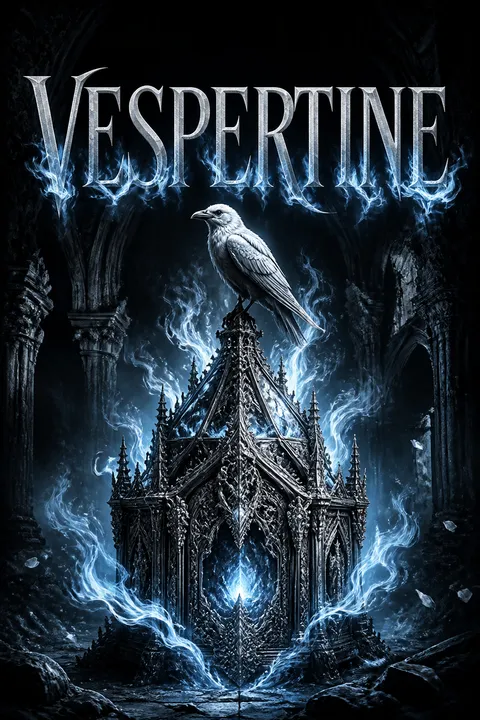


Plot Summary
The Censer Below the Chapel
Artemisia, a scarred novice of the Gray Sisters, finds young Sophia’s censer abandoned beside a tomb. Trouble, the white raven Artemisia once nursed back to health, leads her through a storm-eroded gap into the convent crypt.
There Artemisia finds Sophia hiding from a gaunt, a swift spirit born of starvation. Though a memory of her childhood possession freezes her briefly, she shields Sophia, destroys the gaunt with her censer, and suffers a blighted wrist.
Sister Julienne appears, identifies the spirit as a long-dead nun, and escorts the girls through the crypt. At Saint Eugenia’s shrine, Artemisia senses the bound revenant inside the relic, a presence no other novice can feel. Julienne recognizes her unusual sensitivity, but Artemisia conceals it.
The opening makes Artemisia’s isolation practical rather than merely temperamental: she goes to the cemetery to avoid people, yet her attentiveness to Trouble and Sophia draws her into danger. Her scars both mark past harm and shape present action, limiting her grip while reminding her of a possession she has not emotionally escaped. The shrine’s effect deepens the question of whether her difference is a gift or an opening for further violation. When Artemisia hides what she sensed, self-protection takes precedence over institutional truth, establishing the wary independence that will complicate every later alliance.
The Test She Refuses
The gaunt’s attack makes Artemisia the object of gossip, while she quietly plans to fail an evaluation that could send her from Naimes to the Clerisy’s school in Bonsaint. Confessor Leander tests her with relics bound to spirits of drowning, illness, and fire.
Artemisia senses each one but denies it, unwilling to trade the convent’s familiar duties for power and scrutiny. Leander reveals that her childhood possession gives her rare potential, then tries to force compliance with his penitent relic, which can impose guilt.
Artemisia resists its pressure and threatens to make her apparent instability a public embarrassment. Before he can decide how to answer, a messenger reports possessed soldiers in Roischal. Leander leaves for the crisis, postponing his attempt to take her.
The evaluation pits two competing definitions of competence against each other. Leander sees Artemisia’s sensitivity as an exceptional resource, while she values work that protects the dead and avoids the social performance of clerical rank. Her refusal is not ignorance of her talent; she knowingly lies because accepting the role means surrendering control over her life. Leander’s use of guilt exposes the coercion beneath his polished authority, even as the emergency shows that his concern is not wholly self-serving. The interruption links Artemisia’s private choice to a spreading public disaster, setting up the moment when refusal can no longer keep her outside events.
The Gate Comes Down
Reports of spirits attacking Roischal multiply, and the convent’s alarm becomes physical when possessed soldiers use a chain of horses to wrench down its consecrated gate. The Gray Sisters herd the novices into the chapel while Mother Katherine orders Artemisia to alert Julienne in the crypt.
Through the reopened passage beneath the chapel, Artemisia finds a dead soldier and Julienne mortally wounded beside Saint Eugenia’s open sarcophagus. Julienne entrusts Artemisia with the relic, explaining that the attackers are trying to destroy it because it is the convent’s strongest defense.
Artemisia has no training to wield a revenant, but the soldier’s corpse begins releasing its possessing spirit. She takes the reliquary and opens it, choosing an unknown danger over leaving the people above defenseless.
The gate’s collapse destroys the boundary that has defined Artemisia’s whole world. The convent’s protections prove vulnerable to both supernatural threat and human force, so inherited safety cannot substitute for action. Julienne’s transfer of duty makes Artemisia’s choice less a heroic ambition than a burden passed down at the edge of death. The relic is introduced as both weapon and prison, a contradiction that will govern the central relationship. Artemisia accepts it not because she trusts the institution’s theology or understands the spirit, but because she recognizes that hesitation would leave Sophia and the others alone.
A Revenant Takes Root
The revenant pours into Artemisia, nearly overwhelming her, but its voice emerges as a distinct, furious presence. It directs her to a dead soldier’s sword, and together they destroy a feverling before Artemisia returns to the chapel.
She asks Sister Iris to protect the reliquary, then uses the revenant’s force to drive spirits from the possessed soldiers and helps the sisters destroy the exposed Dead. When a fury disables the defenders, Artemisia releases more of the revenant’s power.
Silver fire consumes the spirits across the chapel and catacombs, but the revenant’s hunger turns toward living souls. Artemisia stops it by threatening to kill herself rather than become its permanent host. She collapses, and the sisters restrain and drug her while the revenant remains inside.
Their first cooperation is born from mutual peril, not trust. The revenant can act only through Artemisia, while Artemisia’s refusal to yield keeps its power from becoming absolute. Yet victory exposes the danger in their arrangement: the same force that saves the convent can consume it. Her willingness to die is both courage and a survival strategy learned through trauma, making self-sacrifice feel more available to her than asking for help. The aftermath also reframes possession as a struggle over agency, not simply a battle between good and evil. Artemisia has survived the immediate threat, but her body and mind remain contested territory.
The Harrow Breaks
Artemisia wakes chained inside a harrow, a carriage designed for transporting the possessed. Leander carries Saint Eugenia’s reliquary while refugees crowd the roads and abandoned villages reveal how far the crisis has spread.
The shackles suppress the revenant, but it senses that spirits are stalking the escort and advises Artemisia to use an attack as cover. Trouble distracts the knights, giving her a chance to lure Leander into the carriage. A blast wrecks it before she can take his keys.
In the ensuing fight, a rivener nearly kills Leander; Artemisia frees herself, takes the reliquary, and helps him destroy the spirit. When Leander tries to recapture her, she throws him into a ditch, steals his horse, and rides east with Trouble following.
The harrow turns the state’s response to possession into a literal prison, showing how care and control can become indistinguishable when authority assumes it knows what a person needs. Artemisia’s escape depends on the revenant’s tactical knowledge, but she does not become its obedient instrument: she saves Leander even while fleeing him. That choice complicates the easy division between enemy and ally, and the spirit’s grudging respect begins to make conversation possible. The horse and raven also provide forms of companionship that do not demand polished speech. Artemisia’s flight is a new kind of freedom, but it carries her directly toward the larger crisis.
The Battle of Bonsaint
Outside Bonsaint, Artemisia finds the city’s drawbridge raised while soldiers and refugees face a vast army of spirits. She charges into battle on Leander’s horse, Priestbane, and the revenant helps her free possessed soldiers before their comrades are forced to kill them.
As the spirits avoid her, the revenant urges her to unleash its full power. Its silver fire destroys much of the army, but its hunger turns toward the living people watching. Artemisia reins Priestbane away before the flames reach them and collapses.
The crowd names her a saint, while Leander arrives demanding her arrest. Captain Enguerrand and the soldiers help Artemisia escape amid the confusion. She falls near the Sevre, climbs back from the riverbank, and hides as Leander accepts Enguerrand’s false report that she drowned.
The battle gives Artemisia public power before she has any public identity she can bear. Her rescue is real, but the crowd sees only the radiant spectacle, not the moment she nearly loses control and almost kills them. The acclaim therefore creates a second danger: others begin to treat her as a symbol rather than a frightened, inexperienced person. Her restraint matters more than the scale of her attack, because she chooses to protect living bodies even when the revenant’s power makes destruction feel effortless. Enguerrand’s decision to mislead Leander offers a fragile counterweight to official authority, founded on trust rather than rank.
A City Across the River
After hiding among refugees, Artemisia crosses the Sevre toward Bonsaint disguised as Anne of Montprestre. The river weakens both her and the revenant, and a cleric examining travelers nearly detects the spirit. Captain Enguerrand, pretending not to recognize her, lets her pass.
In the city, she meets Charles, a young soldier who escorts her to a convent, and Mother Dolours, its forceful abbess and healer. Artemisia also encounters Jean, a soldier traumatized after possession led him to kill a friend.
The convent is crowded with refugees and patients, and Artemisia collapses from exhaustion. Marguerite, her former roommate from Naimes, is there too. She has run away, hidden Artemisia’s reliquary, and disguised the scarred novice’s hands to keep the Clerisy from identifying her.
Crossing the river makes Artemisia’s disguise more than a change of clothes: she must endure a social world whose scale and noise overwhelm her. Her near discovery shows how little control she has over the systems searching for her, while Enguerrand’s quiet aid demonstrates that recognition can be withheld as an act of protection. The convent gathers characters whose injuries resist simple categories: Jean is both a danger to others and a survivor of possession, while Marguerite is both frightened and resourceful. Artemisia’s collapse exposes how thoroughly she ignores her own bodily needs. The people around her begin to supply the care she has never learned to request.
The Runaway and the Shade
As Artemisia recovers, Mother Dolours heals refugees who appear to have plague, revealing their illness is contaminated water rather than pestilence. Artemisia and Marguerite secretly follow curists discussing Leander’s strange behavior and his dead brother, Gabriel.
Marguerite recognizes that Artemisia is speaking with the revenant, but chooses to protect her. The two begin cooperating, and Artemisia learns Marguerite has been keeping a shade summoned from Mother Katherine’s moonstone ring for protection.
When Artemisia and the revenant trace Leander into the convent’s forbidden chambers, they find a dangerous cache of relics and Old Magic records. A dormant dreadnought animates and pursues them. Marguerite and Jean help Artemisia escape, and she finally explains what she is doing. Marguerite joins her, no longer merely a frightened witness.
Marguerite’s hidden shade mirrors Artemisia’s relationship with the revenant: both girls have found that a spirit can be a companion rather than only a threat. Her resourcefulness revises Artemisia’s old picture of her as frivolous, while Artemisia’s choice to disclose the truth gives Marguerite a role based on trust. Jean’s presence turns that trust into practical solidarity. The archive of forbidden objects also unsettles the neat boundary between sacred history and suppressed knowledge. Leander’s investigation has become dangerous enough to animate the past literally, and the group’s survival depends on cooperation among people whom the institutions have classified as weak, unstable, or suspect.
Saints in the Square
At the Saint Agnes festival, Artemisia follows the revenant’s sense of Old Magic toward the cathedral, while Marguerite recognizes that Leander may use the crowds to conceal a plan. A beggar playing the Raven King becomes possessed and targets Artemisia.
She tries to draw him away, but he threatens bystanders, forcing her to fight in the square. The revenant drives the spirit from his body, and the Clerisy sees Artemisia using its power. The expelled spirit becomes a white vicar, which kills civilians and raises more spirits from their bodies.
Artemisia rushes back to protect Marguerite and Jean, exorcising another attacker as the other spirits flee from the revenant. The Divine’s forces fight the white vicar, while Leander attempts to reach Artemisia. Exhausted and overwhelmed by fire and smoke, she loses consciousness.
The festival stages the conflict between communal ritual and actual danger. The Raven King’s effigy is meant to make terror manageable through mockery, but the possessed beggar converts pageantry into a real threat. Artemisia’s effort to draw danger away from the crowd fails, showing that individual courage cannot always control the conditions of violence. Her return to defend Marguerite and Jean marks a shift from solitary rescue to responsibility for particular people. The white vicar’s appearance turns the city’s faith into a public emergency, while the crowd’s gaze begins transforming Artemisia into a legend even as she struggles to remain a person.
The Altar’s Hidden Purpose
Following the festival, Artemisia reaches the cathedral during a service and touches its altar, hoping the revenant can identify the Old Magic beneath it. The contact tears Rathanael from her mind and leaves her reeling. Leander catches her in the crypt and summons his penitent, whose bell inflicts crushing guilt.
Artemisia finds a consecrated dagger in the catacombs and uses its burn to call Rathanael back. She escapes through the tunnels, where the revenant’s damaged state worsens into a near-possession.
Recognizing that it is panicking rather than deliberately betraying her, Artemisia steadies it and leads them both back to the surface. She then searches Leander’s room and finds the missing record of Saint Agnes’s ashes. The revenant realizes that Sarathiel, supposedly destroyed centuries ago, may still be alive inside them.
The altar’s power destabilizes Artemisia’s certainty about the bond she has formed. Rathanael is not simply a source of strength: it can be wounded through her, and her own body becomes the point where ancient institutions enact their violence. Her return to it through pain is unsettling, but the later episode in the tunnels gives her a different response to its fear. Instead of treating its panic as proof of evil, she recognizes an injury that resembles her own history. The discovery of the missing record transforms suspicion into a specific threat: Sarathiel may be hiding in an object everyone has mistaken for harmless remains.
The Ashes Awaken
Artemisia finds Leander holding Saint Agnes’s casket behind the cathedral altar, with the sacristan dead nearby. She confronts him, expecting to uncover the Old Magic practitioner, but learns Leander has been investigating the attacks and intends to throw the ashes into the Sevre.
The revenant identifies the source of the Old Magic as Sarathiel, whose presence has been concealed in the casket. The Divine arrives and tries to stop Leander, exposing her knowledge of the relic. During the struggle, she breaks the altar and the casket falls open.
Sarathiel erupts from the ashes. Rathanael’s fire destroys its visible form, but Sarathiel survives by possessing Leander. The Divine accepts its promise that they will become one, while Artemisia is shackled and imprisoned as a threat.
This reversal forces Artemisia to revise her account of Leander without absolving him of the harm he has caused. His coercive methods and secrecy made him look like the source of the crisis, yet he has been trying to contain it alone. The deeper failure belongs to an institution that sends him away and withholds records, leaving him without allies. The Divine’s complicity grows from a different vulnerability: loneliness makes Sarathiel’s promise of intimate recognition persuasive. When the casket opens, the story’s categories of saint, relic, and monster collapse into one another. The danger was not the return of a dead enemy alone, but the desire to trust power without testing what it wants.
The Divine’s Last Bargain
Sarathiel uses Leander’s body to convince the Divine, Gabrielle, that Artemisia must surrender Rathanael’s reliquary. When Gabrielle doubts its promises, Sarathiel kills her and turns to torture.
Marguerite claims she knows where the reliquary is, apparently betraying Artemisia, but she is part of a rescue arranged with Mother Dolours. The abbess leads soldiers and refugees in a revolt against Sarathiel’s possessed guards, then prays its hold out of Leander’s body long enough to free Artemisia.
Marguerite and Jean escape with her as Captain Enguerrand and Charles help rally the city. Sarathiel remains inside Leander, and the cathedral is barricaded. The escaping group knows that flight will not save Bonsaint: the revenant will regain strength, and the city has nowhere safe to run.
Gabrielle’s death exposes the difference between companionship and possession. Sarathiel has offered her the intimacy she craves, but it treats her life as expendable once her doubts threaten its plan. Marguerite’s apparent betrayal works because Artemisia has learned that trust cannot mean certainty; it must be tested through action. Mother Dolours’s intervention likewise challenges the assumption that a powerful spirit can only be opposed by matching its force. Her prayer creates the opening, while soldiers and civilians make that opening consequential. The city’s resistance is not a miracle delivered from above, but a coalition of people who have been frightened, misled, or harmed and still choose to act together.
Seven Runes for Bonsaint
With the revenant’s relic hidden by Marguerite, Artemisia cannot use its power while the shackles remain on her wrists. She realizes that Bonsaint was built from an older city whose stones once supported Old Magic, making the entire city a possible ritual site. Rather than wait for the smith to find a key, she asks for a blade and begins drawing a seven-part array in her blood.
Rathanael refuses to cut her itself, so Artemisia makes the first wound and lets the spirit complete the rune. She rides Priestbane around the city with Marguerite, Captain Enguerrand, Charles, and a growing crowd, laying down the remaining marks. When possessed knights breach the convent, Jean breaks the shackles with a mallet, restoring Rathanael’s full power.
The plan grows from Artemisia’s ability to connect what formal scholarship has kept separate: the city’s reused stones, the forbidden history of Old Magic, and the practical need for a ritual site. Her blood makes the abstract plan bodily, while Rathanael’s inability to cut her reveals a boundary it has chosen not to cross. The route through Bonsaint also changes the crowd from spectators into participants. They do not merely acclaim Artemisia; they accompany and support her. Jean’s strength becomes useful without erasing his vulnerability, and Marguerite’s presence counters Artemisia’s old reflex to bear every cost alone.
The Fire That Chooses
At the convent, Artemisia uses Rathanael’s fire to destroy the spirits attacking the grounds, but its hunger threatens every living soul in the city. She pulls the flames back before they reach the people, then finishes the final rune inside the chapel.
Sarathiel reaches the doorway in Leander’s body, but Leander briefly regains control and lets Artemisia complete the ritual. Old Magic tears both revenants apart. Artemisia refuses Rathanael’s demand that she release it and holds on, praying for it as the ritual consumes them.
The book leaves the moment in apparent devastation before its epilogue confirms that Artemisia survives and Rathanael remains with her. In the aftermath, she learns the binding ritual began as Rathanael’s attempt to help Saint Eugenia control its power, not as a deliberate plan to imprison spirits.
The climax makes restraint the decisive form of power. Artemisia can unleash enough force to defeat Sarathiel, but doing so without limits would destroy the people she means to save. Her refusal to consume Bonsaint distinguishes her agency from the revenant’s hunger, while her final grip on Rathanael turns their bond from a bargain based on mutual necessity into an act of care. The revelation about the ritual’s origin does not erase its cruelty or Eugenia’s sacrifice. Instead, it complicates moral judgment: catastrophic systems can begin as attempts to protect, then persist because their beneficiaries stop asking what those protections cost.
Epilogue
Artemisia wakes in an eastern monastery, where Mother Dolours has decided not to separate her from Rathanael. She learns that the revenant invented the binding ritual while trying to help Saint Eugenia control its power, and that Eugenia chose to use it at terrible cost.
Marguerite may study to become a curist, while Leander, recovering from Sarathiel’s possession, leaves to take vows with monks who illuminate manuscripts. He gives Artemisia Priestbane before riding away. Unable to let the farewell stand, she mounts the horse and follows him, with the white raven rising among the others.
The ending refuses a clean restoration. Artemisia survives, but the history of relics now looks less like uncomplicated holiness and more like a record of desperate choices whose costs were hidden by doctrine. Mother Dolours’s decision to let Rathanael remain with Artemisia suggests that relationship, consent, and mutual care may offer another model of power, though the revenant’s past makes that trust uncertain. Leander’s departure is an attempt to choose a life not governed by office or coercion. Artemisia following him does not promise romance or absolution; it shows her beginning to choose connection without abandoning her own judgment.
Analysis
Vespertine builds its fantasy around the question of who gets to define a person as dangerous, sacred, or worth saving. Artemisia is first treated as an unsettling novice, then as a weapon, and finally as a saint. Each label grants access to power while narrowing her personhood. Her resistance is therefore not simply a refusal of authority. It is a sustained attempt to keep judgment, consent, and care in view when institutions reduce people to functions.
The spirit system gives that conflict a literal form. Relics turn the dead into sources of power, while the living vessel bears the physical and psychological cost. The Clerisy’s rites protect communities, yet the relics also preserve suffering inside objects and call coercion holy when it serves the public good. Old Magic complicates the moral picture further. It is not harmless, but neither is it automatically corrupt; the question is what its users will sacrifice, and whether they admit the cost. The saints’ history has been simplified because a clean origin story is easier to govern than a record of desperate compromises.
Artemisia’s partnership with Rathanael offers no easy solution. Their bond begins with mutual dependence and the threat of possession. It develops because Artemisia listens, sets boundaries, and recognizes fear beneath rage. She does not excuse the revenant’s violence, but she refuses to treat it as a mindless object. That distinction becomes the emotional counterpoint to Sarathiel, which exploits Gabrielle’s loneliness by offering closeness while denying her real agency.
The book’s strongest idea is that care is not sentimental softness. It is attention to limits: feeding a body, protecting someone feared by the crowd, refusing power when its use would consume innocents. Artemisia’s victory depends on knowledge, but also on help from Marguerite, Jean, Enguerrand, and others. Her growing capacity to accept that help marks a deeper transformation than public sainthood. She remains wary of institutions and uncertain about the Lady, but she no longer mistakes isolation for strength.
Review Summary
Vespertine by Margaret Rogerson receives an overall 4.09/5 rating. Readers praise the unique medieval fantasy premise featuring nun-in-training Artemisia who becomes possessed by a snarky ancient revenant. Many highlight the compelling character development, atmospheric worldbuilding, and witty banter between Artemisia and her spirit companion. The lack of romance is noted positively by some, negatively by others. Common criticisms include slow pacing in the middle, repetitive prose, and confusing magic systems. Reviewers appreciate the Joan of Arc parallels and respectful handling of PTSD, anxiety, and religious themes. Most recommend it despite minor flaws.
People Also Read










Characters
Artemisia
Scarred spirit fighterA Gray Sister novice raised at the convent of Naimes, Artemisia is observant, blunt, and far more comfortable with the dead than with the living. Her burned hands and history of childhood possession have taught her to ignore pain and expect little help, habits that make her capable in crisis but careless with her own needs. She values practical service over rank and resists being made into a symbol by people who do not know her. Her bond with spirits challenges her assumptions about danger and personhood, while her cautious attachments to Marguerite and Rathanael test her instinct to survive alone.
Rathanael
Imprisoned ancient revenantThe Fifth Order spirit bound to Saint Eugenia’s relic, Rathanael is powerful, sharp-tongued, proud, and deeply fearful of imprisonment. Its contempt for humans disguises a keen interest in human sensation and survival. Earlier vessels were trained to suppress its voice, leaving it unused to being heard as a thinking presence. With Artemisia, necessity forces cooperation, but the relationship also exposes its capacity for attachment and its difficulty distinguishing danger from abandonment. Its knowledge of Old Magic makes it an indispensable guide, though its history and motives remain more complicated than either human doctrine or its own boasts suggest.
Confessor Leander
Relic-wielding investigatorA young, high-ranking cleric, Leander carries a rare penitent relic that lets him impose guilt and compel truth. He is disciplined, proud, and accustomed to treating other people’s resistance as an obstacle to urgent work. His severity is sharpened by the pressure of his office and the death of his elder brother, Gabriel. He recognizes Artemisia’s talent before she recognizes her own, but his methods make trust difficult. His investigation into the attacks is conducted in isolation, leaving even people who share his aims uncertain whether he is protector, threat, or both.
Marguerite
Runaway novice and allyArtemisia’s former roommate is sensitive, talkative, and often dismissed as silly by people who mistake visible emotion for shallow thought. Marguerite wants a life beyond the narrow future assigned to her at Naimes, and her appetite for letters, gossip, and city life reflects a genuine hunger to see the world. Fear does not make her passive: she plans carefully, keeps secrets, and notices what others overlook. Her longstanding awkwardness with Artemisia comes from mutual misreading, not a lack of care, and she is more capable than Artemisia has allowed herself to see.
Mother Katherine
Artemisia’s first protectorThe elderly abbess of Naimes is perceptive, patient, and quietly formidable. She recognized Artemisia’s suffering as more than misbehavior and brought the child to the convent after learning of her burned hands. Mother Katherine teaches through attention rather than force, making room for damaged people and animals to recover at their own pace. Her authority is softened by humor and an ability to see past Artemisia’s guarded manner. She represents the kind of care that does not require a person to become easy or grateful before they can be helped.
Mother Dolours
Unorthodox healer abbessThe abbess of Bonsaint’s convent is a forceful, practical healer whose command of multiple relics serves the sick rather than ceremony. She has little patience for officials who interfere with care, and her bluntness conceals a willingness to accept burdens she would rather refuse. Mother Dolours is comfortable questioning religious authority while remaining deeply attentive to the Lady’s demands. Her example broadens Artemisia’s idea of what a cleric can be: powerful without being polished, obedient without surrendering independent judgment.
The Divine of Bonsaint
Lonely provincial rulerThe young Divine governs Bonsaint and the surrounding northern province, carrying the ceremonial weight of a position she did not expect to receive. In public she appears delicate and distant, yet she seeks contact with ordinary worshippers and yearns for reassurance that she can lead. Her isolation makes her responsive to intimacy and spiritual certainty, especially when both seem to come from a powerful source. She embodies the personal vulnerability hidden beneath sacred office, and the danger of confusing being understood with being safe.
Sister Julienne
Crypt’s solitary guardianA reclusive holy woman who watches over Saint Eugenia’s shrine, Julienne is eccentric, unsettling to the novices, and more perceptive than her rambling manner suggests. She has spent years guarding knowledge that the convent does not openly teach. Her recognition of Artemisia’s sensitivity makes her the first person to treat the novice’s difference as meaningful rather than shameful. Julienne’s austere life reflects the cost of serving as keeper of a dangerous inheritance.
Sister Iris
Convent battle mistressThe strict instructor who trains the novices in censer and dagger forms, Sister Iris commands both fear and respect. Her sternness is a working discipline, not cruelty: she watches for danger, corrects carelessness, and protects the girls under her charge. Artemisia trusts her practical judgment more readily than her own emotions. Iris represents the convent’s everyday defense against the Dead, built from repetition, courage, and a willingness to care for novices even when they make themselves difficult to help.
Sophia
Young novice and raven keeperA young novice who cares for Trouble, Sophia is curious, brave when frightened, and still young enough to speak her fears plainly. Her bond with Artemisia is built through small acts of protection and shared danger. She reminds Artemisia that vulnerability is not the same as helplessness, while her innocence gives the threat at Naimes a human scale beyond institutional duty.
Charles
Openhearted city soldierA young soldier serving in Bonsaint, Charles is sociable, loyal, and quick to turn concern into practical help. He befriends Artemisia while she is hiding under another name, without knowing who she is, and treats Jean with a patience the wider community does not always show. His readiness to speak and connect contrasts with Artemisia’s social fear, but he does not demand that she become more comfortable for his sake. His loyalty grows through action rather than reverence.
Jean
Traumatized giant soldierA physically imposing soldier, Jean is left silent and fearful after possession drives him to hurt people. His size makes others read him as a threat even when he is trying to help. Charles’s friendship and Artemisia’s understanding offer him rare contact without immediate suspicion. Jean’s struggle centers on the fear that his own body may betray him again, a burden that makes his eventual practical courage more meaningful than his strength alone.
Captain Enguerrand
Guard captain and protectorThe experienced captain responsible for Bonsaint’s city guard is measured, compassionate, and willing to risk his position when authority conflicts with protecting people. He recognizes Artemisia as a person rather than a weapon or public miracle. His decisions during the battle and pursuit show a leader who understands that discipline sometimes requires disobedience. His care for his soldiers and family grounds his courage in human obligations.
Trouble
White raven guideA rare white raven once rejected by the other birds, Trouble survives because Artemisia nurses him and later entrusts him to Sophia. He mimics human speech, especially words he has learned from the girls, but his most important communication is his attention to danger. His loyalty repeatedly turns up at crucial moments, though whether his timing is divine guidance or raven cleverness remains uncertain.
Plot Devices
The Sight and spirit orders
Makes the dead perceptiblePeople with the Sight can perceive spirits, and spirits can possess them. The Dead are classified into five orders according to the circumstances of their deaths, from barely formed shades and wisps to violent spirits and the rare, catastrophic revenants. The categories give the Gray Sisters and Clerisy a practical language for recognizing threats, choosing weapons, and performing rites. The system also shapes social life: convents protect the Sighted, corpse-wagons carry the unblessed dead to ritual care, and communities fear the consequences of neglect. Its taxonomy is useful, but it does not guarantee that institutions understand the individual minds inside the categories.
Relics and vessels
Turns spirits into contested powerA relic contains a spirit and can grant its wearer abilities connected to that spirit’s nature. Clerics use these powers to heal, fight, sense danger, or compel truth, but stronger relics can overwhelm their wielders. A human vessel must control the bound spirit, often through training and painful methods. Saint Eugenia’s relic is exceptional because it holds a revenant, whose power can destroy vast numbers of spirits but also threatens to consume living souls. Artemisia’s relationship with Rathanael makes the system’s ethical cost visible: the relic is a weapon, a prison, and a possible relationship between beings who have rarely been allowed to speak freely.
Old Magic
Reopens a forbidden pastOld Magic is blamed for the Sorrow, the catastrophe that shattered the gates of Death and allowed the Dead to torment the living. The Clerisy has outlawed it, and its surviving records are hidden among dangerous relics and ancient archives. In Bonsaint, traces of it connect the spirit attacks to the cathedral’s past and eventually reveal that old stones can retain the conditions needed for ritual work. The story complicates the simple equation of forbidden power with evil: Old Magic can be used to protect people, but its scale and consequences make any experiment perilous. Its history has been edited by institutions that benefit from the sacred story built around it.
Lichgates and consecrated incense
Creates fragile defensesConvents and cities use consecrated iron gates, incense, censers, and blades to keep spirits at bay. These defenses shape Artemisia’s training and the daily duties of the Gray Sisters, who protect the living while preparing the dead for passage. They are powerful against spirits but not invulnerable: the possessed soldiers at Naimes break through the gate with horses, and gaps in the convent foundations allow danger to enter by another route. The protections also carry the prayers and fears of earlier generations, making a threshold such as the lichgate spiritually hostile to the Dead and emotionally charged for Artemisia.
The white raven
Connects danger with human careTrouble is both a companion and a warning signal, repeatedly appearing when Artemisia needs a route, distraction, or alert. His white feathers make him conspicuous among ordinary ravens, and his learned words give the girls a comic but useful means of interpreting his alarm. Ravens gather around corpses and convents, so their presence belongs naturally to the world of death rites, yet Trouble’s loyalty grows from Artemisia’s earlier kindness rather than from a clear supernatural rule. He helps move the plot while embodying the book’s recurring pattern: care given to a vulnerable creature can return as unexpected aid.
About the Author
Other books by Margaret Rogerson



Download PDF
Download EPUB
.epub digital book format is ideal for reading ebooks on phones, tablets, and e-readers.








