

Key Takeaways
Hold Catholicism's opposing truths together without diluting either one.
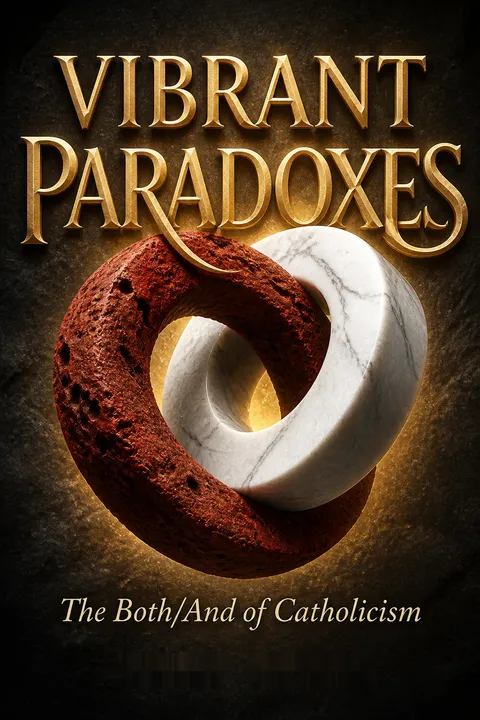
Paradox without compromise. Barron’s central idea is that Catholic thought can affirm realities that seem opposed without reducing them to a bland middle position. Its model is Jesus, understood as fully divine and fully human, with neither nature canceling the other. The same pattern appears in faith and reason, grace and nature, and body and soul. These pairings are not invitations to avoid hard questions. They are claims that reality can hold together dimensions that simplistic either-or thinking separates.
A wider lens. Barron presents this both-and instinct as a way to read the Church’s varied traditions and practices. The point is not that every apparent conflict can be reconciled, but that a genuine account should preserve the force of each truth rather than quietly discarding one.
What's useful here is the refusal to assume that tension automatically means contradiction. In ethics and political life, competing values often reveal distinct goods that need careful ordering, such as liberty and care for the vulnerable. A both-and approach can prevent premature simplification. It also needs a test: some claims really do conflict, and merely naming them as paradox does not resolve the conflict. The strongest version of Barron's method therefore requires clear definitions and an account of how the two sides relate, rather than treating complexity itself as proof of wisdom.
Pair demanding moral ideals with mercy that does not deny harm.
Standards and forgiveness. Barron argues that the Church should not lower its moral ideals simply because people find them difficult. He illustrates the point through just-war teaching: its requirements are so demanding that even the Allied bombing of cities in World War II raises grave moral questions. Difficulty does not, in his view, make a principle disposable. The same reasoning informs the Church’s demanding sexual ethics.
Mercy faces reality. High standards are paired with confession and forgiveness. Barron’s example is a remorseful person confessing complicity in a grave act of war: the priest can counsel and assign penance, yet still offer absolution. Mercy matters precisely because wrongdoing is real. It does not make the harm imaginary or the ideal irrelevant.
This pairing resembles restorative approaches to justice, which take injury seriously while refusing to define a person solely by the injury committed. It also guards against two familiar failures: moralism that offers condemnation without a path back, and permissiveness that calls harm harmless. A necessary distinction is between forgiveness and the consequences needed to protect people or repair damage. In institutional settings, especially where authorities have failed victims, appeals to mercy cannot replace transparency or accountability. The insight is strongest when compassion and responsibility remain active together.
Let science explain nature without making it the measure of all reality.
Different questions, different tools. Barron challenges scientism, the belief that only what empirical science measures is real or knowable. Science can investigate the physical structure of a book, for example, but that alone does not establish what its words mean or whether their message is true. Barron also argues that God, in classical Catholic thought, is not a hidden object inside the universe competing with physical causes. God is proposed as the ground of why contingent things exist at all.
Faith is not credulity. Barron compares religious faith to trusting a person who speaks. Reason can assess evidence and credibility, but knowledge of another person also depends on receiving what that person chooses to disclose. In this account, faith extends reason rather than replacing it.
The distinction between measuring an object and interpreting its meaning is important in a culture impressed by scientific success. It supports intellectual pluralism without dismissing science: different methods can answer different kinds of questions. The limit is that the boundary between empirical and metaphysical claims is often disputed, and a philosophical argument for God is not thereby a universally accepted proof. Barron's case is most persuasive when it asks science not to overclaim, while also holding theology responsible for engaging evidence and for clarifying what kind of claim it is making.
Treat the body as part of salvation, not a disposable shell.
Creation includes matter. Barron reads Genesis as theology, not as a scientific account of the universe’s origins. Its creation story presents the natural world as made by God, good, and not itself divine. The human being is given the task of naming creatures, which Barron interprets as an early picture of rational inquiry: people can study an intelligible world without worshipping or abusing it.
The body belongs. This commitment shapes the Christian understanding of the Incarnation and resurrection. God taking human flesh affirms material existence, while the bodily resurrection of Jesus signals that salvation is not simply escape from the physical world. The body is not an inconvenient container for a supposedly more authentic self; human life is embodied, and the material world can mediate spiritual meaning.
This account offers a theological basis for taking physical vulnerability, ecological care, and bodily life seriously. It also resists the familiar tendency to treat nature as either sacred beyond inquiry or as mere raw material for control. The framework does not settle every contemporary dispute about identity, medicine, or technology. Those questions require careful attention to lived experience and empirical knowledge as well as theological commitments. Its contribution is a starting principle: embodiment is not a mistake to overcome, but a dimension of human life that deserves serious interpretation and care.
Train freedom toward the good instead of worshipping choice alone.
Choice is not the whole story. Barron contrasts freedom understood as choosing among options with freedom formed for excellence. In the second view, discipline can make a person more capable, not less free. A musician who practices scales gains the ability to play with fluency; similarly, moral formation can make generous or courageous action less effortful.
Desire needs direction. Barron reads the Genesis story of the forbidden tree as humanity’s attempt to make its own will the ultimate measure of good and evil. He argues that objective goods, including truth, life, justice, friendship, and beauty, give freedom something worthwhile to pursue. The Church’s moral limits are presented as boundaries intended to protect love and human flourishing, not as a rejection of pleasure or the body.
This is close to virtue ethics, where freedom grows through habits that enable people to act well rather than merely to select options. The analogy with musical training makes the point tangible: constraints can expand capacity. But claims about objective goods do not remove the need to debate how those goods are understood or who gets to interpret them. A mature account of formation must also distinguish chosen discipline from coercion. The framework is most compelling when moral teaching is explained as a route toward a positive human good, not simply as a demand for obedience.
Meet people where they are, then invite them into Christ's story.
Walk alongside first. In the Emmaus story, two disillusioned disciples are leaving Jerusalem after Jesus’ death. The risen Jesus joins them without first demanding that they change course. He listens to their account, then uses Scripture to help them see its larger meaning. They recognize him when he breaks bread with them. Barron draws a three-part lesson: accompany people, interpret experience through Scripture, and bring them toward the Eucharist.
Begin with healing. Pope Francis’s image of the Church as a field hospital reinforces the priority of meeting wounded people with care. Barron says the Church should begin with the central Christian announcement of Christ, not lead with a list of regulations. That does not mean rules are irrelevant. It means moral teaching makes better sense within a relationship that offers welcome, healing, and conversion.
The sequence matters because persuasion is not only the transfer of information. Listening builds trust, and a shared interpretive story can help people connect events that otherwise feel fragmented. The medical analogy also highlights an ethical priority: urgent wounds require attention before secondary concerns. Still, accompaniment should not become a technique for steering people toward a predetermined outcome without regard for their agency. Its integrity depends on genuine listening, practical care, and honesty about the beliefs being offered.
Build community by circulating mercy, not trading blame or favors.
Grace is meant to move. Barron offers an interpretation of the Parable of the Talents in which the servants receive shares in God’s mercy, not merely personal abilities or money. The servant who buries his share has misunderstood the gift: mercy is meant to be passed on, not guarded as private property. Pope Benedict’s ethic of gratuity makes a related point. Alongside market exchange and legal obligation, communities need gifts freely offered for the good of others.
Blame creates false unity. Drawing on René Girard, Barron describes how groups can discharge internal conflict by blaming a scapegoat. Shared accusation may briefly unite people, but it does so at a victim’s expense. The Christian alternative, in Barron’s account, is a community shaped by forgiveness and solidarity with the scapegoated rather than by collective condemnation.
Gift-giving and scapegoating expose two different ways communities manage dependence and conflict. One builds connection through generosity; the other manufactures cohesion by assigning blame. In contemporary terms, this raises questions about how institutions reward cooperation and how public debate selects its villains. Generosity alone, however, cannot substitute for fair exchange, enforceable rights, or protection from exploitation. The stronger social model combines just rules with freely given care, while scrutinizing any unity that depends on silencing a vulnerable person.
Let resurrection hope challenge suffering without pretending to explain it.
Do not blame the sufferer. In the Book of Job, a righteous man loses his family, wealth, and health. His friends insist that suffering must reflect wrongdoing, but the story rejects their neat explanation. Barron applies the same caution to disasters and illness: religious people should not claim to know that a tragedy is divine punishment or identify its hidden purpose with confidence.
Hope is not denial. Christianity’s response centers on Jesus, who suffers unjustly and is raised bodily from death. The resurrection does not make pain unreal; it challenges the claim that death and violence have the final word. This also rebukes the prosperity Gospel, which treats worldly success as evidence of faith. Barron’s hope is spiritual flourishing, not a promise that believers will avoid loss.
This account is strongest when it refuses to turn another person’s pain into a lesson or a verdict. It also makes a clear distinction between hope and prediction: resurrection faith promises a horizon beyond present suffering, not an explanation for each particular loss. That distinction matters in pastoral care, where premature meaning-making can intensify distress. Faith can sustain people through grief, while medicine, social support, and efforts to prevent avoidable suffering remain essential responses in the present.
Make baptism a public vocation, not merely a private identity.
A threefold calling. Barron uses the traditional account of Christ as priest, prophet, and king to describe what baptism asks of ordinary Christians. The priestly role means fostering holiness and reconciliation. The prophetic role means learning and speaking truth, even when it is unpopular. The kingly role means ordering shared talents and responsibilities toward a common good.
Faith enters public life. These roles apply beyond church services. Barron points to parents, teachers, workers, politicians, and business leaders as people whose decisions can shape communities. He argues that religious commitment should not be confined to private comfort. Public witness, however, is not simply the pursuit of political power; it should serve human dignity and orient collective life toward justice and care.
This model counters the assumption that religion belongs only to private identity or ritual. It gives laypeople an active role in shaping institutions, culture, and civic life rather than treating the clergy as the only agents of the Church. In pluralistic societies, that participation is most credible when it offers reasons others can examine and respects the rights of those who disagree. The distinction between moral principles and particular policy choices is also important: a shared commitment to human dignity does not dictate a single technical solution.
Analysis
Vibrant Paradoxes is a collection of essays rather than a linear argument, so its coherence comes from a recurring interpretive habit: refuse easy reductions. Barron returns to the same pattern across theology, politics, biblical interpretation, suffering, and moral life. Christian claims are presented not as a retreat from ordinary experience but as a way to read it through a larger frame, especially the Incarnation and resurrection. The most memorable essays make that frame concrete: a confession booth joins demanding ideals to forgiveness; the Emmaus road links listening, Scripture, and shared bread; a hospital stay becomes a meditation on dependence.
The form strengthens the book’s public-facing purpose. Personal anecdotes make unfamiliar theological ideas accessible, while current events give ancient concepts immediate stakes. The cost is that a broad essay collection can move quickly from a vivid example to a sweeping diagnosis of modern culture. Readers may find some arguments more asserted than demonstrated, particularly when the book makes claims about secularism, science, politics, or contested moral questions. Its best moments are not those that settle every debate, but those that clarify what kind of question is being asked and what assumptions shape the answer.
The book’s deepest contribution is its account of Christian faith as simultaneously intellectual, embodied, communal, and demanding. Faith is not reduced to private feeling, ethics, or anti-scientific belief. Nor is mercy treated as a reason to ignore wrongdoing. That integration is compelling, but it also places a burden on religious institutions: their practice must embody the welcome, truthfulness, and care they proclaim. The collection is most valuable when read as an invitation to think in fuller dimensions, rather than as a final word on every issue it touches.
Review Summary
Vibrant Paradoxes is highly praised for its insightful, thought-provoking essays on Catholic faith and culture. Readers appreciate Bishop Barron's ability to explain complex theological concepts in an accessible manner. The book's short essays cover various topics, from philosophy to contemporary issues, and are described as perfect for daily reflection. While some found certain arguments less convincing, most reviewers commend Barron's intellectual depth, writing style, and capacity to strengthen readers' faith. The book is recommended for both Catholics and non-Catholics seeking a deeper understanding of Catholicism.
People Also Read



Glossary
Vibrant paradox
Opposites held togetherBarron’s term for Catholicism’s way of affirming apparently opposed truths without dissolving them into compromise. Its central model is the Christian claim that Jesus is fully divine and fully human. The approach also appears in relationships such as faith and reason, grace and nature, and body and soul.
Mimetic desire
Desire learned by imitationRené Girard’s term for desire shaped by observing what another person wants. The resulting triangle among a person, a model, and a desired object can generate rivalry when people imitate one another’s wants. Barron uses the idea to explain conflict in settings ranging from children competing over a toy to political leaders contesting power.
Scapegoating mechanism
Unity through blaming a victimGirard’s account of how a divided group can regain a temporary sense of unity by blaming or attacking an individual or minority as the source of its problems. The apparent social peace comes at the victim’s expense. Barron argues that the Gospels expose this pattern by presenting Jesus as an innocent victim rejected by a crowd and vindicated by God.
Ethic of gratuity
Giving without required returnPope Benedict XVI’s term for generosity that is neither required by law nor exchanged through contract. Barron argues that markets and political systems need justice and mutual obligation, but that these alone can leave a society calculating and cold. Freely offered gifts of care and resources imitate divine generosity and help make social life humane.
Freedom of indifference
Choice without a fixed goodBarron’s label for a view of freedom that places primary value on the ability to choose or refuse according to personal inclination. In this account, objective rules can appear only as limits. Barron contrasts it with freedom formed by discipline toward worthwhile goods, where training expands a person’s ability to act well.
Freedom for excellence
Freedom formed for good actionBarron’s term for freedom developed through practice and discipline until a person can pursue a good with increasing skill and ease. Learning a language or a sport illustrates the idea: rules initially constrain, but eventually make capable action possible. Applied to moral life, the concept treats formation as an expansion of freedom rather than its opposite.
Argument from contingency
Reasoning from dependent existenceA philosophical argument that contingent things, which could have been otherwise or might not have existed, require an explanation beyond themselves. Barron presents the argument as pointing toward a necessary ground of existence, which Catholic theology calls God. God is not proposed as one more cause within the universe, but as the ground that allows contingent reality to exist.
Theological hermeneutic
Reading Scripture as a wholePope Benedict XVI’s approach to biblical interpretation, used alongside historical-critical scholarship. It attends to the original historical setting and human authors while also reading the Bible as a coherent whole shaped by divine authorship. The approach asks how Scripture can speak to present readers, rather than leaving its meaning confined to the ancient world.
Munus triplex
Christ's threefold officeThe theological term for Christ’s roles as priest, prophet, and king. Barron applies this pattern to baptized Christians: they are called to foster holiness and reconciliation, bear and communicate truth, and guide shared life toward the good. It presents Christian vocation as active in both religious practice and public responsibilities.
Divinization of one's passivities
Offering suffering to GodA phrase Barron draws from Pierre Teilhard de Chardin for entrusting to God experiences a person does not choose or control, such as illness, loss, or unfair treatment. The idea distinguishes these endured conditions from activities and achievements consciously dedicated to God. It frames suffering as a possible site of spiritual participation, not as proof that pain is good or should be sought.
About the Author
Download PDF
Download EPUB
.epub digital book format is ideal for reading ebooks on phones, tablets, and e-readers.








