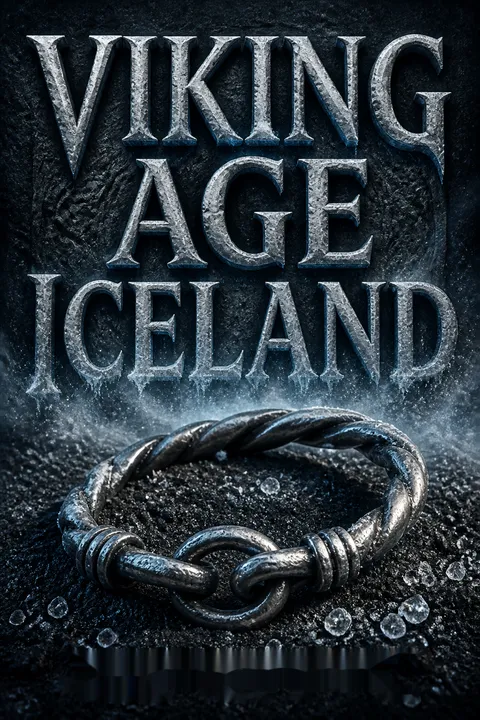


Key Takeaways
Iceland built a state without a king, using law to keep power negotiable
A polity without rulers. Norse settlers reached Iceland from about 870 onward, bringing traditions of law and political organization but leaving behind much of the hierarchy of mainland Scandinavia. Around 930 they established the Althing, a national assembly, and a countrywide legal system. Yet Iceland had no king, standing army, or executive authority able to enforce judgments. Chieftains led followers, but their power depended on consent and alliance, not command.
Order had limits. This was neither an egalitarian democracy nor a conventional state. Wealth and rank varied, slavery existed, and powerful families could exploit weaker farmers. Byock’s central argument is that Iceland’s institutions repeatedly made authority negotiable, slowing the rise of overlords for centuries.
What's striking is that political order here rests on repeated coordination rather than a final authority. This resembles polycentric governance, where several overlapping institutions manage shared problems without one central commander. Such systems can be adaptive because local actors retain choice, but they rely on participants accepting common procedures. The Icelandic case also cautions against equating decentralization with equality: farmers had meaningful political options, yet people without property and women had fewer formal protections.
Make leaders earn allegiance by solving problems, not commanding obedience
Leadership was a relationship. A goði was a political chieftain, and a goðorð was the chieftaincy he held, shared, inherited, bought, or received as a gift. A farmer could become a thingman, a recognized follower, by choosing to join a goði’s assembly group. The bond was not territorial: neighboring farmers could follow different leaders, and a dissatisfied farmer could switch allegiance through a public procedure.
Service brought leverage. Chieftains competed to attract followers by providing legal help, making alliances, hosting feasts, and supporting clients in disputes. A leader who demanded too much risked losing support. But this was not an equal marketplace: a chieftain’s wealth, legal skill, and armed supporters gave him substantial bargaining power over a farmer in trouble.
This arrangement makes allegiance look less like a fixed identity and more like an ongoing exchange. Modern political science uses the idea of credible commitment: supporters need reason to believe a leader will deliver the protection promised. The Icelandic system made departure possible, which could discipline leaders. Still, exit was not equally available to everyone. A poor farmer facing a powerful neighbor could have formal choice but few safe alternatives, a reminder that voluntary institutions can contain real asymmetries.
Put advocates between private grievances and a legal system with no enforcer
Law needed people. Icelandic law set procedures, rights, penalties, and forums for disputes, but no sheriff or state force automatically carried out a verdict. Advocacy was third-party support: an advocate spoke or acted for a client, built alliances, pursued a case, or helped enforce a settlement. Chieftains often took this role, sometimes for payment or property, and sometimes to strengthen their standing.
Skill could become profit. In the saga of Arnkel and Snorri, farmers with valid inheritance claims struggle to act without a chieftain’s backing. Their rights matter, but legal success depends on support and political strength. A powerful advocate could protect a vulnerable client, yet also charge heavily or acquire land through the arrangement. Law created a process, not a guarantee of impartial justice.
The distinction between a right and the capacity to exercise it remains central to legal systems today. Representation can make formal protections usable, but it also creates dependence on intermediaries with their own interests. Iceland’s advocates resemble both lawyers and political brokers, combining technical expertise with coalition-building. The arrangement is effective when a broker wants a stable settlement. It is less reassuring when the same person profits from the client’s vulnerability.
Turn feud into negotiation before pride makes violence self-renewing
Violence had alternatives. Icelanders could seek a court judgment, accept arbitration, negotiate compensation, or resort to violence. These paths often overlapped. In one early twelfth-century feud, two chieftains arrived at the Althing with more than a thousand followers between them. A mediator persuaded one leader to accept a settlement rather than continue demanding vengeance. Large armed gatherings could display commitment, but they also made compromise a public, face-saving option.
Restraint had social value. The book distinguishes acknowledged killings, which could be compensated, from concealed murder, which invited retaliation. Settlements, public opinion, and the risk of paying compensation helped limit escalation. This did not eliminate bloodshed. It made prolonged violence costly and politically dangerous, especially for leaders who needed farmers to keep supporting them.
The system turns reputation into a peacekeeping resource. A mediator can help opponents retreat without appearing simply to surrender, a dynamic familiar in negotiation research and conflict resolution. Compensation also makes harm legible in shared terms, though no payment can restore a life or satisfy every grievance. The Icelandic model worked not because people lacked anger, but because social and economic interdependence made endless retaliation difficult to sustain.
Land was power, so legal protection could become a route to dispossession
Property fed political ambition. In a society dependent on livestock and farming, land meant hay, pasture, fishing rights, wood, and status. Once the settlement frontier closed, leaders seeking wealth often had to gain control of someone else’s property. They could do so through inheritance disputes, paid advocacy, or agreements that transferred land in exchange for protection.
Arnkel’s bargain shows the risk. The chieftain accepted a freedman’s property as payment for guardianship, then backed claims to additional land. The freedman’s former owners believed they had inheritance rights, but they lacked the political support to challenge Arnkel. Their eventual alliance with another chieftain helped bring Arnkel down. The episode shows that law could restrain power, but powerful people could also use legal procedure to make taking property look legitimate.
This is a sharp account of how institutions can both constrain and enable extraction. A contract may record genuine consent, yet the parties may enter it from radically unequal positions. The book’s close attention to land makes political economy concrete: wealth is not an abstract store but control over the resources that keep households alive. The same logic applies broadly, although Iceland’s unusually land-based subsistence economy gave property disputes exceptional force.
Treat ecological limits as political facts, not background scenery
Settlement changed the landscape. Iceland offered pasture, birch woodland, fish, seals, birds, and driftwood, but little arable land and few large building trees. Settlers cleared woodland and grazed livestock heavily. Within generations, forests and grasslands diminished, especially in the fragile highlands. Turf houses, built with thick sod walls and limited timber, were a practical response to the scarcity of wood.
Climate shaped the stakes. A mild period helped settlement, but colder conditions and more frequent drift ice arrived from the mid-twelfth century. Erosion and cooling increased pressure on productive lowlands. Byock links these shifts to competition and political instability, while recognizing that the evidence does not establish climate as a single cause. Human land use mattered too: environmental damage turned already scarce resources into sharper sources of conflict.
The book treats ecology as part of political history, not scenery behind it. Environmental historians often emphasize feedback loops: economic choices alter landscapes, and changed landscapes narrow later choices. Iceland offers a clear example, especially where grazing practices damaged shallow soils. Still, environmental pressure does not dictate one political outcome. Institutions, technology, and local cooperation shape whether scarcity produces adaptation, inequality, or conflict.
When survival depends on one good summer, build local buffers
A bad year could cascade. Iceland’s short growing season made hay harvest uncertain. A cold, wet summer could leave too little fodder for winter, forcing farmers to slaughter animals, search for wild foods, fish, or hunt seals. A second poor season could turn hardship into hunger. These conditions are what the book calls a bad year economy: one in which ordinary prosperity depends on little going wrong.
Hreppar shared risk. These local associations of landowning farmers organized common grazing and labor, provided some fire and livestock insurance, and helped support people in need. They could soften a local shock, but a region-wide crisis overwhelmed their resources. Their importance shows how survival depended not only on individual farms but also on cooperation among neighbors.
The hreppar function like mutual-aid institutions: they pool some risks before disaster arrives. That principle appears in insurance, public health, and disaster planning, where local networks can respond faster than distant authorities. But shared risk is not shared capacity. A system built for isolated household losses may fail when everyone experiences the same shock. The distinction between local resilience and region-wide resilience is as useful now as it was in medieval Iceland.
Use sagas as maps of social rules, not literal records of events
Plausibility is evidence. The family sagas were written centuries after many of the events they describe, and their authors shaped stories for literary and social purposes. Byock does not treat them as transcripts. He reads them alongside law books, archaeology, and historical works to identify recurring expectations about property, marriage, conflict, and leadership.
Stories preserve choices. Mord the Fiddle’s legal strategy for helping his daughter divorce is not verifiable as a factual episode. Yet its details reveal how the audience understood procedure, inheritance, shame, and the danger of pushing an opponent too far. Repeated patterns across sagas can illuminate a culture’s norms, even when individual characters or incidents are invented. The method works best when literary evidence is checked against independent sources.
The approach distinguishes factual accuracy from cultural value. A story can be unreliable about whether an event occurred and still reveal what its audience found believable, troubling, or instructive. This resembles the use of fiction in cultural sociology, where narrative patterns disclose shared assumptions. The caution is important: repeated conventions may reflect storytelling craft as much as everyday behavior. Combining sagas with archaeology and law reduces, but cannot erase, that interpretive risk.
Women could shape feuds while remaining excluded from formal justice
Influence was not equality. Freeborn women could own property, head households, inherit, and initiate divorce. Yet they could not serve as chieftains or members of court panels, and they generally could not prosecute cases themselves. They often had to act through male relatives or advocates, even when the legal claim was their own.
Private influence mattered. The sagas show women urging male kin toward vengeance, as Thorgerd does after her son Kjartan is killed. They also show women restraining conflict. Groa intervenes when a quarrel between two boys threatens to spread through her household. These stories reveal women’s agency in family decisions, but also how often their power had to operate outside the public institutions that decided cases.
The contrast is useful because it prevents two common simplifications: portraying medieval women as powerless, or treating property rights as proof of equality. Agency can operate through informal influence while formal access remains restricted. That distinction matters in many societies, where private authority and public representation are distributed differently. Saga accounts spotlight dramatic interventions, however, so they may tell more about exceptional women and conflict than about routine household decision-making.
Iceland converted by bargaining, then made the Church part of local power
A crisis became a settlement. Around the year 1000, Christian and pagan groups faced the prospect of conflict. The law-speaker Thorgeir, accepted by both sides, mediated a decision to adopt Christianity across the country. Some old practices were temporarily tolerated. The conversion followed a familiar Icelandic pattern: negotiate a shared rule rather than divide the polity into rival systems.
The Church entered existing structures. Chieftains and farmers built churches on their own land and often retained practical control over church property. The tithe, introduced in 1096, created new revenue, but did not immediately make the Church independent. Bishops later challenged lay control, especially over property and marriage. Their struggles show religious change reshaping politics without quickly displacing local power networks.
The conversion illustrates institutional layering: a new faith enters through an existing political framework rather than replacing it outright. This can lower the cost of social change because participants need not abandon every familiar practice at once. The compromise also had boundaries. Temporary tolerance could not settle every doctrinal or property dispute, and lay control left the Church structurally dependent on the very families it sometimes challenged.
Farmers accepted Norway when local big chieftains threatened their old autonomy
Power began to concentrate. In the twelfth and thirteenth centuries, some chieftains accumulated multiple chieftaincies, church properties, and regional influence. These stórgoðar, or big chieftains, faced resistance from stórbœndr, the prosperous big farmers who increasingly acted as local leaders. The result was a more stratified society, but not a fully functioning centralized state.
A distant king seemed safer. During the 1220s to 1260s, conflict among leading families intensified. In 1262 to 1264, Icelanders accepted the Norwegian king’s authority through agreements that promised peace and continued use of Icelandic law. The farmers’ choice helped end the Free State and abolished the chieftaincies, while preserving important local legal traditions. The transition was a political change, not an instant erasure of Icelandic society.
The ending complicates any simple celebration of decentralization. A system that protects local autonomy can become vulnerable when leaders accumulate wealth faster than institutions can check them. Turning to a distant monarch may then seem less threatening than domination by nearby rivals. That choice can preserve some rights while surrendering others. The Icelandic transition is therefore a case of institutional tradeoffs, not a clean victory for either independence or centralized rule.
Analysis
Byock’s most useful contribution is to show how a society can possess sophisticated laws and national institutions without a centralized executive. Iceland’s order was not lawless, but neither was it governed by a state that monopolized enforcement. Power moved through personal alliances, advocacy, assemblies, property claims, and negotiated settlements. The result was a political system that made authority conditional, while leaving room for powerful people to turn legal knowledge and social influence into wealth.
The environmental and political arguments reinforce each other. Farming depended on scarce hay meadows, pasture, and timber, while overgrazing and erosion made good land still more valuable. A dispute over property was therefore not merely a status contest. It could threaten the material basis of a household. Conversely, the need to cooperate in seasonal work and endure periodic shortages helped make prolonged feuding costly. Law and compromise were not detached ideals. They were useful tools in a dispersed farming society where people had to keep living beside one another.
The sagas are central to this interpretation, but they require disciplined reading. Byock treats them as evidence of social expectations rather than transparent reports. That move makes them valuable for studying everyday concerns rarely recorded elsewhere, including marriage, inheritance, and the tactics of small farmers. It also places limits on certainty: narrative patterns can reveal cultural norms without proving that specific incidents occurred or that ordinary life always followed the pattern.
The book’s account is strongest when it resists easy labels. Iceland was neither a democracy nor a primitive society, neither a kingless utopia nor simply a collection of feuding families. Its institutions protected meaningful choices for many free farmers while excluding women from formal political and judicial roles and leaving vulnerable people exposed to coercion. The later concentration of power and the agreement with Norway show that decentralization can endure, but not indefinitely or without cost. Its history is a study of how law can restrain power while also furnishing power with its instruments.
Review Summary
Viking Age Iceland receives mostly positive reviews for its detailed exploration of medieval Icelandic society, law, and culture. Readers appreciate Byock's use of sagas as historical sources and the book's insights into the unique aspects of Iceland's "Free State" period. Some find certain sections dry or overly focused on legal minutiae. The book is praised for its thorough research and interdisciplinary approach, combining environmental science, anthropology, and archaeology. It's recommended for those interested in Viking history, medieval Iceland, and understanding the context of Icelandic sagas.
People Also Read





Glossary
Free State
Iceland’s independent polityByock uses Free State for Iceland’s independent political order from the establishment of the Althing around 930 until submission to the Norwegian king in 1262 to 1264. It had a national legislature and courts, but no king or central executive with routine power to enforce judgments. The term avoids implying either a modern democracy or a conventional monarchy.
goðorð
Chieftaincy held as propertyA goðorð was the political office or following associated with a goði, an Icelandic chieftain. It was not a territorial lordship. A goðorð could be inherited, bought, shared, or transferred, and possessing one did not give a chieftain automatic command over followers. The institution made leadership a source of political opportunity while limiting the authority attached to it.
thingman
A chieftain’s chosen followerA thingman was a farmer or other eligible person publicly affiliated with a goði’s assembly group. The relationship helped organize political participation and could provide access to advocacy and support in disputes. It was not an oath of permanent loyalty. A follower could change chieftains through established procedures, although personal ties and practical constraints influenced how freely that option could be used.
advocacy
Third-party legal supportIn Byock’s account, advocacy is an informal arrangement in which one person supports another in a dispute by speaking, negotiating, litigating, or helping enforce a settlement. It was crucial because Iceland lacked public officials who automatically carried out judgments. Advocates could protect clients, build consensus, and profit through payment, gifts, or property transfers.
vinfengi
Contractual political friendshipVinfengi was a negotiated relationship of friendship that created expectations of reciprocal aid. It could supplement kinship or a formal chieftain-follower bond, and could connect people of different ranks or affiliations. Gifts and feasts helped mark these relationships. If one party failed to provide promised assistance, the arrangement could be ended.
hóf
Restraint in conductHóf means moderation or restraint in dealings with others. In the book, it is a practical political virtue: a leader who avoided excessive demands was more likely to retain followers and allies. Its opposite, ójafnaðr, describes overbearing or unfair behavior. Saga characters who crossed accepted limits could provoke resistance, lose support, or face violence.
hreppar
Local farmer associationsHreppar were geographically defined, self-governing associations of landowning farmers. They organized shared grazing and labor and provided forms of livestock and fire insurance, poor relief, and local assistance. Unlike a chieftain’s following, membership was tied to place. They helped farmers meet practical needs without relying on a political overlord.
Grágás
Free State law collectionsGrágás is the name given to the surviving medieval Icelandic law collections, especially two major manuscripts copied in the thirteenth century. They preserve rules about assemblies, courts, property, injury, marriage, and everyday conduct. They are not a single official code or a complete record of enforcement. Byock reads them alongside sagas and other evidence to understand how law operated.
Landnám tephra
Ash layer dating settlementThe Landnám tephra is a widely distributed volcanic ash layer dated to 871, give or take two years. Archaeologists use it as a marker for the beginning of Iceland’s settlement period. Soil below the layer shows no evidence of human impact, while evidence above it records settlement and environmental change. It provides a way to date sites across different regions.
bad year economies
Subsistence vulnerable to shocksThe book uses bad year economies for subsistence systems that function adequately when conditions are favorable but are highly exposed to setbacks. In Iceland, a cold or wet summer could ruin the hay crop, leaving too little fodder for winter livestock. Local cooperation and emergency foods helped, but repeated poor seasons could overwhelm these buffers and cause hunger.
stórgoðar
Big regional chieftainsStórgoðar, literally big chieftains, were powerful leaders who emerged as authority concentrated during the later Free State. Some controlled several chieftaincies, church properties, and wider regional followings. They sought forms of overlordship that earlier Icelandic institutions had restrained. Their rise met resistance from large farmers and contributed to the political crisis preceding Norwegian rule.
stórbœndr
Prosperous big farmersStórbœndr were wealthy or influential farmers who became important local leaders as the older chieftain system changed. They offered services and helped organize support among ordinary farmers, sometimes filling roles once associated with goðar. Their interests did not always match those of regional big chieftains, and their resistance helped preserve some farmer autonomy during the final decades of the Free State.
FAQ
What's Viking Age Iceland about?
- Medieval Society Focus: The book explores Iceland's social, political, and economic structures during the Viking Age, from the tenth to the thirteenth century.
- Cultural and Environmental Interplay: It examines how the harsh Icelandic environment and Norse cultural practices shaped Icelandic law, governance, and social norms.
- Sagas as Sources: Byock uses Icelandic sagas as ethnographic documents to provide insights into medieval Icelanders' lives, serving as both historical narratives and reflections of societal values.
Why should I read Viking Age Iceland?
- Comprehensive Historical Insight: The book offers a detailed examination of Iceland's unique development, providing context for understanding the broader Viking Age.
- Engaging Narrative Style: Byock's accessible writing makes complex historical and anthropological concepts understandable, with saga narratives adding depth.
- Valuable for Scholars and Enthusiasts: It provides valuable insights and a fresh perspective on the Viking Age for both scholars and casual readers interested in Viking history.
What are the key takeaways of Viking Age Iceland?
- Decentralized Governance: Iceland developed a unique governance form with decentralized power and no formal hierarchies, relying on consensus and advocacy.
- Role of Law and Feud: Legal processes and feuds were integral to conflict resolution, with sagas depicting how individuals navigated these systems.
- Environmental Adaptation: Settlers adapted to Iceland's challenging environment, influencing their social structures and subsistence strategies.
What are the best quotes from Viking Age Iceland and what do they mean?
- "Iceland became a headless polity.": Highlights the decentralized nature of Icelandic governance, with power distributed among local chieftains.
- "Law in medieval Iceland touched virtually all aspects of social intercourse.": Indicates the pervasive influence of law in everyday life, governing social interactions and relationships.
- "The sagas are one of the world’s great literatures.": Emphasizes the literary significance of the sagas as historical documents and artistic expressions.
How does Jesse L. Byock define the term "Viking" in Viking Age Iceland?
- Cultural Context: "Viking" refers to individuals engaged in seafaring raids and exploration, not an ethnic identity.
- Activity-Based Identity: The term was more about actions than a cohesive cultural group, focusing on maritime activities like trade and warfare.
- Historical Usage: "Víkingr" described raiders and freebooters in medieval texts, emphasizing the maritime aspect of their identity.
What is the significance of the Althing in Viking Age Iceland?
- Foundation of Governance: Established around 930, the Althing was Iceland's national assembly, crucial for developing a legal and political framework.
- Symbol of Unity: It represented a unifying institution, fostering community and shared governance, and mediating conflicts.
- Legal Precedent: The Althing served as both a legislative body and a court, maintaining order and providing conflict resolution mechanisms.
How does Viking Age Iceland address the concept of social stratification?
- Fluid Social Structure: Early Icelandic society had limited stratification, allowing individuals to rise in status based on merit.
- Role of Wealth and Land: While distinctions in wealth existed, the absence of a formal aristocracy allowed for social mobility.
- Checks on Power: Free farmers' rights acted as a check on chieftains' ambitions, preventing a rigid class system.
What subsistence strategies are discussed in Viking Age Iceland?
- Pastoralism and Agriculture: Early Icelanders relied on livestock farming, particularly sheep and cattle, due to the harsh climate.
- Hunting and Gathering: They supplemented their diets with hunting seals, fishing, and gathering wild foods.
- Resource Management: Settlers managed resources carefully to avoid overgrazing and environmental degradation, emphasizing sustainable practices.
How does Viking Age Iceland portray the role of women in society?
- Active Participants: Women played significant roles in domestic and public spheres, managing households and participating in legal matters.
- Concubinage and Status: Concubinage allowed women to gain influence and secure resources, elevating their status.
- Legal Rights: Women had legal rights in marriage and inheritance, though their status varied based on relationships and family roles.
How does Jesse L. Byock analyze the sagas in Viking Age Iceland?
- Ethnographic Approach: Byock interprets sagas as reflections of Icelandic society, using them to understand social norms and values.
- Comparative Analysis: He compares sagas with historical and archaeological sources, integrating insights from anthropology and history.
- Focus on Legal and Social Dynamics: By examining saga episodes, Byock highlights the legal and social dynamics in Icelandic society.
What is the significance of the Grágás law code in Viking Age Iceland?
- Foundation of Legal System: Grágás was Iceland's first comprehensive legal code, establishing governance rules without centralized authority.
- Customary Law: It reflects Icelandic society's customs and values, emphasizing negotiation and community involvement.
- Historical Legacy: Grágás influenced later legal developments and is a critical source for understanding medieval Icelandic culture.
How did the Church influence Icelandic society according to Viking Age Iceland?
- Integration of Christianity: The Church adapted to local customs, facilitating Christianity's acceptance among Icelanders.
- Legal Authority: Bishops held significant power in legal matters, negotiating authority with secular leaders.
- Cultural Impact: The Church contributed to education and literacy, preserving sagas and legal texts crucial for understanding the period.
Download PDF
Download EPUB
.epub digital book format is ideal for reading ebooks on phones, tablets, and e-readers.








