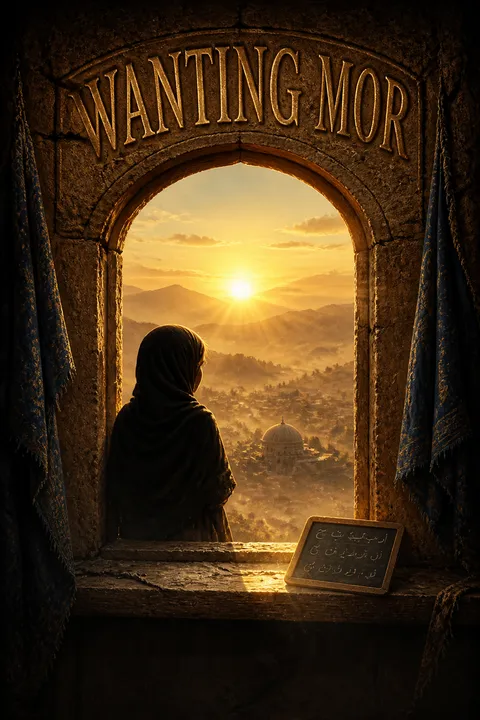


Plot Summary
Tea for the Dead
After days of coughing, Jameela finds her mother, whom she calls Mor, dead in their village home. The girl had swept, scrubbed pots, and made Mor's favorite tea, expecting a fond look when she woke. Instead, she helps the women wash and wrap her mother's body, then watches the funeral party carry her away.
Her father, Baba, grieves too, but he has little food to offer and no comforting words. That evening he makes tea badly, gives Jameela the last bread, and sleeps in the house rather than leaving for his usual company. She remembers Mor's lesson that hardship tests a person like fire tests clay, and tries to endure the first night without her.
Mor's death turns ordinary domestic work into an intimate measure of love: Jameela's chores are not merely obligations but an attempt to earn the affection she expects to receive. The reversal is devastating because she completes them before discovering that there will be no response. The funeral's practical rituals give the child tasks when grief has made thought impossible, while Baba's clumsy kindness hints at a bond that might still be repaired. Mor's clay metaphor offers Jameela a way to imagine survival, but it also places the burden of endurance on a child who has little control over her circumstances.
Sold Home, Kabul Bound
The night after the burial, Jameela sees Baba smoking opium, a habit he had promised Mor to stop. Soon he declares their village unlucky and decides they will move to Kabul, where he expects construction work.
He sells their household goods, including Mor's clothes and the bedding Jameela had hoped to keep, then hurries her away before she can properly visit her mother's grave. A truck carries them through bomb-scarred roads and mined fields into Kabul's crowded, polluted streets.
Baba leaves Jameela waiting before the home of an employer, then presents her as help for the household. The employer's wife puts her to work scrubbing burnt pots. Jameela sees a silent girl watching from the doorway and hopes the new arrangement might eventually give them a home of their own.
The move is presented as Baba's attempt to escape poverty, but Jameela experiences it as the loss of nearly every object that connected her to Mor. The city promises opportunity in the abstract while immediately assigning the child a servant's labor. The contrast between the dangerous countryside and Kabul's congestion prevents either place from becoming a simple refuge. Jameela's hope that employment will lead to a family home shows how she makes optimism out of whatever adults leave within reach. Her father's addiction and impulsive decisions quietly undermine that hope before she has the language to name the danger.
One Night Too Far
Jameela learns to use the city stove and watches the employer's daughter, Farzana, struggle through lessons she longs to have herself. At a dinner party, the household dresses for a celebration while Jameela serves guests who drink, dance, and mock her village clothing. Baba arrives drunk and joins the revelry, exposing a side of him Jameela had only heard about from Mor.
She stays awake until dawn, then hears shouting upstairs. The employer throws Baba and Jameela out, and they are pushed into the street with only her blue porani. Baba insists he has another plan and leads her to a ruined house, where a widow greets him as an old friend. Jameela realizes he intends to marry her, even though she has not been asked what she wants.
The party forces Jameela to see her father through the eyes Mor had tried to shield her from. His drunkenness is not a private failing anymore; it changes her safety and standing in another household. The scene also sharpens her sense of dignity: she accepts hard work, but the guests' behavior and her father's participation make the home feel morally unsafe. Baba's immediate transition from expulsion to marriage reveals how quickly he treats major changes as solutions to his own discomfort. Jameela's silence is not consent. It is the constrained response of a child whose survival depends on adults who rarely explain their plans.
Marriage in the Ruins
The widow lives in a partly ruined house with her adult son, Masood, who lost part of a leg to a landmine. Baba marries her in a small nikah, spending the remaining money from their possessions as the marriage gift. Jameela cooks the feast and watches her new relatives take the choicest meat while leaving her rice and almonds.
After the guests leave, Baba orders her to clean instead of letting her rest. Masood tells her she need not cover in front of him, but she keeps her porani on and distrusts his stare. The next morning, though, he insists on making his own tea despite the difficulty of his crutches. They exchange stories of family losses and war, and their shared grief begins to soften Jameela's suspicion.
The marriage supplies a roof, but not the feeling of belonging Jameela associates with family. Food becomes a small, visible test of who is valued, and the new relatives' choices teach her to watch gestures more closely than assurances. Masood complicates her first judgment of him: his physical vulnerability does not make him automatically gentle, yet his determination to manage for himself earns her respect. Their exchange about war creates a rare relationship founded on mutual disclosure rather than obligation. Jameela is learning that compassion does not require abandoning caution, a distinction that will matter as she navigates households where kindness and control are often mixed.
Letters Rubbed Away
Jameela carries bricks, cooks, and tries to satisfy her stepmother, who criticizes her work and resents the time Masood spends with her. When the pair begin tracing letters in the courtyard dirt, Masood writes Jameela's name for her.
Her stepmother interrupts, orders her back to sweeping, and scuffs the letters away. Baba later tells Jameela to gather her things and leads her through the market, speaking incoherently about a chance at happiness. At a crowded intersection he makes her wait, then disappears into the flow of people.
Jameela stays there for hours, hungry and thirsty, watching for him. The butcher, Akram, gives her soup and water, lets her pray outside his shop, and finally takes her to meet his family when darkness makes it unsafe to remain alone.
The erased name condenses Jameela's central struggle: she is trying to become legible to herself through literacy, while her stepmother sees education as a threat to her usefulness. Baba's disappearance turns the marketplace into more than a setting; it makes public space the site of a private betrayal. Jameela's long wait reveals how stubbornly she protects the possibility that her father will return, even as evidence accumulates against it. Akram's kindness is important partly because it respects her boundaries. He offers water outside rather than insisting she enter a private space, showing that safety can be built through attention to another person's stated limits.
The Butcher's Bowl
At Akram's home, Jameela meets his wife Fatima and their children, including Tahira, who shares her room. Their ordinary family prayers and breakfast make the small apartment feel warmer than the larger houses where Jameela has worked.
Akram takes her back to his shop the next morning, asks other vendors to watch for Baba, and entrusts her with money from a mechanic who wants to help. Jameela overhears Akram arguing that she should stay with them, while Fatima worries they cannot afford another child and the schooling she deserves.
Fatima's decision is no. Akram takes Jameela to an orphanage, gives her more money, and apologizes for being unable to keep her. Jameela enters the institution feeling that the one family that welcomed her has also let her go.
Akram's household introduces care without possession. Jameela is fed, included in prayer, and given money she is trusted to protect, yet the adults also acknowledge their limits instead of disguising them as affection. Fatima's refusal hurts precisely because it is not presented as cruelty; poverty and responsibility shape the decision. This distinction keeps Jameela's experience emotionally complex rather than dividing adults into rescuers and villains. The orphanage becomes a necessary institution, but arrival there carries the wound of another separation. Jameela's hunger for a permanent family remains, even as the book begins to offer her other forms of belonging.
School Behind the Veil
At the orphanage, Jameela meets Soraya, an older girl who commands respect, and Zeba, who mocks her name and appearance. She is placed in a beginners' class with Arwa, a neglected younger girl she initially avoids.
Learning the alphabet exhilarates Jameela, and teacher Khalaa Kareema helps her read religious histories and write her name. The orphanage manager, Khalaa Gul, regularly brings foreign visitors to inspect the children and describe their needs. An army surgeon examines Jameela's cleft lip and offers to repair it.
Soraya and Zeba warn that the operation may be dangerous and distrust the soldiers, but Jameela decides to accept, believing the surgeon can help her. The choice strains her friendship with Soraya, who sees the decision as a risk Jameela does not understand.
Education gives Jameela a kind of agency that domestic service denied her: she can learn her name, read accounts of the Prophet, and imagine a future shaped by thought rather than chores. Yet the orphanage's dependence on donors turns children into evidence of need, and Khalaa Gul's practice of displaying them exposes the ethical tension between resources and dignity. The proposed surgery intensifies that tension by making Jameela's body part of a charitable encounter. Her choice is not simple vanity. It combines a wish to alter how others see her with a young person's desire to claim control over one decision. Soraya's warning arises from experience, not mere opposition.
Beauty's Uneasy Price
Jameela has surgery at the soldiers' medical camp and returns to the orphanage with her lip bandaged. Once it heals, the joined scar lets her see a face she had never known, and the other girls gather to ask about the operation. Attention pleases her, but it also feeds her vanity. She leaves Arwa's class for the older girls, begins distancing herself from the child, and turns away when Arwa seeks comfort.
A dream in which Mor refuses to look at her leaves Jameela awake in tears. At dawn she prays beside Soraya, who has also resisted the girls' cruelty toward another resident. Their shared place in the prayer line restores a quiet closeness, though Jameela has not yet fully faced the harm she has done Arwa.
The repaired lip changes Jameela's appearance, but the more consequential change is how she begins to measure herself through attention. Her new confidence borrows the same hierarchy that once made her vulnerable: beauty becomes a hoped-for guarantee of acceptance. The dream of Mor refusing to see her gives this insecurity moral shape, connecting self-display to fear of losing the person whose approval mattered most. Soraya's example offers an alternative model. She uses her social authority to protect a humiliated girl rather than to secure status. Jameela's renewed closeness with Soraya is not a completed transformation, but it places her beside a practice of compassion she can choose to imitate.
Back Through the Alleys
Months later, Jameela and Soraya visit Akram's shop on an orphanage errand. Akram recognizes Jameela only after she identifies herself, then invites both girls home for dinner. On the return walk, he takes a wrong turn, and Jameela recognizes the alley leading to her stepmother's house. Masood opens the door, now walking with an artificial leg, while Jameela stays concealed beneath her chadri.
Her stepmother mistakes Akram and the girls for people seeking a rental, and Jameela glimpses Baba inside without speaking to him. Soon afterward, the stepmother visits the orphanage to ask for Soraya as a bride for Masood. Soraya accepts the courtship, hopeful about a home of her own, while Jameela quietly helps prepare her wedding clothes.
The alleyways make Jameela's past physically close but emotionally inaccessible. She can recognize the house, the people, and the improvements to Masood's mobility, yet her veil lets her remain unseen. That asymmetry gives her a moment of control over a family history in which adults made decisions around her. Soraya's courtship brings the two women's paths together: Jameela's former household may become Soraya's future, so affection and apprehension coexist. Helping with the wedding clothes is an act of friendship, but every stitch recalls the home Jameela lost. Her generosity does not erase longing; it gives longing a task that does not require her to surrender her own judgment.
Lost in a Minefield
Before the wedding, Jameela bathes Arwa, teaches her to clean herself, and braids her hair, finding in the small act an echo of Mor's care. At the ceremony, Jameela stands covered while Baba attends as a witness. When the guests ask after his daughter, he says she was lost in a minefield, though she is only a few steps away.
He then welcomes Soraya as if she were his own child. Soraya understands the cruelty and loses the joy she had brought into the ceremony. Jameela cannot reveal herself without exposing Soraya's new marriage to a family secret, so she keeps silent beneath her chadri. As Soraya leaves with Masood, she reassures Jameela that their friendship is not finished.
The wedding places Jameela inside a ritual of family recognition while making her absence part of the public story. Baba's lie is not merely a denial of her location; it converts a living daughter into a socially convenient loss. His tenderness toward Soraya makes the erasure sharper, because Jameela watches him perform the fatherly role she needed from him. Her silence protects Soraya from a sudden public rupture, but it also repeats the self-suppression expected of her. The bathing of Arwa offers a counter-image: Jameela can transmit Mor's care without possessing a household or claiming authority over the child. Care becomes something she chooses to give, not a price demanded for shelter.
The Girl Returns
Six days after Soraya's wedding, Zeba takes Jameela to visit her, using an errand from Khalaa Gul as cover. They arrive while Soraya is confronting her mother-in-law over the way she has treated Jameela in the past.
When Zeba announces Jameela's presence, neighbors gather and Baba rushes out, demanding to know where she has been. He recognizes her repaired lip and calls her his daughter, but does not invite her to live with him. Zeba's questions expose the awkward silence.
Jameela says she cannot leave the orphanage, where the children and Khalaa Kareema need her, and asks to visit instead. The explanation protects her from begging to be chosen again. She leaves the courtyard with Soraya and returns to the orphanage, which now feels more like home.
Jameela's return reverses the wedding's concealment: the neighbors see her alive, and the family can no longer control the story by pretending she vanished. Yet recognition is not the same as repair. Baba's surprise and public affection do not undo the choice that left her in the market. When he fails to offer a place in the household, Jameela speaks of the orphanage's needs rather than asking for one. The answer is both self-protection and a genuine account of where she has built relationships. She is no longer waiting for a father's decision to determine whether she belongs somewhere.
Home Chosen, Not Given
The next day, Baba arrives at the orphanage looking disheveled and says he has left his wife. He promises to find Jameela a new home, use her literacy to earn money, and arrange a prosperous future. His shaking hands and hidden drink reveal that the old instability has not disappeared. Jameela listens, then tells him she will not go with him.
She wishes him well but refuses to make herself responsible for his life. Khalaa Gul welcomes her decision, and Jameela returns to her class. When Arwa runs up, clean and eager for her, Jameela embraces her instead of recoiling. She gives the child Mor's advice about goodness and beauty, passing on the tenderness that once sustained her.
Jameela's final refusal is not a rejection of family as an ideal; it is a refusal to confuse kinship with dependable care. Baba's promises still appeal to the child who once waited for him, but she can now compare those promises with the life she has actually built. Her decision transfers the burden of responsibility back to the adult who should carry it. The embrace with Arwa completes a quieter arc: Jameela recognizes the vulnerable child she once judged as dirty and inconvenient, then offers the attention she had needed herself. Mor's teaching survives not as a demand for self-erasure, but as an ethic Jameela can give freely.
Analysis
Wanting Mor follows a girl through a sequence of homes that promise safety but make belonging conditional. In the village, Jameela's work is tied to her mother's affection. After Mor dies, the same labor becomes a means of survival under adults who may sell possessions, demand service, or abandon her. The novel therefore treats domestic work as more than background realism. It is the measure by which Jameela is repeatedly valued, and her education becomes a challenge to that narrow role.
The story's account of war is deliberately close to the body. Mines prevent families from recovering a dead goat, roads carry the marks of successive armies, and a landmine injury shapes Masood's daily life. These details keep national conflict from becoming an abstract backdrop. Yet the novel also refuses to make every hardship a direct battlefield event: grief, addiction, poverty, and gendered vulnerability continue inside homes and institutions long after violence has moved elsewhere.
Jameela's faith gives her a method of reflection, not a guarantee of rescue. Prayer helps her endure, while remembered teachings help her assess anger and kindness. Her growth is measured by how she treats Arwa, not by whether she becomes beautiful, obedient, or admired. The lip operation briefly makes appearance feel like a solution, then exposes the instability of self-worth built on other people's attention.
The ending offers a hard-won distinction between being claimed and being cared for. Jameela does not stop loving her father, but she refuses to let his latest promise overrule the evidence of his choices. She chooses the people and work that have become dependable, then gives Arwa the tenderness she once needed. The novel's final inheritance is not a secure household or a healed face alone. It is Jameela's ability to turn received care into care freely given.
Review Summary
Wanting Mor is a moving story of Jameela, a young Afghan girl navigating life after her mother's death. Readers appreciate the authentic portrayal of Afghan culture and the protagonist's resilience. The book tackles complex themes like war, poverty, and religion, offering insight into life in post-Taliban Afghanistan. While some found the pacing and character development lacking, many praised the author's sensitive handling of difficult subjects. The novel is recommended for middle-grade readers, though some suggest parental guidance due to its mature themes.
People Also Read








Characters
Jameela
resilient village girlJameela is a village child whose cleft lip, poverty, and limited choices make her sharply aware of how others judge her. She is observant, careful with religious practice, and eager to learn, though grief and insecurity can make her defensive or unkind. Mor's lessons give her an inner vocabulary for patience and goodness, while daily encounters teach her to distinguish genuine help from control. Jameela wants the security of family, but she also longs for literacy, dignity, and some say over her own life. Her defining strength is not that she never falters; it is that she notices the consequences of her choices and can change how she treats someone more vulnerable.
Mor
patient moral compassJameela's mother is loving, modest, and rich in stories. She teaches her daughter practical skills, religious habits, and the importance of patience during hardship. Mor's hopes for Jameela's education reveal a belief that a girl deserves more than work and obedience, even in a village with few opportunities. Her advice remains present in Jameela's mind as a standard for how to endure pain without passing it on to others.
Baba
charming, unstable fatherJameela's father can be warm and generous in flashes, but grief, opium, and alcohol make him unreliable. He seeks work and a more secure life, yet often acts on impulse and expects Jameela to adapt to the consequences. His charm helps him move among adults, while his dependence weakens his ability to protect his daughter. Jameela's attachment to him persists because she remembers his moments of tenderness, making it difficult for her to judge his promises clearly.
Masood
wry, watchful stepsonMasood is the son of Jameela's stepmother and lives with a landmine injury that cost him part of a leg. He is proud of managing daily tasks without unnecessary help, and his dry humor can make him seem harsher than he is. He is alert to tensions in his household and capable of recognizing Jameela's need to learn. His relationship with her begins in suspicion and develops through shared conversation about loss, disability, and the war that shaped both their families.
Soraya
orphanage's guarded leaderSoraya is an older orphanage resident whose confidence and knowledge of its unwritten rules give her authority among the girls. She is guarded around outsiders and distrustful of help that might carry a hidden cost, but she can act decisively to protect someone being humiliated. Her friendship with Jameela moves through friction, loyalty, and blunt advice. Soraya's strong opinions are grounded in experience, and beneath her self-possession lies a desire for safety and a life beyond institutional routines.
Arwa
neglected little shadowArwa is a small, neglected girl who follows older residents in search of affection. Her poor hygiene and awkwardness repel Jameela at first, but Arwa is also trusting, persistent, and eager to help. She has learned to accept rejection without giving up on connection. Her vulnerability makes her a quiet test of whether Jameela will repeat the indifference she has experienced or offer the care she once received from Mor.
Jameela's stepmother
ambitious household keeperMasood's mother is a widow who values security, household order, and the status that money can provide. She can be sociable and attentive when it serves her purposes, but she is exacting with Jameela and suspicious of influences that distract the girl from work. Her manner reflects the pressure of maintaining a home after loss, though she often turns that pressure outward rather than offering warmth. She is not simply strict; she measures people by how useful or threatening they seem to the household she is trying to control.
Akram
kind marketplace rescuerAkram is a butcher who notices a hungry child waiting alone outside the market. He offers food, respects Jameela's caution, and brings her to his family rather than leaving her exposed overnight. His generosity is practical rather than grand, and he understands that helping someone does not guarantee he can solve every problem. He becomes an important example of adult care that combines warmth with honesty about limits.
Fatima
cautious family anchorFatima is Akram's wife and the mother of his children. She welcomes Jameela into the home but weighs that compassion against the family's limited resources and existing responsibilities. Her caution is not a lack of feeling; it reflects the difficult arithmetic of a poor household. Fatima represents a form of care that can be sincere even when it cannot become permanent guardianship.
Khalaa Gul
pragmatic orphanage matronKhalaa Gul manages the orphanage and is focused on keeping its doors open in a world of scarce resources. She seeks support from visiting foreigners and can treat the girls as part of that appeal, sometimes overlooking their discomfort. Her decisions are shaped by institutional survival, not only personal temperament. She is capable of affection and practical accommodation, but she also expects obedience and protects the orphanage's authority.
Khalaa Kareema
teacher who opens doorsKhalaa Kareema teaches the younger girls and recognizes Jameela's hunger for learning. She makes books available, explains difficult ideas, and treats the child as a student rather than a worker or object of pity. Her respect for factual religious history echoes Mor's standards and gives Jameela a model of mentorship grounded in curiosity. She also depends on the girls' help, so their relationship grows through both teaching and shared work.
Zeba
sharp-tongued senior girlZeba is a confident older girl who can be competitive, mocking, and quick to bend rules for her own benefit. She is socially alert and understands how to navigate the orphanage and Kabul's streets. Her loyalty to Soraya draws her into Jameela's life in unexpected ways. Zeba's behavior is inconsistent but not simple: beneath her teasing she can act decisively when a friend needs help.
Tahira
Akram's school-age daughterTahira is Akram and Fatima's daughter. She shares a room with Jameela and gives her a glimpse of a child who can sleep without fear and attend school. Her ordinary routines make the warmth of Akram's household tangible.
Khalaa Gaur
kind village neighborKhalaa Gaur is a neighbor who helps Jameela prepare for Mor's burial and brings food when the household is short of it. Her support is immediate and practical, shaped by the same poverty and exhaustion affecting the village.
Nooriya
kind village washerNooriya is one of the village girls who offers to wash Jameela's laundry after Mor dies. Her kindness gives Jameela a brief moment of relief, though Jameela eventually returns to the work herself.
Khalaa Rasheeda
orphanage science teacherKhalaa Rasheeda teaches an older class at the orphanage. She tries to keep the girls focused despite cramped conditions and their habit of turning lessons into jokes. Her classroom shows Jameela that learning can continue beyond the beginner level.
Plot Devices
The blue porani
portable shelter and identityJameela's blue porani is both practical clothing and an object charged with memory. Mor gave it to her, so wearing it helps Jameela carry her mother into unfamiliar houses and streets. It also lets her choose how much of herself other people can see, especially when adults treat her face as something to inspect or display. The cloth changes meaning as it frays, is used to mark Mor's grave, and eventually becomes part of Jameela's growing understanding of modesty and self-respect. It is not a simple symbol of concealment: it gives her a small measure of control over visibility.
Letters and Jameela's name
a path into agencyThe alphabet first reaches Jameela through glimpses of Farzana's lessons, then through Masood's attempt to write her name in the courtyard dirt. Her stepmother erases those letters, but the desire to read survives. At the orphanage, Khalaa Kareema turns that desire into lessons, books, and a new ability to study religious history. Literacy gives Jameela more than a future skill: it lets her encounter ideas directly and imagine a role beyond domestic work. Learning her own name is especially meaningful because other people repeatedly try to define her by appearance, labor, or family status.
Prayer and remembered teaching
a practice of self-commandPrayer gives Jameela recurring moments of structure when grief, hunger, and fear make daily life feel unstable. Mor's stories and religious guidance shape how Jameela interprets patience, anger, and responsibility. These practices do not erase material hardship or guarantee that adults will act justly. Instead, they offer her a way to pause before reacting and a language for asking what kind of person she wants to become. The book also shows variation in how the girls practice their faith, making prayer a lived discipline within the orphanage rather than a decorative marker of setting.
The lip operation
appearance tests self-worthJameela's cleft lip has affected how she expects others to look at her. When an army surgeon offers an operation, the choice gathers several pressures at once: hope for a different face, suspicion of foreign soldiers, and the desire to control a decision about her own body. The operation succeeds, but the result does not automatically give Jameela confidence or belonging. Instead, new attention tempts her to rank herself against other girls and distance herself from Arwa. The repaired lip therefore complicates the idea that changing an outward feature can resolve an inward wound.
The orphanage
refuge with its own costsThe orphanage becomes a place where Jameela can receive schooling, build friendships, and take on responsibilities beyond housework. It is not an uncomplicated sanctuary. The institution lacks resources, depends on donors, and sometimes displays the girls' hardship to attract support. Its crowded social life also recreates hierarchies around age, beauty, and popularity. These contradictions make the orphanage a believable alternative to unstable households rather than a perfect replacement for family. Over time, Jameela's attachment to its teachers and children becomes part of her own definition of home.
FAQ
Synopsis & Basic Details
What is Wanting Mor about?
- Journey of a young orphan: Wanting Mor follows Jameela, a young Afghan girl whose life is upended by the death of her mother and subsequent abandonment by her father in the bustling city of Kabul.
- Search for belonging and identity: The story chronicles Jameela's struggle for survival, her experiences navigating the complexities of a post-war society, and her search for a place to call home and a sense of self.
- Finding strength in unexpected places: Jameela finds refuge and opportunity in an orphanage, where she builds new relationships, discovers the power of education, and ultimately confronts the past that shaped her.
Why should I read Wanting Mor?
- Deeply moving portrayal of resilience: The novel offers a raw and intimate look at the impact of war on civilians, particularly children, and showcases the incredible strength of the human spirit in overcoming unimaginable hardship.
- Rich cultural insights: Through Jameela's eyes, readers gain a nuanced understanding of Afghan culture, traditions, and the challenges faced by its people amidst conflict and changing social dynamics.
- Empowering story of self-discovery: Jameela's journey from vulnerability to empowerment, driven by her pursuit of education and her capacity for compassion, provides an inspiring narrative about finding one's voice and purpose.
What is the background of Wanting Mor?
- Set in post-2001 Afghanistan: The story takes place shortly after the American invasion, depicting a society grappling with the aftermath of years of conflict, including landmines, poverty, and shifting social norms.
- Inspired by a true story: Author Rukhsana Khan based Jameela's experience of abandonment on a single paragraph in a report about Afghan orphanages, highlighting the real-life struggles of children in crisis.
- Explores cultural and religious context: The narrative is deeply embedded in Islamic faith and Afghan customs, showing how characters navigate their lives, grief, and moral choices within this framework, using phrases like "Inna lillahi wa inna ilaihi rajioon" and referencing prayer times and Islamic teachings.
What are the most memorable quotes in Wanting Mor?
- "If you can't be beautiful you should at least be good. People will appreciate that.": This quote, attributed to Jameela's mother, serves as a guiding principle for Jameela throughout her trials, emphasizing inner virtue over outward appearance or circumstance, a key theme in Wanting Mor.
- "Don't become angry. Don't become angry. Don't become angry.": Jameela repeats this advice from her mother, referencing a Hadith, as a mantra to control her intense emotions in the face of betrayal and injustice, revealing her internal struggle and connection to faith.
- "God is enough for me and He is the best disposer of affairs." (Hasbiyallahu wa ni'mal wakeel): This powerful Arabic phrase, used by Jameela and referenced in the context of prophets and believers facing hardship, encapsulates the theme of faith and reliance on Allah in the face of overwhelming challenges and uncertainty.
What writing style, narrative choices, and literary techniques does Rukhsana Khan use?
- First-person, child's perspective: The story is told entirely from Jameela's point of view, using simple, direct language that reflects her age and limited understanding of the adult world, creating immediate empathy and highlighting her vulnerability.
- Sensory details and internal monologue: Khan employs vivid sensory descriptions (smells of opium, dust, food; sounds of wailing, traffic, prayer calls) and Jameela's internal thoughts to immerse the reader in her experience and emotional state, revealing her psychological complexities.
- Symbolism and recurring motifs: The narrative subtly uses recurring symbols like the porani (modesty, identity, connection to mother), food (scarcity, generosity, power), and the scar (physical imperfection, emotional wound, healing) to add layers of meaning and track Jameela's development and the themes in Wanting Mor.
Hidden Details & Subtle Connections
What are some minor details that add significant meaning?
- The butcher's fly strip: The description of the fly strip in Agha Akram's shop, with flies hopelessly stuck and struggling, subtly mirrors Jameela's own feeling of being trapped and unable to escape her circumstances, highlighting the theme of helplessness before finding refuge.
- The cat in the courtyard: The appearance of the battle-scarred black cat in the stepmother's courtyard, a "battle-scarred warrior," parallels Jameela's own journey of survival and resilience in a harsh environment, suggesting a shared struggle for existence.
- The erased letters in the dirt: The stepmother deliberately rubbing out the letters Masood taught Jameela in the courtyard dirt symbolizes her attempt to erase Jameela's identity, potential for education, and connection to Masood, underscoring the stepmother's cruelty and Jameela's thirst for knowledge.
What are some subtle foreshadowing and callbacks?
- Mor's pottery analogy: Mor's story about the strength of clay pots coming from the firing process foreshadows Jameela's own trials as her "firing," suggesting that hardship is necessary to strengthen her character and prevent her from "cracking."
- Jameela's ripped porani: Jameela tearing a piece of her porani to mark Mor's grave is a poignant callback to their last moments and symbolizes her carrying a piece of her mother with her, while also foreshadowing her later use of a ripped piece to mark her path back to Agha Akram's shop.
- The stepmother's Farsi/Pushto mix: The stepmother's habit of mixing Farsi and Pushto words while speaking Farsi, noted by Jameela, subtly foreshadows her later attempts to deceive or manipulate, as her language reflects a lack of fluency and authenticity in her interactions.
What are some unexpected character connections?
- Jameela's connection to Arwa: Jameela initially finds Arwa annoying and dirty, mirroring the potential judgment she fears from others due to her lip, but their bond deepens as Jameela sees her own past vulnerability in Arwa, creating an unexpected parallel character arc focused on nurturing and breaking cycles of neglect.
- Masood's shared trauma: Masood's revelation that his leg was lost to a landmine and his father died in prison connects him to Jameela through shared experiences of loss and the lingering impact of war, creating a subtle bond of understanding beneath the surface of their awkward initial interactions.
- Khalaa Kareema's reminder of Mor: Jameela notes that Khalaa Kareema reminds her of Mor, not just in kindness but also in her practical, fact-based approach to faith, creating a subtle connection that makes Khalaa Kareema a maternal figure and reinforces the theme of finding family outside biological ties.
Who are the most significant supporting characters?
- Agha Akram: The kind butcher who finds Jameela after her abandonment is a pivotal figure, representing unexpected human kindness and providing the crucial link that leads her to the orphanage, highlighting the theme of compassion in a harsh world.
- Khalaa Kareema: As Jameela's teacher, she is instrumental in Jameela's intellectual and emotional growth, fostering her love for learning and becoming a trusted mentor and maternal figure who offers stability and belief in Jameela's potential.
- Soraya: Jameela's closest friend at the orphanage, Soraya represents resilience, independence, and the complexities of navigating difficult choices; her relationship with Jameela evolves from peer support to a deeper bond tested by marriage and differing perspectives.
Psychological, Emotional, & Relational Analysis
What are some unspoken motivations of the characters?
- Baba's desire for escape: Beyond providing for Jameela, Baba's motivation to move to Kabul and later remarry seems driven by a desperate need to escape the grief and poverty of the village, and later, the consequences of his addiction, rather than a clear plan for Jameela's well-being.
- Stepmother's insecurity and social climbing: The stepmother's cruelty towards Jameela and her focus on appearances (fancy house, dinner party, tight clothes) suggest an unspoken motivation rooted in insecurity and a desire for social status, viewing Jameela as a threat or burden to her aspirations.
- Khalaa Gul's pragmatic survival instinct: Khalaa Gul's actions, like parading the girls for foreign donors or sending Jameela on errands, are motivated by the unspoken need to ensure the orphanage's survival and secure resources in a challenging environment, even if it compromises the girls' dignity at times.
What psychological complexities do the characters exhibit?
- Jameela's internal conflict with anger: Jameela constantly battles the urge to feel and express anger, particularly towards her father and stepmother, internalizing Mor's advice ("Don't become angry") as a coping mechanism, revealing the psychological toll of suppressed emotions and trauma.
- Baba's denial and addiction: Baba's opium use is a clear manifestation of his inability to cope with grief and responsibility, leading to denial about his actions and their impact on Jameela, showcasing the psychological escape sought through addiction.
- Stepmother's projection and manipulation: The stepmother projects her own insecurities onto Jameela ("looking down her nose") and manipulates situations (lying about Jameela's fate) to maintain control and justify her actions, demonstrating complex psychological defense mechanisms.
What are the major emotional turning points?
- Discovery of Mor's death: The initial shock and grief of finding her mother dead is the foundational emotional turning point, leaving Jameela with a profound sense of loss and the sudden weight of adult responsibilities.
- Realization of Baba's abandonment: Sitting alone in the marketplace and understanding her father is not coming back is a devastating emotional turning point, shattering her trust and forcing her to confront the reality of being truly alone.
- Choosing to stay at the orphanage: Jameela's decision to refuse Baba's final offer and remain at the orphanage marks a powerful emotional turning point, signifying her self-acceptance, recognition of where she belongs, and assertion of her own agency and path.
How do relationship dynamics evolve?
- Jameela and Baba: Their relationship deteriorates from a distant but present father-daughter bond to complete abandonment, followed by a brief, awkward reunion where Jameela ultimately rejects his attempt at reconciliation, showing a shift in power and Jameela's emotional independence.
- Jameela and Soraya: Their dynamic evolves from cautious peers to close friends and confidantes, supporting each other through orphanage life and personal challenges, demonstrating the formation of chosen family bonds that become more reliable than biological ones.
- Jameela and Arwa: Initially marked by Jameela's disgust and avoidance, their relationship transforms into one of nurturing and responsibility, with Jameela taking on a protective role, mirroring the care she wished she had received and highlighting her capacity for compassion and breaking cycles of neglect.
Interpretation & Debate
Which parts of the story remain ambiguous or open-ended?
- Baba's ultimate fate: The story leaves Baba's future uncertain after Jameela refuses to go with him. His state of disarray and continued reliance on substances suggest a difficult path, but his ultimate fate is not revealed, leaving his story open-ended.
- The stepmother's true feelings: While consistently portrayed negatively, the stepmother's internal motivations beyond surface cruelty remain somewhat ambiguous; her brief moments of discomfort or glancing at Baba could be interpreted as fleeting guilt or simply annoyance at being exposed.
- The long-term impact of the scar and surgery: While the physical scar heals and Jameela gains confidence, the narrative leaves open the question of the deeper psychological impact of being defined by her physical difference and the experience of the surgery itself, suggesting that some wounds are not fully visible.
What are some debatable, controversial scenes or moments in Wanting Mor?
- Baba's abandonment in the marketplace: This is arguably the most controversial moment, sparking debate about the depths of Baba's despair or depravity, and whether his actions are solely due to addiction and manipulation or a more fundamental failure of character.
- Khalaa Gul's use of the girls for fundraising: Khalaa Gul parading the girls, including Jameela showing her lip, to solicit donations from foreigners is debatable; while presented as necessary for the orphanage's survival, it raises questions about exploitation and the commodification of trauma.
- Jameela's initial treatment of Arwa: Jameela's initial disgust and meanness towards Arwa, a younger, dirtier child, can be controversial, challenging the reader's sympathy for Jameela and sparking debate about how trauma can sometimes lead victims to perpetuate harm, even subtly.
Wanting Mor Ending Explained: How It Ends & What It Means
- Jameela chooses the orphanage over Baba: The ending sees Jameela firmly refuse her father's offer to leave the orphanage and start a new life, asserting her independence and recognizing the orphanage, despite its flaws, as her true home and chosen family.
- Breaking the cycle of abandonment: By choosing to stay and take responsibility for younger girls like Arwa, Jameela actively rejects the pattern of abandonment she experienced, signifying her healing and commitment to nurturing others, embodying the positive legacy of her mother's values.
- Finding strength and purpose in self-reliance and community: The ending highlights that Jameela's "wanting Mor" (mother) evolves into a desire for moral strength and purpose, found not in a traditional family structure but in her own capabilities (education, teaching) and the supportive community she built at the orphanage, demonstrating resilience and self-empowerment.
Download PDF
Download EPUB
.epub digital book format is ideal for reading ebooks on phones, tablets, and e-readers.








