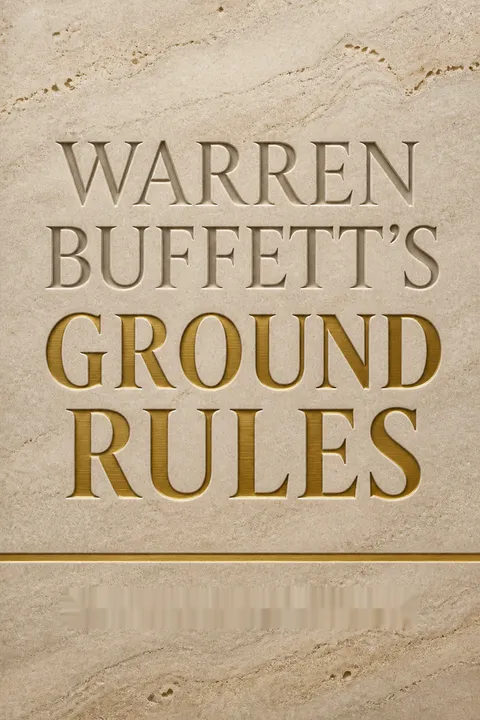


Key Takeaways
Value the business before listening to its daily price
Start with ownership. A share represents a small claim on a business, not just a number to trade. Buffett's mentor Benjamin Graham captured the market's volatility through Mr. Market, an imaginary investor whose moods swing between optimism and gloom. His offers can be useful, but they do not determine what a business is worth. Estimate that value independently, then act when the price is attractive.
Ignore the forecast. Buffett did not try to predict interest rates, the economy, or next month's market level. A business can be correctly valued while its stock moves the wrong way for a long time. The Partnership began with $105,100 in 1956 and compounded partners' capital at nearly 24% annually after fees over its life, but that remarkable record was not a promise. The discipline, not the result, is the lesson.
The useful separation here is between information and judgment. A market price tells an investor what someone will pay now, not necessarily what the underlying enterprise can earn over time. That distinction resembles the difference between a thermometer reading and a diagnosis: the number matters, but it does not explain itself. Independent valuation is demanding, however, and estimates can be wrong. The practical safeguard is not confidence alone, but a purchase price that leaves room for error.
Give compounding time, and guard every percentage point
Reinvest the gains. Compounding occurs when returns themselves remain invested and begin earning returns. Its two main ingredients are the rate of return and time, and its effects become much more visible over long stretches. Buffett illustrated the point with the $24 paid for Manhattan: at 6.5% annual growth, it would have become about $42 billion over 338 years; at 7%, about $205 billion. Those figures are deliberately extravagant, not forecasts. They show how tiny rate differences can become large over time.
Watch the leaks. Fees, taxes, and spending reduce the amount left to compound. Buffett's own example of skipping a $10 haircut to invest the money dramatized how small savings can grow across a long investment life. The more practical lesson is to avoid needless costs and give a sound investment enough time to work.
Compounding makes patience financially productive, but it can also make projections look more certain than they are. A return sustained for centuries is a mathematical illustration, not a realistic assumption about any business or market. Inflation, changing competition, and bad decisions interrupt neat curves. The sound application is therefore modest: protect the portions of return that can be controlled, such as fees and unnecessary trading, while treating future returns as uncertain.
Make a low-cost index your default unless active skill earns its keep
Use the market as a baseline. An index fund offers broad exposure to businesses without requiring investors to choose individual stocks. It also avoids the high costs and frequent decisions that can erode returns. Buffett observed that most actively managed portfolios struggle to match a broad market measure, and that their results tend to be worse than better.
Keep the hurdle high. In his 2013 letter to Berkshire shareholders, Buffett described instructions for his wife's trust: invest 90% in a very low-cost S&P 500 index fund and 10% in short-term government bonds. That recommendation was not a claim that no manager can outperform. It set a demanding comparison point. Active investing makes sense only when an investor has a credible reason to expect better results after costs, taxes, and mistakes.
Indexing is powerful partly because it narrows the gap between a good plan and a plan people can actually follow. It reduces both financial friction and the temptation to react to alarming headlines. The comparison also clarifies what active management must prove: not that it can produce gains, but that its gains exceed a low-cost alternative over time. An index is not risk-free, and a broad U.S. index is not automatically suitable for every investor's needs, but it is a useful default benchmark.
Give active managers three years at minimum, five when possible
Measure against a rival. Buffett judged results relative to the Dow and other investment benchmarks, not simply by whether the portfolio gained money that year. A manager who loses less than the market can have done a good job; one who gains while lagging the market may have done poorly. Buffett preferred a five-year evaluation and treated three years as the shortest useful test.
Allow for market cycles. A conservative value strategy can lag during a speculative boom, then hold up better when prices fall. Buffett's Partnership outperformed in each of three declining market years listed in the book. Combined, it gained 45%, while the Dow lost about 21%. The record is striking, but the declines were moderate. Investors should set a benchmark and a time horizon before results arrive, then resist rewriting the test to excuse failure.
A precommitted benchmark is a defense against hindsight. Without one, a manager can always find a favorable comparison after the fact, while investors confuse a rising market with skill. A multiyear window also reduces the noise of short-term price movement. Still, three or five years cannot settle every question: a strategy may be out of favor for longer, and one unusually successful period may reflect luck. A fair test combines performance with a clear understanding of what the manager is trying to do.
Pay managers for outperformance, not merely for gathering assets
Design the incentives. Buffett's Partnership charged no fixed management fee. Under its consolidated terms, he received no performance allocation until partners earned a 6% return; gains above that threshold were divided, with 25% going to Buffett. Prior shortfalls had to be recovered before the performance allocation resumed, and Buffett and his family held a substantial share of the Partnership's capital.
Check whose interests grow. A fee based simply on assets under management rewards a manager for attracting more money, even when additional capital makes good investments harder to find. Buffett's arrangement tied his compensation more closely to partner results and made his own wealth rise or fall alongside theirs. It did not remove every conflict, but it made the important ones easier to see.
Compensation is a behavioral design tool, not a footnote. A manager rewarded for asset growth has reason to prioritize fundraising, while a manager paid only for performance may take excessive risks to chase a bonus. Buffett's hurdle, recovery provision, and personal investment addressed several of these tensions together. Alignment is never complete: investors still need transparency, sensible risk controls, and a way to judge results. A well-crafted fee structure helps, but it cannot turn a poor investment process into a sound one.
Buy only what you can value, then size positions by conviction
Search for a discount. Buffett called broadly undervalued stocks Generals. In the early years, many were small companies whose assets or earnings seemed worth substantially more than their share prices suggested. Commonwealth Trust, for example, was bought around $50 a share when Buffett estimated its value at $125. Some positions were asset bargains; others, such as American Express and Disney, depended more on the strength and staying power of the business.
Stay within your limits. Buffett's approach evolved from buying statistically cheap companies, sometimes called net-nets, toward owning stronger businesses at reasonable prices. He concentrated when he believed the facts were clear, but allowed a position as large as 40% only under exceptional conditions. His circle of competence meant investing only where he could understand the business and judge its value. Passing was part of the method.
This is a useful alternative to treating investment style as a permanent identity. The same investor can use asset-based analysis in one case and business-quality analysis in another, provided each fits their knowledge and the price offers sufficient value. Concentration can improve results when judgment is unusually strong, but it magnifies the cost of error too. The key question is not whether a portfolio has many holdings or few. It is whether each position's size reflects the strength and limits of the evidence.
Treat deal spreads as payment for specific risks, not free money
Know what must happen. Buffett called investments tied to announced corporate events Workouts. In a merger, for example, the target's shares may trade below the agreed purchase price because the deal could fail or take time to close. The gap is compensation for those risks, not a guaranteed profit. Buffett assessed the likelihood of completion, the expected timeline, the chance of a better offer, and the consequences if the deal collapsed.
Study the failure case. In Texas National Petroleum, a sale to Union Oil depended partly on a tax ruling. The deal closed after a delay, and Buffett reported annualized returns of about 20% on bonds and 22% on shares and warrants. Those results came from a specific transaction, not a promise about future deals. Buffett limited borrowing against the Partnership's overall capital and emphasized that a failed deal could cause a sharp loss.
A deal spread is best understood as a small insurance market: the investor earns a limited potential gain while accepting the possibility of a sudden, larger loss. That asymmetry explains why a high apparent annual return can be misleading if the probability of failure is poorly assessed. The approach rewards careful reading of legal, regulatory, and financing details, not simply optimism about a company's announcement. The Partnership's results show why specialization can pay, and why copying the visible trade without the underlying analysis is dangerous.
When a company's assets are misused, ownership can unlock value
Think like an owner. Buffett called large or controlling investments Controls. They let an investor influence how a company uses its assets, rather than relying entirely on the market to recognize value. At Sanborn Map, the investment portfolio was worth about $65 a share while the entire stock traded near $45. Buffett helped secure a distribution of the portfolio and changes to the business, which had become less profitable.
Convert, then redeploy. Dempster Mill was a struggling farm-equipment maker bought at a discount to estimated asset value. After hiring Harry Bottle, Buffett saw inventories reduced from about $4 million to $1 million, costs cut, and idle assets turned into cash and securities. The episode shows that value can be created by improving a business or redirecting capital, not only by waiting for a stock price to rise.
The Sanborn and Dempster stories shift valuation from a passive exercise to a question of governance: who controls the assets, and what are they doing with them? That perspective connects investing with operational management and the principal-agent problem, where decision-makers may not act in owners' interests. Control can create leverage over change, but it also brings responsibility and conflict. Selling assets can release capital, yet liquidation is not automatically wise when a business supports employees, customers, and a community.
Define conservatism by sound analysis, not familiar labels
Popularity is not protection. Buffett argued that a conventional investment is not necessarily a conservative one. A widely admired stock bought at an inflated price can carry serious risk, while an unfashionable business bought well below a cautious estimate of its worth may offer more protection. His test was whether the facts, reasoning, and price supported the decision, not whether other investors agreed.
Separate fluctuation from loss. Buffett distinguished a temporary market decline from a permanent loss of capital. He diversified enough to avoid relying on a single uncertain outcome, but concentrated when he believed both the valuation and the downside were unusually well protected. The Partnership's strong results during its declining-market years supported his case, though they could not prove that concentrated portfolios are safer for every investor.
The distinction between price volatility and permanent impairment is central to long-term ownership. A falling quotation can create opportunity if the business remains sound, but it can also reveal that the original analysis was wrong. That makes the concept of risk more demanding than simply measuring how much a stock moves. Buffett's case for concentration is strongest when the investor has unusually reliable knowledge and a genuine margin of safety. It should not be mistaken for a general argument against diversification.
Choose the best after-tax compounding, not the smallest tax bill
Treat deferred tax as a loan. An unrealized gain creates a future tax liability, but the tax is not paid until the investment is sold. Until then, that money remains invested and can compound. Buffett therefore included the tax due on sale when thinking about net worth, even if the tax had not yet been paid.
Do not let tax avoidance choose the portfolio. Holding a less attractive investment merely to avoid realizing a gain can reduce after-tax wealth if a better opportunity is available. Buffett argued that changing holdings can be rational when the expected improvement in returns outweighs the tax cost. His target was the strongest after-tax compounding with acceptable risk, not a tax bill of zero.
Tax deferral has genuine economic value because it keeps more capital working, but it is not an independent investment strategy. Its value depends on the quality of what remains invested and on the eventual tax rules. This is a useful example of distinguishing a means from an end: minimizing taxes can help maximize wealth, but it can also become an expensive fixation. The right comparison is between realistic after-tax outcomes, not between a tax payment and the emotionally appealing idea of avoiding one.
When ideas vanish, refuse to invest just to stay busy
Capacity changes the game. Buffett's early Partnership could invest in tiny, overlooked companies. As its assets grew, some of those opportunities became too small to affect overall results. In 1966, with about $44 million at the start of the year, he stopped accepting new partners. By 1969, with roughly $100 million and few attractive ideas, he chose to close the Partnership rather than pursue investments he did not understand.
Keep principles fixed through a cycle. During the Go-Go era, aggressive funds and speculative conglomerates drew money and attention. Jerry Tsai's Manhattan Fund attracted enormous assets, then lost about 90% of its value in the following years. Buffett did not claim to know when the boom would end. He acknowledged changing opportunities, lowered his expectations, and arranged alternatives for partners, including the Sequoia Fund and municipal bonds.
The decision to stop is an investment decision too. It recognizes that opportunity depends on both market conditions and the scale of capital seeking returns. The story also separates discipline from market timing: Buffett did not need to call the exact top to know that he lacked suitable ideas. Closing a successful operation required resisting the incentives to preserve fees, reputation, and momentum. The lesson has limits, since an investor can misread temporary scarcity as permanent decline, but continuing simply to stay active is not a sound remedy.
Analysis
The book's central achievement is to make Buffett's record legible as a process rather than a string of lucky stock picks. Its narrative follows an investor from a small Omaha partnership, where obscure bargains were plentiful, toward a larger operation that had to change its methods and eventually stop. Across that arc, the durable principles are unusually consistent: appraise businesses independently, demand an adequate discount, avoid pretending to forecast markets, measure performance honestly, and align the manager's interests with the capital entrusted to them.
Its strongest practical contribution is the integration of investing behavior with investment mechanics. Market psychology explains why prices detach from business value; partnership terms explain how incentives shape conduct; the Dempster and Sanborn cases show that control and capital allocation can alter underlying value. These are not separate lessons. Together they describe a system in which valuation, temperament, governance, and scale reinforce or undermine one another.
The record also requires careful interpretation. Buffett's partnership results were extraordinary, but they arose in a particular era, with small sums, unusual skill, and access to opportunities unavailable at scale. A memorable track record cannot establish that readers can reproduce it. For most investors, the index recommendation is therefore not a timid footnote. It is the book's honest recognition that active investing has a high bar and that confidence is not evidence of an edge.
The most useful adaptation is consequently neither to imitate Buffett's concentrated positions nor to turn his every tactic into a universal rule. It is to adopt his decision standards: know what is being valued, know why the price is attractive, understand what could make the thesis fail, and compare the expected result with the simplest alternative. Sometimes that process points to a stock, a bond, or a control investment. Often it points to an index, patience, or no action at all.
Review Summary
Warren Buffett's Ground Rules compiles Buffett's early investment letters, offering insights into his value investing approach before Berkshire Hathaway. Readers appreciate the book's analysis of Buffett's evolving strategies, from "cigar butt" investing to quality businesses. The content is praised for its relevance to both novice and experienced investors. Some find the repetitive structure and dated material drawbacks, while others value the timeless wisdom. Overall, the book is seen as a valuable resource for understanding Buffett's investment philosophy and character, though opinions vary on its readability and modern applicability.
People Also Read






Glossary
Ground Rules
Partnership operating principlesBuffett's written principles for the partnership, shared with investors before they committed money and updated over time. They explained that returns were not guaranteed, defined how performance would be judged, rejected market forecasting as a requirement, and promised value-based investments with attention to permanent loss. They also established expectations about the manager's own investment alongside partners.
Mr. Market
Mood-driven price offerBenjamin Graham's personification of the stock market as an investor whose changing moods produce changing offers to buy or sell a business. The offers can be irrationally optimistic or pessimistic. An investor should estimate business value independently and use market quotations when they are advantageous, rather than letting them dictate the estimate.
Generals
Undervalued public companiesBuffett's category for generally undervalued stocks selected mainly through financial analysis, with attention to business quality and management as well. Some traded below a cautious estimate of what a private owner might pay; others looked cheap relative to comparable companies. The category supplied much of the Partnership's equity exposure and could take years to pay off.
Generals-Private Owner
Stocks cheap to whole buyersA subdivision of Generals consisting of companies whose market prices were substantially below Buffett's estimate of their value to a private owner. The investor might profit if the market corrected the discount or, in some cases, acquire enough shares to influence the company. The possibility of taking control was an additional route to realizing value.
Generals-Relatively Undervalued
Cheap versus comparable companiesA subdivision of Generals for companies too large, or otherwise unsuitable, to value meaningfully as private-owner acquisitions. Buffett compared businesses of similar quality and sought a substantial discount in one relative to the others. He sometimes reduced exposure to a broad shift in valuations by pairing a purchase with a short position in a more expensive comparable company.
Workouts
Investments tied to corporate eventsBuffett's term for investments whose returns depend mainly on a corporate event, such as a merger, liquidation, reorganization, or spin-off. In a merger, the target shares may trade below the announced price because the deal could fail or take time. Analysis focuses on completion odds, timing, competing offers, and the loss if the transaction collapses.
Controls
Influence over company decisionsInvestments in which Buffett's partnership owned a controlling interest or a large enough position to influence company policy. Because market quotations could be unreliable or unavailable for such holdings, Buffett estimated their value as businesses. Control could allow him to improve management, change capital use, or distribute assets, but it also demanded active oversight.
net-nets
Stocks below net current assetsCompanies whose market prices are below the estimated value of their current assets after subtracting all liabilities. The calculation emphasizes assets such as cash, receivables, and inventory, often after discounting their stated accounting values to estimate what a prompt sale might realize. The approach seeks protection from a low purchase price, but requires checking for hidden liabilities and ongoing losses.
margin of safety
Discount protecting against errorThe gap between an investor's conservative estimate of a business's value and the price paid for it. That gap provides some protection if assumptions prove imperfect or circumstances worsen. It does not eliminate investment risk, and its usefulness depends on the quality of the valuation and whether the business's assets or earnings retain value.
deferred tax liabilities
Unpaid tax on unrealized gainsA future tax obligation associated with investment gains that have increased in value but have not yet been realized through sale. Because the tax is not paid immediately, the money otherwise owed can remain invested and compound. The benefit depends on future returns, tax rates, and the eventual decision to sell or transfer the asset.
high-water mark
Recovery before renewed feesA condition in an investment fee arrangement that requires previous losses or shortfalls to be recovered before the manager again receives a performance-based allocation. In Buffett's Partnership, deficiencies below the return threshold carried forward. This protected partners from paying an incentive fee on a recovery that merely restored earlier losses.
circle of competence
Area of reliable understandingThe set of businesses and investment situations an investor can understand well enough to evaluate their economics and risks. The boundary is personal and may be narrow. Its purpose is not to encourage expertise in everything, but to help investors identify where their judgments are dependable and to pass on opportunities they cannot assess.
FAQ
What's Warren Buffett's Ground Rules about?
- Investment Philosophy Overview: The book compiles Warren Buffett's early partnership letters, focusing on his investment philosophy and strategies from 1956 to 1970. It highlights value investing and the importance of a long-term perspective.
- Key Investment Strategies: It categorizes investments into Generals, Workouts, and Controls, explaining Buffett's approach to each. The book emphasizes understanding intrinsic value and market behavior.
- Lessons for Investors: The letters provide timeless principles for both novice and experienced investors, aiming to make Buffett's teachings accessible and relevant for modern readers.
Why should I read Warren Buffett's Ground Rules?
- Learn from a Master: Gain insights directly from Warren Buffett, one of the most successful investors in history, through his practical advice and strategies.
- Timeless Investment Principles: The book distills Buffett's core investment philosophies, applicable regardless of market conditions, to help make informed investment decisions.
- Comprehensive Resource: It serves as a reference for Buffett's early investment strategies, offering a structured learning experience through key excerpts from his letters.
What are the key takeaways of Warren Buffett's Ground Rules?
- Value Investing Focus: Emphasizes buying undervalued securities and understanding intrinsic value, with the belief that the market will reflect true value over time.
- Long-Term Perspective: Advocates for focusing on the underlying business rather than short-term market fluctuations, helping to mitigate emotional decision-making.
- Risk Management: Highlights the importance of maintaining a margin of safety to minimize potential loss and achieve sustainable long-term returns.
What are the best quotes from Warren Buffett's Ground Rules and what do they mean?
- “If I was running $1 million, or $10 million for that matter, I’d be fully invested.”: Reflects Buffett's confidence in finding value opportunities and the power of being fully invested.
- “The availability of a quotation for your business interest (stock) should always be an asset to be utilized if desired.”: Emphasizes viewing market prices as opportunities rather than constraints.
- “We do not want to get active merely for the sake of being active.”: Highlights the preference for thoughtful, strategic action over unnecessary activity, reinforcing patience and discipline.
What is the concept of "Generals" in Warren Buffett's Ground Rules?
- Definition of Generals: Refers to generally undervalued stocks characterized by low market prices relative to intrinsic value, often lacking immediate market sponsorship.
- Investment Strategy: Buffett concentrated investments in a few Generals, aiming for significant price appreciation over time.
- Long-Term Holding: Generals were held for extended periods, aligning with Buffett's philosophy of long-term investing.
How does Buffett define "Workouts" in Warren Buffett's Ground Rules?
- Definition of Workouts: Securities whose financial results depend on corporate actions like mergers or reorganizations, with a predictable timeline for returns.
- Arbitrage Opportunities: Viewed as a form of arbitrage, capitalizing on the difference between current market price and expected payout, typically yielding stable returns.
- Risk Assessment: Success relies on accurately assessing deal closure likelihood and potential risks, emphasizing thorough due diligence.
What are "Controls" in Warren Buffett's Ground Rules?
- Definition of Controls: Situations where Buffett acquired a significant ownership stake, allowing influence over management decisions, often evolving from Generals.
- Active Management: In control, Buffett took an active role in improving operations, sometimes replacing management to unlock shareholder value.
- Valuation Focus: Emphasizes assessing intrinsic value, with investment value determined by business performance rather than market fluctuations.
What is the significance of "compounding" in Warren Buffett's Ground Rules?
- Power of Compounding: Critical for wealth creation, emphasizing reinvesting gains for exponential growth over time, foundational to Buffett's philosophy.
- Long-Term Strategy: Illustrates how patience enhances compounding effects, encouraging focus on long-term potential.
- Real-World Examples: Uses anecdotes to demonstrate compounding's impact, showing how small, consistent gains lead to substantial wealth.
How does Buffett approach risk management in Warren Buffett's Ground Rules?
- Margin of Safety: Emphasizes buying below intrinsic value to protect against permanent loss, a key principle for sustainable returns.
- Long-Term Focus: Advocates for a long-term horizon to ride out volatility, focusing on business performance over market fluctuations.
- Diversification Strategy: Suggests a diversified portfolio across Generals, Workouts, and Controls to mitigate individual investment risks.
What lessons can modern investors learn from Warren Buffett's Ground Rules?
- Value Investing Principles: Focus on intrinsic value and long-term growth rather than short-term trends for sustainable success.
- Patience and Discipline: Importance of avoiding impulsive decisions based on market noise, staying true to a well-defined strategy.
- Understanding Your Circle of Competence: Know strengths and limitations, focusing on investments within one's expertise for better decisions.
How does Buffett define conservatism in investing in Warren Buffett's Ground Rules?
- Knowledge and Reason: True conservatism is based on correct facts and sound reasoning, not popular opinion.
- Independent Thinking: Encourages thinking independently, warning against crowd influence and emphasizing thorough analysis.
- Concentration Strategy: A concentrated strategy can be conservative when confidence in analysis is high, focusing on minimal loss chances.
How does Buffett's approach to investing evolve throughout Warren Buffett's Ground Rules?
- From Quantitative to Qualitative: Evolves from strict quantitative focus to incorporating qualitative business assessments.
- Concentration Strategy: Becomes more comfortable with concentration, moving away from diversification principles.
- Long-Term Value Orientation: Emphasizes long-term value creation, focusing on high-quality businesses for compounding value over time.
Download PDF
Download EPUB
.epub digital book format is ideal for reading ebooks on phones, tablets, and e-readers.








