

Key Takeaways
Stop improving the elevator until you know what tenants actually need.
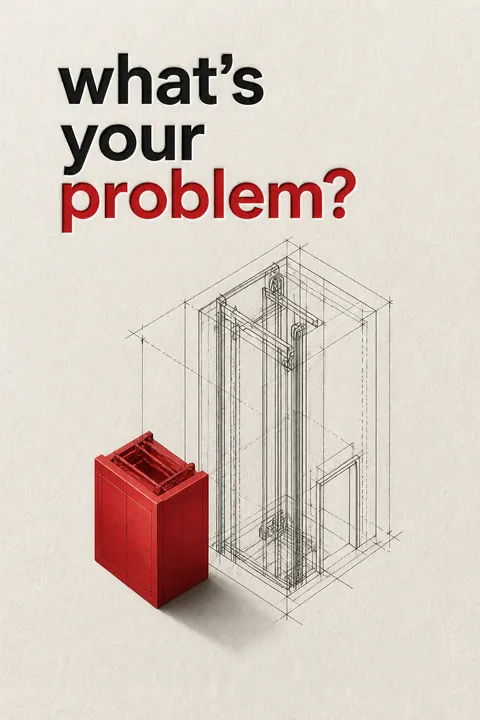
The stated problem can mislead. Tenants complain that an office elevator is slow, so building managers naturally consider a faster motor or a replacement. But if the real issue is the frustration of waiting, mirrors beside the elevator can reduce complaints without changing its speed. Reframing means changing the way a problem is understood so a different set of solutions becomes possible. It is not simply analyzing the chosen problem more carefully.
The elevator example neatly separates a measurable condition from the human difficulty attached to it. That distinction matters in service design, where people may care less about a system's technical performance than about uncertainty, inconvenience, or the feeling of being ignored. Still, a clever reframe must not erase a genuine need: mirrors would be a poor response if the delay made people miss critical appointments. The practical question is not whether the original complaint is valid or invalid, but which version of the problem is both consequential and open to improvement.
Reframe in short loops, then return to action with a test.
Pause without getting stuck. The rapid reframing method has three steps: Frame the problem, Reframe it by generating alternative interpretations, and Move Forward by testing a promising one. Reframing is a brief loop off the path of action, not a demand to understand everything before doing anything. Five to fifteen minutes may be enough to find a useful new angle; complicated issues may need several rounds separated by experiments. A written problem statement and a shared whiteboard can help a group keep the issue visible.
This cadence resembles iterative learning in engineering: make a provisional model, intervene, observe, and update. It is a useful alternative to both impulsive action and endless analysis because uncertainty is treated as something to reduce through contact with reality. The short-loop design also makes reflection more likely to survive a busy workplace. Its limitation is that a timer cannot make a difficult problem simple. High-stakes decisions may demand deeper evidence, while a short reframing session should be understood as a first diagnostic pass, not proof that the diagnosis is sound.
Write the problem plainly, then inspect what your wording assumes.
Make the frame visible. A short, full-sentence problem statement slows premature solution-making and gives others something concrete to question. Problems may arrive as a pain point, such as falling sales; a hard-to-reach goal, such as a revenue target; or a solution someone already wants, such as building an app. Check whether the statement is true, vague, emotionally loaded, or quietly steering toward a preferred answer. Ask who owns the problem and whether the apparent choices are the only ones. At Brooklyn's Royal Palms Shuffleboard Club, the founders avoided choosing between serving food themselves and having no food. A food truck in an adjoining garage supplied dinner without the club taking on a restaurant's operating burden.
Writing externalizes a private interpretation, making it easier for colleagues to disagree with the frame without treating disagreement as a personal attack. The Royal Palms example also shows why apparent trade-offs deserve scrutiny: the options presented by a decision may reflect habit, not necessity. In behavioral decision research, defaults and option sets shape what people consider possible. However, broadening options is not automatically better. A useful review should uncover consequential assumptions, not turn every routine choice into an elaborate strategy exercise.
Look beyond your expertise for causes your favorite tool cannot see.
Zoom out before calculating. A shipping puzzle asks how many company ships a traveler will pass on a seven-day crossing. Many people count only the ships that depart during the trip and answer seven; the complete picture includes six already at sea, for thirteen total. The mistake comes from focusing on visible details inside a narrow frame while overlooking what lies beyond it. Experts can make a similar error when they shape every problem to fit their preferred tools. A finance team examining a company's stock price focused on financial measures until an HR executive asked who spoke with outside analysts. The overlooked issue was how those conversations were handled.
The puzzle makes a cognitive blind spot tangible: careful calculation cannot repair an incomplete model. Systems thinking makes a parallel move by looking for upstream conditions and interactions, rather than treating the nearest visible event as the whole cause. Diverse expertise helps because people notice different parts of a system, though simply putting varied specialists in a room is not enough. The group must give them permission to challenge the frame. Expertise remains valuable, but it should be a source of hypotheses, not a fence around what counts as the problem.
Question the goal behind the goal before optimizing the current one.
Trace what success serves. A database review team was told to halve its two-week processing time. Its new leader asked whether speed was really the goal, or whether the business needed changes made sooner. About 80 percent of requests were simple and safe enough for employees to handle directly, so the team created a self-service route. Those requests no longer waited for review, and the team had more capacity for complex work. Goal maps help expose this logic: ask why a target matters, what benefit it provides, and whether another route could deliver that benefit. Egypt and Israel reached a territorial compromise at Camp David by distinguishing Egypt's interest in owning Sinai from Israel's security concerns.
A target is often a proxy for an outcome, and proxies can become traps when people optimize them after their connection to the desired result weakens. This is familiar in economics and organizational measurement: a metric can redirect effort toward what is counted instead of what matters. Goal mapping makes those causal assumptions discussable. Yet questioning a goal should not become a license to discard obligations or quietly change what success means. Especially in public services, the people affected by a goal deserve a voice in deciding which outcomes count.
Search for bright spots before diagnosing why everything fails.
Study exceptions for clues. Bright spots are moments, people, or places where a problem is absent or less severe. A couple who often argued noticed that difficult conversations went smoothly at breakfast. Most fights happened late at night, when they were tired and hungry, so they agreed not to raise contentious topics after ten. The same search can work across a group. In Argentina's Misiones province, most schools struggled to keep children enrolled, but three schools retained 90 percent or more without extra resources. Their teachers treated illiterate parents as partners, showing how children's lessons could help families with immediate tasks. Two districts that adopted the approach increased retention by 50 percent the following year.
Studying exceptions shifts attention from blame and deficiency toward conditions that already support success. That is a strength of positive deviance approaches: workable practices are discovered within a community, which can make change more credible than an imported prescription. The strategy is also compatible with careful causal inquiry, since an exception suggests a variable worth examining, not necessarily the cause. A successful outlier may have advantages others lack, so copying its visible behavior without understanding its context can disappoint. The key is to investigate what differs and test whether those conditions can be recreated.
Treat yourself as part of the system, not a neutral observer.
Look for your contribution. People readily explain a problem through someone else's character, while overlooking how their own actions or the surrounding system may help produce it. Replace the blame question with a more useful one: what did each person contribute, and what could change next time? A factory manager began incident discussions by asking employees how the company had failed them, which reduced defensiveness and opened discussion of shared causes. When a problem feels too large to influence, scale it down to actions available at your level. Ukrainian health officials, for example, routed medicine purchasing through international agencies, bypassing corrupt intermediaries and saving money and lives.
This approach connects individual self-awareness with systems analysis. A person can take responsibility for their part without pretending to control every condition, and a system can be changed without reducing its failures to one villain. That balance is especially useful in safety work, where punishment can suppress reporting and leave hazards intact. Self-examination also has a boundary: asking people to inspect their contribution must not be used to shift responsibility onto those with the least power. A fair diagnosis tracks influence as well as participation.
Model other people's incentives before labeling them irrational.
Step outside your own viewpoint. Perspective taking is the deliberate effort to understand another person's context, goals, information, and worldview, not merely to imagine their feelings. Start by considering how they might see the situation, then adjust for ways their experience differs from yours. A software team blamed poor adoption on a clumsy interface; private employee interviews revealed that workers feared sharing knowledge because the company rewarded individual project wins. Changing the incentives helped adoption. In another case, an advertising client insisted on a viral video because her bonus depended on view counts. Understanding that incentive made a workable compromise possible.
Perspective taking counters the common tendency to mistake unfamiliar behavior for defective character. It also reveals that people can act rationally within incentives that damage a larger system. This is a central insight in organizational economics: changing the reward structure may work better than exhorting people to behave differently. But understanding a motive is not the same as endorsing it. Some conduct is harmful even when it makes sense to the person doing it, so empathy should clarify the intervention, not excuse the impact.
Validate the problem with behavior, not applause.
Test the diagnosis in reality. Before building a solution, check whether the problem matters to the people who supposedly have it. Entrepreneur Kevin Rodriguez wanted to open a gelato shop. A friend took him to visit existing shops and talk with owners; abundant nearby competition and weak profitability persuaded him to abandon the idea before investing his savings. A harder test than asking whether customers like an idea is asking them to act. The founders of Managed by Q pitched residential building managers and requested a deposit. Only one of twenty signed up. They then tested the service with office managers, and eighteen of twenty-five paid. When a solution is cheap and safe to simulate, a rough pretotyping test can assess demand without building the product.
The distinction between stated preference and costly behavior is a cornerstone of experimental design. A deposit, trial, or real-world observation often provides more diagnostic information than enthusiasm in a meeting. The book's examples also show why tests should target assumptions, not merely polish a favored idea. Still, payment is not the only meaningful signal: a deposit may exclude people with limited cash, and early adopters may not represent the broader market. Strong validation combines observable commitment with attention to who can participate and who is being left out.
Keep competing explanations alive when certainty or status shuts inquiry down.
Resist premature certainty. Geologist Thomas Chamberlin argued that scientists should compare several working explanations rather than fall in love with one. The same discipline applies to everyday problems: keep plausible frames open until evidence distinguishes them, and allow that the answer may combine several causes. When someone rejects a diagnosis, first ask whether the adviser could be wrong. Then look for evidence, incentives, or concerns that explain the resistance. If a low-cost failure is safe, letting a proposed approach fail once can sometimes build trust better than forcing agreement. The aim is not to win an argument, but to make it possible to update beliefs.
Multiple hypotheses are a practical defense against confirmation bias: once a story feels right, people tend to notice supporting evidence and discount anomalies. Comparing alternatives makes disconfirmation part of the method rather than a threat to identity. The approach also requires humility from advisers, whose confidence can be mistaken for evidence. There are limits: keeping every possibility open indefinitely delays action, and a reversible test is not ethical when failure could harm people. Good inquiry pairs intellectual flexibility with clear thresholds for deciding and responsibility for consequences.
Analysis
The book's strongest contribution is a change in the unit of problem solving. Instead of treating the problem statement as a fixed assignment and creativity as the search for answers, it treats the frame itself as a hypothesis. This changes what counts as progress: a team may advance by discovering that its goal is a proxy, its assumed cause is wrong, or its proposed solution serves an incentive no one has named. The examples make this practical rather than abstract. Mirrors beside an elevator, a self-service database, and a food truck in a garage are not technological marvels. Their ingenuity lies in changing which constraint matters.
The method also joins three capacities that organizations often separate: diagnosis, social understanding, and experimentation. Looking for bright spots tests causal explanations against exceptions. Perspective taking reveals incentives and lived conditions hidden from decision makers. Problem validation then checks whether a revised diagnosis predicts real behavior. Together, these moves resemble disciplined scientific inquiry, adapted to settings where data are incomplete and action cannot wait for certainty.
Its most important caution is ethical. Reframing can expose false assumptions, but it can also be used to redefine away an inconvenient obligation or to place responsibility on someone with little power. A manager could call resistance a motivation problem while ignoring low pay, or label a complaint a perception problem when the service is genuinely failing. Good reframing therefore needs criteria beyond novelty: Does the new frame fit evidence, reflect affected stakeholders' interests, and improve outcomes without transferring hidden costs?
The practical standard is not to reframe everything. It is to notice when familiar solutions keep failing, when the problem statement already contains an answer, or when a consequential assumption has gone untested. In those moments, a short pause can save months of efficient work in the wrong direction.
Review Summary
What's Your Problem? is highly praised for its practical approach to problem-solving through reframing. Readers appreciate the engaging writing style, real-world examples, and actionable techniques. Many found the book's insights applicable to both professional and personal challenges. The concept of examining problems from different perspectives resonated with readers, who felt it improved their decision-making skills. While some noted repetition and structural issues, most reviewers considered the book valuable for anyone seeking to enhance their problem-solving abilities.
People Also Read









Glossary
Rapid reframing method
Short problem-solving loopA practical sequence for reconsidering a problem without abandoning action. First state the problem, then generate alternative ways to understand it, and finally choose a next step that tests the framing in the real world. The process can be repeated as new evidence appears, rather than requiring a perfect diagnosis before work begins.
Exploring the frame
Finding overlooked detailA way of reframing that investigates the original problem statement more deeply. It searches for overlooked stakeholders, causes, constraints, or circumstances that alter what the problem means. The resulting solution remains connected to the original objective, but addresses a hidden aspect of it rather than merely optimizing the obvious feature.
Breaking the frame
Changing the problem itselfA form of reframing that steps away from the initial definition and changes the objective or interpretation. Instead of asking how to improve adoption of shelter dogs, for example, a program might ask how to help families keep their pets and prevent shelter entry. The new frame can reveal solutions unavailable under the original one.
Bright spots
Useful positive exceptionsPeople, places, or moments where a problem is absent, smaller, or handled especially well. Examining these exceptions can expose behaviors or conditions that help explain success and may be repeatable elsewhere. Bright spots can be found in one's own experience, within a peer group, in another field, or by sharing the problem widely.
Perspective taking
Understanding another viewpointA deliberate cognitive effort to understand another person's context, goals, knowledge, constraints, and worldview. It goes beyond feeling sympathy or imagining how one would feel in the same situation. Effective perspective taking requires adjusting for differences between one's own experiences and those of the person being considered.
Pretotyping
Simulating demand before buildingA way to test whether people will use or buy a proposed product without constructing the finished solution. A team might create a basic sales page or advertisement and observe whether anyone commits. Unlike a conventional prototype, the emphasis is not on demonstrating a working product, but on learning whether the idea addresses a real demand.
Boundary spanners
Insiders with outside perspectivePeople who understand an organization's language and priorities but are not fully embedded in the group making a decision. Their partial distance can help them question assumptions while remaining close enough to contribute quickly and communicate effectively. They can provide a practical alternative when involving distant or highly unfamiliar outsiders is difficult.
Multiple working hypotheses
Several explanations tested togetherAn approach associated with Thomas Chamberlin in which a problem solver develops and compares several plausible explanations instead of committing to one favored theory. Each explanation guides inquiry but remains provisional. Evidence can support one, combine several, or lead the investigator to abandon them for a better account.
About the Author
Other books by Thomas Wedell-Wedellsborg

Download PDF
Download EPUB
.epub digital book format is ideal for reading ebooks on phones, tablets, and e-readers.








