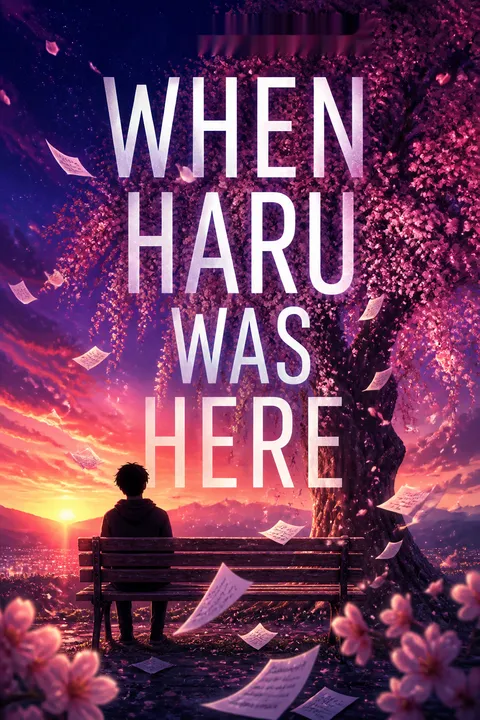


Plot Summary
Prologue
Before the main story, Eric1 watches his older sister Jasmine3 leave for college and clings to his best friend, Daniel,4 whose rooftop kiss seems to promise a change neither boy explains. The following summer in Tokyo, Eric1 gets lost and meets Haru,2 a local who guides him through the Star Festival.
They trade bracelets, share food and tea, and hang wishes among jasmine flowers. Haru2 tries to give Eric1 his number, but Eric1 boards the train to meet Daniel;4 the paper slips away before they can exchange it. Eric1 returns to Chicago with only Haru2’s bracelet and the feeling that he chose one unfinished story over another.
The opening establishes Eric’s defining habit: he treats closeness as something that can be preserved by waiting, remembering, and keeping small objects. Jasmine’s departure makes ordinary change feel like a loss, while the rooftop kiss gives Eric reason to hope Daniel’s feelings match his own. In Tokyo, a brief connection with Haru becomes charged by the festival’s story of lovers separated by distance. Eric’s choice to keep his promise to Daniel is not a simple mistake; it reflects his loyalty and his reluctance to risk changing a friendship. The lost paper turns that hesitation into a lasting uncertainty.
A Life on Hold
Nearly a year after Daniel’s4 death, Eric1 is still living at home, unsure what to do with his future. An interview at a Chicago film company ends when he learns its internship requires college enrollment. Jasmine3 visits from Michigan, urges him to contact her former boyfriend Kevin5 about work, then confides that she has left school to tour Europe with a band.
Eric1 agrees to keep her plan from their parents.12 After she leaves, he takes Daniel’s4 birthday present to their old café and imagines sharing it with him. Instead, Haru2 appears across the table. Their reunion feels miraculous, but when Eric1 steps inside to retrieve the forgotten gift, Haru2 vanishes into the rain without exchanging contact information.
Eric’s stalled ambitions and his attachment to rituals are linked: both let him postpone choosing a future after Daniel’s death. The imagined account of Jasmine’s departure gives him a second family separation to manage, one he can frame as a decision rather than an irreversible loss. Haru’s sudden appearance interrupts that carefully maintained version of life, but his disappearance repeats the original missed connection. The scene makes uncertainty emotionally productive: Eric is not simply meeting a boy again, he is being forced to confront how much of his life depends on unfinished goodbyes.
The Star Survives
The next morning, Haru2 is inexplicably in Eric’s1 bedroom, then follows him to a university event where Kevin5 hopes to introduce him to a theater professor. Haru2 appears and disappears in front of Eric,1 unseen by everyone else. Before Eric1 leaves, Haru2 folds him an origami star. Eric1 decides the visitor may be a grief-born hallucination and rides away without him, but the paper remains real in his pocket.
Days later, he searches Chicago for Haru,2 remembering that Haru2 wanted to see the Bean. In the rain, Eric1 finds him soaked on a park bench. He apologizes for abandoning him and offers the promised city tour. Haru2 accepts, and they share deep-dish pizza before Eric1 brings him home.
The origami star serves as evidence without settling the question of what Haru is. Eric can dismiss the encounter as fantasy only until an object survives outside his perception. His decision to leave Haru at the station repeats the earlier choice in Tokyo, but the search reverses his usual passivity: he risks looking foolish and physically travels across the city. The reunion is built through repair, not fate alone. By apologizing and keeping his promise, Eric begins to act on attachment instead of merely preserving it in memory.
A City Between Worlds
Kevin’s5 connection to Professor Angelina Lin11 gets Eric1 a box-office job at the Chicago Theater. When Eric1 spots someone in Daniel’s4 familiar red sweatshirt outside, he discovers it is Haru,2 who has come looking for him. The two explore the theater, and Eric’s1 attempt to play its grand piano brings back a childhood memory of Jasmine3 defending his painted nails when their mother12 objected.
Later, Haru2 takes Eric1 to the planetarium, where a handkerchief floats and, briefly, the boys rise among projected stars. At the Skydeck, Eric1 explains that Daniel4 was the friend who brought him to Japan and admits he had loved him. Haru2 listens without pressing him. Just as Eric1 begins to feel secure with him, Haru2 disappears again.
The theater joins Eric’s possible future to his family past: a job is not a dramatic breakthrough, but it gives him a place from which to begin making things again. The piano memory shows Jasmine’s care in concrete form, especially her defense of Eric’s self-expression. Haru’s impossible feats create a private reality that feels emotionally true even when Eric cannot verify it. His confession about Daniel changes the bond between the boys: Haru is no longer only a lost possibility, but someone who can witness the grief Eric has kept largely unspoken.
The Dance That Never Came
A flashback to senior year shows why Eric1 has never resolved his feelings for Daniel.4 At a party, Daniel4 leaves Eric1 with a stranger while he gets ice with Leighton.10 Eric1 later finds them kissing. Daniel4 admits he has been seeing Leighton10 for months, then says the rooftop kiss with Eric1 was not meant to become a relationship. Eric1 leaves hurt, and the boys drift apart.
On homecoming night, Daniel4 asks Eric1 to be his date, but runs late; Jasmine3 eventually tells Eric1 that Daniel’s4 car has been in an accident and he may not survive. Eric1 bolts toward the hospital, falls, and hits his head. Their planned first dance never happens, leaving Eric1 with both an unreturned love and no chance to say goodbye.
The flashback corrects the romantic meaning Eric assigned to Daniel’s kiss. Daniel’s tenderness was real, but it did not mean what Eric needed it to mean. The distinction is painful because Eric had organized his future around a shared college plan and an imagined dance, treating proximity as proof of reciprocity. The accident then freezes their relationship at its most unresolved point. Eric’s grief is intensified not only by losing Daniel, but by being left to interpret gestures and silences that can no longer be clarified.
Rain on the River
As Eric1 settles into theater work, Simon8 and Alex9 become his irreverent new coworkers. Haru2 returns, and a tour of the theater draws Eric1 into another memory of Jasmine3 before he and Haru2 slip into the empty auditorium.
Eric1 films the ornate rooms for a scholarship application, then tells Haru2 he has barely touched his camera since Daniel4 died. On the Riverwalk, Eric1 admits he had applied to college mainly to follow Daniel,4 not because the school suited his filmmaking ambitions.
Haru2 reveals he crossed an ocean simply to find Eric1 again. They take an unattended boat onto the river, where Eric1 begins imagining a film about Chicago. When rain traps them beneath a bridge, Haru2 kisses him, giving their connection a tenderness Eric1 had never received from Daniel.4
This section contrasts love as projection with love as mutual attention. Eric once mistook a shared plan for a shared desire, but Haru’s willingness to cross continents makes his own choice explicit. The boat ride also returns Eric to creative work: the city becomes material he can shape rather than a place where he is stranded. Haru’s kiss does not erase Daniel or repair the past. It gives Eric a present-tense experience of reciprocity, one that can coexist with grief instead of needing to replace it.
The Exception's Price
At a theater cast party, Eric1 meets Christian,6 a celebrated actor with a luxurious penthouse. Christian’s6 attention feels like an entry into a world Eric1 usually watches from outside. Eric1 chooses Christian’s6 invitation over a planned outing with Haru,2 then accepts a rose and attends an art opening with him.
Haru2 appears there, playing piano, and offers Eric1 a chance to leave for the movie they had postponed. Eric1 stays. Later, Christian6 takes him home and they kiss, but Christian6 reveals that he generally does not date Asian men and treats Eric1 as an exception.
Eric1 is unsettled, yet continues the intimacy and hopes the remark means less than it does. Haru’s paper flowers and Christian’s6 real rose become opposing signs of affection and status.
Christian’s attraction is powerful partly because it offers Eric recognition from someone who seems socially secure and desirable. The racialized comment exposes the terms of that recognition: Eric is being singled out as an exception to a preference that excludes people like him. His choice to continue despite discomfort is not simple naivety; it reflects how grief and loneliness can make conditional attention feel better than none. Haru’s paper gifts are materially modest, but they carry personal knowledge. The contrast asks whether a grand gesture matters if the giver cannot see the whole person.
Snow Without a Way Home
Christian6 later invites Eric1 to drinks, but spends the evening with another man and leaves him alone with Nick.7 After Nick7 kisses him without permission, Eric1 goes to Christian’s6 apartment with the forgotten jacket and learns Christian6 considers their encounter over. Haru2 finds Eric1 drunk on the street and tries to get him home.
Eric,1 angry at Haru’s2 unpredictable disappearances, lashes out and tells him to leave; Haru2 sends Kevin5 Eric’s1 location before vanishing. Kevin5 gets him to safety, but Eric1 wanders away and calls Jasmine.3 In his confused state, he meets her at a diner and then follows Haru2 through a train that seems to have no end. The next morning he wakes in Jasmine’s3 room, unable to recall how he got there.
Several forms of abandonment converge here: Christian withdraws attention, Nick mistakes access for consent, and Haru’s care arrives on terms Eric cannot control. Eric’s anger at Haru is partly displaced grief, but it also registers a genuine need for reliability. The episode’s danger makes his isolation physical rather than metaphorical. Kevin’s intervention matters because it is practical and unglamorous: he locates Eric and brings him indoors. Eric’s dream of chasing Haru through endless train cars turns the fear of losing people into a landscape he cannot escape.
The Last Paper Flower
After the chaotic night, Haru2 stays away for weeks. Eric1 waits outside the theater, searches their old places, and finally folds a paper rose containing an apology. Haru2 returns in the rain, but refuses Eric’s1 list of plans. He has come to say goodbye, explaining that he cannot remain in Eric’s1 life and does not want Eric1 to spend it waiting for him.
Eric,1 hurt by another departure, tells him to go and walks away without looking back. Haru2 does not follow. Eric1 then begins boxing up Haru’s gifts and resumes college applications, including one to New York. The absence does not immediately free him, but his attention starts shifting from watching the street toward choices he can make for himself.
Haru’s farewell turns the story’s central fantasy inside out. A second chance cannot mean permanent access to someone who appears and disappears beyond Eric’s control. Haru’s decision to leave is painful, but it challenges Eric’s habit of making waiting proof of devotion. Eric’s angry response preserves some agency: he cannot stop the goodbye, but he can refuse to perform acceptance for Haru’s comfort. Packing away the gifts and applying elsewhere are small actions, not cures. Their importance lies in redirecting Eric’s energy toward a life not organized around someone’s return.
A Song Through Grief
After seeing Daniel’s former boyfriend10 with someone new, Eric1 accepts another invitation from Nick.7 When Eric1 refuses sex, Nick7 throws him out into the snow; lost and freezing, Eric1 imagines Jasmine3 beside him and finally admits he has been pretending she is still alive and touring.
He wakes alone, goes home, and reads the letters he had avoided. They reveal that Jasmine3 died after a serious illness, and that her supposed European tour was the story Eric1 invented to survive her absence. A letter directs him to recordings of her piano music.
Their parents12 join him as it plays, grieving together. Eric1 writes to Jasmine,3 Daniel,4 and Kevin,5 then makes a film from home movies and Chicago footage. At its screening, his family and friends applaud, and he feels Jasmine’s3 presence without mistaking it for her return.
The revelation reframes the novel’s most persistent absence: Eric has not merely avoided reading letters, he has protected a version of reality in which Jasmine chose distance rather than died. Her recording allows memory to become shared instead of privately rehearsed. Eric’s letters to Jasmine, Daniel, and Kevin transform grief into communication, including an apology to someone still living. The film carries this change into public form. Rather than trying to make loss disappear, Eric edits family images and city scenes into an artwork that can hold affection, pain, and ordinary life together.
Epilogue
Two years later, Eric1 is interning at a media company in New York and making films from the city around him. On the week of the Star Festival, he spots Haru2 on a subway train and runs to catch him at the next stop.
Haru2 returns a letter Eric1 dropped and recognizes the washi paper as coming from his family’s Osaka shop. Jasmine3 may have visited that shop before Eric1 ever met Haru.2 They choose to get coffee together, with the whole summer ahead of them. This time, neither boards the train alone.
The reunion offers possibility without pretending the earlier grief has been undone. Eric has moved to New York, resumed filmmaking, and built a life that does not depend on Haru’s presence. The shared stationery hints at a connection predating their first meeting, but the novel leaves its meaning open rather than turning coincidence into proof of destiny. What changes is Eric’s response: he recognizes Haru, approaches him, and makes a direct invitation. The ending answers the opening’s missed train not with certainty about forever, but with two people choosing to remain on the same platform for a conversation.
Analysis
When Haru Was Here treats grief less as a sequence of stages than as a problem of perception. Eric1 sees Daniel4 in strangers, speaks to Jasmine3 as if she were away, and experiences Haru2 as bodily present even when no one else can see him. The novel does not reduce these experiences to a simple explanation. Instead, it asks what a memory can do: it can shelter a person from unbearable facts, but it can also isolate him from the living.
The three central relationships show different forms of attachment. Eric1’s love for Daniel4 grows partly from shared routines and an imagined future, which makes Daniel4’s limited romantic reciprocity difficult to accept. Christian6 offers public desirability but attaches it to racial exclusion and status. Haru2 offers careful attention, yet his unpredictable presence makes dependence on him its own danger. These contrasts prevent the story from treating romance as a cure for bereavement.
Jasmine’s letters provide the clearest ethical shift. They do not demand that Eric1 stop missing her; they ask him to remain in contact with people who are still here. His apology to Kevin5 and his collaboration with his parents12 turn mourning into relationship rather than solitary rehearsal. The final film extends that movement outward. Eric1 uses images and music to make a story other people can witness, converting private loss into art without claiming that art repairs it. The ending’s hope is modest but earned: he can carry those he has lost while still approaching someone new.
Review Summary
When Haru Was Here has received mixed reviews, with an average rating of 3.83/5. Many readers found it emotionally impactful, praising Thao's portrayal of grief and loss. The book's plot twist surprised some, while others felt it was predictable. Some critics noted structural issues and underdeveloped characters. Several reviewers compared it to Thao's debut novel, with opinions split on which was better. Despite its flaws, many readers appreciated the book's exploration of coping with death and moving forward.
People Also Read


Characters
Eric Ly
Grieving young filmmakerEric is a Vietnamese American teenager drawn to movies, editing, and the precise details other people overlook. He is loyal and observant, but often turns uncertainty into waiting, hoping that a friend’s gesture will eventually become a promise. His closeness to Jasmine3 gives him a model of protective love, while his feelings for Daniel4 make him vulnerable to reading more into intimacy than the other person intends. Eric’s voice is shaped by humor and self-consciousness, especially when he feels outside a room socially or creatively. His central struggle is learning to pursue a future that belongs to him, rather than treating another person’s presence as the condition for beginning.
Haru
Tokyo paper-craft romanticHaru is the Japanese stranger Eric1 meets during Tokyo’s Star Festival. He works with his family’s traditional paper shop and takes pleasure in handmade objects, local customs, and finding beauty in an unplanned day. His teasing manner sits beside genuine attentiveness: he notices what Eric1 wants to see and remembers the small details that make him feel known. Haru’s connection with Eric1 is intense but difficult to rely on, and his intermittent presence gives their time together an unusual pressure. He represents an intimacy grounded in curiosity and reciprocity, while remaining a person with limits Eric1 cannot simply wish away.
Jasmine Ly
Protective pianist sisterJasmine is Eric’s1 older sister, a gifted pianist who has long been his confidante and creative collaborator. She is funny, affectionate, and practiced at protecting him, including when their family’s expectations make his self-expression difficult. Her own ambitions pull her between music and the more secure path others imagine for her. Jasmine understands Eric’s1 sensitivities without always knowing how to tell him what she needs in return. The siblings share private jokes, old photographs, and a deep musical language, making her both a source of comfort and a powerful influence on how Eric1 understands family, courage, and art.
Daniel
Unspoken first loveDaniel is Eric’s1 closest friend from school, an outgoing, affectionate presence who has shared rooftops, birthday rituals, and plans for adulthood with him. His ease with people contrasts with Eric’s1 watchfulness, and that difference helps explain why Eric1 is drawn to him. Daniel can be generous and spontaneous, but he does not always communicate clearly about what he wants. Their closeness leaves Eric1 with both genuine warmth and unanswered questions. Daniel’s role in Eric’s1 life is not reducible to romance: he is also the friend around whom Eric1 has built habits and imagined a future.
Kevin Park
Steady chosen familyKevin is Jasmine’s3 longtime boyfriend and a familiar part of the siblings’ shared life. An architecture student, he is practical and dependable, offering Eric1 help with work and checking on him even when Eric1 withdraws. Kevin’s care is quiet rather than forceful, and he continues to treat Eric1 as family after his relationship with Jasmine3 changes.
Christian Chan
Polished theater starChristian is a successful young actor whose wealth, confidence, and polished social circle fascinate Eric1. He is attentive when it suits him and comfortable moving through elite spaces where Eric1 feels like an outsider. His charm can make unequal expectations look like romance, and he is more practiced at keeping intimacy on his own terms than at considering its effects.
Nick
Charm with sharp edgesNick is Christian’s6 wealthy friend, fluent in compliments, expensive drinks, and the social rituals that make newcomers feel chosen. His attention initially seems generous, especially when Eric1 feels overlooked. But Nick’s warmth is self-serving, and he treats Eric’s1 hesitation as an inconvenience rather than a boundary.
Simon
Theater's blunt allySimon is one of Eric’s1 coworkers at the Chicago Theater. Sardonic and socially bold, he steals snacks, gossips about the cast, and says the unsparing thing others avoid. His humor can be careless, but he also notices Eric’s1 moods and tries to draw him into the life around the box office.
Alex
Theater's styling optimistAlex works with Eric1 and Simon8 at the theater and brings a generous, theatrical energy to their friendship. A makeup artist with a flair for style, she helps Eric1 feel more confident and encourages him to take social risks. Her faith in reinvention is playful, but it also gives Eric1 practical companionship as he tries to re-enter the world.
Leighton
Daniel's guarded boyfriendLeighton is a student interested in photography and film who moves in Daniel’s4 social orbit. His presence unsettles Eric1 because he represents a relationship Daniel4 has not explained. Leighton is not especially close to Eric1, which leaves Eric1 to interpret their encounters from the outside.
Angelina Lin
Theater's generous connectorProfessor Lin, who asks Eric1 to call her Angelina, chairs the university theater department and knows Jasmine3 through her performances. She is direct, observant, and willing to connect Eric1 with a practical opportunity when she sees his potential.
Eric's mother
Household's watchful heartEric’s mother expresses care through food, reminders, and attention to family traditions. She worries about her children and tries to keep the household protected, even when her concern clashes with their independence.
Eric's father
Quiet family sentimentalistEric’s father works as a mechanic and often appears stern, but he records family life and quietly preserves its memories. He relies on Jasmine3 and Eric1 for help navigating English paperwork, revealing a tenderness that is easier for him to show through shared tasks than conversation.
Plot Devices
Origami stars and roses
Paper keeps connection tangibleHaru’s2 handmade paper objects, including a star, a rose, and an attempted message, give Eric1 physical reminders of a relationship that repeatedly disappears from view. The paper makes memory touchable without explaining whether Haru’s2 visits are supernatural or grief-shaped. Eric1 also folds a rose himself, changing the object from something he receives into a way to apologize. The device links the family paper shop, the Star Festival, and Eric’s1 later filmmaking through the idea that fragile materials can carry meaning beyond their size.
The Star Festival
A calendar for reunionThe festival’s tale of lovers separated among the stars gives Eric1 and Haru2 a shared frame for their first meeting. Wishes on paper, annual reunion, and the jasmine flowers at the temple connect romantic possibility to Eric’s1 family life. The festival also becomes source material for Eric’s student film and a memory he returns to when he cannot reach Haru2. Its promise is not that every separation can be undone, but that longing can still be made into a story.
Letters and recordings
Grief becomes shared testimonyJasmine’s3 letters remain unopened while Eric1 maintains a version of events that lets him imagine she is simply far away. When he finally reads them, a keyboard recording lets him hear the music she made for him. The letters also direct him toward obligations he has avoided, including reconnecting with Kevin5 and spending time with their parents12. Together, written words and recorded sound move grief from private fantasy into family conversation and creative work.
Eric's films and footage
Memory becomes an authored storyEric’s1 camera first records Tokyo during the festival, then returns as a tool for building a future after he has stopped making films. His scholarship project and final short film combine home videos of Jasmine3, her recorded piano music, and images of Chicago. Editing allows him to choose how separate moments sit beside each other without pretending they happened at the same time. Film becomes a form of remembrance that acknowledges absence while giving Eric1 a way to share what mattered.
FAQ
Synopsis & Basic Details
What is When Haru Was Here about?
- Grieving teen finds connection: Eric, grappling with the recent death of his friend Daniel, unexpectedly meets Haru, a mysterious young man, during a school trip to Japan.
- Fleeting encounter sparks longing: Their connection is immediate and profound, but Haru disappears, leaving Eric yearning for more and questioning reality.
- Letters and memories guide: Back home, Eric navigates his grief and explores his feelings through memories and letters from his sister, Jasmine, who has also passed away.
Why should I read When Haru Was Here?
- Emotional exploration of grief: The novel offers a sensitive portrayal of grief, loss, and the search for connection in the aftermath of tragedy.
- Magical realism and mystery: The story blends realistic emotions with elements of magical realism, creating an intriguing and thought-provoking narrative.
- Exploration of identity and sexuality: Eric's journey involves self-discovery, navigating his sexuality, and finding his place in the world.
What is the background of When Haru Was Here?
- Contemporary setting in Chicago: The story is set in modern-day Chicago, with scenes also taking place in Tokyo, Japan, highlighting cultural contrasts.
- Focus on Vietnamese-American experience: The novel explores aspects of Vietnamese-American culture, including family dynamics, language, and traditions.
- Themes of grief and mental health: The story touches on themes of grief, mental health, and the challenges of coping with loss in the digital age.
What are the most memorable quotes in When Haru Was Here?
- "You and I are the only thing that's real.": This quote, spoken by Daniel, encapsulates the intense connection and sense of isolation Eric feels with him, highlighting their unique bond.
- "I wish I knew the ending to our story sooner. Maybe it wouldn't hurt as much.": This reflects Eric's longing for control and understanding in the face of unpredictable loss and heartbreak.
- "Always.": This simple word, repeated throughout the story, signifies the enduring nature of love and memory, even in the face of death and separation.
What writing style, narrative choices, and literary techniques does Dustin Thao use?
- First-person perspective: The story is told from Eric's point of view, allowing readers to intimately experience his thoughts, feelings, and perceptions.
- Magical realism and dreamlike sequences: Thao incorporates elements of magical realism, blurring the lines between reality and imagination, particularly in Eric's encounters with Haru.
- Use of flashbacks and memories: The narrative weaves together past and present, using flashbacks and memories to reveal character relationships and explore themes of grief and longing.
Hidden Details & Subtle Connections
What are some minor details that add significant meaning?
- The red bracelet's journey: The bracelet, initially a symbol of connection with Haru, becomes a constant reminder of lost love and the passage of time, subtly influencing Eric's actions and decisions.
- Jasmine's borrowed jacket: The recurring mention of Jasmine's borrowed jacket symbolizes her continued presence in Eric's life and the lingering impact of their sibling bond.
- The significance of the piano: The piano, a symbol of Jasmine's musical talent and their shared childhood, represents the power of memory and the enduring nature of family connections.
What are some subtle foreshadowing and callbacks?
- Daniel's "glitch in the Matrix" theory: Daniel's theory about the world being a simulation foreshadows the blurring of reality and imagination that Eric experiences later in the story, particularly with Haru.
- The Star Festival legend: The legend of Orihime and Hikoboshi foreshadows Eric and Haru's fleeting connection and the theme of star-crossed lovers separated by fate.
- The recurring image of closing train doors: The image of closing train doors, first seen when Eric and Haru part ways in Japan, becomes a recurring motif symbolizing missed opportunities and the pain of separation.
What are some unexpected character connections?
- Professor Lin's connection to Jasmine: Professor Lin's acquaintance with Jasmine adds depth to the story and highlights the interconnectedness of the characters' lives, even after death.
- Kevin's unexpected support: Kevin's continued support of Eric, despite his breakup with Jasmine, reveals his loyalty and compassion, challenging Eric's assumptions about their relationship.
- Christian's connection to Nick: The revelation of Christian's relationship with Nick exposes a hidden layer of complexity and challenges Eric's perception of Christian's character.
Who are the most significant supporting characters?
- Mom and Dad's quiet support: Eric's parents, though not always explicitly expressive, provide a constant source of love and stability, representing the enduring power of family.
- Simon and Alex's unconventional friendship: Simon and Alex, with their quirky personalities and unconventional advice, offer Eric a sense of belonging and acceptance, challenging societal norms and expectations.
- Kevin's unwavering loyalty: Kevin's loyalty and support, even after his breakup with Jasmine, demonstrate the enduring power of friendship and the importance of community.
Psychological, Emotional, & Relational Analysis
What are some unspoken motivations of the characters?
- Eric's desire for control: Eric's initial reluctance to embrace change and his longing for the past stem from a desire to control his emotions and avoid further pain.
- Haru's need to connect: Haru's persistent pursuit of Eric, despite the challenges and uncertainties, suggests a deep-seated need for connection and validation.
- Daniel's fear of commitment: Daniel's reluctance to fully commit to Eric may stem from a fear of vulnerability and a desire to protect himself from potential heartbreak.
What psychological complexities do the characters exhibit?
- Eric's survivor's guilt: Eric grapples with survivor's guilt, questioning why he lived while Daniel and Jasmine died, leading to feelings of self-blame and worthlessness.
- Haru's ephemeral nature: Haru's fleeting appearances and disappearances suggest a deeper psychological complexity, possibly representing Eric's idealized version of love and connection.
- Daniel's internal conflict: Daniel's internal conflict between his feelings for Eric and his desire to conform to societal expectations contributes to his complex and ultimately tragic character arc.
What are the major emotional turning points?
- Eric reading Jasmine's letters: Reading Jasmine's letters allows Eric to confront his grief and begin the healing process, marking a significant emotional turning point.
- Eric's confrontation with Christian: Eric's confrontation with Christian forces him to confront his own insecurities and question his self-worth, leading to a newfound sense of self-acceptance.
- Eric's final conversation with Haru: Eric's final conversation with Haru allows him to let go of the past and embrace the possibility of a future without him, marking a significant step toward emotional independence.
How do relationship dynamics evolve?
- Eric and Jasmine's sibling bond: Eric and Jasmine's sibling bond evolves from a close, supportive relationship to a source of comfort and guidance after her death, highlighting the enduring power of family.
- Eric and Daniel's unrequited love: Eric and Daniel's unrequited love evolves from a close friendship to a source of pain and regret, ultimately leading to a greater understanding of self and the complexities of human connection.
- Eric and Haru's fleeting connection: Eric and Haru's fleeting connection evolves from a source of hope and possibility to a symbol of acceptance and letting go, highlighting the importance of cherishing the present moment.
Interpretation & Debate
Which parts of the story remain ambiguous or open-ended?
- The true nature of Haru: Whether Haru is a real person, a figment of Eric's imagination, or a supernatural entity remains ambiguous, leaving room for interpretation and debate.
- The meaning of Jasmine's letters: The extent to which Jasmine's letters are a source of genuine guidance or a reflection of Eric's own desires is open to interpretation.
- The possibility of future happiness: Whether Eric will find lasting love and happiness remains open-ended, leaving readers to imagine his future beyond the confines of the story.
What are some debatable, controversial scenes or moments in When Haru Was Here?
- Eric's relationship with Christian: Eric's relationship with Christian, particularly the scene where Christian reveals his preference for non-Asian partners, raises questions about internalized racism and the complexities of identity.
- Eric's treatment of Kevin: Eric's treatment of Kevin, particularly his initial reluctance to acknowledge their friendship and his later outburst, raises questions about grief and the challenges of navigating relationships after loss.
- Eric's reliance on Haru: Eric's reliance on Haru, particularly his willingness to abandon other commitments and neglect his own well-being, raises questions about codependency and the importance of self-reliance.
When Haru Was Here Ending Explained: How It Ends & What It Means
- Acceptance and letting go: The ending signifies Eric's acceptance of loss and his ability to let go of the past, allowing him to move forward with a renewed sense of purpose.
- Embracing the present moment: Eric's final encounter with Haru teaches him the importance of cherishing the present moment and finding beauty in life's unpredictability.
- The enduring power of love and memory: The story concludes with a sense of hope and possibility, highlighting the enduring power of love and memory to transcend time and distance.
Download PDF
Download EPUB
.epub digital book format is ideal for reading ebooks on phones, tablets, and e-readers.








