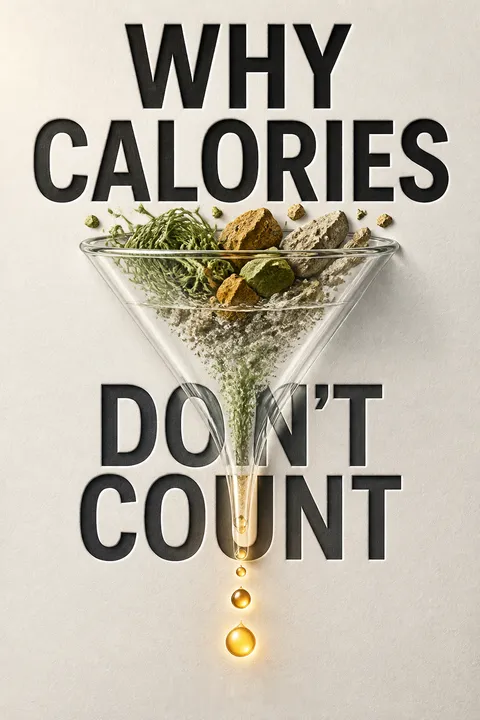


Key Takeaways
Treat calorie labels as estimates of energy, not a verdict on food
A calorie is a measurement. A bomb calorimeter burns food completely and measures the heat it releases. Human digestion is gentler and incomplete, so the energy measured in a laboratory is not necessarily the energy a person absorbs and uses. Yeo calls the usable share caloric availability. It varies with a food’s structure, processing, nutrient mix, and the person eating it. The package numbers mostly rely on Wilbur Atwater’s century-old general factors: 9 calories per gram of fat, and 4 each for carbohydrates and protein. Lulu Hunt Peters helped popularize calorie counting in 1918 after losing 70 pounds by tracking intake.
Energy balance still matters. The body cannot create energy from nothing, but a calorie count alone does not tell the full story of how food affects digestion, appetite, or energy expenditure.
The distinction is between an accounting identity and a practical measurement. Energy balance remains a useful way to describe weight change, just as a household budget balances income and spending. But an approximate food label is not a precise forecast of what a particular body will absorb. That distinction can reduce both false certainty and needless guilt. It also suggests a useful question: what does this food do to fullness and eating patterns, not merely what number does it carry? Labels can inform comparisons, but they cannot rank a food’s total health value.
Build meals around protein to make a calorie deficit easier to sustain
Protein takes more work. Compared with fat and carbohydrates, protein is harder for the body to process. Its digestion and metabolism release more energy as heat, a process called diet-induced thermogenesis. The book estimates a thermic cost of 15 to 30 percent of protein’s usable energy, compared with 5 to 10 percent for carbohydrates and 0 to 3 percent for fat. Protein also tends to make meals more filling. The author describes Roux-en-Y gastric bypass, a surgery that reroutes food through the gut, raising several fullness-related hormones and often changing appetite. Research on higher-protein meals points to a similar, though smaller, effect.
Source matters less than intake. Protein can come from meat, fish, dairy, pulses, tofu, or other plant foods. The book cites about 16 percent of daily energy from protein as a useful reference point, not a universal prescription.
Protein links physiology to behavior: a meal that satisfies hunger for longer can make lower intake less dependent on constant restraint. This is a more realistic route to a calorie deficit than treating appetite as a character flaw. The thermic effect is real, but it should not be mistaken for a dramatic calorie-burning shortcut. The practical value lies in a combination of satiety, nutrient supply, and meal structure. A protein target also needs context: food access, kidney health, cultural preferences, and dietary pattern all affect what is reasonable for an individual.
Most diets succeed by shrinking intake, not through their sales pitch
Look beneath the branding. The book groups many popular approaches by what they change in practice. Atkins and other low-carbohydrate plans often increase protein; keto sharply limits carbohydrates; gluten-free eating can remove many common grain-based foods; and paleo plans exclude grains and legumes. Plant-based approaches often supply more fibre and less energy-dense food. These patterns can help some people eat less without deliberately counting every calorie. Their shared mechanism is a calorie deficit, meaning the body receives less usable energy than it expends.
There is no universal plan. A restrictive diet may work for a while and still be impossible to maintain. The author notes that long-term evidence for keto was limited when the book was written, and that an all-meat carnivore diet lacks fibre and has no established long-term safety record. A workable approach has to fit someone’s biology and daily life.
This is a useful way to evaluate diet claims: separate the proposed mechanism from the measurable behavior the diet produces. Rules can work by changing appetite, available foods, or meal routines, without the advertised theory being correct. Yet the shared calorie-deficit explanation does not make diets interchangeable. Nutritional adequacy, cost, enjoyment, and medical circumstances differ, and short-term weight loss does not establish long-term safety. The strongest test is not whether a plan sounds biologically clever, but whether it produces a healthy pattern that a person can actually keep.
Ultra-processed diets can prompt 500 extra calories a day
Food form can change intake. The NOVA system classifies foods by how and why they are processed, from minimally processed ingredients to industrial formulations. In a 2019 inpatient study, 20 adults ate as much as they wanted while switching between an ultra-processed diet and an unprocessed diet. On the ultra-processed diet, participants consumed about 500 more calories each day, gained roughly 1 kilogram over two weeks, and lost a similar amount on the other diet. Protein intake stayed nearly constant while carbohydrate and fat intake rose.
The category is broad. Many ultra-processed products are high in salt, sugar, and fat, and low in fibre or protein, but the label covers a wide range of foods. Yeo argues it is not a reliable health verdict by itself. In the study, fibre was matched using supplements, and the menus still differed in other ways, so the exact cause of the extra intake remains open.
The inpatient design is valuable because it tests eating behavior under controlled conditions, rather than relying only on people’s memories or food diaries. Its result supports the idea that food environments can shape intake without conscious intention. But a 20-person trial lasting weeks cannot tell how every product, population, or long-term pattern behaves. NOVA is especially useful as a prompt to inspect a food’s ingredients and nutritional profile, not as a stand-alone moral ranking. A classification that treats varied products as one group risks obscuring meaningful differences.
Use fibre to support fullness, bowel health, and gut microbes
Fibre changes the journey. Dietary fibre is plant carbohydrate that human digestive enzymes cannot fully break down. Soluble fibre can form a gel and slow digestion, while insoluble fibre adds bulk to stool and helps it move through the bowel. Some soluble fibre is fermented by gut microbes into short-chain fatty acids, compounds that support gut function and can influence appetite and metabolism. In the 1960s, surgeon Denis Burkitt observed that rural Ugandan diets rich in fibre were associated with bulky stools and fewer of several diseases common in industrialized countries. The association helped establish the Burkitt fibre hypothesis.
The evidence is substantial, not simple. The book reports that a review of 58 trials found 15 to 30 percent lower mortality from several major diseases among people with higher fibre intake. Average intake in the UK and US was only about 18 and 16 grams daily, respectively. The author suggests aiming for more than 30 grams a day.
Fibre is compelling because it acts through several pathways at once: physical bulk, slower digestion, and microbial fermentation. That makes it a better food-quality signal than a single calorie number. The historical comparison Burkitt made helped generate a productive research question, but differences between populations cannot by themselves prove fibre caused differences in disease. The subsequent clinical and epidemiological evidence strengthens the case, while still leaving room for other dietary and social factors. Increasing fibre gradually and through varied plant foods is more practical than treating one supplement or “superfood” as the answer.
Use calorie labels for comparisons, not as exact personal accounting
Portions distort precision. A nutrition panel may give calories for a serving much smaller than what someone actually eats. The book’s examples include a 30-gram cereal serving and 75 grams of dried pasta, amounts many people do not weigh at home. Restaurant portions and shared packages add further uncertainty. Menu calorie information may still help: the author cites evidence that it reduces calories purchased by about 8 percent per meal.
A rough adjustment is only a proposal. Yeo suggests a net metabolisable energy estimate: 9 calories per gram of fat, 3.8 for sugar, 3.6 for complex carbohydrates, and 3.2 for protein. Applying his adjustment to one restaurant meal reduced the label-based total by about 6.6 percent. He presents this as a back-of-the-envelope improvement, not an official replacement for food labels or a personalized calorie target.
This takeaway resists two opposite errors: treating labels as gospel and dismissing them as useless. A number can help compare two similar products or reveal that a portion is larger than expected. It becomes misleading when used as an exact measure of an individual’s energy needs. The proposed adjustment makes the book’s argument tangible, but the apparent precision of decimals can overstate the evidence behind a simplified formula. A stronger everyday use of labels is comparative: notice protein, fibre, sugar, and portion size alongside calories.
Treat weight as biology interacting with environment, not character
Genes shape appetite. Twin studies cited in the book estimate that genetics accounts for roughly 40 to 70 percent of variation in body mass index across populations. This does not mean an individual’s weight is fixed. In the Gemini study of children in England and Wales, BMI heritability was estimated at 86 percent in higher-risk home environments and 39 percent in lower-risk ones. The household assessment included food availability, parental feeding practices, and opportunities for activity.
Storage capacity also varies. Fat cells normally store energy safely, but their ability to expand differs among people. When storage capacity is exceeded, fat can accumulate in organs such as the liver and interfere with their function. Body shape and ancestry also influence risk. Thus, identical weight or BMI does not imply identical health, and a person’s weight cannot be read as a simple measure of willpower.
Heritability is often misunderstood as destiny. It describes how much variation in a population is associated with genetic differences in a particular environment, not how much of one person’s weight is genetically determined. The Gemini findings make the environmental point especially vivid: a trait can appear more heritable when conditions amplify underlying susceptibilities. This shifts the discussion from blame to risk reduction. It also cautions against using BMI as a complete diagnosis. Weight can signal risk, but individual health assessment needs more than a single number.
Make healthy eating possible before demanding better choices
Choice requires resources. The author describes privilege as having money, time, and nutrition knowledge. Someone working multiple jobs may have little time to cook, even if they know what a healthy meal looks like. The book reports that one in five UK children under 15 lived with an adult facing moderate or severe food insecurity. In a separate meal study, ingredients for a 2,000-calorie daily unprocessed menu cost an estimated $151 per week, compared with $106 for the ultra-processed menu.
The environment matters. In Norfolk, England, takeaway outlets increased more quickly in the most deprived areas than in the least deprived ones. These patterns complicate advice to cook from scratch or shop for fresh ingredients. People do make food decisions, but the available options, prices, and time pressures shape those decisions.
This is where nutrition advice becomes a question of policy, not just personal discipline. Food insecurity and obesity can coexist when affordable food is energy dense but poor in nutrients. That apparent contradiction disappears once access and food quality are considered together. The evidence does not mean every person facing hardship has the same diet, or that individual decisions do not matter. It does mean advice is incomplete when it ignores cost and convenience. Public health improves when healthier options become affordable and accessible, rather than merely more heavily promoted.
Track protein, fibre, and sugar; choose a pattern you can keep
Use food as the guide. After 29 days eating a whole-food plant-based diet, Yeo lost 4 kilograms and his cholesterol fell by 12 percent. When he returned to unrestricted animal-based eating, he regained 2 kilograms in five days. He took a lasting lesson from the experiment, reducing meat rather than giving it up entirely. His flexitarian routine includes vegan lunches and several meat-free dinners each week.
Choose measures with context. The book’s practical reference points are protein at about 16 percent of daily energy, fibre above 30 grams a day, and free sugars below 5 percent of daily energy. Free sugars include added sugars, honey, syrups, and sugars in fruit juice, but not sugar within whole fruit. These are guideposts, not a one-size-fits-all prescription. A sustainable eating pattern should also account for medical needs, culture, budget, and preference.
The personal experiment illustrates both the appeal and the limit of a named diet: a change can produce measurable benefits, while the return to old habits can quickly reverse some of them. The durable result came from adapting the pattern rather than preserving a temporary challenge unchanged. The suggested nutrient targets offer more useful prompts than calorie fixation, but they are still population-level advice and cannot replace clinical guidance. The broader principle is to focus on food composition and repeatable routines, while treating weight change as one possible outcome rather than the sole measure of health.
Analysis
The book’s central move is to preserve energy balance while challenging the assumption that package calories are a precise measure of the energy a particular person obtains from food. This is a productive distinction. A physical law can be correct while the measurements used to apply it are rough, and while the behavior implied by a simple equation is difficult to sustain. The book joins food chemistry to appetite, food processing, genetics, and social inequality, making weight management less like arithmetic and more like a system of interacting constraints.
Its strongest evidence is varied in quality. The controlled inpatient study of ultra-processed eating demonstrates that food form can change voluntary intake under specified conditions. The twin and household studies show that biological susceptibility is expressed differently across environments. Historical observations about fibre helped generate hypotheses, while later trials and reviews provide broader support. The author generally avoids treating these distinct forms of evidence as equally decisive, though readers should remember that associations between dietary patterns and disease can reflect multiple factors.
The proposed net metabolisable energy values are the least secure practical element. They are an accessible illustration of thermic differences, but the fixed factors simplify complex foods, individual variation, and preparation effects. They should not be mistaken for a validated personalized calorie system. This potential weakness does not undermine the book’s larger insight: food quality changes satiety, absorption, and the effort required to process nutrients.
The most consequential contribution is ethical as well as scientific. By connecting appetite biology to affordability, time, and food access, the book challenges the idea that obesity is simply a failure of discipline. Its advice is strongest when it moves from prohibitions to useful priorities: protein, fibre, less free sugar, less red and processed meat, and eating patterns people can maintain. The resulting model is neither “calories are meaningless” nor “just count harder.” It is that energy matters, but food and context determine how energy balance is lived.
Review Summary
Why Calories Don't Count received mixed reviews, with readers appreciating the author's scientific expertise and accessible writing style. Many found the book informative and thought-provoking, praising its exploration of calorie measurement, digestion, and diets. However, some criticized the misleading title and overly technical sections. Readers valued the debunking of fad diets and insights into food insecurity. While some found the personal anecdotes entertaining, others felt they detracted from the core message. Overall, the book was seen as a valuable resource for understanding the science behind weight management and making informed dietary choices.
People Also Read




Glossary
caloric availability
Energy the body can useThe amount of energy a person can extract from food through digestion and metabolism. It differs from the food’s total heat of combustion and from the calorie estimate printed on a package. Food structure, processing, fibre, nutrient composition, and individual digestion all affect how much energy becomes available.
Atwater general factor system
Standard food-energy estimatesA system developed by Wilbur Atwater that estimates food energy using average factors: 9 calories per gram of fat, and 4 calories per gram of carbohydrate or protein. The figures account for average digestion and energy losses, but do not fully reflect differences among foods, fibre content, processing, or the heat produced during metabolism.
diet-induced thermogenesis
Heat from processing foodThe increase in energy expenditure that occurs after eating as the body digests, absorbs, metabolizes, and stores nutrients. The amount varies by macronutrient. Protein generally has a higher thermic cost than carbohydrate, while fat has the lowest. This energy is released as heat rather than stored or used to produce ATP.
Net metabolisable energy
Estimated energy after processingA proposed way to estimate food energy after accounting for some energy lost as heat during metabolism. Yeo suggests using 9 calories per gram of fat, 3.8 for sugar, 3.6 for complex carbohydrates, and 3.2 for protein. He presents these as rough general estimates, not as an official or individualized replacement for current food labels.
NOVA
Food processing classificationA food classification system that groups foods according to the extent and purpose of processing. It distinguishes unprocessed or minimally processed foods, culinary ingredients, processed foods, and ultra-processed products. The system is designed to describe processing, not directly to rank every item’s nutritional quality, so foods within a group can differ substantially.
protein leverage hypothesis
Protein intake may shape eatingA hypothesis that people regulate food intake partly to obtain a relatively consistent amount of protein. When a diet contains a lower proportion of protein, a person may eat more total food, including carbohydrate and fat, while attempting to meet protein needs. Yeo discusses this idea in connection with greater calorie intake on an ultra-processed diet.
Burkitt’s fibre hypothesis
Low fibre linked with diseaseA hypothesis developed by surgeon Denis Burkitt from observations of dietary and disease patterns in Uganda and Britain. It proposed that low-fibre diets contribute to bowel disorders and other diseases common in industrialized societies. The idea prompted extensive research, though early population comparisons alone could not establish that fibre was the cause.
glycaemic index
Rate of blood glucose riseA rating system comparing how quickly carbohydrate-containing foods raise blood glucose relative to pure glucose. Foods with more intact structure, fibre, or protein often produce a slower rise, although preparation and accompanying ingredients also matter. The index is measured for foods eaten in isolation and does not, by itself, determine whether a food or meal is healthy.
FAQ
1. What is Why Calories Don’t Count by Giles Yeo about?
- Challenging calorie myths: The book debunks the idea that all calories are equal and that simply counting them leads to weight loss.
- Science of weight loss: Giles Yeo explores the history, measurement, and science of calories, digestion, metabolism, and how different foods yield different amounts of usable energy.
- Societal and dietary context: The book also examines the impact of ultra-processed foods and socioeconomic factors on obesity and health.
2. Why should I read Why Calories Don’t Count by Giles Yeo?
- Debunks common diet advice: The book exposes why calorie counts on packaging are often misleading and why popular dieting advice can be flawed.
- Empowers informed choices: Readers gain a deeper understanding of how the body processes food, enabling healthier and more confident food decisions.
- Addresses social context: Yeo discusses how privilege, environment, and food insecurity affect diet and health, encouraging empathy and awareness.
3. What are the key takeaways from Why Calories Don’t Count by Giles Yeo?
- Calories are not equal: The calories listed on food labels do not reflect the actual usable energy our bodies extract.
- Protein and fiber matter: Foods high in protein and fiber are more satiating and provide fewer net calories, aiding weight management.
- Focus on health, not weight: Prioritizing overall health and food quality is more effective than obsessing over calorie counting or weight alone.
4. How does Giles Yeo define and explain “caloric availability” in Why Calories Don’t Count?
- Usable energy concept: Caloric availability is the number of calories our bodies can actually extract and use from food, which is often less than the total or labeled amount.
- Influencing factors: Protein and fiber reduce caloric availability because protein requires more energy to metabolize and fiber is largely indigestible.
- Dietary implications: Understanding caloric availability helps explain why high-protein, high-fiber diets can promote weight loss even if calorie counts appear similar.
5. How are calories in food measured, and why are calorie labels often inaccurate according to Giles Yeo?
- Bomb calorimeter method: Food calories are measured by burning food in a bomb calorimeter, capturing all released heat, which overestimates usable energy.
- Atwater factors: Standard calorie counts use Atwater factors, which adjust for digestion but still oversimplify the complex process of metabolism.
- Label limitations: These methods ignore individual differences, food processing, and energy lost as heat, making calorie labels rough estimates rather than precise values.
6. What is the Atwater factor system, and why does Giles Yeo critique it in Why Calories Don’t Count?
- Definition: The Atwater system assigns fixed calorie values to fat, carbs, protein, and alcohol based on early digestion studies.
- Historical context: Developed over 120 years ago, these factors still underpin most food labeling worldwide.
- Critique: The system oversimplifies digestion and metabolism, failing to account for energy lost as heat or differences in food processing, leading to inaccuracies in actual usable calories.
7. How does the human body convert food into usable energy, as described in Why Calories Don’t Count?
- Digestion and absorption: Food is broken down into proteins, fats, and carbohydrates, which are absorbed into the bloodstream.
- ATP production: These nutrients are metabolized in cells to produce ATP, the body’s energy currency, through processes like glycolysis and the Krebs cycle.
- Energy storage and use: Excess nutrients are stored as glycogen or fat, and ATP powers all bodily functions, with energy expenditure divided into basal metabolism, activity, and thermogenesis.
8. What role do protein and fiber play in weight loss and satiety according to Giles Yeo?
- Protein’s satiating effect: Protein is more filling than fats or carbs, reducing hunger and overall calorie intake.
- Higher energy cost: The body expends more energy digesting and metabolizing protein, increasing diet-induced thermogenesis.
- Fiber’s benefits: Fiber slows digestion, supports gut health, and reduces net calorie absorption, aiding weight management and lowering disease risk.
9. How does Why Calories Don’t Count by Giles Yeo address ultra-processed foods and their impact on health?
- Definition and classification: Ultra-processed foods are industrial products with many additives, classified as Group 4 in the NOVA system.
- Health risks: These foods are typically high in sugar, salt, and fat, but low in protein and fiber, making them more calorically available and linked to weight gain.
- Socioeconomic factors: Ultra-processed foods are often cheaper and more accessible, especially in deprived areas, contributing to health inequalities.
10. What does Giles Yeo say about the relationship between privilege, food insecurity, and obesity in Why Calories Don’t Count?
- Food insecurity in wealthy nations: Even in rich countries, millions lack consistent access to nutritious food, affecting diet quality.
- Deprivation and diet: Lower socioeconomic status leads to reliance on cheaper, ultra-processed foods, increasing obesity risk.
- Challenging stigma: Yeo urges readers to recognize systemic issues and privilege, rather than blaming individuals for their weight or food choices.
11. What practical dietary advice does Giles Yeo offer in Why Calories Don’t Count?
- Focus on nutrient quality: Prioritize protein (~16% of daily energy), fiber (>30g/day), and limit free sugars (<5% of daily energy).
- Moderation and sustainability: Choose diets that fit your biology and lifestyle, such as flexitarian approaches, for long-term success.
- Navigating real-world choices: When eating ultra-processed foods, select options higher in protein and fiber and lower in sugar, salt, and fat.
12. How does Giles Yeo propose redefining calorie counting with “net metabolisable energy” in Why Calories Don’t Count?
- Limitations of current labels: Traditional Atwater factors don’t account for energy lost during digestion and metabolism.
- Adjusted values: Yeo suggests more accurate values—9 cal/g fat, 3.8 cal/g sugar, 3.6 cal/g complex carbs, 3.2 cal/g protein—to reflect usable energy.
- Dietary impact: This correction helps explain why high-protein and high-fiber diets are more effective for weight loss, even when calorie counts appear similar.
About the Author
Other books by Giles Yeo
Download PDF
Download EPUB
.epub digital book format is ideal for reading ebooks on phones, tablets, and e-readers.








