

Key Takeaways
Europe conquered through a military tournament, not germs alone
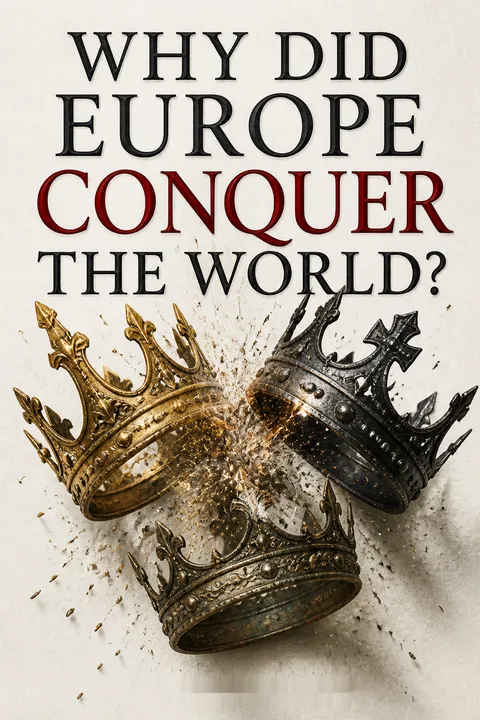
A dramatic reversal. Around 900, western Europe was poor, politically divided, and less technologically advanced than the Middle East or China. By 1914, European powers controlled or had conquered roughly 84 percent of the world’s land, including territories that later became independent. The puzzle is not simply why Europeans could conquer, but why they developed the military advantage that made conquest possible when other Eurasian societies also had guns, horses, and immunity to many crowd diseases.
The answer begins with competition. Philip Hoffman argues that European rulers repeatedly fought one another, spent heavily on war, and improved the weapons, ships, fortifications, training, and administration used to fight. Disease helped European conquest in the Americas, but it cannot explain Portuguese coercion in South Asia or European expansion across Asia and Africa. The book traces the military race to political conditions that differed across Eurasia.
The opening reversal makes a useful distinction between having an advantage and explaining how it arose. Disease helps explain why conquest could be devastating in the Americas, but it cannot explain why Europeans arrived there with the tools and ambitions to conquer. The argument also resists treating later European dominance as inevitable. Its strongest move is to ask what produced military capacity before industrialization, rather than crediting industrialization with an earlier advantage it had not yet created.
War improves weapons only when rivals can spend and learn
Competition has conditions. Hoffman calls the recurring European contest a tournament: rulers compete for prizes such as territory, commercial advantage, religious victory, or prestige. The model predicts military innovation when rival powers can challenge one another, the prizes matter enough to justify war, and the political costs of raising resources are both low and comparable. Spending must be substantial, armies must rely on the technology being improved, and innovations must be accessible across borders.
War is not enough. A ruler may fight often but spend too little to generate much learning. A state facing nomadic enemies may invest in cavalry rather than artillery and firearms. And a state unable to copy a rival’s tactics, equipment, or expertise may not catch up. The model therefore explains not just how rivalry can produce innovation, but why similar-looking wars can have very different technological results.
The tournament model separates rivalry from the capacity to turn rivalry into accumulated knowledge. That distinction matters beyond military history: competition produces progress only when organizations can finance experimentation, retain what works, and transfer lessons between teams. The framework is especially powerful because it identifies several bottlenecks instead of treating conflict as a magic innovation engine. Its simplification is also worth remembering: real states have shifting alliances, mixed motives, and changing fiscal constraints, so the model clarifies mechanisms rather than predicting every war.
Rulers chased glory while subjects financed the battlefield
Private rewards, public costs. Early modern European rulers often pursued glory, reputation, territory, commercial advantage, or religious victory. These prizes could be difficult to divide through negotiation. A ruler might gain prestige from winning while subjects bore much of the cost through taxes, conscription, and destruction. In the 1780s, military spending reached about 7 percent of France’s GDP and 12 percent of Britain’s. In major powers, war absorbed 40 to 80 percent of government budgets, before some debt and subsidies were counted.
Elites often supported war. Nobles treated military service as an honor and a route to status, while merchants could expect commercial gains from victories at sea. Defeat rarely cost a major ruler his throne before 1790, limiting the personal downside. This uneven distribution of rewards and costs helps explain why rulers chose conflict even when ordinary people might have preferred peace.
This is a classic principal-agent problem: leaders choose policies whose benefits they capture while spreading much of the cost across others. The framework helps explain why a war can be politically attractive even when its social return is poor. It also cautions against describing state spending as a unified public preference. Still, elite motives were not the whole story. Rulers needed allies, credit, and compliance, so the ability to mobilize resources depended on bargaining with groups whose interests were not identical to the crown’s.
Europe's military productivity surged before the Industrial Revolution
A measurable lead. European military improvement did not wait for steam engines or factories. Between 1600 and 1750, the rate at which a French infantryman could fire successfully rose about tenfold, as firearms improved and bayonets replaced separate pike-bearing soldiers. Hoffman estimates labor productivity growth in this area at roughly 1.5 percent annually, an extraordinary pace for a preindustrial economy.
The gains reached beyond weapons. Better tactics, discipline, provisioning, ship design, and administration made each soldier or sailor more effective. The relative price of English pistols fell sixfold between the mid-sixteenth and early eighteenth centuries, another sign of improving production. British copper sheathing made ships faster and reduced time spent in repair. These examples show why military technology means an entire system, not just the object held by a soldier.
The productivity lens makes military history more than a chronology of clever inventions. It asks whether a society can produce greater capability from its labor and equipment, and it reveals unusually rapid improvement in a sector where the evidence can be measured. The system-wide definition is persuasive: a faster gun is less useful without training, supply, and organization. But fire rates and prices are proxies, not complete measures of battlefield effectiveness. The book acknowledges this, and the distinction guards against mistaking a measurable improvement for automatic victory.
Frequent fighting did not guarantee Asian military innovation
Similar wars, different outcomes. China fought foreign wars during about 56 percent of the years from 1500 to 1799, but roughly 97 percent of those conflicts were against nomads, for whom mounted archers and frontier defenses often mattered more than firearms. China did innovate during periods of heavy gunpowder warfare, particularly in the late sixteenth and seventeenth centuries, then lost momentum as conflict and incentives changed. Japan’s warlords improved firearms and tactics during civil war, but innovation slowed after Tokugawa unification ended internal competition.
India is the clearest test. Eighteenth-century India experienced near-constant war, yet its rival states struggled to collect taxes and control resources held by local elites. Succession struggles also made victory less secure. Spending and innovation remained limited, and many advances came from European experts. The cases show why frequency of war alone cannot explain Europe’s lead.
These comparisons are the book’s strongest test of a simple arms-race explanation. China, Japan, and India do not fit a single story of cultural reluctance or technological incapacity. Their changing incentives help explain why innovation rose in some periods and stalled in others. The comparisons also prevent a misleading equation between military lag and general backwardness. A limitation is that the evidence is uneven across states and technologies, so the model’s broad pattern is more secure than every individual ranking or causal attribution.
Political history fragmented Europe and kept its arms race alive
Fragmentation was not geography’s verdict. Europe was not more mountainous than historical China, and coastal irregularity does not explain why European peninsulas remained divided. Hoffman instead traces Europe’s political fragmentation to centuries of conflict after Rome’s collapse. In this period, warrior groups and their leaders developed strong loyalties to their own communities and hostility toward rivals. The independent western Church also resisted rulers who might reunite Charlemagne’s former realm, using alliances and religious authority to limit their power.
China followed another path. Repeated unification produced a central bureaucracy that tied elite advancement to service in the imperial state. That structure helped preserve political unity, including under conquerors who could take over the existing administration. A fragmented Europe had several comparable powers capable of fighting each other; a unified China was often the regional hegemon. These outcomes shaped which enemies rulers faced and which military technologies they had reason to improve.
The argument treats institutions and political boundaries as historical outcomes rather than as direct reflections of terrain or timeless national character. That shift makes the comparison more dynamic: a bureaucracy, a church, or a coalition of elites can redirect incentives across generations. It also challenges tidy geographical explanations without denying that geography matters. The account’s cultural-evolution argument is more speculative than its fiscal evidence, however. Explaining how warfare shaped shared norms across centuries requires more than showing that both warfare and group loyalty existed.
Tax bargains turned wartime pressure into lasting state capacity
Political learning changed the cost of war. Hoffman uses political learning for the process by which rulers and successors found ways to raise more revenue or borrow more easily. In France, a military defeat in 1356 left King John II captive. His son, Charles V, secured permanent taxes by negotiating with elites and showing that revenue could provide protection against disorder. In Brandenburg Prussia, Frederick William exchanged concessions to nobles for taxes, then used military strength to make higher levies permanent.
Institutions made a difference. England’s Glorious Revolution of 1688 to 1689 strengthened Parliament’s control over taxation and spending. It also helped the government borrow on a larger scale and at lower cost. These arrangements reduced the political obstacles to mobilizing resources. The resulting capacity was uneven across Europe, but its strongest states could fund larger armies and navies than rivals in much of Eurasia.
The idea of political learning links institutional change to practical trial and error. War creates pressure, but negotiation and administrative innovation determine whether that pressure leaves behind durable capacity or only temporary extraction. This complicates the claim that stronger states simply emerge from conflict: revenue depends on credibility and cooperation, not force alone. The model also highlights a tradeoff. Institutions that make governments better at raising money can support public security, but they can equally make sustained warfare easier to finance.
Private ventures carried Europe's weapons advantage into overseas conquest
Private hands, public origins. Cortés and Pizarro were private adventurers, not commanders of enormous royal armies. Their expeditions could draw on weapons, veterans, and military knowledge already common in Europe. Cortés even had thirteen small armed vessels built and transported across rough terrain to help capture Tenochtitlan. Yet the rulers’ far larger military budgets, rather than small private expeditions, had driven much of the earlier technological improvement.
Companies joined profit to force. The Dutch and British East India Companies raised private capital, traded overseas, and fought competitors. The British Company eventually used its military power to conquer much of India. Entrepreneurs elsewhere faced stronger barriers, including limits on overseas travel or private gun ownership. In the Ottoman Empire, commercial law made it difficult to create a long-lived corporation able to raise capital for distant, risky projects. Europe’s military edge could therefore flow into private ventures with fewer obstacles.
The passage from public investment to private conquest is central to the explanation. Military capacity developed for rivalry at home became an asset that merchants and adventurers could deploy abroad, while profit gave them reasons to take risks governments could not easily supervise at a distance. This resembles a broader pattern in which public infrastructure enables private activity, without guaranteeing that the resulting activity serves the public. The contrast among legal systems is useful, though it should not be mistaken for a claim that private enterprise was absent elsewhere.
Research kept Europe's weapons race running through relative peace
War gave way to an armed peace. After 1815, European powers fought less often within Europe. Glory and religious victory mattered less, while defeat carried higher risks for rulers and governments. Negotiating became easier. But military spending continued, supported by more uniform tax systems, representative institutions, nationalism, and conscription. In the six major European powers Hoffman studies, real military spending rose about 1.7 percent per year from 1816 to 1913, even after accounting for temporary wartime increases.
Innovation no longer required battle. Research and development, engineering, and industrial production improved rifles, artillery, ships, and supply systems. The theoretical lethality of field artillery rose dramatically, while railways and steam power helped transport and supply large forces. By 1914, European empires controlled or had conquered roughly 84 percent of the world’s land. Reduced fighting at home did not mean an end to coercion abroad.
This account distinguishes peace from demilitarization. Once research can produce military advantage without battlefield learning, states can sustain competition during periods without major wars. The nineteenth century therefore changes the mechanism, not the underlying contest. The framework also shows how industrial capacity amplifies military power through transport and supply, not only through more destructive weapons. The caution is that technical lethality does not translate mechanically into control: tactics, logistics, disease, local resistance, and political choices still shape what weapons accomplish.
Empire's costs fell on ordinary people, not just conquered societies
Conquest brought gains and devastation. Europeans acquired American silver, crops, and opportunities to profit from trade and slavery. But conquest also destroyed Indigenous communities, enabled the slave trade, and financed further wars. In Europe, war meant crushing taxes, violence by poorly disciplined troops, and damage to agriculture. The book notes that British empire between 1880 and 1912 required a subsidy rather than generating an overall profit, while redistributing income toward wealthier groups.
Industrialization remains contested. Some historians argue that military victories won Britain overseas trade, raised wages, and helped make labor-saving inventions worthwhile. Hoffman treats this as plausible but unproven. He points to the importance of skilled human capital and political institutions, and notes that most major British industrial inventors had no military connection. The military tournament may have contributed to economic change, but it does not erase the costs or supply a complete explanation of the Industrial Revolution.
The conclusion refuses to treat national power as a synonym for general welfare. A state may grow richer or more influential while its ordinary taxpayers, conquered populations, and enslaved people bear the losses. That distributional question is essential whenever military success is presented as a national achievement. The discussion of industrialization is strongest when it separates plausible mechanisms from demonstrated causes. Even if war helped create some conditions for growth, the evidence does not justify turning suffering into a simple story of progress.
Analysis
Hoffman’s central contribution is a causal sequence rather than a single-factor answer: political history shaped state size, elite incentives, and fiscal capacity; those conditions shaped military competition; competition financed learning and innovation; and military capacity could then be redirected into private overseas ventures. This sequence explains why the same technology and frequent warfare produced different results across Eurasia. It also prevents the familiar mistake of making industrialization the cause of a European advantage that existed before factories transformed the economy.
The tournament model is most persuasive when used comparatively. China’s wars against nomads, Japan’s innovation before unification, and India’s eighteenth-century conflicts reveal that warfare alone is insufficient. The crucial variables are what rulers are fighting for, how much they can mobilize, which military technology suits their enemies, and whether they can learn from rivals. The model converts these differences into a coherent analytical framework, while the historical cases supply causal texture.
Its limits are equally important. Political history explains why the model’s conditions differed, but those explanations include long chains of cultural change and institutional persistence that are harder to test than tax revenue or weapons prices. The model also privileges rulers’ choices and military outcomes. The same history looks different from the perspective of people taxed, conscripted, enslaved, displaced, or killed. Finally, Europe’s military lead was not universal or unstoppable: Asian states innovated, resisted, and sometimes defeated Europeans, while technology’s effectiveness depended on tactics, logistics, distance, and allies.
The book’s strongest implication is therefore not that war reliably creates progress, but that institutions determine who can convert conflict into durable capability, and who pays for it. European expansion was a contingent historical outcome, not proof of an inherent civilizational superiority. Its military success carried economic consequences, but the gains were uneven, and the proposed link between empire and the Industrial Revolution remains debated.
People Also Read









Glossary
Tournament
rivalry for a prizeHoffman’s model of rulers competing for prizes such as territory, prestige, religious victory, or commercial advantage. War and military spending are more likely when prizes are valuable, rival powers are sufficiently comparable, and the political costs of mobilizing resources are low. Repeated contests can generate military innovation when spending creates opportunities to learn.
Gunpowder technology
integrated military capabilityThe broad military system built around firearms, artillery, armed ships, and fortifications, together with the tactics, training, discipline, logistics, and administration that made them effective. Hoffman uses the term broadly because weapons alone cannot explain military performance. The system changed over time, as innovations such as bayonets replaced pikes and improved ships carried more effective artillery.
Learning by doing
improvement through useMilitary innovation generated through the practical experience of making, using, and adapting weapons and organizations. Wars reveal which tactics and equipment work; rulers and military personnel can then revise methods or copy successful opponents. In Hoffman’s model, greater military spending creates more opportunities for this learning, although new knowledge and access to rivals’ innovations also matter.
Political learning
lowering mobilization costsThe process through which rulers develop ways to raise taxes, borrow, or otherwise mobilize military resources at lower political cost. It may involve bargaining with elites, administrative change, or financial innovation. Successful arrangements can benefit successors, as when wartime negotiations establish lasting taxes or political changes make government borrowing easier.
Parochial altruism
loyalty paired with hostilityA pattern of behavior in which people show strong loyalty and willingness to sacrifice for their own group while displaying hostility toward outsiders. Hoffman uses the concept to explain how warrior societies without centralized states could organize defense and raids. Punishing or shaming those who shirked could strengthen cooperation within a group.
Armed peace
deterrence without major warA condition in which rival states maintain substantial military forces and continue competing, but avoid frequent direct wars. Hoffman applies the idea to much of nineteenth-century Europe, where changing political incentives made negotiated settlements more likely. Military spending and research nevertheless continued, allowing weapons and military systems to improve during relative peace.
The Princeton Economic History of the Western World Series Series




Download PDF
Download EPUB
.epub digital book format is ideal for reading ebooks on phones, tablets, and e-readers.








