

Key Takeaways
Treat the New Deal as democracy rebuilt, not merely an economy rescued
A change in purpose. The New Deal did more than try to restart business after the Depression. It expanded the federal government’s role in jobs, workers’ rights, public power, retirement income, and unemployment support. Roosevelt argued that people needed a working connection to their government, not simply assurances that prosperity would return. The program’s public buildings, parks, roads, and libraries made that claim tangible: they were shared places built with public money and labor.
A lasting daily presence. Social Security, unemployment insurance, bank protections, and labor laws became part of ordinary life. So did thousands of public works projects. Rauchway’s point is that the New Deal matters partly because its institutions became so familiar that their origins are easy to miss. The crisis response altered the baseline of what Americans could expect government to do.
The book’s strongest move is to define democracy through everyday material experience. A right written on paper can feel remote; a pension arriving, a library opening, or a public job can make collective institutions legible. This connects political legitimacy to state capacity: people are more likely to regard government as theirs when it demonstrably solves shared problems. Yet visible provision alone is not democratic proof. The same state can build public goods while distributing them unjustly. The New Deal’s legacy is therefore best understood as a continuing test: does public action expand people’s ability to participate, and who gets left outside the public?
When government answers desperation with force, dictatorship can seem plausible
A capital turned battlefield. In 1932, unemployed veterans known as the Bonus Army camped in Washington to demand early payment of a bonus promised for their wartime service. After Congress rejected the payment, Hoover’s administration sent troops to clear the camps. Soldiers used tear gas and burned the settlement; two veterans, William Hushka and Eric Carlson, were killed by police during the conflict. General Douglas MacArthur also ignored repeated orders to stop the military operation.
A different response. Roosevelt still opposed paying the bonus immediately, but in 1933 he offered returning marchers food, shelter, and places in the Civilian Conservation Corps. Eleanor Roosevelt visited their camp. Most accepted work. The contrast was not simply generosity versus austerity. It showed that government could respond to protest with useful employment rather than treating the petitioners as enemies.
This episode makes democratic stability feel less abstract. Economic distress can erode trust, while a forceful response can persuade citizens that public institutions serve order before people. The useful distinction is not between a state that acts and one that stays out of the way. It is between action that recognizes citizens as participants and action that reduces them to a threat. The Bonus Army’s politics also resist easy moral sorting: some leaders flirted with authoritarian ideas, yet their followers had a legitimate grievance. Protest movements can contain dangerous currents without making the underlying need illegitimate.
Build public capacity that improves whole regions, not isolated balance sheets
A river as a public system. The Tennessee Valley Authority, or TVA, treated electricity, flood control, navigation, farming, and soil conservation as connected problems. Its Norris Dam was part of a regional plan, not just a power plant. The government’s role also created a public comparison point for private utilities, helping expose excessive prices and pressuring monopoly profits downward. By the 1950s, more than 1.3 million people used affordable TVA electricity, manufacturing grew faster than the national average, and regional income rose substantially.
Planning with consequences. The TVA’s dams controlled floods, slowed erosion, and helped clear the river. But the Norris reservoir displaced about 3,500 families, and some tenants received little assistance. The model demonstrated the reach of coordinated public investment, while also showing that regional gains do not automatically compensate people forced to bear a project’s costs.
The TVA offers a powerful case for treating infrastructure as a system of complements. Power matters more when paired with transport, skilled work, flood management, and agricultural improvement. This resembles modern approaches to regional development, where isolated subsidies often underperform because bottlenecks remain elsewhere. The public utility also illustrates a less familiar form of market intervention: government can provide a benchmark without taking over the entire sector. The caution is equally important. Aggregate measures of prosperity can conceal concentrated losses. A credible development plan needs not only a regional balance sheet, but also a clear account of displacement, consent, and compensation.
Measure public progress by who benefits, who is displaced, and what it enables
Modernity had a price. The TVA helped transform a poor, flood-prone valley, but its reservoir required the purchase of roughly 150,000 acres. Families dismantled homes and moved; tenant farmers, who owned no land, could lose their livelihood without receiving compensation for property. The program’s environmental purpose also changed over time. War production and later energy demand pushed the TVA toward coal and nuclear power, complicating its original promise of sustainable regional development.
Power can be repurposed. Cheap TVA electricity helped make nearby Oak Ridge a viable site for the secret atomic-weapons project during World War II. The river’s energy, first harnessed as part of a public development plan, became part of the machinery of war. The story does not erase the TVA’s gains. It shows that infrastructure creates capacities whose later uses may depart sharply from their founding aims.
Large projects are often judged by outputs that are easy to count: megawatts, miles, jobs, or regional income. This chapter encourages a fuller accounting that includes involuntary relocation and the long life of built systems. Infrastructure is path-dependent: once a dam, grid, or transport corridor exists, it shapes which industries become practical and which political choices become easier. That can be a benefit, but it can also narrow future options. Public planning is not automatically farsighted simply because it is public. Its democratic quality depends on whether affected communities can influence decisions and whether later generations can revise the original bargain.
Respect self-government by listening when expert plans threaten local livelihoods
Investment and sovereignty. The Indian New Deal funded conservation work, schools, hospitals, water systems, and the Navajo council house at Window Rock. It also sought to reverse the federal policy of breaking up tribal lands and to support Native self-government. The council house, built largely by Navajo workers with local materials, made tribal governance visible and practical.
Good intentions were not enough. John Collier’s office tried to reduce sheep and goat herds to prevent erosion, but the policy threatened a central source of Navajo wealth and independence. Officials imposed an across-the-board sheep reduction despite warnings that small herders would suffer more. A later goat-buying program left many animals to rot after the packing company could not process them. Navajo voters rejected the Wheeler-Howard reorganization measure in 1935, partly amid anger over these policies. Their refusal was itself an exercise of self-determination.
This history distinguishes participation from consent. A program may employ local people, use local materials, and promise autonomy while still overriding local judgment about what makes a livelihood viable. The Navajo case also complicates the assumption that conservation is politically neutral. To an administrator, fewer animals may protect soil; to a herder, livestock may represent security, wealth, and freedom from wage dependence. Effective policy needs ecological knowledge and cultural knowledge in the same room. Consultation cannot be a ceremonial step after the plan is already designed; it must be able to change the plan.
Count who is excluded: New Deal benefits and racial harms shared one state
Relief and discrimination coexisted. New Deal programs helped many African Americans find work, and the WPA barred racial discrimination in its projects. Advisors including Robert Weaver and William Hastie challenged discriminatory practices, while the group known as the Black Cabinet brought Black perspectives into federal policy. The administration’s record also helped shift many Black voters toward the Democratic Party.
The exclusions were structural. Southern officials often administered programs through Jim Crow systems. The Social Security Act initially excluded domestic and agricultural workers, jobs held by many Black Americans. Housing agencies relied on real-estate practices that treated integrated or Black neighborhoods as risky, restricting access to mortgages and reinforcing segregation. Hunters Point in San Francisco illustrates how such housing discrimination became connected to enduring patterns of low homeownership, pollution, and poor health. The New Deal expanded public power, but did not distribute its protections equally.
The chapter rejects the comforting idea that broad social programs are automatically universal. Administrative categories can appear neutral while tracking older inequalities in work, wealth, and residence. This is a useful lesson for policy design: measure not only who is formally eligible, but who can actually access a benefit and what barriers shape that access. The New Deal’s coalitions also reveal a political tradeoff. Roosevelt protected southern support for relief legislation by avoiding a direct fight over civil rights, but that compromise preserved the power of segregationists. Material progress and racial justice were linked, yet they were never interchangeable.
Give people paid work and public spaces that make citizenship tangible
Work as a public relationship. Roosevelt argued that direct employment could give jobless people income and a visible connection to government. The Works Progress Administration hired millions for projects that ranged from roads and sidewalks to schools, parks, and public art. Its workers built or improved 572,000 miles of rural roads and laid about 24,000 miles of sidewalks. Such projects made daily life safer and connected communities, while wages put money into local economies.
Culture counted as work. The WPA also paid artists, musicians, writers, and actors. The Federal Writers’ Project produced state guides that recorded local histories and landscapes; public murals portrayed ordinary labor as worthy of civic attention. The programs were imperfect, including narrow assumptions about women’s work, but they treated cultural production and public space as parts of national life, not luxuries reserved for prosperous times.
The argument joins economic security to civic recognition. A paycheck addresses immediate need; a public project can also signal that the worker’s effort belongs to a shared undertaking. The arts programs widen that claim by making communities see themselves represented in public places and records. This is close to the idea of co-production, in which citizens help create the services and environments they use. Still, the dignity of work should not become a reason to stigmatize direct cash support. Employment is valuable when it is useful and fairly paid, not because people in hardship must prove their worth through labor.
Do not mistake recovery for repair, or small programs for sufficient ones
The recovery was incomplete. The New Deal’s jobs programs expanded in stages, and officials repeatedly reduced support too soon. The Civil Works Administration quickly hired millions, but ended in 1934 as its funding ran out. In 1937, Roosevelt cut WPA employment before the economy had fully recovered; a recession followed, and the administration had to expand the program again. Wartime budgets eventually reached roughly ten times the largest New Deal budgets, and wartime employment absorbed the remaining unemployment more decisively.
Reform went beyond stimulus. Rauchway argues that the New Deal sought to remodel economic and political arrangements, not simply return to pre-crash normality. Its ideals reached into postwar commitments to labor standards, social security, and human rights, though they were never fully realized. Present-day appeals to a Green New Deal draw on that ambition: public action can reshape the conditions producing a crisis, rather than merely cushion its immediate effects.
This closing distinction remains useful in crisis policy. Stabilization prevents a collapse; structural reform asks why the system was so vulnerable and who bore the damage. The New Deal’s stop-start record shows that good intentions and new agencies do not guarantee adequate scale or timing. A policy can be popular, visible, and still too small for the problem it addresses. At the same time, wartime mobilization is not a clean template for peacetime democracy: its spending power came with coercion and a military purpose. The deeper lesson is to match public capacity to the scale of need while keeping democratic accountability central.
Analysis
Rauchway builds the case for the New Deal through places rather than a list of laws. Arlington turns policy into a question of how a government treats desperate citizens. Norris Dam shows regional planning as a practical alternative to leaving infrastructure and poverty to market forces. Window Rock and Hunters Point then complicate any celebratory account: federal power could expand Native self-government while overriding Navajo choices, and deliver jobs or services while reinforcing racial exclusion. The final walk through ordinary streets connects those political bargains to the sidewalks and public spaces still used every day.
The book’s central historical claim is not that the New Deal solved the Depression or fulfilled its democratic promise. Its programs were uneven, often inadequate in scale, and shaped by political compromises that protected white supremacy. Rather, the New Deal changed what Americans could imagine government might responsibly do. It made public employment, social insurance, regional planning, and federal responsibility for economic security part of the political landscape. Its influence extended beyond domestic institutions to wartime and postwar language about freedom from want and fear.
The book is especially persuasive when it treats public works as both material construction and political communication. A road or library can demonstrate capacity, but it can also reveal whose labor and needs count. That dual perspective avoids two common errors: treating government projects as neutral engineering, or judging them only by abstract spending totals. The same approach invites a careful use of New Deal analogies today. Invoking the period is not a policy by itself. The relevant questions are whether a proposal builds durable public capacity, whether benefits and burdens are shared fairly, and whether affected communities can shape decisions. The New Deal matters less as a ready-made blueprint than as evidence that crisis can open political space for structural change, and that the resulting institutions remain vulnerable to exclusion, underfunding, and repurposing.
Review Summary
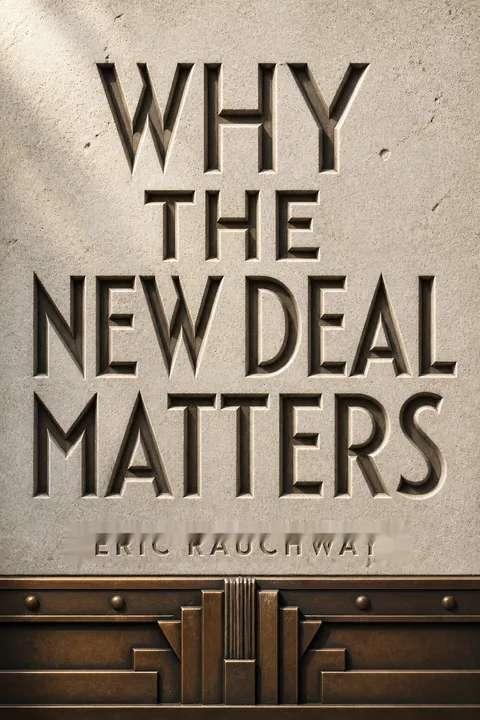
Why the New Deal Matters receives mixed reviews averaging 3.97/5 stars. Readers appreciate Rauchway's accessible writing style, focus on specific locations and programs like the TVA, and honest treatment of the New Deal's racial and social shortcomings. Many praise its relevance to modern policy debates and its examination of FDR's democratic vision. However, critics note the book lacks comprehensiveness, depth, and detail, feeling too brief for experienced readers. Some desire more analysis of negative impacts and better organization. Overall, reviewers recommend it as a solid introduction for those with basic knowledge seeking to understand the New Deal's lasting influence.
People Also Read






Glossary
Tennessee Valley Authority
regional public development agencyA federal agency created in 1933 to develop the Tennessee River Valley. Its responsibilities included building dams, generating and selling electricity, controlling floods, improving navigation, producing fertilizer, and supporting better land use. The TVA became a prominent example of regional planning and public power, while its projects also displaced residents and its energy mission later relied increasingly on coal and nuclear generation.
Works Progress Administration
federal jobs programA federal agency established in 1935 to employ people who could not find private-sector work during the Depression. The WPA funded practical public projects such as roads, sidewalks, schools, and parks, as well as arts, writing, music, and theater programs. It aimed to provide wages and useful work, but its funds could not employ everyone in need, and its jobs and conditions were not distributed equally.
Indian New Deal
Native reform and investmentThe Roosevelt administration’s shift in federal policy toward greater investment in Native communities and support for tribal institutions. Programs funded conservation work, schools, hospitals, utilities, and public buildings, while legislation sought to halt the breakup of tribal lands and expand self-government. Its results were mixed: it strengthened some Native institutions but also imposed federal plans, including livestock reductions that many Navajos opposed.
redlining
racialized mortgage exclusionA practice of marking neighborhoods as hazardous for mortgage lending, often on the basis of racial composition as well as other neighborhood characteristics. New Deal housing agencies worked with real-estate and lending professionals whose assessments treated Black or racially mixed areas as poor risks. The resulting barriers limited access to mortgages and helped entrench residential segregation and unequal homeownership.
Black Cabinet
Black federal policy advisorsAn informal network of African American officials and advisors who worked within the Roosevelt administration. Members raised concerns about how New Deal programs affected Black Americans, pressed for fairer employment, and influenced policy and appointments. It was not an official cabinet department or a formally constituted committee, in part because Roosevelt feared that an official body would provoke white southern opposition.
public yardstick
government price benchmarkRoosevelt’s idea that a publicly operated utility could provide information about the real costs of producing electricity. That benchmark would let citizens and officials judge the prices charged by private power companies and expose excessive profits. The proposal did not require government to take over the entire electricity industry; it used public provision as a comparison point and competitive check.
Civil Works Administration
rapid federal work reliefA temporary federal jobs program launched in late 1933 under Harry Hopkins. It rapidly hired millions of people for projects such as road repair, school construction, sanitation, and public health work, aiming to replace charity with wages. The program demonstrated how quickly federal hiring could expand, but its spending outpaced its funds, and it was wound down in 1934.
Download PDF
Download EPUB
.epub digital book format is ideal for reading ebooks on phones, tablets, and e-readers.








