

Key Takeaways
We cannot afford fortunes built by extracting wealth others produce
The gap widened sharply. Sayer argues that the rich are not simply people with unusually large paychecks. Their fortunes increasingly depend on rules that let owners claim income produced through other people's work. In the UK, the top 1% received 13% of income in the period covered, up from roughly 5.9% to 9% through much of the postwar boom. In the United States, the richest 0.01% saw real income rise 685% from 1979 to 2012.
Look beyond individuals. The book's target is not personal wealth as such, or every person with a high salary. It is the system that concentrates assets, enables extraction, and gives wealth political influence. The question is where income comes from, not merely how much someone has.
What's powerful here is the shift from judging personalities to tracing economic relationships. A fortune can look like an individual achievement when its supporting conditions remain invisible: employees, public infrastructure, legal protections, and accumulated knowledge. That is a useful corrective to both celebrity narratives and moral scolding. The argument is strongest when it distinguishes different sources of wealth rather than treating the rich as one uniform group. A high income can reflect productive skill, market power, inheritance, or several at once. The book's challenge is to make those sources visible enough for public debate, not to assume every case has the same answer.
Separate useful investment from financial claims that create no new capacity
One word, two activities. Sayer distinguishes investment that builds useful capacity from financial activity that aims to earn a return. A school, railway, or training program can create skills and services that did not exist before. Buying an existing property or a share may instead transfer ownership or raise an asset's price, without funding anything new. Calling both activities investment can make extraction look like production.
Judge the result, not the label. Financial returns can accompany useful investment, but they do not prove it occurred. A bridge toll, for example, could enrich its owner even if the owner neither built nor improved the bridge. The distinction matters because economic statistics and public language often treat money gained as evidence that society gained something too.
This distinction resembles a basic accounting question: did the transaction expand productive capacity, or did it change who holds a claim on existing output? It helps explain why rising asset prices can coexist with weak investment in services, equipment, or skills. The framework is especially useful for evaluating policy claims that a tax break or market transaction automatically creates growth. Yet financial markets can also direct money toward new projects and provide liquidity, meaning the category cannot be judged by the instrument alone. The practical test is what the financing supports, who bears the risk, and who receives the eventual gains.
Trace rent and interest to control of assets, not merit
Ownership can yield income. Sayer calls income unearned when it comes from controlling an existing asset that others need, rather than from work that contributes to useful goods or services. Rent from scarce land is the clearest case. Similar power can come from monopolies, patents, or control of essential infrastructure. Interest is another source: the lender's claim grows while the borrower makes payments, often from wages.
Credit still has a purpose. Loans can help fund production, but Sayer argues that interest adds a cost and can shift income upward, especially when borrowers have little bargaining power. Compound interest magnifies that burden: at 5%, a debt doubles in about 14 years. The argument is not that every payment to an owner is identical, but that ownership alone does not establish a contribution deserving unlimited reward.
The book makes a moral question legible by asking who can refuse a transaction. A tenant needs housing; a struggling borrower may have few alternatives. That context changes the meaning of a formally voluntary contract. This connects economic analysis to bargaining power: equal legal permission to lend or borrow does not make the parties equally placed. The distinction also deserves careful application. Maintenance, administration, and genuine risk-taking can involve work or costs, while not every return is pure extraction. The most persuasive analysis separates those costs from the additional income secured mainly by scarcity, monopoly, or unequal control.
Do not mistake high pay for proof of deserved contribution
We inherit productive advantages. Today's workers draw on knowledge, technology, public institutions, and infrastructure built across generations. Sayer cites estimates that US output per person per hour grew about fifteenfold since 1870, a change no individual's effort can explain alone. He also argues that family resources and unequal access to education shape which skills people develop and which jobs they can reach.
Jobs are not equally designed. Some positions contain interesting, skilled work; others concentrate repetitive or unpleasant tasks. Pay differences can then reflect the structure of jobs and workers' bargaining power, not simply innate ability. A UK government study cited in the book found that children from middle-class families were 15 times more likely to enter middle-class jobs than children from working-class families. Merit matters, but it operates on an unequal starting field.
This account complicates the familiar claim that income is a clean measure of individual contribution. In sociology, the idea of social reproduction captures how advantages pass through family life, schooling, and occupational expectations without requiring a conspiracy. Sayer adds a less commonly discussed point: work itself shapes capacities, so unequal jobs can help produce the ability differences later used to justify unequal pay. That does not mean skill or responsibility should never affect compensation. It does mean that observed success cannot be read as an independent test of merit when opportunity and job quality are unequally distributed.
Follow finance into the crisis: stagnant wages fed debt and asset bubbles
Demand weakened as income shifted upward. Sayer traces the crisis to decades of wage stagnation, weaker labor power, and growing financial activity. When households had less income to spend, borrowing helped sustain consumption, while spare capital sought returns in property and financial assets. By 2007, the book reports, 79% of British bank lending went to property or to financial institutions trading assets, rather than directly supporting productive businesses.
Risk traveled, not disappeared. Securitisation means bundling loans and selling claims on their repayments. It let lenders pass loans onward and make more, while complex products obscured the underlying risks. Leverage, or borrowing to make larger bets, magnified both gains and losses. When the housing bubble broke, banks were rescued with public support, while households and public services bore much of the damage.
The account connects household experience to the architecture of financial markets. Debt can temporarily compensate for stagnant earnings, but it leaves future income committed to repayment and makes demand vulnerable to a downturn. The crisis is therefore not just a story of a few reckless traders; it also involves incentives that rewarded short-term returns while shifting risks elsewhere. The book's causal story is intentionally broad, and the author acknowledges that the origins are complex. Financial deregulation, wage trends, housing policy, and global capital flows interacted. That complexity argues for examining the system without pretending that one mechanism explains every country's crisis.
Treat political capture as a system, not a conspiracy of villains
Power works in several ways. Wealth gives its owners influence through political donations, lobbying, social networks, and access to policymakers. It also creates structural leverage: governments depend on major businesses and lenders to sustain investment and employment, so those actors can shape policy even without making an explicit threat. Sayer describes a shifting alliance of interests, not a single command center.
Secrecy strengthens that leverage. Tax havens hide ownership and financial activity behind offshore companies and trusts. The book cites an estimate of $21 trillion to $32 trillion held offshore by wealthy individuals in 2012, and reports that 98 of the UK's 100 largest listed companies used tax havens. Sayer uses the term legal corruption for private interests shaping rules to their advantage through lobbying, political finance, or privileged access.
The emphasis on structure avoids a familiar trap: replacing institutional analysis with a hunt for one villain. Political influence can persist even when no individual actor controls the whole process, because many institutions respond to the same incentives and share assumptions about what counts as economically necessary. The discussion also connects secrecy to accountability. If ownership and liabilities are hard to trace, citizens cannot assess who benefits from policy or bears its costs. Still, lobbying and political donations vary in form and legitimacy. The core democratic question is whether access is transparent, balanced, and answerable to the public.
Demand public accountability instead of relying on rich donors' charity
Generosity is not the same as justice. Philanthropy can fund valuable work, but donors often choose the priorities and methods, while recipients have limited say. Sayer points to a Gates Foundation health program in Africa that saved lives yet, according to reporting cited in the book, also diverted staff and resources from basic care. A well-intentioned intervention can therefore disrupt local priorities when the funder controls the agenda.
Rights change the relationship. Charity depends on a donor's discretion; public provision can make support an entitlement, subject to collective decisions and accountability. Philanthropy may also improve a donor's reputation or influence while leaving the source of the wealth untouched. The book does not claim that charitable giving never helps. It asks whether social needs should depend on the preferences of a small number of powerful individuals.
This is a distinction between relief and governance. Private giving can move quickly, support experiments, and address needs that public institutions neglect. But when private wealth sets social priorities, communities become accountable to donors rather than to one another. The insight connects philanthropy to democratic theory: good outcomes are not the only measure; who gets to decide also matters. Public programs can be bureaucratic or poorly designed, so replacing charity with state provision is not automatically a solution. The deeper standard is accountable decision-making that includes expertise and local knowledge while treating support as a right, not a favor.
Cut excessive consumption without confusing well-being with endless growth
More spending has diminishing returns. Sayer draws on research suggesting that once basic material security is reached, further income contributes less to well-being than health, trust, relationships, and meaningful participation. In the book's account, happiness in the UK and US had largely stalled despite rising incomes. Greater inequality can intensify status competition, encouraging people to buy goods partly to signal rank rather than meet practical needs.
Luxury has wider costs. The rich can direct labor and materials toward second homes, private jets, and other low-use goods, while housing and other necessities become less accessible. If everyone consumed at the US rate described in the book, roughly five planets would be needed to sustain that level. The point is not to condemn all comfort or consumption, but to question an economy that treats ever more purchasing as proof of progress.
The distinction between well-being and consumption is a useful challenge to growth measured only through market activity. A purchase can raise output while adding little lasting value to the buyer or imposing costs on others. Status consumption also makes inequality culturally contagious: people with less may imitate the spending patterns of those above them, even when it strains household finances. The caution is that income remains crucial below a threshold of security. A critique of excess should not become an argument for austerity among people who lack housing, care, or reliable services. Sufficiency requires redistribution, not just restraint.
Make climate action fair: contract emissions while poorer nations develop
Responsibility is unequal. Greenhouse gases remain in the atmosphere for decades, so current emissions alone do not capture the historical contribution of industrial economies. The book cites Princeton researcher Stephen Pacala's estimate that the world's richest 7% were responsible for half of global emissions. It also notes that some emissions produced in China serve consumers in wealthier countries, complicating country-by-country comparisons.
Contraction and convergence is a proposal to reduce total emissions while moving nations toward equal emissions per person. Countries currently above a sustainable per-person allowance would cut more; poorer countries could develop within that limit. The idea offers a clear fairness principle, though Sayer notes it does not fully account for the historical emissions already accumulated by richer countries.
Climate policy is more durable when its burden matches capacity and responsibility. A per-person framework makes visible the inequality hidden by national totals, while consumption-based accounting can reveal emissions embedded in imported goods. Together, those lenses challenge the assumption that the country where a product is manufactured should carry the whole burden. Contraction and convergence is a compelling organizing principle, not a complete negotiating formula. Historical responsibility, different development needs, and the timing of reductions remain difficult questions. Naming those disputes strengthens the case for cooperation; it does not erase the need to reduce emissions rapidly.
Tax asset extraction and democratize firms before chasing more growth
Change the rules, not just the recipients. Sayer proposes taxing land value, wealth, inheritance, and capital gains more heavily, while curbing monopolistic rents and tax avoidance. He argues that credit should support productive projects, with lenders sharing risk instead of shifting it onto borrowers or taxpayers. Publicly accountable banks could help direct credit toward social and environmental priorities.
Share control at work. The book also calls for workers to have representation and ownership in larger firms, alongside user input where appropriate. It favors stronger public provision for services such as health and transport, a living wage, and a shorter working week. These proposals aim to reduce dependence on rentiers and spread both economic power and meaningful work more fairly.
The proposals follow from the book's central diagnosis: inequality is reproduced through ownership, finance, and the design of work, so transfers alone may leave the machinery intact. The alternatives are not limited to a binary choice between private corporations and centralized state planning. Cooperatives, mutual institutions, public banks, and regulated markets offer different ways to distribute decision-making. The challenge is institutional design: shared ownership needs competent management, transparent accounts, and safeguards for users and workers alike. The book offers directions rather than a detailed transition plan, leaving practical questions of sequencing, political coalition-building, and cross-border coordination open.
Analysis
Sayer's most important contribution is methodological: he asks readers to trace income back through social relations rather than treating market prices as verdicts on merit. The recurring distinction between producing useful capacity and holding claims on other people's output gives the book a coherent spine across land, debt, company ownership, executive pay, tax havens, and consumption. It also explains why the title is more than a provocation. The rich can impose costs through resource use, political influence, and claims on future income, even when their wealth is legally acquired.
The argument is strongest when it exposes how institutional power hides in ordinary vocabulary. Calling asset purchases investment, salaries earnings, or public services costs can settle moral questions before anyone has examined what happened. Its account of the crisis likewise improves on stories centered only on individual greed: financial incentives, wage stagnation, credit expansion, and political accommodation reinforced one another.
Some boundaries remain contestable. The distinction between earned and unearned income depends on judgments about what counts as a useful contribution. A financial intermediary may facilitate a transaction that genuinely improves coordination, while an owner may bear real risk or provide organizational skill. The relevant question is not whether a return is financial, but whether its size and distribution correspond to contribution, risk, need, or simply leverage. Sayer recognizes mixed cases, but the moral vocabulary can sometimes sound more settled than the economic classification.
The environmental argument also changes the policy endpoint. Redistribution could strengthen demand, yet growth in high-consuming societies may intensify ecological damage. This tension makes the book more than an argument for restoring a postwar settlement. Its deeper challenge is to define prosperity in terms of secure capabilities, shared power, and ecological limits. The proposals are suggestive rather than a complete institutional blueprint, but that openness invites scrutiny of who should govern credit, ownership, and the common inheritance, and how those decisions can remain democratic at scale.
Review Summary
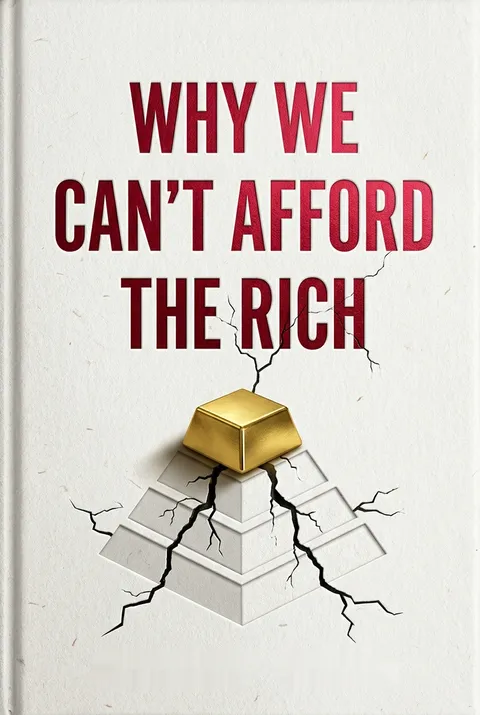
Why we can't afford the rich receives mostly positive reviews for its critique of wealth inequality and capitalism. Readers appreciate Sayer's clear explanations of complex economic concepts and his analysis of how the rich extract wealth from society. Some find the book thought-provoking and eye-opening, while others criticize its logic and examples. The book is praised for its detailed research and engaging writing style, though some find it repetitive or entry-level. Overall, it's seen as a valuable introduction to leftist economic thinking, despite mixed opinions on its proposed solutions.
People Also Read





Glossary
moral economy
ethical scrutiny of economic rulesAn approach that examines whether the basic institutions and practices of economic life are morally defensible. In Sayer's use, it goes beyond condemning individual greed to ask whether property, pay, debt, and transfers distribute benefits and burdens fairly, and whether the people who control key assets have a legitimate claim to the income they receive.
earned income
income tied to useful workIncome Sayer describes as dependent on work that contributes directly or indirectly to producing useful goods and services. It does not mean that pay precisely matches effort, merit, or social value. Public-sector work and unpaid care can contribute to provisioning, even when their output is not sold in a market.
unearned income
income from need or asset controlA category covering two different sources of income. Some transfers are provided on grounds of need, such as support for children, older people, or those unable to work. Sayer's central concern is asset-based income, such as rent, interest, or gains from ownership, received because the owner controls something others need.
rentier
recipient of asset-based incomeA person or organization that receives income from controlling assets others need, rather than primarily from producing goods or services. Landlords receiving rent are the clearest example, but Sayer extends the idea to owners of monopolies, financial assets, and other sources of income grounded in control or scarcity.
financialisation
finance's growing economic dominanceThe expansion of financial activity and its influence over businesses, governments, and households. Sayer uses the term for a shift toward making money through lending, asset trading, speculation, and financial claims, rather than primarily through long-term production of goods and services. He links this shift to growing rentier power and economic instability.
value-skimming
fees taken from transactionsIncome gained by intermediaries who arrange or facilitate large financial transactions and take commissions, fees, or other portions of the value involved. The percentage may be small, but the transactions can be enormous or repeated frequently. Sayer argues that this activity can reward financial insiders without necessarily adding comparable productive value.
unequal division of labour
unequal allocation of work qualityThe arrangement in which some people are concentrated in skilled, interesting, and influential work, while others perform repetitive, unpleasant, or low-status tasks. Sayer argues that this structure limits access to fulfilling work and helps reproduce differences in skills, confidence, pay, and social standing that are later presented as evidence of merit.
contraction and convergence
equalize emissions as totals fallA climate proposal that reduces total greenhouse-gas emissions while moving countries toward equal emissions allowances per person. Countries currently emitting above the shared sustainable level would cut more, while lower-emitting countries could develop within the limit. Sayer presents it as a fairness principle, while noting that it does not fully settle historical responsibility.
belief in a just world
assuming outcomes reflect deservingnessA concept associated in the book with psychologist Melvin Lerner. It describes the tendency to assume that people generally receive what they deserve, and deserve what they receive. Sayer argues that this belief encourages deference to wealth and blame toward poverty, despite the influence of inherited advantage, unequal power, and limited opportunities.
FAQ
What's Why We Can't Afford the Rich about?
- Wealth Inequality Focus: The book examines the growing divide between the rich and the rest of society, arguing that the wealth of the rich is largely unearned and detrimental to the economy and environment.
- Wealth Extraction vs. Creation: Andrew Sayer distinguishes between wealth extraction (through rent, interest, and profit) and wealth creation, suggesting that the rich primarily extract wealth produced by others.
- Call for Change: Sayer advocates for a rethinking of economic structures to address inequality and environmental crises, emphasizing the need for a more equitable distribution of resources.
Why should I read Why We Can't Afford the Rich?
- Insightful Analysis: The book provides a critical perspective on the economic systems that allow the rich to accumulate wealth at the expense of the majority, making it a valuable read for understanding contemporary issues.
- Engaging and Accessible: Despite its serious subject matter, Sayer presents his arguments in a clear and often humorous manner, making complex economic concepts more relatable.
- Timely Relevance: Given the ongoing discussions about wealth inequality and climate change, the book is particularly relevant for those interested in social justice and sustainable economic practices.
What are the key takeaways of Why We Can't Afford the Rich?
- Distinction of Income Types: Sayer emphasizes the difference between earned and unearned income, arguing that much of the wealth of the rich comes from unearned sources like rent and interest.
- Critique of Neoliberalism: The book critiques neoliberal policies that favor the wealthy and exacerbate inequality, suggesting that these policies are unsustainable in the long run.
- Call for Economic Justice: Sayer advocates for systemic changes to redistribute wealth and promote social equity, highlighting the moral implications of wealth extraction.
What are the best quotes from Why We Can't Afford the Rich and what do they mean?
- Wealth Dependency: “Their wealth is mostly dependent ultimately on the production of goods and services by others.” This quote underscores the idea that the rich do not create wealth independently; rather, they benefit from the labor of others.
- Job Creator Myth: “The rich depend on hoodwinking us all into thinking that they are the source of jobs, prosperity and everything we value.” Sayer critiques the narrative that the wealthy are job creators, suggesting that this belief perpetuates inequality.
- Rethinking Economics: “We need to rethink what economic activity is for, and what kind of lives we want to lead.” This quote calls for a fundamental reevaluation of economic priorities, advocating for a focus on well-being rather than mere profit.
How does Andrew Sayer define economic inequality in Why We Can't Afford the Rich?
- Systemic Issue: Sayer defines economic inequality as a systemic issue rather than an individual failing. He argues that it is shaped by historical, social, and economic structures that favor the wealthy.
- Meritocracy Myth: He critiques the myth of meritocracy, stating that many people believe they get what they deserve without recognizing the advantages that the rich have. This belief obscures the reality of inherited wealth and privilege.
- Role of the Commons: Sayer emphasizes that economic inequality is exacerbated by the privatization of the commons, which should benefit society as a whole. He advocates for recognizing and reinvesting in these shared resources to address inequality.
What is the distinction between earned and unearned income in Why We Can't Afford the Rich?
- Earned Income Defined: Earned income is derived from work that contributes to the production of goods and services, reflecting a direct relationship between effort and reward.
- Unearned Income Explained: Unearned income, on the other hand, comes from control of assets (like land or capital) and does not require any productive contribution, making it a form of wealth extraction.
- Moral Implications: Sayer argues that unearned income is often unjustifiable, as it relies on power dynamics rather than merit or need, leading to systemic inequality.
How does Why We Can't Afford the Rich address the role of the rich in job creation?
- Challenging the Myth: Sayer challenges the common belief that the rich create jobs, arguing that their wealth often comes from wealth extraction rather than productive investment.
- Jobless Growth: The book highlights the phenomenon of jobless growth, where economic expansion does not lead to increased employment, particularly in the context of neoliberal policies.
- Aggregate Demand Importance: Sayer emphasizes that job creation is more closely tied to aggregate demand than to the actions of the wealthy, suggesting that redistributing wealth could stimulate job growth.
How does Andrew Sayer critique neoliberalism in Why We Can't Afford the Rich?
- Economic Inequality: Sayer critiques neoliberalism for exacerbating economic inequality, arguing that policies favoring the wealthy lead to a concentration of power and resources.
- Environmental Impact: The book links neoliberal policies to environmental degradation, suggesting that the pursuit of profit often comes at the expense of sustainability.
- Call for Alternatives: Sayer advocates for alternative economic models that prioritize equity and environmental health over profit maximization.
What solutions does Why We Can't Afford the Rich propose for addressing wealth inequality?
- Redistribution of Wealth: Sayer suggests that redistributing wealth from the rich to the poor could stimulate economic growth and improve overall well-being.
- Public Ownership: The book advocates for public ownership of key resources and services, allowing for more equitable distribution of wealth and reducing reliance on rent-seeking behaviors.
- Rethinking Economic Priorities: Sayer calls for a fundamental reevaluation of economic goals, emphasizing the need for policies that promote social justice and environmental sustainability.
How does Why We Can't Afford the Rich connect wealth inequality to environmental issues?
- Consumption Patterns: Sayer discusses how the extravagant consumption of the wealthy contributes significantly to environmental degradation. He argues that their lifestyles are unsustainable and exacerbate climate change.
- Resource Plundering: The book highlights the connection between wealth accumulation and the exploitation of natural resources. Sayer warns that "the plundering of the earth’s resources cannot continue," stressing the urgency of addressing these issues.
- Call for Sustainable Practices: The author advocates for a shift towards more sustainable economic practices that prioritize environmental health and equity. He argues that reducing inequality is essential for achieving environmental sustainability.
What role do power and property rights play in Why We Can't Afford the Rich?
- Control Over Resources: Sayer emphasizes that power and property rights determine access to the commons and resources necessary for economic participation. Those who control these resources can dictate terms and extract wealth from others.
- Inequality of Opportunity: The concentration of property rights in the hands of a few leads to inequality of opportunity, as many are excluded from accessing the resources they need to succeed. This perpetuates cycles of poverty and disadvantage.
- Need for Reform: The book calls for a reevaluation of property rights and power structures to ensure that wealth is distributed more equitably. Sayer argues that reforming these systems is essential for achieving economic justice.
How does Why We Can't Afford the Rich critique the notion of "trickle-down economics"?
- Ineffectiveness of Trickle-Down: Sayer argues that the idea that wealth will trickle down from the rich to the poor is a myth. He cites historical evidence showing that policies favoring the wealthy do not lead to widespread economic benefits.
- Focus on Shareholder Value: The book critiques the focus on maximizing shareholder value, which often comes at the expense of workers and communities. Sayer states that "the goal of corporations is to maximize profit for their shareholders, not create jobs."
- Need for Systemic Change: Sayer emphasizes that addressing inequality requires systemic change rather than reliance on market forces. He advocates for policies that directly support the needs of the majority rather than the interests of the wealthy.
Download PDF
Download EPUB
.epub digital book format is ideal for reading ebooks on phones, tablets, and e-readers.








