

Key Takeaways
Treat mistakes as design signals, not proof that someone is careless.
Blame rarely fixes systems. Human error is often the final visible link in a chain of bad conditions. Anesthesiologists once suffered about one death per 5,000 procedures. They reduced that rate to roughly one per 200,000 to 300,000 by standardizing equipment, using checklists, and encouraging nurses to question doctors. One machine’s control turned opposite to its counterpart, inviting an avoidable mix-up; making the controls consistent removed the trap.
Change the conditions. The broader lesson is that people have predictable limits in attention, memory, and judgment. A driver distracted by a dashboard device may be at fault, but redesigning the interface can prevent the next crash more reliably than telling drivers to concentrate harder. The book argues for understanding the setting that made an error likely, not stopping the investigation at the person who made it.
What's striking is how the anesthesiology story turns fallibility into an engineering problem. Safety science often treats accidents as products of interacting conditions, not isolated bad actors. That approach makes improvement possible: standard controls and checklists reduce dependence on perfect attention. It need not excuse negligence, however. Individual accountability still matters when people knowingly ignore safeguards. The strongest response pairs fair scrutiny of a person’s actions with a search for system features that could make the same error easy to repeat.
Assume your eyes will miss what your attention was not seeking.
Seeing is selective. The book calls a failure to notice something directly in view a looked-but-didn’t-see error. Vision is sharp only in a small central area, and the eyes continually shift to gather information. What gets noticed depends on what a person expects or is trying to find. In one street experiment, a brief interruption let researchers replace a person asking for directions with someone else. Fewer than half the passersby noticed.
Rare targets vanish. In a visual-search experiment, people looking for a tool missed it 30 percent of the time when it appeared in only one image out of a hundred. Similar limits matter in screening jobs: radiologists and airport security staff look for rare dangers, so repeated normal results can encourage premature search termination. Change blindness, the failure to spot a major change during a visual interruption, can persist even when people feel certain they would notice.
The practical implication is not to distrust vision altogether, but to match the search method to the task. A quick glance is useful for understanding a scene; it is poor evidence that every detail has been checked. Safety inspections benefit from explicit search routines, varied images, and pauses that interrupt expectation. The same principle applies to everyday work: a reviewer searching for familiar errors may miss a surprising one. Confidence in having looked is not the same as evidence that the target was seen.
Give facts meaning before asking memory to keep them.
Meaning outlasts detail. Former classmates could recognize 73 percent of faces nearly fifty years after graduation, but recall only 18 percent of names. Names and coin designs often lack useful associations, so they are easy to lose. In a study, only one of twenty people could accurately draw all eight tested features of a penny. By contrast, a runner learned long strings of numbers by turning groups of digits into familiar race times.
Make information memorable. Grouping dates such as 1776, 1865, and 1945 works because each number connects to a meaningful event. A hiding place or password chosen for being unusual may be less memorable, not more. Tom Vander Molen hid treasured gold coins inside an old paint can, forgot where he had put them, then unknowingly discarded the can. A quick, meaningful association is often safer than an elaborate trick.
This account fits a broad principle of learning: information becomes easier to retrieve when it connects to an existing structure. Chunking helps because memory can work with a meaningful unit rather than many unrelated bits. But meaning is personal, not universal. A mnemonic that helps one person may confuse another, and a memorable association can still be inaccurate. The useful question is not simply whether a detail feels vivid, but whether the cue reliably leads back to the information that needs to be recalled.
Audit the frame before trusting your apparently rational choice.
Presentation changes preference. In a classic decision experiment, people preferred a sure option when outcomes were described as lives saved, but often chose a risky option when the same outcomes were described as lives lost. The facts had not changed; their frame had. Music also shifted supermarket wine purchases: French music boosted French wine sales, while German music favored German wine, although most shoppers did not notice the influence.
Numbers become anchors. An anchor is an initial figure that pulls later estimates toward itself. Grocery stores sold 32 percent more of an item when it was advertised as four for a price rather than as one at the equivalent price. A house’s listing price similarly influenced estimates by both real estate professionals and amateurs. Before deciding, recast the options in another way, such as comparing unit prices or costs per square foot.
Framing is a reminder that a choice is partly shaped before conscious reasoning begins. Recasting options can expose hidden assumptions, much as presenting medical outcomes in both survival and mortality terms makes the trade-off easier to inspect. Still, reframing is not a magic debiasing switch. Anchors can persist even after they are identified, and some presentations contain genuinely relevant information. The goal is to compare equivalent outcomes in more than one format, then separate the evidence from the emotional force of its packaging.
One focused task beats a brain pretending to multitask.
Attention has a bottleneck. What people call multitasking is usually rapid switching between tasks, not doing two conscious activities at once. On a flight approaching Miami, a crew became so absorbed in diagnosing a faulty landing-gear light that nobody kept track of the plane’s descent. The crash killed 99 people. The distraction was small; the cost was not.
Switching has a price. In a workplace study, employees were interrupted about twenty times an hour, often focusing on one activity for only three minutes. Research cited in the book found it could take up to fifteen minutes to regain deep concentration after a distraction. While driving, even a two-second glance away from the road doubled accident risk. Talking hands-free does not remove the mental demand. When a task carries serious consequences, remove competing demands instead of trusting attention to juggle them.
The important distinction is between tasks that have become automatic through practice and tasks that require active judgment. Walking while talking may be manageable; entering an address into a navigation screen while driving is not the same kind of pairing. Human attention is not a limitless resource, and switching consumes time as well as accuracy. Still, eliminating every interruption is unrealistic in many jobs. The useful design question is which interruptions can be batched, delayed, or blocked during the moments when focused attention matters most.
Write predictions down before outcomes rewrite your memory.
Hindsight edits the past. Hindsight bias is the tendency for knowing an outcome to make it seem more predictable than it was. After Watergate conversations were compared with John Dean’s testimony about them, his recollection contained major distortions and made his role appear more central. In studies of predictions, people later raised their estimated odds for events they believed had happened and lowered them for events they believed had not.
Keep a decision record. Gamblers often remembered wins as evidence of foresight and losses as near-wins ruined by chance. A written note made before the result can preserve what was known, what was uncertain, and why a choice was made. That record helps distinguish a sound process that produced bad luck from a weak process that happened to succeed. Without it, memory can quietly turn almost any outcome into proof that the original judgment was sensible.
A decision log is a small form of protection against outcome bias, the habit of judging a decision by how it turned out rather than by what could reasonably be known beforehand. This is valuable in medicine, investing, and management, where a good choice can fail and a bad one can get lucky. The record should capture the assumptions and confidence level, not merely the final choice. Otherwise, the log itself can become a tidy story written to flatter the decision-maker.
Measure confidence against results before bravado spends your money.
Confidence needs calibration. Calibration means how closely a person’s confidence matches actual performance. In one study, U.S. weather forecasters who predicted a 30 percent chance of rain were right about 30 percent of the time. Many other people are less well calibrated. Gym members expected to visit about ten times a month but went only four to five times, and the studied members overpaid by about $700 on average.
Test the forecast. People often mistake what they ought to do for what they will do. Overconfidence also showed a gender pattern in the book’s research: men traded stocks 45 percent more often than women, and frequent traders earned less. In a war-game experiment, men who were more confident about success were more likely to start a conflict. These are group findings, not rules about every man or woman. Track predictions against outcomes instead of treating confidence as proof.
Calibration converts vague self-belief into a testable skill. Forecasting becomes more useful when people state probabilities and receive clear feedback, rather than simply announcing that something seems likely. The gender findings add a useful caution: risk-taking may reflect differences in perceived reward, confidence, and social experience, not just a fixed appetite for danger. Group averages should not be used to judge individuals. Their practical value is to reveal patterns worth checking in one’s own decisions and in the incentives surrounding them.
Make the safe action obvious, and dangerous confusion difficult.
Build in guardrails. A constraint limits the ways an object or process can be used incorrectly. An affordance is a clue that suggests how something should be used. These ideas matter in medicine: two heparin vials, one containing a dose a thousand times stronger than the other, had similar shapes and blue labels. Nurses gave the wrong dose to newborn twins twice. The twins survived, but the packaging had made a dangerous mix-up too easy.
Design for fallibility. The manufacturer later used a red label for the stronger dose, added a cap that required an extra step, and made warnings easier to read. The book also describes surgical teams marking the correct site and pilots using checklists rather than relying on memory. A second safeguard should catch the first one’s failure. If different people repeat the same error, the cause is likely not just individual carelessness.
This is error-proofing in practice: safer systems make the correct action easier and the hazardous action harder. Redundant checks are especially useful when the consequences are severe and a single slip is plausible. The design still needs testing with real users, under fatigue and time pressure, rather than only in an ideal demonstration. Color can help distinguish products, but a label, shape, or physical barrier provides another cue if color is overlooked or difficult to perceive.
Use novice eyes to catch what expertise edits out.
Expertise compresses detail. Skilled readers, musicians, and performers recognize patterns quickly instead of processing every element separately. That speed is an advantage, but it can hide anomalies. A music teacher found a printed error in a familiar score only after a less-skilled student played the note exactly as written. Experienced musicians had repeatedly supplied the note they expected to see.
Break the routine. Functional fixity is the tendency to keep using a familiar solution even when a simpler one is available. In one water-jar puzzle, people who had learned a complicated method kept applying it when a short pour would solve the problem. A fresh group usually found the simpler approach. For important reviews, combine expert judgment with a genuinely independent reader, a checklist, or a deliberate search for what does not fit the expected pattern.
Expert intuition is not worthless; it is a fast form of pattern recognition built through sustained practice. Its weakness appears when a task contains a rare exception that does not fit the learned pattern. A novice can sometimes notice the literal evidence because there is no practiced expectation to override it. The best review process does not replace specialists with beginners. It gives specialists structured ways to inspect anomalies and invites another perspective that is less invested in the familiar explanation.
Predict your future by ordinary days, not postcard highlights.
Vivid details mislead. The focusing illusion occurs when one noticeable feature receives too much weight in a judgment about overall happiness. Pete and Jen Marino moved from Wisconsin to California, drawn by its climate and glamour. They later found that daily concerns such as safety, cost, and family life mattered more than the sunny image. Research described in the book found similar overall life satisfaction among Midwesterners and Californians, despite different views of the weather.
People adapt. Healthy people often underestimated how much they would want treatment when facing serious illness, while some patients wanted treatment even for a short extension of life. In a study of colostomy patients, those with permanent colostomies reported improving satisfaction, while those hoping for reversal remained less satisfied. A changeable outcome can keep attention fixed on what is missing. When imagining a major choice, picture a routine week, not just the feature that first made the option attractive.
Forecasts of happiness are vulnerable to salience: a dramatic feature is easy to imagine, while ordinary routines are harder to simulate. Asking what a typical Tuesday would look like can counter that imbalance. Adaptation also complicates predictions, because people often adjust to circumstances more than outsiders expect. Yet adaptation is not universal, and severe losses should not be minimized by assuming that everyone will simply get used to them. The useful lesson is to broaden the forecast, not to dismiss real constraints.
Analysis
The book’s unifying claim is that errors are not random eruptions of stupidity. They arise from ordinary mental shortcuts interacting with environments that demand more attention, memory, or judgment than people can reliably supply. Vision selects; memory reconstructs; confidence exceeds evidence; and familiar patterns can obscure exceptions. These tendencies help people function efficiently, so eliminating them is neither realistic nor always desirable. The more practical task is to anticipate where a strength becomes a vulnerability and design safeguards around that boundary.
The stories make this thesis memorable by moving between intimate mishaps and high-stakes failures. A forgotten gold coin and a misread wine price sit beside anesthesia deaths, aviation accidents, and wrongful convictions. That range makes a persuasive moral point: the same cognitive machinery can produce a minor inconvenience or a catastrophe, depending on context. The anesthesiology example is especially instructive because changes to equipment, routines, and team communication coincided with a dramatic reduction in deaths. It shows why system design can outperform exhortations to be more careful.
The evidence also deserves calibrated reading. Many cited studies are controlled experiments or findings from particular settings, and their results do not automatically generalize to every person or culture. Some statistics are historical, and gender comparisons describe group averages rather than individual capacities. The book’s vivid cases explain mechanisms, but a striking anecdote is not itself proof of how often a problem occurs. Its strongest contribution is therefore not a catalogue of exact universal rates. It is a set of questions: What was attention directed toward? What information had meaning? Which cue or incentive shaped the judgment? What safeguard would catch the predictable slip?
Taken together, the answer is a practical form of humility. People should not assume that awareness cancels bias, that experience guarantees accuracy, or that a bad outcome reveals an obviously bad decision. Better learning requires records made before outcomes, feedback that is specific enough to correct forecasts, and systems that invite challenge. Fallibility becomes less dangerous when it is treated as a design condition rather than a character defect.
Review Summary
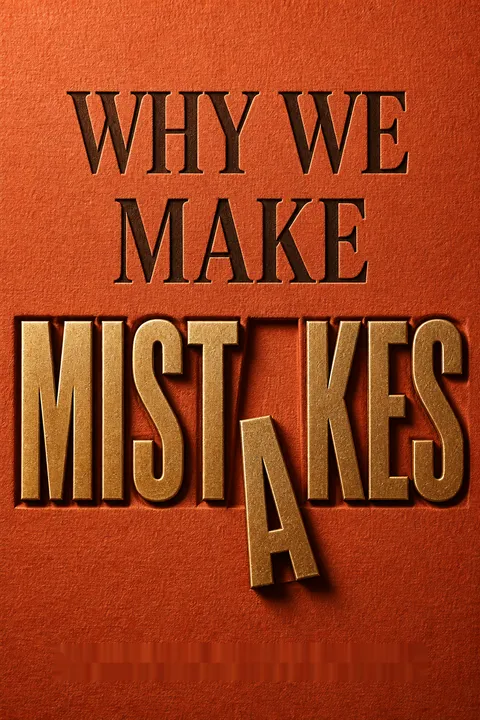
Why We Make Mistakes explores human error and cognitive biases through engaging anecdotes and research studies. Readers find it accessible and insightful, praising Hallinan's clear writing style and extensive examples. Many appreciate the book's practical advice for avoiding common mistakes. Some critics note overlap with similar works and desire more in-depth analysis. Overall, reviewers recommend it as an entertaining introduction to the psychology of decision-making, particularly for those new to the topic.
People Also Read



Glossary
looked but didn't see error
Looking without noticingA failure to notice an important object or detail despite looking in its direction. The error reflects the limits of attention and visual processing, not necessarily poor eyesight. People may believe they have taken in an entire scene when they have registered only the details relevant to their current expectations or task.
change blindness
Missing a visual changeA failure to detect a change in a scene, sometimes a large one, when a brief interruption disrupts visual continuity. In research demonstrations, people have failed to notice that the person they were speaking with had been replaced during a momentary obstruction. The effect reveals that observers do not preserve a complete, detailed record of everything they see.
inattentional blindness
Missing an unattended objectThe failure to notice a visible object because attention is occupied by another task. A person can look directly toward something and still fail to register it when mentally absorbed elsewhere. The book illustrates the danger with a bus driver who, while distracted by a phone conversation, reported not seeing either a warning sign or a bridge.
hindsight bias
Outcome makes past seem obviousThe tendency for knowledge of an outcome to alter judgments or memories of what was predictable beforehand. People often remember having assigned higher odds to events that occurred and lower odds to events that did not. This can make past decisions seem more insightful or more foolish than they actually were at the time.
anchoring
First number pulls later judgmentA judgmental bias in which an initial number influences later estimates or choices, even when the number is arbitrary or not especially relevant. A home’s listing price can affect estimates of its value, while a grocery promotion framed around buying several items can encourage shoppers to purchase more than they intended.
calibration
Confidence matched to accuracyThe degree to which a person’s stated confidence corresponds to actual performance over repeated judgments. If someone predicts a 30 percent chance of an event across many comparable cases, good calibration means the event occurs about 30 percent of the time. Probability estimates paired with clear feedback can help improve calibration.
affordances
Clues to how objects workPerceptible features of an object that suggest how it can be used. A knob suggests turning, while a slot suggests inserting something. Clear affordances help people understand a product without relying on instructions. Poorly designed objects, such as an ambiguous glass door, leave users uncertain about the action expected.
functional fixity
Sticking with a familiar solutionThe tendency to continue using a known approach even when a simpler or more effective option is available. In the water-jar experiments described in the book, participants who learned a complicated method often kept applying it to new problems that could be solved with a short pour. People encountering the problems fresh were much more likely to find the simple solution.
focusing illusion
Overweighting one vivid factorA distortion in judgments about well-being that occurs when one noticeable feature of a situation dominates attention. People considering a move may overemphasize climate while underweighting routine factors such as work, expenses, safety, and family life. The book uses comparisons between California and the Midwest to show how a salient difference can distort predictions of overall happiness.
FAQ
What's Why We Make Mistakes about?
- Exploration of human errors: The book examines why people make mistakes, ranging from minor errors to significant misjudgments, and the psychology behind these actions.
- Focus on cognitive biases: It highlights biases like overconfidence and hindsight bias that lead to errors in judgment and decision-making.
- Real-world examples: Joseph T. Hallinan uses anecdotes and research to show how these mistakes occur in various contexts, such as finance, medicine, and personal relationships.
Why should I read Why We Make Mistakes?
- Understanding human behavior: The book offers insights into common cognitive pitfalls, helping readers become more aware of their decision-making processes.
- Practical applications: Readers can apply the lessons to improve judgment in areas like investing and personal relationships.
- Engaging writing style: Hallinan's storytelling makes complex psychological concepts accessible and relatable, keeping readers engaged.
What are the key takeaways of Why We Make Mistakes?
- Cognitive biases influence decisions: Our decisions are often swayed by biases we may not be aware of, leading to systematic errors.
- Importance of feedback: Receiving timely and accurate feedback can help individuals calibrate their judgments and improve decision-making.
- Value of constraints: Implementing constraints can help reduce errors by guiding behavior and limiting choices, making sound decisions easier.
What are the best quotes from Why We Make Mistakes and what do they mean?
- “To err is 90 percent human.” This underscores that mistakes are inherent to being human, suggesting a focus on understanding and learning from errors.
- “Almost everyone is overconfident—except the people who are depressed, and they tend to be realists.” Highlights the pervasive nature of overconfidence, which can lead to poor decision-making.
- “Hope impedes adaptation.” Reflects the idea that the option to change circumstances can hinder acceptance and adaptation, affecting happiness.
How does Why We Make Mistakes explain overconfidence?
- Overconfidence in predictions: Individuals often overestimate their abilities and prediction accuracy, leading to judgment errors.
- Real-world implications: Examples include investors trading excessively due to overconfidence, resulting in poorer financial outcomes.
- Calibration training: Improving calibration—understanding judgment accuracy—can help mitigate overconfidence effects.
What is the concept of "hindsight bias" in Why We Make Mistakes?
- Definition of hindsight bias: It's the tendency to see events as predictable after they occur, distorting our understanding of past decisions.
- Impact on learning: Hindsight bias can prevent accurate assessment of decision-making processes, leading to repeated mistakes.
- Strategies to combat it: Keeping a record of predictions and outcomes helps recognize biases and improve future decision-making.
How does Why We Make Mistakes address the concept of "inattentional blindness"?
- Definition of inattentional blindness: It's when individuals fail to notice unexpected objects while focused on a task, leading to oversights.
- Real-life examples: Anecdotes like drivers missing signs while distracted illustrate its impact on daily life.
- Awareness and strategies: Emphasizes awareness of inattentional blindness and suggests reducing distractions to minimize effects.
What role does context play in memory and decision-making in Why We Make Mistakes?
- Context's influence on memory: Context significantly affects how we remember information and make decisions, with improved recall when context is reinstated.
- Real-world applications: Context shapes perceptions and decisions, such as interpreting events based on emotional state or environment.
- Strategies for better recall: Creating meaningful contexts enhances memory retention and decision-making, using techniques like associating information with environments.
How does Why We Make Mistakes relate to the concept of "task saturation"?
- Definition of task saturation: Occurs when overwhelmed by multiple tasks, leading to decreased performance and increased errors.
- Examples from aviation: Pilots engrossed in one task lose awareness of primary responsibilities, illustrating multitasking dangers.
- Implications for everyday life: Task saturation affects anyone juggling responsibilities, emphasizing focus and prioritization to avoid mistakes.
What specific methods does Why We Make Mistakes suggest for reducing errors?
- Feedback mechanisms: Implement systems providing immediate feedback on decisions, allowing learning from mistakes.
- Using constraints: Create constraints in decision-making to limit options and guide behavior, reducing errors.
- Encouraging reflection: Reflect on past decisions and outcomes to improve future judgment and decision-making.
How does Why We Make Mistakes explain the role of overconfidence in decision-making?
- Overconfidence defined: It's the tendency to overestimate abilities, knowledge, or prediction accuracy, leading to poor decision-making.
- Examples of overconfidence: Overconfident investors often perform worse than cautious counterparts, highlighting risk dangers.
- Strategies to combat overconfidence: Awareness of overconfidence helps make rational decisions, using techniques like seeking feedback.
How can I apply the lessons from Why We Make Mistakes in my daily life?
- Be aware of biases: Recognizing cognitive biases helps make informed decisions and reduce errors.
- Seek feedback: Actively seek feedback on decisions and be open to learning from mistakes to improve judgment.
- Implement constraints: Create constraints in decision-making processes to simplify choices and guide behavior toward better outcomes.
Download PDF
Download EPUB
.epub digital book format is ideal for reading ebooks on phones, tablets, and e-readers.








