

Key Takeaways
Turn a troubling discovery into a small action people can join.
A cause takes shape. Doc Hendley begins as a bartender who feels his life has shrunk to late nights and drinking. After a conversation about international aid, he researches the global water crisis and learns that dirty water is killing children and forcing families to walk hours for water. Instead of waiting for expertise or a perfect plan, he asks friends to help stage a fundraiser called Wine to Water. The first event draws more than 300 people and raises over $6,000. A second event brings in another $6,000.
Start where you stand. Hendley sees that bar patrons care about others but may need a clear, accessible way to act. Music, drinks, and a short explanation turn concern into donations. He still has no solution for delivering the money, but he has made the first useful move: gather people around a specific need.
What's striking is how the first fundraiser lowers the emotional and practical barriers to participation. People do not need to become aid specialists; they can show up, understand the problem, and contribute. That resembles civic organizing, where a shared activity can convert private concern into collective capacity. The limitation is equally instructive: money raised is not yet impact. Hendley must find credible partners and learn how water projects work before enthusiasm can become responsible aid. The story distinguishes a strong beginning from a finished solution.
Fix what is already broken before buying a grand solution.
Choose the repairable need. Hendley arrives in Darfur without engineering credentials, expecting to deliver dramatic solutions. In Marla Camp, home to thousands of displaced people, he first arranges a temporary water bladder that holds about 2,500 gallons. A tanker fills it, giving residents a nearby supply while a permanent well remains out of reach. Children who had spent hours fetching water suddenly have time to play.
Look beneath the failure. Local workers help him investigate derelict pumps. At one school, the well is not dry: worn seals and corroded pipe have stopped the pump from working. Repairing it costs about $30, compared with roughly $6,000 to drill a new well. Hendley reports that around 60 percent of installed wells in the region were inoperable. The lesson is not that new infrastructure is unnecessary, but that neglected maintenance can hide a far cheaper, faster solution.
The contrast between a broken pump and a new drilling project captures a basic principle of systems engineering: diagnose the failure before replacing the whole system. The temporary bladder also shows the value of a bridge solution when a durable fix is delayed. Yet the book does not present repair as universally sufficient. A pump can fail again, and trucking water is costly and temporary. Effective aid needs both immediate relief and a realistic plan for maintenance, spare parts, and eventual infrastructure.
Serve people on every side, while never confusing trust with safety.
Water crosses battle lines. Darfur's violence is driven by conflict over land, resources, and political power, not a simple division between good and bad communities. Hendley chooses to work in rebel-controlled areas that other organizations avoid, including Marla Camp. He also takes his team to Melem, a Janjaweed stronghold, and repairs a school well for local children, despite his anger at the militia's violence. His stated work is water, not political endorsement.
Access is not protection. Relationships with commanders sometimes open routes that aid organizations cannot use. But promises prove fragile: after Hendley negotiates permission to resume water deliveries to Marla, the driver is beaten and the bladder is damaged. Later, his convoy is ambushed. The memoir's hard-earned distinction is that impartial service may build access and preserve human dignity, but it cannot neutralize armed groups or guarantee the safety of aid workers.
The choice to provide water without treating it as a reward for political virtue reflects humanitarian impartiality: need, rather than affiliation, is the basis for assistance. It also forces an uncomfortable question about access. Repairing a well in a hostile area may help civilians and create a channel for further work, but aid workers can overestimate what goodwill buys them. The book keeps both truths in view. Neutral service matters, yet it is not a substitute for security analysis or a remedy for the political violence producing the crisis.
Treat local knowledge as essential infrastructure, not a courtesy.
Learn before leading. Hendley initially struggles with Darfur's logistics, language, aid bureaucracy, and security realities. He attends coordination meetings, volunteers on food and supply distributions, and gradually learns how organizations operate. When he hires local staff, he finds people who already understand well repair, translation, and community relationships. Hilary, Amir, Ismael, and others are not simply extra hands; their skills make the work possible.
Trust has practical value. The team includes Muslim and Christian workers, and their shared purpose matters more than identical backgrounds. Local colleagues help Hendley interpret community priorities, navigate relationships with elders and commanders, and notice risks an outsider might miss. The book also shows the cost of getting this wrong: a failed translation during a confrontation leaves the team exposed. Cultural humility is not a performance or a costume. It means listening, relying on expertise, and understanding that outsiders cannot safely or accurately operate alone.
This account makes local knowledge visible as an operational resource, not merely a moral ideal. Language, social trust, and technical familiarity affect whether a project can be built, maintained, or even reached. In organizational terms, the local team holds context that cannot be reproduced by a visiting expert's checklist. The caution is that hiring local staff does not automatically create equal partnership; authority and funding still sit largely with the outside organization. Genuine collaboration requires sharing decisions, not just assigning implementation.
Measure clean water by the time and childhood it gives back.
Water changes a day. In Marla Camp, children carry containers to a distant source because there is no clean supply nearby. Hendley describes the journey as a substantial daily burden for families already displaced by violence. When the temporary bladder begins dispensing water, the children no longer need to spend so much of the day hauling it. They gather to play, using improvised toys and a makeshift ball. The scene becomes Hendley's reminder of why he stays in Darfur.
Survival is not the whole outcome. Water reduces exposure to disease and eases the labor of collection, but it does not restore homes, reunite families, or make a camp safe. The book repeatedly asks whether keeping people alive is enough when their lives remain constrained by fear and deprivation. That question prevents a narrow tally of wells and liters from standing in for human well-being. Clean water matters partly because it creates room for ordinary life, learning, play, and care.
The children playing make an infrastructure benefit legible in human terms: water access returns time. Public health measures often count disease avoided, but time-use matters too, especially when collection work falls on women and children. The scene also resists a purely technical view of service delivery. Still, playfulness should not be mistaken for recovery. A moment of relief can coexist with displacement and danger. The most honest measure combines immediate health gains with whether people regain the freedom to shape their daily lives.
Train communities to maintain the systems aid workers install.
Make repairs transferable. After years of repairing pumps, Hendley recognizes that fixing the most wells is not the same as creating lasting access. In his final weeks in Darfur, his team assembles repair kits and trains two- or three-person village groups, whom they call water leaders. They also teach families about hygiene and sanitation, since unsafe practices can undermine the benefits of clean water. The aim is for residents to diagnose and repair common failures without waiting for an international team.
Local production lowers costs. In Cambodia, Wine to Water works with local partners and a locally assembled drilling rig. The cost of a well falls from about $2,500, the price paid to contractors, to about $500. Residents participate in drilling and learn how to maintain the wells with local parts. These examples turn sustainability from a slogan into a practical design choice: build skills, tools, and supply chains where the water system is used.
Maintenance is often the least glamorous part of infrastructure, yet it determines whether a well remains useful after a project team leaves. Training local repair groups addresses a familiar failure in development work: equipment arrives, but the skills and parts needed to keep it functioning do not. The Cambodia example also links local ownership to cost control. However, local capacity cannot erase every constraint. Communities still need reliable parts, financing, and support when repairs exceed their training. Empowerment works best as an ongoing partnership, not a handoff that abandons people.
In a disaster, make aid durable and let survivors shape it.
Choose what lasts. After Haiti's 2010 earthquake, Hendley sees bottled water being distributed while survivors also drink from contaminated gutters. Wine to Water instead works with FilterPure to provide ceramic pot filters set inside buckets. A filter can serve a family of eight to ten people for as long as five years. Hendley also supports building a filter factory in Haiti, designed to produce up to 1,500 filters monthly and involve local workers in addressing the country's water crisis.
Help without taking over. In Port-au-Prince, Hendley encounters members of a church clearing the rubble themselves after the building collapsed and killed more than 30 people. A young man asks him to stop documenting their effort and join it. Hendley takes a bucket and helps carry debris. The episode sharpens a principle: survivors are not passive recipients awaiting rescue. Aid should bring useful resources and solidarity while respecting the work people are already doing.
The filter response combines public-health urgency with a longer view of waste, supply, and local employment. It also shows that material choices carry social consequences: a single-use shipment solves one immediate problem, while a reusable filter and local production can support longer-term access. The church scene adds a crucial correction to the outsider's rescue narrative. Still, local production is not automatically sustainable; it needs quality control, inputs, and demand. The strongest design joins technical reliability with meaningful local participation.
Treat trauma as an operational risk, not a private weakness.
The body keeps score. After the ambush near Teige, Hendley becomes withdrawn, angry, confused, and hyper-alert. A fellow aid worker recognizes the change and urges him to leave Darfur for a break. In Nairobi he meets a counselor, though he is reluctant to talk. Back in the field, a conversation with his colleague Coy eventually helps him speak about the attack and painful memories connected to it. The book presents recovery as uneven, and companionship as a real form of support.
Courage has limits. Hendley had treated danger as part of the job, but the attack changes how he experiences travel and security. The organization eventually removes him from the field temporarily, and his colleagues notice that his behavior could put him or others at risk. His improvised boxing sessions with Coy offer release and a route into honest conversation, but they are not a clinical model. The deeper point is that aid work can injure the people doing it, and rest, peer support, and professional care belong in the safety plan.
This section usefully reframes psychological health as part of operational competence. Hypervigilance, anger, and withdrawal are not evidence that a worker lacks commitment; they can impair judgment in an already dangerous environment. The colleague who notices and intervenes functions as an informal safeguard. The memoir also makes clear that one conversation or a brief break is not a universal cure. Organizations need routine support structures, clear leave policies, and access to qualified care, rather than relying on personal toughness or crisis improvisation.
Build the team and funding model that let the mission outlast you.
Passion needs structure. Wine to Water begins with Hendley and friends, but its growth exposes what two enthusiastic founders lack: organization. Annie Clawson joins and brings the planning skills needed to manage events, schedules, and outreach. Local supporters learn to host their own fundraisers, extending the work beyond the founders' immediate circle. The organization raises about $100,000 in 2007 and nearly $200,000 in 2008, before a CNN Heroes feature brings another $200,000 in the final 34 days of 2009.
Make the work livable. Hendley and Annie often accept reduced or no pay, while Hendley juggles fundraising, fieldwork, and family life. His wife Amber supports his decision to devote himself to the organization, and becoming a father deepens his empathy for parents facing unsafe water. The story makes sustainability personal as well as institutional: a mission needs staff, funding, and public participation, but it also has to account for the people carrying it.
The transition from founder energy to a functioning organization is a classic scaling problem. Annie's administrative strengths complement Hendley's field experience, while do-it-yourself fundraisers let supporters become contributors rather than spectators. That distributed model reduces dependence on one charismatic person. The tension is that low overhead can become a virtue signal if it depends on chronic underpayment or exhaustion. Financial discipline matters, but so does paying for competent staff and protecting family life. A durable mission must preserve the people and systems that make its work possible.
Analysis
Wine to Water is a memoir of vocation, but its strongest argument is practical: humanitarian work becomes effective through a chain of adaptations, not through a single heroic gesture. Hendley starts with fundraising, discovers that money requires trusted partners, reaches Darfur and learns logistics, then shifts from delivering water to repairing and maintaining systems. Conflict repeatedly disrupts those plans, forcing him to rethink access, neutrality, risk, and what lasting impact can mean. The narrative's memorable scenes, especially children playing after water arrives and a village team learning to repair pumps, make infrastructure visible as a human capability rather than a piece of equipment.
The book also complicates the familiar lone-rescuer story. Hendley's initiative matters, but his work depends on Tasha, local technicians, community elders, aid colleagues, his wife, and eventually an organized staff. His most consequential learning is relational: trust can open doors, local expertise can reduce costs, and listening can reveal a problem outsiders miss. Yet the memoir shows that relationships cannot reliably protect people from armed violence, and that humanitarian service cannot repair the political conditions creating displacement. That boundary matters. Effort is not the same as control over outcomes.
As a first-person account, the book offers vivid experience rather than a systematic evaluation of program effectiveness. Its estimates and episodes should be read as part of a particular period and place, not as universal evidence that one model suits every crisis. Its durable contribution is a way of thinking: act on a concrete need, learn the surrounding system, involve the people who live with the consequences, measure what happens after implementation, and take the human costs seriously. The title's reversal is more than a clever origin story. It names a life redirected from a familiar social world toward the basic resource that makes other forms of life possible.
Review Summary
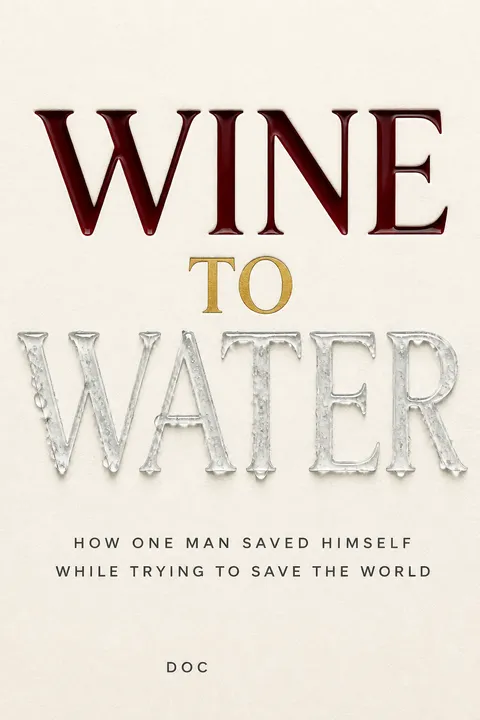
Wine to Water is a memoir by Doc Hendley, detailing his journey from bartender to founder of a non-profit providing clean water globally. Readers praise Hendley's authenticity, passion, and ability to make a difference. The book offers insights into the water crisis, particularly in Darfur, and Hendley's experiences there. While some found the writing style informal and occasionally awkward, most were inspired by his story. The book's religious undertones were appreciated by some but off-putting to others. Overall, it's considered an engaging and thought-provoking read.
People Also Read








Glossary
Wine to Water
Grassroots water nonprofitThe nonprofit organization Hendley starts after learning about the global clean-water crisis. It raises funds through community events and supports water projects, initially in Darfur and later in other countries. Its work develops from financing projects to partnering with local organizations, training residents, and supporting locally produced water systems.
IDP
Displaced within one's countryAn internally displaced person, someone forced to leave home by conflict or another crisis but who remains within their own country's borders. Darfur's camps hold many IDPs who have fled attacks on their villages. The term distinguishes them from refugees, who have crossed an international border.
water leaders
Local pump-repair teamsHendley's name for two- or three-person groups trained in Darfur villages to maintain and repair local wells. Teams receive repair tools and supplies and learn how to keep hand pumps functioning. The approach aims to reduce dependence on outside aid workers and give communities practical responsibility for continued water access.
bucket chlorination
Treating water with chlorineA water-treatment approach used in Jebel Marra in which chlorine is added to buckets of drinking water to help make it safer. Hendley uses it as a near-term measure while longer-term well projects remain difficult to establish. The program also requires supplies and instruction so residents can treat water correctly.
no-go zone
Restricted high-risk areaA region aid organizations designate as too dangerous for their personnel to enter. In Darfur, some areas controlled by rebel groups are treated this way by the United Nations. Hendley chooses to work in some such places, where residents may have little outside assistance, while accepting that travel and project work carry serious risks.
bio-sand water filters
Locally made water filtersFilters Wine to Water distributes in northern Uganda. The book describes them as a low-cost filtration option included in a broader program of water and sanitation training. The organization pairs equipment distribution with instruction on sanitation and rainwater collection, aiming to build local knowledge alongside access to cleaner water.
FAQ
1. What is "Wine to Water: A Bartender’s Quest to Bring Clean Water to the World" by Doc Hendley about?
- Doc Hendley’s transformation: The memoir chronicles Doc Hendley’s journey from a North Carolina bartender to the founder of Wine to Water, a nonprofit dedicated to providing clean water to communities in crisis.
- Humanitarian work in Darfur: The book focuses on Hendley’s experiences in Darfur, Sudan, where he worked amidst civil war, genocide, and extreme danger to repair wells and deliver clean water.
- Grassroots activism: It details how Hendley leveraged his bartending background to raise funds and awareness, turning bar events into life-saving initiatives.
- Personal growth and challenges: The narrative explores Hendley’s internal struggles, the trauma of witnessing suffering, and the relationships he built with locals and aid workers.
- Broader impact: The story expands to show how Wine to Water grew beyond Darfur, impacting communities in Uganda, Cambodia, Haiti, and more.
2. Why should I read "Wine to Water" by Doc Hendley?
- Inspiring true story: The book offers a compelling account of how an ordinary person can make an extraordinary difference in the world.
- Firsthand look at humanitarian crises: Readers gain insight into the realities of aid work in conflict zones, including the complexities and dangers involved.
- Practical lessons in leadership: Hendley’s story demonstrates the power of grassroots action, adaptability, and relationship-building in effecting change.
- Emotional and personal narrative: The memoir is candid about the emotional toll of humanitarian work, making it relatable and authentic.
- Motivation for social impact: It encourages readers to find their own path to service, regardless of background or expertise.
3. What are the key takeaways from "Wine to Water" by Doc Hendley?
- Anyone can make a difference: Hendley’s lack of formal training in international development shows that passion and determination can overcome inexperience.
- Clean water is critical: The book highlights the devastating impact of water scarcity and contamination, and how simple solutions can save lives.
- Relationships matter: Building trust with local communities and even with adversaries (like the Janjaweed) is essential for successful aid work.
- Resilience in adversity: Hendley’s perseverance through trauma, danger, and setbacks is a central theme.
- Empowering locals: Sustainable change comes from training and equipping local people to manage their own water resources.
4. How did Doc Hendley start Wine to Water, and what was his motivation?
- Origin in bartending: Hendley was inspired to act after learning about the global water crisis while working as a bartender, realizing he could use his skills and network to raise funds.
- First Wine to Water event: He organized a bar event in Raleigh, North Carolina, raising thousands of dollars for water projects.
- Desire for purpose: Hendley was motivated by a sense of guilt over his lifestyle and a longing to do something meaningful.
- Personal connection: Conversations with friends and family, as well as his Christian upbringing, influenced his decision to take action.
- Commitment to direct impact: He wanted to ensure that funds raised would go directly to those in need, leading him to work in the field himself.
5. What challenges did Doc Hendley face while working in Darfur, according to "Wine to Water"?
- Physical danger: Hendley and his team faced ambushes, gunfire, and threats from both Janjaweed militias and government forces.
- Emotional trauma: Witnessing starvation, violence, and the deaths of colleagues and locals took a psychological toll.
- Cultural barriers: Navigating language differences, religious customs, and local politics required sensitivity and adaptability.
- Logistical obstacles: Securing supplies, repairing wells, and transporting water in a war zone was fraught with difficulties.
- Aid world bureaucracy: Hendley encountered red tape, slow-moving organizations, and sometimes unhelpful international agencies.
6. How did "Wine to Water" by Doc Hendley address the global water crisis, and what solutions were implemented?
- Well rehabilitation: The team focused on repairing broken wells, which was often more cost-effective and immediate than drilling new ones.
- Water trucking and bladders: Temporary solutions included trucking in water and installing large bladders in camps to provide clean water quickly.
- Chlorination and sanitation: Hendley’s group distributed chlorine tablets and taught basic hygiene to prevent waterborne diseases like cholera.
- Local empowerment: Training local “water leaders” to maintain wells and educate their communities ensured sustainability.
- Expansion to other countries: The model was adapted for use in Uganda, Cambodia, Haiti, and beyond, including building local filter factories.
7. What role did relationships and local partnerships play in the success of Wine to Water’s projects?
- Building trust: Hendley’s success depended on earning the trust of local leaders, villagers, and even rebel commanders.
- Cross-cultural teamwork: His team included both Christians and Muslims, showing the importance of unity across religious and cultural lines.
- Negotiating with adversaries: Hendley sometimes had to negotiate with Janjaweed or government officials, using gifts or services to gain access.
- Empowering locals: By training local teams, Wine to Water ensured that projects continued after international staff left.
- Collaboration with other NGOs: Partnerships with organizations like UNICEF and Samaritan’s Purse provided resources and logistical support.
8. What are some of the most powerful stories or moments in "Wine to Water" by Doc Hendley?
- Ambush survival: Hendley’s convoy was ambushed by gunmen, and a box of chlorine tablets destined for water purification deflected a bullet that could have killed him.
- First water delivery in Marla: The joy of children playing after receiving clean water for the first time was a transformative moment.
- Loss of team members: The execution of Ismael, a local team member, underscored the personal risks and sacrifices involved.
- Boy soldier Mustafa: Meeting a 12-year-old boy soldier personalized the tragedy of the conflict and the loss of childhood.
- Haiti earthquake response: Hendley’s work distributing water filters in post-earthquake Haiti demonstrated the adaptability and reach of Wine to Water.
9. How does Doc Hendley’s personal journey and background influence the message of "Wine to Water"?
- Ordinary beginnings: Hendley’s background as a bartender and “rebel” preacher’s son makes his transformation relatable and inspiring.
- Honest self-reflection: He is candid about his struggles with guilt, trauma, and feeling like an outsider in both the aid world and at home.
- Faith and doubt: While influenced by his Christian upbringing, Hendley’s approach is inclusive and practical rather than preachy.
- Growth through adversity: His experiences in Darfur and beyond lead to personal growth, a sense of purpose, and a commitment to family.
- Empathy and humility: Hendley’s willingness to admit mistakes and learn from locals is central to his effectiveness and the book’s message.
10. What are the main concepts and definitions explained in "Wine to Water" by Doc Hendley?
- IDP (Internally Displaced Person): People forced to flee their homes but remaining within their country, often living in camps with little access to water.
- Janjaweed: Government-backed Arab militias responsible for violence and genocide in Darfur.
- Well rehabilitation: The process of repairing existing wells, often more efficient than drilling new ones.
- Water bladder: A large, temporary storage container used to distribute clean water in camps.
- Bucket chlorination: A method of disinfecting water using chlorine tablets, crucial in preventing disease outbreaks.
11. What are the best quotes from "Wine to Water" by Doc Hendley and what do they mean?
- “Whiskey is for drinking; water is for fighting over.” – This quote, used as an epigraph, highlights the critical importance and scarcity of water in conflict zones.
- “All I could think about was, What the hell is a guy like me doing in the Sudanese desert, getting shot at in the middle of the largest humanitarian crisis of our lifetime?” – Reflects Hendley’s humility and the sense of being an unlikely hero.
- “I realized that what I needed to do was to empower the locals, to give them the tools they needed to solve their own problems and become self-sufficient.” – Emphasizes the book’s core philosophy of sustainable, community-driven change.
- “There are few feelings in this world greater than knowing that the person you love most believes in you and is your biggest fan.” – Shows the importance of personal support and relationships in sustaining difficult work.
- “Water is the most basic human right. It is not a privilege.” – Summarizes the book’s central message about the universality and urgency of access to clean water.
12. How has Wine to Water grown since its founding, and what is its ongoing impact according to Doc Hendley?
- Expansion beyond Darfur: Wine to Water now operates in multiple countries, including Uganda, Cambodia, Haiti, and Peru, adapting its model to local needs.
- Grassroots fundraising: The organization encourages supporters to host their own events, making it a true grassroots movement.
- Sustainable solutions: Focus on local empowerment, training, and use of appropriate technology ensures long-term impact.
- Recognition and growth: Media exposure, such as the CNN Heroes award, has increased donations and awareness, allowing for greater reach.
- Personal and organizational resilience: Despite financial and personal challenges, Wine to Water continues to provide clean water to thousands, driven by Hendley’s
Download PDF
Download EPUB
.epub digital book format is ideal for reading ebooks on phones, tablets, and e-readers.








