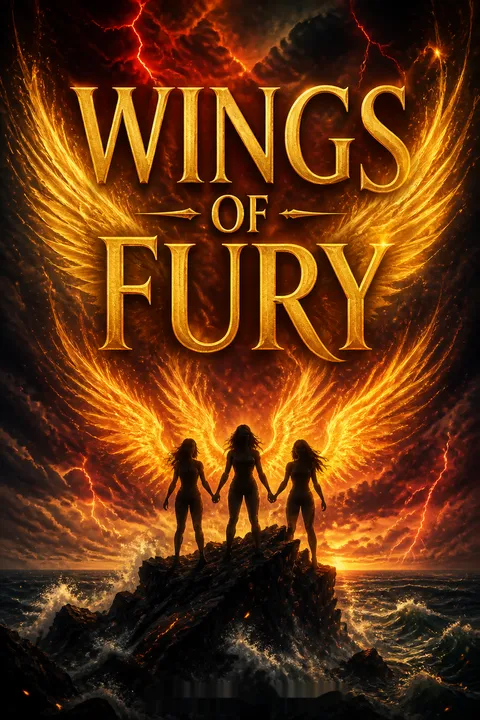


Plot Summary
Prologue
When Althea is eleven, soldiers sent by Cronus seize her mother, Stavra, from a temple sanctuary. General Decimus brands Althea with a mark of ownership and promises to return for her. Ten months later, Stavra comes back pregnant. She dies giving birth to a half-Titan girl, and Althea, still grieving, refuses to let the soldiers take the baby without resistance.
She tries to flee with her newborn sister, but the soldiers wrench the child away. Althea never learns what name her mother would have chosen. Her sisters Cleora and Bronte remain beside her, bound by the promise Stavra made Althea swear: protect the family.
The opening gives Althea’s later defiance a precise origin: she has watched the state turn women into property, then learned that even love cannot guarantee protection. Her mother’s death makes Althea’s promise both an act of devotion and a burden laid on a child. The stolen infant deepens that burden into unresolved guilt, while Decimus’s mark makes political domination physically intimate. By having the soldiers take the baby despite Althea’s resistance, the prologue establishes the limits of solitary courage. The story’s central question is not whether Althea will fight, but whether she can protect her family without letting responsibility become another form of captivity.
A Boat Paid in Blood
At eighteen, Althea lives with Cleora and Bronte in the Guild of Gaea, where years of chores have not erased Decimus’s threat to claim her. She uses the silver paid after Stavra’s death to buy a small boat, hoping to take her sisters to the southern isles. Cleora, terrified of suffering their mother’s fate, nearly lets the temple matron burn a permanent chastity mark into her face.
Althea stops the ritual, then tells her sisters about the boat. Bronte admits she has secretly saved more than a hundred coins by grinding grain in the village. Cleora hesitates, still drawn to the guild as refuge, but the sisters agree to revisit their choice after their mother’s death anniversary.
The boat turns grief into a practical plan, but the sisters do not share the same idea of safety. Althea sees escape as action, while Cleora seeks shelter in rules that have failed to protect their mother. Bronte’s hidden savings reveal a quieter form of resistance: she has been preparing for freedom without demanding that her sisters move at her pace. Their conflict is not a simple division between courage and fear. Each sister has adapted differently to a world that makes women responsible for surviving its violence.
The Fates Name a Son
Seeking guidance before leaving, Althea visits three oracles in Othrys. They bind her hands with a thread and reveal that a living son of Cronus is hidden on Crete. The boy is destined to challenge his father, but the oracles insist he will fail without Althea’s help.
They also warn that her family will pay dearly for the struggle and tell her to trust a guide she will recognize by his good deeds. The reading unsettles her faith in her own plans, but a more urgent warning cuts through it: her sisters are in danger. Althea races back toward the temple, carrying a short piece of the oracles’ thread and no clear explanation for why fate has tied her to a god.
The prophecy does not offer Althea comfort or certainty. It gives her a task whose stakes exceed her control and places her family inside a political struggle they never chose. The thread makes fate tangible, but its power is ambiguous: it might guide her, or merely make the burden harder to ignore. Althea’s decision to act comes less from belief in the oracles than from the immediate danger they name. Her skepticism remains, yet she begins to treat inherited promises and supernatural warnings as obligations that must be tested through action.
The Temple Goes Silent
Decimus has returned to search the temple. Althea and Bronte hide, but Cleora goes back for their mother’s lyre and is seized. Decimus’s men kill the matron and Acraea, the cook who had helped the sisters, while Althea and Bronte escape through the woods. At their cave, Althea encounters Colonel Theo Angelos, one of the soldiers present when their baby sister was taken.
He claims the oracles sent him to guide them to Crete, but Decimus catches up and threatens Theo’s enslaved mother. In the ensuing fight, Althea and Theo survive by turning the hamadryads against the soldiers. Decimus marks Althea with a binding curse, and she reluctantly accepts Theo’s help, leaving Cleora behind.
The attack forces Althea into the choice she fears most: escape with one sister while another remains captive. Her promise to protect her family can no longer mean preventing every loss, and she has to act despite that failure. Theo’s past makes trust morally complicated; he did not rescue their infant sister, but he is now risking his life against Decimus. The curse extends ownership beyond a visible brand, making obedience a pressure inside Althea’s body. Her alliance with Theo begins not in trust, but in necessity and unresolved judgment.
Crete's Masked Refuge
After Theo sails Althea and Bronte to Crete, masked women warriors capture the party and bring them before Adrasteia, a nymph who leads the island refuge. The women bar men from their community, but they allow the sisters to meet the hidden boy they seek. Zeus lives in a guarded cave, surrounded by comforts and maidens, and initially treats Althea and Bronte as entertainment sent by his mother, Rhea.
When Althea explains that Cronus holds Cleora and that the oracles expect Zeus to overthrow him, Zeus rejects the responsibility. Adrasteia’s people send the travelers away. Zeus gives Althea no help, and the sisters leave Crete without their brother, with only the possibility that the prophecy has led them to the right place.
Zeus’s first refusal exposes the difference between being assigned a destiny and accepting responsibility for it. His hiding protects the women who raised him, but it also preserves the conditions that let Cronus rule. Althea judges him harshly because her own family is paying for his safety. The Cretan community offers a partial alternative to Thessaly’s order, yet its rules and scars show that refuge is built from fear as well as solidarity. The scene makes clear that liberation cannot be delivered by lineage alone; the sheltered heir must choose to become accountable.
The Route Called Starfall
On the voyage north, Althea’s glowing thread draws the boat to an abandoned temple of Aphrodite. Bronte finds a hidden map there, signed by their father, Tassos. Theo recognizes its route as the path used in Operation Starfall, an escape network that smuggled women out of Cronus’s territory.
Adrasteia later confirms that Stavra and Tassos organized the refuge together. The discovery sends Althea back to Crete. She and Bronte abduct Zeus from his cave, but when their matching thread rings glow together, he sees a future in which he rules beside others rather than alone. Zeus agrees to train with Theo and help challenge Cronus, though fear still governs him.
The map alters Althea’s inheritance: her parents were not only victims of Cronus’s power, but organizers who created routes to evade it. Their work makes escape a collective practice, not a miraculous individual feat. Althea’s return to Zeus also marks a shift from asking the hidden heir to save her family to insisting that he become answerable to the people his father endangers. The linked rings suggest a bond that predates conscious choice, but Zeus’s agreement matters because destiny alone cannot substitute for consent.
The Curse Beneath the Water
As Zeus trains, Althea learns more about the island’s women. Euboea tells her that Stavra and Tassos began rescuing women after Euboea’s sister was murdered for trying to escape an abusive marriage; Tassos himself was killed by Cronus. The Star Eater, a winged shadow in the water, calls Althea its daughter and demands release.
Ida, the island’s healer, explains that Decimus’s oath has cursed her and that resistance will bring physical torment. Ida offers to cut away Althea’s painful memories with the adamant blade, but Althea refuses to erase what her mother endured. The Erinyes then appear, warning that she has only three days to fulfill her oaths. The deadline turns her family’s rescue into an immediate race.
This section places different forms of escape side by side. The Cretan women cut their faces to reject beauty as the measure of their worth, while Ida’s ritual also risks teaching them to remove pain rather than confront its causes. Althea refuses because grief is part of how she remembers her mother and understands the violence she must resist. The Star Eater’s claim complicates her identity without resolving it; inherited power may connect her to the very family she opposes. The Erinyes make promises consequential, converting Althea’s private guilt into a deadline she cannot postpone.
Thunder Draws the Raiders
A sea dragon attacks Euboea’s fishing party, and Theo is thrown into the surf. Zeus summons thunder and lightning to drive the creature back, then collapses from the effort. The storm reveals his presence to the slave traders and Decimus, who invade the camp. Ida betrays the refuge, hoping to secure favor with Cronus, and kills her sister Adrasteia when she pleads for the women.
Decimus captures Bronte and the islanders. Theo leads Althea and the unconscious Zeus to a boat, but Decimus’s curse nearly compels Althea to return. Theo breaks the compulsion by forcing her underwater, then shields Zeus from arrows and is wounded. Althea sails them away, leaving Bronte captive as the island falls.
Zeus’s power saves lives and simultaneously exposes the people who hid him. The episode refuses the easy equation of strength with safety: his storm changes the balance of a fight, but it also gives Decimus a path to the refuge. Ida’s betrayal grows from fear and a desire for recognition, showing how oppression can recruit its victims as enforcers without granting them real power. Althea’s escape repeats her earlier separation from a sister, but this time she resists the curse and carries the possibility of resistance with her.
The Gods Choose Althea
Helios rescues Althea, Theo, and Zeus from the sea and brings them to his western mansion. There they meet Helios, Eos, Selene, and Metis, who reveals that the Titan family is divided over Cronus’s rule. Metis has foreseen a rare Cretan violet becoming a draught that will weaken him, and she assigns Althea the task of delivering it.
The gathering also exposes Theo as Prometheus’s son, though he has never claimed that inheritance. The next morning, Althea finds Zeus tied up at the docks and Theo apparently serving Decimus in exchange for his mother’s freedom. Decimus captures Althea and returns her to Othrys. Zeus escapes with Metis, while Theo disappears into the water, leaving Althea convinced he has betrayed them.
The divine alliance widens the conflict beyond Althea’s family, but it does not remove her from its center. The gods possess knowledge and political influence, yet they give a mortal woman the most dangerous task. Theo’s apparent betrayal mirrors the book’s recurring problem of judging loyalty under coercion: he has a mother in captivity, just as Althea has sisters. The sequence withholds his true intentions, allowing Althea’s hurt to feel credible rather than foolish. Her return to Cronus’s reach shifts the story from flight toward a confrontation inside the ruler’s own house.
The Family They Rewrote
At the palace, Althea reunites with Bronte, then finds Cleora playing for Cronus as though she belongs there. Cronus claims the sisters are his daughters with Rhea, divested of their Titan powers as infants and raised by Stavra under altered memories. He says Cleora and Bronte are now Hestia and Demeter, while Althea is Hera. Mnemosyne, the goddess who manipulates memory, reinforces the deception.
When she visits Althea, however, the draught leaves her vulnerable, and she reveals that Cronus arranged Tassos’s murder and changed Stavra’s memories. Althea binds and gags Mnemosyne before she can alter her own mind. She hides the remaining potion and prepares to face Cronus without knowing which memories her sisters still possess.
Cronus weaponizes intimacy: he presents domination as family care and treats memory as property he can revise. His account threatens Althea’s sense of self, but it cannot erase the lived relationship between the sisters and Stavra. Mnemosyne’s confession makes the past politically unstable, since even sincere memories may have been engineered. Althea’s resistance does not depend on having a perfectly reliable history; it depends on noticing coercion in the present and protecting the people in front of her. The imposed divine names sharpen the conflict between a self inherited from others and one claimed through action.
Stars Against Cronus
Cronus stages a reunion with the captured Zeus and demands that Althea’s sisters accept their supposed divine family. Theo returns with Zeus and his freed mother, but his apparent service to Cronus is a ruse. At a toast, Althea slips Metis’s draught into Cronus’s drink. She then uses the adamant sickle to cut the wing marks on his arm, releasing the strength he had suppressed in his children.
Cleora and Bronte awaken as Titanesses, and Althea’s own wings emerge. She battles Cronus through the palace and into the heavens, then drives a star into him and sends him toward the sun. Back on earth, she makes Decimus revoke his curse; it kills him. The sisters survive, and Althea helps the Erinyes release Theo.
The climax turns the instruments of control against their maker. Cronus’s sickle, intended to partition and suppress divine power, becomes the means by which the sisters reclaim it; the potion weakens his physical dominance, while Althea’s recovered wings make refusal more than symbolic. Yet the resolution is collective: Bronte and Cleora fight beside her, Zeus acts, Theo returns, and the Cretan women resist the soldiers. Althea’s victory does not make her independent of others. It changes what interdependence can mean, from a promise that burdens one child to coordinated action among equals.
Four Sisters in Wheat
With the palace ruined and Cronus gone from the battlefield, Althea, Bronte, and Cleora refuse to settle into the names he imposed on them. They search the eastern fields for the half-sister taken from the temple as a newborn. At last Althea finds a young girl named Delphine among nomadic harvesters, singing the lullaby that Theo used to soothe her nightmares.
The girl has Stavra’s face and Althea’s broad nose, and she accepts Althea’s wings without fear. Her adoptive mother permits the sisters to approach. Delphine takes Althea’s hand, and the sisters’ bond feels complete again. Althea offers to introduce her to Bronte and Cleora and take her flying, turning the old promise to protect her family into an invitation to share a wider world.
Finding Delphine does not undo the years of separation or restore the childhood the sisters lost. It does, however, replace an empty grave with a living relationship that can begin without pretending the past was harmless. Delphine’s acceptance of Althea’s wings contrasts with the masks and scars that once made safety depend on hiding or altering the female body. The ending reframes Althea’s oath: protection need not mean carrying every sister alone or preventing all harm. It can mean making room for each person to choose connection, identity, and movement.
Analysis
Wings of Fury makes the struggle over power intimate by locating it in bodies, memories, households, and promises. Cronus does not rule only through soldiers. He brands women, restricts their movement, alters recollection, and presents coercion as care. His control works most effectively when it resembles protection, as it does when Cleora accepts a palace life that seems safer than the one she fled. The danger is not merely that the ruler lies; it is that his victims are made to participate in the lie as a condition of survival.
Against this system, the novel offers several forms of resistance rather than a single heroic solution. Stavra and Tassos create escape routes; Bronte saves money and builds relationships; the Cretan women make a refuge; Theo breaks with military obedience; Zeus must learn discipline; and Althea turns a family vow into collective action. These forms are not equally safe or uncomplicated. The refuge’s scar ritual, for example, gives its members solidarity while also asking them to alter themselves in response to men’s violence. The novel recognizes the difference between choosing a mark and being branded, but it also asks whether survival strategies can reproduce the assumptions they oppose.
Althea’s development is therefore not a simple movement from fear to fearlessness. She begins by treating protection as a personal duty and repeatedly blames herself when she cannot prevent a sister’s capture. The climax gives her power, but it does not make her the sole agent of change. Her sisters, Zeus, Theo, and the Cretan women all matter. Even the final reunion with Delphine cannot restore the lost years; it offers the sisters a chance to form a relationship without forcing the child to become only a symbol of their grief.
The book’s most searching question concerns identity. A name, a memory, a scar, or a destiny can be imposed by someone with power, but none alone defines a person. Althea’s recovered strength matters because she chooses what to do with it. Freedom is not the absence of bonds; it is the ability to make bonds without surrendering the self.
Review Summary
Wings of Fury receives mixed reviews, with ratings ranging from 1 to 5 stars. Positive reviews praise the feminist retelling of Greek mythology, strong female characters, and engaging plot twists. Critics appreciate the unique focus on Titans and the empowering message. However, negative reviews cite issues with character development, pacing, and historical accuracy. Some readers find the feminist themes heavy-handed and the writing style lacking. Overall, the book appeals to fans of YA mythology retellings but may disappoint those seeking a more nuanced approach.
People Also Read





Characters
Althea Lambros
Defiant sister and seekerThe youngest Lambros sister is restless, physically courageous, and quick to challenge rules that make women dependent on men. She carries her mother’s promise to protect her sisters as both a source of purpose and a source of guilt. Her first instinct is to solve danger by acting alone, but her journey repeatedly forces her to rely on Bronte, Theo, and even Zeus. Althea distrusts authority and resists easy comfort, yet she is deeply moved by loyalty and by the possibility that her mother’s work mattered. Her defining tension is between self-determination and the conviction that she must save everyone.
Bronte Lambros
Archer and clear-eyed singerAlthea’s older sister is a skilled archer, singer, forager, and thoughtful debater. She often notices practical needs Althea overlooks, as when her secret savings make the sisters’ escape possible. Bronte is less eager to charge into danger, but fear does not prevent her from acting when her family is threatened. Her humor and curiosity help her form connections beyond the temple, especially with the girls on Crete. She values preparation and mutual care, and she can challenge Althea without abandoning her. Bronte represents a quieter kind of courage: the ability to build community while still defending its members.
Cleora Lambros
The household's steady heartThe eldest sister has made herself indispensable by organizing the temple kitchen and creating a sense of home for Bronte and Althea. Her orderliness is not mere temperament; it is a way to make an unstable life feel survivable. Cleora is devout and cautious, and she seeks safety in institutions even when those institutions cannot guarantee it. Her fear of being taken by Cronus leads her to consider permanent bodily scarring, revealing how thoroughly the threat has shaped her choices. She loves her sisters, but she does not experience courage in the same impulsive way Althea does. Her patience is a form of strength, not passivity.
Theo Angelos
Soldier with divided loyaltiesA celebrated officer in Cronus’s army, Theo is disciplined, capable, and burdened by obligations to his mother and his oath to the throne. His good deeds complicate Althea’s distrust, especially because he was present when her infant sister was taken. He has the instincts of a soldier but also a musician’s sensitivity, and his singing can calm Althea when memory and grief overwhelm her. Theo tends to conceal painful truths rather than risk exposing the people he loves. His relationship with Althea develops through friction, shared danger, and the difficult work of deciding what loyalty requires.
Zeus
Sheltered young TitanRhea’s hidden son has grown up protected on Crete, surrounded by attendants and shielded from the world his father rules. At first, he is vain, indulgent, and frightened of what would happen if he left the island. Beneath that self-protection is a young man who longs for family and worries about becoming like Cronus. Theo’s training and Althea’s blunt demands force Zeus to confront the difference between possessing power and using it responsibly. His humor and impulsiveness remain visible even as he begins to take other people’s safety seriously.
Stavra Lambros
Mother and fugitive-makerAlthea, Bronte, and Cleora remember Stavra as a brave mother who taught them their worth and insisted that family members care for one another. Her life contains more than the memories her daughters inherit: she worked with Tassos and allies to help women escape abusive households and Cronus’s reach. Stavra’s courage was practical, not merely rhetorical; she used boats, safe routes, and trusted relationships to move people toward refuge. She also understood that resistance carries danger. Her influence shapes Althea’s choices even when the girls do not yet know the full extent of her work.
Cronus
The possessive high rulerThe God of Gods rules the First House through military power, personal entitlement, and a carefully maintained public image. He is accustomed to treating people as instruments of his household and believes that his authority gives him the right to decide what is best for them. Cronus is not simply a distant tyrant: he can present himself as attentive and paternal, which makes his manipulation more difficult to recognize. His fear of losing power shapes how he manages his family and the memories surrounding his reign. He embodies a system in which care is offered only on the condition of obedience.
Rhea
A mother hiding her childCronus’s wife and sister, Rhea has endured the loss of children and the constraints of life beside the ruler. Her decision to conceal her youngest son requires allies and years of secrecy. She is rarely present in Althea’s journey, but her choices create the possibility of Cronus’s challenge. Rhea’s role reflects the risks of protecting a child within a family where power is treated as inheritance and possession.
Euboea
Cretan warrior and survivorA fierce member of the Cretan refuge, Euboea has escaped an abusive marriage with help from Stavra and Tassos. She is wary of men and protective of the women who have built a life on the island. Her knowledge of the community’s history gives Althea a clearer picture of her parents’ work. Euboea’s scars and guarded manner reflect both what she survived and the choices the refuge has made to feel secure.
Adrasteia
Refuge leader and guardianA woodland nymph who helps lead the Cretan community, Adrasteia is protective of the people entrusted to her and cautious about outsiders. She helped Rhea conceal Zeus and honored Stavra’s commitment to women seeking safety. Her care for her sister Ida complicates her leadership, exposing the personal cost of trying to preserve a community under threat.
Ida
Healer with hard convictionsAdrasteia’s sister is a healer and ritual practitioner who believes women can free themselves by cutting away the pain of their pasts. Her convictions come from long experience with suffering, but her methods risk repeating the control she means to oppose. Ida’s knowledge of curses and remedies makes her an important guide to the dangers Althea faces.
Mnemosyne
Keeper of altered memoriesThe goddess of memory serves as Cronus’s counselor and has the power to reshape what others believe they remember. Mnemosyne is personable and can speak candidly, but her work places her inside a system that treats memory as a political tool. Her presence raises a difficult question for the characters: how can anyone trust a past that may have been edited by someone else?
Metis
Prophetess and political plannerAn Oceanid prophetess and Zeus’s betrothed, Metis combines foresight with political judgment. She understands that Cronus’s rule has unsettled the Titan family and prepares a specific strategy to weaken him. Her prophecies are practical as well as mystical: they direct Althea toward a task requiring courage and precision.
Helios
Watchful god of daylightThe god of the sun sees much of the world as he travels across the sky, including its suffering. He is a relative of Zeus and a critic of Cronus’s increasingly militarized rule. Helios offers the travelers shelter and brings them into contact with allies, while his perspective reminds them that divine power can be used in service of more than personal ambition.
Decimus
General who claims ownershipA brutal officer serving Cronus, Decimus treats women as possessions and regards Althea as someone he has a right to claim. He relies on military authority, threats, and supernatural coercion to make others obey. His fixation on Althea makes him a personal face of the larger system that the sisters are trying to escape.
Delphine
The youngest lost sisterA girl raised among nomadic harvesters, Delphine sings to a doll and meets strangers with a confidence that surprises them. She has grown up with a name and a life of her own, though the past she shares with the Lambros sisters is hidden from her.
Plot Devices
The string rings
Fate made tangibleThe oracles use thread to reveal Althea’s connection to the hidden son of Cronus and leave her with a piece of it. Althea ties the thread around her finger, where it glows at moments of danger or recognition. Zeus wears a matching ring, and their rings respond when they touch. The thread links prophecy to action without making the outcome certain. It signals possible direction, but Althea still has to decide whether to follow it.
The modesty marks
Ownership made visibleWomen wear velos, masks that conceal their faces, while ownership tags branded onto the back of the neck mark women claimed by men. The masks can offer protection from unwanted attention, yet they also embody the restrictions imposed on women. Decimus’s mark has an additional supernatural force: his oath binds Althea and can compel her to return to him. The distinction between disguise, safety, and control shifts as Althea learns how much power has been attached to her body.
Adamant sickle
Power divided and releasedThe indestructible sickle Cronus used against Uranus can affect divine souls in ways ordinary weapons cannot. Cronus uses its power to suppress the strength of his children, leaving marks on their bodies as evidence of what was taken. Its role changes when Althea turns the blade against the marks on Cronus’s arm. The same object used to control the sisters becomes the instrument through which they reclaim their buried abilities.
Mnemosyne's memory craft
The past made unstableMnemosyne can alter a person’s memories, allowing Cronus to conceal his choices and reshape what others believe about their own lives. The power makes his rule difficult to challenge because testimony and sincere recollection may both be unreliable. Althea learns that Stavra’s memories were changed and that her sisters are vulnerable to the same manipulation. The device turns memory into a political battleground and forces Althea to judge present actions rather than rely solely on a shared past.
Operation Starfall
A hidden road to refugeThe map hidden beneath an Aphrodite temple traces the route Stavra and Tassos used to smuggle women out of Cronus’s territory. Its chain of island temples offers a practical escape corridor through dangerous waters and reveals that the sisters’ parents built a resistance network. The map connects the family’s private losses to a wider history of women seeking safety. It also changes Althea’s understanding of her parents from passive victims into people who organized escape for others.
Wings of Fury Series

About the Author
Other books by Emily R. King



Download PDF
Download EPUB
.epub digital book format is ideal for reading ebooks on phones, tablets, and e-readers.








