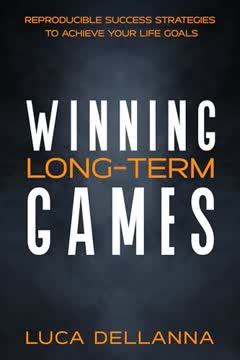
Key Takeaways
1. Play Short-Term Games to Advance Long-Term Goals
The difference is that short-term players play short-term games to win them, whereas long-term players play short-term games to advance their long-term goals.
Shift your mindset. The fundamental principle of winning long-term games is to stop viewing them as a series of isolated short-term victories. Instead, every short-term action should be a deliberate step towards your overarching long-term objectives. This means evaluating each interaction, project, or decision not just by its immediate outcome, but by its contribution to your future success.
Build lasting assets. Short-term gains often come at the expense of long-term assets like trust, skills, relationships, and reputation. A long-term player prioritizes building these assets, understanding that they compound over time and are essential for sustained success. For example, a manager develops their team's skills rather than just pushing for immediate task completion, or a solopreneur builds audience trust over quick sales.
Iterated interactions. Approach every interaction as an "iterated game," where the goal isn't to extract maximum value from a single encounter, but to improve the conditions for future interactions. This fosters goodwill, gathers valuable information, and strengthens connections, ensuring that even if a short-term outcome isn't perfect, it still contributes positively to your long-term trajectory.
2. Design Strategies That Are Sustainable, Constructive, and Inevitable
Good long-term strategies not only have a long-term time horizon but also embrace it and leverage it to achieve better and more certain outcomes than what a short-term strategy can reliably achieve.
Three core properties. Effective long-term strategies are characterized by three essential qualities: sustainability, constructiveness, and inevitability. These properties ensure that your path to success is not only effective but also resilient and robust against unforeseen challenges. They leverage the extended time horizon to build a solid foundation.
Sustainable growth. A sustainable strategy avoids actions that require risks or sacrifices you cannot maintain without severe consequences, such as burnout or damaged relationships. While short-term tactics like working overtime might be useful sparingly, they should never become a long-term strategy. Your approach must be viable for the entire duration of your pursuit, balancing effort with well-being.
Constructive progress. A constructive strategy focuses on building long-term assets like know-how, trust, and relationships, rather than consuming them. It's about making each step contribute to future success, like using a first shot in golf to get closer to the hole, making subsequent shots easier. Inevitability means proactively identifying and addressing potential problems, learning from every experience, and adapting your approach to almost guarantee success.
3. Beware of Short-Term Successes and Survivorship Bias
You shouldn’t imitate all successful people, only those who succeeded using good strategies – strategies that can reliably bring success to those using them.
The illusion of quick wins. Many people are lured into adopting aggressive short-term strategies by observing others who achieve rapid success. However, this often overlooks the role of luck, excessive risk-taking, or unsustainable behaviors that lead to short-term gains but long-term failure. The "terror of falling behind" can push individuals away from sound long-term strategies.
Survivorship bias. We tend to overestimate the quality of a strategy by only looking at those who succeeded with it, ignoring the many who failed. This "hindsight gerrymandering" can make random outcomes appear strategic. For example, an investor's success might be attributed to a specific, non-reproducible factor (like investing in companies with foreign CEOs) simply because it was present in their winning trades.
Alice and Bob. Consider the example of Alice, who takes high risks for high growth but also high failure, versus Bob, who takes lower risks for steady, reproducible growth. While Alice might dominate the top percentile of winners in the short term, Bob's strategy yields higher average wealth over the long run because he avoids catastrophic failures. Don't confuse the strategy that produces the most winners with the best strategy for you.
4. Optimize for the Distribution of Outcomes, Not Just the Best Case
What matters is not the Maximum Possible Outcome but the Distribution of Outcomes.
Beyond best-case scenarios. When evaluating a strategy, it's crucial to look beyond its potential best-case scenario, which is often what we observe due to survivorship bias. Instead, assess the full "distribution of outcomes"—what happens across a range of possibilities, including good and bad luck. A truly good strategy yields satisfactory long-term results even under adverse conditions.
The lottery paradox. Even if a lottery ticket had a positive expected value (meaning, on average, you'd win money), it would still be a bad strategy for most individuals. The reason is the distribution of outcomes: a tiny chance of a huge win versus a near-certain chance of a small loss. For most, losing a significant amount is consequential, making the bet undesirable despite its theoretical "positive" expectation.
Maximize certainty. The goal isn't to achieve your objective as fast or as efficiently as possible, nor to maximize the absolute best outcome. Instead, it's to maximize your chances of achieving and sustaining your goals with near certainty. This means designing a strategy where even individual projects might fail, but the overall strategy cannot, by ensuring failures contribute to learning and asset building.
5. Build and Protect Your Long-Term Assets (The Goose)
Never kill your Goose, nor risk it.
The Goose and the Golden Eggs. This fable illustrates a critical mistake: sacrificing a valuable long-term asset (the Goose) for immediate, greater yield (more Golden Eggs). Many talented individuals fail because they "kill their Goose"—damaging their reputation, health, relationships, or capital in pursuit of faster or larger short-term gains.
Examples of killing the Goose:
- An athlete overtraining and injuring their body.
- A solopreneur sending too many sales emails, eroding audience trust.
- A company releasing a faulty product, breaking customer loyalty.
- An investor taking excessive risks with their capital for marginally higher returns.
Prioritize asset building. Long-term assets like trust, health, know-how, and strong relationships are the true engines of sustained success. Building these assets often doesn't make sense in the short term, as there's always something more "urgent." However, dedicating consistent time and effort to their development is indispensable for long-term potential and avoiding plateaus.
6. Proactively Derisk by Learning from All Failures
To have a good chance of winning long-term games, you must be aware of common sources of failure and do something about them before it’s too late.
Study failure, not just success. A more reliable path to success is to study those who failed, especially those with decent skills and work ethic. This provides invaluable insights into potential risks you might face. Don't assume you're smarter or immune; instead, ask what conditions might lead you to make similar mistakes and prevent those conditions.
Pre-mortems and fishbone diagrams. Don't wait for failure to learn. Use "pre-mortems" by imagining your future self having failed and asking what went wrong, then addressing those issues now. For a more comprehensive approach, use "fishbone diagrams" (as detailed in the appendix) to systematically map out potential causes of failure across various categories, reducing blind spots.
Derisk, don't eliminate risk. Derisking doesn't mean taking zero risks; it means ensuring that individual bets cannot fail in a way that impairs your long-term future. Take calculated risks, but always ensure their downside is limited and that even failure contributes to learning or asset building. Never accept a risk that might lower your chances of eventual success below 99%.
7. Increase Your Luck by Taking More Calculated Bets
Most successful people are talented and/or hard-working. That said, they also got lucky.
Luck is a multiplier. While talent and hard work are crucial, luck often plays a significant role in success. The key is not to passively wait for luck, but to actively "increase its surface area" by putting yourself in situations where you can get lucky. This means exposing yourself to more opportunities and trying more things.
Portfolio of bets. Most successful individuals don't succeed with their first attempt; they start with a portfolio of "bets" (projects, ideas, connections) and iterate until one takes off. Your strategy must account for the possibility that you might need many attempts before finding significant success. This requires a balance: work on each bet well enough to give it a chance, but quickly enough to allow for many attempts.
Frugality and resilience. To afford many bets, be reasonably frugal with your time, money, trust, and other assets. Avoid depleting your resources on a single, high-stakes gamble. Structure your bets so that even if they fail, they strengthen relationships, build skills, or provide valuable insights, making future attempts more likely to succeed.
8. Avoid Races to the Bottom and Define Your Boundaries
Be careful of any career, community, or hobby you participate in. Are they races to the bottom? Do they have the potential to become one?
The trap of excessive sacrifice. Life is full of "races to the bottom"—competitions where winning demands increasingly unreasonable sacrifices or reckless risk-taking. Initially, these races might seem appealing due to easy early wins, but as competition intensifies, they become detrimental to overall well-being. Participants with a narrow vision for success often find themselves miserable, having sacrificed too much.
Broad vision for success. Instead of letting the competition dictate your limits, define your boundaries based on a broad vision for a fulfilling life, encompassing professional, personal, social, and spiritual goals. Use these boundaries to decide to what extent you will compete, rather than if you will compete. This ensures that even if you don't reach #1, you gain more than you risked.
Smaller, reproducible competitions. While large, high-stakes competitions often become races to the bottom where reproducible success is impossible (e.g., winning a World Cup), smaller competitions allow you to outwork or outsmart competitors without undue sacrifice. If a competition becomes too fierce, pivot to another where your unique strengths can lead to reproducible success.
9. Choose Reproducible Objectives for Guaranteed Success
No strategy can guarantee success for goals that only allow a limited number of winners or a limited number of trials.
Skill vs. reproducibility. We often mistakenly believe that if a competition involves skill, being the most skilled guarantees victory. However, even in skill-based games like chess, luck and the sheer number of talented competitors mean that winning isn't guaranteed. A strategy's dependence on luck is determined by its structure and the number of available "winning" slots, not just the presence of random elements.
Limited winners, limited trials. Goals that inherently allow only a limited number of winners (e.g., becoming #1 in a highly competitive field) or a limited number of attempts are not reproducibly achievable. No matter your talent or determination, you can only have a chance at these goals, not a guarantee. This is a critical distinction for long-term planning.
Adapt your goals. To make success almost inevitable, choose goals that allow for many winners and can be pursued through multiple trials. If your dream goal is non-reproducible, acknowledge this and adjust your expectations. You can still pursue it, but understand that it's a bet, not a guaranteed outcome, and ensure its pursuit doesn't compromise your overall long-term strategy.
10. Cultivate Holistic Success Across All Life Stages and Areas
If you optimize your long-term goals in a vacuum, you might achieve them in a way that will not matter because it will have precluded your other eventual goals.
Beyond single-metric optimization. Just as short-term games shouldn't be optimized in isolation, neither should individual long-term goals. Focusing solely on one area, like career success, can lead to "pyrrhic victories" where you achieve your objective but destroy other vital aspects of your life, such as health or relationships. Holistic success means optimizing for your life as a whole.
Balance across life stages. Don't over-optimize for your current stage of life as if it will last forever. Our priorities and needs shift over time. A full life requires acknowledging and preparing for future stages. The author suggests dedicating a portion of time and resources (e.g., 20%) to each time horizon (short, medium, long) and life area (professional, personal, spiritual) to minimize regrets, regardless of how long you live.
The Pareto Frontier. Use the concept of the Pareto Frontier to evaluate your life and choices. Instead of comparing yourself to someone who earns the most (single metric), compare yourself to those who achieve a similar level of income while also having the most free time (multi-metric). This healthy comparison helps you define ambitious yet balanced goals and avoid toxic comparisons with those who have different priorities or shorter time horizons.
11. Address Emotional Blindspots and Commit with High Quality
When it comes to smart and motivated people, as I expect most of my readers to be, blind spots are more likely to be emotional than informational.
Emotional barriers to action. Often, smart and motivated individuals know what to do but fail to do it due to emotional blindspots. These are areas where discomfort, mixed feelings, or avoidance prevent action, often hidden under a "I've gotten away with it all my life" mentality. Procrastination on a task multiple times is a strong indicator of such underlying discomfort.
Mixed values and emotions. You might hold conflicting beliefs or emotions about an action or its outcome. For example, wanting wealth but believing wealthy people are evil, or wanting to sell a product but associating selling with pestering. These mixed signals paralyze action. To overcome this, spend time with virtuous people who embody the desired action or outcome, or take smaller, pleasurable steps to build positive associations.
High-quality commitment. True long-term commitment isn't just declared; it's demonstrated through consistent actions. Low-quality commitment involves stating long-term goals but focusing actions on short-term fixes. High-quality commitment means aligning your daily choices with your long-term vision, such as a manager consistently training their team even when urgent tasks loom. Face and derisk what you've been avoiding, as that's where the biggest improvements lie.
12. Embrace Continuous Learning and Adaptation
Your current plan is probably not complete or correct enough to get you where you want to be, but if you adapt it along the way, keeping yourself on a trajectory toward success, you will almost inevitably arrive there.
Learning as a core strategy. Playing the long game demands constant learning and adaptation. Your initial plan is rarely perfect, but by continuously gathering knowledge and adjusting your approach, you can stay on a trajectory toward success. Learning and adaptation should be integral parts of your strategy, not afterthoughts.
Metapractice. Don't just practice your skills; "metapractice" by also practicing how you practice. Ask yourself: Am I learning enough? How can I tweak my practice to learn more effectively? This could involve taking notes, recording sessions, seeking mentors, or setting clear objectives for each practice session. Improving your learning process accelerates skill development.
Surrender to your gifts. Acknowledge and leverage your natural talents and predispositions, even if they don't align with your idealized image of success. Refusing to "surrender to who you are" can unnecessarily restrict options and stack odds against you. Also, avoid the "effort trap"—the belief that sheer effort alone can overcome lessons you're unwilling to learn. Recognize when effort is compensating for a deeper, unaddressed issue, and then surrender to that lesson or its consequences.
Last updated:
Review Summary
Winning Long-Term Games receives a 4.15/5 rating with mixed feedback. Positive reviewers praise its concise, actionable wisdom on building long-term strategies for life and business, drawing comparisons to Warren Buffett and Charlie Munger's teachings. Several readers found it immediately applicable to their careers. However, critics argue the content feels superficial, better suited as a blog post or tweet rather than a book. Writing quality concerns were raised, including a misspelling of "Buffett." The brevity divides readers between those appreciating its conciseness and those finding it lacks depth.
Similar Books