

Key Takeaways
Treat body language as part of the message, not decoration
Delivery changes the words. At a startup pitch contest, the authors rated presenters on visible signs such as eye contact, smiling, and fidgeting. Contestants who placed among the top eight averaged 8.3 out of 15, compared with 5.5 for the others. The relationship was a correlation, not proof that gestures alone determined the outcome. Still, it supports the book’s central argument: listeners respond to how a message is delivered, not just to its content.
Mood travels through the body. In a call-center training, employees used the same scripts but sounded irritated, distracted, or insecure when their posture and emotional state got in the way. Relaxation and a more positive attitude changed how they sounded to customers. The practical lesson is to improve the condition behind the signal, rather than merely decorating the signal.
What's striking is the feedback loop: internal state shapes posture and voice, while the listener's reaction can then reinforce the speaker's mood. This resembles emotional contagion research, which examines how people unconsciously echo one another's expressions and feelings. It also explains why a script cannot guarantee a warm interaction. The pitch-contest comparison is suggestive, but confidence may have accompanied stronger ideas, better preparation, or greater experience. Body language is best treated as one contributor to an encounter, not a secret lever that overrides competence or context.
Read clusters against context, change, and a person's baseline
One gesture is weak evidence. The book's five interpretive principles are: combine related cues, connect visible behavior to possible inner states, account for context, watch for changes, and learn a person's habits. Crossed arms might signal defensiveness, or simply cold weather. A familiar nose touch may be someone's ordinary mannerism, not a sign of deception.
Timing sharpens a reading. A person who sits tensely from the start offers less evidence than someone whose posture changes immediately after a new price is proposed. The authors say isolated signals may be accurate in only 60 to 80 percent of cases, while three to five cues pointing in the same direction provide stronger grounds for an interpretation. Even a cluster supports a hypothesis, not certainty.
This method resembles Bayesian reasoning: begin with a tentative expectation, update it with new evidence, and give more weight to cues that are unusual for this person and situation. It is a stronger approach than treating gestures as a fixed dictionary. The caution matters because people often notice evidence that confirms a suspicion and overlook ordinary explanations, a familiar bias in judgment. A cluster can increase confidence without making an inference objectively correct. The useful question is not, What does this gesture mean? It is, What changed, what else changed, and what explanations fit?
Change the feeling beneath your posture before rehearsing the pose
Forced gestures can look false. The authors argue that posture expresses emotion, so copying a confident stance while feeling panicked may produce signals that do not fit together. Their call-center trainees illustrate the point: one sat tensely and sounded irritated, while another slouched and sounded insecure, despite both following the same conversation plan. Relaxation exercises, sports, meditation, and making work feel more pleasant helped trainees change their manner and their customer interactions.
Prepare for a real state. Before presenting, the book suggests recalling how the body feels in a comfortable conversation, then finding a stable, relaxed stance that can be carried into the room. The aim is not to act like a different person. It is to reduce tension enough that voice, expression, and words support one another.
The emphasis on congruence is valuable because communication is relational: listeners respond to the whole encounter, including timing, tone, and visible strain. A practical extension is to treat preparation as state management, not pose practice. Breathing, rehearsal, and a familiar opening can make genuine ease more accessible. Yet the claim that inner feelings must change before outward behavior can improve is too absolute. In some situations, adopting a steadier posture or slowing the breath can help reduce arousal. External adjustment and internal change can work in both directions.
Use open, responsive signals to invite cooperation, not to mimic mechanically
Make attention visible. The book associates forward orientation, open palms, gentle nods, and a relaxed head tilt with receptiveness. These cues can help a listener feel heard; illustrative hand movements can also make a speaker's ideas easier to follow. Mirroring means naturally matching some of another person's posture or movement, which the authors present as a way to build rapport. It should not become a precise imitation that calls attention to itself.
Adapt to the setting. The authors describe preparing for a presentation in Qatar by wearing locally appropriate clothing, respecting greeting customs, and opening with a few Arabic sentences. Their point is that a gesture's effect depends on cultural expectations. Even eye contact and hand signals that seem friendly in one place may be uncomfortable or disrespectful elsewhere.
These suggestions align with interactional synchrony, the tendency for people in comfortable conversations to coordinate aspects of movement and timing. Such coordination can signal affiliation, but it is not a universal shortcut to trust. Deliberate mimicry may feel patronizing, while a person's cultural norms, disability, or role can shape their preferred style of engagement. Responsiveness is a better goal than resemblance: attend to whether the other person seems comfortable, and adjust without assuming that a familiar gesture carries the same meaning for everyone.
Project confidence with space and calm, then stop before dominance
Confidence can simplify a first impression. In one seminar, the authors briefly replaced a trainer's Crocs with dress shoes. Most participants did not notice the change, which they attributed to his confident delivery. Their lesson is not that clothing never matters, but that a relaxed, upright presence can outweigh a small visual distraction.
Contain the gesture, not the person. The book calls the space between chest and stomach used for purposeful hand movements the Clinton box. Bill Clinton reportedly limited his once-wild gesturing to this area to appear more controlled without abandoning natural movement. Confidence becomes counterproductive when it turns into a pointed finger, an overpowering handshake, or repeated superior gestures. The authors distinguish assertiveness, clear and calm expression, from aggression that provokes resistance.
The section captures a useful balance: audiences often respond to both competence and warmth, so confidence without consideration can read as threat rather than leadership. The Crocs story is memorable, though it cannot establish that confidence made observers miss the shoes. Likewise, the book's posture prescriptions should not be mistaken for a reliable way to manufacture authority. Popular claims that brief power poses reliably change hormones or performance have faced substantial replication concerns. Grounded confidence, preparation, and respect are safer foundations than trying to occupy more space.
Treat defensive gestures as feedback, not as a verdict about character
Barriers can reveal friction. Crossed arms, clasped hands, a turned-away torso, or hiding behind furniture may accompany discomfort, disagreement, or a desire for distance. Their meaning depends on the moment and the person. A room that has become cold can explain crossed arms; a sudden change after a proposal may deserve attention.
Repair the interaction. The authors tell of a professor whose lectures drew few students despite interesting material. He turned his back to write on the board, hid behind a lectern, and responded to students with a closed posture. He unintentionally made participation harder. When resistance appears, check whether your own behavior is creating distance, change the subject or setting, and invite the other person to explain what would work. Aggressive gestures may call for a calm question or apology, not a counterattack.
This approach treats communication as a system rather than a one-way reading exercise. A defensive posture may be a response to the speaker, the room, or the stakes, and the speaker can change those conditions. That is especially useful in teaching, management, and negotiation, where people may have little freedom to leave. The caution is that a gesture cannot diagnose motive: crossed arms do not prove hostility, and a turned body does not prove disinterest. Direct, non-accusatory questions remain more reliable than silently assigning someone a character trait.
Read facial microexpressions as emotional clues, not lie detectors
Brief expressions can flag a reaction. The authors define microexpressions as short facial muscle movements lasting half a second or less. They describe seven basic emotions: anger, dislike, fear, surprise, happiness, sadness, and contempt. In their account, a brief, symmetrical lift of both mouth corners suggests happiness, while a one-sided lift suggests contempt; nose wrinkles can signal dislike. These are clues to a possible emotional response, not a complete explanation of it.
Practice improves recognition. The book reports an average initial microexpression-test score of 24.09 percent among 2,664 participants, and an average score of 89.45 percent after training. It also reports an association between higher test scores and sales performance. These figures come from the authors' described tests and studies, not a guarantee that a trained observer can accurately read every person in real situations.
The strongest use of a fleeting expression is as a prompt to pause and explore a reaction, especially when words and facial movement seem inconsistent. That is different from claiming access to another person's hidden truth. Emotion research supports the importance of facial communication, while also showing that display and interpretation are shaped by context, culture, and individual variation. The reported training gains are striking, but laboratory-style recognition tests are not the same as accurately inferring motives during a complex negotiation. A disciplined observer stays curious rather than certain.
Use eye contact and smiles cautiously across people and cultures
Eyes provide information, but not a verdict. The authors offer 60 to 80 percent eye contact as a Western business guideline, while noting that expectations differ across cultures. They also warn that pupil changes are too small to assess reliably at normal conversational distance. Their account challenges the idea that eye direction alone identifies a liar, and notes that blink rate varies with attention and thinking.
A smile can be performed. A Duchenne smile involves muscles around the eyes as well as those around the mouth, and is commonly treated as a sign of genuine enjoyment. But the book cites research in which 70 percent of participants could imitate such a smile from a photograph. This complicates the simple genuine-versus-fake test. Read facial cues alongside context, baseline behavior, and other signals.
Eye contact is a social convention as much as a signal. Treating it as a universal measure of honesty can unfairly penalize people whose culture, neurotype, or circumstances shape how they look at others. The same problem applies to smiles: an expression can be socially polite, deliberately reassuring, or genuinely joyful, and these motives can overlap. The book's own cautions are valuable here. Rather than ranking one cue as more truthful than speech, assess consistency across the interaction and seek clarification when a decision depends on what the person means.
Map the decision process, then test your reading without cornering people
Look for a shift toward commitment. The book links chin rubbing, removing or handling glasses, opening a jacket, leaning forward, and gathering papers with reflection, openness, or a wish to leave. None has a guaranteed meaning. Their value lies in timing and in whether other signals support the same interpretation.
Use two practical tools. SCAN is a four-step method for observing behavior: Select relevant cues, Calibrate them against context and personal habits, Analyze plausible meanings, and Note the evidence before drawing a conclusion. BLINK, short for Body Language Interpretations Nominology Know-how, uses carefully framed statements to invite a reaction without asking a blunt question. Instead of demanding a candidate's salary expectation, for example, state the role's standard salary and observe the response. Follow the observation with respectful clarification.
SCAN is useful because it slows down the leap from observation to judgment. BLINK adds a negotiation tactic: present a concrete option and watch for a response. That can surface preferences that a rehearsed answer conceals, but it also risks turning conversation into covert testing. Strategic framing may elicit reactions to the wording, power imbalance, or surprise rather than to the underlying offer. The most defensible practice is to use these methods to generate better questions, then confirm important conclusions openly. Reading signals can guide inquiry, but it cannot replace consent or conversation.
Analysis
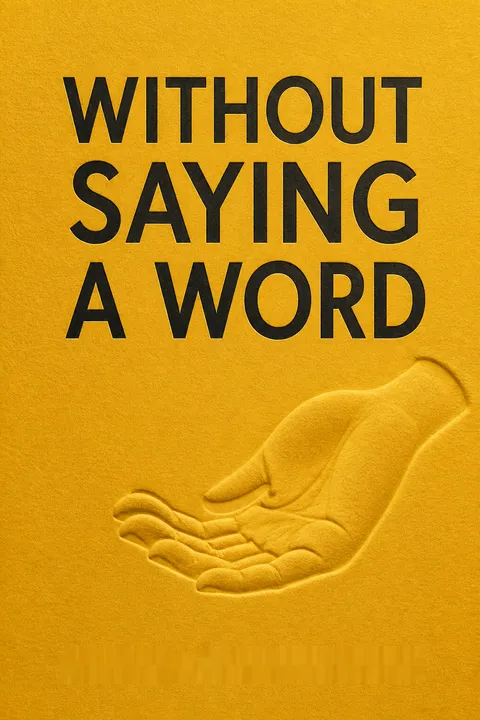
Without Saying a Word is a practical business and communication guide organized around a clear progression: first learn rules for interpreting nonverbal behavior, then notice positive and negative signals, then apply those observations to emotion, facial expression, and negotiation. Its narrative anchors make the advice memorable. A presenter distracted by Crocs illustrates how presence can eclipse minor appearance details; a professor behind a lectern shows how posture can discourage participation; the call-center training shows that an identical script can sound different when the speaker's state changes.
The most durable contribution is not the catalog of gestures. It is the interpretive discipline the book tries to impose on that catalog: look for combinations, context, changes, and individual habits. That discipline partially counters the genre's temptation to promise a universal dictionary of gestures. Its practical tools, SCAN and BLINK, turn observation into a repeatable process for business conversations, while its strongest caution is that cues indicate possible emotions, not proof of deception.
The book is less reliable when it assigns precise meanings to particular movements or extends animal and evolutionary analogies into confident social conclusions. A crossed arm, a glance, or a head tilt may have several causes, and people differ in how they express emotion. Its numerical findings and performance correlations should therefore be treated as the authors' reported evidence, not universal laws. The book's value is highest when it makes readers more observant and more responsive, not when it encourages them to believe they can decode a person at a glance. In practice, nonverbal literacy works best as a prompt for empathy, hypothesis testing, and better questions.
Review Summary
Without Saying a Word receives mixed reviews, with an average rating of 3.46/5. Readers appreciate its practical insights on body language and non-verbal communication, finding it useful for personal and professional situations. Many praise the book's clear explanations, illustrations, and end-of-chapter summaries. However, some critics find the content basic or common sense, and suggest it may be more beneficial in print format. The book is noted for its potential value in improving social skills, negotiations, and writing fictional characters, though some question the universal applicability of its interpretations.
People Also Read



Glossary
Body language intelligence
Reading and using nonverbal cuesThe authors' term for the combined ability to notice nonverbal behavior, interpret it with attention to context, and use that understanding to communicate more effectively. It includes both reading other people's reactions and managing one's own posture, expression, and movement. The book presents it as a learnable skill relevant to presentations, sales, negotiation, and relationships.
Combinations Within Context Change Habits
Five checks for interpretationThe book's mnemonic for its five principles of reading body language: assess combinations of cues, relate outer behavior to possible inner states, consider the context, notice changes over time, and account for a person's habits. The phrase reminds readers not to assign a fixed meaning to an isolated gesture, but to compare multiple signals with the person and situation.
Microexpressions
Brief facial emotion signalsThe authors define microexpressions as subtle facial muscle movements that last half a second or less and can occur involuntarily during emotion. They associate them with seven basic emotions: anger, dislike, fear, surprise, happiness, sadness, and contempt. The book presents them as useful clues to a momentary emotional reaction, while also emphasizing the need to interpret them with context and other cues.
Clinton box
A contained gesture areaA term used in the book for the space between the chest and stomach where a speaker can make clear, controlled hand gestures. The authors describe Bill Clinton's use of this restricted area as a way to replace overly broad gestures with more contained movements that still felt natural. The technique aims to support clarity and confidence without eliminating expressiveness.
SCAN method
A four-step observation processThe authors' structured method for interpreting body language: Select relevant cues, Calibrate them against context and personal habits, Analyze plausible meanings, and Note the observations before reaching a conclusion. It encourages observers to record visible behavior separately from interpretation, reducing the risk of jumping from one gesture to an unsupported judgment.
BLINK Conversation Technique
Eliciting reactions through statementsAn approach the authors use to explore a conversation partner's preferences without asking a direct question. BLINK expands to Body Language Interpretations Nominology Know-how. The speaker presents a relevant statement or option, then observes the listener's response for possible signs of agreement, discomfort, or uncertainty. The technique is intended to guide discussion, not establish another person's thoughts with certainty.
Facial Action Coding System
A system for classifying facial movementA method for describing visible facial muscle actions, developed by Paul Ekman and Wallace Friesen and discussed in the book as a foundation for analyzing expressions. Rather than assigning a personality or motive to a face, the system identifies movements of facial muscles in a consistent way. Researchers and other specialists use it to study facial behavior and expression.
Duchenne smile
Smile involving eye musclesA smile characterized by movement around both the mouth and the eyes. The book contrasts this with smiles formed mainly by the mouth and presents the eye-muscle action as a common sign of genuine pleasure. It also notes that people can imitate features of this smile, so the expression should not be treated as definitive proof of a person's emotion.
FAQ
What's "Without Saying a Word" about?
- Focus on Body Language: "Without Saying a Word" by Kasia Wezowski and Patryk Wezowski is a comprehensive guide to understanding and mastering body language to enhance personal and professional success.
- Scientific Approach: The book delves into the science behind nonverbal communication, offering insights into how body language can reveal emotions and intentions.
- Practical Applications: It provides practical advice and exercises to help readers improve their body language intelligence and interpret others' nonverbal cues effectively.
Why should I read "Without Saying a Word"?
- Enhance Communication Skills: The book offers valuable insights into improving your communication by understanding and using body language effectively.
- Professional Success: By mastering body language, you can increase your chances of success in negotiations, presentations, and interpersonal interactions.
- Personal Development: It helps in building self-confidence and emotional intelligence, which are crucial for personal growth and relationship building.
What are the key takeaways of "Without Saying a Word"?
- Body Language Intelligence: Understanding and interpreting body language can significantly impact your success in various aspects of life.
- Microexpressions Matter: Recognizing microexpressions can provide honest insights into others' emotions, even when they try to hide them.
- Practice and Application: Regular practice and application of body language techniques can lead to improved communication and relationship outcomes.
What are the best quotes from "Without Saying a Word" and what do they mean?
- "Your body always wants to tell the truth about what you are feeling." This quote emphasizes the authenticity of body language as a reflection of true emotions.
- "Body language never lies." It highlights the reliability of nonverbal cues over spoken words in revealing genuine feelings and intentions.
- "Combinations Within Context Change Habits." This phrase underscores the importance of considering context and habitual behaviors when interpreting body language.
How does "Without Saying a Word" define body language intelligence?
- Five Principles: The book outlines five principles for interpreting body language: combinations, internal vs. external, context, changes, and habits.
- Nonverbal Communication: It emphasizes the importance of nonverbal signals in understanding emotions and intentions.
- Practical Exercises: The book includes exercises to help readers develop and refine their body language intelligence.
What is the SCAN method in "Without Saying a Word"?
- Select: Identify relevant body language elements for interpretation.
- Calibrate: Apply the five basic principles to each element to prepare for analysis.
- Analyze: Reexamine possible interpretations in the context of the situation.
- Note: Document observations and conclusions for accurate interpretation.
How can microexpressions be used according to "Without Saying a Word"?
- Universal Emotions: Microexpressions reveal seven basic emotions: anger, dislike, fear, surprise, happiness, sadness, and contempt.
- Involuntary Signals: These expressions are brief and often involuntary, providing honest insights into a person's feelings.
- Practical Application: Recognizing microexpressions can enhance negotiation skills and improve interpersonal communication.
What is the BLINK Conversation Technique™ in "Without Saying a Word"?
- Body Language Interpretations Nominology Know-how: BLINK is a system for obtaining information without asking direct questions.
- Trigger Emotional Reactions: Formulate statements to elicit nonverbal responses that reveal true feelings.
- Diplomatic Exploration: Use BLINK to explore difficult subjects and gather insights without causing resistance.
How does "Without Saying a Word" suggest improving self-confidence through body language?
- Winner’s Pose: Adopting a relaxed, upright stance with open body language can project self-confidence.
- Relaxation Techniques: Practice relaxation exercises to reduce tension and improve communication effectiveness.
- Positive Gestures: Use gestures like the hand pyramid and open palms to convey confidence and openness.
What are some negative body language cues mentioned in "Without Saying a Word"?
- Crossed Arms: Indicates defensiveness or a closed attitude.
- Avoiding Eye Contact: Suggests uncertainty, shyness, or hiding something.
- Clasped Hands: Can signal nervousness or insecurity.
How does "Without Saying a Word" address cultural differences in body language?
- Cultural Variations: The book acknowledges that some gestures have different meanings across cultures.
- Universal Expressions: Despite cultural differences, certain microexpressions are universally recognized.
- Contextual Awareness: It emphasizes the importance of understanding cultural context when interpreting body language.
What exercises does "Without Saying a Word" recommend for practicing body language skills?
- Practice Scenarios: The book provides scenarios for readers to practice interpreting body language.
- Use of SCAN Method: Encourages using the SCAN method to analyze and document body language observations.
- Regular Application: Suggests incorporating body language practice into daily interactions for continuous improvement.
Download PDF
Download EPUB
.epub digital book format is ideal for reading ebooks on phones, tablets, and e-readers.








