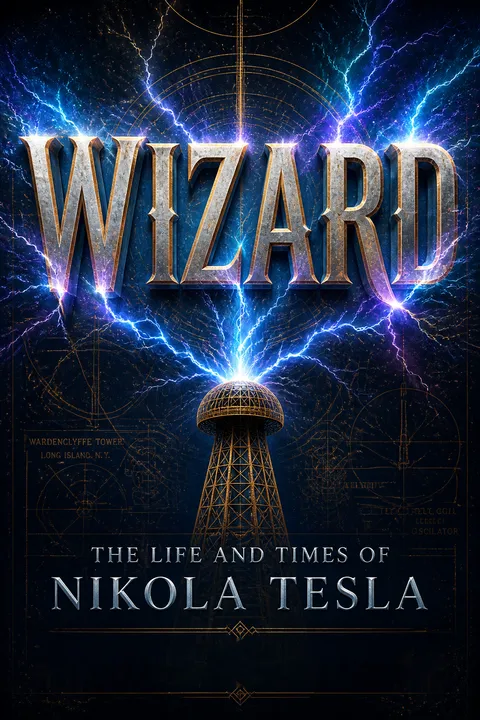


Key Takeaways
Turn elegant mental models into machines people can actually use
Ideas became engineering. Tesla’s distinctive gift was not simply imagining dramatic inventions. He could mentally test a design, revise it, and then translate it into working machinery. His alternating-current motor grew from a visual insight about how changing magnetic fields could keep a rotor turning, then became a practical system of motors, generators, and transformers. The book presents this ability to join theory with construction as the source of Tesla’s lasting importance.
The achievement was systemic. Tesla did not just propose a different motor. His polyphase equipment helped make it possible to transmit power over long distances and use it for factories, transport, and homes. The book’s central portrait is therefore of an inventor who repeatedly tried to turn natural forces into useful infrastructure, not merely a maker of clever devices.
What is striking is the combination of private visualization and public engineering. Modern design practice similarly depends on moving between abstract models, prototypes, and systems that other people can maintain. Yet a vivid mental model is not evidence that a machine will work at scale. Tesla’s durable achievements are strongest where calculation, hardware, and independent testing converged. The distinction helps preserve his real accomplishment without requiring every bold proposal to be accepted as fact.
Let loss sharpen your gifts without making work your only refuge
Grief shaped the boy. Tesla grew up in a Serbian Orthodox family in Croatia, where his mother designed household tools and his father prized memory, languages, and learning. At about five, Nikola’s older brother Dane died in an accident. Tesla later recalled feeling that his own achievements could never match Dane’s, and the biographer interprets this loss as one source of his insecurity and drive. That psychological explanation is plausible, not a proven diagnosis.
Discipline became both tool and trap. As a child, Tesla secretly read by candlelight and practiced self-control. At college he could study for extraordinary stretches, then gamble intensely, before abruptly swearing off the habit. His ability to visualize inventions before building them became a major advantage. So did his readiness to neglect sleep, money, relationships, and health in pursuit of work.
The biography usefully shows that exceptional concentration can have a cost. Cognitive science distinguishes productive absorption from compulsive overwork: both can feel internally compelling, but only the former reliably supports sustained performance. The author’s account of Dane’s death offers a meaningful lens on Tesla’s drive, although psychological explanations based on retrospective memoirs should remain tentative. Childhood adversity can shape ambition, but it does not produce genius by itself, and a single family tragedy cannot explain a lifetime of choices.
Build the whole power system, not just a clever motor
AC needed a practical engine. At school, Tesla challenged the assumption that alternating current could not drive a motor without a sparking commutator. In 1882, while walking in Budapest, he pictured a rotating magnetic field. Two or more alternating currents, timed out of phase, could make a magnetic field rotate continuously and turn a motor. He soon developed multiple motor designs and later demonstrated them publicly.
The network changed the stakes. Alternating current could be transformed to high voltage for transmission, then reduced for safer use. Tesla’s patents covered a broader polyphase system, not only the motor. Westinghouse adopted it, and the system became central to the Niagara Falls power project and the 1893 Chicago fair. Earlier researchers had explored rotating fields, but Tesla’s work made a commercially workable system possible, a distinction upheld in patent litigation.
This is a classic case of innovation happening at the level of a system rather than a single component. Infrastructure research shows that technologies succeed when generation, distribution, standards, and end uses fit together. Tesla’s motor mattered because it solved a bottleneck in a larger electrical network. The historical record still requires care: earlier experiments anticipated parts of the rotating-field idea, while Tesla’s originality lay in its practical development and integration. Priority is often layered, not an all-or-nothing verdict.
Pair invention with partners who can finance, manufacture, and sell it
A patent cannot build a market. Tesla arrived in America in 1884 and worked for Edison, redesigning direct-current machinery. He says he was promised a large bonus that never arrived; the surviving accounts differ, and no signed agreement is presented. After leaving, he was pushed out of a company formed around his arc-lighting work and briefly dug ditches before finding backers for his alternating-current system.
Westinghouse understood the opportunity. He bought rights to Tesla’s patents and brought him to Pittsburgh to adapt the motors to the company’s equipment. When costs and litigation threatened the project, Tesla gave up the lucrative royalty arrangement to help keep development alive. His generosity helped the system advance, but it also left him with less leverage as corporations earned from the technology. The biography repeatedly contrasts Tesla’s faith in partners with his weak attention to contracts, budgets, and commercial execution.
The episode illustrates a central principle of innovation economics: invention and commercialization require different capabilities. Researchers may create valuable knowledge, while firms provide capital, manufacturing, distribution, and legal protection. Tesla’s willingness to trade royalties for momentum can be read as visionary commitment, but also as a costly failure to price future value. The fairest lesson is not that inventors should distrust business, but that collaboration needs explicit terms, aligned incentives, and a clear account of who carries risk.
Use spectacle to open doors, then let evidence carry the claim
Demonstrations made Tesla famous. At London’s Royal Institution in 1892, he showed lamps glowing without direct wires and passed high-frequency current through his body while holding illuminated tubes. At the 1893 Chicago World’s Fair, his displays of wireless lighting and the spinning metal egg captivated visitors. The spectacles helped audiences see that electricity could do more than power familiar bulbs and motors. They also made Tesla a public figure, supported by journalists, authors, financiers, and elite friends.
Fame had a downside. Tesla spoke freely about signaling other planets, transforming weather, and transmitting enormous power without wires. His public image as a wizard amplified attention, but it also made it harder to separate practical demonstrations from predictions. The book shows a man who needed publicity to attract support yet resented the press, worried about imitation, and sometimes disclosed claims more grandly than the available proof justified.
Public demonstration is a powerful bridge between technical work and social imagination. Science communication research finds that vivid examples can attract attention and make abstract mechanisms memorable. But spectacle can also produce an illusion of proof: a dazzling effect may demonstrate that something happens without establishing its mechanism, range, safety, or usefulness. Tesla’s performances were effective invitations to inquiry. Their strongest legacy depends on pairing the wonder with reproducible measurements and clear boundaries around what remains hypothetical.
Match a project’s ambition to its proof and funding
Wardenclyffe began modestly. Tesla’s partnership with J. P. Morgan was intended to fund a tower and laboratory for long-distance wireless communication. The plan changed after Tesla learned that competitors were using related apparatus. He aimed instead at a global network for messages, images, and power, and enlarged the tower project without securing Morgan’s agreement or sufficient new funding.
The mismatch proved fatal. The Long Island tower rose to about 187 feet, with a deep underground shaft and elaborate equipment, but it never became an operating global system. Morgan refused further investment, construction stalled, and Tesla borrowed from relatives, friends, and creditors. The property was eventually transferred to cover his hotel debt, and the tower was demolished in 1917. The book sees both genuine technical ambition and serious errors of judgment: Tesla treated a speculative world system as if its commercial success were already assured.
Wardenclyffe is more than a story of a visionary thwarted by a financier. It is a case study in scope creep, governance, and capital discipline. A project’s social value does not guarantee a workable business model, and a funder’s original agreement cannot be presumed to cover a radically expanded design. At the same time, early infrastructure ventures often require patient capital and can be hard to evaluate with ordinary short-term returns. The tragedy lies partly in the gap between Tesla’s expansive promise and the evidence investors could verify.
Separate documented invention from dazzling speculation before belief hardens into history
Some claims remain uncertain. In Colorado Springs, Tesla monitored electrical disturbances and initially wondered whether they could be signals from another planet. He later suspected that he had detected Marconi’s transmissions, which were using a three-beat signal. The book considers both possibilities and notes that Tesla’s explanations changed over time. His reports of communication with Mars are not established evidence of extraterrestrial contact.
The same caution applies to later inventions. Tesla described power transmission without wires, particles faster than light, and a defensive particle-beam weapon capable of destroying distant aircraft. He wrote technical descriptions of the weapon, but the book does not establish that a functional death ray existed. His more grounded work in X rays, high-frequency electricity, remote control, and turbines should not be conflated with unverified claims. The biography’s narrative is most compelling when it keeps those categories distinct.
This distinction is essential because extraordinary claims can become attached to genuine accomplishment through the force of a compelling biography. Historical method asks whether a claim is supported by independent records, repeatable tests, and consistent explanations, not merely whether the claimant was brilliant. Tesla’s imagination deserves serious attention, especially where it generated testable designs. But attributing unexplained signals to aliens, or treating unpublished weapon plans as demonstrated technology, crosses from history into conjecture. Respect for a thinker includes preserving uncertainty.
Treat scientific credit as a contest shaped by patents, institutions, and proof
Radio had many contributors. Tesla publicly described wireless transmission principles and patented tuned circuits, oscillators, and remote control. Marconi built a practical wireless telegraph system, demonstrated it over long distances, and won international recognition. The biography argues that his apparatus depended on Tesla’s earlier work, while also documenting contributions by Hertz, Lodge, Preece, Branly, and others. In 1943, after Tesla’s death, the U.S. Supreme Court invalidated key Marconi patent claims, citing earlier work including Tesla’s.
Recognition followed power as well as priority. The book traces how industrial rivalries, corporate textbooks, professional societies, and legal disputes shaped the story engineers inherited. Tesla’s name was often omitted, while others received credit or royalties. Yet priority is not identical to practical success, and the history of radio cannot be reduced to a single inventor. The strongest conclusion is that Tesla’s work was foundational, while the technology emerged through a contested network of researchers and operators.
Scientific credit is produced through institutions: patents define ownership, journals establish priority, companies control products, and textbooks stabilize memory. Sociologists of science call this a credit economy, where recognition is a resource that can shape careers and future research. Tesla’s case makes that mechanism visible. Still, correcting an omission should not create a new single-hero myth. Marconi’s practical demonstrations mattered, and wireless developed through cumulative work. A nuanced history can acknowledge Tesla’s foundational role without erasing the wider technical community.
Keep later inventions testable when the first grand project collapses
Tesla kept inventing after Wardenclyffe. He developed a bladeless turbine, using closely spaced disks and the adhesion and viscosity of fluids to create rotation without conventional blades. He proposed using it in pumps, power plants, ships, and vehicles. Companies tested versions of the device, but engineers reported problems including disk fatigue, cost, and disappointing efficiency compared with established turbines. The concept attracted interest, yet it never delivered the commercial rescue Tesla expected.
His final years mixed insight and isolation. Tesla continued to seek support for turbines, wireless power, and particle-beam weapons, while living on credit and moving among hotels. He fed pigeons, wrote for science magazines, and guarded plans that were not independently demonstrated. After his death in 1943, officials examined his papers because of wartime concerns, but investigators reported finding no military device of immediate value. The book ends with a real innovator whose legacy is strongest where his work can be traced and tested.
The turbine episode shows how a promising physical principle can fail at the level of materials, manufacturing, efficiency, or cost. Engineering success is not secured by conceptual elegance; it requires repeated testing against alternatives and the ability to improve a design under real operating conditions. Tesla’s persistence kept possibilities alive, but isolation narrowed the feedback he received. The contrast invites a modern lesson: protect speculative work, but expose prototypes early to independent measurement, skeptical engineers, and users.
Analysis
Wizard is a biography of an inventor and a history of how inventions acquire owners, markets, and reputations. Its strongest narrative is the contrast between Tesla’s gift for seeing systems and his difficulty making institutions work for him. The rotating magnetic field becomes practical because it joins motors, generators, transformers, patents, and Westinghouse’s manufacturing capacity. Wardenclyffe fails for nearly the inverse reason: a technically ambitious idea expands beyond the agreed contract, available capital, and the evidence investors can inspect.
The book’s chronological structure gives this contrast dramatic force. Childhood grief, obsessive discipline, public demonstrations, celebrity friendships, legal conflicts, financial distress, and later isolation are placed in one continuous life. Its psychohistorical interpretation is evocative, especially when it links Tesla’s self-sacrifice and ambition to the death of his brother. But such links are interpretations, not clinical findings. The author’s claims about Tesla’s sexuality, unconscious motives, and emotional collapse should be read with similar caution.
The central historical argument, that Tesla’s contribution to alternating-current power was obscured by corporate and professional rivalries, is persuasive in its broad outline. Patent records and contemporary testimony support his foundational role. The radio story is less reducible: the book persuasively emphasizes Tesla’s earlier circuits and concepts, but practical wireless emerged through the work of many researchers, and Marconi’s demonstrations helped make it commercially visible. The Supreme Court’s later ruling on patent claims does not settle every question of invention priority.
The book is most valuable when it distinguishes documented engineering from Tesla’s spectacular forecasts. Its evidence supports major achievements in AC power, high-frequency apparatus, X-ray experimentation, and remote control. It does not establish contact with Martians, faster-than-light particles, or a functioning death ray. That tension is not a flaw in Tesla’s story. It is the story: disciplined invention and extravagant speculation occupied the same mind, while institutions rewarded the first unevenly and treated the second as either genius or folly.
Review Summary
Wizard: The Life and Times of Nikola Tesla is a comprehensive biography that offers a detailed look at the genius inventor's life and work. Readers appreciate the thorough research and wealth of information provided, but some find the technical details and chronological structure challenging. The book effectively separates myth from fact, presenting Tesla as a complex figure with both brilliance and flaws. While praised for its depth, some reviewers note that the extensive details and tangents can be overwhelming. Overall, it's considered a valuable resource for those interested in Tesla's life and inventions.
People Also Read
Glossary
Rotating magnetic field
A turning magnetic forceA magnetic field that changes direction continuously, produced by alternating currents arranged out of phase. Tesla used this effect to keep a motor’s rotor turning without a commutator. Earlier researchers had explored related effects, but Tesla developed the principle into practical motor designs that became part of his alternating-current system.
Polyphase system
Multiple phased AC circuitsAn electrical power system using two or more alternating currents with timed phase differences. Tesla’s system linked generators, transformers, and motors so power could be transmitted at high voltage and used efficiently at its destination. The book distinguishes this integrated practical system from earlier experiments that demonstrated rotating magnetic effects without a workable power network.
Telautomaton
A remotely controlled machineTesla’s name for a machine controlled at a distance through wireless signals. His 1898 model boat could be steered and operated remotely, demonstrating principles of selective control and radio guidance. Tesla imagined more advanced machines that could respond to commands and perform tasks, but the book distinguishes the working boat from his broader predictions about intelligent machines.
Magnifying transmitter
A powerful resonant transmitterTesla’s large electrical oscillator, developed to generate high-voltage, high-frequency currents for wireless transmission. At Wardenclyffe he intended it to support a global communication system and possibly transmit power. The name refers to Tesla’s effort to intensify electrical oscillations, not to a proven ability to deliver industrial quantities of energy around the world.
Wardenclyffe
Tesla’s Long Island wireless siteThe laboratory and tower Tesla built at Shoreham, Long Island, beginning in 1901. Initially funded by J. P. Morgan for wireless communication, the project grew into Tesla’s larger vision of a worldwide network for messages, images, and power. Funding stopped before the system became operational, and the tower was demolished in 1917.
Tesla currents
Tesla’s term for transmission currentsA phrase used in the book for the high-frequency currents and transmission methods Tesla associated with his wireless system. Tesla argued that his approach relied on the electrical properties of the earth and differed from the radiated, damped waves used by some competitors. The phrase reflects Tesla’s own technical claims, not a separate accepted category in modern physics.
Telegeodynamics
Mechanical signaling through earthTesla’s proposed method of sending mechanical vibrations through the ground to distant receivers. He imagined using resonant oscillations to transmit signals, guide ships, or investigate underground structures. The biography connects this idea to Tesla’s broader interest in resonance and earth currents, while noting that his sweeping claims about destructive effects were not demonstrated at global scale.
Tesla turbine
A bladeless disk turbineA turbine made from closely spaced disks rather than conventional blades. Pressurized fluid spirals between the disks, and viscosity and adhesion transfer motion to the shaft. Tesla proposed the design for pumps, engines, ships, and power generation. Tests showed a strikingly simple concept, but reported problems with efficiency, disk fatigue, manufacturing costs, and competition from established turbines.
FAQ
What's Wizard: The Life And Times Of Nikola Tesla about?
- Comprehensive Biography: The book provides a detailed account of Nikola Tesla's life, from his heritage and childhood in Croatia to his groundbreaking inventions and struggles in America.
- Focus on Inventions: It highlights Tesla's major contributions to electrical engineering, including the development of alternating current (AC) systems, wireless communication, and various electrical devices.
- Historical Context: Tesla's achievements are placed within the broader context of the late 19th and early 20th centuries, a time of rapid technological advancement and fierce competition among inventors.
- Personal Insights: The author, Marc J. Seifer, delves into Tesla's personality, relationships, and the challenges he faced, painting a complex picture of the man behind the inventions.
Why should I read Wizard: The Life And Times Of Nikola Tesla?
- In-depth Research: Marc J. Seifer has compiled extensive documentation and original sources, making this biography a thorough and informative read for anyone interested in Tesla's life and work.
- Inspiring Story: Tesla's life is a testament to creativity, innovation, and perseverance, offering inspiration through his relentless pursuit of knowledge and commitment to improving humanity through technology.
- Understanding Innovation: The book offers a deep dive into the mind of one of history's greatest inventors, providing insights into the creative process and the challenges faced by innovators.
- Cultural Impact: Tesla's inventions have shaped modern society, and understanding his contributions helps readers grasp the foundations of contemporary electrical engineering and wireless communication.
What are the key takeaways of Wizard: The Life And Times Of Nikola Tesla?
- Tesla's Innovations: The book emphasizes Tesla's pioneering work in AC power systems, which revolutionized electricity distribution and laid the groundwork for modern electrical engineering.
- Struggles with Recognition: It discusses the challenges Tesla faced in gaining recognition and financial support for his inventions, often overshadowed by contemporaries like Edison.
- Visionary Thinking: Tesla's ability to envision the future of technology, such as wireless communication and renewable energy, is a central theme, showcasing his foresight and innovative spirit.
- Legacy of Innovation: Tesla's legacy is one of profound impact on science and technology, influencing countless fields and continuing to inspire future generations of inventors and scientists.
What are the best quotes from Wizard: The Life And Times Of Nikola Tesla and what do they mean?
- "The progressive development of man is vitally dependent on invention.": This quote reflects Tesla's belief in the importance of innovation as a driving force for human progress and survival.
- "I have annihilated distance in my scheme.": This quote reflects Tesla's ambition to create a global communication system that transcends physical barriers, highlighting his visionary approach to technology.
- "The central source of cosmic energy for the earth is the sun.": Here, Tesla expresses his understanding of solar energy as a limitless resource, foreshadowing modern discussions about renewable energy and sustainability.
How did Tesla's background influence his work according to Wizard: The Life And Times Of Nikola Tesla?
- Serbian Heritage: Tesla's upbringing in a Serbian Orthodox family instilled in him a strong sense of identity and cultural pride, which influenced his later work and aspirations.
- Education and Early Interests: His education in engineering and physics, combined with early experiences in nature, shaped his innovative thinking and led to his groundbreaking inventions.
- Family Tragedies: The loss of his brother and the pressure from his parents created emotional turmoil that fueled his drive for success and recognition in his field.
What were Tesla's major inventions discussed in Wizard: The Life And Times Of Nikola Tesla?
- Alternating Current (AC) System: Tesla's development of the AC system allowed for efficient long-distance electricity transmission, which became the standard for electrical power distribution.
- Induction Motor: The book details Tesla's invention of the induction motor, which operates without a commutator, making it more efficient and reliable than previous designs.
- Wireless Transmission: Tesla's experiments with wireless communication and energy transmission are highlighted, showcasing his vision for a future where power could be transmitted without wires.
How did Tesla's financial struggles impact his career as described in Wizard: The Life And Times Of Nikola Tesla?
- Lack of Business Acumen: Tesla's idealism often clashed with the realities of the business world, leading to financial difficulties and missed opportunities for commercialization.
- Dependency on Investors: Tesla relied heavily on financial backers like George Westinghouse and J.P. Morgan, which created vulnerabilities in his career when these relationships soured.
- Impact on Innovations: Financial difficulties led to the abandonment of significant projects, such as the Wardenclyffe Tower, which was intended for wireless transmission of energy.
What role did J.P. Morgan play in Tesla's life and work according to Wizard: The Life And Times Of Nikola Tesla?
- Financial Backing: Morgan provided Tesla with significant financial support for his wireless telegraphy project, enabling him to pursue his ambitious plans.
- Control Over Patents: The agreement with Morgan included control over Tesla's patents, complicating the inventor's ability to manage his own inventions.
- Impact on Legacy: Morgan's involvement in Tesla's work ultimately shaped the trajectory of the inventor's career, highlighting the complex interplay between innovation and capitalism.
How did Tesla's rivalry with Edison influence his career as described in Wizard: The Life And Times Of Nikola Tesla?
- Conflict of Ideas: The rivalry between Tesla and Edison, often referred to as the "War of Currents," was marked by differing philosophies on electricity, with Tesla advocating for AC and Edison for DC.
- Professional Rivalry: Their relationship soured as Tesla's AC system gained popularity, leading to public disputes and shaping the future of electrical engineering.
- Legacy of Innovation: Despite the challenges posed by Edison, Tesla's innovations ultimately prevailed, leading to the widespread adoption of AC power.
What were the main conflicts Tesla faced with his contemporaries as described in Wizard: The Life And Times Of Nikola Tesla?
- Competition with Marconi: Tesla faced significant competition from Guglielmo Marconi, who was also working on wireless communication, leading to disputes over patent rights and recognition.
- Rivalry with Edison: The rivalry with Thomas Edison, known as the "War of Currents," was a defining conflict in Tesla's career, with differing approaches to electricity.
- Criticism from Peers: Tesla often faced skepticism and criticism from other scientists and inventors, particularly regarding his more ambitious ideas, complicating his efforts to gain acceptance.
How did Tesla's personal beliefs influence his inventions as described in Wizard: The Life And Times Of Nikola Tesla?
- Philosophical Approach: Tesla's belief in the interconnectedness of all things and the potential for technology to improve humanity shaped his vision for his inventions.
- Pacifism and Peace: The book highlights Tesla's desire to use his inventions for peaceful purposes, such as his vision for wireless communication to promote global understanding.
- Environmental Concerns: Tesla's commitment to sustainability and efficiency is evident in his designs, reflecting his belief in using technology to benefit the planet.
How does Wizard: The Life And Times Of Nikola Tesla portray Tesla's legacy and impact on modern technology?
- Cultural Icon: The book illustrates how Tesla has become a symbol of innovation and creativity, inspiring generations of inventors and scientists.
- Technological Foundations: Tesla's inventions laid the groundwork for many modern technologies, including wireless communication and electrical power systems.
- Environmental Visionary: Tesla's emphasis on sustainable energy solutions resonates with today's environmental movements, positioning him as a pioneer in the quest for a sustainable future.
Download PDF
Download EPUB
.epub digital book format is ideal for reading ebooks on phones, tablets, and e-readers.








