


Plot Summary
A Purse in the Darkness
In 1327, eight-year-old Gwenda lies awake in Kingsbridge’s crowded hospital, knowing hunger will return when winter comes. Her father, Joby, has no land and a maimed hand, so he has taught his children to steal. At the All Hallows service, he singles out Sir Gerald, whose purse could feed the family for months.
Gwenda cuts it free in the cathedral darkness, but the rich girl Caris notices her and tries to protect her from the crushing crowd. Sir Gerald lifts Gwenda so she can see the altar, bringing her dangerously close to discovery. She escapes to her father with the money, then finds her three-legged dog, Hop, waiting outside.
The opening makes poverty a force that reaches into a child’s hands and directs them toward crime. Gwenda understands the risk, but hunger is not an abstract hardship: it threatens her mother’s milk and the lives of younger siblings. Caris’s kindness complicates the scene. The privileged girl sees Gwenda as a child in danger, while Gwenda experiences that attention as a threat to her survival. Their first connection is therefore both genuine and unequal, a pattern that will recur as they grow.
The Secret Beneath the Oak
At archery practice, eleven-year-old Merthin meets Caris, who persuades him and his younger brother Ralph to test Merthin’s homemade bow in the forbidden forest. Gwenda follows with Hop. Ralph kills the dog and a hare, then a wounded knight, Thomas Langley, stumbles into their clearing pursued by two men-at-arms. Ralph shoots one pursuer through the eye; Thomas kills the other.
Merthin binds Thomas’s injured arm and helps hide the bodies. Thomas then buries a sealed letter beneath an oak, warning Merthin that people will kill to keep its contents secret. The children swear to stay silent. Gwenda later tells Joby, who strips the dead men and sells their weapons, drawing danger back to the family.
The children’s game abruptly becomes an adult political crime, and each child responds according to character. Ralph acts with startling physical instinct, Merthin observes and assists, Caris takes charge, and Gwenda reacts through fear and loyalty. Thomas’s buried letter turns their shared secret into a long-term liability. The episode also introduces a harsh asymmetry: the children can witness power, even exercise it for a moment, but they cannot control the consequences once adults begin pursuing the truth.
Three Lives Take Shape
Sir Gerald discovers his stolen purse and learns that his debts will cost him his lands. Earl Roland arranges for the family to live as priory pensioners, while Ralph is promised a path toward knighthood and Merthin is assigned to carpentry. Merthin protests, insisting that he made a bow and wants to fight, but the earl dismisses him as a builder.
Meanwhile, Caris watches her mother Rose weaken despite the monks’ bloodletting. When Rose dies, Caris rejects her aunt Petranilla’s claim to replace her as mother. Asked what future she wants, Caris says she intends to become a doctor, though adults laugh at the ambition. In the priory, young Godwyn asks to study medicine at Oxford, but Prior Anthony refuses to fund him.
The children’s futures are shaped less by aptitude than by class, gender, and institutional permission. Merthin’s skill is visible, but his birth determines his trade; Caris’s intelligence is treated as a curiosity rather than a qualification. Rose’s death gives Caris a concrete reason to distrust inherited medical authority, while Godwyn’s blocked ambition teaches him to see power as something that must be maneuvered into place. Their different responses to constraint will drive the intertwined conflicts that follow.
The Cathedral Cracks
Ten years later, Merthin is still an apprentice, Caris is the wool merchant Edmund’s capable daughter, and their childhood friendship has become a secret love affair. During the rainy Fleece Fair, Merthin spots a structural failure as part of the cathedral’s south aisle collapses. No one dies, but the damage demands expensive repairs.
The fair is already losing business to Shiring, where traders have better facilities. Edmund proposes replacing Kingsbridge’s narrow, decaying wooden bridge, but Prior Anthony refuses to fund it. Merthin studies the bridge and notices cracks near its central pier, while Caris presses for a plan that lets the merchants finance a replacement. Neither knows how soon the old bridge will fail.
The cathedral’s collapse converts Merthin’s private talent into civic responsibility. He sees buildings as systems with causes, not as sacred objects immune to explanation; the monks’ response, by contrast, leans on custom and piety. The bridge dispute exposes a political structure that can collect tolls but resists investment. Caris’s practical intervention marks her as more than a merchant’s daughter, while her hidden intimacy with Merthin gives the public crisis a personal stake: their shared future depends on a town capable of change.
The Bridge Takes the Crowd
During a crowded Fleece Fair, the old bridge gives way under carts and people. Merthin had recognized that the current was scouring away a central pier’s support, but no one cleared the bridge in time. Caris and Merthin rush to rescue the injured. Ralph survives by pulling Earl Roland from the water, while the earl’s heir, William, escapes.
Across the river, Gwenda has just escaped the outlaws who bought her from Joby; she kills Alwyn, then Sim Chapman drowns while trying to drag her under. She reaches Wulfric, only to find his parents and brother dead in the cathedral. The disaster also kills Prior Anthony. Caris organizes care as the town begins counting its losses.
The bridge failure gathers the novel’s private histories into one public catastrophe. Its cause is physical and traceable, yet its consequences feel random to those swept into the river. Gwenda’s survival is neither clean triumph nor release: she has escaped two men by killing, then loses Wulfric’s family in the same disaster. Caris and Merthin respond by acting, while the townspeople’s old hierarchies briefly dissolve in the water. The bridge’s collapse makes civic neglect impossible to mistake for mere inconvenience.
Godwyn Claims the Priory
With Prior Anthony dead, Godwyn maneuvers for control of Kingsbridge Priory. He uses a staged relic accident to push blind sub-prior Carlus out of the election, then engineers the nomination of Friar Murdo, whose unpopularity will unite the monks behind Godwyn. He also discovers that Thomas Langley entered the monastery through a gift from Queen Isabella, recorded in a charter hidden among Anthony’s papers.
Godwyn leaks the secret to Murdo, knowing Murdo will confront Thomas. Thomas withdraws rather than expose his past, leaving Godwyn as the remaining acceptable candidate. He is elected prior, but the victory begins a rule built on manipulation, secrecy and the pursuit of status.
Godwyn’s rise shows how institutional authority can be captured through procedure rather than open force. He turns a religious ritual into political theater, then uses a buried record as leverage while pretending his motives are reformist. His ambition is not simply to govern well: he wants the recognition and elevation that education promises him. Thomas’s withdrawal reveals the cost of that strategy. A secret kept to protect lives becomes a weapon in a contest where the wielder’s moral certainty is increasingly self-serving.
A Bridge Built by Many
After the collapse, Merthin builds a ferry to keep market traffic moving, then proves that a permanent replacement must be stone because faster water has undermined the old timber piers. His design uses two bridges with Leper Island as a midpoint, pointed arches, protective stone around the piers and cofferdams that let masons work below water.
When the earl blocks stone from the priory quarry, Godwyn and Edmund take their case to the royal court and win permission to resume transport. Merthin persuades townspeople to haul the stones and drain the cofferdams by hand. His bridge begins to rise, while the town’s willingness to cooperate makes the project a public achievement rather than a private contract.
Merthin’s engineering depends on noticing what others dismiss: the river’s altered force, the weakness beneath a pier, the value of a pointed stone. Yet technical ingenuity alone cannot build the bridge. He needs Caris’s financing, Edmund’s persuasion, the townspeople’s carts and labor, and a legal victory against the earl. The bridge is therefore both a structure and a test of collective capacity. Its construction briefly offers a model of authority based on competence and shared investment, in contrast to the priory’s command without accountability.
Gwenda Chooses Wulfric
Joby sells Gwenda a second time, trading her to a chapman for a cow. The chapman intends to sell her to outlaws, but Gwenda escapes by luring Alwyn close and stabbing him with his own dagger. During the bridge collapse she survives by clinging to an ox and fighting off Sim Chapman. Back in Wigleigh, she rejects her family after Joby proposes selling her again.
She loves Wulfric, now bereaved and engaged to Annet, and secretly helps him reclaim his father’s land. A potion from Mattie Wise cannot make him choose her. After Annet marries another man, Gwenda comforts Wulfric through grief, and they become lovers, though his heart is still entangled with Annet.
Gwenda’s agency is built from survival skills learned under coercion, but the story distinguishes survival from freedom. She can escape captivity through violence, yet she cannot force Wulfric to love her or make the village grant him land. The failed potion matters because it exposes the difference between desire and consent: Gwenda wants affection, but she cannot manufacture it without risking the very bond she seeks. Her persistence is not passive endurance; it is a repeated choice to work, protect and remain beside Wulfric.
Ralph’s Violence Returns
As lord of Wigleigh, Ralph denies Wulfric his inheritance, then uses that power to demand sex from Gwenda in exchange for reconsidering the decision. He later keeps his authority and refuses Wulfric’s claim, leaving the couple to live as laborers. Years later, Ralph rapes Annet, Wulfric’s former fiancée.
The villagers’ complaint reaches Lord William, and a court convicts Ralph, but he escapes before sentence can be carried out. King Edward pardons him in return for military service in France. At Crécy, Ralph fights fiercely, helps defend the Prince of Wales and is knighted. His rise rewards battlefield courage while leaving the harms he inflicted on peasants largely unresolved.
Ralph’s trajectory exposes the difference between martial bravery and moral courage. He can endure battle and win royal favor, yet treats serfs’ bodies and property as extensions of his own power. His escape from judgment is not an acquittal but a political reprieve: the king needs soldiers, and Ralph’s violence is useful when directed outward. The episode makes the social order brutally legible. The same capacity praised as courage in war becomes predation at home, with status determining which form of violence is celebrated.
Scarlet Saves the Merchants
Kingsbridge’s fairs decline, and Edmund’s wool business nearly collapses. Caris sees that raw wool can be turned into valuable cloth, then studies how Italian dyers use alum and madder to make scarlet hold its color. After repeated experiments, she finds a reliable formula and sells a finished bolt at a high price.
The business revives weaving, dyeing and fulling across the region. Godwyn tries to force all clothmakers to use the priory’s inadequate mill, so Edmund and Caris challenge him in court. They lose because Kingsbridge residents are ruled as the prior’s serfs and cannot appeal to royal justice. Caris and Edmund then seek a borough charter, hoping to free trade from monastic control.
Caris’s breakthrough is empirical: she learns by testing mixtures, observing results and revising her method. That practice contrasts with the monks’ reliance on inherited authorities, but the conflict is not simply science versus superstition. Caris must also understand markets, labor and political power. The scarlet cloth rescues livelihoods, yet its success reveals how easily innovation can be strangled by a landlord’s privilege. Her commercial achievement becomes a campaign for civic freedom, joining practical knowledge to political resistance.
A Vow Saves Caris
Caris becomes pregnant after sleeping with Merthin, but she fears that marriage and motherhood will erase her independence. She takes a dangerous potion from Mattie Wise and survives the resulting illness, but loses the pregnancy. Meanwhile, Philemon and Elfric help Godwyn frame her as a witch, using her healing work, her private mutterings and false testimony from Elizabeth Clerk.
At the trial, Caris dismantles the accusations, but the nuns are ordered to inspect her body for the Devil’s Mark. Mother Cecilia knows Caris’s life is at stake. She offers a way out: Caris confesses, receives absolution and enters the nunnery. The bishop suspends the death sentence only while Caris remains a nun.
Caris is trapped between two forms of authority: the marriage system she fears and the church court that can condemn her. Her decision to end the pregnancy expresses a desire to preserve selfhood, but it also leaves her vulnerable to a public accusation that turns her independence into evidence of evil. Cecilia saves her through institutional knowledge rather than force. The convent becomes both sanctuary and sentence, granting Caris a sphere of work while placing her under rules she has never trusted.
Ralph Escapes the Gallows
After raping Annet, Ralph faces a trial supported by Wulfric, Gwenda, Annet and Father Gaspard. The jury finds him guilty. Before he can be taken to Shiring for execution, Earl Roland’s clerk helps him escape through a side door, with Alan Fernhill close behind. Ralph becomes an outlaw, raiding travellers and market-bound peasants.
Thomas organizes a militia after the attacks threaten Kingsbridge’s trade. When the king’s army moves to France, Ralph is captured with the outlaws but receives a royal pardon in exchange for fighting. At Crécy, he survives the battle and is knighted. The reward returns him to noble society without undoing the violence that made him an outlaw.
Ralph’s escape links local justice to royal expediency. The trial recognizes the harm he has done, but the king’s need for soldiers overrides the verdict. His pardon does not restore moral standing so much as convert his violence into a useful instrument of state power. The contrast between the peasants’ vulnerability and the nobles’ mobility is stark: Wulfric’s family can be dispossessed by a lord, while Ralph can leave a death sentence behind by taking up arms for the king.
Caris Builds Her Own Case
After becoming a nun, Caris continues to challenge Godwyn’s rule. She revives the scarlet-cloth business, supports the bridge and helps the town pursue a borough charter that would end the prior’s control. The legal case fails because the citizens are judged to be serfs, not free burgesses.
Caris is later made guest master and takes charge of the hospital, where her practical skill earns trust from patients and nuns alike. The new hospital gives the sick separate rooms, a pharmacy and better sanitation. Godwyn responds by tightening control, while Philemon becomes his chief ally. Caris’s work gains influence, but her independence remains vulnerable to clerical authority.
Caris’s professional authority grows through repeated acts of care and administration, not through formal permission. She can organize a rescue, devise a treatment or build a hospital, yet the law still classifies townspeople as dependents of the priory. That contradiction is central to her struggle: competence does not automatically become power. The hospital offers a limited alternative institution, while the borough charter promises a larger one. Both are efforts to make responsibility answerable to those who bear its consequences.
Florence Takes Merthin
After Caris enters the convent, Merthin leaves Kingsbridge for Florence, determined to become a builder beyond the town that has constrained him. He prospers, designs a new bridge and palaces, and marries Silvia, a strong-willed Florentine whose family is wealthy in trade. They have a daughter, Lolla.
When the plague devastates Florence, Merthin falls gravely ill and recovers, but Silvia and nearly all her relatives die. The city’s streets empty, his building projects stop and his life there loses its shape. He inherits wealth and responsibility for surviving children, yet realizes that success abroad has not displaced his attachment to Caris. He decides to return to Kingsbridge with Lolla.
Florence gives Merthin the professional recognition denied him in Kingsbridge, but success does not resolve his deepest attachment. The plague strips away the family and commercial world that made his new life possible. His return is therefore not simply a homecoming: it is a choice made after grief has exposed what achievement could not replace. Silvia’s death also leaves Merthin with a child and a future he must build without the woman who shared it.
The Plague Reorders the Town
As the plague returns to Kingsbridge, Caris directs the hospital’s response, separating the sick, rationing care and enforcing cleanliness while the priests prescribe bleeding and prayer. She helps create a new hospital and eventually becomes prioress. Merthin returns with Lolla, his daughter by the late Silvia, and resumes building, though his attachment to Caris remains unresolved.
Godwyn, meanwhile, tightens monastic rules and tries to expand his authority. The plague kills townspeople from every rank, leaving property, labor and leadership unsettled. Caris organizes relief where the old institutions falter, while Merthin’s designs and the guild’s resources offer the town practical ways to rebuild.
The plague is both a biological crisis and a stress test of authority. Its indiscriminate reach exposes the limits of status, inherited medical theory and religious certainty. Caris gains legitimacy because people see her decisions working in real time; Godwyn’s authority, by contrast, depends on obedience and institutional rank. Merthin’s return restores a technical resource to the town, but not an uncomplicated romance. Their unresolved bond mirrors Kingsbridge itself: capable of renewal, yet burdened by old losses.
The Treasury Is Robbed
Godwyn’s new palace drains the priory’s resources, and he secretly takes the nuns’ legacy to fund construction. Caris discovers the theft when she challenges him over hospital improvements, but Bishop Henri refuses to intervene without further proof. Meanwhile, Philemon uses a heresy accusation to attack Caris’s standing, and his testimony nearly brings her back under a death sentence.
Cecilia protects her by having Caris confess and remain a nun. Later, the treasury’s missing ornaments and stolen charters deepen suspicion around the priory. Caris and Merthin begin tracing the hidden records, while Philemon maneuvers for greater power and the townspeople struggle to preserve the institutions that keep them alive.
Godwyn and Philemon embody different kinds of institutional corruption: Godwyn rationalizes theft as service to the priory, while Philemon treats people as tools and secrets as leverage. Caris’s resistance is repeatedly forced into legal and procedural channels controlled by the men she opposes. Her survival depends on alliances with other women, including Cecilia and the nuns, whose authority is limited but not negligible. The missing treasure becomes a material record of the trust the priory has squandered.
A Family’s Price
Ralph’s power over Wigleigh continues to shape Wulfric and Gwenda’s life. He denies Wulfric land, demands Gwenda’s sexual submission and later punishes the couple through his control of their livelihood. Gwenda’s older son Sam grows into a strong, impulsive young man, while younger Davey is quieter and inventive.
When labor shortages create a chance to work in Outhenby, Sam leaves without permission. Ralph’s bailiff later tracks him down after Sam kills Jonno Reeve during an attempted arrest. Sam is convicted of murder and faces execution. Gwenda and Wulfric lose the land they had built their hopes around, while Ralph’s authority remains entangled with the family’s choices.
Gwenda’s family story tests what survival costs across generations. She fought to escape being treated as property, yet her sons inherit a world where a landlord can still dictate work, movement and punishment. Sam’s violence resembles Ralph’s in its speed and force, but it arises in defense of his freedom, not in the pursuit of domination. The distinction matters without erasing the consequence: Jonno is dead, and Sam’s life now depends on the same hierarchy that has repeatedly denied the family justice.
The Town Chooses Its Future
As another outbreak threatens Kingsbridge, Caris again organizes care and argues that public health requires separation, clean water and practical treatment. Merthin, now back from Florence and bereaved, resumes work on the cathedral tower and the town’s buildings. Their love remains strong, but Caris’s duty to the priory and Merthin’s wish for a shared life keep them divided.
Ralph, now earl, still governs through fear, while his family’s future depends on the children he has raised and the alliances he can command. Caris pushes for a new hospital and civic protections, even as Philemon contests her authority. The supplied narrative leaves the town facing renewed danger and unresolved political and personal choices.
The story’s final movement, as represented in the supplied text, refuses a neat resolution. Kingsbridge has survived one plague and rebuilt its bridge, trade and institutions, but survival has not repaired every relationship or made power just. Caris’s public role has expanded, while her private life remains constrained by the vows that once saved her. Merthin has returned, yet love alone cannot settle the conflict. The approaching plague makes their choices urgent again, without promising that courage or skill can control every outcome.
Analysis
World Without End treats a town as a living system, not a backdrop. Kingsbridge depends on bridges, mills, markets, roads, farms, hospitals and the people who keep them working. When any one part fails, the damage travels: the collapsing bridge kills hundreds and ruins trade; the plague empties households and fields; restrictive rules leave resources idle precisely when the town needs them most. Merthin understands structures physically, while Caris understands them socially and medically. Their best work succeeds when observation becomes shared action.
The novel also asks who is allowed to define competence. Caris can heal, organize and negotiate, yet the church repeatedly casts her judgment as improper because she is a woman. Merthin’s designs are superior, but guild and noble rank can keep him from building. Meanwhile, Ralph’s violence earns him status when it serves a king, while comparable harm against peasants is harder to prosecute. The distinction is not between order and disorder, but between whose interests an order protects.
Gwenda’s story makes that imbalance intimate. She learns to survive through labor, cunning and endurance, yet her children inherit the same narrow choices. Her persistence is a form of agency, though it cannot guarantee the future she wants for them. Across these lives, the book resists the comforting idea that virtue is always rewarded or that institutions naturally correct themselves. Change comes when people build alternatives, as Merthin does with the bridge and Caris with the hospital, and when others risk solidarity rather than defer to rank. But the supplied narrative leaves those gains vulnerable: plague returns, political power shifts, and the people who create a better system must keep defending it.
Review Summary
World Without End is a compelling sequel to Pillars of the Earth, set in 14th century Kingsbridge. Follett masterfully weaves historical events like the Black Death and Hundred Years' War into the lives of well-developed characters. The epic tale spans decades, exploring themes of love, power, and progress. While some readers found it repetitive or overly long, many praised Follett's storytelling and immersive historical detail. The book's relevance to modern issues and its exploration of medieval medicine particularly resonated with readers.
People Also Read







Characters
Caris
The healer and reformerThe daughter of wool merchant Edmund Wooler, Caris is intelligent, observant and resistant to being directed by men or institutions. Her mother’s illness first draws her toward medicine; the failure of conventional treatments sharpens her skepticism. She has a gift for organizing people under pressure and for noticing practical causes that others overlook. Her ties to Merthin, Gwenda and the nunnery pull her between private desire and public responsibility. Caris’s defining impulse is to test claims against what happens to actual people, whether the subject is a medicine, a law or a religious rule.
Merthin
The inventive builderSir Gerald’s older son, Merthin is physically slight but intellectually bold, fascinated by how structures work. He observes flaws in bridges and cathedrals that established builders miss, and he can turn an abstract problem into a workable machine. He is patient in craft and emotionally persistent, especially in his love for Caris. His life is repeatedly shaped by the gap between what he can build and what the guilds or nobles will allow. He values competence over rank, yet he also longs for recognition and a lasting home.
Gwenda
The stubborn survivorJoby’s daughter, Gwenda grows up amid hunger and learns to steal because her family has no reliable income. She is observant, resourceful and physically tough, with a fierce instinct for protecting those she loves. Her attachment to Wulfric is patient but not passive: she works beside him, argues for his rights and makes hard choices when the family is threatened. Gwenda understands manipulation because she was raised by someone who used it to survive. Her deepest struggle is to keep her loved ones safe without becoming the kind of person who treats them as possessions.
Wulfric
The land-loving peasantThe son of Samuel, a prosperous peasant, Wulfric is strong, handsome and deeply attached to the land. He measures a good life through work, family and the chance to pass a productive holding to the next generation. His loyalty can be admirable, but it also makes him slow to see when other people’s desires are shaping his choices. He prefers direct effort to strategy, which leaves him vulnerable in manorial politics. Gwenda’s devotion offers him companionship, while his pride in farming gives him an identity beyond the social rank imposed on him.
Ralph Fitzgerald
The ambitious fighting manMerthin’s younger brother, Ralph is physically powerful, proud and eager to rise in the nobility. He is drawn to combat, rank and the visible signs of authority, and he measures himself against the humiliation his father suffered. His lack of patience with resistance makes him dangerous to people below him in status. Ralph can be brave and decisive, but those qualities are not matched by empathy or self-restraint. His relationships are shaped by possession and control, especially when he believes someone has challenged his standing.
Godwyn
The calculating priorPetranilla’s son and Prior Anthony’s nephew, Godwyn is ambitious, intelligent and acutely aware of hierarchy. He sees education and church office as routes to power, and he studies people as carefully as he studies institutional rules. His political skill often exceeds his moral judgment: he can present self-interest as reform or religious duty. Godwyn wants Kingsbridge Priory to command respect, but he is also drawn to the prestige that comes with command. His devotion is real enough to shape his choices, yet it does not prevent him from manipulating others.
Philemon
The opportunistic monkGwenda’s older brother, originally called Holger by his family, Philemon has long wanted the security and status of monastic life. He is watchful, eager to please those above him and unusually skilled at discovering private information. His devotion to Godwyn gives him a route into influence, while his lack of scruple makes him useful to political schemes. Philemon’s appetite for approval sits uneasily beside his talent for exploiting other people’s weaknesses.
Thomas Langley
The soldier turned monkThomas enters Kingsbridge as a wounded knight and later serves as the priory’s building supervisor. He is courteous, self-controlled and practical, with a soldier’s decisiveness tempered by a serious desire for spiritual peace. His missing arm is a visible reminder of the violent life he left behind. Thomas respects Merthin’s skill and treats younger workers with more fairness than many masters. He keeps his past private, not because he is ashamed of every part of it, but because he understands the danger that secrets can carry.
Gwenda’s parents, Joby and Ethna
Parents shaped by wantJoby is a landless laborer whose habitual theft begins as a response to poverty but hardens into a way of life. He is clever enough to improvise, not wise enough to see the lasting harm he causes his children. Ethna is practical and fiercely loyal to the family, even when that loyalty requires her to defend choices Gwenda cannot forgive. Together they show how scarcity can make survival feel like the only moral rule, while leaving their children to pay its cost.
Edmund Wooler
The merchant aldermanCaris’s father is a wool merchant, a civic leader and a warm host despite his disability. He understands negotiation, trade and the interdependence of town and priory. Edmund trusts practical talent and is willing to take risks when the town’s future demands it. His relationship with Caris is affectionate and unusually respectful for the period: he listens to her reasoning and makes room for her abilities. He also carries old resentment toward his brother Anthony and the social structures that once confined his family.
Petranilla
The family strategistGodwyn’s mother, Caris’s aunt and a formidable figure in Kingsbridge, Petranilla is politically shrewd and emotionally controlled. She believes status must be won through planning, alliances and the careful use of other people’s weaknesses. Her devotion to Godwyn is intense, and she sacrifices her own independence to advance his career. She is less affectionate than Edmund but more perceptive about power, especially the barriers facing women. Her relationship with Caris is strained because she sees the younger woman’s independence as both a risk and a squandered advantage.
Mother Cecilia
The practical prioressThe head of the nunnery, Cecilia combines firm discipline with a nurse’s attention to suffering. She understands how to keep an institution functioning and recognizes Caris’s gifts before others do. Cecilia values obedience, but she is not blind to the limits of male authority or to the harm caused by bad medicine. She gives Caris room to work in the hospital and knows when a rigid rule must bend to preserve a life. Her influence rests on competence more than display.
Madge Webber
The formidable clothmakerMark Webber’s wife, Madge is blunt, energetic and practical. She understands the labor behind cloth production and knows how to persuade people to work together. Her family rises from poverty through weaving and Caris’s dyeing methods, but Madge remains grounded in daily needs rather than social display. She is a loyal friend to Caris and a sharp judge of people. Her confidence is earned through work, and she is willing to confront authority when the town’s vulnerable residents are threatened.
Mark Webber
The gentle giantA huge, mild-mannered builder and weaver, Mark is one of the most physically imposing men in Kingsbridge but rarely uses strength to intimidate. He works hard, cares for his family and earns the trust of poorer townspeople. His partnership with Madge turns a modest weaving household into a successful enterprise. Mark’s influence comes not from rank but from his steadiness and generosity, which make people willing to follow him when a crisis demands collective effort.
Elfric Builder
The guild-bound masterMerthin’s master and Alice’s husband, Elfric is a competent political operator but an insecure craftsman. He values obedience, guild rules and family advantage, and he resents Merthin’s independent talent. Elfric knows how to ingratiate himself with powerful patrons, especially the priory, and he treats apprentices as dependents rather than emerging professionals. His practical skills are real, but his fear of being surpassed repeatedly narrows his judgment.
Alice
Caris’s guarded sisterCaris’s older sister, Alice, is more conventional and socially cautious than her sibling. Her marriage to Elfric strengthens her position in Kingsbridge but also draws her into his resentments and family disputes. She can be sharp and ungenerous, especially when she feels overlooked or threatened. Alice wants security and respectability, and she is less willing than Caris to challenge the roles assigned to women. Their relationship is shaped by affection, rivalry and different ideas of what a safe life requires.
Annet
The favored village beautyPerkin’s daughter is attractive, flirtatious and conscious of the social advantages beauty can bring. She is accustomed to being pursued and to using charm in ordinary negotiations. Annet values security and land, not only romance, and she understands that marriage can determine a woman’s material future. Her choices complicate Gwenda’s love for Wulfric and expose the narrow options available to women whose survival depends on marriage.
Lady Philippa
The powerful countessPhilippa is the wife of Earl William and daughter-in-law of Earl Roland. She is intelligent, self-possessed and capable of exerting influence in a world where formal authority belongs to men. Her warmth is selective, and her political judgment is sharper than her husband’s courtiers sometimes expect. Philippa sees how personal behavior can alter alliances, reputations and the safety of vulnerable people. She is also a mother, and that bond can make her choices more urgent than courtly etiquette.
Mattie Wise
The practical healerMattie is a village healer who uses herbs, close observation and experience rather than claims of supernatural power. She understands that a woman’s remedies are more likely to be called witchcraft than a man’s, so she works discreetly and warns clients not to mistake medicine for miracles. Mattie is compassionate but unsentimental, charging for her work when she can and helping those who cannot pay. She gives Caris a model of knowledge built from testing and attention.
Bishop Henri
The practical churchmanHenri is the bishop of Shiring and the formal authority over Kingsbridge’s religious institutions. He is pragmatic, politically cautious and more interested in keeping the diocese functioning than in pursuing every moral dispute. He can recognize competence, but he avoids conflicts that threaten his position or consume time needed elsewhere. His decisions often depend on pressures from the king, the priory and the town, making him a hinge between religious law and civic power.
Sir Gregory Longfellow
The king’s legal fixerA lawyer with court connections, Gregory is confident, strategic and adept at turning complicated law into political advantage. He serves powerful patrons and thinks in terms of leverage, precedent and the king’s interests. Gregory does not need to like the people he assists; he needs to understand what they can offer. His polished manner disguises a willingness to work in morally ambiguous territory when it serves the crown.
Lolla
Merthin’s spirited daughterLolla is Merthin’s daughter, raised amid the shifting worlds of Florence and Kingsbridge. Bright, restless and quick to resist control, she wants the freedom to choose her companions and direction. Her intelligence and stubbornness echo qualities Merthin recognizes in himself and Caris. As she grows, her independence unsettles the adults who love her, forcing them to confront the difference between protecting a child and trying to govern her every choice.
Sir Thomas Langley’s family
The cost of sanctuaryThomas’s estranged wife and children live beyond the priory’s protected walls, carrying the human cost of his hidden life. Their existence reminds Thomas that renouncing his former identity did not erase the obligations he left behind. They matter to the story because his silence protects more than himself, and because the safety offered by religious sanctuary can leave other people exposed.
Tilly
The young noble wardTilly is a young member of Earl Roland’s family, raised among the nobility and educated at the nuns’ school. She is still growing into her own judgment, but she is observant and capable of resisting the future others arrange for her. Her position makes her both valuable in political alliances and vulnerable to decisions made by powerful relatives. Tilly’s story highlights how noble birth can offer privilege without giving a young woman control over her life.
Sam
Gwenda’s strong-willed sonSam is Gwenda and Wulfric’s elder son, tall and forceful like his father but quicker to anger. He wants a life larger than the one available to a peasant laborer and is drawn toward action and risk. His decisions reflect the pressure of a social world that restricts movement while demanding obedience. Sam’s relationship with his parents is affectionate but increasingly strained by his desire to choose his own path.
Davey
The inventive younger sonGwenda and Wulfric’s younger son is clever, observant and less physically imposing than Sam. He notices opportunities that others miss and is willing to experiment, including with a valuable dye crop. Davey’s ambitions reflect a younger generation beginning to imagine that skill and initiative might open doors beyond inherited labor. His caution and secrecy sometimes frustrate his mother, but they also help him protect ideas until they are ready.
Merthin and Caris’s community
Kingsbridge’s working peopleThe merchants, builders, farmers, monks, nuns and laborers of Kingsbridge form a collective character around the named leads. Their work sustains the town, while their shared dependence on the priory leaves them exposed to its decisions. They are not a single-minded crowd: fear, self-interest, faith and solidarity pull them in different directions. Their choices determine whether innovations such as the bridge, hospital and cloth trade become lasting civic institutions.
Plot Devices
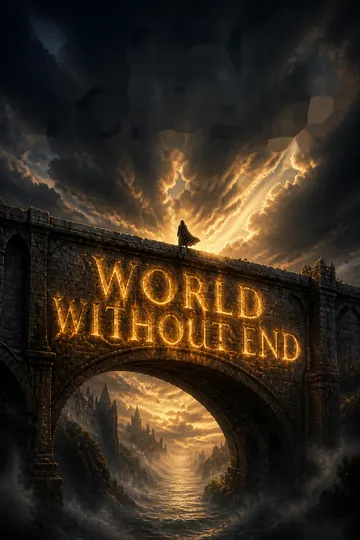
The stone bridge
A town’s lifelineThe old wooden bridge is both a physical structure and Kingsbridge’s economic artery. Its collapse exposes how changes to the riverbank have made the original design unsafe. Merthin’s solution uses stone arches, cofferdams, protective rubble and an ingenious ferry to keep trade moving while construction proceeds. The bridge’s financing forces merchants, the priory and the crown into conflict over tolls, rights and authority. Its rebuilding demonstrates Merthin’s engineering skill while making the town’s prosperity depend on cooperation rather than inherited privilege.
The royal letter
A buried political threatThomas Langley hides a sealed message beneath an oak after escaping two men-at-arms. He fears that whoever carries it will be killed, so Merthin becomes the keeper of its location. The letter connects Thomas’s arrival at the priory to a gift from Queen Isabella and gives later characters leverage over the monks and the crown. It turns a childhood secret into a long-running test of loyalty, secrecy and political survival. Its contents reveal a dangerous truth about the royal family.
Scarlet cloth
Trade remade by experimentWhen English wool stops selling reliably, Caris experiments with madder and alum to produce bright, colorfast scarlet cloth. The process creates a valuable new industry that gives work to weavers, dyers and fullers, and helps restore Kingsbridge’s finances. The innovation also threatens the priory’s control of its fulling mill, bringing Caris and Edmund into conflict with Godwyn. Scarlet cloth is therefore both a practical solution to economic crisis and a challenge to the town’s old rules.
The plague
A test of care and powerThe plague repeatedly strips away the ordinary protections of class, wealth and religious status. Caris and the nuns respond with practical care, isolation, clean water and observation, while many male physicians rely on bleeding and inherited theories. The disease changes labor markets, inheritance, family structures and the authority of the priory. Its recurrences keep testing whether Kingsbridge can adapt, and whether people will protect one another when fear makes isolation, abandonment and violence seem easier.
Priory charters
Law as contested territoryCharters and old grants determine who owns land, controls mills, collects tolls and may appeal to royal courts. The characters repeatedly discover that a right written centuries earlier can matter more than fairness in the present. Godwyn uses institutional authority to preserve the priory’s privileges, while Edmund and Caris seek a borough charter that would give the merchants civic power. The hidden letter is a related secret, but the broader device is the struggle over who gets to interpret law and whose interests it serves.
FAQ
Synopsis & Basic Details
What is World Without End about?
- A sprawling historical epic: The story follows the lives of several families in the town of Kingsbridge, England, over a period of decades, beginning in 1327.
- Focus on community and change: It explores the challenges and triumphs of the townspeople as they navigate political intrigue, economic hardship, and the devastating effects of the plague.
- Intertwined destinies: The narrative weaves together the personal struggles and ambitions of characters from different social classes, highlighting their interconnectedness and the impact of their choices on the community.
Why should I read World Without End?
- Immersive historical setting: Follett masterfully recreates the atmosphere of medieval England, bringing to life the daily routines, social customs, and political tensions of the era.
- Complex and compelling characters: The novel features a diverse cast of characters with intricate motivations and relationships, making their journeys both relatable and captivating.
- Epic scope and intricate plot: The story spans generations and encompasses a wide range of themes, including love, ambition, betrayal, and the struggle for survival, offering a rich and rewarding reading experience.
What is the background of World Without End?
- Historical context: The novel is set in 14th-century England, a time of political instability, economic hardship, and the devastating impact of the plague.
- Geographical setting: The story is centered around the fictional town of Kingsbridge, a bustling market town with a significant priory, which serves as a microcosm of medieval society.
- Cultural and social elements: The novel explores the social hierarchy of the time, the role of the church, the importance of trade, and the daily lives of people from different social classes, from peasants to nobles.
What are the most memorable quotes in World Without End?
- "For the love of Christ, who teaches us charity, breakfast will be provided after the All Hallows service. Meanwhile, there is pure drinking water in the courtyard fountain. Please remember to use the latrines outside – no pissing indoors!": This quote, delivered by Brother Godwyn, highlights the strict rules and practical concerns of the priory, while also revealing a touch of humor.
- "You can come out. I'm no danger to you in this state.": This line, spoken by the wounded knight Thomas Langley to Merthin, shows his remarkable poise and courtesy even in a life-threatening situation, and foreshadows his later transformation into a monk.
- "I'm going to be a doctor.": Caris's bold declaration, made in response to questions about her future, reveals her unconventional ambition and sets the stage for her lifelong pursuit of knowledge and healing.
What writing style, narrative choices, and literary techniques does Ken Follett use?
- Detailed historical realism: Follett meticulously researches historical details, creating a vivid and immersive portrayal of 14th-century England.
- Multiple perspectives: The narrative shifts between different characters' viewpoints, allowing readers to understand their motivations and see the story from various angles.
- Foreshadowing and callbacks: Follett uses subtle hints and recurring motifs to foreshadow future events and create a sense of interconnectedness throughout the sprawling narrative.
Hidden Details & Subtle Connections
What are some minor details that add significant meaning?
- The three-legged dog, Hop: This seemingly minor detail in the opening scene becomes a symbol of vulnerability and the harsh realities of life for the poor, and its death foreshadows the violence and loss to come.
- The red cloth: The expensive scarlet cloth that Edmund buys for his wife, Rose, becomes a symbol of his love and longing for her recovery, and later a reminder of her absence.
- The names of the characters: The names of some characters, such as Philemon (meaning "loving" or "affectionate"), often contrast with their actions, highlighting the complexities of human nature.
What are some subtle foreshadowing and callbacks?
- Philemon's interest in the monks: His early fascination with the monastic life foreshadows his later role as a manipulative and power-hungry prior.
- Merthin's skill with a bow: His early talent for archery, though dismissed by his father, foreshadows his later resourcefulness and ability to overcome challenges.
- The description of the cathedral's windows: The mention of the transept windows being larger than those in the nave foreshadows the later collapse of the south aisle, which was built in the older style.
What are some unexpected character connections?
- The shared ancestry of Sir Gerald and Jack Builder: This connection, revealed through family stories, highlights the interconnectedness of the characters and the legacy of the past.
- The relationship between Petranilla and Prior Anthony: Their sibling bond, though often strained, reveals the complex dynamics of power and ambition within the priory.
- The connection between Thomas Langley and Merthin: Their shared experience in the forest, though seemingly random, creates a bond that influences their later actions.
Who are the most significant supporting characters?
- Mother Cecilia: The prioress of Kingsbridge, she is a powerful and influential figure who provides guidance and support to the nuns and the townspeople.
- Brother Thomas: A former knight turned monk, he is a complex character whose past actions continue to influence his present life.
- Edmund Wooler: A wealthy wool merchant and alderman of Kingsbridge, he is a key figure in the town's economic and political life, and a father figure to Caris.
Psychological, Emotional, & Relational Analysis
What are some unspoken motivations of the characters?
- Godwyn's ambition: His desire for power and recognition drives his actions, often leading him to manipulate others and compromise his own values.
- Ralph's need for validation: His constant need to prove his strength and worth stems from his insecurity about his social status and his father's disappointment.
- Caris's fear of commitment: Her reluctance to marry Merthin is rooted in her fear of losing her independence and being confined to a traditional role.
What psychological complexities do the characters exhibit?
- Godwyn's internal conflict: He struggles with his desire for power and his religious beliefs, often justifying his actions with appeals to God's will.
- Ralph's self-destructive tendencies: His need for validation and his inability to control his anger lead him to make impulsive and harmful decisions.
- Caris's struggle with her identity: She is torn between her desire for independence and her love for Merthin, and her ambition to be a healer and her duty as a nun.
What are the major emotional turning points?
- The death of Rose Wooler: This event highlights the fragility of life and the powerlessness of individuals in the face of disease, and it sets the stage for Caris's desire to become a healer.
- The collapse of the bridge: This disaster forces the townspeople to confront their vulnerabilities and the need for leadership and reform, and it also leads to the loss of Wulfric's family.
- The discovery of the buried letter: This event reveals the dangerous secrets and political intrigue that underlie the lives of the characters, and it sets the stage for future conflicts.
How do relationship dynamics evolve?
- The rivalry between Merthin and Ralph: Their relationship is marked by a mixture of affection and resentment, as they compete for their father's approval and struggle with their different destinies.
- The complex bond between Caris and Godwyn: Their relationship is marked by a mixture of affection and rivalry, as they navigate their shared family history and their different paths in life.
- The evolving relationship between Caris and Merthin: Their love is tested by time, distance, and personal ambition, but it remains a constant source of hope and inspiration.
Interpretation & Debate
Which parts of the story remain ambiguous or open-ended?
- The true nature of Thomas Langley's past: The reasons for his sudden decision to become a monk and the details of his involvement with Queen Isabella remain shrouded in mystery.
- The ultimate fate of the buried letter: The letter's contents and its potential impact on the political landscape are left unresolved, leaving readers to speculate about its significance.
- The long-term consequences of the plague: The novel does not fully explore the long-term effects of the plague on the town of Kingsbridge, leaving readers to imagine the challenges and changes that lie ahead.
What are some debatable, controversial scenes or moments in World Without End?
- The treatment of women: The novel depicts a patriarchal society in which women are often treated as property, and their desires and ambitions are often suppressed.
- The use of violence: The novel contains several scenes of graphic violence, which may be disturbing to some readers.
- The portrayal of religious figures: The novel presents a complex and often critical view of the church, highlighting the hypocrisy and corruption of some of its leaders.
World Without End Ending Explained: How It Ends & What It Means
- A cycle of destruction and renewal: The novel ends with the town of Kingsbridge facing new challenges, but also with a sense of hope and resilience.
- The importance of community and leadership: The story emphasizes the need for strong and compassionate leaders who can guide their communities through times of crisis.
- The enduring power of love and hope: Despite the many tragedies and setbacks, the novel ultimately celebrates the human spirit's capacity to endure and overcome adversity, and the enduring power of love and hope.
Kingsbridge Series


About the Author
Other books by Ken Follett







Download PDF
Download EPUB
.epub digital book format is ideal for reading ebooks on phones, tablets, and e-readers.








