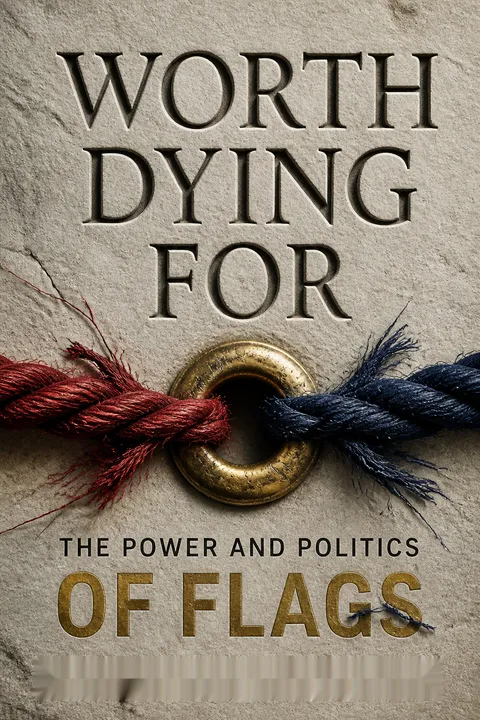


Key Takeaways
Read flags as emotional shortcuts, not neutral pieces of cloth
A nation in miniature. A flag compresses a country’s history, geography, values, and conflicts into a glance. That compression can make it reassuring to one person and threatening to another. After the World Trade Center attacks, three firefighters raised the American flag over the ruins, turning a small visual gesture into an image of collective endurance. In Belgrade, an Albanian nationalist sent a drone over a football match carrying a flag that claimed disputed territory and challenged Serbian belonging. The match collapsed into violence. In both cases, the cloth mattered because people understood the message behind it.
Meaning travels by feeling. Flags spread after silk made lightweight banners practical for armies. Their military origins help explain why they still signal solidarity and opposition so quickly. Their meaning is never entirely fixed: it depends on history, audience, and the moment.
What's striking is how efficiently a flag turns an abstract identity into a visible object. Social identity research describes how group symbols can strengthen belonging while sharpening the boundary between insiders and outsiders. The Serbian football incident shows that the danger is not simply a symbol's design, but the disputed history packed into it. This makes flags useful evidence for understanding conflict, but poor evidence of unanimous public opinion. A flag can be flown by a government, a protester, or a small faction, each claiming to speak for a much larger population.
Let the American flag hold both national promise and protest
A symbol with many owners. The Stars and Stripes began with thirteen stars and stripes for the original colonies. Its meaning grew through war, national ritual, art, and everyday display. Francis Scott Key watched the flag remain above Fort McHenry after a British bombardment in 1814, an episode that inspired the national anthem. For many Americans, the flag now represents freedom and opportunity. Others see military power, racism, or a gap between national ideals and lived experience. The book contrasts a Black man in impoverished Galveston who asked what he had to celebrate with Black students who planned to join the Marines to serve their country.
Dissent belongs too. In 1989, the Supreme Court ruled that burning the flag as political protest was protected symbolic speech. The ruling made the flag a test of whether patriotic symbols belong to the state alone.
The American example illustrates a useful democratic distinction: respect for a symbol cannot require agreement with the government that uses it. Constitutional protection for flag-burning allows citizens to criticize the nation through one of its most potent emblems. That freedom can feel offensive precisely because the symbol matters. The tension is productive, but it does not erase unequal experiences. A shared national image may invite people into a common story while leaving the material conditions that divide them untouched.
A union flag can proclaim unity while exposing unequal belonging
One design, several nations. The Union Jack combines the crosses associated with England, Scotland, and Ireland, but does not include the Welsh dragon. Its origins lie in royal unions and the later formation of the United Kingdom, not in an equal agreement among four equally powerful partners. England accounts for about 84 percent of the UK population, and many English people have historically treated British and English identity as interchangeable. Scottish and Welsh identities have remained more distinct. In Northern Ireland, British and Irish flags can mark political allegiance so intensely that even city hall flag policy has provoked months of protest.
Belonging can change. In England, both the Union and St George’s flags became associated with far-right groups. Athletes such as Linford Christie and Mo Farah helped make public displays of Britishness more inclusive, while devolution and Brexit revived arguments about national identity.
A flag can function like a constitutional diagram: its inclusions and omissions show which identities the state recognizes and which it leaves implicit. The Union Jack's layered construction is especially revealing because England's dominance can make a formally composite symbol feel English by default. Yet symbols can also be reclaimed. The appearance of Black British athletes wrapped in the flag challenged the assumption that Britishness belonged to one ethnic group. That shift shows why political symbols are neither inherently inclusive nor permanently captured by their first prominent users.
Treat European flags as layered records, not timeless designs
History survives redesign. European flags carry traces of religious conflict, revolution, monarchy, and dictatorship. The French tricolour emerged from revolutionary politics and became associated with liberty, equality, and fraternity. Germany's black, red, and gold flag has been tied to democratic movements, rejected by imperial and Nazi regimes, and restored after the Second World War. The swastika, an ancient symbol used in several cultures, became inseparable in the West from Nazi rule and genocide. The European flag's twelve stars were selected partly to avoid disputes over member numbers, not to represent twelve countries or a religious doctrine.
Unity has limits. The European Union reused a design first adopted by the Council of Europe. It can represent peace and shared principles, but national identities formed over centuries remain powerful. A common flag cannot settle how much political union people want.
These examples show that symbols accumulate meanings rather than simply inherit them from their designers. Historical context can transform an image, as the swastika's global religious history coexists with its specific and devastating Nazi association in Europe. The European flag offers a different challenge: it symbolizes cooperation without possessing the emotional depth of many national flags. This is not necessarily a design failure. Political institutions may need symbols of negotiated coexistence, even when those symbols cannot manufacture a common identity on their own.
Shared Arab colors could not make colonial borders feel like one nation
A common palette, competing states. The 1916 Arab Revolt flag used black, white, green, and red, colors linked to Islamic dynasties and Arab identity. Sharif Hussein hoped a common banner would help unite Arab peoples against Ottoman rule. British and French plans for the region, including the secret Sykes-Picot agreement, instead divided territory into spheres of influence. Hussein's larger political project failed, while his Hashemite descendants ruled Jordan and Saudi Arabia emerged under the rival House of Saud.
Flags mark rival claims. Jordan and several other Arab states adapted the Revolt colors. Saudi Arabia chose a green flag bearing the Islamic profession of faith and a sword, emphasizing the House of Saud and its religious authority. Across the region, flags can express kinship, but they also belong to states with different rulers, interests, and communities. Shared colors do not guarantee a shared nation.
The gap between pan-Arab imagery and state rivalry illustrates a broader problem in nation-building: cultural resemblance does not automatically produce political consent. A shared language or religious tradition may support solidarity, but institutions, borders, and distributions of power shape whether that solidarity lasts. The chapter's historical account also cautions against treating the modern Middle East as an ancient, unified political unit. Colonial decisions mattered, but local rulers and movements pursued their own ambitions rather than merely inheriting a map imposed from outside.
Militant groups turn sacred symbols into high-speed propaganda
Recognition is a weapon. Islamic State adopted a black flag bearing the shahada, the Muslim profession of faith, and presented it as a sign of religious legitimacy. The words and color have meanings far beyond the organization, but its propaganda tried to make the flag inseparable from its violence. In June 2014, Islamic State fighters captured Mosul, a city of about 1.8 million defended by roughly 30,000 Iraqi troops. The defenders fled. The group's carefully publicized brutality and unmistakable banner helped make its advance appear terrifying and unstoppable.
Symbols compete for authority. Other militant groups use related religious imagery, while Hezbollah, Hamas, and Fatah deploy distinct emblems to signal their political and military aims. Understanding these flags can clarify what groups claim, but it should not confuse a movement's interpretation of Islam with the faith of Muslims generally.
The flag's propaganda value comes from repetition and association. Communication research often distinguishes a message's content from its reach; a simple image, repeated across photographs and video, can acquire global recognition even when its interpretation is contested. Islamic State exploited that process by claiming a religious symbol for a political project. The crucial nuance is that familiar religious language is not proof of broad religious legitimacy. Careful analysis separates a group's claim to represent a faith from the diverse beliefs and practices of the people whose symbols it borrows.
New Asian flags negotiate ancient identity, state power, and modern rupture
Old stories serve new states. India's flag combines saffron, white, green, and the Ashoka Chakra, a wheel associated with an ancient Indian emblem. Gandhi had promoted a spinning wheel as a sign of self-reliance, but the final design used the chakra, which could speak across several religious traditions. China's red flag draws on Communist politics while using five stars that connect to older Chinese symbolism. The Communist Party is the largest star, with smaller stars arranged around it.
Symbols can divide as well as unite. South Korea retained a flag built around yin and yang, while North Korea replaced it with a red banner and Communist star. Japan's sun-disc flag predates its militarist period, yet its wartime history still affects how neighboring countries view it. These designs show that state symbols can preserve cultural memory, assert government authority, or reopen historical wounds.
The Asian examples reveal how national identity is assembled from selective memory. A new regime rarely starts from a blank page: it adapts older cultural forms to make political change feel both legitimate and familiar. The same flexibility can also conceal coercion, as when a state promotes one official interpretation and suppresses regional flags. Reading a design therefore requires attention not only to its stated symbolism, but also to who is allowed to display competing symbols and under what risks.
African liberation colors unite a continent, not necessarily each country
Independence found its colors. Ethiopia's red, gold, and green flag became an inspiration for African independence movements after Ethiopian forces defeated Italy in 1896. Marcus Garvey's Universal Negro Improvement Association promoted a red, black, and green flag for people of African descent and the struggle against colonialism. Ghana, the first sub-Saharan African country to gain independence in the postwar era, used red, gold, and green, adding a black star. Similar colors spread widely across the continent.
A flag cannot finish reconciliation. South Africa's post-apartheid flag brought several colors together in a Y-shaped design intended to suggest convergence. Mozambique's flag includes an AK-47, a reminder of its liberation struggle that some citizens find divisive. Across Africa, borders often joined many ethnic and linguistic communities. Pan-African colors could express shared resistance without resolving each country's internal conflicts.
The African examples distinguish continental solidarity from domestic nation-building. A symbol can create a powerful shared language against colonial rule, while leaving the difficult work of power-sharing and reconciliation to institutions and political practice. South Africa's design makes that aspiration visible, but no design can ensure equal citizenship by itself. The Mozambique debate adds a further point: a symbol that honors liberation for one group may evoke violence for another. Inclusive nationhood requires listening to those competing memories, not only choosing attractive colors.
Latin American flags turn revolution into durable national origin stories
Independence becomes visible. Simón Bolívar's Gran Colombia used yellow, blue, and red, a design inherited by Colombia, Venezuela, and Ecuador after the federation broke apart. Mexico placed an eagle, cactus, and snake at the center of its flag, drawing on an Aztec foundation story that Spanish rule had tried to suppress. The Wiphala, a multicolored Andean flag, has become a symbol of Indigenous identity and rights. In Bolivia, its required display alongside the national tricolour sparked disagreement over whether it represented recognition or division.
Flags can mark sovereignty disputes. In Panama, activists carrying the national flag challenged US control of the Canal Zone. A 1964 confrontation left more than twenty people dead and helped build pressure for a new arrangement. Panama took over the canal in 1999. Across the region, flags preserve revolutionary ideals alongside unfinished political struggles.
Origin stories give nations a shared past, but they also decide whose past receives public recognition. Mexico's Indigenous image and the Wiphala show how national symbols can recover histories marginalized by colonial rule. Such recognition is meaningful, yet representation can provoke disputes over who counts as the nation and who controls its institutions. Panama's flag conflict makes sovereignty tangible: control over a territory was contested through a visible claim, then changed through diplomacy and political pressure.
Judge global flags by the work they do, not the ideals printed on them
Some flags cross borders. The white flag signals a request to communicate, negotiate, or surrender, and its misuse in war can constitute a crime. The Red Cross, Red Crescent, and Red Crystal identify humanitarian protection, though each emerged from concerns about neutrality and recognition. The Olympic rings aim to represent unity among continents, while the rainbow flag has become a visible sign of LGBT identity and inclusion. These symbols do not represent conventional nation states, but they can still rally people or identify spaces of safety.
Universal claims meet power. The United Nations flag depicts a world framed by olive branches, yet the Security Council's permanent membership reflects the victors of the Second World War. The UN flag can signify global cooperation, but the institution's structure limits how fully it speaks for the world. A symbol's reach depends on the trust and authority attached to it.
Transnational flags demonstrate that symbols can coordinate action without creating a single political community. The Red Cross emblem is useful because it marks a protected role across opposing forces; its value depends on restraint and shared rules, not affection. The rainbow flag works differently, making visibility itself a claim to safety and equal status. The UN flag faces a harder legitimacy problem: a global emblem can promise universal representation while decision-making power remains concentrated. Symbolic unity is most credible when institutional practice supports it.
Analysis
The book's central argument is that flags are not passive illustrations of nations. They are compact political instruments: they make history visible, help people recognize allies, and give governments or movements a claim to collective legitimacy. Their force comes partly from simplicity. A few colors or shapes can carry a story that would take books to explain, while leaving enough ambiguity for different audiences to invest different meanings in the same design.
That compression creates both solidarity and risk. The American flag can stand for liberty to one citizen and exclusion to another. The Union Jack can represent a shared state while reminding its constituent nations that union has never meant equal power. Islamic State's banner shows how a group can appropriate a broadly meaningful religious profession and use repetition to associate it with a narrow political project. Across the examples, the meaning of a flag depends not only on origin, but on who displays it, where, and under what conditions.
The book's geographical range makes the argument persuasive, but it also makes precision essential. A design's official explanation is not the same as its public meaning, and a symbol's use by a state or faction cannot prove that everyone represented by it agrees. Some flag origins are disputed, and traditions may be politically useful even when their historical basis is uncertain. The most reliable reading therefore holds three questions together: What story does the design claim? Which group has the power to promote that story? Who sees themselves excluded or threatened by it?
The result is a practical way to read political imagery. Flags reveal not a settled national essence, but an ongoing contest over belonging, sovereignty, memory, and authority. People may salute, burn, ban, or reclaim them because these actions contest who gets to define the community. A flag cannot repair a divided society or make an institution legitimate by itself. It can, however, make those disputes visible, and sometimes turn them into a force that changes what people are willing to defend.
Review Summary
Worth Dying For receives mixed reviews, averaging 3.65/5 stars. Many readers appreciate Marshall's accessible writing style and fascinating historical information about flags worldwide. However, significant criticisms emerge regarding Western bias, particularly in the "Flags of Fear" chapter focusing on Islamic organizations while excluding Nazi and KKK symbols. Multiple reviewers note factual errors, orientalist perspectives, and the author's political biases undermining credibility. Some find the book too unstructured or wish for more images. Positive reviews praise its educational value and entertaining approach to vexillology, while negative reviews criticize it as superficial and opinion-heavy.
People Also Read


Glossary
vexillology
the study of flagsThe study of flags, including their design, history, symbolism, and use. The book uses vexillology to examine how national and organizational flags developed, how their meanings changed, and how their display communicates political identity. The term is useful because flags operate not only as graphic designs, but also as historical and social symbols.
fimbriations
thin separating border stripesIn heraldry and flag design, fimbriations are narrow bands, often white or gold, placed between areas of contrasting color. They make a design clearer and follow conventions that separate certain colors, or heraldic metals. The Union Jack's thin white lines around red crosses are examples.
shahada
Islamic profession of faithThe shahada is the Islamic profession of faith, declaring belief in one God and in Muhammad as God's messenger. It appears on the flags of Saudi Arabia and Islamic State, among others. Its use is not unique to any one organization, so its appearance must be distinguished from the political claims made by the group displaying it.
pan-African flag
symbol of African solidarityThe red, black, and green flag promoted by Marcus Garvey and the Universal Negro Improvement Association in 1920. It represented people of African descent and the struggle against colonialism and racial subordination. Its colors later became associated with broader pan-African identity, although African states adopted varied combinations and meanings.
Wiphala
Andean Indigenous flagA square, multicolored flag used as a symbol of Indigenous identity across the Andes, especially in Bolivia, Ecuador, Peru, and Chile. Its modern political use has grown alongside the organization of Indigenous communities. In Bolivia, it is displayed alongside the national flag, a choice that has prompted debate about recognition and national unity.
Open Registry
foreign ship registration systemA system that lets a ship owner register a vessel in a country without requiring the owner or crew to be citizens of that country. Panama's open registry attracts vessels through comparatively flexible rules and tax advantages. The practice is also known critically as a flag of convenience because a ship's flag may have little connection to its owner or operations.
symbolic speech
expression through symbolic conductCommunication that expresses an idea through an action or symbol rather than spoken or written words. In Texas v. Johnson, the US Supreme Court treated flag-burning as symbolic speech and held that political expression of this kind is protected by the First Amendment. The ruling made the flag a symbol both of national allegiance and of the right to dissent.
Politics of Place Series
About the Author
Other books by Tim Marshall
Download PDF
Download EPUB
.epub digital book format is ideal for reading ebooks on phones, tablets, and e-readers.








