

Key Takeaways
Build a catalogue, not a lottery ticket, and let each release compound.
Make success cumulative. The book rejects the idea that one title must become a runaway hit. A growing catalogue gives readers more chances to discover an author, and gives satisfied readers something else to buy. The authors describe some books earning modest monthly income, then feeding readers toward other titles through connected series and bundles. Small returns can add up across a body of work, though neither sales nor a full-time living is guaranteed.
Let chance find your work. Hugh Howey spent years publishing without broad attention before his Wool story broke through. Its success mattered, but so did the books he had already written and the follow-up work he produced for interested readers. The practical lesson is to keep improving and publishing rather than staking a career on one launch.
The catalogue model treats creative work like a portfolio: individual titles can underperform while the whole collection gains value through cross-discovery. That is a useful antidote to the emotional pressure of judging a career by one release. It also changes the role of luck. More work creates more opportunities for a lucky break, but output alone does not ensure quality, visibility, or income. A sustainable pace matters, especially for writers whose time, health, or responsibilities make high-volume production unrealistic.
Write from creative instinct, then position the finished book for its readers.
Separate the modes. The authors argue for a sequence: create and revise with the story or subject in charge, then switch to business decisions when the work is ready to meet the public. This lets artistic choices remain alive without pretending that presentation is irrelevant. A writer can follow an unusual idea, then decide how to describe, price, and package it so the right reader recognizes its appeal.
Know the audience. Their own company published everything from a political science-fiction serial to a comic western featuring a unicorn. They accepted that this variety might lose readers who wanted one genre, while attracting people who enjoyed their broader identity as storytellers. The point is not that every writer should cross genres. It is that business choices should clarify the work, not dictate what the writer is allowed to imagine.
This division of labor resembles separating exploration from evaluation. When the same mental mode must invent and judge at once, fear of market rejection can shrink the creative range; when presentation is postponed indefinitely, readers may never understand what the work offers. The sequence offers a practical compromise. Authenticity is not automatically a market advantage, however. It becomes useful when the work and its framing help a particular audience identify why it belongs in their reading life.
Make every cover, page, and edit earn a reader's trust.
Presentation is part of the product. The authors warn that a weak cover, careless description, broken link, or visible typo can tell a browser to move on before the story gets a chance. Their standard is not elaborate perfection, but professional execution: hire a designer when necessary, edit with outside help, and inspect the final files on an actual reading device. A typo or wrong call to action in a compiled edition can make the whole operation look inattentive.
Protect reading flow. They use the term flow for the reader's absorption in the imagined world, where attention stays on the story rather than the mechanics of the prose. Confusing sentences, missing words, and inconsistent formatting interrupt that experience. A three-pass process helps: draft freely, revise for clarity and story, then polish. The final pass is not a substitute for outside eyes.
A book's packaging acts as a trust signal before the reader can assess its contents. That makes design and editing more than cosmetic concerns: they shape the expectations with which the story is received. The emphasis on flow also captures an important asymmetry. Authors know what they meant and can mentally repair gaps that a new reader cannot. Still, polish should not erase distinctive voice. Editing is strongest when it removes accidental friction without sanding away deliberate style.
Choose the readers who fit your work instead of chasing universal approval.
Define the right reader. The authors use the idea of 1,000 True Fans to describe a core audience that eagerly buys new work, recommends it, and wants to stay connected. The number is a guiding idea, not a promise or precise business target. Their advice is to picture an ideal reader and make decisions with that person in mind, rather than trying to satisfy every possible buyer.
Accept the tradeoff. Sean and Johnny chose to publish in widely different genres, knowing some readers would not follow them across every project. Their collaborator Dave, by contrast, stayed closer to dark fiction because that matched his interests. Either choice can work when it is deliberate. The mistake is diluting a distinctive project to appeal to people who were unlikely to enjoy it in the first place.
A clearly defined audience helps creative decisions and marketing reinforce each other. It resembles product design: a tool made for a specific user can solve that user's problem better than a vague tool designed for everyone. The authors' own genre-hopping also shows that a brand need not mean repeating one formula; it can center on a consistent sensibility. The limitation is scale. A loyal niche audience can sustain some careers, but the necessary size and purchasing power vary by genre, price, and an author's costs.
Build strategies around readers, because publishing tactics and platforms keep changing.
Keep the durable goal. The authors distinguish a strategy, such as connecting readers with the next book, from a tactic, such as using a retailer's temporary free promotion. In their account, Amazon changed how free downloads affected rankings, damaging writers who had built their entire promotional plan around that one mechanism. The underlying goal of helping interested readers discover a book remained intact, even when the tactic stopped working.
Stay flexible. The book's examples come from the fast-changing e-book market of 2013 and 2014, so its platform recommendations are historical rather than current instructions. Its lasting advice is to ask whether a tool still serves the purpose, then adjust without abandoning the purpose. Selling on multiple platforms, for instance, reduced the authors' dependence on one retailer, though it also added management work.
The distinction between ends and means is a form of strategic resilience. A writer anchored to a platform feature can mistake a temporary advantage for a business foundation; a writer anchored to reader satisfaction can test alternatives when conditions change. The approach also supports experimentation without treating every new tool as essential. Diversification has costs, though. More channels can mean more administration and weaker focus, so resilience comes from selective redundancy, not from trying to be everywhere.
Give readers an easy first step, then a valuable next purchase.
Design a reading path. A product funnel is an arrangement in which an accessible first work leads readers toward related paid books or a collection. The opening title should be easy to try, often free, while a clear call to action points to the natural next step. A call to action is a prompt asking the reader to do something, such as buy the sequel, choose a bundle, or join an email list.
Make the offer coherent. The authors' Unicorn Western example began with a free first book. At the end, readers could buy the next installment separately or choose the nine-book saga for $9.99, compared with nearly $27 at the individual prices then used. The bundle made the value visible. The sequence only works, however, when the first book satisfies readers and the next offer genuinely matches what they just enjoyed.
The funnel concept maps a reader's growing confidence onto a sequence of choices. A free or low-cost introduction reduces the risk of trying an unknown author; a well-timed bundle rewards readers who already know they want more. This is customer experience design as much as promotion: the next step should feel helpful, not like an ambush. A free entry point can also attract people who never intend to buy, so its value depends on what follows and on the author's ability to reach the audience again.
Own a direct way to reach readers instead of renting every connection.
Reduce platform dependence. The authors call reliance on someone else's website or social network digital sharecropping: building an audience on property controlled by another company. A platform can change its rules, limit access, or disappear. Their proposed foundation is an independently controlled website and an email list, while treating social networks and retailers as useful but secondary channels.
Make contact worthwhile. Readers should know why they are signing up and receive the promised benefit, whether that is a free book, early notice, or occasional updates. The authors recommend communicating regularly enough that the relationship does not go cold, and writing in a personal, useful voice rather than sending only bland sales notices. Email should not become a time sink; brief, considerate replies can maintain a human connection without taking over the writing day.
An owned contact channel is a form of operational resilience: it gives a creator a way to communicate when a distributor or social platform changes the rules. It also shifts the relationship from rented attention toward voluntary permission. That permission creates an obligation, not merely an asset. Irrelevant or excessive messages can spend trust faster than they build it, and a mailing list is not truly independent if the author neglects backups, privacy, or the service that delivers the messages.
Use flexible structure and regular work sessions to finish more books.
Give the draft room. For fiction, the authors use story beats, brief chapter-level predictions that guide a draft without dictating every event. If a character's behavior contradicts the plan, the writer should reconsider the circumstances rather than forcing the character to obey an outline. For nonfiction, they recommend a nested outline: major ideas, supporting points, and examples, expanded as needed.
Separate drafting from polishing. Their workflow keeps the first draft moving, then revises for readers and polishes the language. Regular sessions, a prepared workspace, deadlines, and limits on interruptions help make writing more dependable. The authors favor speed as a way to quiet premature self-criticism, not as a universal word-count contest. Their own prolific output reflects extensive practice and is not a sensible benchmark for every writer.
Flexible structure reduces two opposite risks: wandering without direction and obeying a plan after it has stopped making sense. It resembles navigation with a route that can be revised when the terrain changes. Regular work sessions also lower the startup cost of returning to a project. The authors' emphasis on speed is most helpful when a writer is over-editing too early; for research-heavy work or writers with different rhythms, slower drafting may be the more productive choice.
Request honest reviews, then stop treating each rating as a verdict.
Reviews build confidence. The authors value reviews mainly as social proof: visible evidence that other readers have tried a book. They recommend asking satisfied readers politely, making the request easy to act on, and offering review copies only with a request for an honest opinion. They reject bought or fabricated reviews, since short-term appearance can damage a writer's credibility if exposed.
Keep criticism in proportion. A negative review may reveal a real weakness, but it may also reflect a reader's preferences or assumptions. The authors advise looking for repeated patterns rather than overreacting to one comment, and avoiding public arguments with reviewers. They also warn against constantly checking rankings and sales. Their own example of refreshing a book's chart position throughout a promotion shows how quickly measurement can become distraction.
Reviews serve two different functions: they help prospective readers judge a purchase, and they give writers feedback. Confusing those functions makes every low rating feel like a personal diagnosis. Patterns across independent readers are more informative than a single reaction, while even repeated criticism needs interpretation against the intended audience. The book's advice to ask directly is sound when it preserves reviewer freedom. Trust is the core asset, so any incentive that pressures people toward praise undermines the very proof the reviews are meant to provide.
Analysis
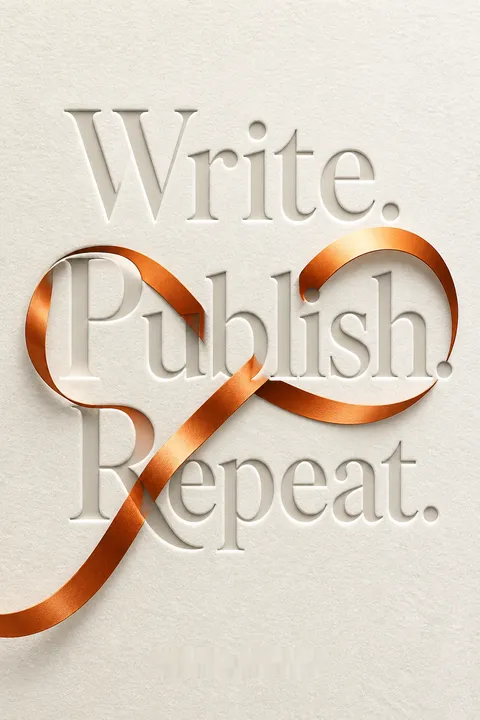
Write. Publish. Repeat. is a business guide built around a deceptively simple claim: an independent writing career is not secured by a clever launch, but constructed through repeatable production, professional presentation, and reader relationships. Its most useful shift is from the isolated book to the connected catalogue. A title can be an artistic object, an entry point, a link to another title, and a long-lived asset at once. That portfolio view explains why the authors prioritize funnels, series, bundles, and direct reader contact.
The book also offers a practical theory of creative labor. It separates invention from commercial framing, then recommends routines and flexible structures that make completion more likely. This avoids both romantic waiting for inspiration and rigid production formulas. Its implicit standard is not maximal output at any cost, but sustained work that can be improved and sold. The authors' own extraordinary publishing pace, however, risks making their model appear more universal than it is. The principle of consistency travels better than their volume; caregiving, disability, employment, and financial constraints alter what a sustainable pace looks like.
The business advice is strongest when it concerns durable human behavior: readers need to recognize a book, trust its quality, and find a satisfying next step. It is weaker when historical platform tactics are treated as general prescriptions. The text itself distinguishes tactics from strategy, which helps readers separate its enduring logic from its dated details. Its enthusiasm for marketing also benefits from a boundary: audience service is not the same as unlimited access to an author's time, and reader data creates responsibilities as well as leverage.
The central lesson is therefore not that every writer should imitate a high-output publishing company. It is that creative independence requires deliberate systems. Writers can choose the scale, genre, channels, and business model that fit their circumstances, but they cannot avoid making those choices. The book's title compresses that discipline into a cycle: make work, release it professionally, learn from the response, and continue.
Review Summary
Write. Publish. Repeat. receives mostly positive reviews, praised for its practical advice on self-publishing and building a writing career. Readers appreciate the authors' honesty about the hard work required and their emphasis on producing quality content consistently. The book's strengths include marketing strategies, reader engagement tips, and a realistic approach to the publishing industry. Some criticisms mention the book's length and occasional repetitiveness. Overall, it's highly recommended for aspiring and established indie authors, offering valuable insights into the business side of writing.
People Also Read






Glossary
1,000 True Fans
core repeat readersA model of creative sustainability in which a relatively small group of deeply committed supporters repeatedly buys an artist's work, recommends it, and may support related offerings. The number 1,000 is illustrative rather than a fixed threshold. The idea emphasizes durable reader relationships over dependence on a single bestseller.
80/20 Rule
prioritize high-return workA rule of thumb used by the authors to distinguish activities that produce most useful results from activities that consume time for smaller returns. For writers, they prioritize creating and improving books, connecting related titles, and reaching readers, while often treating extensive social media, merchandise, or print production as lower-priority work.
product funnel
path from discovery to purchaseAn organized sequence of related products that begins with an easy-to-try work and offers readers increasingly substantial next steps. A free introductory story might lead to a paid sequel and then a discounted collection. The sequence aims to reduce the risk of trying an unfamiliar author and make continued reading straightforward.
call to action
prompt for a readerA piece of text that asks a reader to take a specific next step, commonly placed in a book's back matter or sales description. Examples include buying the next installment, choosing a bundle, joining an email list, or leaving a review. The authors stress making the requested action clear and explaining its benefit to the reader.
digital sharecropping
building on rented platformsThe risk of developing an audience or business primarily on a digital platform controlled by another company. The platform can change its rules, restrict access, or shut down, leaving the creator with little control. The authors recommend using such platforms while also maintaining an independent website and a direct reader contact channel.
story beats
flexible plot guidepostsBrief, usually chapter-level notes describing likely events in a fiction draft. They give the writer a sense of direction without requiring the finished story to follow the plan exactly. In the authors' approach, beats can change when characters develop in unexpected ways, preserving both narrative momentum and character credibility.
flow
absorbed reading experienceThe state in which a reader is immersed in the story or ideas rather than distracted by the mechanics of the text. Errors, confusing sentences, broken links, and poor formatting can interrupt that absorption. The authors use the term to explain why editing and careful production matter to the reading experience.
USP
distinctive buyer reasonShort for unique selling proposition, the feature or promise that distinguishes an author or book for its intended audience. It answers why a reader should choose this work among similar options. In the book's account, a USP should fit the author's broader identity and offer a clear reason for the right readers to care.
Download PDF
Download EPUB
.epub digital book format is ideal for reading ebooks on phones, tablets, and e-readers.








