

Key Takeaways
Write for the decision you need, not for the document you were assigned.
Action is the real test. A message can be grammatically correct and still fail if readers cannot tell what they are meant to understand or do. The book’s standard is writing that gets a result: approval, a reply, a purchase, or a job interview. Busy readers are more likely to act when the point is clear, relevant, and quick to find.
Respect the reader’s time. The book cites government letters rewritten in plain language that drew more responses and saved the Veterans Benefits Administration $500,000 a year. Clear writing is not decoration. It can reduce confusion, prevent extra exchanges, and help work move forward.
This turns writing from self-expression into a form of decision design. The writer is not merely transmitting information, but reducing the effort required to choose and act. That perspective usefully raises the stakes of ordinary documents: a vague request can impose real costs through delays and repeated clarification. The principle does not mean every message should push for an immediate decision. Sometimes the right outcome is informed reflection. The writer still needs to define what success looks like for this reader, in this situation.
Put the requested action near the start, then build the case beneath it.
Give readers a map. For a short message, state the request or central point early. For a longer paper, begin by showing its direction, organize the supporting material under clear headings, and close by recapping the main points. A summary should reinforce what the document has established, not spring a new argument on the reader at the end.
Make the next move explicit. A memo or letter should identify what needs to happen, who is responsible, and when it is due. A numbered structure can make distinct points easier to scan and refer to. When a document is complex, an outline helps the writer think through the logic before asking the reader to follow it.
This is a practical answer to a basic problem in cognition: readers cannot reliably hold an unmarked argument in working memory while also deciding what it means. Headings and early statements of purpose lower that burden. The structure also makes weaknesses visible to the writer, since a missing link is harder to hide in a clear outline. There is a limit, however. A rigid template can flatten an argument whose evidence genuinely unfolds over time. Structure should clarify the reasoning, not dictate it.
Replace business fog with active verbs, concrete facts, and everyday words.
Make the meaning visible. Prefer an active sentence that names the actor and action to a passive construction that obscures who did what. Choose familiar words when they mean the same thing as inflated alternatives, and replace vague claims with measurable detail. In one example, a program described only as a great success becomes persuasive when the writer reports that enrollment doubled to 560, with students from 27 other states and two countries.
Use precision, not ornament. Jargon can disguise uncertainty as expertise, while vague modifiers leave readers guessing. Technical language is appropriate when writer and reader share it. For a general audience, explain specialized ideas in plain English and test a draft on someone outside the field.
The advice links style to the quality of thought: choosing an active verb often forces the writer to identify an actor, while a concrete number exposes what a broad claim actually rests on. This is more than a readability trick. It makes reasoning inspectable. Plain language should not be confused with simplistic thinking, though. Some technical distinctions matter, and compressing them into everyday terms can erase nuance. The useful discipline is to make complexity understandable without pretending it is absent.
Make every email earn its place in an overloaded inbox.
Treat attention as scarce. The book describes executives receiving 50 to 100 or more messages a day, with some getting hundreds. The subject line should state the topic and give the recipient a reason to open the message. Keep the body concise, but include enough context to prevent a confusing reply chain. If a response is needed, say what is needed and by when.
Send with restraint. Copy only people who need the information, assign one clear recipient responsibility when possible, and think twice before using Reply All. Email is not private simply because it is electronic; company systems may preserve messages even after deletion. For heated or sensitive matters, pause before sending, or use a conversation instead.
Email makes sending cheap, but receiving and interpreting it remain costly. That mismatch explains why a brief message can still waste time if its subject is vague, its audience is oversized, or its request is unclear. The book’s etiquette advice is therefore a form of coordination design: make ownership visible and reduce unnecessary traffic. Concision is not an absolute good, however. A message so compressed that it omits context creates follow-up work. The aim is fewer total exchanges, not the fewest possible words.
Build presentations around audience needs, not your credentials or slide deck.
Start with the audience’s problem. A business presentation should connect its evidence to a decision, rather than opening with a long account of the speaker’s accomplishments. One useful sequence moves from objective and background to facts, conclusions, recommendations, and next steps. The Pyramid Principle, a method for grouping supporting ideas beneath a larger conclusion, can help organize complicated material.
Make the spoken message memorable. A presentation deck should carry only the points that support the argument, not become a wall of text. For a speech, settle on one main idea, write in a natural speaking voice, and rehearse. The book’s example of President Reagan addressing children after the Challenger disaster shows how direct, audience-aware language can make a grave subject accessible.
A presentation is a live coordination event, not simply a report projected onto a wall. The audience needs both a logical route through the material and a reason to care about the destination. This explains the value of benefit-led openings and headlines that state what evidence means, rather than merely labeling a chart. The format can also tempt speakers to overvalue visual polish. A clean slide cannot rescue a weak argument, and a highly compressed deck may need a separate written document when readers must study details independently.
Make reports lead from evidence through judgment to a named next step.
Give facts a purpose. A report should make clear why it exists and what the reader needs to know. One workable structure is purpose, summary, findings, conclusions, recommendations, and next steps. Include the facts that bear on the issue, then explain what patterns they suggest and what action follows. Distinguish what was observed from what the writer believes it means.
Make the evidence trustworthy. Report facts fully, including unwelcome ones, and do not imply that a small sample represents a sweeping investigation. The book recommends firsthand observation as a check on statistics and office assumptions. Its example of the New York Botanical Garden’s seven-year, $165 million campaign shows a plan built around defined programs and resources, which exceeded its fundraising target.
The distinction between evidence and interpretation is central to credible organizational decisions. Readers can challenge a recommendation without having to wonder whether the underlying facts were selectively presented as certainty. The insistence on firsthand observation adds an important corrective to dashboard thinking: numbers can reveal patterns, while direct contact can show what those patterns mean in practice. Field experience is not automatically representative, however. Strong reports explain the limits of both data and observation, then show why the evidence still supports a particular next step.
Sell proposals by proving fit, payoff, and readiness for objections.
Make the case, not just the pitch. A recommendation should appear early, followed by the reasoning and evidence that support it. Explain how the proposal fits the audience’s goals, what benefits it offers, and what it will require. Anticipate serious objections and address them honestly. A weak objection invented to make the proposal look stronger will not reassure a skeptical reader.
Fit the funder’s priorities. Grant proposals should state what is requested, what it will accomplish, and why the organization can deliver. The book advises setting realistic outcomes and demonstrating a credible track record. It also warns that strong writing cannot compensate for a weak program. A proposal must be readable enough to get considered, but its underlying work must justify the investment.
Persuasion here is treated as informed risk reduction. Decision makers are not only asking whether an idea sounds attractive, but whether the proposer understands its costs, trade-offs, and execution challenges. Candor can strengthen confidence because it shows that the case has survived contact with inconvenient facts. At the same time, tailoring a proposal to a funder’s stated priorities should not become mere mimicry. A project needs a genuine connection to those priorities, or polished alignment can conceal a mismatch that will surface during implementation.
Test direct-mail offers instead of trusting cleverness or convention.
Let response settle the argument. In direct mail, the offer often matters more than decorative flourishes. A free item, discount, or trial can change whether people respond, but intuition alone cannot tell a writer which version will work. Test one change at a time so the result gives useful evidence. A long letter can outperform a short one when it earns attention, supplies relevant facts, and makes an attractive offer.
Value relationships over single transactions. The book’s “true value” concept means estimating what a customer or donor may contribute over time, not just on the first response. The New York Red Cross found that first-time donors given a free first-aid manual gave in four of the next seven years, with donations rising 20 percent.
Direct response makes communication unusually measurable: the writer can compare an appeal with actual behavior rather than relying on internal opinions about what sounds persuasive. Testing also disciplines creativity by revealing which element carries the result. Yet a successful response rate is not the same as lasting trust or social value. A manipulative offer may generate short-term action while damaging the relationship. The strongest use of testing is to improve relevance and clarity, then assess whether the promised experience keeps people willing to return.
Make your resume a case for an interview, not a life history.
Show the employer what matters. A resume should summarize the experience and results relevant to a particular job. Lead with a clear account of what you offer, then describe accomplishments in terms of outcomes rather than duties. The book urges applicants to be specific, truthful, and concise, and to remove material that does not strengthen the case.
Use the cover letter to connect the dots. Identify the kind of role sought, show how the applicant’s background could help the organization, and suggest a practical next step toward an interview. Tailor the letter to the reader rather than sending a generic pitch. The book cites a Russell Reynolds estimate that 70 percent of jobs are obtained through personal contacts, making relationships another route into the conversation.
The resume is best understood as a selection aid, not a miniature autobiography. Its job is to help a busy reader see fit quickly, while also helping the applicant organize a coherent account of their own value. That framing discourages both padding and empty self-praise. It also highlights an important limitation: past outcomes do not automatically predict performance in a new context. A strong application connects evidence of achievement to the actual demands of the role, rather than assuming impressive credentials speak for themselves.
Be candid and considerate when rejecting, correcting, or requesting action.
Be clear without being cold. When turning someone down, acknowledge the person’s situation, explain the decision, and offer a useful next step where possible. The book illustrates this with a store manager who rejects a customer’s request for a free replacement refrigerator. Rather than sending a curt form response, the manager recognizes the customer’s loss, explains why replacement is not justified, and leaves the door open if the problem returns.
Choose words with care. The chapter on politically sensitive language argues for attention to likely audience reactions without treating every possible offense as a rule. When a word may be misunderstood, a clearer alternative can preserve the point and avoid needless harm. For inclusive phrasing, the book recommends recasting many sentences in the plural rather than forcing awkward constructions.
This advice treats courtesy as part of accuracy: a rejection that ignores the recipient’s experience misrepresents the human situation, even if the policy explanation is technically correct. Acknowledgment can lower defensiveness without requiring agreement. The same principle applies to word choice: writers should consider both intended meaning and likely interpretation. Sensitivity cannot guarantee that nobody will take offense, and excessive caution can blur important distinctions. The practical standard is to avoid foreseeable, unnecessary friction while remaining honest about the decision and its reasons.
Edit for meaning first, then make the page easy to scan.
A polished screen is not proof. Word processors make rearranging and revising easier, but they can also make unfinished writing look deceptively complete. Draft first, then edit for unnecessary material, logical order, accuracy, tone, and missing steps. The book recommends setting a draft aside overnight and asking another person to identify confusing passages. Spellcheck helps, but it cannot reliably catch a correctly spelled word that is wrong in context.
Write for the eye as well as the mind. Short paragraphs, useful headings, numbered points, and consistent formatting make business documents easier to navigate. Avoid dense blocks, excessive emphasis, and decorative type choices. Page numbers help readers refer to long documents. The goal is not visual polish for its own sake, but an appearance that makes the argument feel manageable.
Revision is a way of changing perspective. Time and outside readers interrupt the writer’s familiarity with a draft, making hidden assumptions and missing links easier to notice. Page design serves a similar purpose by showing readers where ideas begin and how they relate. These techniques are especially useful when attention is divided, but formatting can create a false sense of rigor. A document may be beautifully organized and still contain weak evidence. Editing must test both the surface and the reasoning beneath it.
Analysis
The book’s deepest argument is that writing is operational infrastructure. A message can coordinate people, allocate money, preserve trust, or quietly prevent a decision from happening. That makes its repeated advice about short sentences and clear requests more consequential than a style manual’s housekeeping. The writer’s task is to reduce avoidable effort for readers while retaining the evidence they need to judge.
Its strongest method is to connect form to purpose. Email needs a useful subject and a restrained audience because attention is scarce. A recommendation needs a visible conclusion because the reader must decide. A resume needs relevant results because it is a filter for an interview. Across formats, the same question recurs: what must this reader know or do next? This consistency gives a broad handbook the coherence of a single argument.
The book also understands that clarity is ethical. Euphemism can obscure failure, inflated claims can manipulate, and careless language can impose unnecessary injury. Plainness helps readers detect the difference between what is known and what is being argued. That does not make every concise sentence honest, but it makes evasion harder to disguise.
Some advice is rooted in its publication era, especially its computer and email specifics. Its enduring contribution is not a particular software feature or etiquette rule, but the insistence that new tools do not remove the writer’s responsibility. A modern reader can update the medium while keeping the underlying discipline: identify the audience, establish the purpose, select relevant evidence, make the requested action visible, and revise until the document serves its reader.
The book’s preference for standard usage and conventional form deserves contextual judgment. Shared conventions can reduce friction in professional settings, yet language norms vary across communities and change over time. The durable test is not conformity for its own sake. It is whether the wording is accurate, comprehensible to its intended audience, and suited to the consequences of the communication.
Review Summary
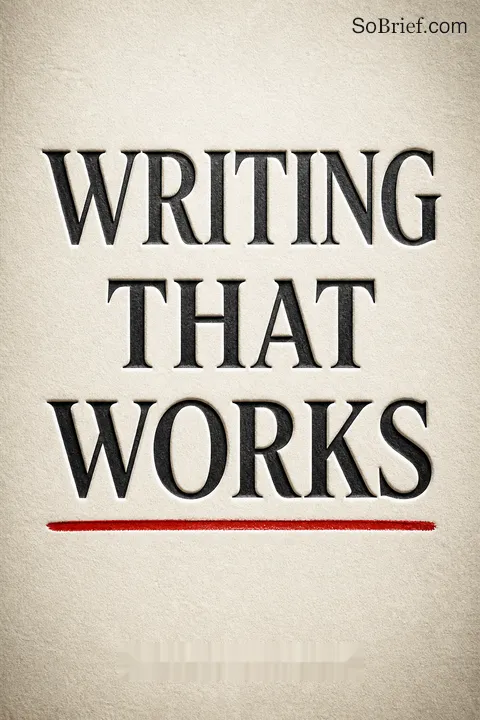
Writing That Works receives generally positive reviews for its practical advice on business writing, though some find it outdated. Readers appreciate its tips on clarity, conciseness, and effective communication in various formats. Many find the book helpful for improving emails, presentations, and overall professional writing. Some criticize its dated examples and lack of coverage on modern communication methods. Despite its age, many readers still find value in its timeless principles for clear, impactful writing in business contexts.
People Also Read



Glossary
Pyramid Principle
Grouped reasoning beneath a conclusionA method for organizing an argument in levels. The writer states a central idea, supports it with grouped points, and supports those points with evidence. Each higher level summarizes the reasoning beneath it. The structure helps readers see how details connect to a conclusion and can help writers discover whether their own logic is coherent.
true value
Long-term customer worthThe concept of evaluating a customer or donor by the value of the relationship over time, rather than by the first transaction alone. A first mailing may cost more than it immediately earns if recipients later make repeat purchases or donations. Estimating this longer-term value helps organizations decide how much they can reasonably invest to attract and retain supporters.
e-mail tag
Clarification through repeated messagesA back-and-forth chain of email caused by an unclear initial message or reply. Missing context, vague requests, or an absent deadline can force the recipient to ask what the sender means, doubling the exchanges needed to complete a task. Including the relevant subject and requested action helps prevent this avoidable correspondence.
techno-euphemism
Jargon that conceals bad newsA technical-sounding phrase used to make an unwelcome event difficult to understand. The book uses the term for language that hides a failure behind abstractions, such as describing a failed test in procedural terms without plainly stating what went wrong. Such phrasing compounds bad news with suspicion that the writer is trying to obscure it.
presentation deck
Slides supporting a spoken argumentA sequence of slides or pages, usually organized around brief points, that provides a framework for a live business presentation. A deck can help an audience follow an argument and discuss a recommendation, but its compressed format cannot carry every nuance of a carefully written report. Its points should support a clear line of reasoning and lead toward a decision or action.
FAQ
What's "Writing That Works" about?
- Purpose: "Writing That Works" by Kenneth Roman and Joel Raphaelson is a guide to effective business communication. It covers various forms of writing, including emails, memos, reports, and proposals.
- Audience: The book is aimed at nonprofessional writers who need to use written communication to achieve results in business, government, education, and the arts.
- Content: It provides practical advice on how to write clearly and persuasively, with specific examples of good versus bad writing.
- Evolution: The book has evolved over its editions to include modern communication methods like email, reflecting changes in how people communicate in business.
Why should I read "Writing That Works"?
- Improve Communication: The book offers strategies to enhance your writing skills, making your communication more effective and efficient.
- Practical Examples: It includes side-by-side examples of good and bad writing, helping you understand what works and what doesn't.
- Relevance: With the rise of digital communication, the book's insights into email and other modern writing forms are particularly relevant.
- Professional Growth: Effective writing can improve your career prospects by making you a more persuasive and clear communicator.
What are the key takeaways of "Writing That Works"?
- Clarity is Crucial: Clear and precise communication is essential for effective business writing.
- Know Your Audience: Tailor your writing to the needs and expectations of your audience to achieve the desired results.
- Structure Matters: Organize your writing logically to guide the reader through your argument or proposal.
- Edit Ruthlessly: Always revise your work to eliminate unnecessary words and ensure clarity and impact.
How does "Writing That Works" address email communication?
- Ubiquity of Email: The book acknowledges the widespread use of email and its impact on business communication.
- Email Etiquette: It provides guidelines for writing effective emails, including clear subject lines and concise content.
- Avoid Overuse: The authors caution against over-reliance on email for communication that might be better handled in person or over the phone.
- Professionalism: Despite its informal nature, email should maintain a level of professionalism, with attention to grammar and tone.
What are the principles of effective writing according to "Writing That Works"?
- Don't Mumble: Be direct and clear in your writing to maintain the reader's attention.
- Active Voice: Use active voice to make your writing more engaging and personal.
- Be Specific: Avoid vague language and provide concrete details to support your points.
- Edit for Perfection: Proofread to eliminate errors and ensure your writing is polished and professional.
How does "Writing That Works" suggest handling memos and letters?
- Clear Titles: Use descriptive titles to immediately convey the subject of your memo or letter.
- Direct Address: Address memos to the person responsible for action, with copies to others for information.
- Structure and Action: Organize your memo with a clear structure and end with a call to action.
- Personal Touch: Handwritten notes can add a personal and direct touch, especially for praise or appreciation.
What advice does "Writing That Works" offer for writing reports and plans?
- Purpose and Clarity: Clearly state the purpose of your report or plan to engage the reader's interest.
- Fact-Based Foundation: Build your report on a foundation of relevant facts and draw clear conclusions.
- Action-Oriented: Make your plan a call to action, with specific steps and recommendations.
- Separate Opinion from Fact: Clearly distinguish between factual information and your interpretations or recommendations.
How does "Writing That Works" approach writing for an audience, such as in presentations and speeches?
- Audience Focus: Tailor your presentation to the audience's interests and the context of the event.
- Simplicity and Clarity: Keep your message simple and clear, using headlines and structured points.
- Engagement: Involve the audience with visual aids and interactive elements to maintain interest.
- Strong Finish: Conclude with a memorable summary or call to action to leave a lasting impression.
What are some of the best quotes from "Writing That Works" and what do they mean?
- "Effective writing is hard work even for the best writers, but the principles are simple." This emphasizes that while writing well requires effort, the foundational principles are straightforward and accessible to everyone.
- "People who write well do well." This highlights the career advantages of being able to communicate effectively through writing.
- "The ultimate time-saver is effective communication." Clear writing saves time for both the writer and the reader by reducing misunderstandings and the need for follow-up.
How does "Writing That Works" address political correctness in writing?
- Sensitivity: The book advises being sensitive to the feelings of others and avoiding language that might offend.
- Balance: It suggests a balanced approach, being considerate without being overly cautious or stifling free expression.
- Gender-Neutral Language: Offers practical tips for avoiding gender-specific language, such as using plural forms or second-person pronouns.
- Courtesy: Emphasizes courtesy and respect as fundamental to effective communication.
What does "Writing That Works" say about writing resumes and getting interviews?
- Purpose of a Resume: A resume should summarize your qualifications and position you as a candidate for an interview.
- Clarity and Relevance: Keep your resume clear, concise, and relevant to the job you're applying for.
- Cover Letters: Accompany your resume with a personalized cover letter that highlights your key qualifications.
- Follow-Up: After an interview, send a follow-up note to express appreciation and reinforce your interest.
How does "Writing That Works" suggest editing your own writing?
- Time and Distance: Let time elapse between drafts to gain a fresh perspective on your writing.
- Seek Feedback: Solicit opinions from others to catch errors and improve clarity.
- Cut Unnecessary Words: Edit ruthlessly to eliminate unnecessary words and enhance clarity.
- Check Tone and Accuracy: Ensure the tone is appropriate and all facts are accurate to maintain credibility.
Download PDF
Download EPUB
.epub digital book format is ideal for reading ebooks on phones, tablets, and e-readers.








