

Key Takeaways
Write for the reader’s mind, not for the beauty of your sentences.
Understanding is the outcome. A piece of nonfiction succeeds only when its ideas make sense to someone else. The writer’s subject and the reader’s current interests overlap like two circles; that shared space is where communication can begin. If the overlap seems tiny, the answer is not to insist harder on the topic. Find the reader’s questions, needs, or experiences that connect to it.
Design for comprehension. The book’s central shift is from polishing words in isolation to considering what happens in the reader’s head. A brilliant explanation that goes unread or misunderstood has not done its job. Expertise matters, but its value depends on whether a reader can use it.
This standard resembles user-centered design: a tool is judged by whether people can use it, not by the designer’s affection for its elegance. In writing, comprehension is a more demanding measure than readability, since fluent prose can still leave a reader with a false model. The principle also has an ethical edge. Attention-grabbing techniques should clarify consequential ideas, not merely steer behavior. The writer’s task is not to make every reader agree, but to make the argument legible enough that agreement or disagreement can be informed.
Picture one real reader to make broad communication feel personal.
Specificity sharpens choices. “Everyone” is too vague to guide decisions about background, tone, or examples. Imagine a particular person with a reason to read: a patient comparing treatments, a voter trying to understand a policy, or a curious nonexpert encountering a scientific idea. This activates the ordinary perspective-taking people use in conversation.
Build a bridge first. Hope Jahren’s memoir Lab Girl invites readers to examine a leaf and ask a question, then treats that act of curiosity as a first step into science. The move gives readers a shared role before introducing specialized knowledge. Writers can also test explanations with people who resemble their intended readers, noticing where interest rises, questions appear, or attention drifts.
A reader persona is useful when it functions as a hypothesis, not a stereotype. Marketing often segments people by demographics; effective explanation needs the more human detail of what someone is trying to accomplish and what they already believe. This connects to perspective-taking research, where imagining another person’s situation can improve social judgment, though it can also produce confident but inaccurate assumptions. Actual conversations are the corrective. A specific imagined reader helps draft; real readers help revise.
Expose what readers know, then choose the necessary depth.
Expertise creates blind spots. The curse of knowledge is the difficulty of recalling what it was like not to know something. In a Stanford experiment, people tapping the rhythm of familiar songs expected listeners to identify them far more easily than the listeners did. Experts make a similar mistake when they treat jargon or missing background as obvious.
Survey the mental starting point. Readers may understand a topic partly, overestimate their grasp, or hold misinformation. The illusion of explanatory depth describes how people often feel they understand familiar mechanisms until asked to explain them in detail. Decide how broad, deep, and well-supported an explanation needs to be for this audience. Simplicity helps, but concealing important complications can mislead. Move interesting but distracting material into a separate home rather than forcing every detail into the main text.
The song-tapping experiment captures a general problem in teaching: the teacher hears a complete melody internally, while the learner receives only disconnected taps. Asking someone to explain a familiar object can reveal the gap between recognition and causal understanding. That gap is useful, but it should not become an excuse to patronize readers. A layered explanation can serve both skimmers and specialists: state the core idea plainly, then provide supporting detail. The hard editorial question is not whether complexity belongs, but which complexity changes the reader’s conclusions.
When beliefs resist facts, acknowledge values before offering evidence.
Context can overpower wording. After a passenger was forcibly removed from a United Airlines flight, the chief executive described the incident as a need to “re-accommodate” customers. Against video of the event, the corporate euphemism sounded detached and inflamed criticism. Readers interpret language through what they have already seen and felt.
Reason is not the only audience. Some readers settle quickly when evidence is ambiguous; others avoid information that threatens their habits or identity. Moral judgments may draw on concerns such as harm, fairness, loyalty, authority, sanctity, or freedom. A writer addressing disagreement should recognize those concerns, represent opposing views fairly, and explain causes and consequences without lecturing. More data alone may not loosen a belief that protects a person’s sense of self.
This advice aligns with a broad finding from social psychology: people evaluate arguments partly through their social identities and prior commitments, not just their evidentiary quality. Recognizing values can lower the cost of listening, especially when disagreement signals group loyalty. Yet value-sensitive framing has a boundary. Translating a message into an audience’s moral vocabulary can invite attention, but disguising evidence or pandering to prejudice corrodes trust. Respectful persuasion starts by representing the other position accurately, then makes a case that readers can inspect rather than demanding that they surrender their identity.
Open with a useful promise or a small, solvable mystery.
Curiosity needs a foothold. Information gap theory describes curiosity as a desire prompted by a perceived gap in knowledge. Another form of curiosity comes from the pleasure of learning for its own sake. Writers can appeal to either by promising useful understanding or posing a question whose answer matters. The gap must be small enough to cross; a subject that feels entirely unfamiliar may not invite exploration.
Earn the next paragraph. Daniel Pink’s book When begins with the departure of the Lusitania, a story that becomes relevant to the book’s concern with timing. Such openings work because readers expect a connection and want to discover it. Titles and first lines have little time to earn attention. Clickbait shows how powerfully an unanswered question can attract a reader, but also how quickly exaggerated promises destroy credibility.
An opening is a compact contract: it signals what kind of attention the reader is being asked to invest and what return to expect. This is closely related to prediction in learning, where a mismatch between expectation and outcome can provoke inquiry. But novelty alone is not enough. A surprising beginning that never pays off trains readers to distrust surprise. The strongest hook creates a manageable question, then resolves it with information that improves the reader’s model of the subject, rather than withholding an answer simply to prolong engagement.
Alternate abstract ideas with concrete examples readers can picture.
Abstraction consumes attention. Cognitive load is the mental work required to process information. A reader confronting unfamiliar theory, dense sentences, and unexplained terminology may spend all available effort decoding the prose. Remove jargon that adds no precision, define necessary terms, and give readers a clear organizing idea before piling on supporting detail.
Give concepts something to hold. An analogy compares an unfamiliar idea with a familiar one. A denial-of-service attack, for instance, can be explained as a system overwhelmed by too many incoming demands. Concrete examples and sensory details make abstractions easier to imagine, but analogies must fit and be familiar to the audience. The image of crime as a “beast” led readers in one study toward punitive solutions, while describing crime as a “virus” encouraged attention to causes. Metaphors frame conclusions as well as explain them.
The approach echoes cognitive-load theory: working memory is limited, so needless decoding competes with learning. A concrete image can reduce that burden and make a relationship easier to reason about. Yet every analogy carries an argument inside it. Calling a problem a disease suggests treatment; calling it an attack suggests defense. That framing power is useful when deliberate and dangerous when hidden. Writers should ask not only whether an analogy makes an idea vivid, but also which assumptions and remedies it quietly makes seem natural.
Use brief human stories to make explanations memorable, not misleading.
Stories make ideas human-sized. A short scene can give an abstract claim a person, place, and consequence. In a story about stereotyping, a Black graduate student whistles classical music while walking home, hoping to counter a threatening assumption. The moment makes an invisible social pressure concrete without requiring an elaborate plot. Research on story listening also suggests that a narrative can coordinate activity across listeners’ brains, a process called neural entrainment.
Keep evidence in view. Stories help readers remember, but a vivid anecdote can distort their sense of what is common. One dramatic case may feel more probable than a statistical pattern. Pair stories with relevant evidence, and use anecdotes that genuinely illustrate the claim. A story should clarify the answer, not delay it when readers need a direct explanation.
Narrative is a powerful teaching format because it organizes events into causes, choices, and outcomes, the same structure people use to interpret daily life. That makes stories memorable, but memory is not the same as representativeness. Behavioral research on availability shows that vivid examples can disproportionately shape judgments of probability. For that reason, stories work best as explanatory companions to data, not replacements for it. A useful editorial test is whether the reader can state both what the story illustrates and what it cannot establish.
Repeat essential ideas in fresh forms for distracted readers.
Readers miss things. They skim, pause, lose focus, or enter a book at a chapter that interests them. Repetition helps important ideas survive those imperfect reading conditions. Martin Luther King Jr.’s repeated refrain gave his speech a memorable organizing phrase; repetition can likewise give nonfiction readers a thread to follow.
Revisit with added value. Repeating a point need not mean copying the same sentence. State the principle, show it in a story, then return to it with a practical implication. Headings, summaries, examples, and chapter endings can reinforce key ideas without making the prose feel like a lecture. The book recommends selecting only a few central points and returning to them intentionally. Repetition is not padding when each appearance deepens or clarifies the idea.
This is a practical response to the gap between a text’s permanence and a reader’s attention. Print remains available, but availability does not guarantee that an idea reaches working memory or gets retrieved later. Repetition with variation supports recall while giving readers multiple routes into the same concept. The risk is over-signaling: a point repeated without new context can feel like distrust of the audience. A good refrain changes function as it recurs, moving from orientation to evidence to application.
Make clarity and humility your proof of expertise, not jargon.
Readers judge the writer through the prose. In experiments described by psychologist Daniel Oppenheimer, passages made needlessly complex were judged less favorably than clearer versions, including when readers were told the writer was Descartes. Technical language can signal membership, but unexplained jargon can also make outsiders feel excluded. Clear explanations make expertise visible through the quality of the thinking.
Close the distance. Humility means respecting the reader and acknowledging ordinary human fallibility, not pretending to know less than one does. A small self-deprecating aside can make an expert more approachable, while humor can release tension around difficult material. But humor is audience-dependent: it should support understanding, not mock vulnerable people or distract from the subject. Tone is ultimately the reader’s impression, not the writer’s intention.
Clarity is not the enemy of rigor. In technical work, precision sometimes requires specialized vocabulary, but the term should earn its place by doing work that ordinary language cannot. Humility also has uneven social costs: people from underrepresented groups may be judged differently when they assert authority, so advice to soften one’s tone should not become a universal demand for deference. The useful distinction is between reducing needless distance and shrinking legitimate expertise. Readers deserve both accessible language and an honest account of what the writer knows.
Choose writing techniques for the reader, then revise until they feel natural.
There is no universal recipe. Stories, analogies, repetition, imagery, and humor can all help, but their value depends on the audience, topic, and purpose. A fixed rule such as beginning every section with a story may become predictable or slow down readers who need a direct answer. The same technique can enliven one passage and obstruct another.
Revise as a reader’s advocate. Tone can be adjusted through paragraph length, sentence structure, point of view, and vocabulary. Outside readers can identify confusion that the writer cannot see because the writer already knows the subject. Editing also means deleting or relocating material that serves the writer’s fascination more than the reader’s need. Practice and feedback turn techniques into a personal style rather than a visible formula.
The book’s craft is best understood as a repertoire, not a checklist. This resembles expert practice in fields such as design, where principles guide choices but context determines the implementation. A personal style does not excuse a writer from considering audience effects; nor should audience adaptation erase every distinctive voice. The productive tension is between consistency and responsiveness. Revision makes that tension concrete: retain the details that clarify, cut those that merely display effort, and test whether the resulting piece helps a real reader think more clearly.
Analysis
The book’s most consequential move is to redefine writing as an interaction between a text and a reader’s cognitive, emotional, and social life. That shift explains why its advice ranges from audience selection to metaphor, humor, repetition, and sentence structure. These are not ornamental tricks. Each is a way of lowering a particular barrier: unfamiliarity, cognitive overload, distrust, boredom, or resistance to changing a settled belief.
The framework is strongest when it joins craft to a plausible account of cognition. Experts forget what they do not know; concrete examples support abstraction; stories give concepts human scale; and varied repetition accommodates interrupted attention. Together, these claims make editing less mysterious. The writer can ask what the reader must infer, remember, or feel at each point, then revise accordingly.
The central tension is that understanding and persuasion are not identical. A metaphor can make an argument vivid while steering readers toward a policy conclusion. A story can make evidence memorable while distorting how typical an event is. A warm tone can invite trust, but trust can be exploited. The book acknowledges these hazards, and its practical advice is most responsible when clarity, evidence, and respect operate together.
The approach also challenges the myth that accessible writing is intellectually thin. Plain language can expose a weak idea because it removes the shelter of jargon. At the same time, simplification should preserve uncertainty and relevant qualifications. The goal is not to make every complex subject easy, but to make its complexity navigable without disguising it.
Ultimately, effective nonfiction is a form of disciplined attention: attention to what the writer means, what the reader brings, and what the words cause the reader to imagine. The writer’s voice remains personal, but its success depends on whether another mind can enter the work and leave with a truer, more usable understanding.
Review Summary
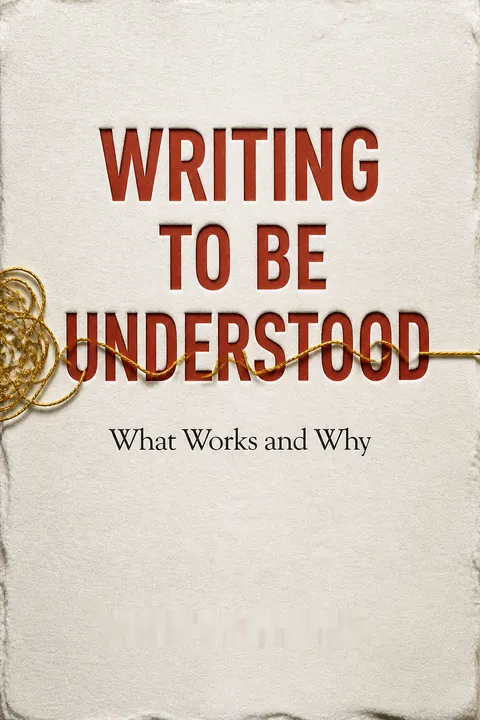
Writing to Be Understood receives overwhelmingly positive reviews for its practical advice on nonfiction writing. Readers appreciate Janzer's insights on audience engagement, explaining complex ideas, and avoiding boredom. The book is praised for its clear organization, conversational tone, and valuable tips from various experts. Many reviewers find it helpful for both novice and experienced writers, highlighting its focus on cognitive science and reader psychology. Some critics note that certain sections may be basic for advanced writers, but overall, the book is highly recommended for anyone looking to improve their nonfiction writing skills.
People Also Read







Glossary
Cognitive empathy
Taking another perspectiveThe ability to understand another person’s point of view, including what they know, need, feel, and may be doing when they encounter information. For writers, it means imagining the reader’s context and likely interpretation. It differs from affective empathy, which concerns feeling an emotional response to another person’s state.
Curse of knowledge
Forgetting what beginners lackThe difficulty of imagining what it is like not to know something once it has become familiar. Experts may assume readers understand terms, background, or causal steps that are obvious only to insiders. The resulting gaps are often invisible to the writer, which is why outside readers can identify confusion that self-editing misses.
Illusion of explanatory depth
Overestimating how well one understandsA tendency to believe one understands a familiar object or process more deeply than one actually does. When asked to explain how it works step by step, people often discover gaps and revise their self-assessment. The concept helps writers anticipate readers who feel they already know a topic but have not examined its mechanisms.
Information gap theory
Curiosity from missing knowledgeA theory of curiosity proposing that people become curious when they notice a gap between what they know and what they want to know. The gap can motivate learning, but it must feel bridgeable. An opening that creates a manageable question can invite readers forward, while a topic that feels wholly unfamiliar may fail to spark interest.
Neural entrainment
Listeners’ brains align during storiesA term used for the observed alignment of brain activity among people listening to the same narrative, including patterns that correspond with the storyteller’s activity. The research described in the book suggests that stories engage shared patterns of attention and interpretation, helping explain why narrative can coordinate listeners’ understanding.
Moral taste buds
Different foundations for moral judgmentA metaphor for the moral concerns people weigh in different combinations when judging actions or ideas. The foundations discussed include care and harm, fairness and cheating, loyalty and betrayal, authority and subversion, sanctity and degradation, and liberty and oppression. Writers can use the model to anticipate which values a message may affirm or threaten.
FAQ
What's "Writing to Be Understood" about?
- Purpose: "Writing to Be Understood" by Anne H. Janzer is a guide for nonfiction writers who aim to explain complex topics clearly and engagingly to a general audience.
- Focus: The book explores techniques and strategies that successful nonfiction writers use to connect with readers, such as storytelling, analogies, and tone.
- Structure: It is divided into three parts: understanding your readers, explaining complicated ideas, and avoiding boring writing.
- Goal: The ultimate goal is to help writers communicate effectively, ensuring their ideas are not only read but also understood and remembered.
Why should I read "Writing to Be Understood"?
- Improve Communication: If you're a nonfiction writer, this book offers practical advice on making your writing more accessible and engaging.
- Reader Connection: It provides insights into understanding your audience's needs and how to tailor your writing to meet those needs.
- Practical Techniques: The book is filled with actionable techniques, such as using analogies and stories, to make complex ideas more relatable.
- Broaden Impact: By applying the methods in the book, you can reach a wider audience and ensure your message is effectively communicated.
What are the key takeaways of "Writing to Be Understood"?
- Audience Understanding: Knowing your audience is crucial; tailor your writing to their knowledge level and interests.
- Clarity and Engagement: Use stories, analogies, and repetition to make complex ideas clear and engaging.
- Tone and Style: Adjust your writing style to convey the right tone, whether it's conversational, authoritative, or humorous.
- Humility and Humanity: Show vulnerability and respect for your readers to build trust and credibility.
How does Anne H. Janzer suggest understanding your readers?
- Identify Ideal Readers: Create detailed profiles of your target audience to guide your writing decisions.
- Empathy Development: Use cognitive empathy to understand your readers' perspectives and emotional contexts.
- Reader Context: Consider the reader's situation, such as their knowledge level and motivation for reading.
- Feedback and Interaction: Engage with real people to test your ideas and refine your understanding of your audience.
What methods does Anne H. Janzer recommend for explaining complicated ideas?
- Use of Analogies: Analogies help readers understand abstract concepts by relating them to familiar experiences.
- Storytelling: Stories make abstract ideas relatable and memorable by engaging multiple parts of the brain.
- Repetition: Reiterate key points in varied ways to reinforce understanding and retention.
- Concrete Examples: Balance abstract ideas with concrete details to reduce cognitive load and aid comprehension.
How can writers avoid being boring according to "Writing to Be Understood"?
- Tone and Style: Choose a tone that suits your audience and subject, and use a style that keeps readers engaged.
- Imagery and Metaphors: Use vivid imagery and metaphors to make your writing more interesting and relatable.
- Humor: Incorporate humor to lighten complex topics and make your writing more enjoyable.
- Personal Connection: Share personal anecdotes and show vulnerability to connect with readers on a human level.
What role does curiosity play in engaging readers, according to Anne H. Janzer?
- Curiosity as a Tool: Curiosity can be used to draw readers in by creating a knowledge gap they want to fill.
- Engaging Introductions: Start with intriguing questions or stories to pique readers' interest from the beginning.
- Balance of Known and Unknown: Find a sweet spot between what readers know and what they want to learn.
- Satisfying Curiosity: Ensure that the curiosity you spark is satisfied with clear and insightful explanations.
How does Anne H. Janzer define and use tone and style in writing?
- Voice vs. Tone: Voice is your unique way of expressing yourself, while tone is how the reader perceives your writing.
- Style Elements: Adjust paragraph length, sentence structure, point of view, and vocabulary to convey the desired tone.
- Conversational Writing: Aim for a conversational tone that is clear and engaging, not a direct transcription of speech.
- Avoiding Jargon: Minimize jargon to make your writing accessible and prevent alienating readers.
What are some effective repetition techniques in "Writing to Be Understood"?
- Rephrase Key Points: Reiterate important ideas using different words and contexts to reinforce understanding.
- Structural Repetition: Use titles, subtitles, and summaries to highlight and revisit key concepts.
- Value-Added Repetition: Add new insights or examples when repeating ideas to maintain reader interest.
- Learning and Memory: Recognize that repetition aids learning and helps readers retain information.
How does Anne H. Janzer suggest using humor in nonfiction writing?
- Engagement and Disarmament: Humor engages readers and makes complex topics more approachable.
- Self-Deprecating Humor: Use humor to show vulnerability and build a connection with readers.
- Balance and Appropriateness: Ensure humor serves the content and is appropriate for the audience and topic.
- Hope and Positivity: Combine humor with hope to leave readers with a positive impression.
What are the best quotes from "Writing to Be Understood" and what do they mean?
- "Your success depends on the reader, so understand their needs." This emphasizes the importance of audience awareness in effective writing.
- "Stories are not just stories; they are the best invention ever created for delivering mental models that drive behavior." This highlights the power of storytelling in shaping understanding and memory.
- "Credibility is granted by the reader, not asserted by the writer." This underscores the idea that trust and authority must be earned through clear and respectful communication.
- "The end of a laugh is followed by the start of a listen." This illustrates how humor can open readers up to new ideas and information.
How can writers find their personal style according to Anne H. Janzer?
- Experimentation: Try different techniques and methods to see what resonates with you and your audience.
- Balance and Adaptation: Find a balance between your natural voice and the needs of your readers.
- Feedback and Reflection: Use feedback from readers to refine your style and improve your writing.
- Continuous Learning: Keep exploring new ideas and methods to evolve your personal writing style over time.
Download PDF
Download EPUB
.epub digital book format is ideal for reading ebooks on phones, tablets, and e-readers.








