

Key Takeaways
Follow a peculiar spark until it contains a protagonist, conflict, and world
Start with curiosity. A novel can begin with an image, overheard remark, headline, title, or odd pairing of traits. DeLillo found a story in two news headlines placed side by side; Tolkien discovered the meaning of a character as he drafted. The spark matters because it invites imaginative questions, not because it is unprecedented. Combine ideas or genres when each alone feels thin, and keep notes so a fleeting thought survives the day.
Test the premise. Ask who the protagonist is, what that person wants, why it matters, what opposes the goal, and what human concern a reader might recognize. Then ask how setting, tone, and familiar genre expectations serve that struggle. A premise that generates new answers and worthwhile questions can sustain a novel; an arresting concept alone may not.
What's valuable here is the shift from idea hunting to idea testing. A premise becomes generative when it supports a causal chain: character desire produces choices, choices create consequences, and consequences reveal a larger concern. That is close to how good scientific questions work: an observation is only a starting point until it yields testable implications. Still, an idea need not reveal every element before drafting. Excessive screening can mistake uncertainty for weakness, when uncertainty is often the space where a writer discovers the story.
Give the protagonist a clear goal whose real stakes are personal
Pair outer and inner wants. External motivation is the protagonist's visible objective in the plot; internal motivation is the personal need, value, or fear that makes the objective matter. In McCarthy's The Road, a father and son travel south, but the deeper drive is the father's effort to keep his child alive. The destination supplies movement; the parental bond gives the journey its emotional force.
Make the conflict bite. Obstacles should threaten something the protagonist values, not merely delay progress. The goal may be simple, even misguided, but the reasons behind it can be complicated. A character may want to win, belong, or protect someone, while fear, pride, or self-defeating choices interfere. Readers need to understand what failure would cost, even if they have never faced the plot's literal circumstances.
The distinction between an objective and its personal meaning helps prevent plot from becoming a checklist of events. In decision theory, a choice matters because of the value attached to its outcomes, not simply because an action occurs. Fiction can use the same logic: the reader understands risk through what the protagonist stands to lose. One useful nuance is that not every character needs a neatly stated psychological need. Ambivalence can be compelling, provided the story makes the competing pressures legible through action.
Let obstacles expose character instead of explaining complexity in advance
Keep the starting want clear. Complexity emerges when a character pursues a comprehensible goal under pressure, not when the writer piles on motives until no desire is recognizable. Ahab's pursuit of the whale exposes obsession and destructive pride; Frodo's responsibility for the Ring tests courage and vulnerability. Both become more dimensional through choices made against obstacles.
Use the cast and past purposefully. Supporting characters should have wants of their own while helping readers see the protagonist or the central conflict from another angle. Backstory can be incidental, adding texture, or direct, supplying information essential to present action. Either kind should earn its space. An antagonist, too, needs a motive that makes sense to that character, even when it opposes the protagonist's aims.
This approach treats character as something demonstrated under constraint, an idea shared with behavioral psychology: stated intentions are less revealing than choices made when goals collide. It also avoids the familiar trap of assigning every trait a traumatic origin. The caution is that clear motivation should not become a formula for psychological simplicity. People can pursue contradictory aims, but the narrative must give readers enough behavioral evidence to follow those contradictions rather than asking them to solve an opaque personality puzzle.
Choose a narrative lens that controls what readers know and feel
Point of view sets access. Point of view is the narrator's relationship to the events and the information available to the reader. First person can create intimacy but limits what the narrator directly knows. Third-person limited stays close to one character while allowing some narrative distance. Omniscient narration can move among characters and places, but too much shifting can blur focus. An unreliable narrator's account differs from what readers infer; that gap should deepen meaning, not merely conceal facts.
Voice shapes interpretation. Voice is the attitude conveyed through perspective, tone, and language. In Carver's Cathedral, the narrator's wary descriptions reveal his prejudice before he understands it himself. A suitable voice does more than report events: its judgments, rhythms, and blind spots guide how the reader experiences them. Test the point of view early, before it restricts a large portion of the draft.
Narration is an information design problem as much as a stylistic one. Every chosen viewpoint grants some knowledge and withholds other knowledge, shaping suspense, sympathy, and credibility. This resembles camera placement in film, except prose can enter thought and let diction carry judgment. The strongest choice is not automatically the most intimate or expansive one. A tightly limited perspective can create productive uncertainty, while a broad narrator can offer needed context, if the shifts remain purposeful.
Describe places through the protagonist's attitude, not an inventory
Choose details with meaning. Description should make a place imaginable and establish how it feels to the viewpoint character. A struggling musician might experience an office as airless and a bar as liberating, or find both dispiriting for different reasons. The physical setting has not changed; the character's relationship to it determines which details matter. Specific sensory impressions can make even an invented world feel present without cataloguing everything in the room.
Prefer precision to decoration. Fresh comparisons should surprise while still making sense. Avoid mixed metaphors, piled-up modifiers, thesaurus-driven word choices, and familiar expressions that no longer create a vivid image. A description succeeds when it conveys both what is there and how to read it. The goal is not to show every detail, but to select details that let readers complete the scene in their own imagination.
Selective description resembles attention in everyday perception: a person notices what matters to a current goal, not every object in view. That makes setting a subtle form of characterization, while also inviting readers to participate in imagining the world. The method is especially effective when the viewpoint character's response changes over time, so a familiar place can acquire new significance. A possible limit is that not every setting should mirror the protagonist; a setting can also resist, surprise, or exceed the character's understanding.
Make the opening scene complete, gripping, and quietly predictive
Begin in a meaningful moment. A hook starts inside an action or interaction, gives readers enough context to orient themselves, and leaves a question worth following. The opening should establish the protagonist's perspective and a local conflict, then resolve that small problem while opening the larger one. In The Shining, Jack Torrance's tense job interview introduces his desire for work and hints at the anger that threatens his family and prospects.
Plant the long arc. The opening should suggest what the ending will test or answer. In the conventional three-act structure, Act I establishes the character and stakes, an inciting incident brings conflict into focus, and plot point 1 turns the protagonist toward the larger story. These are useful landmarks, not mandatory formulas. An opening can be quiet; it cannot depend on confusion, stock imagery, or intense emotion without a clear human context.
An opening functions like a compact promise: it teaches readers what kind of attention the book rewards. A small, character-centered conflict can provide orientation and intrigue at once, reducing the cognitive burden of entering a new world. The preview of the ending is useful as structural coherence, but it need not make the conclusion obvious. The best foreshadowing is often a question or tension whose significance becomes clearer only after the reader has seen the character change.
Build the middle with setbacks that grow from the protagonist's goal
Escalate through relevance. The second act usually occupies about half the novel. It sustains attention by presenting linked conflicts that alternately frustrate and advance the protagonist's objective. Each resolution should alter the situation, not simply reset it. A victory can reveal a new cost; a failure can create an unexpected opening. The next problem should grow from the previous one and threaten what the protagonist personally values.
Aim toward a breaking point. Near the middle, a first culmination makes success seem close, only for the protagonist to fall short. The resulting darkest moment makes failure feel real. Plot point 2 then gives the protagonist a reason to make one last push, launching the final act. In The Silence of the Lambs, Starling's investigation appears to be closing in on the killer before the case shifts and she must face danger herself.
The proposed pattern of gains, reversals, and renewed effort reflects how suspense depends on changing probabilities: readers keep recalculating whether the goal remains possible. Relevance is crucial; a dramatic event that does not change the protagonist's options or threaten a meaningful value is mostly noise. At the same time, escalation need not mean every scene is more dangerous than the last. Variation in pace and emotional register can preserve tension better than a relentless sequence of crises.
Make each scene earn its pages through conflict and consequence
Give scenes a local arc. A scene usually works best when someone wants something, encounters resistance, and reaches a meaningful outcome. It should also contribute to a larger character, plot, or thematic movement. If a scene has no connection to the story around it, its charm alone may not justify its length. Subplots can provide contrast and reveal the protagonist, but they should not take over the main story or linger without purpose.
Control the reader's time. Use transitions, scene breaks, and white space to skip routine actions and linger on consequential moments. Dialogue should sound shaped rather than transcribed, and tension often grows through what characters avoid saying. Showing and telling are complementary tools: a focused summary can orient the reader, while a scene lets the reader experience a decisive interaction. Pacing means choosing what deserves attention, not making every page loud.
The scene-level test is a practical form of narrative economy: every unit of attention should change understanding, pressure, or expectation. It also accommodates quiet fiction, because an emotional realization can provide consequence without physical action. The advice against irrelevant scenes should not be confused with demanding plot utility from every image. Texture, humor, or atmosphere can matter in cumulative ways, especially when their significance is not immediately obvious. Revision is where a writer can distinguish purposeful texture from mere drift.
Resolve the outer quest, then show what victory or failure changed
Answer both questions. The climax resolves the protagonist's external objective through success or failure. The dénouement, the quieter movement after the climax, shows what that outcome means for the protagonist and ties up necessary remaining threads. These answers may differ: a character can achieve the practical goal yet remain personally unfulfilled, or lose the goal while gaining a changed understanding of self.
Let meaning emerge from events. Theme is the broader human significance readers can draw from a character's particular struggle. It should arise from the story's conflicts and consequences rather than be imposed as a lesson. In The Wizard of Oz, Dorothy's return home matters because the journey has changed how she understands belonging. A surprise ending can delight when earlier events make it plausible in retrospect; a sudden solution or changed story rules can instead feel like a broken promise.
Separating external outcome from inner consequence prevents a simplistic equation of success with growth. It also explains why endings can revise the meaning of earlier scenes: the final choice reveals what the journey has cost and what the protagonist has learned. Theme is strongest when it remains an inference rather than a verdict delivered to the reader. However, a protagonist need not become morally improved. Recognition, loss, or a clearer failure can complete an arc as convincingly as triumph.
Revise for the story's discovered shape, then polish each sentence
Draft to discover. Planning provides direction, but a writer should remain alert to scenes and characters that develop unexpectedly. Bates describes novel writing as a balance between conscious design and surprise: O'Connor, for example, said a character's decisive act in one story surprised her shortly before it happened, yet felt right. A new direction is useful when it strengthens the story, not simply because it is unexpected.
Revise at two scales. First assess the whole: plot coherence, character change, tone, subplots, and the patterns that suggest theme. Then edit the sentences. Reading aloud can expose clumsy rhythm, repetition, and missing words; a trusted reader can reveal where the intended effect fails. A marked-up draft, consistent notes, and a simple style guide help track continuity. Routine, modest goals, and recording ideas can make the long project manageable.
Revision is presented not as cosmetic cleanup but as a second mode of composition, which aligns with how creative work often becomes intelligible through repeated inspection. A finished draft externalizes a complex idea, making patterns visible that were difficult to plan in advance. The invitation to follow the story is strongest when paired with editorial judgment: surprise alone is not evidence of quality. A writer needs both openness to emergent structure and a willingness to remove material that does not serve it.
Analysis
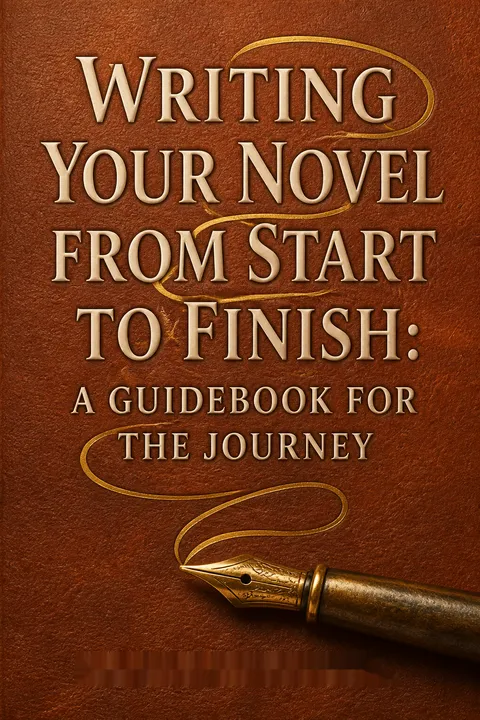
Bates organizes novel writing as a journey from an initial spark through beginnings, middles, endings, and revision. The unifying claim is that craft elements become meaningful through their relationships: plot tests a character's desire, setting reflects a viewpoint, scenes build the larger arc, and the ending changes how the reader understands what came before. This connected model is more useful than a checklist of isolated techniques because it gives writers a way to diagnose weakness. If a scene feels inert, ask what the character wants; if a setting feels decorative, ask how the protagonist experiences it; if the ending disappoints, inspect the promises established at the start.
The guide's strongest contribution is its balance of structure and discovery. Its landmarks, including the turning points of a three-act narrative, reduce the intimidation of a long manuscript without requiring every writer to outline every event. The book also demystifies revision by treating it as an interpretive stage, not a sentence-polishing chore. Its examples, from The Road to The Wizard of Oz, show how a concrete external quest can carry a private emotional question.
A limitation follows from that clarity. The emphasis on a protagonist's identifiable desire and a resolved arc suits many novels, especially plot-driven ones, but less readily describes works built from diffusion, collective experience, deliberate stasis, or unresolved ambiguity. The book acknowledges alternatives, yet its central teaching remains classically narrative: a character wants, resists, and changes. Readers can treat this as a powerful default model rather than a universal law. The most durable lesson is not to force every novel into a template, but to make each formal choice answerable to the particular experience the book seeks to create.
Review Summary
Writing Your Novel from Start to Finish receives positive reviews for its practical advice, helpful worksheets, and step-by-step guidance. Readers appreciate its accessible approach and find it useful for both new and experienced writers. Many reviewers consider it an invaluable resource, praising its structure and examples from popular literature. Some criticisms include spoilers in examples and a linear approach that may not suit all writers. Overall, the book is highly recommended for its comprehensive coverage of the novel-writing process and its engaging presentation.
People Also Read








Glossary
Internal motivation
Personal need beneath the goalThe protagonist's personal want, fear, or value that gives emotional meaning to the visible events of the story. It may involve belonging, safety, love, or proving one's worth. The internal motivation helps explain why the external quest matters and gives readers a human point of connection to circumstances they may never encounter themselves.
External motivation
Visible goal in the plotThe protagonist's stated objective in the story, such as reaching a destination, solving a crime, or saving someone. It drives plot events and gives the character something concrete to pursue. Its importance becomes greater when it parallels an internal motivation, so that obstacles threaten both the practical goal and something personally valuable.
Character arc
Change through conflictThe movement from a character's wants and values, through conflict that tests them, to an outcome that reveals who the character has become. A character may succeed or fail at the goal. The arc feels complete when the events have a discernible effect on the protagonist, even if the change is painful or incomplete.
Three-act structure
Setup, escalation, resolutionA broad way to organize a novel. The first act establishes the protagonist and stakes, then turns toward the main quest. The second act escalates conflicts and pushes the protagonist toward a major setback and renewed effort. The third act brings the central confrontation and shows the consequences. Bates presents this as a flexible guide to narrative momentum, not a compulsory formula.
Plot point 1
Turn into the main questThe pivotal event near the end of the first act that changes the story's direction and commits the protagonist to the larger plot. It follows the setup and the initial conflict that reveals personal stakes. The protagonist crosses from the introductory situation into the central struggle, giving the second act its forward-driving objective.
First culmination
Near-success before setbackA second-act moment when the protagonist appears close to achieving the goal. The apparent progress creates hope, but the character falls short or discovers a serious complication. That reversal helps produce the darkest moment and keeps the central objective uncertain rather than allowing the story to resolve too early.
Darkest moment
The apparent point of defeatThe setback following the protagonist's near-success, when failure seems most likely and the stakes feel especially severe. It should threaten something the protagonist genuinely values, rather than merely add spectacle. The protagonist must still have a credible reason to continue, so this low point can lead into a final effort rather than end the story's movement.
Plot point 2
Turn toward final confrontationThe second-act turning point that gives the protagonist a reason or opportunity to make a last push after a major setback. It changes the story's direction toward the final act. The protagonist's renewed commitment should remain connected to the original goal and the personal stakes established earlier.
Dénouement
Meaning after the climaxThe winding-down portion after the climax, where the consequences of success or failure become clear. It can resolve remaining plot threads and show the effect of events on the protagonist's personal life. Its length and content depend on the story: a mystery may need explanation, while another novel may close with a brief, resonant image.
Incidental backstory
Past detail adding textureInformation about a character, place, or object that enriches description, atmosphere, or plausibility but is not essential to understanding the present action. It is a deliberate choice rather than a required explanation. It should add value without pulling the reader away from the story's central present-time movement.
Direct backstory
Past information needed nowInformation about earlier events that has a substantive bearing on the current action or a character's choices. Because readers need it to understand the present story, it should be delivered with care, through scene, dialogue, brief narration, or a character's response. It should clarify the current narrative rather than become an unrelated history lesson.
Download PDF
Download EPUB
.epub digital book format is ideal for reading ebooks on phones, tablets, and e-readers.








