

Key Takeaways
You can farm for a living, but only if the business works
The dream needs a ledger. Salatin separates the romance of country life from the discipline of earning a living from land. His family’s story makes the distinction concrete: after losing a farm in Venezuela, his parents settled on badly eroded Virginia land, paid off its mortgage, and rebuilt its fertility while holding outside jobs. Their son learned to sell directly as a teenager, then left newspaper work in 1982 to farm full-time. His first new venture, a walnut buying station, brought little cash in a poor crop year. Keeping expenses low helped the family survive until poultry and other enterprises grew.
The book’s strongest promise is conditional, not magical: farming can provide income when production, sales, costs, and family life work together. That realism gives its optimism credibility. The origin story also reveals an important advantage: Salatin inherited access to land and a family shaped by thrift, so his path is not a universal starting point. The useful lesson is not to copy his circumstances, but to assess honestly what support, savings, skills, and time a new farm would require.
Start farming where you are, before you buy land
Land is not the first step. Salatin argues that experience and customers matter more than ownership. A would-be farmer can work for an established grower, garden a yard, sell at a farmers’ market, or arrange to use someone else’s land. He describes a New York City resident who raised broilers in a garage, found customers, and later sourced birds from a nearby farm for those buyers. The model turns a lack of acreage into a reason to test demand and learn the trade before taking on a mortgage.
This is a form of risk reduction: small experiments reveal whether someone enjoys the work and whether buyers exist before expensive commitments become difficult to reverse. It also broadens the definition of farming beyond acreage, toward skills, access, and a customer relationship. Still, a backyard trial cannot reproduce every challenge of commercial production, such as regulation, processing, or seasonal cash flow. It is a first test, not proof that a larger operation will succeed.
Capture more of the food dollar by selling something finished and distinctive
Raw commodities leave value behind. Salatin notes that farmers receive only a small share of the final food price when others process, package, and sell what they grow. Direct sales and value-added products let a farm keep more of that margin. As a teenager, he turned spent hens that brought 19 cents each into cooked, picked chicken sold for $1.50 per pound. His son made maple doughnuts from a few tapped trees, earning far more per gallon of sap than syrup alone would bring. These examples show how processing, convenience, and a clear story can make small production worthwhile.
Value adding is not simply charging more for the same thing. It means taking on work that customers value, whether that is preparation, quality, convenience, or a memorable experience. The strategy can protect a farm from the weak bargaining position of commodity markets, but each added step also brings labor, equipment, and regulatory demands. A higher selling price is not automatically a higher profit. The sound question is whether the extra margin compensates for the new work and risk.
Prove local demand before you scale production or borrow
Sales should lead expansion. Salatin warns against raising a crop first and hoping buyers appear afterward. Markets are built through repeated contact, not delivered automatically with a good harvest. His approach to finding customers uses three moves: educate people about the product, give them a concrete example to try, and encourage satisfied buyers to recommend it. When he introduced pasture-raised eggs to restaurant chefs, he brought samples. Chefs noticed that the eggs held together and handled better in cooking, and one restaurant became a steady buyer. The demonstration answered a practical need, not just an abstract claim about farming.
The story illustrates a useful principle of product discovery: let a potential buyer experience the feature that matters to them. A chef cares about performance in a kitchen, while a household may care about taste, provenance, or trust. The approach also treats customers as a source of information, not merely an audience for promotion. Its limit is that a successful sample or a few loyal patrons do not establish the size of a market. Expansion still needs evidence about repeat orders, delivery costs, and capacity.
Build the farm around grass, then let animals do useful work
Pasture is productive infrastructure. Salatin puts perennial grass at the center because it protects soil, feeds grazing animals, and avoids repeated planting and harvesting. Managed grazing means moving animals between areas so plants can recover and manure is spread more evenly. He also designs enterprises so animals perform farm tasks: pigs root through cattle bedding and mix it into compost, while chickens following cattle eat fly larvae and disturb manure pats. The animals produce saleable food while helping cycle nutrients and reduce some machinery and labor needs. The operating principle is to work with animal behavior while managing access carefully.
This approach treats a farm as a set of linked processes rather than isolated crops and livestock. It can turn a cost, such as bedding or manure, into a resource, while putting biological activity to work. The tradeoff is complexity: animals must be moved at the right time, infrastructure must fit the system, and poor management can damage pasture or compromise sanitation. The method is not simply letting nature take over. It depends on close observation and active control.
Stack complementary enterprises to earn from the same land in different seasons
One acre can do several jobs. Salatin uses stacking to describe combining compatible enterprises so one uses the space, infrastructure, or by-products of another. In an orchard, for example, chickens can eat fallen fruit and insects while adding manure and producing eggs. Seasonal planning adds another layer: turkeys can extend a poultry operation toward the holidays, while firewood sales can bring in winter income when field work slows. The point is not to crowd every possible activity onto a farm. It is to choose additions that fit available labor, customer interests, and the natural calendar.
A diversified farm resembles a portfolio: different products can spread income across seasons and make better use of shared resources. Yet more enterprises also mean more decisions, skills, and points of failure. A second product is valuable only if it complements the first rather than competing for labor during its busiest period. The book’s emphasis on timing is crucial: diversification is not a checklist of activities, but a design problem involving workload, infrastructure, and the pace at which customers buy.
Keep debt and fixed costs low while your skills catch up
Flexibility is financial protection. A mortgage, specialized building, or expensive machine creates bills before a new farm has reliable sales. Salatin urges beginners to rent or borrow access where possible, choose equipment that serves several purposes, and avoid upgrading for appearance. He advises buying land only after a farmer knows how to earn from it and can carry living costs through a long learning period. His own family’s frugality helped them endure lean early years. The goal is not permanent austerity, but to let dependable farm income, rather than optimistic forecasts, justify larger commitments.
Low fixed costs buy time, and time matters in a business exposed to weather, biology, and an uneven learning curve. Flexibility also preserves the ability to change enterprises when assumptions prove wrong. But frugality should not become a reflexive rejection of investments that protect workers, animals, food safety, or reliable production. The relevant test is not whether an item looks expensive, but whether its cost is justified by the value and resilience it creates.
Track each enterprise and price your hours, not just your harvest
Revenue can hide a losing business. Salatin recommends recording income and expenses separately for each farm activity so profitable enterprises do not quietly subsidize weak ones. He also calculates the return on labor. Cleaning chicken gizzards, for example, took an hour to produce about $10 in sales, while that hour could be spent processing roughly $100 worth of chickens. He stopped offering the low-return task. Such comparisons make it easier to decide what to expand, change, or quit. Records should include time and production details, not just receipts, because a busy farm can still be earning little per hour.
This is management accounting in practical form: measure activities at a level where decisions can change. It forces attention away from impressive gross sales and toward margin, labor, and opportunity cost. The method also guards against treating every tradition or customer request as automatically worthwhile. Numbers are not a complete verdict, though. Some tasks may build loyalty, reduce risk, or support another enterprise in ways that are hard to assign to one line item. The records clarify tradeoffs; judgment still matters.
Agree on the family mission and earn the neighborhood’s trust
People are part of the operation. Salatin calls disagreement between spouses over the farm’s purpose a major threat: decisions about spending, workload, children, and lifestyle need shared expectations. He also argues that newcomers must build relationships with rural neighbors through practical help, respect for property, and fair dealing. Borrowed tools should be returned in good condition, animals kept under control, and advice offered only when invited. In his experience, neighbors became a source of knowledge, machinery, and emergency help. A farm is not truly independent; its success often depends on relationships beyond its boundary fence.
The book understands that trust is operational infrastructure. A reliable neighbor can provide knowledge or help that would otherwise require costly equipment, while a shared family purpose can prevent ordinary sacrifices from becoming recurring conflict. The advice is most persuasive when framed as reciprocity rather than conformity: genuine respect does not require hiding one’s identity or accepting unfair terms. Goodwill is valuable, but clear agreements, safe practices, and equitable compensation matter just as much.
Analysis
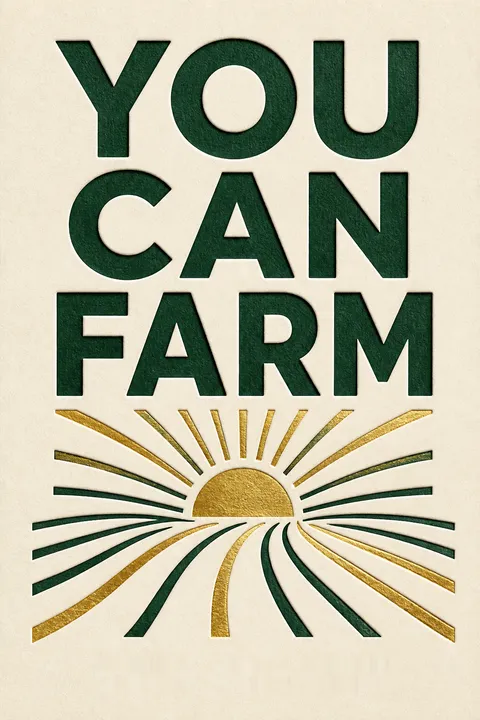
You Can Farm is part business manual, part ecological argument, and part family memoir. Its organizing claim is that small-scale farming can be financially viable when the farmer stops copying industrial production and starts designing around local customers, biological cycles, and low fixed costs. The narrative gives the proposal a human scale: an inherited farm is first a burden of eroded soil and uncertain income, then a long experiment in grazing, direct sales, and patient enterprise building. Stories of eggs, chickens, pigs, and customers make its abstract economics easy to picture.
The book’s most durable contribution is its integrated model. Soil management is not separated from livestock, livestock from labor, or production from marketing. Grass feeds animals, animals cycle fertility, and direct sales give the farmer a reason to produce quality rather than undifferentiated volume. Its advice to test demand, maintain records, and delay major capital purchases is especially useful because it applies even to readers who do not share the author’s agricultural philosophy.
Its limitations deserve equal attention. Many financial projections and food-system statistics are specific to the book’s 1998 context, and some claims about nutrition, disease, regulation, and conventional agriculture are presented with more certainty than the text demonstrates. They should be treated as the author’s arguments, not current independent verification. The farm’s success also rests on unusual advantages, including family land, years of experimentation, and an existing customer base. The book sometimes makes alternatives sound easier to reproduce than the skills and market conditions allow.
The practical reading is therefore neither literal imitation nor dismissal. Treat the principles as hypotheses to test locally: find customers, calculate labor and costs, learn from experienced growers, and expand only when the management can support it. The deeper message is that a farm becomes viable through design, not acreage alone. Its economics and ecology must be built together, with enough flexibility to revise the plan when reality disagrees.
Review Summary
You Can Farm receives generally positive reviews for its practical advice on starting and running a successful farm business. Readers appreciate Salatin's encouragement, realistic approach, and emphasis on sustainability. The book covers topics like animal husbandry, marketing, and financial planning. Some criticize Salatin's writing style and personal opinions, while others find his perspective refreshing. Many readers, even those not interested in farming, find value in learning about sustainable food production. The book's age is noted, but most content remains relevant.
People Also Read

Glossary
Designer agriculture
Distinctive, customer-focused farmingSalatin’s term for farming that deliberately offers products with clear differences in quality, production, locality, or experience. Rather than competing mainly on volume and low price, a designer farm responds to customers seeking distinctive food and a relationship with its source. The approach links production choices to direct marketing and a recognizable story.
Stacking
Combining complementary enterprisesA farm-design method in which compatible crops, animals, and activities use the same land or infrastructure at different times or in linked roles. For example, chickens in an orchard can produce eggs while eating fallen fruit and insects. Stacking aims to make one enterprise’s output or by-product useful to another, increasing the farm’s overall productivity without simply expanding its acreage.
Salad Bar Beef
Managed pasture-based cattleSalatin’s name for raising beef cattle on diverse pasture, using controlled grazing so animals harvest fresh forage and fields receive periods of recovery. The method emphasizes grass, portable fencing, and water access rather than grain finishing and extensive machinery. The phrase also names his book explaining the system.
Pigaerator
Pigs that turn beddingSalatin’s term for using pigs to root through and aerate deep livestock bedding. Grain encourages the pigs to mix the material, helping turn it into compost while the animals grow for meat. The practice replaces some mechanical compost turning, but depends on suitable bedding, animal management, and timing.
Raken House
Combined rabbit and chicken housingA named Polyface setup combining rabbit cages above a floor where chickens scratch through bedding and droppings. The chickens help aerate the material and reduce odor while producing eggs; the rabbit manure and bedding can become compost. It illustrates the book’s broader practice of combining species so one enterprise contributes useful work to another.
3 Es
Educate, demonstrate, encourage referralsSalatin’s approach to building a farm clientele through education, examples, and evangelism. Education helps potential customers understand why a product differs. Examples, often samples or demonstrations, let them experience the difference. Evangelism means encouraging satisfied customers to recommend the farm to others. Together, these steps turn product quality and personal relationships into a direct-marketing strategy.
FAQ
1. What is "You Can Farm: The Entrepreneur's Guide to Start & Succeed in a Farming Enterprise" by Joel Salatin about?
- Comprehensive farming guide: The book is a practical manual for aspiring and new farmers, focusing on how to start and succeed in a profitable, sustainable farming business.
- Alternative agriculture focus: Salatin emphasizes models that are environmentally enhancing, economically viable, and enjoyable, challenging conventional industrial agriculture.
- Holistic approach: The book integrates philosophy, practical advice, and real-world examples, covering everything from soil health and animal husbandry to marketing and risk management.
2. Why should I read "You Can Farm" by Joel Salatin?
- Realistic and inspiring: Salatin offers an honest look at both the rewards and challenges of farm life, helping readers assess their own readiness and potential.
- Decades of experience: The book distills lessons from Salatin’s successful family farm, providing actionable wisdom for avoiding common pitfalls.
- Empowering and comprehensive: Readers gain confidence, vision, and a roadmap for building a sustainable, family-friendly farm business.
3. What are the key takeaways from "You Can Farm" by Joel Salatin?
- Start small and practical: Begin with what you have, gain experience, and avoid large upfront investments in land or equipment.
- Focus on marketing: Develop a clear marketing plan before producing, and build direct relationships with customers.
- Diversify and synergize: Stack multiple enterprises and use animals as labor to maximize land use and profitability.
- Embrace environmental stewardship: Farming should improve the land, support biodiversity, and align with natural cycles.
4. What are the core philosophical principles in "You Can Farm" by Joel Salatin?
- Environmentally enhancing agriculture: Farms should leave the environment better than before, improving soil, water, and biodiversity.
- Bioregional and seasonal focus: Produce and consume food locally and seasonally to reduce energy use and support natural rhythms.
- Entrepreneurial independence: Advocate for small, decentralized, and diversified farm businesses that foster creativity and freedom.
- Family and humane values: Integrate the whole family into the farm and ensure animals can express natural behaviors.
5. How does Joel Salatin recommend getting started in farming according to "You Can Farm"?
- Start with available resources: Use a backyard, garden, or small livestock to begin, even without owning land.
- Gain hands-on experience: Work on other farms, attend markets, and build both production and marketing skills.
- Delay land purchase: Focus on learning and making money on a small scale before investing in land or infrastructure.
6. What are the most common reasons for failure in farming enterprises, according to "You Can Farm"?
- Lack of shared vision: Disagreements between partners, especially spouses, can undermine the farm’s mission.
- Poor marketing focus: Producing without a clear marketing plan often leads to unsold products and financial loss.
- Impatience and overextension: Wanting too much too fast and overextending financially can doom a farm.
- Ignoring advice and isolation: Refusing counsel and trying to do everything alone leads to inefficiency and burnout.
7. What are the best centerpiece agricultural opportunities recommended by Joel Salatin in "You Can Farm"?
- Pastured broilers: Low startup costs, quick turnaround, and high demand make this enterprise highly recommended.
- Egg production: Pastured or free-range eggs fetch premium prices and complement other farm activities.
- Grass-fed beef and dairy: "Salad bar beef" and grass-based dairy require minimal infrastructure and have strong market demand.
- Market gardening and value-added: Growing vegetables or running a home bakery can diversify income and utilize farm resources.
8. What agricultural enterprises does Joel Salatin advise avoiding in "You Can Farm"?
- Seedstock and exotics: These require deep pockets, social status, and have unstable or limited markets.
- Horses and confinement operations: Horses are costly and mostly recreational; confinement farming increases financial risk and reduces control.
- Capital-intensive monocultures: High startup costs and machinery dependency increase risk and reduce profitability for beginners.
9. How does Joel Salatin’s method in "You Can Farm" use animals to reduce labor and increase profitability?
- Animals as labor force: Animals perform tasks like tilling, compost turning, and pest control, reducing machinery and labor costs.
- Multi-species integration: Stacking species (e.g., chickens after cattle) creates symbiotic relationships that improve sanitation and productivity.
- Machinery independence: Using animals for materials handling keeps the farm size-neutral and profitable without expensive equipment.
10. What is the concept of "stacking and synergism" in "You Can Farm" by Joel Salatin?
- Multiple enterprises per acre: Stacking means layering different species and production types to maximize income from the same land.
- Symbiotic systems: Outputs from one enterprise become inputs for another, reducing waste and enhancing productivity.
- Diversification for resilience: Combining complementary enterprises spreads risk and creates a more stable farm business.
11. What marketing and pricing strategies does Joel Salatin recommend in "You Can Farm"?
- Education before sales: Focus on educating consumers about the benefits of clean, pasture-based farming to build trust and demand.
- Build loyal clientele: Turn customers into advocates through superior products, service, and personal connection.
- Value-added and direct sales: Capture more of the retail dollar by processing products and selling directly to consumers.
- Set minimum returns: Price products to ensure a sustainable hourly return, and communicate value clearly to customers.
12. How does Joel Salatin address soil fertility, pasture management, and sanitation in "You Can Farm"?
- Perennial grass focus: Maximize perennial grasses and minimize tillage to build healthy, productive soil.
- Nutrient cycling: Use composting and animal manures to return organic matter and nutrients to the soil naturally.
- Biodiversity and rotation: Encourage diverse plant species and rotate animals to maintain soil health and reduce disease.
- Natural sanitation: Use sunlight, ventilation, and deep bedding with proper carbon:nitrogen ratios to keep animal housing clean and healthy.
About the Author
Download PDF
Download EPUB
.epub digital book format is ideal for reading ebooks on phones, tablets, and e-readers.








