

Key Takeaways
When ordinary farm work is illegal, local food innovation cannot begin.
A farmer’s recurring fight. Joel Salatin’s central complaint is that rules designed for industrial food production often make ordinary local practices difficult or illegal: processing animals on the farm, selling directly to neighbors, teaching visitors, or bringing young people on as apprentices. The book grows from decades of disputes at Polyface, his family farm in Virginia. Its title began as a remark at a 2003 gathering of farmers, where he described the obstacles facing both his farm and the wider local-food movement.
The cost of prohibition. Salatin argues that the damage is not limited to fines or paperwork. When regulations prevent small-scale experiments, consumers lose choices and farmers lose possible ways to earn a living. His stories are a case for preserving room for local alternatives, not a comprehensive survey of food law.
The book’s most durable insight is about institutional design: rules built around large, standardized operations can quietly exclude smaller ones without explicitly banning them. That effect deserves scrutiny even when the rule’s stated purpose is legitimate. At the same time, Salatin’s vivid cases are not a representative study of every agency or farmer. The argument is strongest as a challenge to ask who can afford compliance, who helped shape the standard, and whether the burden actually reduces the risk it claims to address.
Judge food safety by clean outcomes, not the size of the facility.
A flexible exemption. Salatin describes the Producer-Grower Exemption, a federal provision that allowed qualifying farmers to process their own poultry without continuous federal inspection, subject to limits and sanitation requirements. Virginia officials first approved his open-sided processing shed, then a new department head called it inherently unsanitary and demanded walls and other costly features, although the law had not changed.
A result that did not settle it. In one small comparison of retail samples, students found 133 colony-forming units on Polyface chicken and 3,600 on a supermarket sample. Salatin says the federal officials ultimately accepted his argument that the facility met the law’s sanitation standard. The sample was limited, however, and could not prove that one processing model is reliably safer in general.
The distinction between performance standards and prescriptive standards matters well beyond agriculture. A rule can specify the desired result, such as a clean product, or mandate a particular building and procedure as a proxy for that result. Performance standards allow adaptation, but only if measurement is credible and enforcement consistent. Salatin’s bacterial comparison makes the case for testing outcomes, not for treating one small sample as conclusive. A sound system needs both adaptable methods and robust evidence.
Scale compliance costs to volume, or small food ideas never launch.
Prototypes need room. Salatin argues that new businesses begin as experiments, not fully equipped factories. He wanted to test small batches of cheese and other products before investing in commercial facilities, but describes requirements that made those first steps uneconomic. A friend’s cheese operation, he says, faced roughly $100,000 in required equipment before making a saleable product.
Overhead shapes the market. Bacon offers another example: a distant licensed processor charged about $1 per pound to cure and another dollar to package it. With slaughter costs added, Salatin calculated that only about half the price of a $6 pound of bacon remained to cover the animal, feed, labor, and sales. Such fixed costs weigh far more heavily on a small producer than on a high-volume firm. He calls this a failure to scale rules to the business.
This is a clear example of an entry barrier created by fixed costs. If compliance costs are mostly independent of output, they can protect incumbents without anyone needing to announce that protection as a goal. Food safety requirements still matter, especially where contamination can affect many people, but proportionality is possible: risk-based controls can ask what a small producer actually does and sells. The key question is not whether rules exist, but whether their costs and safeguards match the scale and hazards of the operation.
Treat farms as living local economies, not commodity factories.
Value comes from connection. Salatin rejects the idea that a farm should only produce raw ingredients. Processing, selling, teaching, and living on the land can help make a small farm viable. He describes buying a portable bandsaw mill so timber could be turned into lumber on the property. In his account, selling logs brought about $500 per acre, while milling them into lumber raised the value to roughly $5,000 per acre.
Zoning fragments the work. Local rules, he says, treated activities such as milling a neighbor’s tree, selling a neighbor’s produce, hosting paid farm visits, or building a small home as incompatible with agriculture. His son’s proposed 720-square-foot cottage had to expand to meet a 900-square-foot minimum; the resulting home reached 2,160 square feet, cost more, and took about two years to complete. Salatin sees these limits as barriers to farm succession and community commerce.
The farm described here is a network of linked activities, not a single production unit. That resembles the idea of a local economic cluster: nearby producers share customers, tools, skills, and infrastructure. Such integration can make rural businesses more resilient, but it also creates real questions about traffic, sanitation, noise, and safety. Good planning should address those impacts directly, rather than assume that every activity beyond commodity production is automatically incompatible with farming.
Test environmental programs against outcomes, not official labels.
A recommended practice can misfire. Best Management Practices, or BMPs, are official methods intended to reduce environmental harm. Salatin describes a government-supported manure lagoon installed to prevent runoff into the Chesapeake Bay. He contrasts it with his farm’s deep-bedding system: wood chips and other carbon-rich material absorb manure, then pigs root through the bedding and help turn it into compost for fields.
The administrator’s admission. Salatin recounts a visit from an official who told him that lagoon users were often storing manure and spreading it in winter, when nutrients could wash into waterways. The official believed the program had worsened pollution but said institutional and political pressures made it difficult to change. Salatin’s broader point is that a well-intended program can persist after its consequences diverge from its goal. His account is a warning, not a controlled comparison of all manure systems.
The story highlights institutional lock-in: once a program gains funding, expert endorsement, and political prestige, evidence of failure can threaten careers as well as policy. That problem appears in many fields. Yet a vivid account of one administrator’s experience cannot establish that a program generally caused more pollution. Environmental policy needs ongoing measurement, comparison with feasible alternatives, and a way to revise or end programs when results disappoint. The valuable principle is accountability to outcomes, not automatic distrust of expertise.
An inspection report can measure appearance while missing the hazard.
The eggs were judged visually. After customers at a restaurant became ill, a health official blamed eggs from Polyface and ordered them destroyed. USDA inspectors examined a sample of 100 eggs under bright lights and rejected the batch after finding two with material that could be scraped from the shells. Salatin says the eggs passed a later inspection after being cleaned.
The outbreak was not traced. He sent eggs and manure for laboratory testing and says no salmonella was found, but the health department had not cultured the eggs or the sauce served at the restaurant. The restaurant had held hollandaise sauce at room temperature for hours, another possible source. The episode illustrates how a grading or appearance rule may not identify the cause of illness. It does not prove that the eggs were harmless at the relevant time or that another source caused the outbreak.
Foodborne illness investigations are difficult because evidence can disappear, several exposures may overlap, and a later negative test cannot necessarily resolve what happened earlier. The book rightly asks whether inspection measures the hazard that matters or an easier-to-see substitute. But visual standards and microbiological testing serve different purposes, and neither alone is enough. A reliable system needs transparent methods, careful causal reasoning, and clear communication about uncertainty, especially when a business’s reputation and livelihood are at stake.
Shorten food chains so producers stay visible and accountable.
Trust is part of the transaction. Salatin’s model depends on direct sales and repeat relationships between farmers and customers. He argues that a buyer who knows the farmer, the animals’ feed, and how the meat was raised has more information than a shopper choosing an anonymous package. He contrasts a local hamburger made from one or two animals with supermarket ground beef that, he says, can combine meat from as many as 1,000 animals.
A different kind of marketing. Relationship marketing means building sales through ongoing contact and trust between producer and customer, rather than relying only on anonymous brands and labels. Salatin presents this connection as a source of accountability and as a way to keep more economic value in the community. Familiarity cannot guarantee safe handling, but it can make it easier to ask questions and identify who is responsible.
Visibility can strengthen accountability because a producer’s reputation is directly exposed to customers. That is a genuine advantage of shorter supply chains, especially when buyers can visit, ask questions, and return with concerns. Still, trust is not a substitute for hygiene or independent verification. People can misjudge familiar sellers, and small operations can make mistakes too. The stronger case is not that local automatically means safer, but that proximity creates useful feedback and makes responsibility easier to locate.
Animal tracking cannot repair unhealthy production systems.
A database is not disease prevention. Salatin describes the proposed National Animal Identification System, or NAIS, as a plan to register animal premises, identify individual animals, and record movements so officials could trace contacts during an outbreak. He worries that each transfer would impose costs and reporting duties on farmers, including small owners with only a few animals.
Traceability has limits. Salatin cites problems he associates with animal identification programs in Australia, including tags that could not be read and animals that remained incorrectly listed in databases. He argues that tracking cannot correct crowded housing, poor diets, or unsafe processing, and could further burden small farms. These claims reflect his account and perspective, not an independent evaluation of every identification system. His alternative emphasis is on improving animal health and decentralizing production and processing.
Traceability and prevention solve different problems. A working identification system may help locate exposed animals after an outbreak, but it cannot by itself reduce the conditions that create disease or contamination. Its usefulness depends on accurate data, compliance, and a proportionate response. Salatin’s concern about cost and surveillance is especially relevant for smallholders, while his critique risks treating identification and intensive production as inseparable. Policy should assess those questions separately and make clear who bears the cost.
Improve animal welfare without pretending every husbandry tradeoff is simple.
Animals need more than labels. Salatin condemns confinement systems that prevent animals from behaving naturally, while describing pasture-based practices that let chickens forage and pigs root outdoors. He also argues that animal welfare debates can become distorted when people who know animals only as pets apply pet-centered assumptions to farm life.
Tradeoffs deserve scrutiny. One example is the temporary use of farrowing crates, which restrict a sow’s movement around birth but may reduce the risk of piglets being crushed. Salatin favors considering alternatives and limiting confinement, rather than treating every use as identical. He also opposes efforts to ban the shipment of live chicks, arguing that poultry can tolerate short periods without food and water. His case is that welfare should be judged in context, not by slogans alone.
Animal welfare is best treated as a set of observable outcomes, including health, injury, stress, and opportunities for species-typical behavior, rather than as a contest between labels. Salatin’s emphasis on seeing animals in their environment can correct abstract or pet-based assumptions. At the same time, practical tradeoffs should be tested rather than accepted on a farmer’s authority alone. Combining hands-on knowledge with independent welfare assessment can protect animals without flattening every husbandry decision into a simple yes or no.
Give consumers a genuine opt-out, then make responsibility explicit.
A parallel food system. Salatin proposes a national Food Security Act that would let consumers choose food outside the government-inspected system. Under his suggested model, buyers would formally accept responsibility for that choice and waive the right to sue the seller. The aim is not to replace conventional food for everyone, but to make room for local producers and customers who knowingly prefer direct transactions.
Freedom needs workable rules. Throughout the book, farmers use workarounds such as cow shares, pet-food labels, or donations when ordinary sales are blocked. Salatin sees these evasions as evidence that people want alternatives, but acknowledges that officials may close them. His broader proposal is a parallel market with consumer choice, complaint-driven oversight, and measurable safety standards, rather than forcing every producer into the same industrial model.
The book’s strongest political idea is pluralism: people should be able to choose among food systems rather than depend on a single approved channel. That principle can encourage experimentation and reveal which models earn public trust. Yet a liability waiver cannot resolve every concern. Buyers may lack information, harms can affect people beyond the transaction, and children cannot consent. A credible opt-out would therefore need meaningful disclosure and safeguards against third-party harm, not simply a signed form.
Analysis
This book is part memoir, part polemic, and part proposal for rebuilding local food economies. Its organizing force is not a single technical framework but a sequence of conflicts: a poultry shed challenged by inspectors, beef held during an investigation, bacon made uneconomic by processing requirements, a farm’s activities restricted by zoning, and animal tracking presented as a solution to disease. The accumulated stories make regulation tangible. The reader sees how an abstract rule becomes a blocked sale, an extra building, or a lost business opportunity.
Salatin’s central contribution is to distinguish rules that measure outcomes from rules that mandate institutional form. A facility designed for thousands of animals may not be the right template for a farm processing a few hundred. Likewise, an official environmental practice may fail if it ignores how farmers actually use it. These are serious questions about scale, incentives, and institutional learning. The book is especially persuasive when it shows how fixed costs and inconsistent enforcement can disadvantage small operators without directly prohibiting them.
Its evidentiary limits also matter. Salatin’s examples are firsthand and memorable, but they cannot establish how common each abuse is, and several claims about pathogens, official motives, or environmental effects are presented without comparative evidence. He sometimes treats direct relationships as a stronger safeguard than they can reliably be. Familiarity can support accountability, but it does not ensure sanitation, and public-health rules can protect people who have little power to assess risk themselves.
The book is most useful when read neither as a legal guide nor as proof that regulation is inherently corrupt. It is a challenge to compare actual risks with actual burdens, ask who can comply, and allow different systems to be tested. Its deepest proposal is institutional pluralism: preserve a path for local food businesses while making safety claims and enforcement open to scrutiny.
Review Summary
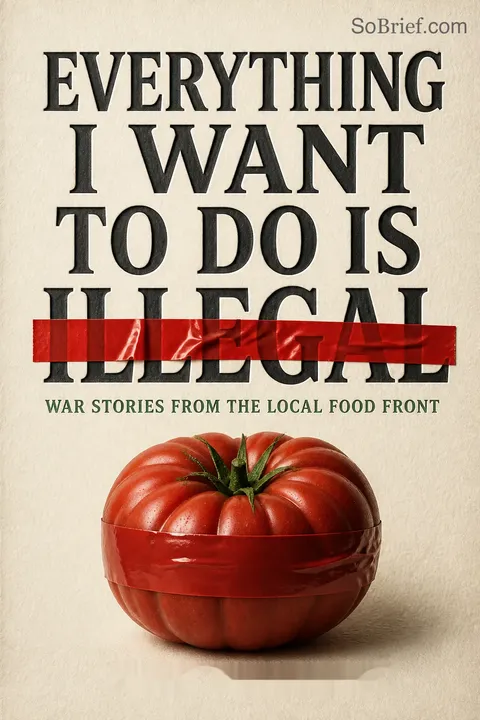
Everything I Want To Do Is Illegal presents Joel Salatin's frustrations with government regulations that hinder small-scale farming. Readers appreciate his passion and insights into sustainable agriculture, but some find his political views extreme. The book highlights bureaucratic obstacles faced by local farmers and advocates for food system reform. While many praise Salatin's writing style and arguments, others criticize his tone and digressions into unrelated topics. Overall, the book is seen as thought-provoking but polarizing, appealing more to those interested in local food movements and libertarian perspectives.
People Also Read


Glossary
Producer-Grower Exemption
On-farm poultry processing allowanceThe poultry exemption described by Salatin, associated with Public Law 90-492, allows qualifying producers to process birds they raised without continuous federal inspection, subject to limits and sanitation requirements. He cites a ceiling of 20,000 birds per year. His account stresses that state interpretations and added procedures can affect how the exemption works in practice.
Custom
Processing an owner's animalA meat-processing arrangement in which a customer brings an animal they own to a facility and receives the resulting meat for personal use. In Salatin’s account, packages are marked not for sale, so the owner may not resell them. He contrasts custom processing with state or federally inspected processing that permits commercial sales.
Best Management Practices
Official recommended operating practicesPractices promoted by agencies or technical institutions to reduce environmental harm from activities such as manure handling or logging. Salatin argues that these standards can reflect the assumptions of the specialists who write them and may overlook simpler alternatives or unintended consequences. The term is commonly shortened to BMPs in the book.
Hazard Analysis and Critical Control Point (HACCP)
Food safety hazard-control systemA food-safety approach that identifies hazards in a production process and sets controls at points where those hazards can be prevented, reduced, or monitored. Salatin discusses HACCP as a system requiring processors to develop documented plans and says its implementation increased paperwork and costs for small facilities. The book focuses on its effects on access to processing, not a full technical explanation.
National Animal Identification System
Animal identification and tracking proposalA system proposed in the period covered by the book to register animal premises, identify individual animals, and record their movements. Its stated purpose was to trace animals and contacts during disease outbreaks. Salatin criticizes its anticipated reporting burden, cost, and surveillance implications, and argues that traceability does not address unhealthy production conditions.
Relationship marketing
Sales built on ongoing trustA way of selling in which producers and customers know one another and maintain an ongoing connection. In Salatin’s model, buyers can learn who raised their food and how it was produced, while the farmer’s reputation depends on serving those customers well. He contrasts this with anonymous transactions through distant brands and distribution chains.
Pasture pulsing
Repeated root biomass renewalSalatin’s term for the recurring release of root material when grasses are grazed or mowed. He argues that this decaying biomass feeds soil life and adds organic matter, helping maintain soil fertility and water retention. The term expresses his view of pasture management as an ongoing cycle of growth, use, and biological renewal.
Food Security Act
Proposed consumer opt-out frameworkSalatin’s proposed legislation for creating a parallel food system. Consumers who chose food outside government-sanctioned channels would formally accept responsibility for their purchase and waive claims against the seller. He pairs consumer choice with the possibility of complaint-driven oversight and measurable safety standards, presenting the proposal as an option alongside conventional food.
About the Author

Download PDF
Download EPUB
.epub digital book format is ideal for reading ebooks on phones, tablets, and e-readers.








