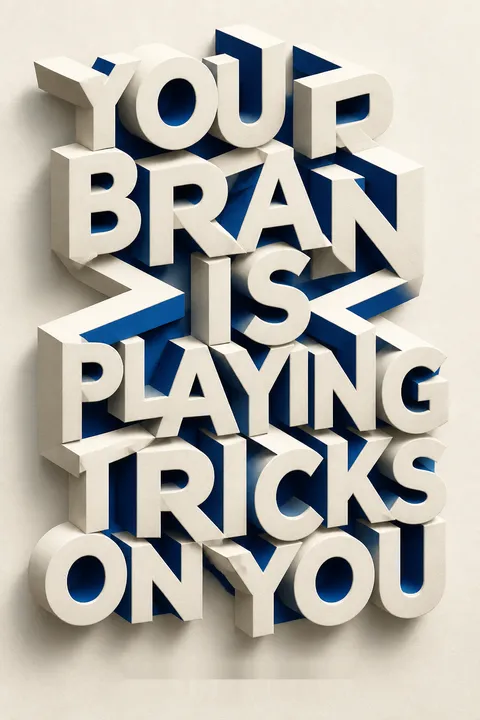


Key Takeaways
Treat perception as a brain-built draft, not a shared live feed
The brain completes the picture. Eyes and ears supply signals, but the brain filters and interprets them to create a usable world. When an image is ambiguous, it settles on one interpretation. In the famous dress debate, people saw different colors in the same photograph and often assumed that others must be mistaken. Neither group had access to the image without interpretation. This process, called ambiguity reduction, helps the mind stabilize incomplete or unclear information.
Useful, but fallible. The brain also fills in the blind spot in each eye and infers that a coin moved between a magician's hands, even when it did not. Reality is not simply invented at will: the image permits certain interpretations, not any interpretation. But what seems directly visible is already a brain-shaped account of the world.
This account makes perception less like a camera and more like an active model built from incomplete evidence. That distinction matters in arguments: disagreement may reflect different interpretations of shared information, rather than dishonesty or stupidity. The same idea encourages curiosity about what evidence would change a person's view. It also has a boundary. Perception is constructed, but not unconstrained: the world pushes back, and repeated checks can distinguish a plausible interpretation from an error. The useful response is neither blind trust in perception nor the claim that every version of reality is equally valid.
Assume memory can be edited by questions, repetition, and expectation
Recall is reconstruction. Memory does not preserve an event as an untouched recording. In an experiment by Elizabeth Loftus and John Palmer, students watched a car crash and were questioned about it a week later. Changing one verb in the question altered how forcefully they remembered the collision, including whether they recalled broken glass that was not shown. Loftus also found that suggestions could lead some participants to remember getting lost in a shopping mall as children, an event that had never happened.
Confidence is not proof. Eyewitnesses may fill gaps with later information, and people can defend choices they did not make. In one choice experiment, 74 percent of participants failed to notice when the option they had selected was secretly switched, then offered reasons for the replacement. Memory can feel vivid and still be wrong, a risk with consequences in therapy, relationships, and courtrooms.
The practical implication is not that memory is useless, but that confidence should not be treated as a measure of accuracy. This is especially important when questions contain assumptions, such as implying that a suspect must be among the people shown. Institutions can reduce harm by preserving original statements, avoiding leading prompts, and seeking independent evidence. A caveat matters: the experiments show that memory can be influenced, not that every recollection is false or that witnesses are generally unreliable. Good procedures protect both the person recalling events and the person being judged.
Use shortcuts for speed, then check when the stakes justify it
Fast thinking saves effort. A heuristic is a quick mental shortcut that often gives a useful answer without reviewing every possible detail. It lets someone shake hands without calculating arm position, or grab an umbrella when dark clouds gather. The same shortcut can mislead. In a classic judgment task, people read a description of a quiet, orderly person and guessed librarian rather than farmer, relying on a familiar stereotype while overlooking that farmers are more numerous.
No single mode always wins. Kahneman's model contrasts fast, intuitive thinking with slower, effortful reasoning, but the book cautions against treating the brain as a simple two-setting switch. A quick rule can outperform exhaustive analysis when time is short or extra detail adds little. Conversely, when consequences are serious, check base rates, seek missing evidence, and notice whether the first information has anchored the judgment.
The point is not to eliminate intuition, an impossible and often counterproductive aim, but to match the depth of checking to the decision. This resembles risk management: a low-cost choice can tolerate a rough estimate, while a medical, legal, or financial decision deserves verification. More analysis is not automatically better, since it can create delay or false precision. A practical question is whether additional information could change the decision. If not, a shortcut may be efficient. If so, pausing to test it is worthwhile.
Treat stress as an alarm, not proof that danger is present
The alarm once fit the threat. Stress prepares the body to fight or flee: heart and breathing rates rise, muscles tense, and digestion recedes. For an animal facing a predator, that brief burst can be lifesaving. Modern pressures such as a deadline or a presentation can trigger a similar response, even when neither fighting nor fleeing would help. Because the body is adapted for intense, short-lived alarms, prolonged stress can exhaust it and disrupt attention, sleep, and health.
Calm the body first. Telling a stressed person simply to calm down can miss the point: the brain is signaling danger. Slow breathing, stretching, exercise, yoga, and meditation can reduce bodily arousal, which may help the mind reassess the situation. Stress and anxiety also differ: stress usually has an identifiable trigger, while anxiety can persist without one. Under pressure, interpretations may skew negative, so tension is a cue to check judgment, not evidence that the worst interpretation is true.
The account links bodily state to interpretation, a useful corrective to the idea that reasoning happens in isolation from physiology. It also suggests a low-tech first step: change the conditions under which a judgment is being made. This is not a promise that breathing exercises resolve harmful workloads, discrimination, or clinical anxiety. Individual techniques can help with arousal, but chronic stress may require changes in circumstances or professional care. Treating stress as information rather than as a verdict preserves both its protective function and the possibility of reconsidering what it signals.
Test cherished beliefs as carefully as claims made by opponents
Beliefs defend themselves. Motivated reasoning means favoring information that supports an existing view and resisting information that threatens it. When a belief conflicts with behavior, cognitive dissonance, the discomfort of holding inconsistent ideas, can prompt a person to revise a belief or invent a justification. In Festinger's experiment, people paid very little to describe a dull task as enjoyable later rated it more positively than those paid more, who had a stronger external reason for saying so.
Group bubbles harden certainty. People may protect a political or personal commitment by explaining away failed predictions rather than reconsidering the commitment. Online, selective exposure makes supportive claims easy to find and share, even when their accuracy has not been checked. The aim is not to abandon every conviction. It is to temporarily act like an investigator: examine contrary evidence, ask what would count against the belief, and separate the factual claim from the emotional cost of changing one's mind.
This is a strong account of why facts alone do not reliably change minds: information is processed through identity, social belonging, and the need to see oneself as consistent. That insight is useful in public debate as well as private reflection. A respectful challenge is more likely to work when it does not demand that someone repudiate their whole identity at once. At the same time, dissonance should not become an all-purpose explanation for disagreement. People may reject a claim because its evidence is weak, not because they are protecting a belief. The evidence still matters.
Separate what you can influence from what you cannot control
Control has two traps. Locus of control describes whether someone tends to attribute outcomes to personal action or outside forces. An internal orientation can support effort and self-esteem, but taken too far it turns setbacks into personal blame. An external orientation can put an unfair event in perspective, but taken too far it can foster learned helplessness: the expectation that action will not change an adverse situation.
Past failure can train passivity. In Seligman's experiments, a dog that could not stop shocks in one setting later failed to escape them even when a route out was available. The book connects this pattern to depression and abuse, while stressing that such situations have many causes. A separate experiment found that telling women a math test showed no gender difference removed a performance gap seen when the test was framed as favoring men. Social expectations can shape perceived ability, but personal effort cannot repair every structural barrier.
The balance here is more useful than a simple instruction to take responsibility for everything. Agency depends partly on real opportunities, and blaming people for failing to act can obscure constraints such as abuse, poverty, or discrimination. Yet recognizing constraints need not mean surrendering all influence. A careful appraisal asks which part of a situation is changeable, which requires help, and which lies beyond personal control. The framing of the math task also shows that confidence is not always a private trait: institutions and expectations can alter the conditions under which people perform.
When certainty spikes early, investigate how much you still do not know
Early confidence can mislead. The Dunning-Kruger effect describes how people with limited skill may overestimate their competence because they lack enough knowledge to recognize their errors. In the researchers' studies, students who performed poorly on grammar and reasoning tasks tended to rate their performance too highly. As they learned more, some first became less confident, then built a better-grounded sense of their ability.
Familiarity is not understanding. Participants asked to draw a working bicycle from memory often produced designs that could not function, despite believing the object was simple to explain. The book connects this illusion of explanatory depth to public claims about complex topics, from vaccines to politics. The pattern is a warning, not a license to dismiss confident people: expertise and confidence do not map perfectly onto one another. Ask what you can explain, what evidence supports it, and what remains uncertain.
This insight makes uncertainty a normal stage of learning rather than a personal failure. It also helps explain why polished explanations can be persuasive despite being shallow: fluency is easily mistaken for mastery. The bicycle task is a particularly effective diagnostic because it asks for causal detail rather than a familiar label. Still, self-doubt is not itself evidence of expertise, and confident specialists may be right. The better test is whether a person can explain their reasoning, identify limits, and revise a claim when strong evidence changes.
Judge behavior in context, and redesign defaults that quietly steer it
Situations change choices. In a study inspired by the Good Samaritan parable, seminary students were more likely to help a person in distress when they were not rushed. Time pressure could outweigh the very values they had prepared to discuss. The book calls attention to a recurring error: explaining another person's behavior as character while treating one's own behavior as a response to circumstances.
Defaults have real consequences. Denmark and Sweden had very different organ-donor rates in the comparison described in the book, largely because one system required people to opt in and the other made donation the default unless they opted out. A nudge is a small change in how choices are presented that steers behavior without forcing it. A marked fly in airport urinals, for example, encouraged better aim and reduced cleaning costs. Such designs can help, but their purpose and limits deserve public scrutiny.
Contextual explanations can make judgment fairer, while choice architecture can make beneficial actions easier. The ethical question is who selects the default and whose interests it serves. A nudge may reduce friction, but it can also obscure meaningful choice when people do not notice how an option has been framed. Transparent design and a genuine ability to opt out matter. Context should not erase accountability either: it helps explain behavior, but explanation is not automatic excuse. Sound judgment holds both the person and the situation in view.
Practice doubt with a method, not as a reflexive rejection
Question the thought after it appears. Metacognitive control means noticing and reassessing an automatic thought rather than treating it as a fact. If a partner does not answer a call, a jealous person might consider ordinary alternatives before concluding betrayal. The book recommends asking what concrete evidence supports a thought, whether it is repeating in a loop, and what advice would be offered to a friend in the same situation.
Check claims outside your own head. When reading online, fact-checkers often open other sources instead of trusting a page in isolation. This lateral reading helps establish who produced a claim and whether reliable sources support it. A confidence index can also replace the binary choice between knowing and not knowing: assign a belief a provisional level of confidence, then update it as evidence changes. The goal is constructive doubt that preserves a shared basis in facts, not suspicion of everything.
This is an actionable form of intellectual humility: uncertainty becomes a procedure for improving judgment, not a pose or an excuse to avoid decisions. It brings together emotional self-regulation and information literacy, two skills often taught separately. The approach is especially valuable when a claim provokes fear, anger, or strong group loyalty, because those reactions make quick sharing more tempting. But endless checking can become paralysis. The discipline is to verify proportionately, prefer dependable evidence, and remain willing to reach a conclusion when the evidence is sufficient.
Analysis
The book's most important move is to replace the image of a neutral observer with a brain that actively constructs a workable account of reality. Perception, memory, judgment, and social behavior are not independent modules operating on pristine data. They are adaptive processes shaped by limited attention, bodily state, prior learning, identity, and context. That framing explains why a confident person can sincerely misremember, why a hurried seminarist may fail to help, and why the same person can interpret evidence differently when it threatens a valued belief.
The argument is strongest when it pairs a mechanism with a recognizable consequence. Optical ambiguity makes perception's constructive role vivid; eyewitness research shows the stakes of reconstructive memory; defaults show how private inertia can become a population-level outcome. Together, these examples resist the idea that cognitive errors are simply individual defects. Some arise from normal shortcuts, others from institutional design, social pressure, or unequal conditions. That distinction matters: asking people to think harder cannot by itself correct a misleading form, a biased procedure, or an abusive environment.
The book also avoids treating rationality as the removal of intuition. Heuristics are necessary because exhaustive analysis is costly, and intuitive judgment can be efficient when the environment is familiar. The useful question is therefore not whether a thought is fast or slow, but whether its method fits the decision and whether it can be corrected. This is a more realistic standard than perfect objectivity.
One tension remains. A catalogue of biases can itself invite overconfidence, as readers begin diagnosing every disagreement as someone else's cognitive error. The book's own principle of graduated doubt offers a remedy: apply scrutiny to the observer as well as the claim, distinguish uncertainty from falsehood, and test interpretations against evidence. Its civic argument follows naturally. A shared reality does not require shared opinions, but democratic disagreement becomes impossible when evidence and fabrication are treated as interchangeable. Critical thinking is therefore not just private self-improvement. It is a practice for keeping disagreement tethered to a world that others can also examine.
Review Summary
Your Brain Is Playing Tricks On You receives mixed reviews, with an average rating of 3.88/5. Readers appreciate its accessible overview of cognitive biases and psychological concepts, finding it informative for beginners. Many praise its concise explanations and real-life examples. However, some criticize its lack of depth and new information for those already familiar with psychology. The book's focus on how our brains can deceive us and influence decision-making is generally well-received. Some readers note editing issues in the English translation. Overall, it's considered a good introduction to cognitive science and critical thinking.
People Also Read




Glossary
Ambiguity Reduction
Stabilizing unclear informationThe brain's largely unconscious process of selecting an interpretation when sensory information is incomplete or ambiguous. It helps create a coherent, usable picture of the world. A reversible image can be perceived in more than one stable way, while context or prior expectations may make one interpretation more likely.
Heuristic
A quick mental shortcutA fast, approximate action or judgment that usually works well enough for everyday demands. Heuristics conserve attention and effort, allowing people to make decisions without considering every available detail. They can also produce errors when a shortcut ignores relevant information, such as how common an outcome is.
Cognitive Biases
Shortcuts that skew judgmentSystematic patterns in judgment that arise when the brain uses simplified ways of processing information. Biases can help people decide quickly, but can also distort conclusions. Examples discussed in the book include confirmation bias, anchoring, representativeness, and negative interpretation bias. Their effects depend on context rather than being uniformly harmful.
Choice Blindness
Missing a changed choiceA phenomenon in which people fail to notice that the option they selected has been replaced, then explain why they supposedly chose the substitute. Experiments with photographs and food choices suggest that people may not reliably remember the precise basis of a decision, even when they confidently give reasons for it.
Motivated Reasoning
Reasoning steered by prior beliefsA way of evaluating information that favors conclusions aligned with existing beliefs and resists evidence that challenges them. It can include searching selectively for supporting material and constructing justifications after the fact. The term describes a tendency, not proof that any particular person is reasoning dishonestly.
Cognitive Dissonance
Discomfort from inconsistencyMental discomfort that arises when a person's beliefs, actions, or preferences conflict. People may reduce that tension by changing a belief or behavior, minimizing the conflict, or adding a justification. In Festinger's experiment, participants paid little to describe a tedious task positively later rated it more favorably than participants paid more.
Locus of Control
Perceived influence over outcomesA person's tendency to see outcomes as shaped mainly by personal action or by external forces. An internal locus emphasizes one's own influence; an external locus emphasizes factors such as luck or circumstance. It is not a fixed either-or trait, and either extreme can be unhelpful when it misrepresents what a person can control.
Learned Helplessness
Expecting action to failA pattern in which repeated exposure to an adverse situation that seems uncontrollable leads someone to stop trying to change it, even when a way out becomes available. The book discusses experiments with animals and people, and connects the concept to depression and abuse while recognizing that these experiences have complex causes.
Dunning-Kruger Effect
Overrating limited competenceA pattern in which people with low skill in a particular task may overestimate their performance because they lack the knowledge needed to recognize their mistakes. As competence grows, self-assessment may initially become less confident before improving. The effect concerns a relationship between skill and self-evaluation, not a rule that all confident people are incompetent.
Metacognitive Control
Reassessing automatic thoughtsThe practice of examining thoughts about one's initial, automatic thoughts, rather than accepting those first reactions as facts. A person can identify an assumption, consider evidence and alternatives, and reduce the thought's influence on behavior. The book presents it as a tool for developing greater flexibility, including in therapeutic settings.
Nudge
A gentle choice promptA change in how a choice is presented that influences behavior without requiring or forbidding an option. Examples include making a beneficial choice the default or using visual road markings to encourage drivers to slow down. Nudges can serve public goals, but their effects may fade as people notice or grow accustomed to them.
FAQ
What's "Your Brain Is Playing Tricks On You" about?
- Overview: "Your Brain Is Playing Tricks On You" by Albert Moukheiber explores how the brain shapes our opinions and perceptions through cognitive biases and mental shortcuts.
- Focus: The book delves into the mechanisms of the brain that lead to misinterpretations, illusions, and the construction of a coherent worldview despite limited and biased information.
- Purpose: It aims to make readers aware of these cognitive processes to improve mental flexibility and decision-making.
- Structure: The book is divided into parts that cover perception, memory, stress, cognitive dissonance, and the influence of social context on our beliefs.
Why should I read "Your Brain Is Playing Tricks On You"?
- Self-awareness: The book provides insights into how our brain's automatic processes can lead to errors in judgment and perception.
- Practical Advice: It offers tools and techniques to recognize and counteract cognitive biases, enhancing decision-making and critical thinking.
- Broader Understanding: Readers gain a deeper understanding of how social and psychological factors influence beliefs and behaviors.
- Engaging Content: The book uses relatable examples and experiments to illustrate complex cognitive science concepts in an accessible manner.
What are the key takeaways of "Your Brain Is Playing Tricks On You"?
- Cognitive Biases: Our brains use shortcuts that can lead to errors in perception and judgment, such as confirmation bias and cognitive dissonance.
- Memory and Perception: Memory is not a perfect recording but a reconstruction that can be influenced by new information and biases.
- Stress and Anxiety: These can distort our perception and decision-making, often leading to negative interpretation biases.
- Social Influence: Our beliefs and actions are heavily influenced by social context and group dynamics, often without our awareness.
How does Albert Moukheiber explain cognitive biases in the book?
- Definition: Cognitive biases are mental shortcuts that simplify decision-making but can lead to errors.
- Examples: The book discusses various biases, such as confirmation bias, where we favor information that confirms our preconceptions, and the Dunning-Kruger effect, where people overestimate their knowledge.
- Impact: These biases affect our perceptions, decisions, and interactions with others, often leading to misunderstandings and conflicts.
- Mitigation: Moukheiber suggests strategies to recognize and counteract these biases, such as questioning assumptions and seeking diverse perspectives.
What is the "illusion of knowledge" as described in the book?
- Concept: The illusion of knowledge refers to the tendency to believe we understand more than we actually do.
- Examples: The book illustrates this with examples like people overestimating their understanding of complex systems or topics.
- Consequences: This illusion can lead to overconfidence and poor decision-making, as individuals may not seek further information or question their assumptions.
- Overcoming: Moukheiber advises maintaining a healthy skepticism and continuously seeking to expand and verify one's knowledge.
How does "Your Brain Is Playing Tricks On You" address stress and its effects?
- Stress Mechanism: Stress is a physiological response to perceived threats, originally meant to aid survival but often maladaptive in modern contexts.
- Impact on Perception: Chronic stress can lead to negative interpretation biases, affecting how we perceive and react to situations.
- Examples: The book uses examples like public speaking anxiety to illustrate how stress can distort our perceptions and hinder performance.
- Management: Techniques such as relaxation exercises, mindfulness, and cognitive restructuring are suggested to manage stress and its effects.
What role does social context play in shaping our beliefs, according to the book?
- Influence: Social context heavily influences our beliefs and behaviors, often without our conscious awareness.
- Group Dynamics: The book discusses how group dynamics and social mimicry can lead to conformity and the adoption of group norms.
- Examples: Experiments like the Asch conformity tests are used to illustrate how social pressure can alter individual perceptions and decisions.
- Awareness: Recognizing the impact of social context can help individuals make more informed and independent choices.
What are some practical tools for improving mental flexibility mentioned in the book?
- Metacognitive Techniques: These involve questioning automatic thoughts and developing a habit of reflective thinking to counter biases.
- Psychoeducation: Understanding the psychological mechanisms behind biases can empower individuals to manage their thoughts and emotions better.
- Critical Thinking: The book emphasizes the importance of critical thinking skills, such as evaluating evidence and considering alternative viewpoints.
- Mindfulness Practices: Techniques like mindfulness and relaxation exercises can help reduce stress and improve focus and decision-making.
What is cognitive dissonance, and how is it explained in the book?
- Definition: Cognitive dissonance is the mental discomfort experienced when holding contradictory beliefs or when behavior conflicts with beliefs.
- Examples: The book provides examples like smokers who rationalize their habit despite knowing the health risks.
- Resolution: People often resolve dissonance by changing their beliefs or justifying their behavior to restore mental equilibrium.
- Applications: Understanding cognitive dissonance can help individuals recognize and address inconsistencies in their own beliefs and actions.
How does the book suggest we deal with misinformation and fake news?
- Critical Evaluation: The book advises critically evaluating sources and seeking evidence before accepting information as true.
- Awareness of Biases: Recognizing biases like confirmation bias can help individuals avoid falling for misinformation that aligns with their preconceptions.
- Fact-Checking: Encourages the use of fact-checking tools and cross-referencing information from multiple reliable sources.
- Education: Promotes the development of critical thinking skills from an early age to better navigate the information landscape.
What are the best quotes from "Your Brain Is Playing Tricks On You" and what do they mean?
- "We don’t see the world as it is, but rather as we are." This quote highlights the subjective nature of perception, influenced by our biases and experiences.
- "Our brain, which filters the myriad of ambiguous information that reality permanently feeds us, construes the world and recreates reality, often unbeknownst to us." It emphasizes the brain's role in shaping our perception of reality, often leading to misinterpretations.
- "To doubt everything or to doubt nothing are two equally convenient solutions, which both exempt us from thinking." This quote encourages a balanced approach to doubt, promoting critical thinking and open-mindedness.
- "The best tool to do so is through doubt: a constructive doubt, turned towards oneself, and not an incriminating doubt turned towards the others." It suggests using doubt as a tool for self-reflection and growth, rather than as a means to criticize others.
How does Albert Moukheiber propose we improve our decision-making processes?
- Awareness of Biases: Recognizing and understanding cognitive biases is the first step to mitigating their impact on decision-making.
- Reflective Thinking: Encourages adopting a reflective approach to thinking, questioning assumptions, and considering alternative perspectives.
- Continuous Learning: Emphasizes the importance of lifelong learning and staying informed to make well-rounded decisions.
- Mindfulness and Relaxation: Suggests using mindfulness and relaxation techniques to reduce stress and improve focus, leading to better decision-making.
Download PDF
Download EPUB
.epub digital book format is ideal for reading ebooks on phones, tablets, and e-readers.








