

Summary Unavailable
This book is not suitable for a summary (it may be a textbook, workbook, cookbook, reference book, or collection). However, you can still explore the FAQs, about author, and other metadata below!
Key Takeaways
Expect continuity without permanence: your future self will be familiar, yet changed.
Identity is partly stable. Pedro Rodrigues Filho became a notorious killer, then, after decades in prison, adopted an austere life of exercise, work, and counseling younger offenders. He described himself as a new person. Personality research offers a less dramatic picture: across fifty years, people retain relative patterns, yet many change in conscientiousness or emotional stability. In one long-term sample, about 40 percent showed reliable change in a given trait.
Morality binds selves. Caregivers saw the greatest identity disruption in frontotemporal dementia, where empathy and social judgment can deteriorate despite preserved memories and movement. This suggests an essential moral self: kindness, honesty, and concern for others may connect a person across time more strongly than appearance or preferences.
What's striking is the refusal to choose between a fixed soul and total reinvention. Identity behaves more like a developmental system than a permanent object. The moral-self account is psychologically useful because relationships depend heavily on trust and character, but it is not exhaustive. Memory, embodiment, social roles, and narrative continuity also matter, and neurological disease can disrupt these dimensions unevenly. The practical implication remains robust: self-improvement need not mean abandoning the person one is. It means deciding which traits deserve preservation while allowing others to mature.
Make future you emotionally close, not merely intellectually imaginable.
Distance changes treatment. In one experiment, students were willing to consume about three tablespoons of an unpleasant drink themselves, but assigned roughly eight tablespoons to a future self or another person. Brain scans likewise found that distant future selves resembled other people more than current selves. When researchers temporarily disrupted a brain region involved in perspective taking, participants became less empathic toward others and less willing to save money.
Connection predicts patience. People who felt more overlap with their ten-year selves were more willing to delay rewards, had accumulated more assets, and reported better financial well-being. Similar connections also correlate with exercise, ethical choices, academic performance, and life satisfaction. Future you is not literally a stranger, but the mind often treats that person as one.
This reframes saving and health behavior as relationship problems rather than mere calculation failures. Social psychology shows that people sacrifice more for close others than distant ones, so strengthening self-related closeness borrows the machinery of attachment. The correlation should not be mistaken for destiny: wealth, stability, and education can make future thinking easier in the first place. Still, the relational lens is more actionable than demanding abstract discipline. A future self becomes easier to help when that self has a face, values, and recognizable concerns.
Protect long-term plans before the present moment starts bargaining.
The present bids aggressively. Temporal discounting is the tendency to value a reward less when it is delayed. People may prefer 34 dollars in seventeen days to 30 dollars in eight days, yet choose 30 dollars immediately over 34 dollars in nine days. The reward gap is similar, but immediate temptation reverses the preference. Hungry participants who selected healthy food for next week often chose chocolate when the same decision applied to today.
Emotion magnifies now. Hunger, fatigue, distraction, and desire activate immediate reward systems, while prefrontal processes help preserve the larger plan. Subjective time also stretches near the present. A two-week wait can feel longer when it begins today than when it lies months away. The solution is to design decisions before the visceral state arrives.
Behavioral economics treats present bias as both a flaw and a possible adaptation. Immediate rewards are certain, while distant rewards can be interrupted by illness, scarcity, or changing circumstances. The problem appears when a short-lived appetite repeatedly overrides a stable, valued goal. This distinction matters ethically: the remedy is not contempt for impulsive people, but architecture that moves decisions into calmer states. Defaults, advance purchases, and environmental barriers can outperform lectures about rationality because they intervene before desire takes command.
Plan for the feelings your future self will actually carry.
Shallow planning shifts pain forward. Poor trip planning is the book's metaphor for imagining the future without considering its concrete demands. Procrastination is its clearest form: the present self avoids an unpleasant task while handing the same task, plus a deadline, to tomorrow. Around 20 percent of adults are chronic procrastinators, and many more find their delays distressing. Self-forgiveness helps only when paired with genuine responsibility, because shame encourages further avoidance.
Borrow experience when possible. People often underestimate how strongly future emotions will register. In a speed-dating study, women who predicted a date using another participant's experience were about twice as accurate as women who simulated the experience themselves. A practical rule follows: consult people who have already lived the future, rather than trusting imagination alone.
The deepest point is that procrastination regulates mood before it manages time. Avoidance provides immediate relief, which reinforces the very pattern that harms later performance. Self-forgiveness can interrupt that loop by reducing shame, but it must preserve agency rather than become a permission slip. The surrogate finding also challenges modern individualism. Personal uniqueness is real, yet humans share recurring emotional and bodily responses. Carefully chosen peers often provide better forecasts than an isolated imagination trying to simulate an experience it has never had.
Never let today's hunger, weather, or optimism impersonate tomorrow.
Current states distort forecasts. Projection bias is the tendency to predict future choices using today's emotions and drives. Hungry office workers chose candy for a later meeting, while recently fed workers chose fruit. Warm weather increased convertible purchases, and snowstorms boosted four-wheel-drive sales. At West Point, cadets assigned to a 7:30 a.m. class were about 10 percent less likely to major in that subject, apparently mistaking morning fatigue for dislike.
Preferences keep moving. The end-of-history illusion describes recognizing past change while underestimating future change. Nearly 20,000 people showed this pattern for personality and values. It can distort careers, relationships, and medical plans. Only about one-third of Americans have an advance directive, even though end-of-life preferences can change dramatically when illness becomes real.
Projection bias resembles the hot-cold empathy gap studied in decision science: a calm person underestimates craving, while a craving person forgets calm. The book usefully extends this beyond food to identity itself. Yet change is not always a reason to delay commitment. Reversible choices should remain flexible, while irreversible choices deserve cooling-off periods, outside perspectives, and explicit acknowledgment that preferences may evolve. Mature planning does not predict one permanent future personality. It creates options for several plausible versions of the person ahead.
Turn distant retirement into a person, a conversation, and a date.
Vividness can change behavior. In experiments, people who met digitally aged versions of themselves allocated about 6 percent of pay to retirement, compared with about 2 percent among those shown current images. In a real Mexican banking study, customers who encountered older versions saved more, with the total amount saved 54 percent higher than in the comparison group. Images work best when paired with an immediate account or decision, not as entertainment alone.
Shrink psychological distance. Writing letters to a future self, exchanging replies, and imagining retirement in days rather than years all strengthen connection. Thinking of retirement as 10,950 days away made people begin saving four times earlier than thinking of it as 30 years away. Mentally traveling backward from the future also more than doubled enrollment in one college-savings experiment.
These interventions resemble concrete mental simulation used in implementation science: a distant goal becomes behaviorally potent when it is specific, sensory, and attached to a next action. Their modest effects are a virtue, not a weakness, because retirement behavior has many causes. Aged images may also trigger fear or age stereotypes, so design should emphasize valued activities and relationships, not merely wrinkles. The general principle is sound: imagination becomes consequential when it changes the choice architecture at the moment action is available.
Pre-commit before temptation arrives, because willpower negotiates badly.
Constrain tomorrow's menu. A commitment device is an arrangement that makes a desired future action easier by limiting future escape routes. Antabuse helped some people with alcohol problems because drinking while taking it produced severe physical reactions, turning many daily negotiations into one decision to take the pill. A softer version is accountability: Craig photographed every meal for a nutritionist and lost fifteen pounds.
Escalate deliberately. Locked savings accounts in the Philippines increased balances by 82 percent, while Save More Tomorrow automatically raised employees' contributions and quadrupled savings rates over roughly four years. Stronger devices remove options, as with a timed kitchen safe or withdrawal restrictions. Automatic penalties can work too, but they must be painful enough to matter and tolerable enough to adopt.
Commitment devices apply game theory to the internal conflict between present and future preferences. The calm self changes the future choice set before the tempted self can renegotiate. This is powerful precisely because it treats self-control as an engineering problem. Safeguards matter, especially with medication, addiction, and financial access. A device should preserve meaningful agency, be transparent about consequences, and fit the actual failure mode. The best constraint is not the harshest one. It is the one a person willingly keeps using.
Attach pleasure to discipline, then shrink the sacrifice until it starts.
Pair the hard with the enjoyable. Temptation bundling means combining a beneficial activity with an attractive one. Students whose gym-only iPods contained compelling audiobooks exercised 51 percent more than those merely encouraged to work out; an encouragement-only audiobook group improved by 29 percent. A related tactic, tangential immersion, uses a mildly engaging side activity to extend boring tasks. Watching an absorbing nature clip helped people brush their teeth about 30 percent longer.
Let good feelings coexist. In supportive group therapy for women with metastatic breast cancer, discussing fear alongside connection and hope improved emotional well-being. Mixed emotions can make difficult realities more tolerable without denying them. The same logic applies to saving, cooking, conflict, and exercise: add an immediate source of meaning or pleasure instead of demanding that present discomfort stand alone.
Immediate reinforcement is central to behavior change because delayed benefits compete poorly with present costs. Temptation bundling borrows from operant learning while preserving dignity: the person is not asked to become a different species, only to make repetition more rewarding. The risk is instrumentalizing every pleasant moment. If all leisure becomes a reward for productivity, attention and enjoyment may degrade. Selective bundling works best alongside unearned rest, which protects pleasure from becoming another performance metric.
Break large sacrifices into daily units that feel psychologically affordable.
Reframe the price. A savings plan framed as 5 dollars per day attracted about four times as many sign-ups as the same plan framed as 150 dollars per month, even though the daily version totaled slightly more annually. Small units resemble familiar expenses, making the sacrifice easier to imagine. The same principle helps with debt repayment, exercise, and volunteering, especially at the beginning of a goal.
Keep the total visible. Smaller units can conceal cumulative cost. Buy-now-pay-later plans exploit this perception, and some daily savers later dropped out after recognizing the full amount. The useful rule is directional: break down resources being built, such as savings, but consider the whole price when spending. Near a finish line, return attention to the larger goal.
Temporal reframing changes mental accounting without changing arithmetic. It can democratize participation by reducing the psychological entry cost for people with less disposable income. Yet any frame can become manipulation when it hides aggregate liability. Good design pairs the small unit with an accessible cumulative total and a clear exit policy. The technique is strongest when it lowers initiation friction while preserving informed consent about the destination.
Spend some of today, or tomorrow may inherit an empty calendar.
Future-mindedness can overshoot. Financial planner Carl Richards nearly rejected a costly three-day kayaking trip, calculating that 1,000 dollars invested at 7.5 percent could become about 4,461 dollars in twenty years. He went anyway and found the experience obviously worth having. Residents often postpone attractions in their own cities, while short-term visitors see far more because they know the opportunity is temporary.
Avoid hyperopia. Hyperopic behavior means being so focused on distant benefits that present life becomes needlessly deprived. The FIRE movement can produce financial independence through extreme saving, but some adherents report that daily happiness collapsed. The better target is a deliberate balance: protect future security while spending time and money on relationships, memories, health, and experiences that cannot simply be postponed forever.
The corrective is not hedonism but portfolio thinking. A life contains financial capital, health, relationships, memories, and opportunities, and maximizing one can impoverish the others. Future planning is therefore multi-objective rather than a single savings equation. The strongest decision rule asks whether a sacrifice protects a deeply held value or merely obeys an abstract ideal of optimization. A future self may be grateful for retirement money, but that self also inherits whatever experiences the present self chose to omit.
Analysis
This is behavioral science presented as a travel narrative. Its structure moves from identity, to predictable time-travel failures, to practical interventions. The audience is anyone making choices whose benefits arrive after today's appetite, fatigue, fear, or convenience has disappeared. The summarization challenge is breadth: the book combines philosophy of personal identity, neuroscience, financial behavior, health, addiction, relationships, mortality, and climate responsibility. It also relies on many anecdotes, while its strongest claims are often correlational rather than causal.
The book's central contribution is relational. Future-oriented behavior is usually described as rational planning, but the evidence here suggests that people prepare for tomorrow when tomorrow feels inhabited by someone worthy of care. That insight links intertemporal choice to attachment, empathy, and identity. It also explains why a vivid aged avatar, a letter, or a retirement account can matter: each turns an abstraction into a social target.
The interventions form a coherent behavioral sequence. First, make the future psychologically present. Second, prevent predictable failures with commitment devices. Third, reduce the immediate cost of good behavior through rewards and smaller units. Finally, protect the present from excessive self-denial. This is more sophisticated than a simple message to delay gratification, because extreme patience can become its own pathology.
The main limitation is that connection is neither sufficient nor equally available. Poverty, illness, unstable housing, discrimination, and financial shocks can make future planning objectively difficult, not merely psychologically distant. Visualization may help, but it cannot substitute for resources or institutional reform. The book is strongest when it treats the mind and environment as partners: compassion for future selves becomes durable when translated into defaults, deadlines, social accountability, and reversible plans. Its lasting model is not live for tomorrow. It is build a relationship with tomorrow, then negotiate fairly with today.
Last updated:
Report IssueReview Summary
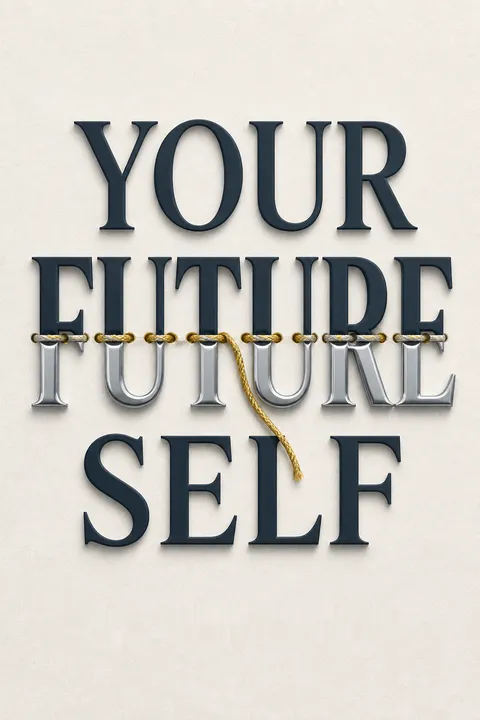
Your Future Self explores how our perception of our future selves impacts present decisions. Hershfield offers strategies to connect with and care for our future selves, encouraging better long-term choices. Readers found the book engaging, with relatable examples and actionable insights. Some praised its philosophical depth and scientific approach, while others felt it was repetitive or lacked concrete advice. The book challenges readers to consider how present actions affect their future selves, promoting a balance between immediate gratification and long-term well-being.
People Also Read







Glossary
mental time travel
Imagining across timeThe mind's ability to mentally move among past, present, and future experiences. It can occur spontaneously through memory and anticipation, or deliberately through planning, visualization, and letters to future selves. The book presents this capacity as a central human intelligence, while showing that its accuracy and motivational force depend on how vividly and realistically the future is represented.
future self-continuity
Connection across personal timeThe perceived similarity and emotional connection between a person's current self and a future version of that person. Stronger future self-continuity is associated with more patient financial choices, greater savings, exercise, ethical behavior, academic performance, and life satisfaction. It does not require expecting no change. A person can anticipate improvement while still experiencing continuity.
essential moral self
Character's deepest continuityThe idea that moral traits such as kindness, honesty, empathy, and concern for others are especially important to judgments of whether someone remains the same person over time. Research involving neurodegenerative disorders suggests that changes to moral behavior can disrupt perceived identity more strongly than bodily decline or memory loss alone.
temporal discounting
Devaluing delayed rewardsThe tendency to assign less value to a reward when it arrives later rather than sooner. The pattern is not always irrational, since future rewards can be uncertain, but it often produces inconsistent preferences. A person may prefer a larger reward later when both options are distant, then choose a smaller reward when one becomes immediately available.
poor trip planning
Shallow future considerationOne of the book's metaphors for considering the future only superficially. The person recognizes that a future exists but fails to imagine its concrete demands, emotions, and constraints. Procrastination and overcommitting to future activities are examples. The result is arriving at a future that differs from the one the present self intended.
projection bias
Projecting current feelings forwardThe tendency to predict future preferences and behavior using current emotions, bodily states, or motivations. Hunger can influence a later food choice, weather can influence a vehicle purchase, and present fatigue can distort judgments about a subject or career. Even when people know their state will change, they often fail to adjust predictions sufficiently.
end-of-history illusion
Underestimating future changeThe tendency to recognize substantial changes in one's personality, values, and preferences from the past to the present while underestimating how much further change will occur. Teenagers, adults, and older people can all feel that they have recently become their final selves. This illusion can distort career, relationship, spending, and medical decisions.
commitment device
A constraint on future choicesA prearranged tool or rule that makes it easier to follow a long-term intention by limiting future opportunities to defect. Examples include automatic savings, locked accounts, accountability partners, timed lockboxes, withdrawal penalties, and externally enforced consequences. Effective devices anticipate the specific temptation that tends to derail the person's future self.
Save More Tomorrow
Automatic escalating savingsA savings program associated with behavioral economists Richard Thaler and Shlomo Benartzi. Employees agree in advance to divert portions of future pay raises into retirement accounts, with contributions increasing over time. Because the commitment begins with future income rather than current take-home pay, employees can raise savings without immediately experiencing the full reduction in spending power.
temptation bundling
Pairing pleasure with effortA behavior-change technique that links a desirable activity with an activity that is beneficial but difficult or boring. Examples include allowing access to a compelling audiobook only during exercise, or reserving a favorite show for household chores. The immediate reward makes repetition more attractive, reducing reliance on delayed health or productivity benefits.
tangential immersion
Mild engagement during boredomA technique for extending an otherwise tedious behavior by pairing it with a secondary activity that is somewhat engaging but not so absorbing that it displaces the main task. Watching an interesting but manageable video while brushing teeth is an example. Unlike temptation bundling, which mainly helps initiation, tangential immersion helps sustain duration.
hyperopic
Excessively future-focusedA term used for behavior that is so farsighted that it sacrifices too much present enjoyment and later produces regret. Extreme saving, postponing travel indefinitely, or waiting for a perfect occasion to use a gift can all become hyperopic. The concept warns that serving a future self requires preserving meaningful experiences for that self as well.
FAQ
What is Your Future Self: How to Make Tomorrow Better Today by Hal Hershfield about?
- Explores mental time travel: The book examines how we imagine our past and future selves, and how this shapes our decisions and well-being.
- Focuses on self-continuity: Hershfield challenges the idea of a single, unchanging self, proposing instead that we are a collection of selves across time.
- Aims for better future outcomes: It provides insights and practical strategies to help readers make choices today that benefit their future selves in areas like health, finances, and happiness.
Why should I read Your Future Self by Hal Hershfield?
- Gain self-awareness: The book reveals why we often make choices that harm our future selves, such as procrastination or overspending.
- Learn actionable strategies: Hershfield offers evidence-based methods, like visualizing aged avatars or writing letters to your future self, to bridge the gap between present and future identities.
- Enhance life satisfaction: By fostering a stronger relationship with your future self, you can improve your financial well-being, health habits, ethical behavior, and overall happiness.
What are the key takeaways from Your Future Self by Hal Hershfield?
- Self as a collection: We are not one static self, but a series of selves with different desires and perspectives over time.
- Future self as "other": Our brains often treat our future selves like strangers, which explains why we neglect their needs.
- Strengthening self-continuity: Building a closer connection with your future self leads to better decision-making and greater life satisfaction.
What does Hal Hershfield mean by "future self" in Your Future Self?
- Multiple selves over time: Hershfield argues that we are an aggregation of distinct selves—morning self, five-years-from-now self, etc.—each with unique feelings and desires.
- Future self as "other": Neuroscience shows our brains often perceive our future selves similarly to how we perceive other people.
- Connection matters: The more connected we feel to our future selves, the more likely we are to make sacrifices today for their benefit.
What are the main psychological concepts in Your Future Self by Hal Hershfield?
- Projection bias: The tendency to project current emotions and preferences onto our future selves, often inaccurately.
- End-of-history illusion: The belief that we will change little in the future, despite having changed a lot in the past.
- Future self-continuity: The sense of similarity and connection to our future selves, which predicts better long-term planning and self-control.
How does Your Future Self by Hal Hershfield explain why we neglect our future selves?
- Future self as stranger: Brain imaging shows we respond to our future selves more like we do to strangers than to our current selves.
- Present bias: We overvalue immediate rewards and discount future benefits, leading to impulsive decisions.
- Emotional intensity: Present emotions feel more vivid and influential than anticipated future emotions, making it harder to act for our future benefit.
What are the three "time-traveling mistakes" described in Your Future Self by Hal Hershfield?
- Missing your flight: Over-focusing on the present and failing to consider the future, resulting in impulsive choices.
- Poor trip planning: Thinking superficially about the future, leading to procrastination and overcommitting to future obligations.
- Packing the wrong clothes: Relying too much on current emotions to predict future needs, causing regretful decisions due to projection bias and the end-of-history illusion.
How can strengthening the relationship with your future self improve decision-making, according to Your Future Self?
- Increases patience and saving: Feeling closer to your future self makes you more likely to delay gratification and save money.
- Boosts ethical and academic outcomes: Stronger future-self connections correlate with more ethical behavior and higher academic performance.
- Enhances well-being: Longitudinal studies show that greater perceived similarity with your future self leads to higher life satisfaction.
What practical methods does Your Future Self by Hal Hershfield suggest for connecting with your future self?
- Visualizing aged avatars: Seeing digitally aged images of yourself increases willingness to save and make future-oriented decisions.
- Writing letters to your future self: Letter-writing exercises foster reflection and planning, strengthening the emotional bond with your future self.
- Using social closeness measures: Tools like the Aron "circles measure" help quantify and build emotional closeness to your future self, improving decision-making.
How does Your Future Self by Hal Hershfield address the role of emotions in future-oriented decision-making?
- Projection bias in action: We inaccurately project current emotional states onto our future selves, leading to poor choices.
- Present emotional magnification: Immediate feelings are more vivid and influential than anticipated future emotions, causing us to prioritize short-term comfort.
- Neural basis of empathy: Disrupting brain regions involved in empathy reduces our ability to connect with future selves, increasing impulsivity.
What is the "end-of-history illusion" in Your Future Self by Hal Hershfield, and how does it affect planning?
- Underestimating future change: People believe they will change little in the future, despite having changed a lot in the past.
- Impact on decisions: This illusion leads to overconfidence in current preferences, causing choices that may not suit our future selves.
- Resistance to change: Fear of the unknown and desire for self-consistency make it harder to anticipate and embrace future personal growth.
What are the best quotes from Your Future Self by Hal Hershfield and what do they mean?
- “You are actually a we.” This highlights the book’s core idea that we are multiple selves across time, not a single unchanging identity.
- “The future self looks more like another person than like the current self.” Neuroscientific evidence explains why we often treat our future selves like strangers, neglecting long-term interests.
- “By strengthening the connections between our past, present, and future selves, we can gain a new perspective on what’s important—and help create the future we want.” This underscores the main message: improving self-continuity leads to better decisions and a happier life.
About the Author
Hal Hershfield is a Professor of Marketing, Behavioral Decision Making, and Psychology at UCLA's Anderson School of Management. He is a leading researcher in the field of time perception and decision-making, particularly focusing on how people think about their future selves. Hershfield's work has been widely recognized and cited in academic circles and popular media. He has conducted numerous studies on topics such as saving for retirement, making ethical decisions, and improving long-term health behaviors. Your Future Self is his first book, synthesizing years of research and providing practical applications for readers to improve their decision-making processes and overall well-being.
Download PDF
Download EPUB
.epub digital book format is ideal for reading ebooks on phones, tablets, and e-readers.








