

Key Takeaways
Read the Nuremberg Laws beside the American statutes their drafters studied
A meeting leaves evidence. On June 5, 1934, senior Nazi legal officials debated laws against marriage and sex between Jews and Germans. Justice Minister Franz Gürtner presented a researched survey of American race laws. Radical official Roland Freisler argued that American legal methods could help Germany. This was a closed policy meeting, not a public attempt to excuse Nazi actions, making it strong evidence of serious study, though not proof that every provision came from America.
A flag obscured the laws. In 1935, New York magistrate Louis Brodsky released anti-Nazi rioters who had torn down a swastika flag. The Nazis used the incident to justify a law making the swastika Germany’s sole national flag. But the anti-Jewish citizenship and marriage laws had been in development for years. Treating all three measures as one reaction hides the legal research behind two of them.
The meeting illustrates why the history of policy is often found in working documents, not just official speeches. A speech can be calibrated for an audience; a closed drafting session exposes which examples officials actually weighed. Still, consultation does not settle causation. A foreign statute can supply vocabulary, authority, or a practical option without determining the final law. The distinction matters here: the archive demonstrates attention and debate more securely than it can prove how much a particular American statute changed the outcome.
Stop reducing American race law to Southern segregation
The legal landscape was wider. American racial restrictions reached far beyond segregated schools, transport, and public facilities. They included federal immigration and naturalization rules, laws limiting political rights, colonial classifications, and state bans on interracial marriage. Thirty states had anti-miscegenation laws, many of which made such marriages invalid and some of which imposed criminal penalties.
The Nazis studied the relevant fields. The Nuremberg Laws focused chiefly on citizenship and sex, not on a system of public segregation. Nazi lawyers examined American rules because they addressed those same areas. Jim Crow still mattered: the 1933 Prussian Memorandum cited Southern segregation. But the book’s central correction is that segregation was only one part of the American legal order that Nazi officials considered useful.
Public memory often organizes American racial history around the most visible scenes of segregation. That lens makes it easy to miss laws that operated at borders, in marriage records, or through voting rules. Whitman’s broader map improves the comparison by matching legal functions rather than familiar labels. It also warns against treating a single region as the whole country. One qualification is essential: a shared legal category does not make the experiences governed by it interchangeable. The question is what a rule did, to whom, and through which institutions.
Measure influence by adaptation, not by literal copying
Borrowing is rarely a photocopy. The American statutes Nazi lawyers examined did not target Jews, and the American legal system did not share the Nazis’ political aims. Yet Nazi officials could still adapt legal devices developed against other groups. They compared how states defined race, how they invalidated marriages, and how they restricted citizenship, then debated which approaches could fit German conditions.
Models also confer legitimacy. American law could reassure Nazi lawyers that race-based rules were not an isolated German invention. The evidence supports sustained interest and, in the case of criminalizing mixed marriage, a meaningful likelihood of influence. It does not support the claim that the United States caused Nazism or that Nazi laws were simply copied from American codes. Influence here includes selective borrowing, practical inspiration, and validation.
This account offers a useful way to assess influence in legal history: distinguish the transfer of a specific rule from the transfer of a technique or a sense of legitimacy. The latter can matter even when wording and targets change. The evidentiary standard should remain careful, however. Officials’ citations and deliberations establish that a model entered the conversation, not what would have happened in its absence. Whitman’s argument is strongest when it names that uncertainty rather than turning a documented exchange into a single-cause story.
Notice how American immigration law legitimized racial citizenship
A celebrated precedent was racial exclusion. The 1790 Naturalization Act limited naturalization to free white people. Much later, the 1921 and 1924 immigration laws used national-origin quotas that favored immigrants from northern and western Europe. Adolf Hitler praised American restrictions in Mein Kampf, presenting them as early steps toward a state organized around racial membership.
Nazi lawyers kept citing the example. After taking power, officials described American immigration controls as a carefully developed system for excluding people deemed racially or physically undesirable. They did not simply copy quota tables. The American example mattered because it showed that a powerful, admired country had made racial selection part of law. Nazi policy initially aimed to drive Jews to emigrate or marginalize them, and citizenship rules helped define who belonged to the political community.
The comparison highlights how border policy can help define the nation within, not just regulate entry from outside. Immigration law and citizenship law reinforce each other: one selects newcomers, the other distinguishes full members from lesser-status residents. That connection helps explain why American precedents could interest Nazi lawyers despite different targets. It also prevents an overly tidy account of American history. A constitutional language of equality coexisted with racial rules, and that contradiction did not make the rules politically invisible to foreign observers.
Study second-class citizenship beyond its legal label
Rights could be emptied without erasing citizenship. After Reconstruction, Southern states used devices such as literacy tests, poll taxes, and grandfather clauses to block Black voting while leaving formal citizenship intact. Elsewhere, American law created categories such as non-citizen nationals for some people in the Philippines and Puerto Rico. Native Americans also faced distinctions between national status and full citizenship.
Nazi officials saw a useful comparison. The Reich Citizenship Law separated full Reich citizens from people who remained German nationals but lacked full political rights. Nazi lawyers studied American examples of legal subordination, including the limits placed on Black political participation. The systems were not identical: American restrictions often evaded constitutional guarantees, while Nazi law announced racial hierarchy openly. But both show that legal membership can be divided into levels.
A rights label tells only part of the story. The practical question is whether a person can vote, hold office, move freely, or claim equal protection in daily life. Whitman’s comparison directs attention to these capabilities rather than assuming citizenship is a single, uniform status. The contrast in legal form remains crucial: indirect disenfranchisement under constitutional pressure differs from an explicit racial classification, even when both create exclusion. Taking both the resemblance and the difference seriously makes the comparison sharper, not softer.
The marriage ban had a closer American precedent than citizenship law
American states had criminalized interracial marriage. Thirty states prohibited such unions, often declaring them void and, in some cases, subjecting participants to imprisonment. In June 1934, Nazi lawyers debated whether Germany should punish mixed marriages and sexual relationships. Gürtner resisted broad criminalization, while radical officials, especially Freisler, pointed to American law as evidence that such punishment was legally possible.
The Blood Law adopted a related approach. Promulgated in 1935, it invalidated marriages between Jews and Germans and criminalized them. It also prohibited extramarital sex between the groups. The law was not copied word for word from an American statute, and its targets and political purpose were different. Still, the record of detailed research and debate makes American anti-miscegenation law one of the book’s strongest cases for direct legal influence.
The comparison is especially revealing because marriage is often treated as private life, yet these laws made intimate choices a matter of state enforcement. Their common mechanism was not simply separating populations, but defining which relationships could produce legitimate family ties. That makes the American precedent more specific than a general resemblance between racist societies. The argument should not be stretched into equivalence: an American precedent could make a legal technique imaginable without dictating the scale, targets, or consequences of Nazi persecution.
Treat racial categories as law’s choices, not biological facts
Classification required political decisions. American states used different rules to decide who counted as Black or white. Some relied on fractions of ancestry; others considered appearance, social association, or family history. Nazi officials studied these variations while facing the problem of defining who counted as Jewish under German law.
The Nazis rejected the harshest American rule. The one-drop rule classified a person as Black if they had any Black ancestry. Many Nazi lawyers considered that approach too severe, and they recognized that Jewish identity could not be judged by appearance in the same way. The 1935 regulations generally classified a person as Jewish with three Jewish grandparents; some people with two were also classified as Jews if they belonged to the Jewish religious community or married a Jew. Family choices became evidence of racial identity.
These rules show that racial categories do not merely describe populations. They create official boundaries, assign consequences, and make intimate histories legible to the state. The shifting American definitions and the Nazi use of ancestry, religion, and marriage reveal how much judgment hides inside apparently technical classification. The comparison also has limits: different histories of migration, community, and visibility shaped what each government thought it was classifying. Those differences make clear that racial law was political construction, not a consistent science.
Legal flexibility can serve persecution, not only liberty
Freisler admired adaptable judging. At the 1934 meeting, he argued that American courts managed race laws despite vague and inconsistent definitions. He saw this as an advantage: judges could act without waiting for a precise scientific account of race. For him, American legal pragmatism offered a way to enforce Nazi goals despite conceptual uncertainty.
Traditional legal habits briefly slowed radicals. Gürtner and other trained jurists raised objections about unclear categories, criminal penalties, and the coherence of the proposed laws. Their caution was not a principled defense of Jews; they accepted persecution, but resisted some radical methods. Whitman argues that legal tradition could impose limits even within a dictatorship, while the Nazis’ rejection of those limits made room for judges and officials to act more freely in the regime’s spirit.
Flexibility is not an ethical quality on its own. It can help a legal system respond to new circumstances, but it can also let officials stretch vague rules toward political ends. The disturbing point is that a practice often praised as practical or adaptive looked useful to a radical Nazi jurist precisely because it reduced the force of technical constraints. At the same time, legal formality should not be romanticized: the officials defending it were collaborators, and their procedural objections only slowed parts of a persecution they accepted.
Compare regimes without confusing shared racism with identical power
The resemblance was real, not total. Nazi lawyers saw the United States as a leading example of racial law, and they found precedents in immigration restrictions, unequal citizenship, and bans on interracial marriage. Yet American constitutional commitments to equality remained a competing force, however often those commitments were evaded. American racial oppression was also dispersed across states and local institutions rather than organized through a Nazi-style centralized apparatus.
The Nazi project changed over time. In the early 1930s, officials chiefly sought to marginalize Jews and force emigration; the later drive to annihilation was a radically different development. Recognizing American influence on some legal methods does not make America responsible for Nazi crimes, or make the two regimes equivalent. It does show that Nazi law developed within a wider Western history of racial exclusion.
The most responsible comparison holds two facts together: Nazi officials found useful examples in American law, and Nazi Germany built a far more centralized and murderous regime. Dropping the first fact sanitizes the history of American racism; dropping the second risks flattening the Holocaust into a generic instance of discrimination. The distinction between legal precedent and political outcome is the key. Shared tools can be used toward different ends, and institutions determine how far those tools reach.
Analysis
Whitman’s central achievement is to change the unit of comparison. Earlier debates often asked whether Jim Crow segregation was copied into Nazi law, then treated the absence of direct imitation as evidence that American influence was negligible. This book asks what Nazi officials were trying to legislate: racial citizenship, restrictions on interracial sex, and legal subordination. Once those functions are compared, the American record looks much more relevant.
The evidence is not equally strong across every claim. The June 1934 meeting transcript and the Ministry of Justice survey establish deliberate research and active debate. The American precedent for criminalizing interracial marriage is especially close to the Blood Law’s mechanism. By contrast, the relation between American citizenship law and the Reich Citizenship Law is more plausibly one of inspiration and legitimation than direct copying. That distinction does not weaken the argument. It clarifies how comparative law can work: a foreign example can expand the set of imaginable policies, reassure officials that a measure is workable, or lend a project historical authority.
The book’s most uncomfortable insight concerns legal culture. Nazi radicalism did not arise only from obedience to a dictator or from a powerful state. It also involved officials claiming discretion to pursue political goals without the restraints of inherited legal categories. Freisler’s attraction to American judicial flexibility therefore complicates the simple contrast between a liberty-protecting common law and an authoritarian civil law. Yet that contrast should not be reversed into a verdict that formal legal systems are inherently safer. Gürtner and Lösener defended technical limits while supporting racial persecution. Their resistance was real, but morally narrow.
The comparison is valuable precisely because it is not an equation. American racial law supplied precedents and working methods; Nazi institutions gave persecution a different reach and end. Historical responsibility depends on preserving both claims at once: foreign examples can shape a regime without causing it, and recognizing influence need not diminish the regime’s agency or crimes.
Review Summary
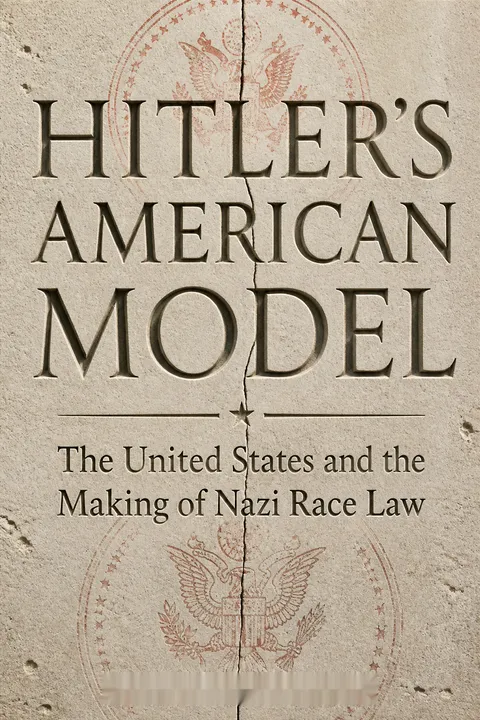
Hitler's American Model explores how American race laws influenced Nazi legal thinking in the 1930s. Reviewers found the book well-researched and disturbing, highlighting America's role in global racism. Some praised Whitman's nuanced approach, while others felt he was too apologetic or repetitive. The book sparked reflection on America's racial history and its ongoing impact. Reviewers appreciated the historical context but wished for more connections to contemporary issues. Overall, it was seen as an important, if uncomfortable, examination of a little-known aspect of American and Nazi history.
People Also Read







Glossary
Nuremberg Laws
1935 racial statutesThe name commonly given to two Nazi laws announced in September 1935: the Reich Citizenship Law, which restricted full political rights to people classified as German or related blood, and the Law on the Protection of German Blood and German Honor, which banned marriage and sexual relations between Jews and Germans. A separate flag law was also announced at the rally.
Reich Citizenship Law
Racially restricted citizenshipA 1935 Nazi law dividing residents into Reich citizens and nationals. Only Reich citizens, defined by the regime through racial ancestry and political loyalty, could possess full political rights. The distinction provided a formal legal structure for reducing German Jews to a subordinate status while they remained nationals of the Reich.
Blood Law
Ban on Jewish-German unionsThe common name for the 1935 Law on the Protection of German Blood and German Honor. It prohibited marriages between Jews and people classified as German or related blood, declared such marriages invalid, and criminalized them. It also prohibited extramarital sex between the groups and imposed other restrictions on Jewish households.
Mischling
Nazi term for mixed ancestryA Nazi racial classification for a person considered to have mixed Jewish and non-Jewish ancestry. Under the regulations implementing the Nuremberg Laws, ancestry was assessed through grandparents, but religion and marriage could also affect classification. Some people with two Jewish grandparents were counted as Jews if they belonged to the Jewish religious community or married a Jew.
Miscegenation
Interracial sexual relationsA term used for sexual relations or marriage across racial categories. In the book, it refers particularly to American state laws that prohibited interracial marriage, often declaring such unions invalid and sometimes imposing criminal penalties. Nazi lawyers examined these laws while debating restrictions on marriage and sex between Jews and Germans.
second-class citizenship
Unequal rights within membershipA status in which people retain some form of national or civic membership but lack rights available to full citizens. American examples included the practical denial of political rights to Black citizens and the category of non-citizen nationals for some colonial populations. Nazi law used a more explicit distinction between Reich citizens and lesser-status nationals.
Legal Realism
Law viewed through social practiceA twentieth-century approach to law that emphasizes how institutions and judges act in real social conditions, rather than treating legal rules as a self-contained logical system. Whitman compares American Legal Realism with Nazi legal thought that rejected formal constraints in favor of political action. The comparison concerns a shared emphasis on practical consequences, not shared political aims.
FAQ
What's Hitler's American Model about?
- Explores Nazi Race Law Origins: The book investigates how Nazi Germany drew inspiration from American race laws, particularly in the formulation of the Nuremberg Laws. It chronicles the historical context of Nazi legal thought and its engagement with American legal practices.
- Focus on Racial Ideology: Author James Q. Whitman argues that the Nazis admired the United States for its racist immigration and citizenship laws, which they viewed as models for their own racial policies. The book highlights the disturbing parallels between American and Nazi racial ideologies.
- Historical Significance: Whitman aims to shed light on the often-overlooked connections between American legal practices and the development of Nazi racial legislation, prompting readers to reconsider the global implications of American racism.
Why should I read Hitler's American Model?
- Understanding Historical Context: This book provides a critical examination of how American laws influenced one of history's most horrific regimes, offering insights into the complexities of racism. It encourages readers to reflect on the historical roots of racial discrimination.
- Challenging Assumptions: Whitman challenges the notion that Nazi ideology was entirely homegrown, revealing the uncomfortable truth about American influence on Nazi policies. This perspective is essential for understanding the broader history of racism.
- Engaging Scholarship: The book is well-researched and presents a compelling narrative that combines legal history with moral inquiry, making it a valuable read for those interested in law, history, and ethics.
What are the key takeaways of Hitler's American Model?
- Nazi Admiration for American Law: The Nazis looked to American race laws as a model for their own legislation, particularly in citizenship and anti-miscegenation laws. Whitman emphasizes that this admiration was not merely superficial but deeply influential in the drafting of the Nuremberg Laws.
- Racial Purity and Citizenship: The book discusses how the Nazis sought to establish a legal framework that defined citizenship based on racial purity, mirroring American practices. This included the criminalization of mixed marriages and the creation of second-class citizenship for Jews.
- Global Racism: Whitman argues that the history of racism is interconnected and that American laws contributed to a global understanding of racial hierarchy. The book serves as a reminder of the far-reaching consequences of racist ideologies.
What are the best quotes from Hitler's American Model and what do they mean?
- "This jurisprudence would suit us perfectly...": This quote reflects the chilling realization that Nazi legal thinkers found inspiration in American race laws. It underscores the disturbing connection between two seemingly disparate legal systems.
- "America was, for the Nazis, the 'classic example' of a country with racist legislation.": This statement encapsulates the book's central thesis, highlighting how the Nazis viewed American laws as a template for their own racial policies. It emphasizes the need to confront uncomfortable truths about American history.
- "The Nuremberg Laws were crafted in an atmosphere of considerable interest in, and respect for, what the example of American race law had to offer.": This quote illustrates the direct influence of American legal practices on Nazi legislation, challenging the perception that Nazi ideology was entirely independent. It calls for a reevaluation of the historical narrative surrounding both regimes.
How did the Nazis use American race law in their own legislation?
- Inspiration for Nuremberg Laws: The Nazis studied American immigration and citizenship laws to inform their own Nuremberg Laws, which established racial criteria for citizenship. They admired the systematic exclusion of certain races from citizenship in the U.S.
- Anti-Miscegenation Laws: American anti-miscegenation laws served as a model for the Nazi Blood Law, which criminalized marriages between Jews and "Aryans." The Nazis sought to prevent "racial pollution" in a manner similar to American practices.
- Legal Framework for Racial Purity: The Nazis adopted and adapted American legal concepts to create a framework that defined and enforced racial purity in Germany. This included the establishment of second-class citizenship for Jews, mirroring the racial hierarchies present in American law.
What specific American laws influenced the Nazis?
- Immigration Act of 1924: This law established quotas based on national origins, which the Nazis admired for its racial basis. Hitler praised it in Mein Kampf, viewing it as a step toward a racially pure society.
- Anti-Miscegenation Statutes: Various states had laws prohibiting interracial marriages, which the Nazis found appealing for their own legal framework. These laws provided a clear example of how to legislate against racial mixing.
- Second-Class Citizenship Laws: The treatment of African Americans and other minorities in the U.S. served as a model for the Nazis in creating a system of second-class citizenship for Jews. The Nazis studied how American law created legal distinctions based on race.
How did the Nuremberg Laws reflect American legal principles?
- Racially Defined Citizenship: The Nuremberg Laws established citizenship based on racial criteria, similar to how American laws defined citizenship through race. This reflected a direct borrowing of ideas from American legal practices.
- Criminalization of Mixed Marriages: The Blood Law criminalized marriages between Jews and "Aryans," echoing American anti-miscegenation laws. This demonstrated the Nazis' intent to legislate against racial mixing in a manner reminiscent of U.S. laws.
- Legal Justification for Racial Discrimination: Both the Nuremberg Laws and American race laws provided legal frameworks that justified racial discrimination. The Nazis used American examples to legitimize their own oppressive policies.
What role did American eugenics play in Nazi ideology?
- Influence on Racial Policies: American eugenics, which aimed to improve the genetic quality of the population, influenced Nazi racial policies. The Nazis admired American eugenicists and their efforts to control reproduction and immigration.
- Legal Framework for Eugenics: The Nazis studied American eugenics laws to inform their own policies on sterilization and racial purity. This included the adoption of similar measures to prevent the reproduction of those deemed "unfit."
- Cultural Exchange of Ideas: The exchange of eugenic ideas between the U.S. and Germany highlights the transnational nature of racist ideologies. The Nazis viewed American eugenics as a model for their own racial engineering efforts.
How did the Nazis perceive American racism?
- Admiration and Critique: The Nazis both admired and critiqued American racism, seeing it as a model while also believing it was insufficiently harsh. They recognized the effectiveness of American laws but felt that their own measures needed to be more stringent.
- Comparison with German Conditions: Nazi leaders compared the American racial situation to their own, often concluding that the U.S. had not gone far enough in its racial policies. This led to a desire to implement more radical measures in Germany.
- Cultural and Racial Kinship: The Nazis viewed the U.S. as a kindred nation in terms of racial ideology, believing that both countries shared a commitment to white supremacy. This perception influenced their approach to race laws and policies.
What were the implications of American influence on Nazi race law?
- Global Racism: The book argues that the influence of American race law on Nazi legislation illustrates the interconnectedness of racist ideologies worldwide. It highlights how American legal practices contributed to the development of oppressive regimes.
- Moral Responsibility: Whitman emphasizes the need to confront the uncomfortable truths about America's role in shaping Nazi policies. This raises questions about moral responsibility and the legacy of racism in both countries.
- Historical Reevaluation: The connections drawn in the book prompt a reevaluation of the historical narrative surrounding both American and Nazi racism. It challenges readers to consider the implications of these relationships for contemporary discussions on race and law.
How does Hitler's American Model address the concept of citizenship?
- Citizenship and Race: The book discusses how citizenship in both the U.S. and Nazi Germany was deeply intertwined with race. The Nuremberg Laws stripped Jews of their citizenship, paralleling the second-class status of racial minorities in America.
- Legal Frameworks: Whitman examines the legal frameworks that defined citizenship, highlighting the exclusionary practices that were prevalent in both societies. This includes the impact of the Fourteenth Amendment in the U.S. and the Reich Citizenship Law in Germany.
- Historical Comparisons: The author draws comparisons between the evolution of citizenship laws in America and Nazi Germany, illustrating how both systems used legal definitions to enforce racial hierarchies.
What role did Heinrich Krieger play in shaping Nazi views on American law?
- Key Legal Scholar: Heinrich Krieger was a prominent Nazi legal scholar whose work, Race Law in the United States, provided insights into American legal practices. His writings were frequently cited by Nazi policymakers.
- Influence on Nuremberg Laws: Krieger's analysis of American anti-miscegenation laws directly influenced the formulation of the Nuremberg Laws, showcasing the transatlantic exchange of racist legal ideas.
- Racial Classification: He emphasized the arbitrary nature of racial classifications in American law, which resonated with Nazi ideologies. His work contributed to the Nazi understanding of how to categorize and control populations.
Download PDF
Download EPUB
.epub digital book format is ideal for reading ebooks on phones, tablets, and e-readers.








