

Key Takeaways
Judge inventions by whether people can actually use them
Adoption makes the difference. An invention is an idea or device; innovation is what happens when it becomes practical, affordable, reliable, and used. The distinction explains why the inventor’s name is often less important than the people who make a product work in daily life.
Bread needed a second invention. Otto Rohwedder’s machine could slice bread, but the slices went stale unless they were packaged. Most bakeries were uninterested until a bakery in Chillicothe, Missouri, agreed to try his combined solution in 1928. The idea was not enough. A workable product and a willing user made it an innovation.
The distinction shifts attention from dazzling prototypes to the often-uncelebrated work of deployment: reliability, price, maintenance, and fit with existing routines. That is useful well beyond technology. A medical treatment that works only in a specialist laboratory has not yet changed public health. Still, adoption alone is not proof of social value. Products can spread through habit, advertising, or lack of alternatives. The stronger test is whether adoption solves a real problem better than the available options.
Innovation turns energy into useful, improbably ordered things
Order takes power. The book frames innovation as arranging matter and information into useful forms that are unlikely to arise by chance. A phone, a photograph, and a living duckling all depend on energy sustaining complex arrangements. In this account, prosperity comes from learning to use energy to create things that save time and effort.
Heat began doing work. Before practical steam engines, heat mostly warmed and cooked, while muscles, wind, and water moved things. Thomas Newcomen’s engine connected these two forms of energy by using steam pressure to pump water from mines. It wasted most of its fuel, but it made a new kind of machine possible, opening a path to later improvements.
This energy lens gives the book a memorable physical foundation: useful order is not magic, but the result of energy applied through organized knowledge. It also helps explain why efficiency matters, since the same service can be delivered with less fuel or effort. The metaphor should not be mistaken for a complete theory of economic value. Energy use can create harmful outcomes as well as useful ones, and the distribution of its benefits is a separate question.
Treat breakthroughs as long chains of shared improvements
Credit is usually crowded. The light bulb is often presented as Edison’s singular invention, but at least twenty-one people independently designed or improved incandescent bulbs by the late 1870s. Joseph Swan was among them. Edison’s distinctive achievement was to combine a more reliable bulb with a system for generating and distributing electricity, then test thousands of possible filament materials with a team.
Steam followed the same pattern. Papin explored the principle, Savery built an impractical water pump, and Newcomen made a useful engine. James Watt later improved efficiency with a separate condenser. Each contribution depended on earlier work, available materials, and other people’s practical skills. The neat story of one genius is often a retrospective simplification.
Seeing innovation as a chain makes it easier to notice neglected contributions, including manufacturing, testing, and distribution. It also clarifies why patents and prizes can distort historical credit: they reward identifiable claims, while progress is often shared and incremental. Yet collective explanation should not erase individual judgment. Edison’s system-building and Watt’s efficiency improvement were consequential choices, even if neither emerged from a vacuum. A good account preserves both the network and the people who moved it forward.
Run many small experiments, because luck favors the prepared
Mistakes can reveal mechanisms. In the 1990s, Mitchell Energy was struggling to extract gas from shale. An employee, Nick Steinsberger, found that a watery mixture used during a drilling job produced a promising surge of gas. Further experiments showed that increasing the water and adjusting the sand could make the method work. The team had stumbled on a result before fully understanding why it worked.
Persistence turns accidents into progress. Thomas Edison’s team tested more than 6,000 plant materials before settling on bamboo for a long-lasting bulb filament. The Wright brothers built gliders, studied flight, measured wing performance, and corrected repeated design errors before their first powered flight. In each case, experimentation gave chance something useful to land on.
Serendipity is not passive good fortune. It depends on enough experiments, attention to surprising results, and the ability to repeat or adapt them. The examples also show why organizations need room for low-cost failure: if every mistake ends a project or career, fewer anomalies get investigated. But trial and error is not automatically wise. In fields where errors can harm patients or the public, experiments need safeguards, staged testing, and clear reporting.
Make innovations affordable enough for ordinary people to adopt
Price can matter more than novelty. The first useful steam engines were clumsy and wasteful, but they could drain coal mines where fuel was cheap. Later engineers improved their efficiency and widened their uses. The same pattern appears in lighting: a minute of work bought about four minutes of kerosene-lamp light in 1880, but by 2000 it could buy about 120 hours from an electric bulb.
Containers cut the cost of trade. Before standardized shipping containers, dockworkers moved and sorted cargo piece by piece. Malcom McLean’s first container ship carried goods from New Jersey to Texas at a reported cost of less than 16 cents per ton, compared with $5.83 for ordinary cargo rates. The breakthrough required new ships, cranes, standards, and port practices, not just a box.
Affordability is a powerful measure of whether an innovation escapes the laboratory and reaches people who can benefit from it. It also explains why an apparently modest cost reduction can matter more than a sophisticated technical feature. The figures in these cases describe particular historical comparisons, not universal laws. Lower prices can also encourage greater use, so efficiency gains do not always translate directly into lower total resource consumption.
Connect people and ideas; isolation slowly erodes capability
Exchange enlarges the collective mind. Modern numerals and zero came from Indian mathematics, were explained in Arabic-language scholarship, and reached European merchants through Fibonacci’s practical arithmetic book. Their value spread through commerce, where positional numbers made calculation and accounting far easier than Roman numerals.
Isolation can reverse progress. After Tasmania became separated from mainland Australia, its small population lost access to a wider pool of knowledge. Over time, some technologies, including certain fishing and cold-weather tools, disappeared. The book uses this case to argue that specialization and trade let communities draw on skills and discoveries no one person holds alone. Cities and connected populations create more chances for ideas to meet and combine.
The idea of knowledge distributed across people is a useful corrective to the image of the self-sufficient inventor. Connections allow specialization, copying, and recombination, while isolation can make skills harder to maintain across generations. But more connection is not automatically better. Networks can circulate errors and amplify conformity as easily as useful knowledge. The relevant question is whether people can exchange ideas broadly while still testing claims and preserving room for dissent.
Let practical invention and scientific explanation teach each other
Practice often comes first. Lady Mary Wortley Montagu learned of smallpox inoculation in the Ottoman Empire and championed it in Britain before doctors understood immunity. Louis Pasteur later helped explain vaccination through experiments showing that a weakened form of a microbe could protect chickens against a more dangerous one. The medical practice preceded a firm scientific account.
Technology can create new science. Steam engines were being improved before thermodynamics explained their operation. The yogurt industry’s need to protect useful bacteria from viruses helped researchers understand CRISPR, a microbial defense system that became a tool for editing genes. These cases complicate the simple story that science always produces technology. Sometimes practical problems create demand for scientific understanding, and the two then advance together.
A two-way relationship between science and technology better fits the cases than a one-direction pipeline. It encourages attention to industrial laboratories, users, and craftspeople as sources of questions that formal research can answer. It also guards against judging basic science only by near-term commercial results. The relationship varies by field: some technologies depend heavily on prior scientific theory, while others grow through practical know-how before mechanisms are understood.
Compare new risks with dangers already built into the status quo
Novelty attracts suspicion. Smallpox inoculation exposed healthy people to infection, yet it offered a chance to avoid a much deadlier disease. Chlorination faced public resistance because people disliked adding a chemical to drinking water, but it helped cities control waterborne illness. In both cases, judging the new practice only by its risks would have ignored the dangers it was meant to reduce.
Caution needs a comparison. The book makes a similar case for vaping as a lower-risk alternative to smoking, while recognizing that it is not risk-free. It also describes a polio vaccine failure caused by inadequately inactivated virus, a reminder that rushed adoption can cause real harm. Sound evaluation compares benefits and hazards against existing options, while continuing to monitor results.
Risk comparison is more informative than treating unfamiliarity as evidence of danger. It also makes the status quo visible: an established practice can be hazardous simply because its harms are familiar. The polio episode shows the necessary counterweight. Enthusiasm for a promising alternative cannot substitute for quality control, transparent evidence, and safeguards proportionate to the consequences of failure. The approach is strongest when it avoids both reflexive rejection and reflexive endorsement.
Build organizations that learn from failure, not merely avoid blame
Useful failure produces evidence. Amazon tried many ventures that lost money, including online auctions and toy retailing. Some efforts failed, while experiments such as its third-party Marketplace and cloud-computing service helped create major businesses. Jeff Bezos’s approach treated experiments as a way to discover what customers would use.
A failed promise is different. Theranos claimed it could run many medical tests from a tiny blood sample, but its devices did not reliably deliver what the company advertised. The gap was concealed from customers and investors, and patients received incorrect results. The contrast matters: a genuine experiment can fail openly and teach something; deception hides failure and prevents others from making informed decisions.
The useful distinction is not between success and failure, but between informative failure and concealed failure. Teams need psychological and procedural space to report bad results, especially when commercial pressure encourages a rosy story. At the same time, celebrating failure can become its own corporate theatre if leaders face no consequences for repeated waste or harm. Learning requires evidence, accountability, and a willingness to stop projects whose core assumptions do not hold.
Measure progress by what people gain per unit of work and material
Productivity can mean less stuff. The book describes growth increasingly coming from delivering more with fewer inputs. Between 1960 and 2010, the land needed to produce a given quantity of food fell by about 65 percent. In the United States, aluminum drink cans went from about 85 grams when introduced to about 13 grams. These changes can raise output while reducing pressure on land and materials.
Work shifts rather than simply vanishes. Farm machinery reduced the need for agricultural labor, while manufacturing and service work expanded. Automation also helped people spend less of their lives at work than earlier generations did. The broad claim is that higher productivity supports new jobs and more leisure, although the benefits do not necessarily reach every worker equally or immediately.
Output per unit of resource is a sharper lens than output alone, particularly when land, energy, and materials are constrained. The history of changing work also warns against assuming that a task disappearing means employment must disappear at the same rate. However, aggregate gains can obscure local losses, difficult transitions, and unequal bargaining power. Productivity is a source of opportunity, not a guarantee that every worker shares in the gains.
Keep markets open so new entrants can challenge comfortable incumbents
Permission matters. Mobile phones could have arrived far earlier: the American regulator allocated little radio spectrum to mobile service in 1947, and licenses and disputes delayed cellular networks for decades. The first American cellular service began in 1984. Meanwhile, established broadcasters and phone companies had reasons to protect their existing position.
Rules can protect or obstruct. Patents, licensing, and safety regulations may support investment or prevent harm, but they can also raise costs, delay experiments, and favor firms already able to navigate the system. The book argues that innovation flourishes when people can enter, test ideas, and reach customers. Its warning is that a society can praise innovation while quietly making experimentation too difficult.
Open entry is a practical way to prevent incumbents from turning past success into permanent control. The mobile-phone story makes the cost of delay tangible, while also showing how regulation and industry interests can reinforce each other. Yet the right lesson is not that all rules are suspect. Safety, privacy, and fair competition are real public concerns. Good governance should make those goals explicit and avoid prescribing a single winner before evidence has accumulated.
Analysis
The book’s most durable contribution is its shift in unit of analysis. Innovation is not a lone inventor’s moment of insight, but a system that turns an idea into a dependable practice through engineering, financing, imitation, distribution, and user acceptance. That frame connects histories as different as inoculation, steam power, shipping containers, gene editing, and search engines. It also helps explain why invention dates are often disputed: the boundary between a promising concept and a useful technology is gradual, and different participants contribute different parts.
The account is strongest when it shows how experimentation and recombination produce results that no planner could specify in advance. It is less conclusive when it turns that historical pattern into a broad prescription for deregulation. The book’s cases support a warning against rules that freeze designs or protect incumbents, but they do not establish that regulation is generally harmful. The comparison must include failures that are invisible because safeguards prevented them, as well as the social costs that can accompany rapid deployment. Public health examples in the book itself show that both reckless adoption and unnecessary delay can cost lives.
There is also a methodological tension in the argument for inevitability. When several people independently approach the same invention, that suggests shared technological conditions made it ripe. But surviving examples are selected from successes, while abandoned possibilities are harder to count. A technology may be inevitable in broad outline yet radically different in timing, ownership, cost, or consequences. Likewise, consumer uptake is evidence that a product meets demand, not proof that its benefits exceed its external costs.
The best synthesis is therefore neither heroic invention nor laissez-faire certainty. Innovation is a distributed search process. It needs open exchange and tolerance for experiments, but also reliable feedback, competition, accountability, and institutions capable of limiting harms without locking in yesterday’s solution. The central policy challenge is to preserve learning while deciding who bears the risk of failure and who receives the gains.
Review Summary
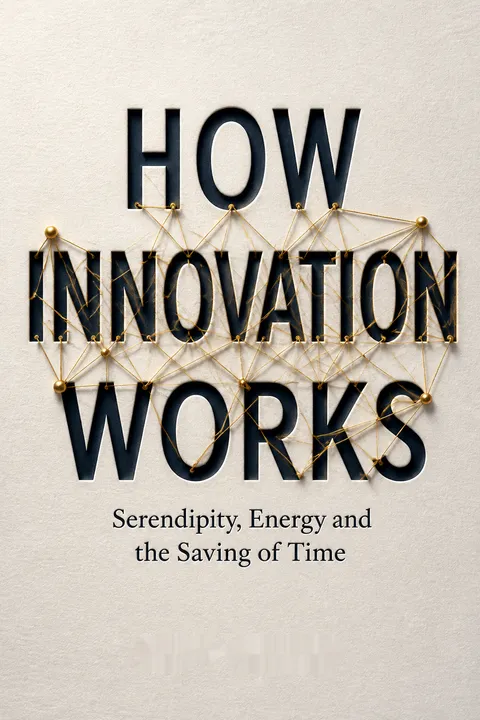
How Innovation Works receives mixed reviews. Many praise Ridley's insights into the gradual, collaborative nature of innovation and his engaging historical examples. Critics argue the book lacks cohesion and depth, with some finding it repetitive or politically biased. Readers appreciate Ridley's exploration of innovation's unpredictability and the role of trial and error. However, some feel the book oversimplifies complex topics and fails to fully support its arguments. Overall, it's seen as an accessible, thought-provoking read on innovation's history and mechanisms, despite its flaws.
People Also Read










Glossary
Innovation
useful adoption of noveltyA new product or method that becomes a practical, adopted way of doing something. In the book, innovation is distinct from invention: an idea does not count as a successful innovation merely because it has been conceived or built. It must become useful, reliable, affordable, and used.
Amara's Law
misjudging technology over timeA pattern in forecasting: people tend to overestimate a new technology’s effects in the short term and underestimate its effects over the long term. The book uses the internet and GPS to show how early disappointment can coexist with large eventual changes, because usefulness and adoption take time to develop.
recombination
joining existing ideasThe process of creating novelty by combining technologies, techniques, or ideas that already exist. A shipping container system, for example, combined familiar boxes, ships, cranes, and standards in a new commercial arrangement. The book treats recombination as a major source of variation in both biological evolution and human innovation.
permissionless innovation
experimenting without prior permissionAn approach in which people may develop and offer new products unless a specific, justified restriction applies. The book associates this idea with the early internet, where relatively permissive rules allowed online businesses to experiment and grow. It contrasts this with systems that require extensive advance approval, which can make experimentation costly or slow.
Jevons paradox
efficiency can increase useThe possibility that making a resource more efficient to use lowers its effective cost and leads people to use more of it, offsetting some or all of the savings. The book notes this effect when discussing energy efficiency, while arguing that in some sectors efficiency gains can exceed the increase in demand and reduce total resource use.
cost disease
slow innovation raises relative costsAn economic effect in which productivity gains in some sectors raise wages across the economy, making services in sectors with slower productivity growth more expensive. The book uses medical care as an example: general economic growth can increase the cost of labor-intensive services even when those services themselves become only modestly more productive.
precautionary principle
caution toward potential harmA policy principle that calls for caution when a new activity may cause harm, even when evidence is uncertain. The book argues that it can become asymmetric if proposed innovations must prove safety while established practices are not judged by the same standard. Properly applied, it must consider both possible harms and the risks of delaying a potentially safer alternative.
FAQ
What's How Innovation Works about?
- Exploration of Innovation: The book explores the nature of innovation, distinguishing it from mere invention. It emphasizes that innovation is a gradual process involving the combination of existing ideas in new ways.
- Historical Context: Matt Ridley provides historical examples across various fields, such as energy, public health, transport, and food, to illustrate how innovations have transformed society.
- Key Themes: Themes like serendipity, trial and error, and collaboration are discussed, highlighting innovation's essential role in human progress and prosperity.
Why should I read How Innovation Works?
- Understanding Modern Life: The book offers insights into how innovations shape our daily lives and contribute to economic growth, helping readers appreciate the complexities behind everyday conveniences.
- Inspiring Stories: Ridley shares compelling stories of various innovators, making the narrative engaging and relatable, and highlighting the human element behind technological advancements.
- Critical Thinking: It encourages readers to think critically about innovation processes and societal impacts, challenging misconceptions about innovation being solely the product of individual genius.
What are the key takeaways of How Innovation Works?
- Innovation is Gradual: Ridley emphasizes that innovation is a slow, evolutionary process that builds on previous knowledge and ideas, reshaping how we view technological advancements.
- Importance of Serendipity: The role of luck and chance in innovation is highlighted, suggesting that many breakthroughs occur unexpectedly, underscoring the need for an open and experimental mindset.
- Collaboration is Key: Innovation is often a team sport, requiring collaboration among diverse individuals and disciplines, crucial for turning ideas into practical applications.
What are the best quotes from How Innovation Works and what do they mean?
- “Innovation is gradual.”: This quote encapsulates Ridley’s argument that innovations develop over time through incremental improvements, suggesting patience and persistence are vital.
- “Innovation is often serendipitous.”: It highlights the unpredictable nature of innovation, where chance encounters or unexpected results can lead to significant advancements, encouraging openness to new possibilities.
- “Innovation is a team sport.”: This emphasizes the collaborative nature of innovation, suggesting successful advancements often result from teamwork rather than individual efforts.
How does Matt Ridley define innovation in How Innovation Works?
- Innovation vs. Invention: Ridley defines innovation as the process of taking an invention and developing it into a practical application that gains widespread acceptance.
- Recombinant Nature: Innovation is described as a recombinant process, where existing ideas are combined in novel ways to create something new, encouraging creativity and experimentation.
- Trial and Error: Innovation often involves trial and error, where failures are part of the learning process, fostering resilience and adaptability among innovators.
What role does serendipity play in innovation according to How Innovation Works?
- Unexpected Discoveries: Many significant innovations arise from chance encounters or unplanned experiments, leading to breakthroughs that might not have been anticipated.
- Open-Mindedness: Maintaining an open mind and being willing to explore unexpected results can enhance the innovation process, allowing innovators to capitalize on unforeseen opportunities.
- Historical Examples: Ridley provides anecdotes, such as the discovery of penicillin, to demonstrate how serendipity has shaped innovation, highlighting the importance of receptiveness to new ideas.
How does How Innovation Works address the relationship between innovation and regulation?
- Regulation as a Barrier: Excessive regulation can stifle innovation by creating barriers to entry and discouraging experimentation, delaying or preventing beneficial technologies.
- Need for Balance: While some regulation is necessary for safety and ethics, it should not hinder innovation; a balanced approach is crucial for progress.
- Historical Context: Ridley uses examples to illustrate how regulatory environments have impacted innovation in fields like biotechnology, emphasizing the need for supportive frameworks.
What examples of low-technology innovation does Ridley discuss in How Innovation Works?
- Wheeled Baggage: The late arrival of the wheeled suitcase transformed travel, illustrating how simple ideas can significantly impact everyday life.
- Corrugated Iron: Its invention and widespread use in construction showcase how a low-tech solution can address practical needs, providing affordable shelter for millions.
- Container Shipping: The impact of containerization on global trade demonstrates the power of low-tech innovations in enhancing efficiency.
How does Ridley illustrate the importance of collaboration in innovation?
- Team Efforts: Most successful innovations result from collaborative efforts among diverse individuals, solving complex problems and achieving breakthroughs.
- Cross-Pollination of Ideas: Sharing knowledge across disciplines can lead to unexpected innovations, fostering creativity and new perspectives.
- Historical Figures: Examples like the Wright brothers illustrate the significance of teamwork in innovation, reinforcing that collaboration is essential for success.
What challenges to innovation does Ridley identify in How Innovation Works?
- Regulatory Barriers: Government regulations can stifle innovation by creating unnecessary hurdles, advocating for a more flexible environment that encourages experimentation.
- Resistance to Change: Societal resistance to new ideas and technologies, often driven by fear, highlights the need for open-mindedness and adaptability.
- Intellectual Property Issues: The complexities of intellectual property rights can hinder innovation, requiring a balanced approach that protects inventors while promoting collaboration.
How does How Innovation Works connect innovation to public health?
- Vaccination History: The history of vaccination, such as Lady Mary Wortley Montagu's role in promoting inoculation, illustrates how innovative health practices can save lives.
- Antibiotics Development: The serendipitous discovery of penicillin highlights the importance of innovation in addressing public health challenges.
- Ongoing Health Innovations: Public health continues to benefit from innovations like new vaccines and treatments, emphasizing the need to foster innovation for global health improvements.
How does Ridley suggest we can foster innovation in How Innovation Works?
- Encouraging Freedom and Experimentation: Creating environments that allow individuals to experiment and share ideas freely is essential for fostering creativity and innovation.
- Reducing Regulatory Barriers: Streamlining regulations that hinder innovation allows for more agile responses to emerging technologies, helping innovators bring ideas to market effectively.
- Promoting Collaboration: Fostering collaboration among individuals, organizations, and sectors can lead to more robust and diverse innovations, enhancing innovative capacity.
About the Author
Other books by Matt Ridley




Download PDF
Download EPUB
.epub digital book format is ideal for reading ebooks on phones, tablets, and e-readers.








