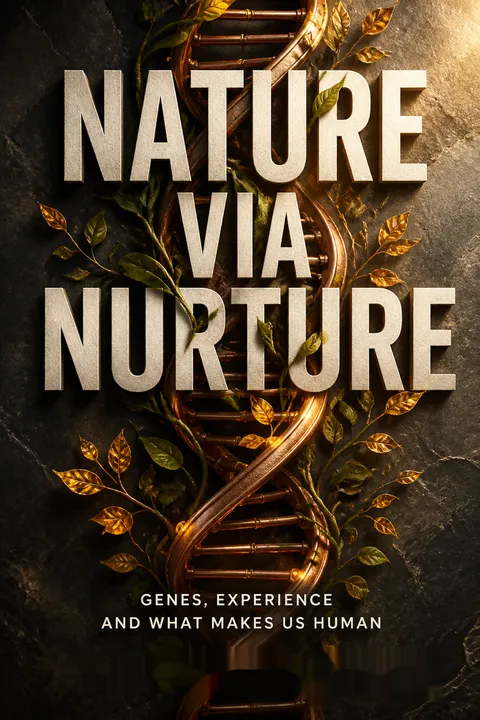


Key Takeaways
Stop asking whether genes or experience matter; ask how they build each other.
The genome headline misled. In 2001, Craig Venter argued that 30,000 human genes were too few to determine human nature, so experience must do more of the work. Ridley calls this a false choice: fewer genes do not mean weaker genetic influence. Genes regulate one another, respond to conditions, and help construct the capacity to learn from experience.
A crowded family tree. The book opens with an imaginary gathering of thinkers, from Darwin and Galton to Pavlov, Boas, and Piaget. Each contributed part of the explanation: inherited tendencies, learning, development, and culture. None is sufficient alone. The genome is not a fixed script; it participates in a continuing exchange with the life being lived.
What's useful here is the shift from arguing over percentages to asking about mechanisms. A genetic influence can operate by shaping what an organism notices, prefers, or learns, rather than dictating a finished behavior. That resembles systems biology, where feedback among components matters more than any isolated part. Still, responsiveness is not unlimited freedom: genes and developmental timing constrain which experiences can have which effects. Interaction replaces the false binary, but does not make every outcome equally changeable.
Small changes in gene timing can build dramatically different bodies.
Same ingredients, new patterns. Ridley compares genomes to recipes rather than blueprints. Many animals share genes, but use them at different times and in different tissues. Regulatory DNA, including promoters, helps control when a gene is active. In the book's example, slight differences near the Hoxc8 gene help explain why mice and chickens develop different proportions of neck and torso vertebrae.
Timing changes the whole. Dmitri Belyaev bred foxes for tameness. After 25 generations, the foxes were friendlier, but also showed physical traits such as floppy ears and shorter snouts. Ridley suggests that selecting for behavior altered the timing of development across multiple traits. The example shows how selection can reshape an organism without requiring a wholly new set of genes.
This is an early, accessible account of evolutionary developmental biology: evolution can alter the regulation of old genetic tools, not only invent new ones. It helps explain how modest DNA differences can yield visible changes. But the book's emphasis on regulatory switches should not be mistaken for a complete account of evolution. Coding changes, gene networks, and developmental context also matter, and a correlation between selected behavior and other traits does not by itself identify the precise mechanism.
Treat human minds as animal kin, while respecting what makes them distinct.
The boundary keeps moving. Darwin's encounter with an orangutan at the London Zoo and Jane Goodall's observations of chimpanzees challenged the idea that animals were mere reflex machines. Goodall described individual chimps with alliances, rivalries, affection, and deception. Chimpanzees also make tools and pass local practices to younger animals. These findings make it harder to reserve social intelligence or culture entirely for humans.
Similarity is not sameness. Ridley argues that humans and other animals share mental capacities, while humans display especially developed language, reasoning, and cumulative culture. A chimpanzee tradition can be sophisticated without becoming a human institution. The right comparison is not whether people are animals or exceptional, but which capacities overlap, which differ, and by how much.
Comparative cognition is strongest when it avoids both caricatures: animals as mindless machines, and animals as people in costumes. Goodall's field observations expanded the questions researchers were willing to ask, while controlled experiments can test whether apparent planning or empathy has alternative explanations. The book's broad continuity claim remains powerful, though capacities such as language are not captured by a single yes-or-no test. Similar roots can support very different levels of complexity.
Instinct and learning are partners, not rival explanations.
Instinct needs a cue. An instinct is not necessarily a rigid action present at birth. It can be an inherited readiness that develops in ordinary conditions and responds to a particular trigger. Tinbergen demonstrated this with sticklebacks: a male fish attacked a crude model with a red underside, even when it lacked the shape of a real rival. The red patch acted as a releasing cue for an evolved response.
Experience tunes the response. Prairie voles form pair bonds more readily than closely related montane voles. Research described in the book links the difference to where oxytocin and vasopressin receptors are active in the brain. Mating helps trigger bonding, but the animals' biology shapes how they respond. The vole findings suggest a possible model for human attachment, not proof that human love works identically.
The key conceptual gain is a more precise use of instinct. A behavior can be biologically prepared while still depending on a cue, a developmental history, or social learning. This avoids treating learning as evidence against evolution. The vole research also illustrates a common scientific hazard: a plausible animal model can generate useful hypotheses without establishing the same mechanism in people. Similar molecules and brain regions are clues, not a license to collapse human relationships into rodent behavior.
Genes shape differences partly by steering people toward fitting environments.
Heritability describes variation. Heritability estimates how much differences within a particular population are associated with genetic differences. It does not tell how much of one person's trait comes from genes. Ridley summarizes twin research suggesting that personality differences are substantially heritable, while the shared family environment explains relatively little variation in many adult personality measures. Intelligence, by contrast, is more affected by family conditions, especially in poverty.
People help choose their worlds. Ridley uses the term niche picking for the tendency to seek experiences that suit existing interests or abilities. A child who enjoys a skill may practise it more, grow better at it, and seek further chances to use it. Parents still matter by providing care and opportunity. Peers also shape children's roles and comparisons, sometimes more directly than parental attempts to mold personality.
The distinction between a population statistic and an individual explanation is essential. Heritability can rise when people share similar opportunities, even though those opportunities remain necessary for everyone. That makes the concept useful for describing variation but weak as a policy slogan. Niche picking adds agency to the model, although choices are not made on an equal playing field. Poverty, discrimination, and access to education can limit which environments people are able to select.
Early environments can leave durable marks, even before birth.
Development has windows. Imprinting is a process in which early experience creates a lasting preference or response. Lorenz found that newly hatched goslings could attach to the first moving figure they encountered, but only during a limited period. Human development also includes sensitive periods. The book describes children deprived of language until adolescence, including Genie, who gained vocabulary but never acquired ordinary grammar.
The womb is an environment. Ridley recounts research connecting low birth weight with greater risk of adult heart disease, and studies of people gestated during the Dutch Hunger Winter that suggested lasting effects of prenatal famine. These examples show that nurture begins before birth and may have long-lived consequences. They do not imply that every early influence is permanent, or that later experience cannot matter.
Developmental timing explains why the same experience can have different effects at different ages. The evidence is strongest for specific capacities and conditions, not a general rule that childhood fixes a whole personality. Genie’s history is especially revealing but also ethically and scientifically limited: one extreme case cannot establish the precise boundaries of a universal language window. Later learning and neural plasticity continue, even when some forms of learning become harder.
Genes help the brain learn, remember, and revise itself.
Learning changes biology. Pavlov's dogs learned to associate a sound with food and began salivating before eating. The book connects this familiar experiment to later work on dopamine neurons, which respond to unexpected outcomes and help update expectations. Surprise matters because it signals that a prediction needs revision.
Memory uses genes. Fruit flies can learn to associate a smell with an electric shock, but researchers found that this process depends on genes involved in forming memories. Such genes are activated during learning and help alter connections between neurons. The point is not that memories are inherited. Rather, genes provide some of the machinery through which experience becomes lasting change in the brain.
This mechanism dissolves a misleading contrast between biological inheritance and learning. The capacity to learn is itself an evolved biological feature, while learning changes the system that makes future responses possible. Prediction-error models also connect animal conditioning with computational approaches to learning. Yet identifying molecular machinery does not explain the full meaning of a memory or a decision. Neural mechanisms are necessary parts of explanation, not substitutes for psychology or personal history.
Schizophrenia shows why complex behavior resists single-cause stories.
Risk is not destiny. Twin and adoption studies described by Ridley suggest a strong inherited vulnerability to schizophrenia. Yet even identical twins do not always share the diagnosis, so genetic similarity alone is not enough. The book rejects the claim that cold or rejecting mothers cause schizophrenia, a theory that blamed families without adequate evidence.
Many pathways remain possible. Researchers explored prenatal influenza, birth complications, brain development, neural signaling, and essential fatty acids. Early genetic leads, including a proposed link to chromosome 5, failed to hold up reliably. Ridley's point is not that every proposal is equally proven, but that complex illness can emerge through interacting risks and developmental events. A factor associated with symptoms may be a consequence or amplifier rather than the original cause.
The chapter's most durable lesson is methodological: correlation, vulnerability, trigger, and cause are different claims. Schizophrenia research is particularly vulnerable to causal overreach because the condition is heterogeneous and unfolds over time. Several mechanisms discussed in the book were preliminary hypotheses, not settled explanations. That uncertainty does not make biological research futile. It makes replication, careful diagnosis, and attention to multiple levels of evidence indispensable.
Human progress depends on shared knowledge, not individual genius alone.
Other animals have traditions. Chimpanzees learn local ways of cracking nuts or gathering insects, and Japanese macaques adopted a young monkey's practice of washing food. These are cultural behaviors: socially transmitted habits. But humans accumulate innovations across generations in a way the book argues other species have not matched.
Exchange turns ideas into a ratchet. The Acheulean handaxe remained in use for roughly a million years with little visible change, despite the large brains of its makers. Ridley argues that later cultural acceleration depended on specialization and exchange, which let inventions travel and combine. Human achievement is therefore collective: each generation inherits tools, language, and knowledge created by people it never meets.
This account usefully separates intelligence from cumulative culture. A capable individual can invent, but networks allow inventions to persist, spread, and recombine. That insight connects cultural evolution to economics and information theory: diversity of contributions matters only when channels of transmission preserve and circulate them. The book's precise timeline and proposed triggers remain debated, and exchange is not the sole ingredient. Teaching, institutions, population size, and political conditions also shape whether knowledge accumulates.
Treat genetic risk as a reason for support, not a sentence.
Risk depends on context. In a study of children in Dunedin, New Zealand, researchers compared maltreatment with versions of the MAOA gene. The book reports that maltreated boys with a lower-activity version were more likely to show antisocial behavior, while the genetic difference alone did not determine the outcome. The finding illustrates interaction, not a gene that makes someone criminal.
Facts do not dictate values. Ridley argues that a biological tendency is not a moral instruction. A predisposition to aggression, for example, does not make aggression acceptable. The book also treats agency as compatible with biology: behavior arises through feedback among brain activity, experience, and action, not a simple one-way chain. Genetic information should therefore inform care without becoming a label that closes off someone's future.
The ethical distinction between prediction and permission is crucial. A risk marker can help identify where support may be valuable, but it can also invite stigma, surveillance, or self-fulfilling expectations. The Dunedin result was influential, yet any single gene by environment finding needs replication and careful assessment of predictive power before clinical or legal use. Good policy should reduce harmful environments for everyone, rather than sort people into supposedly fixed categories.
Analysis
Nature Via Nurture is a popular science argument against the habit of treating biology and experience as competing explanations. Its strongest contribution is not simply the claim that both matter. It shows how inherited systems can be built to respond to particular experiences, and how those experiences can alter the system's later behavior. Development, learning, and gene regulation provide the bridge between what an organism inherits and what it becomes.
The book's vivid examples make that bridge memorable: a gosling's early attachment, a vole's pair bonding, a fly's memory, and a child's language learning. Their common structure is an organism equipped to absorb information under particular conditions. This is a more useful model than either a blank slate or a genetic script. It also clarifies why heritability is often misunderstood: it describes variation in a population under particular conditions, not the share of an individual that is biologically fixed.
The argument needs careful historical handling. Published in 2003, the book presents several unsettled claims as promising research, including specific hypotheses about schizophrenia, human love, sex differences, and genetic contributions to language. These examples illustrate the author's reasoning, but their evidential status is not uniform. A mechanism in rodents, a twin correlation, or a candidate gene is not equivalent to a demonstrated human cause.
There is also a productive tension in the book's gene-centered language. Saying that experience works through genes can illuminate biological mechanisms, but it should not make social conditions seem secondary or reducible to DNA. Poverty, education, discrimination, and family care are real causal forces, even when their effects involve biology. The most defensible conclusion is therefore reciprocal: biology shapes which experiences matter, while environments shape the development and expression of biological capacities. Neither level can be discarded, and neither alone explains a person.
Review Summary
Nature Via Nurture receives mostly positive reviews for its engaging writing style and balanced perspective on the nature vs. nurture debate. Readers appreciate Ridley's accessible explanations of complex scientific concepts and his argument that genes and environment work together to shape human behavior. Some criticize the book for being outdated or overly simplistic in parts. Overall, reviewers find it an informative and thought-provoking read on genetics and human development, though a few feel it lacks depth on certain topics.
People Also Read





Glossary
Nature via nurture
Genes responding through experienceThe book's central idea that genes and environment do not act as rival forces. Genes help build systems that learn from, respond to, and sometimes change with experience. Behavior is produced through this interaction, so an inherited influence can work by shaping which experiences an organism seeks or how it reacts to them.
Promoter
A gene's regulatory regionA stretch of DNA involved in controlling when, where, and how strongly a gene is expressed. Promoters interact with regulatory proteins that can encourage or inhibit gene activity. Changes in these regions may alter the timing or location of gene expression without changing the protein recipe itself.
Heritability
Genetic share of variationA population-level estimate of how much variation in a trait, within a particular group and environment, is associated with genetic differences. It does not measure the genetic share of one individual's trait, and it can change when environments or populations change. High heritability does not mean a trait is impossible to influence.
Niche picking
Choosing fitting experiencesThe tendency for people to seek environments and activities that suit their interests or abilities. A person with an early aptitude may choose more chances to practise it, strengthening the skill and preference in return. Ridley uses the idea to explain how inherited differences can shape experience without directly dictating an adult outcome.
Imprinting
Early experience fixes a responseA form of learning in which an animal develops a lasting preference or attachment during a limited stage of development. Lorenz's goslings, for example, followed the first moving figure they encountered during an early window. The book uses imprinting to show how an inherited readiness can be shaped by a specific experience.
Critical period
A limited learning windowA stage of development when particular experiences have especially strong effects on a capacity or behavior. The book discusses early visual development and language learning as examples. A critical period does not imply that all learning stops afterward, only that some forms of learning become substantially more difficult.
Prepared learning
Learning made easier by biologyA learning bias that makes some associations easier to acquire than others. In experiments described by Ridley, monkeys readily learned to fear snakes after observing another monkey's alarm, but did not similarly acquire a fear of flowers. The concept explains how learning can be flexible while still shaped by evolved predispositions.
Genome Organising Device
A metaphor for gene regulationRidley's playful fictional label for the processes that coordinate genes during development. It allows him to describe genes as if they were components in an organized system, switching one another on and off in response to internal and external conditions. The term is a metaphor, not a biological structure or accepted scientific entity.
Westermarck effect
Familiar childhood inhibits attractionThe proposed tendency for people raised closely together during early childhood to develop sexual aversion toward one another. Ridley discusses studies of Taiwanese arranged marriages and Israeli communal child-rearing as evidence. The idea offers an account of incest avoidance based partly on early shared experience rather than conscious obedience to a social rule.
Minnesota Study of Twins Reared Apart
A study of separated twinsA long-running research project associated with psychologist Thomas Bouchard that examined twins who had been raised in different families. Researchers compared similarities among identical and fraternal twins to estimate genetic and environmental contributions to traits. Ridley uses the project to illustrate both the influence of genes and the limits of interpreting heritability.
Flynn effect
Rising average IQ scoresThe observed rise in average scores on intelligence tests across generations. Ridley cites it as evidence that environmental change can shift a population's average while genetic differences still explain variation among people at a given time. The effect therefore challenges the assumption that environmental gains automatically make genes less relevant.
FAQ
What's Nature Via Nurture about?
- Interplay of Genetics and Environment: The book explores how both genetics (nature) and environment (nurture) interact to shape human behavior and characteristics.
- Critique of Historical Theories: Ridley critiques the oversimplified dichotomy of genetic determinism versus environmental influence, advocating for a more integrated approach.
- Scientific Integration: It combines insights from genetics, psychology, and neuroscience to illustrate the dynamic relationship between genes and experiences.
Why should I read Nature Via Nurture?
- Understanding Human Complexity: The book offers a nuanced perspective on human behavior, challenging simplistic views and encouraging appreciation of the nature-nurture interplay.
- Engaging Narrative: Ridley’s writing style makes complex scientific concepts accessible and interesting through storytelling and anecdotes.
- Relevance to Current Issues: The themes are pertinent to contemporary debates on genetics, psychology, and social policy, informing discussions on education and mental health.
What are the key takeaways of Nature Via Nurture?
- Nature and Nurture Interact: Human behavior results from the interaction of genetic predispositions and environmental influences.
- Critical Developmental Periods: Certain experiences during critical periods can have lasting effects on behavior and development.
- Genes as Flexible Guides: Genes are not rigid determinants but flexible guides influenced by environmental factors.
What are the best quotes from Nature Via Nurture and what do they mean?
- “Nature is designed for nurture.”: This highlights that genetic predispositions are shaped by experiences, with the environment playing a crucial role in gene expression.
- “There ain’t nothing in the middle of the road but a yellow line and a dead armadillo.”: Ridley uses this to emphasize moving beyond binary thinking in the nature versus nurture debate.
- “The genome has indeed changed everything.”: Reflects the transformative impact of genetic research on understanding human behavior.
How does Matt Ridley define the nature-nurture debate in Nature Via Nurture?
- Historical Context: Ridley provides an overview of the debate, noting its persistence and the misconceptions it entails.
- Nature via Nurture Framework: He proposes that genes and environment influence each other, offering a more integrated understanding of behavior.
- Critique of Extremes: Ridley critiques both genetic determinism and radical environmentalism, advocating for acknowledging the contributions of both nature and nurture.
What role do genes play in shaping behavior according to Nature Via Nurture?
- Active Participants: Genes actively shape behavior by taking cues from the environment, rather than being passive carriers of information.
- Influence on Development: Genes guide brain and body development, setting the stage for future behaviors influenced by experiences.
- Genetic Variability: Differences in genetic makeup among individuals lead to variations in behavior, personality, and intelligence.
How does Nature Via Nurture address the concept of critical periods in development?
- Imprinting in Animals: Ridley uses animal studies to show how early experiences during critical periods can shape future behaviors.
- Human Development: Similar critical periods exist in humans, where early experiences can have lasting impacts on personality and behavior.
- Irreversibility of Early Experiences: Experiences during critical periods can be irreversible, highlighting the importance of supportive environments in early childhood.
What examples does Matt Ridley use to illustrate the nature-nurture interplay in Nature Via Nurture?
- Twin Studies: These studies reveal the heritability of traits, showing strong genetic influences even in different environments.
- Animal Behavior: Examples from animal behavior illustrate how genes predispose certain behaviors, which are then shaped by experiences.
- Human Case Studies: Ridley references unique individual cases to demonstrate the combined influence of genetic and environmental factors.
How does Nature Via Nurture explain the role of environment in shaping genetic expression?
- Gene-Environment Interaction: The environment influences gene expression, leading to variations in behavior and personality.
- Critical Experiences: Certain experiences can activate or suppress specific genes, affecting development.
- Long-Term Effects: Environmental influences can have lasting effects on genetic expression, shaping an individual’s life trajectory.
What implications does Nature Via Nurture have for education and parenting?
- Tailoring Approaches: Understanding the nature-nurture interplay can help tailor educational and parenting strategies to individual needs.
- Importance of Early Experiences: Early experiences are crucial in shaping behavior and personality, emphasizing the need for supportive environments.
- Encouraging Exploration: Allowing children to explore their interests can enhance their genetic potential and foster unique abilities.
How does Matt Ridley address the concept of free will in Nature Via Nurture?
- Complex Interplay: Free will exists within the interplay of nature and nurture, with choices and experiences playing significant roles.
- Empowerment through Understanding: Understanding genetic predispositions can empower individuals to make informed choices for personal growth.
- Rejecting Determinism: Ridley challenges genetic determinism, emphasizing that behavior is shaped by both genetic factors and personal experiences.
How does Nature Via Nurture explain the relationship between culture and genetics?
- Cultural Accumulation: Humans uniquely accumulate culture, facilitated by genetic makeup, allowing for knowledge transmission across generations.
- Interaction of Genes and Culture: Culture shapes behavior but does not fundamentally alter human nature; both interact to produce diverse behaviors.
- Examples of Cultural Evolution: Ridley illustrates how cultural practices evolve alongside genetic changes, showing the dynamic relationship between biology and culture.
About the Author
Other books by Matt Ridley


Download PDF
Download EPUB
.epub digital book format is ideal for reading ebooks on phones, tablets, and e-readers.








