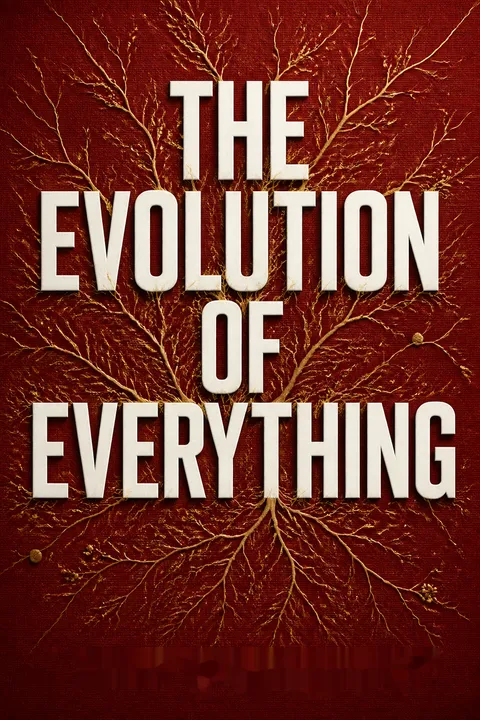


Key Takeaways
Treat evolution as society’s default engine, not biology’s special case.
Order can emerge without orders. Ridley’s central claim is that evolution describes more than genetic change. It also explains how customs, technologies, institutions, and ideas develop through small changes, trial and error, and the spread of what works. Such outcomes are made by people, but often not designed by any one of them. The shop that sells an umbrella is designed; the market, shared language, and social etiquette that make the transaction possible are not.
Look beyond the nearest cause. Thomas Newcomen’s early steam engine helped set off a chain of developments that eventually powered electric lighting, though he could not have planned that result. Ridley argues that history overcredits visible figures and institutions, mistaking the person present at an outcome for its author. Leadership matters, but it rarely explains the whole process.
The book offers a useful correction to a common storytelling bias: people prefer a protagonist, even when a complex system has no single author. This resembles the study of complex adaptive systems, where local interactions can generate large-scale patterns without central direction. The distinction does not make intention irrelevant. Laws, firms, and infrastructure can deliberately shape the conditions in which decentralized change occurs. The strongest version of Ridley’s argument is not that planning never works, but that planners should be cautious about claiming control over outcomes they only partly understand.
Explain biological complexity through selection, not a hidden master plan.
Useful design needs no designer. Natural selection is the gradual spread of inherited variations that improve survival or reproduction. Ridley uses the eye to show how this process can build intricate function without foresight: living molluscs have light-sensitive patches, simple cups, pinhole eyes, and more elaborate lenses. Each form helps its owner, making gradual change easier to understand than a leap from nothing to a finished eye.
Genes have no chief executive. The genome coordinates complex development through countless interacting sequences, not a master gene directing the rest. Some DNA sequences even propagate themselves, whether or not they benefit the body. Ridley also points to antibiotic resistance and cancer as evolutionary contests: populations of bacteria or cells vary, and resistant variants multiply when conditions favor them.
Natural selection is powerful because it accumulates information about past success without needing a forecast. That insight also clarifies why a function can look purposeful after the fact. Yet selection does not guarantee elegance, efficiency, or benefit to the organism as a whole. A gene can spread at the body’s expense, and an adaptation can carry costs alongside advantages. The distinction between function and overall welfare matters beyond biology: a system may work well for its replicators while imposing damage elsewhere.
Treat morality as a negotiated social achievement, not a fixed script.
Moral sense grows through interaction. Adam Smith argued that people care about others’ feelings and learn, through social experience, which actions invite sympathy and which provoke disapproval. He called the imagined neutral judge of one’s conduct the impartial spectator. Moral codes can therefore arise through everyday adjustment, then be recorded and taught by authorities who may appear to have created rules that society had already begun to follow.
Norms change with circumstances. Ridley compares moral change to language change: no committee decreed every shift in grammar, and no single authority produced changing attitudes toward homosexuality or violence. He also draws on Norbert Elias and Steven Pinker’s account of declining violence, connecting greater urban life, stronger state enforcement, and commerce with habits of self-control and consideration. The common law, built through precedent, offers another example of rules accumulating case by case.
This account makes morality empirical: norms can be studied as social practices rather than treated only as commands from above. It also explains why moral change can feel both collective and personally binding. Still, the fact that a norm emerges does not prove that it is just. Social conventions can preserve exclusion as easily as cooperation, and deliberate reform may be needed to challenge them. Emergence explains how norms form; ethical argument is still needed to decide which norms deserve to survive.
Let culture accumulate through exchange, imitation, and useful variation.
Culture can evolve cumulatively. Cultural evolution occurs when information is copied with some fidelity, altered through experimentation, and retained when useful. Language illustrates the process: its rules are real, but they emerge from shared use rather than a central authority. Children learn speech largely by participating, not by memorizing a complete grammar book.
New habits reshape human life. Ridley argues that exchange and specialization may have helped drive the gradual rise of cumulative culture, allowing people to add innovations without losing earlier knowledge. He reverses the familiar claim that genes alone enabled culture: cultural habits, such as dairying, can create conditions that favor genetic changes, including adult lactose digestion. Marriage customs and cities also shift as social and economic conditions change, though their outcomes are not necessarily planned or benign.
The key distinction is between having traditions and accumulating improvements across generations. That distinction helps explain why human societies can preserve skills beyond any one person’s memory. It also invites a useful question: who gets to contribute to the shared stock of knowledge? Exchange can connect groups, but barriers, power, and unequal access can limit which innovations travel. Cultural evolution is a mechanism, not a promise of progress, and its results depend on what people can learn, share, and preserve.
Use markets to coordinate knowledge no planner can gather.
Exchange makes specialization worthwhile. Adam Smith’s account of prosperity begins with people trading, specializing, and learning to do particular tasks better. Prices help coordinate these dispersed choices, while competition and consumer decisions reward some solutions and reject others. Ridley connects this process to the great enrichment: average incomes rose many times over from the early nineteenth century, although the causes remain debated.
Money can evolve from below. When Britain lacked small coins, Birmingham businesses issued copper tokens that workers and shopkeepers accepted. Scotland’s competing banks later issued paper notes and monitored one another through regular exchanges. Ridley presents these as examples of money developing without a government monopoly. He also disputes accounts of the 2008 crisis that blame deregulation alone, emphasizing political housing mandates and incentives that distorted lending.
Markets are not omniscient; they are procedures for testing decisions made with scattered, changing information. That is a stronger defense than claiming every market outcome is fair or efficient. The book’s history of private money shows how competition can discipline issuers, while its account of the financial crisis highlights how public guarantees can weaken that discipline. Its broader critique of state intervention is more contestable: the crisis involved multiple interacting causes, and this summary of the author’s position should not be mistaken for a settled consensus.
Expect inventions to arrive through many small steps, not lone genius.
Discovery often has several claimants. Ridley notes that the incandescent light bulb had more than twenty predecessors, and that inventions such as the telephone and calculus emerged independently to multiple people. The pattern suggests that discoveries often become possible when enough earlier knowledge and tools are in place. Individual inventors still matter, but they work within a chain of accumulated ideas.
Technology advances by viable steps. Moore’s Law describes the historical doubling of transistor density on computer chips at roughly eighteen-month intervals. Ridley uses it to illustrate how each workable stage can enable the next, rather than technology leaping straight to a distant future. He also argues that practical technology often prompts scientific explanation, as the steam engine helped spur thermodynamics. The internet, built through shared protocols and open collaboration, offers a modern example of decentralized development.
The emphasis on multiple contributors corrects the hero narrative without erasing skill or originality. Innovation studies likewise distinguish an invention from the networks, materials, and users that make it useful. The internet is especially revealing because open collaboration produced tools that later supported commercial products. But technological momentum is not destiny: institutions can slow particular developments, and society still chooses how tools are deployed. A technology’s emergence may be hard to predict, while its distribution and consequences remain political questions.
See personality as partly inherited and socially self-shaped, not parent-installed.
Family resemblance does not prove parenting caused it. Psychologist Judith Rich Harris challenged the assumption that parenting style determines children’s adult personalities. Twin and adoption studies, as presented by Ridley, suggest that genes explain a substantial share of personality differences, while the shared family home explains less than many psychologists expected. Harris proposed that peers and children’s efforts to find relationships and status help shape the remaining differences.
The self has no single control room. Ridley also describes the mind as an emergent activity of the brain, not a separate commander inside it. Experiments by Benjamin Libet found brain activity preceding people’s reported awareness of a simple decision. The findings challenge a simple, conscious version of free will, but Ridley also presents the counterview that meaningful freedom can emerge from a brain shaped by its history.
Harris’s argument usefully separates parental care from the stronger claim that parenting explains why siblings become different people. It also highlights how peers and social comparison shape identity. The evidence does not establish that parents have no lasting influence: personality is difficult to measure, and effects can depend on a child’s temperament and circumstances. Likewise, brain activity preceding awareness does not by itself settle what free will means. The careful conclusion is that personality and agency are more distributed than common intuition suggests.
Build education around learner feedback, not inherited bureaucratic routines.
Schooling reflects a historical design. Ridley traces familiar features of modern classrooms, including age-graded groups, bells, fixed schedules, and set curricula, to Prussian reforms after defeat by Napoleon. He argues that these structures emphasized discipline and national needs as well as learning. In Britain, literacy had already risen sharply before compulsory state education, which leads him to question the claim that government created mass literacy by itself.
Learning can organize itself. In Sugata Mitra’s hole-in-the-wall experiments, children shared computers and taught one another without a conventional instructor. The approach became known as a self-organised learning environment, where groups investigate questions using available resources. Ridley contrasts this with centralized schooling and describes low-cost private schools serving poor families who were dissatisfied with local state schools. He urges systems to experiment rather than assume one model fits everyone.
The strongest educational insight is the difference between schooling, an institution, and learning, an activity that can happen in many settings. Peer instruction and digital resources can widen access, especially where formal systems fail. But evidence from particular experiments or schools cannot establish that decentralized provision reliably serves every child. Access, teacher quality, disability support, and accountability remain essential. The practical lesson is to judge education by what students learn, while testing multiple ways to achieve it.
Answer population pressure with security and opportunity, not coercion.
Fear of scarcity can license cruelty. Ridley follows the history of Malthusian population thinking into policies that treated poor people as a problem to be reduced. He connects this outlook to harsh British responses during the Irish famine, eugenic campaigns, and twentieth-century population-control programs. The most extreme example is China’s one-child policy, which used forced sterilization and abortion, with severe human costs.
Development changes family decisions. Ridley argues that population growth slowed in many places as health, education, and prosperity improved, not because governments imposed fertility quotas. When more children survive, parents often choose smaller families. The Green Revolution also increased food production, contradicting forecasts that population growth would necessarily outstrip supply. The book’s central warning is that demographic predictions are not neutral when they become justifications for controlling people.
This history makes a vital ethical distinction between describing resource limits and prescribing coercion against the poor. Better health and education can change family choices while improving lives directly. Yet rejecting population alarm does not require assuming that resources are limitless or that every policy intervention is harmful. Demographic change varies across societies, and environmental pressures are real questions for evidence and governance. The lesson is to address scarcity by expanding capability and choice, not by treating people as excess units.
Credit leaders for decisions, but trace outcomes to forces beyond them.
A leader may permit change without inventing it. In 1978, eighteen farmers in Xiaogang secretly divided collective land into family plots. Their harvest exceeded the land’s output in the previous five years combined. Local officials first reacted with suspicion, but the experiment spread before the national government formally approved family farming. Ridley uses the episode to argue that Deng Xiaoping mattered, yet the reform began with ordinary people testing a new arrangement.
Order can form without a central designer. Ridley also describes private rules in the American West and social codes among prisoners, which helped manage disputes and trade. In business, Morning Star Tomatoes coordinated work without conventional managers. Such examples do not show that government or leadership is unnecessary. They show that people can develop rules and coordination locally, and that powerful leaders may receive credit for changes whose causes are distributed.
This is a useful way to distinguish proximate causes from deeper conditions. A leader can remove obstacles, authorize an experiment, or make a consequential choice without originating every force behind the result. The Xiaogang story also shows that local innovation may require protection when it challenges official rules. Decentralized arrangements can be adaptive, but they can also exclude or coerce. Their value depends on who sets the norms, who can leave, and how disputes are resolved.
Study religions as evolving cultural products without confusing origin with truth.
Beliefs compete and adapt. Ridley argues that religious traditions develop through cultural transmission, social need, and competition, rather than appearing fully formed. He recounts how Christianity grew from among many Roman-era cults, with Paul helping shape a faith that could reach beyond its original community. Religious ideas and gods also change: some traditions develop stronger moral demands as societies and institutions change.
People readily detect agency. Ridley connects religion and superstition to the human tendency to see intention behind events. His crop-circle experiment illustrates the pull of a supernatural explanation: he and relatives made patterns in fields, yet self-proclaimed experts continued to defend mysterious causes. The same instinct can shape claims about luck, disasters, and political events. Ridley’s evolutionary account explains how beliefs may spread, even when people experience them as revelations.
An evolutionary explanation can illuminate why a belief spreads without deciding whether its theological claims are true. That distinction keeps cultural history from pretending to settle metaphysics. The crop-circle episode also shows how authority and group identity can protect beliefs from contrary evidence. At the same time, religious traditions are internally diverse and can support community, moral discipline, or political power in different settings. Explaining their persistence requires more than labeling believers irrational.
Analysis
The book’s unifying move is to shift attention from visible authors to processes that accumulate outcomes: variation, imitation, exchange, selection, and path dependence. Its examples range from the evolution of the eye to common law, urban growth, and open internet protocols. This cross-domain comparison is productive when it identifies a shared mechanism, especially the way local decisions can create order no participant fully understands. It is less secure when resemblance is treated as proof that every system follows Darwinian selection in the same way. Cultural change involves intention, power, teaching, and institutions, all of which can alter what gets copied and who benefits.
Ridley also makes a political argument: decentralized systems often outperform centralized plans because knowledge is dispersed and forecasts are fallible. That is a serious challenge to technocratic confidence, reinforced by examples of disastrous coercive policies. But the book sometimes moves from the limitations of planning to a broad preference for markets, treating the latter’s successes more generously than its failures. Markets need rules, public goods, and remedies for harms that prices do not capture. Conversely, governments can sometimes coordinate large projects that voluntary exchange alone may not provide.
The most durable lesson is therefore methodological rather than ideological. Before crediting a leader or blaming a policy, ask what process produced the outcome, what information participants possessed, and which incentives selected the result. Then ask who gained, who paid, and whether the system can correct its own failures. Evolution is not synonymous with progress or justice. It explains how persistence can arise without a plan; it does not establish that whatever persists is good. That distinction preserves the book’s insight while making its argument more useful across biology, economics, history, and public policy.
Review Summary
The Evolution of Everything receives mixed reviews. Some praise Ridley's ambitious exploration of how bottom-up processes shape various aspects of life and society, finding it thought-provoking and well-researched. Others criticize his libertarian bias and oversimplification of complex issues, particularly in later chapters. The book's central argument that evolution applies beyond biology to areas like economics, technology, and culture is generally appreciated, but many feel Ridley stretches this concept too far. Readers note the book's engaging prose but caution against its ideological slant.
People Also Read








Glossary
General theory of evolution
Change through cumulative selectionRidley’s term for applying evolutionary reasoning beyond biological inheritance. Systems such as language, law, technology, and markets can change through incremental variation, transmission, trial and error, and the persistence of some forms over others. The process may produce useful order without any person having planned the overall result.
skyhook
A top-down explanationA metaphor for an explanation that attributes order or complexity to a controlling intelligence or plan imposed from above. Ridley contrasts skyhooks with cranes, processes that build complexity from simpler elements through incremental steps. The term is used to question explanations that invoke a designer where an emergent process may suffice.
Lucretian swerve
A retreat to a designerRidley’s label for a thinker’s abrupt resort to an unexplained, top-down cause after developing a natural or emergent explanation. The phrase adapts the ancient idea of atoms unpredictably swerving, which Lucretius used to account for free will. In this book it describes a broader intellectual hesitation about accepting undirected change.
impartial spectator
An imagined moral observerAdam Smith’s idea that people can picture how a neutral, well-informed observer would judge their conduct. Smith uses this imagined perspective to explain conscience, approval, and guilt. It develops from people learning to notice and respond to one another’s feelings, rather than relying solely on moral rules imposed by an authority.
selfish DNA
DNA that propagates itselfA way of describing genetic sequences that spread because they are effective at being copied, even when they provide little or no benefit to the organism. The term does not imply that DNA has intentions. It shifts the question of function from what a sequence does for the body to how it persists within the genome.
self-organised learning environment
Group inquiry without direct teachingA learning arrangement associated with Sugata Mitra’s experiments, in which small groups of children use shared digital resources to investigate questions with limited direct instruction. Students learn through discussion, exploration, and peer support. The approach treats learning as something that can organize itself under suitable conditions, rather than as knowledge delivered only by a teacher.
Red Queen
A continuing evolutionary arms raceRidley uses the Red Queen image for situations in which organisms must keep adapting simply to maintain their position against changing rivals or threats. Antibiotic resistance is one example: a drug selects for resistant bacteria, so treatments lose effectiveness and new responses are needed. The metaphor also applies to cancer and immune-system competition.
FAQ
What's The Evolution of Everything about?
- Broad application of evolution: Matt Ridley explores how evolution applies beyond biology to culture, technology, and economics, suggesting that many systems evolve organically.
- Incremental change emphasis: The book argues that change is often gradual and unplanned, similar to natural selection, rather than the result of deliberate design.
- Cultural evolution: Ridley posits that human institutions and behaviors evolve like biological traits, driven by competition and adaptation.
Why should I read The Evolution of Everything?
- Challenge conventional wisdom: Ridley invites readers to rethink beliefs about progress, arguing that societal advancements are often emergent rather than designed.
- Interconnected ideas: The book illustrates how fields like economics and technology are interconnected through evolutionary processes, offering a holistic view of development.
- Engaging narrative: Ridley combines historical anecdotes with scientific insights, making complex ideas accessible and engaging.
What are the key takeaways of The Evolution of Everything?
- Emergence over design: Ridley emphasizes that many life aspects evolve through spontaneous processes rather than conscious planning.
- Cultural and technological parallels: The book draws parallels between biological and cultural/technological evolution, highlighting similar patterns of variation and selection.
- Role of individuals: While individuals can influence change, they are often products of evolutionary processes rather than architects of change.
What are the best quotes from The Evolution of Everything and what do they mean?
- “The world is...self-changing place.”: This quote encapsulates Ridley’s argument that systems evolve without central control or design.
- “People are the victims...unintended change.”: Ridley challenges the notion of human agency, highlighting how societal changes often occur without individuals’ awareness.
- “The way that human history...mislead.”: This critiques traditional narratives that emphasize leaders, suggesting a more accurate view recognizes evolutionary processes.
How does Matt Ridley define evolution in The Evolution of Everything?
- Broad definition: Ridley defines evolution as “the unfolding” of ideas and systems, emphasizing gradual change across various domains.
- Cumulative change: He describes evolution as involving incremental, trial-and-error adjustments rather than sudden revolutions.
- Natural selection analogy: Ridley likens cultural evolution to biological evolution, where ideas compete and adapt over time.
How does Ridley explain the evolution of technology in The Evolution of Everything?
- Incremental innovation: Ridley argues that technological advancements occur through gradual improvement and adaptation, not sudden breakthroughs.
- Cumulative knowledge: New technologies build upon existing ones, with innovations emerging from recombination of ideas over time.
- Self-organizing systems: Technology evolves in a decentralized manner, driven by market forces and consumer needs.
What role does technology play in the evolution of society according to The Evolution of Everything?
- Catalyst for change: Technology acts as a significant driver of societal evolution, enabling new forms of communication and interaction.
- Decentralization of power: It empowers individuals and decentralizes authority, leading to more democratic systems.
- Innovation through competition: Technological advancements often arise from competition and problem-solving, not top-down directives.
How does Ridley address the concept of education in The Evolution of Everything?
- Critique of traditional models: Ridley argues that conventional education stifles creativity and innovation.
- Self-organized learning: He discusses self-organized learning environments where students learn collaboratively without direct instruction.
- Emergence of private education: Ridley highlights the rise of low-cost private schools as a response to inadequate public education.
What examples does Ridley provide to illustrate the evolution of economics?
- Scottish banking system: Ridley discusses the success of the Scottish free banking system, which thrived through competition without a central bank.
- Failure of central planning: He critiques centrally planned economies, showing how they often lead to stagnation and inefficiency.
- Emergence of mobile money: Ridley highlights mobile money systems like M-Pesa, which evolved without government intervention.
How does Ridley connect the evolution of government to the themes in The Evolution of Everything?
- Spontaneous order: Ridley argues that government often emerges as a spontaneous order rather than through deliberate design.
- Critique of centralized power: He critiques governments' tendency to centralize power, leading to inefficiency and corruption.
- Historical examples: Ridley provides examples like the evolution of law in the American West to illustrate order arising without formal structures.
What insights does Ridley offer about the evolution of religion in The Evolution of Everything?
- Cultural evolution of religion: Ridley argues that religions evolve over time, shaped by cultural and social changes.
- Predictability of religious development: He discusses how gods and practices change, often becoming more moral over time.
- Historical context: Ridley provides context for the rise of major religions, illustrating their emergence from specific conditions.
How does Ridley view the future evolution of society in The Evolution of Everything?
- Optimism for progress: Ridley expresses optimism that society will continue to evolve positively through incremental changes.
- Resistance to top-down control: He warns against top-down control, arguing it often leads to negative outcomes.
- Emergence of new systems: Ridley suggests that decentralized currencies and digital technologies will shape the future.
About the Author
Other books by Matt Ridley

Download PDF
Download EPUB
.epub digital book format is ideal for reading ebooks on phones, tablets, and e-readers.








