

Key Takeaways
Take consciousness as fundamental, not a late byproduct of matter
An inventor changes course. Federico Faggin helped develop the technology behind the first microprocessor, yet success did not bring the happiness he expected. Around age 40, he stopped long enough to face the distress he had buried under work. In 1990, during a family holiday at Lake Tahoe, he experienced an intense sense of love and unity, as if he were both the world and the one experiencing it. He interpreted this as direct evidence that consciousness is more fundamental than matter.
Experience becomes a hypothesis. That episode redirected Faggin’s life toward studying consciousness. His central claim is that sensations, meaning, and free will cannot be explained as mere outputs of unconscious matter. He proposes that reality has an inner, experiential aspect as well as an outer, measurable one.
The story makes the book’s starting point personal rather than abstract: first-person experience is treated as evidence that any complete account of reality must address. That is a valuable corrective to theories that describe brain activity while leaving the felt experience unexplained. But a powerful experience can establish what it felt like to Faggin without proving that the universe is made of consciousness or love. The stronger case is methodological: subjective experience is part of the data, even if its metaphysical interpretation remains open. First-person inquiry and public measurement can complement one another without being mistaken for the same kind of proof.
Use quantum physics to loosen certainty, not certify a spiritual answer
Classical confidence had limits. Newtonian physics encouraged a picture of the universe as a clockwork system whose future could, in principle, be calculated from its starting conditions. The twentieth century unsettled that picture. Relativity made measurements of space and time depend on motion; quantum theory described outcomes probabilistically; and chaotic systems showed how tiny differences can make long-term predictions unreliable.
A limit is not a worldview. Faggin argues that these findings undermine strict determinism and a purely mechanical account of reality. He also invokes Gödel’s incompleteness results to challenge the idea of absolute mathematical certainty. The book’s caution is useful: a successful mathematical model is not identical to reality. Yet uncertainty in a theory does not itself demonstrate that consciousness creates physical events.
The historical pattern is persuasive: anomalies forced physicists to revise ideas that had seemed self-evident, so confidence in any final account deserves scrutiny. Still, different limits should not be collapsed into one. Gödel’s theorems concern what can be proved within certain formal systems, while quantum probabilities and chaotic prediction involve different mathematical issues. None alone settles whether consciousness is fundamental. This distinction strengthens the book’s challenge to dogmatic materialism while keeping its proposed alternative in proportion: physics leaves deep questions open, but an open question is not yet evidence for one specific answer.
A computer can process symbols without experiencing what they mean
Bits carry no built-in meaning. In Shannon’s information theory, information measures how surprising a signal is given its probability. A computer can reliably distinguish binary states and transform them according to instructions, but the meanings of those states come from people who design and interpret the system. Faggin calls this symbolic processing, not conscious understanding.
Recognition is not comprehension. A machine may identify a rose from its features without experiencing its scent. Faggin illustrates the stakes with Soviet officer Stanislav Petrov, who in 1983 doubted a satellite warning of a supposed missile attack and did not report it as genuine. His skepticism helped avert escalation. The episode does not prove that machines can never judge well, but it shows why automated outputs need human interpretation and responsibility.
The distinction between processing a representation and experiencing its meaning is central to debates about artificial intelligence. It also echoes a practical principle in computer security: a system can follow its specification perfectly and still fail when the specification misses the real-world context. Petrov’s decision highlights the value of questioning a system, though intuition is not automatically reliable and a human operator can also make catastrophic errors. The useful lesson is not to romanticize people over machines. It is to assign responsibility clearly, test systems against unusual cases, and avoid treating fluent output as proof of understanding.
Study cells as living wholes, not silicon machines assembled from parts
Life keeps rebuilding itself. A paramecium, a single cell, can move, avoid obstacles, find food, and reproduce. Faggin contrasts this with a computer, whose hardware is assembled from stable components and whose program can be copied, but which does not build a living copy of itself. In cells, matter, energy, and information are intertwined: materials flow in and out, and the organism continually changes while maintaining its organization.
The whole remains a puzzle. The book notes that only about 1.5 percent of human DNA encodes proteins; the functions of the rest are varied and not reducible to a single explanation. Faggin calls the inseparable informational, material, and energetic activity of living systems live information. He argues that biology must take this complexity seriously rather than assume cells are ordinary machines.
The contrast usefully shifts attention from isolated molecular parts to organization, exchange, and self-maintenance. Systems biology likewise studies how interactions across levels shape an organism, while ecology shows that life depends on exchanges with its surroundings. These connections support a holistic research program without requiring every claim in Faggin’s model. In particular, a cell’s complexity and autonomy do not establish that it has subjective consciousness or free will. Those are additional hypotheses. The distinction matters because describing life as more than a machine can be scientifically fruitful even before accepting the book’s stronger metaphysical explanation.
QIP links private experience to quantum states, but remains a proposal
A proposed bridge. Quantum Information-based Panpsychism, or QIP, is Faggin’s theory with physicist Giacomo Mauro D’Ariano. It proposes that a quantum system in a pure state corresponds to a conscious experience. A pure state has mathematical properties that distinguish it from ordinary, copyable classical information; Faggin sees this privacy as analogous to the first-person privacy of experience.
Representation is not sensation. On this account, physical measurements reveal shareable outcomes, while the experience itself is known only by the system having it. The theory aims to connect the hard problem of consciousness with quantum information. Faggin presents it as a route to treating consciousness as fundamental, not as an effect produced by the brain. The connection is an interpretation of quantum theory, not an established result that quantum states have feelings.
QIP’s appeal is that it connects a precise feature of quantum theory with a precise feature of experience: some information is not available to an outside observer in the same way as a classical record. That analogy gives the theory a clear conceptual target. However, the no-cloning property does not by itself show that a quantum state feels anything. A scientific theory needs more than resemblance between formal properties; it needs definitions and predictions that distinguish it from competing accounts. Treating QIP as a serious proposal rather than a confirmed discovery preserves its ambition while keeping the evidential question visible.
Read the CIP framework as a map of experience, symbols, and worlds
Three kinds of space. Faggin’s CIP framework separates C-space, the space of private conscious experience; I-space, the space of shared symbolic information; and P-space, the physical world as experienced through a living body. The framework proposes that these are linked aspects of reality, not independent substances.
A self within the whole. Faggin calls the totality of existence One. From One emerge conscious entities he calls seities, each a distinct perspective with consciousness, identity, and free-will agency. Seities communicate through symbols and, in the author’s model, combine into more complex forms. A person’s body mediates between private experience and the physical world. This architecture is intended to explain how meaning, information, and matter relate, while preserving the idea that consciousness is irreducible.
The framework’s strongest contribution may be conceptual housekeeping. It distinguishes an experience, a representation of that experience, and the world encountered through a body, categories often blurred in arguments about minds and machines. Cognitive science also studies how perception is mediated by sensory systems, which makes the separation between world and experienced world a useful question. The larger claims about One and seities go beyond that modest insight. Their value depends on whether the framework can do explanatory work beyond renaming familiar mysteries, and whether its terms can be connected to observations without reducing experience to a metaphor.
Treat physical laws as grammar, not a complete script for reality
Rules constrain expression. Faggin compares physical laws to the grammatical rules of a language. Grammar shapes which sentences are possible, but does not decide what a writer will say. In his model, the laws of physics similarly constrain the behavior of symbols without determining every future event or meaning.
Creation stays open. The author proposes that seities first communicate and develop shared symbolic rules; increasingly complex symbols then form the physical universe and living systems. Meaning precedes the symbols used to express it, just as an idea precedes its written sentence. This reverses the usual materialist story: consciousness and life do not emerge from matter, but matter reflects the communication and knowing of conscious entities. The analogy captures Faggin’s vision, though the proposed cosmic history remains speculative.
The language analogy clarifies a genuine distinction between rules and the particular outputs permitted by those rules. A grammar can constrain speech without specifying a novel’s plot, just as physical laws need not make every complex outcome easy to predict. The analogy becomes less secure when it is used to infer that the universe is literally a communication among conscious entities. A resemblance between formal systems is not proof of shared causes. Even so, the model asks a productive question: which features of reality are fixed by law, and which depend on contingent histories, interactions, or choices?
Use technical power for cooperation, not the fantasy of superiority
Human judgment needs more than calculation. Faggin describes mature intelligence through three interacting centers: the head, for reasoning and creativity; the heart, for feeling, empathy, and values; and the gut, for action and courage. He argues that technical knowledge alone cannot tell people what ought to matter. Machines can extend calculation and pattern recognition, but their use depends on human purposes and decisions.
Competition has consequences. The book connects the drive to be superior with social conflict and ecological damage, arguing instead for cooperation and responsibility toward the wider web of life. Its practical warning is to keep technology answerable to human values rather than treating efficiency as a moral compass. Lived knowing, in this account, means combining understanding with feeling and action, not merely collecting facts.
This ethical conclusion gives the book’s metaphysics a concrete test: does a view of human nature encourage responsibility, care, and wiser technology? Research on collective action and institutional design suggests that cooperation can solve shared problems when trust is paired with clear rules and accountability. Cooperation alone is not a cure for power imbalances, nor is competition always destructive; the important question is what incentives a system rewards. Faggin’s head, heart, and gut offer a memorable corrective to decision-making by calculation alone, while leaving room for evidence, safeguards, and disagreement.
Analysis
Irreducible moves through three registers: Faggin’s personal awakening, a primer on physics and information, and a metaphysical system that gives consciousness primacy. Its most durable contribution is the insistence that a third-person description of neural or computational activity does not automatically explain first-person experience. The distinction between symbols and meaning also sharpens discussions of artificial intelligence: successful pattern recognition is evidence of capability, not by itself evidence of felt understanding.
The book’s decisive step is from an explanatory gap to a quantum ontology. QIP proposes that pure quantum states represent conscious experience because both appear private and non-copyable. That is suggestive, but formal analogy is not identity. Quantum mechanics’ measurement problem does not generally require a conscious observer, and non-clonability does not establish that a system has an inner life. The framework therefore remains a philosophical interpretation with scientific ambitions, not a consensus result. Its claims about seities, survival beyond bodily death, and laws arising through communication are more speculative still.
This does not make the project worthless. It makes careful separation essential: established physics, open scientific problems, and Faggin’s proposed answers should not be treated as equally confirmed. The book is strongest when it exposes hidden assumptions in materialist language and argues that experience belongs in a complete account of nature. It is less conclusive when it treats quantum uncertainty as support for free will or teleology. Readers can take its central challenge seriously without accepting its full cosmology: explain how experience fits into nature, keep models distinct from reality, and demand evidence proportionate to the reach of each claim.
Review Summary
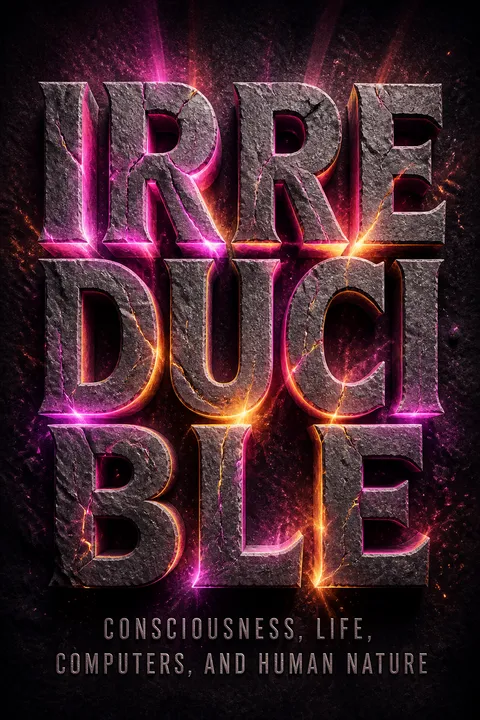
Irreducible by Federico Faggin explores consciousness as a fundamental, irreducible property of reality rather than an emergent phenomenon from matter. The book argues that computers and AI can never achieve true consciousness or semantic understanding, only symbolic processing. Faggin proposes a quantum information-based panpsychism where conscious entities ("seities") communicate through physical reality as symbols. Reviews are polarized: supporters praise the ambitious integration of quantum physics, consciousness, and spirituality, while critics find it repetitive, pseudoscientific, and lacking empirical evidence. Many note the dense, technical writing requires scientific background for full comprehension.
People Also Read







Glossary
QIP theory
Quantum consciousness proposalQuantum Information-based Panpsychism is a theory developed by Federico Faggin and Giacomo Mauro D’Ariano. It proposes that a quantum system in a pure state experiences that state as consciousness. The theory uses the privacy and non-copyability of quantum states as a proposed parallel to first-person experience. It is a proposed interpretation, not an established consensus account of consciousness.
CIP framework
Three-space reality modelThe CIP framework names three connected aspects of reality: C-space for conscious experience, I-space for symbolic information, and P-space for the physical world experienced through a body. Faggin presents them as complementary dimensions of a larger reality, with living organisms mediating between private experience and shared physical symbols.
Seity
Self-aware quantum entityA seity is Faggin’s term for a self-conscious entity with identity and free-will agency. In his model, a seity is represented by a quantum system in a pure state and can communicate with living organisms through information. Seities are distinct perspectives within the totality called One. These claims belong to the author’s proposed metaphysics.
One
The whole of existenceOne is Faggin’s name for the totality of what exists, both potentially and actually. He describes it as holistic, dynamic, and creative, with an inherent desire to know itself. In his model, conscious entities called seities emerge from One and deepen its self-knowing through communication and experience.
Live information
Life’s matter-energy-informationLive information is Faggin’s proposed term for the intertwined material, energetic, and informational activity of living systems. Unlike digital information in a computer, it is not separated from its physical support or energy supply. The author argues that cells process this dynamic information through both quantum and classical interactions.
C-space
Private experience spaceC-space is the experiential aspect of the CIP framework. It refers to the private field of conscious experience, including sensations, feelings, and meaning. It is not physical space as measured by instruments. Faggin treats it as inseparable from I-space, the symbolic dimension through which conscious entities communicate.
I-space
Shared symbolic spaceI-space is the symbolic aspect of the CIP framework. It contains the information that entities make available for communication, including symbols that Faggin calls live information. The framework distinguishes it from C-space, where experience and meaning are private, and P-space, the physical world experienced through an organism.
P-space
Embodied physical experienceP-space is the physical world as experienced by an embodied entity through the sensory and processing capacities of a living organism. In Faggin’s framework, it is not identical to all of reality. It is a particular experienced representation of the wider symbolic world, I-space, shaped by the organism and the entity’s perspective.
About the Author
Other books by Federico Faggin
Download PDF
Download EPUB
.epub digital book format is ideal for reading ebooks on phones, tablets, and e-readers.








