

Key Takeaways
Treat face-to-face conversation as a human skill, not an obsolete channel
Conversation does more than communicate. At Holbrooke, a middle school dean worried that students could exclude classmates without recognizing their hurt. The concern was not simply rudeness: students seemed to lack practice reading faces, listening, and imagining another person’s feelings. Turkle argues that open-ended, in-person conversation is one place those abilities grow. A meta-analysis she cites found empathy scores among American college students 40 percent lower than two decades earlier, though that trend does not prove that phones caused the decline.
Practice can return. In a study described in the book, preteens spent five days at a device-free camp and improved at identifying emotions from faces. Conversation is not an antique rival to technology; it is a human capacity that needs use. The book’s central claim is that reclaiming talk helps restore empathy, intimacy, creativity, and self-understanding.
The valuable shift here is from judging young people to asking what social skills their daily environments let them rehearse. Empathy is not merely a private virtue; it depends on noticing another person and responding to feedback. Conversation supplies that feedback in real time. The evidence deserves care: an empathy trend and a short camp study cannot establish that digital media alone explain developmental change. Still, the practical case is strong. When a skill matters, reliable practice matters too, and conversation gives children repeated chances to notice the human consequences of their words.
Remove the phone before it quietly edits what people dare to say
Presence changes the subject. Turkle describes research finding that even a silent phone on a table can make people feel less connected. When people expect an interruption, they tend to keep conversation light rather than risk vulnerability or controversy. In one student group, friends used a “rule of three”: someone could check a phone when enough others were still looking up to keep the conversation alive. The result was talk made of brief entries and exits.
Connection is not the same as closeness. Turkle calls the appeal of managed, carefully limited contact the Goldilocks effect: digital exchanges can feel close without demanding the full attention and unpredictability of another person. A study comparing face-to-face, video, audio, and text conversations found the strongest emotional bonding in person and the weakest through messaging. A phone can connect people elsewhere while thinning the conversation happening here.
The phone’s influence is not limited to the moment someone looks at it. Its availability changes expectations in advance: speakers anticipate distraction, listeners reserve attention, and the group quietly lowers the stakes. That is a subtle but important design effect. The evidence does not mean every phone-free meal becomes intimate, or that mediated contact is worthless. It means attention is a shared condition, not an individual possession. A group can make presence easier by agreeing on norms, instead of expecting each person to resist a device alone.
Build solitude so connection does not become a substitute for selfhood
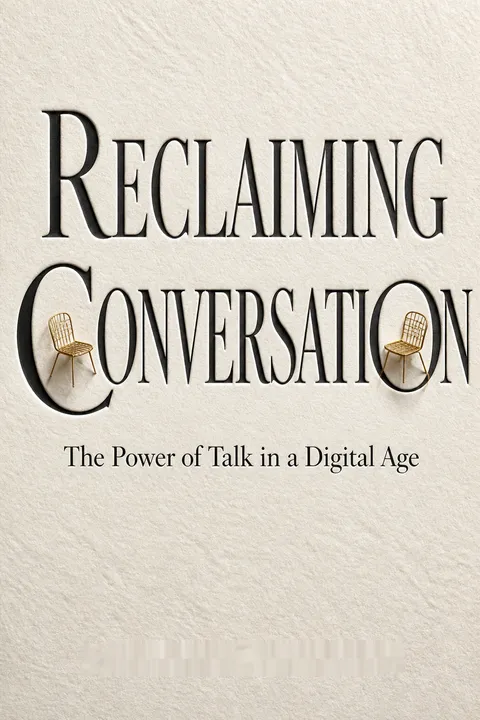
Alone is not automatically lonely. Turkle uses Thoreau’s chairs as a model: solitude supports friendship, and conversation with others gives the self something to reflect on. She calls this relationship a virtuous circle. Solitude here means a chance to gather one’s thoughts, not simply being physically alone. In one experiment, participants asked to sit quietly without books or phones had previously said they would not shock themselves for entertainment. After several minutes, some chose to do so rather than remain alone with their thoughts.
Inner life needs room. Turkle connects quiet and mind-wandering with autobiographical memory and creative thought. She describes a culture of “I share, therefore I am,” in which people seek to confirm or discover feelings by posting them. Sharing can help, but it cannot replace reflection. The book’s alternative is modest: protect unfilled moments, and let children experience boredom without immediately turning it into screen time.
This argument treats solitude as a relationship skill: people who can tolerate their own thoughts may be less likely to use others merely for reassurance. That is a useful counterweight to the idea that constant sociability is always healthy. Yet solitude should not be prescribed as a cure for loneliness, which can arise from genuine social deprivation. Turkle’s most persuasive point is developmental and practical: quiet becomes easier when it is supported by dependable relationships. A child can learn to be alone partly because someone trustworthy is nearby.
Give children attention they can imitate, not rules adults break
Family talk teaches relationship. Children learn to listen, interpret emotion, and repair conflict by watching adults do those things with them. Pediatrician Jenny Radesky studied 55 adults caring for children during meals in fast-food restaurants. Across the observations, adults paid more attention to phones than to the children; some children withdrew, while others tried unsuccessfully to get attention through disruptive behavior.
Rules need a model. One teenager complained that her mother checked her phone at dinner despite forbidding the children from doing so. The mother’s behavior helped set the family’s actual norm. Turkle recommends device-free places or routines, such as meals, car rides, or walks, where children can count on attention. The point is not to stage perfect family discussions. It is to show, repeatedly, that a child’s words and feelings can hold an adult’s attention.
Children learn norms less from speeches than from what reliably happens around them. That makes parental consistency more consequential than a clever household rule: a device-free dinner works only if adults accept the same limit. The research described here points to a plausible mechanism, but a restaurant observation cannot determine every child’s long-term outcome. The broader insight still holds. Small, recurring moments of attention create opportunities for children to name feelings, watch an adult respond, and learn that disagreement does not require retreat or performance.
Use messages to coordinate, not to outsource emotional repair
Some exchanges need a person present. A texted apology can communicate regret, but it may let the sender avoid seeing the hurt or hearing what repair requires. Turkle recounts a student who called a text apology an “artificial truce”: the conflict appeared over, but returned because the underlying issue had not been worked through. A face-to-face apology gives both people a chance to notice reactions and adjust.
Distance can also protect avoidance. Families in the book describe arguing by text because editing feels calmer and safer. That can help someone pause before responding, but it can also turn a temporary cooling-off strategy into the default way to handle conflict. One daughter said her mother’s distress became real to her only when she saw her crying in person. Text can carry practical information and open a difficult discussion; it cannot guarantee that the emotional work has happened.
The distinction is not between good technology and bad technology. It is between a medium that helps someone approach a hard exchange and one that lets them avoid its human consequences. A written pause can be useful when tempers are high, especially if it leads back to dialogue. The warning applies to apologies, breakups, and family conflict because these are not merely information transfers. They require interpreting another person’s response and accepting that the response may complicate the tidy message one hoped to send.
Stay through awkward pauses; important thoughts often arrive unedited
Discovery takes time. Turkle highlights a student’s “seven-minute rule”: allow a conversation to unfold before reaching for a phone, because the first quiet stretch may not reveal where it is going. A pause can be uncomfortable, but it can also give someone time to find words or connect an idea. The philosopher Heinrich von Kleist, as presented in the book, argued that speaking can help thoughts take shape rather than merely deliver thoughts already complete.
Boredom is not always a defect. Turkle links unstructured time with imagination and creative work. A student waiting for a lover to return from the bathroom opened a dating app because nothing new was happening online; a father found his young daughter’s bath routine dull and checked email. These moments show how quickly stimulation can displace attention. Let a lull remain open long enough to see whether it becomes reflection, play, or a better conversation.
This is a defense of process over performance. Edited messages reward preparation and control, while spontaneous speech lets an idea emerge in response to another person. The productive value of silence is not automatic: some pauses are simply uncomfortable, and some conversations need a direct question or a change of subject. The practical challenge is to avoid treating every lull as failure. A brief delay before switching tasks gives attention a chance to deepen, and gives people more than one route through an awkward moment.
Practice focused attention before screens train you to scatter it
Multitasking is rapid switching. Turkle argues that people often feel more productive while moving between tasks, even as performance and comprehension suffer. She notes research showing that distraction on a laptop can harm not only its user but nearby students as well. By 2012, nine in ten college students said they texted in class. A student who printed assignments rather than reading them on a tablet did so because the same device held schoolwork, games, and messages.
Keep more than one attention style. Turkle calls the ability to use both sustained focus and rapid, flexible attention “attentional pluralism.” Her point is not to ban digital tools, but to preserve the capacity to concentrate when a task calls for it. A law professor found that students typing notes often tried to transcribe lectures, while handwritten notes required them to select and organize ideas. The medium shaped the thinking, not just the record.
This section links personal attention to the conditions of learning. A student who cannot retain or connect ideas may struggle to contribute to a discussion, even with information available online. That makes focused attention a resource for participation, not merely a productivity trick. At the same time, online courses and digital materials can widen access and support useful collaboration. The better question is not whether screens belong in education, but which activities benefit from them and which require deliberate protection from competing signals.
Make work reward real exchange and uninterrupted thinking, not availability
Being online can look like doing work. At one software company, employees felt pressure to keep a green status icon beside their names, signaling constant availability. Yet workers said that the pressure crowded out both focused thought and conversation. Other workplaces responded with phone-free meetings, shared breakfasts, or scheduled breaks from email. At one consulting firm, an experiment pairing protected time off from devices with regular team meetings was later expanded across hundreds of teams.
Conversation has a business case. A consulting company that brought employees back to shared offices reported that the change helped collaboration and that the business grew faster. Turkle also describes workplace studies linking face-to-face interaction with productivity in settings such as call centers and software teams. The lesson is not that every job requires an office. Leaders need to protect both private focus and shared conversation, then model the priorities their policies claim to value.
The workplace examples expose a mismatch between what organizations measure and what helps people do good work. Visible responsiveness is easy to count; mentoring, trust, and the accidental exchange that improves an idea are harder to capture. Leaders can change that mismatch through meeting norms and protected time, but office presence alone is no magic ingredient. For distributed teams, deliberate conversation and reliable quiet may matter more than a particular floor plan. The key is to make attention and collaboration legitimate parts of work rather than unpaid extras.
Turn online support into organized, durable civic action
Attention is a beginning. The Kony 2012 campaign’s video spread widely, reaching more than 91 million views on YouTube by July 2012. Its organizers asked supporters to buy signs and display them during “Cover the Night.” The scale of online attention did not translate into a comparable public turnout. One participant concluded that clicking, donating, and sharing had made many people feel they had already taken part.
Different ties do different work. Online networks can rapidly connect acquaintances and spread information. But Turkle, drawing on the civil rights movement, emphasizes that sustained, risky organizing depends on trust built among people who know one another. Students who planned a 1960 lunch-counter sit-in had discussed it for weeks with close friends. Digital mobilization can help people find a cause; meetings, deliberation, and commitments are needed to decide what to do and keep doing it.
The campaign illustrates a measurement trap: visible reach can be mistaken for durable commitment. Digital tools can lower the cost of discovering an issue and finding others who care, which is a genuine civic advantage. But reach does not show whether people changed institutions, accepted risk, or stayed engaged after the news cycle moved on. The useful test for online activism is what it enables next: relationships, shared plans, and accountable action beyond the platform.
Protect private mindspace; data points cannot narrate a life
A number starts a story. Turkle describes “the algorithmic self,” a picture of a person assembled from tracked behavior, measurements, and digital records. A writing program told a student she was preoccupied with death; she wanted to understand the result, but the software could not discuss what her writing meant to her. Data can prompt a question, but interpretation needs context and conversation.
Privacy makes thinking possible. Turkle recalls her grandmother teaching her that library reading records should remain private, so readers could explore ideas without fear of being judged. Online searches, messages, and location histories can instead become part of a lasting digital profile. When people expect to be watched, they may censor what they explore or say. Protecting private space is therefore not only about secrecy; it helps preserve room to question, revise, and disagree.
The distinction between measurement and meaning is especially important as personal data acquire institutional consequences. A tracker may reveal a pattern, but a pattern does not explain why it matters or what response would be wise. The same caution applies to privacy: not every data collection practice has identical risks, and convenience can be genuinely valuable. But treating privacy as an optional luxury misses its role in experimentation and dissent. A person needs room to think before knowing what they think.
Do not confuse simulated empathy with the care only people can give
A responsive machine is not a relationship. Turkle’s “fourth chair” names the new problem of treating machines as conversational companions. She revisits ELIZA, an early program that echoed users in the style of a therapist. Even people who knew it was a simple program sometimes wanted to confide in it. Turkle calls this tendency the ELIZA effect: people attribute understanding to a machine that produces humanlike responses.
The human need remains. A child named Estelle became distressed when a robot companion turned away during a technical failure, believing it had rejected her. Turkle argues that a machine may help with practical tasks, but simulated concern cannot provide shared human experience or mutual care. The broader danger is not a malfunctioning robot; it is treating a substitute as sufficient and withdrawing from the person who could actually listen.
The strongest version of this argument is not that machines are useless or that every interaction must be human. A robot can assist with practical tasks, and a conversational system may offer a low-pressure first step for someone who is isolated. The boundary matters when imitation is presented as a replacement for attachment, care, or therapy. A response can sound understanding without bearing responsibility for what happens to the person. That difference deserves ethical attention, especially when children or elders are involved.
Analysis
Turkle’s argument is best understood as a case about habits and environments, not a simple referendum on screens. Her repeated scenes, at dinner tables, in classrooms, offices, and relationships, show people accepting divided attention as normal while privately wishing for something more. The phone is powerful partly because it offers a convincing sense of control: messages can be edited, attention redirected, and silence filled. The cost is often hard to see in a single interaction. It accumulates as fewer chances to practice listening, tolerate uncertainty, and repair misunderstandings.
The book’s strongest organizing idea is the reciprocal relationship between solitude and conversation. Time alone helps a person form thoughts; conversation tests and enlarges them; the resulting insight feeds further reflection. This connection gives the argument depth beyond etiquette. It explains why attention, privacy, and unscheduled time matter not only for closeness but also for learning, creativity, and citizenship.
The evidence is varied, including interviews, workplace observations, and studies, but the causal claims require restraint. An observed empathy decline does not establish that smartphones caused it, and the adults and children interviewed are not a representative sample of every user. Nor should digital connection be dismissed: it helps separated families stay close, gives isolated people access to communities, and can support education and collective action. Turkle’s more durable claim is conditional: these benefits do not make digital contact interchangeable with embodied conversation.
The practical response is therefore neither abstinence nor nostalgia. It is intentional choice. Protect some spaces for undivided attention, give boredom room to develop, and use digital tools where they genuinely serve a purpose. Most of all, judge technology not only by what it lets people do, but by which human capacities its routines strengthen or leave unused.
Review Summary
Reclaiming Conversation receives mixed reviews, with praise for its insightful analysis of technology's impact on human interaction and empathy. Critics appreciate Turkle's examination of how digital devices affect relationships and communication skills. However, some find the book repetitive and overly long. Readers value the book's focus on the importance of face-to-face conversations and its suggestions for balancing technology use. While some disagree with Turkle's conclusions, many find the book thought-provoking and relevant to modern society's relationship with technology.
People Also Read










Glossary
Goldilocks effect
Controlled digital closenessTurkle’s term for the appeal of connecting with people at a manageable distance. Digital communication can offer contact while limiting spontaneity, exposure, and demands on attention. The comfort of controlling when and how to respond may make mediated connection feel preferable, even when it provides less intimacy than an in-person conversation.
I share, therefore I am
Selfhood through sharingA phrase Turkle uses for the belief that sharing thoughts and feelings online helps a person feel real or whole. When self-understanding depends on posting, messaging, or receiving responses, private reflection can weaken and self-presentation can take its place.
virtuous circle
Solitude and conversation reinforceTurkle’s account of how solitude and conversation support one another. Time alone helps people develop a sense of self and something authentic to bring to others. Listening and speaking with others then provide material for further self-reflection. The cycle links self-knowledge with empathy and more meaningful relationships.
disconnection anxiety
Anxiety without connectionThe unease some people feel when separated from phones or online contact, even when they have chosen to disconnect. The anxiety can interfere with concentration and bring fears of being forgotten or excluded. Turkle argues that constant access can make quiet feel increasingly unfamiliar, reinforcing the urge to reconnect.
machine zone
Compulsive, repetitive screen useA state described in research on gambling machines in which a person becomes absorbed in repetitive interaction and is less aware of why they continue. Turkle applies the idea to digital environments where users keep checking or cycling through apps without a clear purpose, even when they no longer find the activity satisfying.
attentional pluralism
Fluency in different attention stylesTurkle’s term for being able to use both sustained, deep attention and more rapid, flexible attention. The goal is not to reject multitasking in every circumstance, but to preserve the capacity to focus when learning, conversation, or complex work requires it.
algorithmic self
Data-based self-portraitA representation of a person produced through tracked behavior, measurements, and algorithmic analysis. It may include physical, emotional, or online data and can prompt useful questions about personal patterns. Turkle cautions that data alone cannot explain what those patterns mean within an individual life.
ELIZA effect
Attributing understanding to softwareTurkle’s term for the tendency to experience a humanlike computer program as understanding or caring, even when its responses are generated by simple procedures. The effect was named for ELIZA, an early program that echoed users in a therapist-like style and nevertheless invited some people to confide in it.
fourth chair
Conversation with machinesTurkle’s extension of Thoreau’s three-chair image of solitude, friendship, and social life. The fourth chair represents encounters with machines that present themselves as conversational companions. It asks what people may forget about human connection when they treat simulated sociability as equivalent to mutual understanding.
missing chip hypothesis
Lost practice may hinder developmentTurkle’s informal name for the concern that children who receive too little face-to-face conversation may miss practice needed to develop conversational and empathic abilities. The phrase is a hypothesis about developmental opportunity, not proof that devices cause a specific impairment.
FAQ
What's Reclaiming Conversation: The Power of Talk in a Digital Age about?
- Focus on Conversation's Importance: The book emphasizes the critical role of face-to-face conversation in developing empathy, self-reflection, and meaningful relationships in a digital age dominated by screens and technology.
- Impact of Technology: It discusses how constant connectivity through devices leads to a decline in deep, meaningful conversations, resulting in superficial relationships and a crisis of empathy among individuals, especially children.
- Call to Action: Turkle advocates for reclaiming conversation as a remedy to the emotional and social deficits caused by technology, encouraging readers to prioritize real interactions over digital ones.
Why should I read Reclaiming Conversation by Sherry Turkle?
- Understanding Modern Communication: The book provides insights into how technology affects our communication styles and relationships, making it relevant for anyone navigating personal or professional interactions today.
- Empathy and Connection: It highlights the importance of empathy in human relationships and how conversation fosters this essential quality, which is increasingly at risk in our digital world.
- Practical Advice: Turkle offers practical strategies for individuals and families to reclaim conversation, making it a useful guide for improving interpersonal relationships.
What are the key takeaways of Reclaiming Conversation?
- Value of Solitude: The book stresses that solitude is essential for self-reflection and personal growth, allowing individuals to gather their thoughts and prepare for meaningful conversations.
- Empathy Development: It argues that face-to-face conversations are crucial for developing empathy, as they require active listening and engagement with others' emotions.
- Family Dynamics: Turkle discusses how technology disrupts family conversations, suggesting that device-free times can help restore meaningful interactions among family members.
What are the best quotes from Reclaiming Conversation and what do they mean?
- “We had talk enough, but no conversation.”: This quote underscores the difference between superficial communication and deep, meaningful conversations that foster understanding and connection.
- “The very sight of a phone on the landscape leaves us feeling less connected to each other.”: This highlights how the mere presence of devices can inhibit genuine interactions, emphasizing the need for device-free environments to encourage real conversations.
- “Solitude gives birth to the original in us.”: This quote reflects the idea that solitude is necessary for creativity and self-discovery, which are essential for engaging in authentic conversations.
How does Reclaiming Conversation define the "flight from conversation" concept?
- Definition of Flight: Turkle describes the "flight from conversation" as a societal trend where individuals prefer digital communication over face-to-face interactions, leading to a decline in meaningful relationships.
- Causes of Flight: This phenomenon is attributed to the convenience of texting and social media, which allow for quick, edited exchanges but lack the depth and emotional connection of in-person conversations.
- Consequences: The flight from conversation results in a crisis of empathy, as people become less skilled at understanding and relating to others' emotions, ultimately affecting personal and societal relationships.
How does Reclaiming Conversation address the role of technology in communication?
- Technology as a Barrier: Turkle argues that technology often serves as a barrier to genuine communication, as people become more focused on their devices than on the people around them.
- Impact on Relationships: The book discusses how reliance on digital communication can lead to superficial relationships, where individuals may feel connected online but are emotionally distant in real life.
- Encouragement for Change: Turkle encourages readers to rethink their relationship with technology, advocating for intentional use that prioritizes face-to-face interactions and meaningful conversations.
What practical advice does Reclaiming Conversation offer for families?
- Device-Free Times: Turkle suggests establishing device-free times during family meals or gatherings to encourage open dialogue and strengthen family bonds.
- Modeling Behavior: Parents are encouraged to model good conversational habits by putting away their phones and actively engaging with their children, demonstrating the value of attention and presence.
- Encouraging Empathy: The book emphasizes the importance of discussing feelings and experiences openly within families, fostering an environment where children can learn empathy and communication skills.
How does Reclaiming Conversation relate to education?
- Educational Impact: Turkle highlights that the decline in face-to-face conversations among students affects their ability to engage in critical thinking and collaborative learning.
- Empathy in Education: The book argues that empathy is essential for effective learning environments, and that conversations in classrooms can enhance students' understanding and social skills.
- Teacher's Role: Educators are encouraged to create spaces for open dialogue and to limit technology use in classrooms to promote deeper engagement and learning.
What is the significance of solitude in Reclaiming Conversation?
- Foundation for Self-Reflection: Solitude is presented as a crucial component for self-reflection, allowing individuals to understand their thoughts and feelings before engaging in conversations with others.
- Empathy Development: The book posits that solitude fosters empathy, as it helps individuals become comfortable with themselves, enabling them to better understand and connect with others.
- Coping with Technology: Turkle argues that in a world filled with distractions, cultivating solitude is essential for maintaining mental health and emotional well-being.
How does Reclaiming Conversation suggest we reclaim conversation in our lives?
- Prioritize Face-to-Face Interactions: Turkle advocates for making a conscious effort to engage in more face-to-face conversations, especially in personal and family settings.
- Create Device-Free Zones: Establishing areas and times where technology is not allowed can help facilitate deeper conversations and connections.
- Practice Active Listening: The book encourages individuals to practice active listening skills, being fully present in conversations to foster empathy and understanding.
How does Reclaiming Conversation address the issue of loneliness?
- Loneliness in a Connected World: Turkle points out that despite being more connected than ever through technology, many individuals report feeling lonelier due to superficial interactions.
- Need for Genuine Connection: The book emphasizes that true connection comes from meaningful conversations, which are often lacking in digital communication.
- Encouragement to Seek Depth: Turkle encourages readers to prioritize deep, face-to-face conversations as a remedy for loneliness and a way to foster genuine relationships.
How can I apply the concepts from Reclaiming Conversation in my daily life?
- Set Boundaries with Technology: Create device-free zones or times, such as during meals or important conversations, to encourage deeper engagement.
- Practice Active Listening: Make a conscious effort to listen fully to others without distractions, responding thoughtfully to their comments and feelings.
- Encourage Open Dialogue: Foster environments where open-ended questions are welcomed, allowing for richer conversations and deeper connections with others.
About the Author
Other books by Sherry Turkle


Download PDF
Download EPUB
.epub digital book format is ideal for reading ebooks on phones, tablets, and e-readers.








