
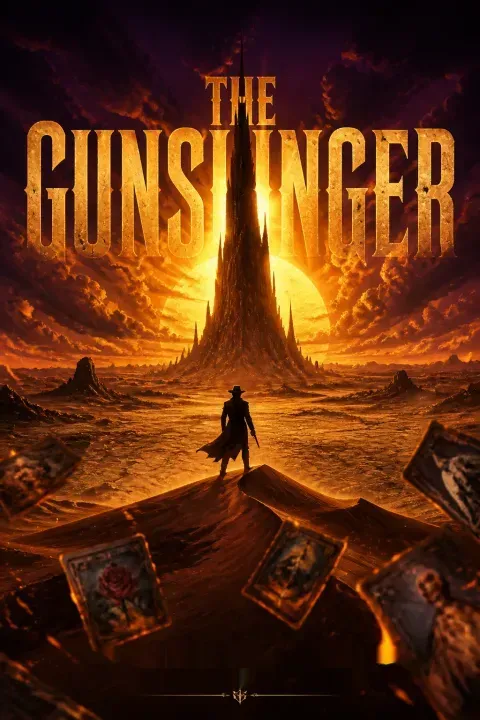


Plot Summary
Brown at the Desert's Edge
For months, Roland1 has followed a black-robed sorcerer3 south across a desert where the old roads and nearly all life have vanished. He finds the stranger's cold campfires, then reaches Brown,5 a young homesteader whose raven, Zoltan,15 repeats scraps of profanity and scripture. Roland's1 exhausted mule dies, and Brown5 cooks it while offering water, food, and a place to sleep.
Brown5 has met the man in black3 and confirms he passed weeks earlier, but knows little about him. When Brown5 asks about Roland's1 near death in Tull, Roland1 begins recounting the town's ruin. The pursuit has been his single purpose for years. Brown's5 quiet hospitality briefly gives that purpose a human audience.
The desert makes pursuit feel less like a chase than a practice of survival: Roland measures progress through scraps, water, and the dwindling animal carrying his supplies. Brown interrupts that solitary discipline without challenging it. His hospitality is practical rather than sentimental, which Roland can accept, while Brown's question invites the gunslinger to turn experience into a story. The raven's fractured prayers and jokes make the homestead feel like a remnant of a culture whose words have outlasted their meanings. By pausing here, the narrative shows that even a man trained to treat attachment as risk can be drawn into company.
Nort Returns to Tull
In Roland's1 account, he rides into Tull after dark, drawn by piano music and the prospect of food. The townspeople watch his guns warily. At the bar, a ragged, grass-addicted man named Nort7 approaches in the ancient High Speech and asks for money for a woman. Roland1 gives him a gold coin, then questions Allie,4 the scarred bartender, about the strange speech and the man in black.3
Allie4 explains that Nort7 had died outside her bar, but a black-robed stranger3 arrived during the storm, performed a grotesque ritual over the body, and restored him to life. Nort7 now believes he has been blessed, yet still cannot stop using the weed. The miracle leaves Allie4 less relieved than trapped with a problem no one can solve.
Nort's return is not a clean miracle but a cruelly incomplete intervention. He is alive, yet his dependence remains, so the supernatural event magnifies rather than repairs his suffering. Allie's account makes the man in black dangerous in a distinctive way: he can alter what a community accepts as possible, then leave ordinary people to manage the consequences. Roland's gold coin buys information, but it also makes him a participant in Tull's economy of need. The scene establishes that knowledge in this world comes through vulnerable people, and that his pursuit repeatedly turns their private pain into evidence.
The Preacher Names Him
Roland1 stays with Allie4 for several days, eating, sleeping, and listening as she plays her fiddle. When the piano player Sheb8 bursts in with a knife, jealous of their intimacy, Roland1 breaks his wrists and lets Allie4 tend him. On Sunday, Roland1 watches preacher Sylvia Pittston6 whip the congregation into a frenzy by naming the unseen stranger3 as evil's source.
Allie4 reveals that Sylvia6 came from the desert and lives beyond the church. Roland1 visits her shack and forces her to explain what the man in black3 told her. Sylvia6 says he has gone to the mountains to regain strength through meditation. Her claim that he fathered a divine child is a deception, but her directions give Roland1 the route he needs.
Tull's religion offers its people a way to assign responsibility for desires they cannot control, and Sylvia turns that need into authority. By making the outsider responsible for every sin, she directs fear away from the town's own cruelty and toward a target it can eventually attack. Roland sees the performance clearly, yet he also uses force to extract the information he wants. His ability to identify manipulation does not protect him from using another person's vulnerability. Allie, meanwhile, is neither simply his refuge nor merely a source of intelligence; her small attachments expose the cost of Roland's habit of treating closeness as temporary shelter.
Tull's Last Gunfight
As a dust storm gathers, Roland1 returns for his mule and prepares to leave Tull. The townspeople rush him with knives and clubs, led by a religious fury Sylvia6 has cultivated. Sheb8 holds Allie4 in front of him, forcing Roland1 to choose between lowering his guns and letting the mob reach him. Roland1 fires; Allie4 and Sheb8 fall, and the attack becomes a town-wide slaughter.
He kills the people who keep charging, including Sylvia,6 until the street is empty. Afterward, he finds Nort's7 corpse displayed above the bar with a hoof mark on its forehead. Roland1 cuts him down, takes food, leaves gold for Allie,4 and sleeps in her bed before the storm carries the bodies away. The pursuit continues, but his survival has cost an entire town.
The massacre is the moment when Roland's professional reflexes become morally indistinguishable from the violence he claims to oppose. Sheb's use of Allie removes the possibility of a clean defensive choice, but Roland's response extends beyond the immediate attackers until no one remains alive in Tull. The town's collective hysteria has real causes, including Sylvia's manipulation and its long-standing brutality, yet the gunslinger answers a crowd as a field of targets. His gesture of leaving gold and burying Nort cannot repair what happened. It shows instead how ritual acts can preserve a remnant of conscience without undoing the deed.
Jake at the Way Station
After leaving Brown,5 Roland1 crosses the desert until thirst and heat bring him close to collapse. He reaches an abandoned coach station and mistakes a small boy for the man in black.3 The boy, John Chambers,2 asks to be called Jake2 and gives Roland1 water and dried meat. Jake2 remembers a city of tall buildings, cars, school, and a statue in a harbor, but cannot explain how he reached the desert.
He had seen a black-robed visitor3 camp at the station. In the cellar, a speaking demon pushes through the wall and uses Allie's4 voice to warn Roland1 that the sorcerer3 is carrying his soul. Roland1 retrieves the demon's jawbone, comforts the terrified boy, and decides they will travel together.
Jake's arrival changes the pursuit from a solitary test of endurance into a relationship with consequences. He comes from a world whose ordinary details are more alien to Roland than demons are, while his forgotten past makes him dependent on the man who has no practice caring for dependents. The speaking demon's use of Allie's voice binds Roland's newest bond to the guilt he has just left behind. Its warning does not explain the danger so much as make intimacy itself feel engineered. Roland nevertheless holds Jake after the encounter, and the unplanned gesture marks the first time his duty acquires a human face.
The Oracle's Three Cards
As Roland1 and Jake2 climb toward the mountains, the boy wanders into a ring of ancient stones where a sexual, prophetic presence nearly overwhelms him. Roland1 drives it off with the demon's jawbone and ties Jake2 safely to camp the next morning. Wanting answers, he takes a drug and returns alone to confront the oracle.
It predicts three people connected to Roland's1 fate: a young dark-haired man marked by heroin, a woman who comes on wheels, and a third figure in chains. The oracle says Jake2 will lead Roland1 to the man in black,3 who will lead him toward the three and the Tower. It also warns that Jake2 may be spared if Roland1 abandons the quest. Roland1 rejects the warning, then returns to Jake2 without telling him what he has learned.
The oracle transforms the quest from a line of pursuit into a structure that requires other people. Its prophecy offers information while making that information ethically costly: Jake is not merely a companion but a route to the man in black. Roland's choice to conceal the prophecy preserves the boy's trust in the short term and deepens the instrumental quality of their bond. The jawbone, an object taken from a dead voice, protects Jake from a force that operates through desire rather than direct attack. Roland's return to camp, exhausted and ashamed, shows that knowledge can sharpen his responsibility without making him willing to obey it.
The Man Above the Falls
The pair crosses the foothills and climbs through the mountains, where the air grows cold and the man's trail becomes easier to smell than see. During the journey, Roland1 tells Jake2 fragments of his vanished homeland and the revolution that destroyed it.
Near a roaring waterfall, Jake2 suddenly recognizes that the path ahead is dangerous and begs to retreat, believing the man in black3 has killed him once already. Roland1 promises to protect him, though he knows the reassurance is false.
They round the bend and find the sorcerer3 waiting on a ledge above them. Roland1 fires three times and misses. The man in black3 invites him to continue on the far side of the mountains, then disappears into the rock passage. Roland1 takes Jake2 into the darkness after him.
The mountain encounter converts the pursuit into an explicit moral test. Jake can articulate the danger, and Roland hears him, but the gunslinger chooses the Tower over the child's fear. His promise of safety is not simple deception for gain; it is the lie that lets him continue acting without pausing to face the choice. The man in black's invitation to meet beyond the mountain gives Roland exactly what he wants, while making the boy's presence the price of access. The natural barrier becomes a threshold into a more intimate conflict, where the antagonist can exploit Roland's attachment rather than merely evade his weapons.
Cort's Lesson in Blood
In the mountain tunnels, Roland1 tells Jake2 about his youth in New Canaan and remembers the day he defeated his teacher, Cort.9 Before that test, the boys had learned that cook Hax13 was involved in a plot to poison meat meant for a rebel leader's forces.
Roland's1 testimony helped condemn Hax,13 whose dignified death left the boy troubled by the gap between law and honor. Years later, after discovering that the sorcerer Marten11 was entangled with Roland's mother,12 Roland1 challenged Cort9 before he was old enough.
He brought his old hawk, David,14 into the fight; the bird distracted Cort9 long enough for Roland1 to win. Cort9 yielded and gave him the key to his guns. The victory made Roland1 a gunslinger, but it also taught him to turn survival into a measure of worth.
Roland's memories show how his identity was made through institutions that confuse discipline with moral clarity. Hax's execution exposes the danger of a system in which loyalty to authority can kill a decent person, while Cort's test converts violence into a formal gateway to adulthood. Roland succeeds through a tactical bond with David, not through strength alone, yet he remembers the event as proof that he was meant to lead. His account to Jake reveals a mind trying to make its past legible without relinquishing its governing rules. The boy's presence makes that self-justifying story newly vulnerable to judgment.
The Rails of the Dead
Following an ancient underground river, Roland1 and Jake2 discover railroad tracks and a handcar that still moves. When the Slow Mutants gather around them, Roland1 shoots one that attacks, then uses the handcar to escape the others.
The mutants block the rails with stones, forcing Jake2 to climb down and clear the track while Roland1 covers him with his guns. They break through and eventually reach a vast abandoned transit station, where preserved corpses and empty shops reveal another buried age.
Jake2 refuses to continue, realizing Roland1 needs him as a path to the Tower. Roland1 gets back on the handcar anyway. When Jake2 runs after him, Roland1 catches him and pulls him aboard. The choice keeps them together, but it does not answer the boy's accusation that Roland1 is using him.
The handcar makes the pair's cooperation physically visible: one person must keep the mechanism moving while the other faces whatever blocks the track. During the attack, Roland protects Jake, but the boy must still leave the relative safety of the machine to clear the stones. The station then gives Jake the space to name the arrangement between them. Roland's response is revealing: he cannot abandon the quest, yet he also cannot allow Jake to be left alone. Catching him as he leaps preserves the bond while postponing its ethical reckoning. The decayed transit system makes progress possible through machinery whose purpose has outlasted its makers.
The Bridge Takes Jake
The handcar carries Roland1 and Jake2 toward a luminous bridge over the underground river. Its rusted supports buckle as they walk, and the man in black3 appears at the far end, blocking the daylight. Jake2 slips through the failing trestle and hangs above the water, begging Roland1 to catch him.
The sorcerer3 urges Roland1 onward, making clear that rescuing the boy may end the pursuit. Roland1 leaps past Jake2 and pulls himself onto the far ledge. Jake2 falls, and his last accusation follows Roland1 out of the darkness.
Roland1 reaches the man in black3 in a state of shock, fires every shot in his guns, and follows him down the mountainside to a place of skulls. The choice wins access to the sorcerer,3 but leaves Roland1 carrying the cost of his own decision.
This is the quest's decisive moral break because Roland does not merely fail to save Jake; he acts after understanding the choice. The collapsing bridge gives the decision urgency, and the man in black makes its terms brutally clear. Roland's leap turns the child's dependence into a sacrifice for knowledge, fulfilling the oracle's warning in the most literal way. Jake's final accusation survives as more than guilt: it identifies the logic by which Roland has treated people as instruments. The gunslinger reaches his quarry, yet the victory is inseparable from the loss that made it possible.
Cards at the Killing Ground
At an ancient field of bones, the man in black3 has Roland1 gather wood, cook a rabbit, and sit for a tarot reading. The cards show Roland1 as the Hanged Man, Jake2 as the drowned Sailor, and figures representing a Prisoner, a woman of shadows, Death, and the Tower.
A card of Life is burned before Roland1 can learn where it belongs. The man in black3 then sends him through a vision of creation and cosmic scale, ending with a single blade of grass containing worlds beyond counting.
Roland1 realizes that the sorcerer3 does not understand the vision's final image. During their prolonged conversation, the stranger identifies himself as Walter3 and admits his past connection to Marten,11 who manipulated Roland's family.12 He says Roland1 must reach the sea and draw three people.
The tarot reading presents Roland's life as a pattern already legible to someone else, but the missing place of the Life card preserves uncertainty at the center of that pattern. The vision then expands the Tower from a personal destination into a question of scale: Roland's world may be only a small part of something immeasurably larger. Walter's failure to interpret the blade of grass reverses their power dynamic. The gunslinger remains committed, but he has learned that the sorcerer is neither omniscient nor the final authority. Naming himself as Walter also connects the pursuit to Roland's family history, showing that this chase began long before the desert.
Ten Years at the Shore
The man in black3 tells Roland1 that the Tower gathers worlds and realities into a single nexus, but cannot say what waits at its summit. He names a greater master, Maerlyn, and hints at a still more fearful keeper of the Tower. Roland1 insists that someone must dare to reach it. The conversation lasts through an enchanted night.
When Roland1 wakes, ten years have passed: Walter3 is a skeleton in his black robe, and Roland's1 hair has grayed. Roland1 takes the jawbone from Walter's3 remains and walks west, as instructed, toward the sea. By evening he reaches the shore and sits beneath the stars, alone but unwavering. The desert pursuit is over. His larger quest has only begun, now directed toward drawing three people and finding the Tower.
The ending closes one pursuit by converting it into another, larger one. Roland has not defeated Walter in a conventional sense; time has simply carried the sorcerer into death while the gunslinger remains committed to the future he described. The ten-year leap makes the cost of their conversation bodily, aging Roland without granting him a clearer answer. At the sea, solitude is no longer merely deprivation: he accepts it as the condition of continuing. Yet the final direction is no longer only toward the man in black. The prophecy's three figures and the Tower turn the ending into a threshold, while Jake's absence remains the unhealed price of crossing it.
Analysis
The novel makes pursuit both a plot and a moral habit. Roland1 follows the man in black3 because the Tower promises an answer large enough to justify the ruins of his world, but his methods repeatedly reduce people to steps along that route. Nort7 is a test of whether supernatural intervention can heal ordinary suffering. Allie4 becomes a source of information and a brief refuge. Jake2 becomes a companion, then a gateway, and finally the person Roland1 chooses not to save. The sequence does not let duty excuse that choice; Jake's2 accusation gives the cost a human voice.
The book also treats civilization as a set of remains whose functions have outlived their explanations. A coach road, a water pump, a transit station, and a handcar still serve travelers, while religious language and the High Speech survive in altered forms. This world has not simply ended. It has become difficult to read. Roland's1 training offers a code for acting in that confusion, but the memories of Hax,13 Cort,9 and Marten11 show how easily codes can confuse obedience with justice and competence with goodness.
The Tower's cosmic scale deepens that uncertainty. The blade of grass suggests that Roland's1 entire reality may be contained within something larger, yet neither he nor Walter3 can make the vision safely comprehensible. Knowledge therefore does not end the quest or settle its ethics. Roland1 leaves the shore older, bereaved, and still committed. The book's unsettling conclusion is that purpose can survive the destruction of certainty, but persistence alone cannot prove that the sacrifices made in its name were right.
Review Summary
The Gunslinger receives mixed reviews. Some praise its atmospheric world-building, complex characters, and intriguing premise. Others find it confusing, slow-paced, and lacking character development. Many readers note it improves upon rereading or within the context of the entire Dark Tower series. The book's ambiguity and open-ended nature frustrate some but intrigue others. Despite its flaws, many readers are compelled to continue the series, drawn in by King's unique blend of western, fantasy, and horror elements.
People Also Read






Characters
Roland
The last gunslingerRoland is a disciplined, solitary gunslinger pursuing the sorcerer3 who has shaped the ruin of his world. He trusts trained reflexes, endurance, and duty more readily than affection, and often treats uncertainty as a problem to be forced into submission. His memories of New Canaan reveal a boy formed by harsh instruction, political violence, and the collapse of inherited order. He is neither emotionally empty nor comfortable with tenderness; rather, he has learned to subordinate both to a quest he considers binding. The arrival of Jake2 unsettles that arrangement. Roland's central tension lies between his capacity to care and his practiced willingness to make other lives serve his purpose.
Jake Chambers
The lost city boyJake is a boy from a world of schools, cars, and tall buildings who wakes in an abandoned desert station with almost no memory of how he arrived. He is frightened, observant, and more resilient than Roland1 first expects. His politeness and dependence do not erase his ability to question the adult protecting him. Jake wants security and companionship, yet senses that Roland's1 mission places him in danger. His attachment to the gunslinger1 grows through shared travel and small acts of care, while his directness exposes contradictions Roland1 prefers not to examine. Jake's role is not simply to be rescued: he is the clearest moral witness to what Roland's1 ambition demands from another person.
The Man in Black
The elusive sorcererThe man in black is a sorcerer whose path draws Roland1 across the desert and into a larger mystery surrounding the Tower. He manipulates belief as readily as physical events, leaving people with wonders that deepen their confusion rather than resolve it. His interventions suggest a careful interest in Roland's1 choices, especially in the attachments that might weaken or redirect the gunslinger's1 pursuit. He is playful, cruel, and difficult to read, but not all-knowing; the cosmic vision he gives Roland1 leaves him uncertain. His relationship with Roland1 combines antagonism with reluctant recognition, as each understands that the other is necessary to the next stage of the quest.
Allie
Tull's scarred bartenderAllie runs the bar in Tull, where hunger, drink, and old resentments shape the town's daily life. A scar marks her forehead, but her deeper wound is the exhaustion of living among people who take what they want and leave her to endure the aftermath. She is practical, sharp-tongued, and more compassionate toward Nort7 than the townspeople who mock him. Her involvement with Roland1 gives her a brief chance at intimacy, though she understands that his attention is bound to the man in black3. Allie sees how easily a miracle can become another burden, and her account of Nort7 gives Roland1 crucial knowledge about his quarry.
Brown
The desert homesteaderBrown lives alone at the desert's edge with a patch of corn and his raven, Zoltan15. He meets strangers without much ceremony, offering food and water while keeping a dry, observant distance. His quiet manner gives Roland1 room to recount Tull without turning the story into a confession demanded under pressure. Brown is neither a guide nor a mystic; his value lies in ordinary hospitality and a willingness to listen. In a world where people have lost their sense of time and often their sense of community, his small, sustainable household offers a fragile example of life continuing without grand claims.
Sylvia Pittston
Tull's fearsome preacherSylvia Pittston is a desert-born preacher who commands Tull's congregation through vivid visions of sin and judgment. Her sermons give the townspeople a shared explanation for their private appetites and fears, making her both a religious authority and a political force. She is theatrical, perceptive, and skilled at turning uncertainty into certainty. The man in black3 has reached her before Roland1 does, and she presents his influence through the language of divine purpose. Sylvia's power depends on an audience willing to mistake emotional intensity for truth, a dependence that makes her dangerous when the town is already hungry for someone to blame.
Nort
Tull's weed-eaterNort is a former worker reduced by a dependence on devil-grass, and the children of Tull turn his visible decline into entertainment. He speaks in the ancient High Speech, a remnant of a more formal civilization that makes Roland1 recognize him as more than another town outcast. Nort's belief in his own blessing does not free him from craving or shame. His predicament reveals the difference between being restored to life and being restored to oneself. Through Nort, the story gives supernatural intervention a human consequence that cannot be dismissed as spectacle.
Sheb
Tull's piano playerSheb plays the piano at Tull's bar and has an old romantic attachment to Allie4. His jealousy makes him dangerous when Roland1 becomes part of her life. Though he appears small beside the gunslinger's1 force, Sheb's grievance helps ignite the town's violence. He represents the intimate rivalries that persist even in a community close to collapse.
Cort
The brutal gunslinger tutorCort trains the sons of gunslingers through pain, discipline, and repeated tests of judgment. He is scarred, physically formidable, and unsentimental about what his pupils must learn. His methods make violence into a ritual of adulthood, but he is not merely a brute: he recognizes ingenuity and understands the burden of command. For Roland1, Cort embodies the code that made him capable and the rigidity that narrows his moral imagination.
Cuthbert
Roland's quick-witted friendCuthbert is Roland's1 childhood companion and fellow pupil, quicker with humor and interpretation than Roland1. He can recognize the emotional meaning of events that Roland1 approaches as tests to be endured. Their friendship is shaped by shared training, danger, and a rivalry that never entirely erases affection. Cuthbert's presence in Roland's1 memories highlights the sociability and levity the gunslinger1 has since lost.
Marten
The court enchanterMarten serves near Roland's father1 and moves through the family home with the authority of a trusted adviser. His easy manner conceals a disturbing influence over Roland's mother12 and a talent for making private loyalties feel unstable. To the young Roland1, Marten represents an adult world in which power operates through access, implication, and betrayal rather than open force. His presence helps explain why Roland's1 later pursuit is bound to old family wounds as well as political ruin.
Gabrielle
Roland's distant motherGabrielle is Roland's mother1, a beloved but increasingly distant presence in his childhood. He remembers her through songs, brief gestures, and moments of tenderness that persist beside his suspicion of the court around her. Her relationship with Marten11 destabilizes Roland's1 trust in family and authority. She matters to his inner life less as a source of explanation than as an unresolved attachment he cannot reconcile with his training.
Hax
The condemned cookHax is the castle's cook, a generous adult who secretly feeds hungry boys and treats them with practical affection. Roland1 and Cuthbert10 overhear him connected to a plot involving poisoned meat for rebel forces. Hax's dignity and warmth complicate the official label of traitor, leaving Roland1 with an early example of how law and honor can diverge.
David
Roland's hunting hawkDavid is Roland's1 aging hawk, a fierce predator trained for hunting and handled with uncommon patience. Roland's1 bond with the bird is based less on ownership than on mutual accommodation. During a decisive test, David's instincts become part of Roland's1 strategy, linking companionship with the violence required by the gunslinger's1 training.
Zoltan
Brown's irreverent ravenZoltan is Brown's5 raven, a sharp-eyed bird that repeats scraps of profanity, rhyme, and prayer. Its words lend bleak comedy to the homestead, where old language survives in broken, unpredictable forms. Zoltan is a companion to Brown5 and a small reminder that life in the emptied world can still surprise.
Aileen
A figure in Roland's pastAileen belongs to Roland's1 memories of the old world and its courtly life. She appears in his recollections as part of a past marked by intimacy, ceremony, and loss. Her presence helps suggest that Roland's1 emotional history is larger than the stark pursuit visible in the desert.
Susan
Roland's lost loveSusan is a young woman from Roland's1 past who taught him forms of intimacy and tenderness distinct from his training. She returns in dreams and memories as a vivid counterpoint to the gunslinger's1 guarded present. Roland1 associates her with love, beauty, and the pain of a world he can no longer recover. Her memory reveals what his discipline protects him from feeling as much as what it preserves.
Plot Devices
The Dark Tower
The quest's distant centerThe Tower is the destination that gives Roland's1 pursuit its meaning, though he begins with little understanding of what it is or why it matters. It gradually emerges as a nexus connecting worlds, time, and scale, rather than simply a place to reach. The man in black3 links Roland's1 search to three people yet to be drawn into his path. Because the Tower remains unexplained, it functions as both a concrete goal and a test of how much Roland1 will sacrifice for an answer. Its promise pulls the story beyond the desert without resolving the danger of the quest.
The Jawbone
A ward against demonsRoland1 takes a jawbone from the way station cellar after a speaking demon uses Allie's4 voice to warn him about the man in black3. He later uses it to break the oracle's hold over Jake2, and it helps protect the boy from a supernatural force that works through sensual temptation. The bone joins death to practical survival: it is a relic from the dead that gives Roland1 a defense against beings who can imitate the living. Its power is not explained fully, so Roland1 treats it as a tool whose limits are discovered through use.
The Oracle's Prophecy
A map made of peopleThe oracle predicts that three people will shape Roland's1 future: a dark-haired man associated with heroin, a woman who comes on wheels, and a third person in chains. It also identifies Jake2 as a passage to the man in black3 and the Tower. The prophecy turns Roland's1 quest from a pursuit of one enemy into a route through other lives. Its warning that Jake2 might be spared if Roland1 turns back gives the prediction moral force, not just mystery. The prophecy's images remain incomplete, leaving Roland1 with direction but not control.
Devil-Grass
Dreams in the wastelandDevil-grass is one of the few plants that can burn in the desert. Its smoke produces vivid, sometimes dangerous dreams, and its use marks the collapse of people who depend on it, most visibly Nort7. The same substance can serve as fuel, escape, and a source of harm, making it part of the world's material life rather than merely a symbol. Roland's1 pursuit repeatedly passes through the aftermath of addiction, while the man in black's3 association with the grass's strange fires adds an uncanny edge to ordinary survival.
The Handcar
A machine toward dangerDeep beneath the mountains, Roland1 and Jake2 find an intact handcar on ancient railway tracks. Its continued operation lets them travel faster through the darkness, but it also carries them into the territory of the Slow Mutants and toward the failing bridge. The machine turns their journey into physical cooperation: one must pump while the other watches, clears obstacles, or clings on. Like the old station and its preserved corpses, the handcar shows that remnants of a vanished civilization can remain useful long after their original world has disappeared.
FAQ
Synopsis & Basic Details
What is The Gunslinger about?
- Relentless pursuit across wasteland: The Gunslinger follows Roland Deschain's unwavering chase of the man in black across a desolate desert landscape, a journey driven by a mysterious and all-consuming quest.
- Quest for the Dark Tower: The story hints at a larger purpose, the search for the Dark Tower, a nexus point of reality, suggesting a battle against cosmic forces threatening existence itself.
- Moral compromises and sacrifices: Roland's journey forces him to make difficult choices, often sacrificing others and his own humanity in his relentless pursuit, raising questions about the cost of his obsession.
Why should I read The Gunslinger?
- Unique blend of genres: The Gunslinger masterfully combines elements of Western, fantasy, horror, and science fiction, creating a distinctive and captivating reading experience.
- Intriguing and complex characters: Roland Deschain is a compelling anti-hero, driven by a mysterious quest and haunted by his past, while the man in black is an enigmatic and powerful antagonist.
- Exploration of profound themes: The novel delves into themes of destiny, morality, sacrifice, and the nature of good and evil, prompting readers to contemplate the deeper meaning of existence.
What is the background of The Gunslinger?
- Post-apocalyptic setting: The story takes place in a world that has "moved on," a term implying a cataclysmic event or gradual decay that has left behind remnants of a once-advanced civilization.
- Mythological and literary influences: The Gunslinger draws inspiration from Arthurian legends, Western folklore, and various literary works, creating a rich tapestry of intertextual references.
- Decline of civilization and technology: The presence of abandoned coach roads, decayed towns, and remnants of advanced technology suggests a world where civilization and technological progress have regressed.
What are the most memorable quotes in The Gunslinger?
- "The man in black fled across the desert, and the gunslinger followed.": This iconic opening line immediately establishes the central conflict and sets the tone for the entire series, highlighting the relentless pursuit at the heart of the story.
- "The world has moved on.": This recurring phrase encapsulates the sense of loss, decay, and the passage of time that permeates the novel, emphasizing the gunslinger's connection to a bygone era.
- "There are other worlds than these.": This cryptic statement, uttered by Jake before his death, hints at the multiverse and the interconnectedness of all things, foreshadowing the larger scope of the Dark Tower series.
What writing style, narrative choices, and literary techniques does Stephen King use?
- Sparse and evocative prose: King employs a minimalist writing style, using concise language and vivid imagery to create a sense of desolation and mystery.
- Nonlinear storytelling and flashbacks: The narrative jumps between the present and the past, gradually revealing Roland's backstory and motivations through flashbacks and fragmented memories.
- Symbolism and allegory: The Gunslinger is rich in symbolism, with the desert, the Dark Tower, and various characters representing deeper themes and concepts.
Hidden Details & Subtle Connections
What are some minor details that add significant meaning?
- The High Speech: The use of the High Speech, an ancient and formal language, by Nort in Tull and later by Roland, connects them to a bygone era of civilization and emphasizes Roland's role as a relic of the past.
- The number 19: While not explicitly stated in The Gunslinger, the seeds are planted for the significance of the number 19, a recurring motif throughout the Dark Tower series, hinting at deeper connections and patterns within the narrative.
- The recurring nursery rhyme: The "rain in Spain" rhyme, seemingly nonsensical, represents Roland's fragmented memories and the loss of his past, highlighting the psychological toll of his quest.
What are some subtle foreshadowing and callbacks?
- The Speaking Demon: The encounter with the Speaking Demon in the cellar foreshadows the challenges Roland will face in confronting his own inner demons and the deceptive nature of the forces he opposes.
- Allie's scar: Allie's scar, described as a "hellish purple," foreshadows the corruption and darkness that pervades the world and the sacrifices Roland will be forced to make.
- The description of Cort: Cort's description as a man with a "face hem-stitched with the scars of bricks and bullets and blunt instruments" foreshadows the violence and brutality that Roland will encounter on his journey.
What are some unexpected character connections?
- Marten and the man in black: The revelation that the man in black is actually Walter, a former associate of Marten, Roland's nemesis, reveals a deeper conspiracy and highlights the interconnectedness of Roland's past and present.
- Sylvia Pittston and the desert dwellers: Sylvia Pittston's origins among the desert dwellers connect her to the wild, untamed forces of the landscape and suggest a deeper understanding of the world's decay.
- Brown and the man in black: Brown's knowledge of the man in black and his cryptic comments about time suggest a possible connection or shared understanding between them, hinting at a larger network of individuals involved in the events surrounding the Dark Tower.
Who are the most significant supporting characters?
- Cort: Cort's brutal training methods and unwavering dedication to the gunslinger code shape Roland's character and prepare him for the challenges ahead, even if his advice proves flawed.
- Allie: Allie's tragic fate and her connection to the man in black highlight the moral compromises Roland is forced to make and the collateral damage of his quest.
- Jake Chambers: Jake's innocence and vulnerability force Roland to confront the ethical implications of his actions and the sacrifices he is willing to make, ultimately leading to a pivotal decision.
Psychological, Emotional, & Relational Analysis
What are some unspoken motivations of the characters?
- Roland's guilt and redemption: Roland's relentless pursuit of the Dark Tower may be driven by a desire to atone for past failures and redeem himself in the face of a decaying world.
- The man in black's desire for chaos: The man in black's actions suggest a desire to disrupt order and sow chaos, possibly driven by a nihilistic worldview or a desire to test the limits of reality.
- Jake's search for belonging: Jake's willingness to follow Roland, despite the dangers, may stem from a deep-seated need for belonging and a desire to find purpose in a world where he feels lost and disconnected.
What psychological complexities do the characters exhibit?
- Roland's obsession and detachment: Roland's unwavering focus on his quest borders on obsession, leading him to prioritize his goal above all else and detach himself from human connection.
- The man in black's duality and manipulation: The man in black exhibits a complex duality, alternating between charm and cruelty, and using his manipulative abilities to control and influence others.
- Jake's trauma and resilience: Jake's experiences in his previous life and his subsequent journey with Roland leave him traumatized, yet he demonstrates remarkable resilience and a capacity for empathy.
What are the major emotional turning points?
- Roland's massacre in Tull: The massacre in Tull marks a significant emotional turning point for Roland, forcing him to confront the consequences of his actions and the moral ambiguity of his quest.
- Jake's death on the trestle: Jake's death represents a profound loss for Roland, highlighting the sacrifices he is willing to make and the emotional toll of his relentless pursuit.
- Roland's confrontation with the oracle: Roland's encounter with the oracle challenges his understanding of his purpose and forces him to grapple with the cosmic forces at play, leading to a period of intense self-reflection.
How do relationship dynamics evolve?
- Roland and Jake's father-son dynamic: The relationship between Roland and Jake evolves from a reluctant partnership to a deep bond of affection and trust, mirroring a father-son dynamic.
- Roland and the man in black's adversarial relationship: The relationship between Roland and the man in black is characterized by a complex mix of animosity, respect, and shared history, with each character challenging the other's beliefs and motivations.
- Roland's isolation and detachment: Roland's solitary nature and his tendency to prioritize his quest above all else often lead to isolation and detachment from others, hindering his ability to form meaningful relationships.
Interpretation & Debate
Which parts of the story remain ambiguous or open-ended?
- The nature of the Dark Tower: The true nature and purpose of the Dark Tower remain ambiguous, leaving readers to speculate about its significance and the ultimate goal of Roland's quest.
- The man in black's motives: The man in black's true motives and his relationship with the Dark Tower are never fully explained, leaving room for interpretation and debate.
- The fate of Roland's world: The fate of Roland's world and the reasons for its decay are only hinted at, leaving readers to imagine the events that led to its decline.
What are some debatable, controversial scenes or moments in The Gunslinger?
- The massacre in Tull: The massacre in Tull is a highly controversial scene, raising questions about Roland's morality and the justification for his actions.
- Roland's decision to let Jake fall: Roland's decision to let Jake fall from the trestle is a deeply disturbing moment, prompting debate about the limits of his dedication to his quest and the value he places on human life.
- The nature of the oracle encounter: The encounter with the oracle is open to interpretation, with some readers viewing it as a genuine glimpse into the future and others as a manipulative illusion.
The Gunslinger Ending Explained: How It Ends & What It Means
- Roland's regression and cyclical journey: The ending, where Roland awakens to find himself ten years older and back at the beginning of his quest, suggests a cyclical nature to his journey and the possibility of endless repetition.
- The loss of humanity and moral compromise: The loss of Jake and the acceptance of his death as a necessary sacrifice highlight the erosion of Roland's humanity and the moral compromises he has made in his pursuit of the Tower.
- The nature of destiny and free will: The ending raises questions about the nature of destiny and free will, suggesting that Roland may be trapped in a predetermined path, unable to escape his fate.
The Dark Tower Series





About the Author
Other books by Stephen King


Download PDF
Download EPUB
.epub digital book format is ideal for reading ebooks on phones, tablets, and e-readers.








