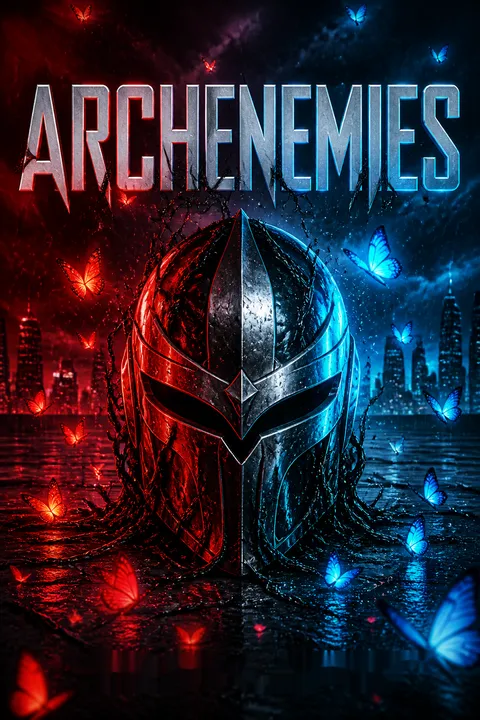


Plot Summary
The Hospital Runaway
Before dawn, Adrian Everhart leads his Renegade team against thieves escaping Gatlon City Hospital with stolen medicines. He sketches a strip of spikes across the road, stopping their van, but the criminals scatter when one opens fire.
His teammates Ruby, Oscar, and Danna help capture most of them, while Nova pursues the most dangerous thief, Hawthorn, whose six thorned limbs can climb walls and seize opponents. Hawthorn wounds Ruby and Danna, then escapes with a fellow thief and the remaining drugs.
Adrian secretly becomes the armored Sentinel and leaps onto a passing barge to stop her. Hawthorn overpowers him and throws him into the river. Nova watches the Sentinel sink, while the Renegades are left injured, short of medicine, and unsure whether the masked vigilante survived.
The opening mission makes the city’s institutional failures tangible: stolen hospital drugs threaten patients far beyond the immediate fight. Adrian’s secret intervention gives him an alternate route to justice, but Hawthorn’s escape turns that confidence into a public and private liability. His team can manage a coordinated response, yet the moment he acts alone, the Sentinel becomes vulnerable. Nova’s view of his apparent death also matters: the same event that looks like a failed rescue to the Renegades becomes a convenient disappearance for the Anarchists.
The Sentinel Goes Under
Adrian surfaces beneath a bridge, sheds the heavy armor, and realizes the Sentinel’s suit cannot keep water out. His drawing tools have fallen into the river, so he cannot even sketch himself dry clothes.
When his fathers, Council members Simon Westwood and Hugh Everhart, arrive to search for the Sentinel’s body, Adrian pretends he had been waiting nearby for the vigilante to surface. Nova studies his wet uniform but does not expose the lie. Simon instead scolds Adrian for abandoning his team without warning.
The reprimand strikes an old nerve: after the Detonator’s attack, Adrian already believes he failed to act decisively enough. Still searching for his murdered mother’s killer, he refuses to accept that Nightmare died in the same blast that killed the Detonator.
The river strips away the Sentinel’s glamour and exposes the practical cost of Adrian’s self-invention. His lie protects his secret, but it also makes him less reachable to the people whose trust he claims to serve. Simon’s criticism names the contradiction: Adrian wants the freedom to act alone while accepting the responsibilities of a team leader. His refusal to believe Nightmare is dead is not only optimism. It is an attempt to keep open the one lead that might connect the Anarchists to his mother’s murder.
A Cure Called Agent N
At a mandatory assembly, the Council publicly praises Nova for killing the Detonator and preventing further bombings. The recognition unsettles Nova because the dead woman had once been her ally, and because Nova knows her choice served both civilians and her Renegade cover.
The Council then unveils Agent N, a liquid developed from prodigy research that can permanently remove a person’s powers. To prove it works, the Renegades inject the imprisoned Puppeteer, Winston Pratt. His control over people vanishes as his puppetlike features dissolve, and the audience applauds.
During the confusion, Winston manipulates two young Renegades, but Danna stops one before she can attack a Council member. The Council orders patrols to train with the serum and authorizes its use against lawbreakers, including the missing Sentinel.
The demonstration turns an abstract policy into a bodily transformation witnessed by a cheering audience. Agent N promises safety without killing, but its permanence makes it a form of state power that reaches inside a person and alters the conditions of their identity. Nova notices what the crowd resists seeing: the Council has already tested the substance on prisoners and plans to distribute it before public debate. Her unease is sharpened by her own recent violence. She cannot dismiss force as inherently unjust when she has used it herself, so the scene begins a genuine moral conflict rather than a simple opposition.
The Helmet in the Vault
After accepting a position in the Renegades’ artifacts department, Nova searches the collection for Ace Anarchy’s helmet, hoping to restore the strength of the Anarchist leader she privately calls her uncle. The public display is only a replica. In the restricted vault, she learns the real helmet sits inside a solid chromium cube, made by Captain Chromium to keep it permanently inaccessible.
Her father’s bracelet tugs toward the imprisoned relic, hinting at a connection she cannot yet explain. Nova also finds her own old mask among recovered Anarchist belongings and secretly keeps it. She reports Agent N’s threat to Ace, who urges her to learn how to turn the serum against the Renegades and use Adrian’s trust to weaken his fathers.
Nova’s new job gives her access to the institution she intends to undermine, but it also reveals how thoroughly the Renegades curate public memory. The false helmet displayed for visitors and the real one sealed away make history itself another controlled artifact. Her bracelet’s response links family inheritance to the larger political struggle, though she does not yet know how. Ace’s advice makes affection instrumental, pressing Nova to treat Adrian as leverage. That demand sharpens the difference between the mission she has inherited and the relationships she is beginning to value.
Hettie’s Costly Secret
Adrian asks Hugh for permission to question Winston, hoping the former Puppeteer knows something about Lady Indomitable’s murder. Winston refuses to trade information until Adrian retrieves Hettie, the wooden marionette he remembers leaving in the abandoned subway station.
Adrian searches the stripped tunnels, finds evidence of the Renegades’ investigation, and arrives late at the Sidekick Olympics without the puppet. Later, he and Nova search the confiscated Anarchist belongings in her warehouse.
They find Hettie among the discarded possessions, and the artifacts supervisor confirms it has no hidden power. When Adrian brings it to Winston, Winston reveals that Nightmare survived the explosion at Cosmopolis Park. Adrian’s fathers dismiss the claim as manipulation, but Adrian cannot let go of the possibility.
Hettie is more than a bargaining chip. The puppet gives Winston a surviving link to a self that existed before his power defined him, while Adrian’s willingness to retrieve it shows how readily he follows an uncertain lead toward his mother’s past. The revelation exploits that vulnerability: Winston understands exactly which hope will keep Adrian searching. Yet Adrian’s suspicion is not merely gullibility. No body was found, and the official certainty around Nightmare’s death is weaker than it appears. The scene asks whether hope is a useful investigative instinct or a way of refusing grief.
A Dream Between Them
At the Sidekick Olympics, Ruby cheers for her younger brothers while Oscar joins in, and the group briefly enjoys a city that still believes in heroes. Nova tells Adrian about a childhood dream of ruined Gatlon and a hooded statue holding a star. At the statue glen, she admits she once believed the place belonged to her alone.
Their closeness builds, but when Nova leans in to kiss him, Adrian stands abruptly and avoids her gaze. Both mistake the other’s retreat for rejection. Later, Adrian finds Hettie and obtains Winston’s claim that Nightmare is alive. He also checks out a little-known medallion from the artifacts vault, a charm rumored to protect its wearer from forces that weaken them.
The statue glen gives Nova and Adrian a rare form of intimacy: each shares a private image shaped by fear, not a polished story meant to persuade. Their failed kiss shows how trauma can distort interpretation. Nova reads Adrian’s retreat as rejection, while his hesitation comes from uncertainty and his own guardedness. The scene also binds the star to their growing connection without explaining its power. By placing this private exchange beside their investigative work, the story lets tenderness develop inside, rather than outside, the conflict that threatens to destroy it.
A Charm Breaks Glass
Adrian tests the medallion on Max, the ten-year-old prodigy confined behind glass because his presence drains other people’s powers. Wearing the charm, Adrian crosses Max’s miniature city and embraces him without weakening. The discovery gives Max a first taste of ordinary brotherly closeness and offers Simon a way to enter the quarantine safely.
Nova sees what the charm means for Max, but also recognizes its possible value against Agent N. Max explains that he once asked the researchers to neutralize him, but the serum did not work. His request came from loneliness, not a wish to harm anyone. Adrian shares the charm’s significance with his fathers, then tattoos its protective symbol onto his own chest so the immunity will last.
The charm changes the quarantine from a sealed boundary into a relationship that can be crossed, even if it cannot yet free Max. Adrian’s experiment is an act of love disguised as a hypothesis, and Max’s startled acceptance reveals how long he has learned to treat touch as a danger to others. Nova sees the same discovery through two ethical lenses: it may protect people from coercion, but it could also help her attack the Renegades. The scene refuses to make the science morally self-explanatory. A protective tool acquires its meaning from the hands and intentions that use it.
A Weapon in the Making
During Agent N training, Nova challenges the Council about safeguards and consequences for misuse, then secretly swaps a real vial for a decoy she prepared with Leroy. She later studies the dangerous mist-missiles stored in the artifacts vault and works with Leroy to turn the stolen serum into a dispersal weapon.
Her own attempt to dissolve the chromium box through electrolysis fails spectacularly: the solution boils over, sprays the shelving, and leaves the helmet untouched. The failure does not end her pursuit. Adrian later confirms that Captain Chromium believes only he can open the container or break it with one of his own weapons. Nova now has a possible route to the helmet, but it depends on power rather than chemistry.
Nova’s scientific competence and political distrust reinforce each other. She does not steal Agent N because she misunderstands its danger; she steals it because she believes the Council will use it without adequate restraint. Yet her plan reproduces the same coercive logic she condemns, since the gas would strip powers from multiple targets without trial. The failed electrolysis is a useful limit on her ingenuity: knowledge does not guarantee control over materials or outcomes. Her next strategy will rely on a supernatural object and a weapon, making the gap between principled resistance and escalation harder to ignore.
Hawthorn Pays the Price
When the Council assigns Frostbite’s team to locate Hawthorn, Adrian follows their patrol despite orders to stay back. From a stack of shipping containers, he sees Frostbite use Turmoil’s Sound Deadener to conceal the team’s questioning.
After Hawthorn refuses to name her drug suppliers, Gargoyle crushes one of her thorned limbs, then another. Adrian knows Hawthorn helped steal hospital medicine and supply lethal drugs, but he also sees an immobilized prisoner being tortured for information. He intervenes as the Sentinel, attacks Gargoyle, and tries to free Hawthorn.
Frostbite’s team turns on him, using Aftershock’s earth-shaking power and Stingray’s venom to bring him down. When Adrian resists, Frostbite orders Gargoyle to kill Hawthorn. Adrian escapes with an ice wound as the team prepares to blame him.
Hawthorn’s crimes do not disappear, but they cannot legitimize what happens to her. The Sound Deadener turns a public code into a private performance: the team can act without witnesses and then remove the physical evidence by neutralizing its victim. Adrian’s intervention exposes his own compromised position. He has repeatedly justified breaking rules by appealing to outcomes, yet here he recognizes that the team’s claimed results cannot excuse cruelty. His defeat is not a simple victory for the code. It is evidence that procedure without accountability can be as dangerous as vigilantism.
A Jungle Made Real
Nova visits Adrian’s home intending to take the Vitality Charm. Instead, he shows her a living jungle mural inspired by her childhood dream, complete with the statue and a small star. Surrounded by the created landscape, Nova tells him that she witnessed a gunman murder her parents and baby sister, Evie, before Ace rescued her.
Adrian shares his own childhood nightmare about his mother’s fall. He draws noise-canceling headphones, and Nova falls asleep against him for nearly a full day, her first real sleep in years. After dinner with Adrian’s fathers and a private kiss, she puts Adrian to sleep and searches the house. She takes the charm and touches the mural’s star, which appears in her father’s bracelet.
The mural transforms Adrian’s drawing power from a tool of combat into a form of attentive care. He remembers Nova’s dream closely enough to give it a place in the world, and she responds by entrusting him with the memory she most fears being judged for. Her sleep suggests that safety can emerge through connection, though it does not erase the trauma that made sleep impossible. The star’s transfer into her bracelet makes intimacy materially consequential. Nova leaves with both a genuine emotional bond and the object she came to steal, unable to separate tenderness from deception.
One Butterfly Too Few
As Nova prepares to use the gala to enter headquarters, Danna sends a butterfly into the Anarchists’ catacombs to spy on her. Nova recognizes the danger and helps the group capture the insect before it reaches a candle flame. Keeping one butterfly separated prevents Danna from returning to human form, so the Anarchists hold it inside a pillowcase rather than kill it.
Nova tells Ace that the Renegades have Agent N and that she has built a gas weapon with Leroy’s help. Ace urges her to retrieve his helmet and treats the serum as a means to defeat their enemies. Nova’s earlier doubts remain, but the plan is set: Honey will handle her wristband and Leroy will wait as her driver.
The captured butterfly makes Nova’s divided loyalties visible as a practical danger. She prevents Danna from discovering the Anarchists’ refuge, but her choice also places a teammate in captivity. Her compassion stops short of releasing the spy because protecting Ace and the mission still outranks trust. Ace’s insistence that Agent N can serve their cause echoes the Council’s own language of necessity. Nova recognizes the resemblance, yet she has not found a way to oppose one coercive system without strengthening another.
A Kiss Before the Break-In
Nova attends the Renegade gala as Adrian’s date, wearing a dress chosen by Honey and concealing the Vitality Charm beneath it. She and Adrian dance, discuss their attraction, and share a kiss that turns their tentative closeness into something neither can dismiss. Nova leaves early under the pretense that her uncle is ill, then meets Leroy, trades her Renegade uniform for her Nightmare costume, and climbs into headquarters through a broken window.
She incapacitates a passing administrator, takes her access card, and reaches the security center. Stingray catches her there, but she uses her sleep power and the charm protects her from his venom. Nova disables the building’s cameras, retrieves Captain Chromium’s pike, and heads for the vault.
The gala gives Nova the public recognition she has been impersonating and the private affection she has begun to feel honestly. The kiss intensifies rather than resolves her conflict because she leaves immediately afterward to betray the people who welcomed her. Her disguise change marks the cost of maintaining two selves, while the charm’s protection lets her cross a threshold that would otherwise expose her to venom. The chapter’s emotional and tactical movements run in opposite directions: she becomes more intimate with Adrian as she becomes more committed to an attack that will wound him.
The Sentinel Unmasked
After the gala, a lone monarch butterfly leads Adrian toward the ruined cathedral, where Phobia attacks him with the image of his dead mother falling from the sky. Adrian begins to reveal the Sentinel’s armor, but Ruby and Oscar arrive before Phobia can finish him.
Danna’s swarm scatters the fear-shaped crows, and the butterflies gather on Adrian, giving him a chance to remove his visor. Ruby and Oscar learn that their team leader is the vigilante they have been ordered to stop.
Together they descend hidden stairs beneath the cathedral and find Ace Anarchy alive in the catacombs. Ace traps Ruby and Oscar in a stone coffin, but Adrian escapes his telekinetic hold with a bomb drawn into the dusty wall and stuns him with a concussion beam. The Renegades take Ace into custody.
Phobia attacks Adrian where his power cannot help: the childhood fear that his mother’s death was inevitable and that he was helpless to prevent it. The illusion nearly exposes his secret, while Danna’s swarm creates the interruption that makes honesty possible. Ruby and Oscar’s discovery threatens the trust Adrian has withheld from them, but it also gives him allies for the confrontation below the cathedral. Ace’s survival reframes the conflict as unfinished history rather than a settled victory. Capturing him answers one mystery while placing the Anarchists’ future in immediate danger.
The Helmet and the Boy
While Adrian is underground, Nova reaches the vault, knocks Callum unconscious, and uses Captain Chromium’s pike to shatter the container holding Ace’s helmet. She carries the relic into the lobby, where Frostbite’s team traps her in ice and fires an Agent N dart at her chest.
The Vitality Charm protects Nova, allowing her to release the gas weapon. Gargoyle loses his stone powers, and Nova uses a second device against Frostbite and Aftershock. Aftershock’s earthquake splits the lobby and collapses Max’s glass quarantine.
Max uses stolen powers to fight for the helmet, but a spear meant for Nova pierces him instead. Nova pulls it free and tries to stop the bleeding. The Sentinel arrives; Nova grabs the helmet and flees, leaving Max critically wounded.
The fight brings the story’s competing claims about protection into one shattered room. Nova uses the charm to survive the Renegades’ irreversible weapon, then uses her own gas weapon to strip powers from her opponents. Her act is both resistance and repetition. The collapse of Max’s quarantine literalizes the damage caused when institutions and insurgents treat a child as strategic property. Nova’s decision to help Max after securing the helmet interrupts her mission, but does not undo the wound or restore the home she has destroyed.
A Promise Made in Hiding
Adrian carries Max to a hospital, where he insists on a civilian doctor because Max’s power could drain a prodigy healer. Max is taken into emergency treatment, and Adrian leaves before his fathers can confront him.
The Renegades retrieve Ace from the catacombs, while Nova returns to the Anarchists’ house with the helmet hidden in a closet. She learns that Ace is in custody and that the Sentinel has been credited with his capture. Adrian visits her exhausted and grieving, believing her innocent; he tells her Nightmare attacked Max and asks her to help find the villain.
Nova says she will help, while staring past him at Ace’s hidden helmet. Max’s condition remains unknown, the Renegades have not uncovered Nova’s identity, and Adrian still does not know that the person he trusts has wounded his brother.
The ending refuses the relief of a solved conflict. Ace is captured, Max’s survival is uncertain, and Nova has lost the simple hope that recovering the helmet would settle her loyalties. Adrian’s request makes the romance ethically urgent: he entrusts Nova with the hunt for the very person she is concealing from him. Her agreement is not a clean return to the Anarchists or a genuine confession to the Renegades. It is another delay, now made more painful by the knowledge that Max’s injury resulted from her choices.
Analysis
Archenemies is organized around competing claims to protection. The Renegades say their authority prevents another Age of Anarchy, while the Anarchists insist that the same authority has become a new form of domination. Agent N gives that argument a concrete instrument: it can stop a prodigy without killing them, but it can also erase a person’s abilities permanently, without the deliberation a punishment of that magnitude demands. The novel keeps the question difficult by refusing to make every target innocent. Hawthorn has helped divert medicine into a lethal drug trade, and the Puppeteer has controlled children. Their crimes are serious; so is the temptation to treat guilt as permission for any response.
Nova and Adrian embody opposing failures of certainty. Nova’s childhood loss teaches her that institutions may not arrive in time, so she plans for self-reliance and revenge. Adrian trusts the Renegades’ code but secretly becomes the Sentinel when he believes its limits prevent him from helping. Each sees a genuine weakness in the other’s worldview. Nova understands how power concentrates behind the language of public safety. Adrian understands that unaccountable action can disguise a private agenda as justice. Their affection does not bridge those differences; it makes the consequences of betrayal personal.
The story’s objects carry these ethical conflicts into the physical world. The helmet concentrates revolutionary power, the chromium cube turns that power into a controlled secret, and the Vitality Charm makes safe contact possible where quarantine had ruled. Adrian’s mural offers a different kind of making: not a weapon or an instrument of rule, but a shared place built from careful attention to Nova’s memory. The final catastrophe tests whether such connection can survive competing loyalties. Nova saves Max after helping endanger him, Adrian trusts her without knowing what she has done, and Ace is captured while his helmet remains hidden. The book closes not with reconciliation, but with an unstable choice: Nova agrees to help hunt Nightmare, knowing that she is the person Adrian wants to find.
Review Summary
Archenemies receives mostly positive reviews, with readers praising the character development, moral complexity, and thrilling plot. Many find it an improvement over the first book, highlighting the exploration of hero-villain dynamics and the slow-burn romance. Some criticize pacing issues and similarities to X-Men. The cliffhanger ending leaves readers eager for the final installment. While opinions vary on the romance and dialogue, most agree the series is engaging and entertaining, with Meyer's writing style keeping readers invested in the characters and story.
People Also Read

Characters
Nova McLain
Insomniac Renegade recruitNova is a guarded young prodigy who can put people to sleep through touch and has spent years learning to stay alert when everyone else rests. Her vigilance makes her an incisive observer, but it also keeps her emotionally distant and suspicious of easy assurances. She is drawn to invention, especially when it offers a practical answer to an immediate threat. Nova’s experience of loss shapes her deep skepticism toward institutions that promise protection, while her growing ties to her teammates complicate her certainty about who deserves trust. Her arc is driven by the tension between self-protection, loyalty, and the possibility that genuine connection can change what she believes.
Adrian Everhart
Artist and team leaderAdrian is a thoughtful Renegade whose power brings his drawings into physical form. He leads his patrol team with warmth and humor, though his instinct to help can become a dangerous need to act without support. The son of Captain Chromium and the Dread Warden, and the child of the late Lady Indomitable, he lives under both family legacy and public expectation. Art gives him a way to imagine solutions that force alone cannot provide. He is drawn to people who question easy rules, particularly Nova, but his desire to protect others often coexists with secrets he believes are necessary. His central struggle is how to reconcile personal conviction with responsibility to a community.
Ace Anarchy
Revolutionary prodigy leaderAce Anarchy is the legendary figure behind the revolution that ended generations of fear and persecution for prodigies. His political vision is bound to personal authority: he sees himself as the guardian of a future that others have failed to build. He values loyalty and strategic patience, and he expects the people around him to accept sacrifice in service of a larger cause. Years of isolation and failing health have narrowed his world, intensifying the gap between the ideals he invokes and the coercive methods he supports. For Nova, he is both a rescuer and a source of inherited obligation.
Max
Quarantined power absorberMax is a ten-year-old prodigy who absorbs abilities from other prodigies, making ordinary closeness dangerous for him and for them. Kept behind glass at Renegade Headquarters, he has built a miniature city that lets him shape a world he cannot freely enter. He is clever, observant, and funny, but his isolation has taught him to describe his own confinement as necessary. Max wants contact and agency as much as he wants safety. His relationships with Adrian, Hugh, and Simon expose the emotional cost of treating a child chiefly as a risk or resource.
Simon Westwood
Invisible father and CouncilorSimon, known publicly as the Dread Warden, is a founding Renegade and Adrian’s father. His power lets him turn invisible, while his parenting tends toward patient advice and concern for teamwork. He wants Adrian to understand that courage does not excuse recklessness, but his public duties can leave difficult conversations postponed. Simon’s careful manner gives him authority without the spectacle of Captain Chromium’s reputation. His bond with Adrian and Max reflects a genuine effort to care for his family inside an organization whose demands often compete with private life.
Hugh Everhart
Invincible Council leaderHugh, Captain Chromium, is Adrian’s father and one of the Renegades’ most celebrated leaders. His near-invulnerability and chromium weapons make him a powerful public symbol, but at home he is affectionate, playful, and eager to encourage his sons. Hugh believes organization and the code protect people from the chaos of unchecked power. That confidence can make him slow to recognize the risks built into Renegade authority. He wants to be both an effective leader and a present father, though the two roles do not always fit neatly together.
Danna Bell
Butterfly-swarm teammateDanna, known as Monarch, can transform herself into a swarm of butterflies. She is witty, sociable, and quick to notice tension among her teammates, often puncturing solemnity with humor. Her ability makes her a skilled scout, but its dependence on the swarm creates vulnerabilities that others can exploit. Danna values loyalty and expects honesty from the people she trusts. Her warmth does not make her naïve; she watches closely when a teammate’s behavior stops matching their explanations.
Ruby Tucker
Bloodstone-armed RenegadeRuby, the Red Assassin, turns her blood into sharp red crystals when she is wounded, and uses a bloodstone grappling hook in combat. She is fierce, funny, and protective of her younger brothers, whom she wants to see included in the world she has entered. Ruby’s banter with Oscar often masks how carefully she watches the people she loves. She prizes teamwork and loyalty, but she is not afraid to challenge Adrian when his choices affect the whole group.
Oscar Silva
Smoke-summoning teammateOscar, called Smokescreen, can create and direct smoke and vapor. He uses a cane for support and often turns difficult moments into jokes, while his confidence around strangers conceals uncertainty about whether Ruby could see him as more than a friend. He is loyal to his team and attentive to the people around him, even when he pretends to care chiefly about food or applause. His humor functions as both social skill and protective armor.
Callum Treadwell
Wonder-minded archivistCallum works in the artifacts department and is fascinated by the history, engineering, and human imagination behind the objects in its vault. His prodigy ability can make other people perceive the wonders around them, a power he uses more to invite perspective than to dominate. Callum is earnest, talkative, and unusually attentive to beauty in a damaged city. He believes creation offers a better foundation for society than revenge, though Nova’s experience makes that faith difficult for her to accept.
Genissa Clark
Ice-wielding squad captainGenissa, known as Frostbite, creates weapons and restraints from ice. She leads a prominent Renegade patrol team and takes pride in efficiency, status, and decisive action. Her confidence in the Council’s authority leaves little room for doubt about who deserves protection or punishment. She can be disciplined and effective, but her contempt for those she considers weak or disobedient reveals how easily public service can become a claim to personal power.
Hawthorn
Thorn-limbed drug thiefHawthorn is a prodigy criminal whose six barbed limbs give her the strength and reach to climb buildings and fight at close range. She participates in the theft of medicines from Gatlon City Hospital and proves difficult for the Renegades to restrain. Her actions make her a real danger to the city, while her treatment exposes the difference between capturing a criminal and abusing one.
Winston Pratt
Marionette-controlling prisonerWinston, formerly known as the Puppeteer, controls people through golden strings attached to his fingers. His theatrical manner can seem childish, but he is perceptive about other people’s hopes and skilled at using them as bargaining tools. He has a history of targeting children, a cruelty that makes sympathy for him difficult even when his circumstances change. His attachment to a childhood puppet hints at a private history beneath the villainous persona.
Honey Harper
Queen of the insectsHoney, called Queen Bee, controls bees, hornets, and wasps. She is theatrical, stylish, and fond of attention, but also deeply loyal to the people she considers family. Her care for Ace often arrives disguised as teasing or fussing. Honey misses the comfort and status she once enjoyed and wants the Anarchists to reclaim what they lost. Her sharp humor makes her seem careless, though she understands the emotional power of belonging and persuasion.
Leroy Flinn
Chemist with acidic skinLeroy, known as Cyanide, produces acidic poisons through his skin and has a background in chemistry. Scars mark his face, a reminder of violence that shaped his distrust of others. He is practical, technically skilled, and more cautious than some of his allies. Leroy helps turn ideas into workable devices, but his competence does not settle the question of how those devices should be used.
Phobia
Fear-shaped AnarchistPhobia can embody different fears through his body and scythe, making him difficult to understand or predict. He speaks rarely, often in unsettling observations that seem aimed at the weakness others are trying to hide. His silence gives him an air of menace, while his loyalty to Ace places him within the Anarchists’ inner circle. Phobia’s power makes fear both his weapon and his language.
The Renegade Council
Leaders of the new orderThe Council includes Captain Chromium, the Dread Warden, Tsunami, Thunderbird, and Blacklight. They lead the Renegades and shape the laws governing prodigies after the Age of Anarchy. Their stated purpose is to protect civilians and prevent the return of villain rule. Their history gives them legitimacy, but their control over lawmaking, enforcement, and public messaging creates a persistent question about who can hold the protectors accountable.
Plot Devices
Adrian’s living tattoos
Drawn powers made permanentAdrian can bring ordinary sketches to life, but his more secretive use of drawing is to ink designs onto his skin and give himself new abilities. Tattoos transform him into the Sentinel, whose armor, weapons, and physical powers let him operate outside official Renegade rules. The device connects his artistic imagination to his growing desire for direct action. It also creates a cost: each new power helps him solve immediate problems while deepening the secrecy that separates him from his team and family.
Agent N
Permanent power removalAgent N is a serum developed from prodigy research that strips a prodigy of their abilities when it reaches the bloodstream and brain. The Council presents it as a nonlethal way to stop dangerous offenders, then demonstrates it on Winston and plans to equip patrol units with the substance. Nova steals a sample and, with Leroy, adapts it into a gas dispersal weapon. Its central function is to make a supposedly safer form of punishment possible while raising the risk of permanent abuse by whoever controls it.
The Vitality Charm
A ward against weakeningThis old medallion is said to protect its wearer from illness, poison, and other forces that weaken the body or its powers. Adrian tests it by entering Max’s quarantine and discovers that he can approach and touch his brother without losing his abilities. The charm gives Simon a chance to do the same and later protects Nova from Stingray’s venom and an Agent N dart. It turns an overlooked artifact into a bridge between people, but also gives Nova the protection she needs to carry out her plan.
Ace’s chromium helmet
Power locked in a cubeAce Anarchy’s helmet amplifies his telekinetic power, making it the object on which the Anarchists base their hopes of restoring his strength. Captain Chromium seals it inside an indestructible chromium cube and lets the public believe the helmet was destroyed. Nova finds the real container in the artifacts vault, tries to dissolve it through electrolysis, then uses Captain Chromium’s pike to shatter it. The helmet’s recovery turns a secret relic into an immediate threat and gives Nova a reason to raid Renegade Headquarters.
Danna’s butterfly swarm
A scout with a weaknessDanna can disperse into a swarm of monarch butterflies, using them to scout and travel through spaces a human body could not reach. The ability gives the Renegades valuable surveillance, but a single butterfly separated from the swarm prevents her from returning to human form. Nova’s allies exploit that weakness by trapping one butterfly, while another later guides Adrian to the Anarchists’ hidden refuge. The swarm works as both a spy network and a fragile connection between Danna’s physical safety and the people she trusts.
FAQ
Synopsis & Basic Details
What is Archenemies about?
- Dual Protagonist Perspectives: Archenemies continues the story of Nova Artino (Insomnia), an Anarchist spy infiltrating the Renegades, and Adrian Everhart (Sketch), a Renegade leader with a secret identity. The narrative follows their intertwined paths as Nova seeks to dismantle the Renegades from within while grappling with her growing feelings for Adrian, and Adrian pursues justice for his mother's murder, unaware of Nova's true allegiance.
- The Threat of Agent N: A central conflict emerges with the Renegades' development and planned deployment of Agent N, a serum capable of permanently neutralizing prodigy powers. This new weapon sparks ethical debates within the organization and becomes a critical target for the Anarchists, who see it as an existential threat to their existence and prodigy rights.
- Secrets, Lies, and Shifting Loyalties: The plot is driven by layers of deception, including Nova's hidden Anarchist identity, Adrian's secret life as the vigilante Sentinel, and the true status of key figures like Ace Anarchy and Nightmare. Characters are forced to question their allegiances and the blurred lines between heroism and villainy in Gatlon City.
Why should I read Archenemies?
- Deep Dive into Moral Ambiguity: The book excels at exploring the gray areas between good and evil, challenging conventional superhero tropes. Readers are prompted to question the Renegades' authority and methods, as well as the Anarchists' justifications for their actions, offering a nuanced perspective on power and justice.
- Complex Character Development: Archenemies delves deeply into the psychological and emotional struggles of its protagonists and supporting cast. Nova's internal conflict, Adrian's quest for identity and justice, and the dynamics within both the Renegade team and the Anarchist remnants provide compelling character arcs that resonate beyond the action.
- Intriguing World-Building & Mystery: The story expands on the established world of Gatlon City, introducing new locations like the artifacts vault and delving into the history of prodigies and artifacts. Mysteries surrounding Ace Anarchy's fate, Nightmare's survival, and the true capabilities of various powers and objects keep the reader engaged.
What is the background of Archenemies?
- Post-Age of Anarchy Gatlon City: The story is set roughly ten years after the Age of Anarchy, a period of chaos and villain rule initiated by Ace Anarchy. Gatlon City is now governed by the Renegades, a council of superheroes who established order and a strict code of conduct for all prodigies.
- Renegade Authority vs. Anarchist Resistance: The core conflict stems from the ideological clash between the Renegades, who believe in regulated power and public safety above all, and the Anarchists, who advocate for prodigy freedom and autonomy, often through rebellious or violent means.
- Prodigy Powers and Society: The world is populated by individuals with extraordinary abilities ("prodigies"), whose powers range widely. Society's relationship with prodigies is complex, marked by both reliance on heroes and fear of unchecked power, a dynamic the Renegades attempt to control through their code and, now, Agent N.
What are the most memorable quotes in Archenemies?
- "One cannot be brave who has no fear.": This recurring phrase, found on Lady Indomitable's body and later spoken by Nightmare, serves as a haunting thematic echo connecting Adrian's past, his mother's death, and the Anarchist ideology, suggesting that true courage requires confronting one's deepest fears.
- "There is no I in hero.": Simon Westwood, the Dread Warden, uses this classic adage to remind Adrian of the importance of teamwork and collective responsibility within the Renegades, directly contrasting with Adrian's secret solo missions as the Sentinel and highlighting the tension between individual action and organizational code.
- "Either you're a Renegade, or you're a villain.": Frostbite delivers this stark, black-and-white declaration to the Sentinel, encapsulating the rigid dichotomy the Renegades often impose on the world and directly challenging the nuanced reality of characters like Adrian and Nova, who operate in the moral gray.
What writing style, narrative choices, and literary techniques does Marissa Meyer use?
- Alternating First-Person Perspectives: The novel primarily uses alternating first-person point-of-view chapters between Nova and Adrian. This choice allows readers intimate access to each character's thoughts, motivations, and internal conflicts, building suspense as their secrets and conflicting goals become increasingly apparent to the reader, even when hidden from each other.
- Fast-Paced, Action-Oriented Prose: Meyer employs a clear, direct writing style that keeps the plot moving quickly, particularly during action sequences and confrontations. The prose is accessible, focusing on character reactions and immediate sensory details during tense moments, making it a compelling read for the young adult audience.
- Symbolism and Motif Integration: Subtle symbolic elements, such as Adrian's art coming to life (representing creation vs. destruction), Nova's sleeplessness (representing her constant vigilance and inability to rest from her mission), and recurring objects like masks and specific artifacts, are woven throughout the narrative to deepen thematic resonance without being overly explicit.
Hidden Details & Subtle Connections
What are some minor details that add significant meaning?
- The Crumbling Cathedral Ruins: The dilapidated state of the cathedral, Ace Anarchy's former sanctuary, symbolizes the Anarchists' current weakened and fragmented state. Its decay mirrors Ace's declining health and the fading hope of their revolution, contrasting sharply with the gleaming, modern Renegade Headquarters.
- Callum's "Wonder" Power: Callum Treadwell's seemingly minor ability to make people see the "wonders" of the world is more than just a quirk; it represents an alternative, non-combative form of prodigy influence. His philosophical musings on creation versus destruction and his ability to shift perspective offer a subtle counterpoint to the dominant power struggles and violence, suggesting a different path for prodigies and humanity.
- The Significance of Nova's Bracelet: Nova's filigree bracelet, made by her father, is initially presented as a sentimental object. However, its reaction to Ace's helmet and the star from Adrian's mural reveals it's made of the same unique material as the helmet, hinting at a deeper connection between Nova's family, Ace, and this powerful energy source, foreshadowing its importance in future events.
What are some subtle foreshadowing and callbacks?
- Adrian's Recurring Nightmare: Adrian's childhood nightmare of his mother falling, unable to fly, foreshadows the revelation that Lady Indomitable's death was not a simple accident but likely caused by a power that neutralized her flight. This callback to his past trauma fuels his relentless pursuit of her killer and connects directly to the Anarchist phrase found on her body.
- The Metronome's Ticking: Turmoil's Sound Deadener, the metronome, is introduced casually as an artifact available for rent. Its distinctive ticking sound becomes a crucial plot device later, used by Frostbite's team to mask their torture of Hawthorn, highlighting how seemingly innocuous objects in the Renegades' collection can be weaponized for morally questionable purposes.
- Winston Pratt's Unconvincing Demise: Despite the Renegades' belief that Nightmare is dead, Winston Pratt's insistence that she is alive, coupled with Adrian's own lingering doubts due to the lack of a body, subtly foreshadows Nova's survival and the eventual reveal of her dual identity, maintaining narrative tension around her secret.
What are some unexpected character connections?
- Max's Link to Agent N: The revelation that Agent N was developed using Max's power-absorbing abilities creates an unexpected and disturbing connection between the isolated child and the Renegades' controversial weapon. This highlights the ethical cost of the serum and positions Max not just as a ward but as a crucial, perhaps exploited, resource for the Renegades.
- Adrian's Mural and Nova's Dream: Adrian's decision to paint a mural based on Nova's childhood dream of a post-apocalyptic jungle city with a statue holding a star is a deeply personal and unexpected connection. It shows the depth of his feelings and empathy for her, while also hinting at a shared subconscious space or destiny, culminating in the literal manifestation of the star in her bracelet.
- Danna's Butterfly as a Spy: Danna's ability to transform into a swarm of butterflies is used in unexpected ways, including sending a single butterfly to spy on Nova and the Anarchists. This reveals a hidden layer of suspicion and surveillance within the Renegades, showing that trust is not as absolute as it appears, and foreshadowing Danna's potential role in uncovering Nova's secret.
Who are the most significant supporting characters?
- Max (The Bandit): Max is pivotal not only as the source of Agent N but also as a symbol of the Renegades' complex relationship with prodigy power. His isolation and Adrian's efforts to connect with him highlight themes of freedom, control, and the human cost of extraordinary abilities, driving a key emotional arc for Adrian.
- Winston Pratt (The Puppeteer): Though quickly neutralized, Winston serves as a crucial plot device, confirming Nightmare's survival and providing Adrian with a lead in his investigation. His transformation by Agent N also offers a chilling demonstration of the serum's effects and raises questions about the fate of neutralized prodigies.
- Callum Treadwell (Wonder): Callum's unique perspective and power to reveal the world's wonders provide a philosophical counterpoint to the story's conflict. His interactions with Nova challenge her cynical worldview and offer moments of unexpected beauty and reflection, adding thematic depth beyond the hero-villain dynamic.
Psychological, Emotional, & Relational Analysis
What are some unspoken motivations of the characters?
- Nova's Need for Belonging: Beyond her mission for Ace and revenge for her family, Nova subtly yearns for acceptance and belonging, which she finds unexpectedly within Adrian's team. Her internal conflict stems from the clash between her Anarchist identity and the genuine connections she forms, particularly with Adrian, creating a deep emotional struggle.
- Adrian's Desire for Control: Adrian's secret identity as the Sentinel is partly driven by a need for control in a world where he feels powerless to prevent tragedy (like his mother's death or the carnival bombing). His vigilante actions allow him to operate outside the constraints of the Renegade code, giving him a sense of agency and effectiveness that his official role sometimes lacks.
- Honey's Nostalgia for Power: Honey's seemingly superficial focus on appearance and parties masks a deep-seated longing for the power and prestige the Anarchists held during the Age of Anarchy. Her encouragement of Nova to exploit Adrian's affection is not just strategic but also fueled by a desire to reclaim their former glory and status.
What psychological complexities do the characters exhibit?
- Trauma and Coping Mechanisms: Both Adrian and Nova exhibit complex psychological responses to childhood trauma. Adrian's recurring nightmares and need for control as the Sentinel, and Nova's insomnia and relentless pursuit of revenge, are coping mechanisms developed in response to witnessing the murders of their loved ones, shaping their identities and actions.
- Dual Identity Strain: Nova's constant performance as a Renegade while secretly being an Anarchist creates significant psychological strain. She experiences cognitive dissonance, guilt over her betrayals (especially towards Ingrid and Winston), and confusion as her genuine feelings for Adrian and his team complicate her mission, leading to moments of emotional vulnerability and lashing out.
- The Burden of Legacy: Adrian grapples with the psychological pressure of living up to the legacies of his famous superhero parents, Captain Chromium and Lady Indomitable. This burden contributes to his self-doubt and fuels his need to prove himself, both within the Renegades and as the Sentinel, impacting his decisions and interactions.
What are the major emotional turning points?
- The Agent N Demonstration: Witnessing Winston Pratt's neutralization by Agent N is a major emotional turning point for Nova, solidifying her opposition to the serum and the Renegades' unchecked power. It transforms Agent N from a theoretical threat into a horrifying reality, intensifying her resolve and highlighting the moral stakes of her mission.
- Adrian's Breakthrough with Max: Adrian's successful use of the Vitality Charm to interact with Max is a profoundly emotional moment, breaking years of physical and emotional separation. This breakthrough offers Adrian hope and reinforces his belief in finding alternative solutions outside the Renegades' established methods, deepening his bond with Max and challenging the status quo.
- Nova's Confession and Kiss with Adrian: Nova's decision to confess her trauma to Adrian and their subsequent kiss marks a critical emotional turning point in their relationship. It signifies a moment of genuine connection and vulnerability, forcing Nova to confront her feelings for Adrian and the potential cost of her mission, adding significant emotional weight to her choices.
How do relationship dynamics evolve?
- Adrian and Nova's Deepening Connection: Their relationship evolves from cautious teammates to a complex bond marked by mutual respect, vulnerability, and romantic tension. Despite the secrets they keep, their shared experiences and emotional confessions create a genuine connection that complicates Nova's mission and challenges Adrian's perceptions.
- The Renegade Team's Loyalty Tested: The loyalty within Adrian's team (Sketch, Insomnia, Monarch, Smokescreen, Red Assassin) is tested by external threats and internal secrets. While they demonstrate strong camaraderie and support for each other, Adrian's secret identity as the Sentinel and Nova's Anarchist allegiance create underlying tensions that threaten to fracture their bond.
- Anarchist Unity Under Strain: The Anarchists' relationships are strained by Ace's declining health, the loss of members like Ingrid and Winston, and the emergence of Agent N. While they remain loyal to Ace and their cause, disagreements arise regarding strategy and the ethical implications of their actions, highlighting the fragility of their unity in the face of overwhelming odds.
Interpretation & Debate
Which parts of the story remain ambiguous or open-ended?
- The True Nature of the Star: The small, glowing star that appears in Nova's bracelet after she touches the statue in Adrian's mural remains highly ambiguous. Its origin (dream, art, magic, prodigy power?) and its potential significance or abilities are left unexplained, hinting at a deeper, possibly mystical, layer to Nova's connection to her father's creations and Adrian's art.
- Phobia's True Identity and Motivations: Despite his prominent presence and terrifying power, Phobia remains largely enigmatic. His origins, his face hidden by his cloak, and his specific fears are left undefined, making him a symbol of the unknown and the psychological terrors he embodies, leaving his ultimate goals and vulnerabilities open to interpretation.
- The Long-Term Effects of Agent N: While the immediate effect of Agent N is clear (neutralization), the long-term physical and psychological consequences for those who receive it remain somewhat ambiguous. The counselor's comments about "relief" and "psychological ramifications" suggest ongoing effects that are not fully understood, leaving the true cost of the serum open to future exploration.
What are some debatable, controversial scenes or moments in Archenemies?
- The Use of Agent N on Winston Pratt: The public neutralization of Winston Pratt, the Puppeteer, is highly debatable. While he is a convicted criminal, stripping him of his powers without a formal trial specifically for this purpose raises significant ethical questions about the Renegades' authority, due process, and whether the punishment fits the crime, particularly as it's used as a demonstration rather than a standard legal consequence.
- Frostbite's Team Torturing Hawthorn: The scene where Frostbite's team tortures Hawthorn to extract information is morally reprehensible and highly controversial. It directly contradicts the Renegade code of upholding justice and protecting civilians, highlighting the hypocrisy and potential for abuse within the organization and sparking debate about whether the ends (catching criminals) justify such brutal means.
- The Sentinel's Actions at the Shipyard: The Sentinel's intervention at the shipyard, culminating in Hawthorn's death (though framed by Frostbite's team), is debatable. While Adrian believes he is acting for justice, his decision to operate outside the law and engage in a violent confrontation, even against corrupt Renegades, raises questions about whether his vigilante actions are truly heroic or simply another form of unchecked power.
Archenemies Ending Explained: How It Ends & What It Means
- Ace Anarchy's Capture and Agent N's Public Debut: The climax sees Nova successfully retrieve Ace's helmet, but Ace is simultaneously captured by the Sentinel (Adrian). This means the Anarchists gain their symbol of power but lose their leader, while the Renegades capture their greatest enemy and plan to use him as the first public demonstration of Agent N's effectiveness, setting up a major conflict for the next book.
- Max's Injury and the Sentinel's Identity Revealed to Team: During the chaos at HQ, Max is gravely injured by Frostbite's pike, and Nova, despite her mission, prioritizes saving him. Adrian arrives as the Sentinel, witnesses Max's injury, and is forced to reveal his secret identity to Ruby and Oscar to get help. This shatters his secret life and forces his closest friends to confront his deception, fundamentally changing their relationships.
- Nightmare's Survival Confirmed, Alliance with Adrian Tested: Nova escapes with the helmet, confirming her survival to the Renegades and the public. Adrian, believing Nightmare tried to kill Max, vows to destroy her and asks Nova (unaware of her identity) for help. The ending leaves Nova in possession of the helmet but facing the potential death of Max (whom she cares for) and the direct opposition of Adrian, whom she has feelings for, setting up a devastating conflict where her dual identities are on a collision course.
Renegades Series
About the Author


Download PDF
Download EPUB
.epub digital book format is ideal for reading ebooks on phones, tablets, and e-readers.








