

Key Takeaways
Treat long-range forecasts as conditional, not as promises
Tiny errors compound. In 1961, meteorologist Edward Lorenz restarted a weather simulation using numbers copied from an earlier printout. The computer had stored six decimal places, but the printout showed only three. That small rounding difference sent the simulated weather down a dramatically different path. The equations had not changed; the starting conditions had changed slightly, and the outcomes soon bore no resemblance to one another.
Forecasts have horizons. Lorenz’s discovery helps explain why weather predictions lose reliability over time. The best forecasts described in the book were useful for a few days, but beyond six or seven days they were effectively worthless. The Butterfly Effect names this sensitivity: a tiny disturbance can grow until it changes large-scale outcomes. It does not mean every butterfly causes a storm. It means weather observations can never be precise enough to support unlimited prediction.
What's striking is that Lorenz found a limit on knowledge, not a flaw in physical law. The atmosphere can follow deterministic equations while remaining practically unpredictable because measurements are incomplete and errors grow. This distinction matters well beyond meteorology: a forecast can be scientifically grounded without being certain. Modern forecasting manages the problem with repeated simulations and ranges of possible outcomes rather than a single confident trajectory. Chaos does not make short-term forecasts useless. It makes their uncertainty part of the result, not an embarrassing footnote.
Do not mistake deterministic rules for predictable outcomes
Feedback changes the game. A nonlinear system is one in which effects are not simply proportional to causes. In a linear system, doubling an input doubles the output. In a nonlinear one, changing the input can alter the system's behavior in a disproportionate or qualitatively different way. Such systems are difficult to solve, but they can generate intricate motion from simple rules.
The waterwheel turns strangely. In Lorenz’s model, water fills buckets on a wheel. A slow flow leaves the wheel still; a stronger flow sets it spinning. At a still higher flow, buckets may remain heavy as they rise, slowing and reversing the wheel. Its motion becomes irregular even though the inflow and the rules remain constant. This is deterministic chaos: a system governed by rules that produces behavior difficult to predict over time.
This challenges a familiar but often invisible assumption: that complicated behavior must have complicated causes. In nonlinear systems, feedback can amplify small differences and make the whole behave in ways no component suggests on its own. Similar reasoning informs control engineering, where a regulator can stabilize a process at one setting and destabilize it at another. The caution is that irregularity alone does not prove chaos. Random disturbances can also produce erratic data, so researchers need evidence of a rule-governed structure, not merely a jagged graph.
Map a system's long-run motion, not just its equations
Turn motion into a map. Phase space is an abstract space in which each point represents a system’s complete state at one moment. For a pendulum, position and velocity locate the point. As the pendulum moves, the point traces a path. A repeating loop signals periodic motion; a point toward which paths converge signals a steady state.
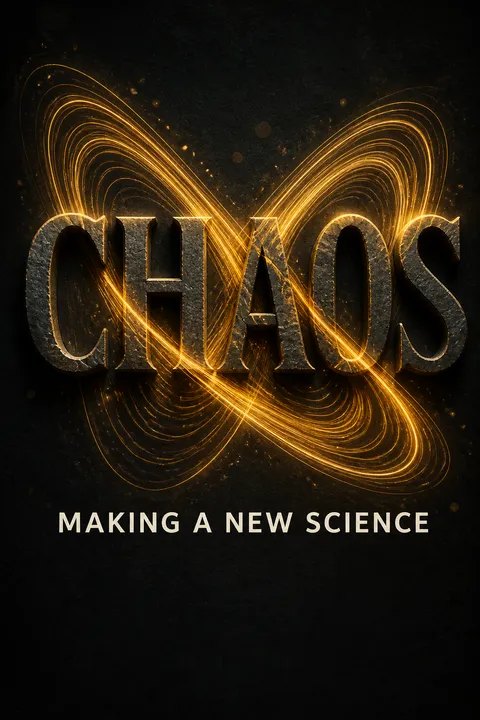
Chaos has a shape. Lorenz’s three-variable weather model did not settle into a point or repeat a loop. Its trajectory stayed within bounds while circling endlessly around a two-winged form, now called the Lorenz attractor. An attractor is the long-run pattern toward which a system’s motion tends. Here, the path never repeats, yet its overall shape persists. The picture revealed structure in data that otherwise looked random.
Phase space is powerful because it shifts attention from isolated measurements to relationships among variables over time. That is a useful move in fields such as neuroscience, where a single reading may mean little without its trajectory and context. Still, a visual pattern is a model of behavior, not automatically an explanation of its cause. The attractor describes what a system does under specified conditions. Establishing which real-world mechanism produces that pattern requires separate evidence.
Watch gradual parameter changes for sudden changes in behavior
One knob, new dynamics. Biologist Robert May explored a simple population model: next year’s population depends on this year’s, with growth restrained as the population becomes large. When the growth parameter is low, the modeled population settles at one level. Increase it past a threshold, and the population alternates between two levels. Raise it further, and the cycle splits again, into four levels, then eight, and so on. These abrupt shifts are bifurcations, changes in a system’s qualitative behavior as a parameter changes.
Order gives way, then returns. The splits arrive faster and faster before giving way to chaos. Yet pockets of regular cycles can reappear within chaotic regions. Mathematician James Yorke proved that, for a class of one-dimensional systems, a cycle of period three implies cycles of other lengths as well as chaotic behavior. A simple model could contain a surprisingly rich range of futures.
The lesson is methodological: test how a model behaves across a range of parameter values, rather than trusting one convenient setting. This resembles stress testing in engineering and sensitivity analysis in statistics. The logistic model is valuable precisely because it is simple enough to inspect, yet complicated enough to overturn intuition. Its lesson should not be mistaken for a direct forecast about every animal population. Real ecosystems have many species, changing environments, and measurement limits; the model establishes a possibility, not a universal diagnosis.
Measure nature across scales, because roughness has structure
A coastline depends on the ruler. Benoit Mandelbrot asked how long Britain’s coastline is. A large measuring stick skips small coves; a shorter one captures more bends and gives a longer result. As the ruler shrinks, the measured length keeps increasing, rather than settling on one simple value. This exposes the limits of ordinary geometry when describing jagged natural forms.
Irregularity can be regular. Mandelbrot called shapes with repeating structure across scales fractals. Their fractal dimension measures how fully a shape occupies space, capturing roughness that whole-number dimensions miss. Similar scaling appeared in cotton-price records and in branching structures such as blood vessels. A fractal description does not claim that every detail is identical. It identifies a statistical or geometric pattern that persists as the scale of observation changes.
Scale is not just a technical choice; it can change the question being answered. A map useful for navigation hides details that matter to a coastal ecologist, while a microscope reveals roughness invisible from a distance. Fractal thinking makes those shifts explicit and can connect structures that look unrelated at first glance. Its reach also has limits: real coastlines stop being self-similar at sufficiently tiny scales, and biological structures face material and developmental constraints. A scaling pattern is a useful clue, not a claim that nature repeats itself without end.
Search for shared transition laws beneath different physical materials
Different systems, matching numbers. Mitchell Feigenbaum studied simple equations as they shifted from regular cycles toward chaos. He found that the intervals between successive period-doubling transitions shrank according to a constant ratio, about 4.669. The same ratio appeared in equations with different forms. This was universality: systems with different microscopic details can share the same measurable behavior near a particular transition.
A calculation met an experiment. At École Normale in Paris, Albert Libchaber built a tiny cell of liquid helium and carefully increased its heating. He observed the predicted sequence of period-doublings in the fluid. Feigenbaum’s numerical pattern was no longer just a mathematical curiosity. It appeared in a physical experiment, suggesting that some broad classes of systems approach chaos in a shared, quantifiable way.
Universality offers a powerful kind of compression: the same mathematical description can apply to systems whose materials and mechanisms differ. In physics, this helps explain why large-scale behavior can become less sensitive to microscopic detail near a transition. The idea also raises a useful question: which features define the class, and which are irrelevant? Shared patterns do not mean that a fluid, a population, and an electrical circuit are interchangeable. The result is strongest when the conditions defining the shared behavior are made explicit and experimentally tested.
Let computers reveal patterns, then make nature answer back
Pictures became experiments. Chaos researchers used computers not only to calculate answers, but to explore how systems changed as they adjusted parameters. At the University of California, Santa Cruz, Robert Shaw and colleagues used an analog computer to watch the Lorenz attractor change in real time. Its electrical imprecision did not erase the pattern. Instead, it helped show that the attractor was robust to small disturbances.
A faucet became a laboratory. Shaw also measured the intervals between drops from a faucet. By plotting successive intervals against one another, researchers could reconstruct a phase-space picture from a simple time series, even without directly measuring every physical variable. The resulting shape could help distinguish deterministic chaos from data that was merely random. Computation suggested what to look for; experiments tested whether the pattern survived contact with the physical world.
The book captures a productive partnership between visualization and proof. A computer can expose a pattern that formal reasoning has not yet made intelligible, while an experiment can reveal whether the pattern depends on the model’s simplifications. This approach resembles exploratory data analysis in modern science: useful for generating hypotheses, dangerous when treated as confirmation by itself. A persuasive picture can be an artifact of sampling, software, or measurement. Robust conclusions require independent checks, careful treatment of noise, and a clear account of what the model leaves out.
Read biological irregularity as a possible signal, not mere noise
The heart is a system. Researchers found that cardiac rhythms can shift through orderly changes before becoming irregular. Experiments with small clusters of chicken heart cells showed period-doubling when researchers changed the timing or strength of an external stimulus. In ventricular fibrillation, the heart’s electrical activity becomes disorganized and pumping fails, even though individual cells may still function. The disorder can belong to the whole system, not simply to one broken part.
Variation can matter. Researchers also explored whether healthy biological systems need a range of rhythms rather than perfect repetition. A system locked into one narrow pattern may lose flexibility, while a changing rhythm can carry information about its state. These ideas helped motivate the study of dynamical diseases, disorders involving disrupted oscillations or control. They are a research perspective, not proof that every irregular heartbeat or mental symptom is chaotic.
This systems-level view complements rather than replaces cellular biology. A heart’s behavior depends on cells, electrical pathways, tissue geometry, and their interactions; studying one level alone can miss failures of coordination. The same principle appears in ecology and network science, where a system’s organization shapes what its parts can do. The clinical promise is real but should be handled carefully. A chaotic-looking signal does not identify a cause, and a mathematical model cannot substitute for diagnosis or demonstrate that a treatment works.
Instability can build durable forms, not only destroy order
Turbulence can shelter structure. Images from the Voyager missions showed Jupiter’s Great Red Spot persisting amid smaller, rapidly changing swirls. Computer models suggested that the large vortex could remain coherent within the surrounding turbulent flow. The same broad lesson appears in snowflake formation: heat diffusion encourages an unstable growing edge, while surface tension smooths it. Their interaction produces branching patterns, with tiny differences in conditions shaping the final form.
Order has a cost. Chaos research challenged the idea that disorder simply means an absence of structure. Nonlinear processes can produce stable patterns, repeating forms, or organized growth while energy flows through a system. This does not overturn the Second Law of thermodynamics, which concerns the overall increase of entropy in isolated systems. It shows instead how local organization can arise within that larger process.
The striking idea is not that disorder secretly disappears, but that instability and constraint can cooperate. In materials science, biological development, and fluid motion, a growing pattern often forms at the boundary between competing forces. This makes instability potentially creative, as well as hazardous. The distinction between local order and total entropy is essential: a snowflake can become intricately organized while the wider system still dissipates energy. Claims of a single universal recipe for life or complexity, however, go beyond what these examples establish.
Analysis
Gleick’s central achievement is to make a mathematical shift legible as a human and institutional story. Lorenz’s rounded-off decimal is a compact opening scene, but the book’s deeper argument is that science had trained itself to overlook nonlinear behavior. Researchers favored equations that could be solved, systems that could be decomposed, and irregular data that could be dismissed as noise. Chaos emerged when scattered investigators began treating those awkward cases as objects of study.
The narrative’s strongest conceptual move is separating determinism from predictability. A system can obey fixed rules and still defeat long-range forecasts because initial conditions cannot be measured with unlimited precision. It can also produce recognizable structure, such as an attractor, rather than pure randomness. Fractals and universality extend this insight: complexity may contain patterns across scale, and different systems may share behavior near a transition. Together, these ideas offer a bridge between microscopic rules and macroscopic forms. The book also portrays scientific knowledge as an achievement of tools and communities. Computers made iteration and visualization practical; experiments such as Libchaber’s helium cell tested whether numerical patterns held in matter. Cross-disciplinary exchange helped insights travel, although the same history shows that publication systems and professional boundaries can delay recognition.
A modern reading should preserve the excitement while narrowing the claims. Chaos is a precise behavior found in some nonlinear systems, not a synonym for every complicated or unpredictable event. Finite, noisy data can make deterministic chaos difficult to distinguish from randomness, and an attractive model does not establish the mechanism of a real phenomenon. Nor does a shared mathematical pattern imply that the underlying systems are identical. The book is most persuasive when it presents chaos as a set of tools for asking better questions, rather than a universal answer. Its lasting lesson is epistemic: equations, simulations, and measurements each reveal part of a system, while the whole may require new representations and disciplined skepticism.
Review Summary
Chaos: Making a New Science received mixed reviews. Many praised its accessible introduction to chaos theory and engaging storytelling about the scientists involved. Readers appreciated learning about fractals, strange attractors, and the butterfly effect. However, some found it lacking in scientific rigor and clarity, with excessive biographical details. The book was seen as groundbreaking when published but may now be dated. Overall, it remains an influential work that sparked widespread interest in chaos theory among general readers.
People Also Read







Glossary
Butterfly Effect
amplified initial differencesA popular name for the way a tiny difference in a system’s starting conditions can grow into a large difference in its later behavior. In Lorenz’s weather model, a small rounding error eventually produced a wholly different simulated pattern. The term illustrates why long-range prediction can fail even when the governing rules are deterministic.
sensitive dependence on initial conditions
nearby starts divergeA property of some dynamical systems in which initially close states move increasingly far apart over time. Because measurements are never perfectly precise, even a very small starting error can eventually overwhelm a forecast. This sensitivity is a defining feature of deterministic chaos, not evidence that the system has no underlying rules.
phase space
map of system statesAn abstract space in which each point represents the complete state of a system at a particular moment. Its coordinates correspond to the variables needed to specify that state, such as a pendulum’s position and velocity. As the system changes, its point traces a trajectory, making long-term patterns easier to visualize.
strange attractor
bounded, nonrepeating motionA long-term pattern in phase space toward which a system’s trajectories tend, despite motion that never settles into a fixed point or repeats periodically. A strange attractor is bounded and structured, yet individual paths within it remain unpredictable. The Lorenz attractor is a familiar example, with a distinctive two-winged form.
bifurcation
qualitative behavior changeA change in a system’s qualitative behavior as a parameter crosses a threshold. In population models, increasing the growth parameter can shift the outcome from a stable population level to alternating cycles, then to more complex behavior. A bifurcation is more than a numerical adjustment: it changes the kind of motion the system exhibits.
period-doubling
cycles repeatedly splitA route toward chaos in which a system’s repeating cycle doubles its period as a control parameter changes. A one-state cycle may become a two-state cycle, then four states, then eight. In the systems discussed by Gleick, these transitions can arrive progressively closer together before irregular behavior appears.
universality
shared transition behaviorThe finding that different systems can display the same quantitative patterns near a particular transition, despite differences in their detailed equations or materials. Feigenbaum found a common ratio in the spacing of period-doubling transitions across distinct mathematical maps. Experiments with liquid helium helped show that this regularity could apply to physical systems.
fractal
scale-patterned irregular shapeA shape or pattern with irregular detail that persists across changing scales of observation. Fractals can arise from repeated rules or describe structures found in nature, such as branching networks and rough coastlines. They need not reproduce every detail exactly; the key idea is that a pattern or statistical character continues across scales.
fractal dimension
measure of roughnessA dimension that can take a fractional value and describes how densely an irregular shape occupies space as it is examined at finer scales. Unlike ordinary whole-number dimensions, it can distinguish degrees of roughness or complexity. Mandelbrot used the concept to characterize forms, such as coastlines, that ordinary length measurements describe poorly.
Lyapunov exponent
rate of trajectory separationA quantity used to measure how nearby trajectories in a dynamical system grow closer or farther apart over time. A positive exponent indicates separation in at least one direction, a signature associated with sensitive dependence. Researchers use Lyapunov exponents to quantify aspects of predictability and stability in chaotic systems.
phase-space reconstruction
recover states from time dataA method for inferring a system’s phase-space structure from a time series, even when its important variables cannot all be measured directly. Shaw illustrated the approach by plotting successive intervals between faucet drips against one another. If the data arise from deterministic chaos, the points may form structure rather than spread like unpatterned noise.
FAQ
What's Chaos: Making a New Science about?
- Exploration of Chaos Theory: The book explores the emergence of chaos theory across various scientific fields, such as meteorology, biology, and physics, highlighting how simple systems can lead to complex, unpredictable behaviors.
- Interdisciplinary Connections: James Gleick demonstrates how chaos theory links different scientific disciplines, showing its universal application across various fields.
- Historical Context: The narrative includes historical anecdotes about key figures like Edward Lorenz and Mitchell Feigenbaum, emphasizing the evolution of scientific thought and the development of chaos theory.
Why should I read Chaos: Making a New Science?
- Understanding Complexity: The book offers insights into how complexity arises from simple rules, challenging traditional notions of predictability in science.
- Engaging Narrative: Gleick's accessible writing style makes complex scientific concepts understandable, with storytelling that keeps readers intrigued.
- Cultural Relevance: The themes of chaos and unpredictability are relevant to contemporary issues, from weather patterns to stock markets, making the book pertinent for today's world.
What are the key takeaways of Chaos: Making a New Science?
- Butterfly Effect: The book introduces the concept that small changes in initial conditions can lead to vastly different outcomes, exemplified by Lorenz's weather models.
- Nonlinearity in Systems: Many natural systems are nonlinear, meaning their outputs are not directly proportional to their inputs, a key characteristic of chaotic systems.
- Fractals and Self-Similarity: Fractals are discussed as a way to understand complex shapes and patterns in nature, highlighting their self-similar properties across different scales.
What is the Butterfly Effect in Chaos: Making a New Science?
- Sensitivity to Initial Conditions: The Butterfly Effect illustrates how small changes in initial conditions can lead to significant and unpredictable variations in outcomes.
- Real-World Examples: Gleick uses examples like weather patterns and ecological systems to demonstrate the Butterfly Effect, showing how interconnected systems can amplify minor disturbances.
- Implications for Predictability: This concept challenges the notion of predictability in complex systems, suggesting that long-term forecasts are inherently uncertain.
How does Chaos: Making a New Science explain the concept of fractals?
- Definition of Fractals: Fractals are complex geometric shapes that can be split into parts, each a reduced-scale copy of the whole, characterized by self-similarity.
- Applications in Nature: Fractals appear in various natural phenomena, such as coastlines and clouds, illustrating the underlying order in chaotic and irregular patterns.
- Mandelbrot's Contribution: Benoit Mandelbrot's work in developing fractal geometry provides tools for understanding complex patterns in nature, crucial for analyzing irregular shapes.
What role did Edward Lorenz play in chaos theory as described in Chaos: Making a New Science?
- Pioneering Work in Meteorology: Edward Lorenz discovered the Butterfly Effect through his work on weather prediction models, revealing the limitations of traditional forecasting methods.
- Introduction of Nonlinearity: Lorenz's equations demonstrated that weather systems are nonlinear, leading to unpredictable outcomes, a significant departure from classical physics.
- Impact on Scientific Thought: His work laid the groundwork for the broader acceptance of chaos theory, challenging established notions of determinism and predictability.
What are strange attractors in Chaos: Making a New Science?
- Definition of Strange Attractors: Strange attractors are patterns in phase space representing the long-term behavior of chaotic systems, characterized by their nonperiodic and complex structure.
- Connection to Turbulence: They help explain the behavior of turbulent flows in fluids, providing a framework for understanding how order can emerge from chaos.
- Visual Representation: Strange attractors can be visualized through computer simulations, revealing intricate patterns that reflect the underlying dynamics of chaotic systems.
How does Chaos: Making a New Science relate chaos theory to other scientific disciplines?
- Interdisciplinary Nature of Chaos: The book shows how chaos theory transcends traditional scientific boundaries, impacting fields like meteorology, biology, and economics.
- Shared Mathematical Framework: Many chaotic systems can be described using similar mathematical models, allowing for cross-disciplinary insights and applications.
- Real-World Implications: Chaos theory's implications extend to practical applications in various fields, leading to better predictions and decision-making.
What are the challenges of studying chaos as presented in Chaos: Making a New Science?
- Complexity of Nonlinear Systems: Analyzing nonlinear systems is inherently difficult, often defying traditional mathematical approaches and making accurate predictions challenging.
- Need for New Methodologies: New scientific methodologies, including computational techniques and graphical representations, are necessary for studying chaos.
- Resistance from Traditional Science: Chaos theory faced skepticism from established scientific communities, slowing its acceptance and integration into mainstream science.
What is the significance of universality in Chaos: Making a New Science?
- Common Patterns Across Systems: Universality refers to different chaotic systems exhibiting similar behaviors, exemplified by Feigenbaum's work on period-doubling bifurcations.
- Implications for Science: Recognizing universality suggests that insights from one system can apply to others, fostering interdisciplinary collaboration.
- Mathematical Foundation: Universality provides a framework for understanding chaos, allowing researchers to classify and analyze chaotic systems based on shared characteristics.
How does Chaos: Making a New Science address the relationship between chaos and order?
- Interplay of Chaos and Order: The book explores how chaos can arise from order and vice versa, challenging traditional views of stability and predictability.
- Examples in Nature: Examples like fluid behavior and population dynamics demonstrate how chaos and order coexist in various systems.
- Philosophical Implications: This relationship raises questions about determinism, free will, and the nature of reality, encouraging readers to reconsider their assumptions.
What methods or techniques are discussed in Chaos: Making a New Science?
- Phase Space Reconstruction: This technique allows researchers to visualize and analyze chaotic systems from time series data.
- Lyapunov Exponents: These measure the stability and predictability of chaotic systems, providing insight into their sensitivity to initial conditions.
- Computer Simulations: Advancements in computing technology have enabled the exploration of complex systems, a recurring theme in the book.
About the Author
Other books by James Gleick


Download PDF
Download EPUB
.epub digital book format is ideal for reading ebooks on phones, tablets, and e-readers.








