

Key Takeaways
Precision synchronizes the planet, but it cannot make human time exact
One clock for everyone. At the U.S. Naval Observatory, dozens of atomic clocks check one another. Their readings are combined with measurements from clocks around the world to establish official time. The reference has shifted from the rotating Earth to cesium atoms, which vibrate more reliably than the planet turns. Because Earth’s rotation still varies, timekeepers occasionally add a leap second to the calendar.
Coordination has consequences. A nanosecond matters to satellite navigation, where it corresponds to roughly a foot of distance, and to communication networks that need closely synchronized signals. Yet the exactness of clocks does not make our experience of time exact. A short wait can feel interminable, while an hour absorbed in something enjoyable can vanish. Shared clock time coordinates society; it does not describe lived time.
The clock is not merely a device for reading time. It is infrastructure that lets distant people, machines, and institutions act together. That makes standard time powerful, but not neutral: once schedules can be synchronized precisely, lateness becomes easier to identify and penalize. The distinction between clock time and felt time is therefore practical, not just philosophical. Measurement can tell a system when a task began; it cannot decide whether the task deserves urgency, or whether a person has had enough rest.
Every saved second invites new demands, so efficiency rarely buys leisure
Savings become expectations. Elevators illustrate the urge to shave time from ordinary life. Their designers improve routing, increase speed, and tune door-closing intervals, while riders press the door-close button even in buildings where it has been disabled. In New York, telephone directory assistance adopted automated prompts and computer-spoken numbers to save seconds. The changes did not necessarily save time for callers; they often shifted time from the company’s process to the customer’s.
The target keeps moving. Faster delivery and communication give early adopters an advantage. Once everyone adopts them, the advantage disappears, but the faster pace remains. Overnight shipping made next-day arrival possible, and soon it became the expected service. A time-saving tool can genuinely reduce effort, but people and institutions often use the recovered capacity to demand more work, faster responses, and tighter schedules.
Efficiency is often evaluated by the seconds removed from one task, not by what happens to those seconds afterward. That narrow accounting helps explain why a faster process can leave people feeling no less busy. The deeper question is who receives the benefit: the customer, the employer, or the system that now handles more transactions. The book’s examples suggest that time-saving is not an automatic route to leisure. It becomes leisure only when someone deliberately chooses not to refill the time.
Treat Type A as a cultural warning, not a proven heart-disease diagnosis
A catchy label, weak evidence. In 1959, cardiologists Meyer Friedman and Ray Rosenman described Type A behavior as a cluster of competitiveness, aggression, impatience, and time urgency. The idea quickly became a popular explanation for the health risks of rushing. But the original study involved only 83 men, selected subjectively rather than at random. The chosen group also smoked more, drank more, and weighed more than the comparison group.
The category kept shifting. Later researchers used inconsistent tests and produced mixed results. Some studies linked Type A traits to higher blood pressure; others found no reliable relationship to heart disease. Gleick does not argue that stress is harmless. He distinguishes that reasonable concern from the unsupported claim that a stable personality type reliably predicts cardiac illness. Type A survives more convincingly as a description of a hurried culture than as a settled medical diagnosis.
This is a useful case study in how a memorable category can outrun its evidence. A label gives people a shorthand for recognizable behavior, but it can also disguise uncertainty about causes. The distinction matters: a culture may reward impatience even when researchers cannot show that one personality profile causes disease. The idea remains valuable as social criticism, provided it is not mistaken for a clinical test. Stress can matter without every stressed person fitting a single, scientifically dependable type.
Connectivity removes delays that once gave decisions room to mature
Speed means connection. The phrase real time began in computing, where a system had to process information quickly enough to keep pace with events outside it. The idea spread from weather forecasting and bank transactions to live news, online communication, and business. As communication sped up, work that once unfolded through mail could happen in rapid volleys of faxes, calls, and messages.
The pause had a function. Before instant transmission, a letter could sit in an out-box long enough for its writer to reconsider it. Faster networks remove that accidental delay. Gleick describes the resulting flood of email and online material as a source of overload: people scan, skip, and delete, yet still feel behind. A delay may be irritating, but it can also create space to reflect. When technology removes the pause, deliberate reflection has to be scheduled rather than simply inherited from the process.
Connectivity changes more than transmission speed. It changes what counts as a reasonable response, and therefore alters the social contract around attention. A message that arrives instantly can make silence look like neglect, even when the recipient is thinking, working, or resting. The useful distinction is between access and obligation: being reachable does not necessarily mean being available. The book’s account of older communication rhythms makes a persuasive case for treating some delays as protective structure, not mere friction.
Protect biological and cognitive processes that speed cannot compress
Bodies keep their own clocks. The body’s daily rhythm is not perfectly aligned with the twenty-four-hour clock. Gleick cites research suggesting the internal cycle runs closer to twenty-five hours and must be reset by environmental cues. Rapid travel across time zones disrupts that adjustment, producing jet lag. A clock can jump ahead; the body cannot instantly follow.
Some tasks need duration. Composting requires a maturation period even after material appears ready. The same principle applies to sleep, drug testing, and reflection: processes governed by biology cannot always be shortened safely. Gleick points to the painkiller Duract, withdrawn eleven months after approval following cases of liver failure and death, as a warning about pressure to accelerate drug review. Pauses also matter in speech: removing too many can make spoken language harder to understand. Speed is useful, but it cannot repeal process.
The distinction between mechanical delay and biological duration is essential. A computer may finish a calculation sooner when given more capacity; a body may need time to respond, recover, or reveal a treatment’s effects. Treating both as interchangeable bottlenecks invites poor decisions. The examples also resist an overly romantic defense of slowness: faster methods can help, but only when the underlying process permits compression. The practical test is not whether a task feels slow, but whether its essential sequence can safely be shortened.
Multitasking often means switching attention, not expanding mental capacity
A computer metaphor misleads. Multitasking entered common use from computing, where one machine could alternate among several jobs on tiny time slices. People adopted the word for activities such as reading email during a conversation or checking news while eating. Some describe this as parallel processing, but the brain may instead be switching focus rapidly between tasks.
The fragments still cost attention. One user starts a computer, connects to a network, and begins downloading news before breakfast, claiming to save a few minutes. Another watches several television programs by repeatedly changing channels. These practices can feel energetic and efficient, yet the book also notes the human forebrain’s limited capacity for handling competing demands. The habit of filling every spare interval can make life feel faster without proving that more careful thought fits into the same interval.
The important question is not whether a person can perform two activities at once, but what quality each activity receives. Some combinations are compatible because one requires little active attention; others compete for the same mental channel. The computer analogy can make switching seem costless, even though human attention is not a neutral processor. At the same time, the book avoids treating all divided attention as failure. The more useful standard is purpose: does combining tasks serve the person, or merely keep every moment occupied?
Fast media expand perception, but more movement does not guarantee more substance
Cameras revealed hidden motion. In the 1870s, photographer Eadweard Muybridge used a line of cameras to capture a horse’s stride. His images showed details too quick for the unaided eye, including the moment when all four feet leave the ground. Later, Harold Edgerton’s brief flashes froze events such as a milk drop striking a surface. Slow-motion photography made speed visible by breaking it into parts.
Entertainment learned the same trick. Film and television adopted faster cuts, shorter scenes, and dense visual sequences. Such editing can communicate quickly and create a vivid visual language, but directors and critics also worried that viewers might absorb images without digesting them. The book does not claim that fast editing is inherently shallow. It asks readers to notice the trade: rapid presentation can make more information perceptible while reducing the time available to dwell on any one image or idea.
The history of high-speed photography complicates a simple complaint about fast media. Technology does not only accelerate experience; it can reveal structure that perception previously missed. Yet visibility is not understanding. A sequence can be legible at speed while still leaving little room to interpret its significance. The distinction between information density and insight helps preserve both sides of the argument: fast visual forms are genuine artistic tools, but speed alone cannot demonstrate depth.
Keep slack in systems, because perfect efficiency makes small delays dangerous
The airline works as a web. American Airlines used computers to route aircraft through complex patterns, keeping less than 2 percent of its fleet idle at any given moment. One plane, No. 241, visited fifteen destinations in a week. The schedule saved time and resources, but left little spare capacity when an engine failed. A replacement plane had to be flown in, while crew schedules and legal rest requirements created further delays.
Tight coupling spreads trouble. In a tightly coupled system, connected tasks depend on one another’s timing. A delay in one place can cascade through the network. Airline block times are also uncertain because winds can change a flight by much more than small engineering improvements can save. Efficiency can make a system productive under normal conditions, but removing every buffer makes disruptions harder to absorb. Some slack is not waste. It is what keeps a local problem from becoming everyone’s problem.
The airline story exposes a central engineering tradeoff: the system optimized for ordinary conditions may be least prepared for unusual ones. Slack looks inefficient when nothing goes wrong, which makes it vulnerable to removal by short-term accounting. But resilience is itself a form of performance, even if it produces no visible output on a calm day. The challenge is not to preserve every idle resource. It is to identify where tightly linked dependencies make a small reserve disproportionately valuable.
Don't mistake time saved for time owned or money earned
The daily ledger breaks down. Time-use researchers divide a day into activities, but the numbers can exceed twenty-four hours because people do several things at once and because categories are difficult to define. One estimate puts average daily time spent on sex at about four minutes; paperwork for the U.S. government is also estimated at about four minutes. These precise figures sit on top of messy definitions and imperfect reporting.
Time is not a bank account. Money saved can be stored and spent later. Time cannot be recovered once used, and a saved minute does not automatically become a useful or pleasurable minute. The book’s time diaries, which record activity in sequence, offer a more grounded view than asking people to describe a typical day, but even diaries cannot capture every motive or overlapping task. Saving time is better understood as choosing how to spend it, not accumulating a reserve.
The accounting metaphor is useful until it starts pretending that every minute is fungible. A minute removed from waiting is not automatically equivalent to a minute gained for reading, sleep, or conversation. The examples also show how measurement can create false confidence: a precise number may conceal an arbitrary category. Better time decisions require more than tracking duration. They require deciding which activities matter, and recognizing that the value of an interval depends on what it contains.
More choices enrich daily life, then crowd the attention needed to enjoy them
Small patterns get crowded. Mathematician Richard Guy’s Strong Law of Small Numbers says that there are not enough small numbers to satisfy all the patterns people try to find in them. A short numerical sequence can fit several explanations before its later terms reveal that the patterns differ. Gleick extends the idea to culture: familiar names, logos, and categories are limited resources, while products and options multiply.
Abundance demands sorting. The book describes crowded condiment aisles and the growing difficulty of finding distinctive names for medicines and businesses. In 1996, 234 trademark applications used the word “millennium”; the number rose to 404 the following year. More options can improve variety, but they also require more decisions and make attention scarcer. Complexity is one source of hurry: the world offers more to notice than any person can inspect.
The mathematical example offers a sharp model for cultural overload: early evidence is often too small to distinguish competing explanations, and a small set of names or categories can be claimed repeatedly. The social extension is not an exact mathematical law, but it captures a real pressure in the book’s account. More choice is not simply a burden; variety can be valuable. The cost appears when selection itself consumes the attention that was meant to be spent enjoying the options.
Practice being unoccupied before constant stimulation makes quiet feel unbearable
Boredom has a history. Gleick notes that boredom, understood as empty time rather than another person’s tedious speech, is a relatively modern idea. In a world of phones, television, and computers, doing nothing can feel like a lack rather than an experience. Yet quiet can let thoughts connect in ways that are hard to sustain amid constant interruption.
Idleness is not one-size-fits-all. The book does not claim that everyone should enjoy solitude or that every pause produces wisdom. People may think more productively in conversation, prayer, or writing than while sitting alone. Its sharper point is that stimulation has become the default response to an empty moment. Instead of automatically filling every gap, decide whether it deserves to remain open. Time is not a possession to save; it is the medium in which life happens.
The call to tolerate quiet is strongest when it is treated as an option, not a moral test. Solitude can support reflection, but it can also feel lonely or unproductive; activity can be meaningful rather than merely distracting. The deeper invitation is to notice the reflex to fill every pause and recover some choice over it. That makes idleness less a lifestyle prescription than a way to resist letting available stimulation dictate every moment.
Analysis
Faster is not a simple complaint about modern technology. It is a study of how measurement, communication, commerce, and habit reinforce one another until acceleration feels both chosen and compulsory. The book begins with exact time, the atomic standard that coordinates systems on a planetary scale, then follows its consequences into elevators, media, workplaces, and private routines. The structure matters: the clock is not merely a symbol of haste. It is a practical infrastructure that makes coordination possible, and that coordination creates opportunities for tighter schedules and new demands.
The strongest argument is the distinction between speed and time saved. A faster process can reduce friction, but its benefit is often absorbed by greater throughput, higher expectations, or a new layer of activity. In this sense, acceleration behaves less like a tool that enlarges leisure than like a ratchet that moves the baseline. The airline example gives this claim a systems-level form: when spare capacity is removed, ordinary efficiency becomes vulnerability to cascading disruption.
The book is also careful to resist easy nostalgia. Fast photography reveals real details; rapid editing can create a legitimate visual language; connectivity can save effort and distribute information. The problem is not speed by itself, but the assumption that faster is always better, or that speed can substitute for judgment, biological time, and reflection. Its criticism of Type A research adds an important methodological caution: a cultural truth can be compelling even when its medical evidence is weak.
One useful extension is to distinguish technical efficiency from human choice. A system can measure seconds and optimize throughput, but it cannot decide what a saved interval is for. Nor can a time-use chart resolve whether overlapping activities count as leisure, work, or both. The book’s lasting challenge is therefore political as well as personal: who sets the pace, who benefits from each acceleration, and who bears the cost? Its closing idea is not to reject technology, but to treat attention and slack as resources that require deliberate protection.
Review Summary
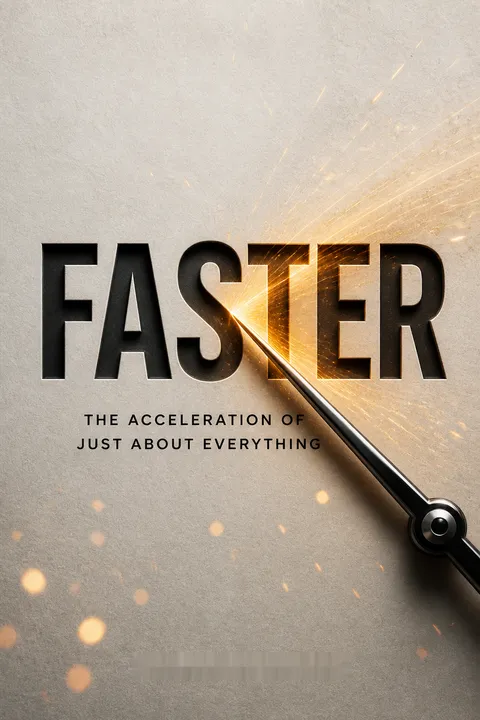
Faster: The Acceleration of Just About Everything explores how technology and society's obsession with speed have transformed our perception of time. While some readers found it insightful and thought-provoking, others felt it was dated and lacked cohesion. The book examines various aspects of modern life, from multitasking to time-saving devices, and questions whether our pursuit of efficiency truly benefits us. Gleick's writing style and use of anecdotes received mixed reactions, with some praising his observations and others finding the content superficial or redundant.
People Also Read







Glossary
Hurry sickness
Impatience shaped by time pressureA term associated with cardiologists Meyer Friedman and Ray Rosenman for a persistent sense of urgency, impatience, and pressure to do more in less time. The book treats it as a recognizable cultural condition, while noting that the claim that a defined Type A personality reliably predicts heart disease was not established by the research.
Type A behavior
A proposed impatience-prone personalityA behavior pattern described by Friedman and Rosenman, including competitiveness, aggressiveness, and a strong sense of time urgency. It became a popular explanation for heart risk, but researchers did not settle on a reliable way to identify Type A people or demonstrate that changing the pattern reduces heart disease risk.
real time
Processing at event speedIn computing, real time describes a system that processes incoming information and responds quickly enough to keep pace with the events it models or controls. The term later expanded into ordinary language to suggest immediacy. Gleick distinguishes the technical meaning from the casual use of the phrase as an intensifier for anything happening now.
race condition
Timing-dependent process failureA computer systems problem in which the result depends on the timing or order of separate processes that operate concurrently. If one process assumes another has completed when it has not, a brief opening can cause errors or security failures. Gleick uses it as an analogy for situations in which opinions are measured before they have fully formed.
Strong Law of Small Numbers
Short patterns invite false matchesMathematician Richard Guy’s observation that there are too few small numbers to satisfy the many patterns people seek in them. Several distinct mathematical sequences can begin with the same few terms before diverging. The idea warns against treating a short run of evidence as proof that a pattern will continue.
tight coupling
Interdependent processes with little slackA property of a complex system in which connected tasks or components depend closely on one another and have little room to absorb delays. Tight coupling can make a system respond quickly, but a disruption in one part may cascade through the rest. Airlines, with interlocking aircraft, crew, and connection schedules, illustrate the risk.
Taylorism
Scientific management of workA system of workplace efficiency associated with Frederick Winslow Taylor. It applies measurement and time-and-motion analysis to tasks, seeking to organize workers and machines for predictable, efficient production. The approach helped shape modern management, while also encouraging employers to treat time as a variable to optimize and workers as parts of a production process.
Moore's law
Exponential growth in chip capacityGordon Moore’s prediction that the density of semiconductor chips, and therefore computing power, would roughly double every eighteen months or so. Gleick uses it to describe the accelerating pace of computer technology. Its effects include not only faster machines, but also rapid product cycles and frequent obsolescence.
FAQ
What's Faster: The Acceleration of Just About Everything about?
- Exploration of speed: The book examines how modern life has become increasingly fast-paced, affecting everything from work to leisure. It highlights the societal obsession with speed and efficiency.
- Impact of technology: James Gleick discusses how technology, such as the internet and atomic clocks, has accelerated our perception of time and efficiency, altering daily routines and expectations.
- Cultural reflections: The author reflects on the cultural implications of living in a fast-paced world, including the psychological effects of hurry sickness and the diminishing quality of experiences.
Why should I read Faster by James Gleick?
- Insightful analysis: Gleick provides a thought-provoking analysis of the acceleration of life, prompting readers to reconsider their relationship with time and technology.
- Cultural critique: The book critiques modern culture's obsession with speed, encouraging readers to reflect on societal pressures and their own habits.
- Witty and accessible: Gleick's writing style is engaging and accessible, using anecdotes and historical context to enrich the narrative.
What are the key takeaways of Faster?
- Time as a commodity: Gleick emphasizes that time is often equated with money, leading to a constant rush to save time at the expense of quality experiences.
- Hurry sickness: The book introduces hurry sickness, describing the anxiety and stress associated with a fast-paced lifestyle.
- Technology's double-edged sword: While technology increases efficiency, it also contributes to disconnection and overwhelm, with potential negative consequences.
What are the best quotes from Faster and what do they mean?
- “Speed is the form of ecstasy...”: This quote highlights the paradox of modern life, where the thrill of speed can lead to stress and disconnection.
- “A man with a watch...”: It illustrates the confusion and anxiety from our obsession with precise timekeeping, suggesting that more control can lead to less certainty.
- “Decomposition takes time.”: This serves as a reminder that not everything can be rushed, emphasizing the importance of patience.
How does Faster define "hurry sickness"?
- Psychological condition: Hurry sickness is characterized by a constant sense of urgency and impatience, manifesting in behaviors like multitasking.
- Health implications: Gleick discusses the stress and anxiety associated with hurry sickness, which can lead to serious health issues.
- Cultural phenomenon: The book positions hurry sickness as a reflection of societal values prioritizing speed and efficiency over well-being.
How does Faster address the relationship between technology and time?
- Technological acceleration: Gleick explores how technology has accelerated our perception of time, making tasks quicker but contributing to a sense of overwhelm.
- Impact on daily life: Technology has changed routines, often leading to a faster pace of life, enhancing efficiency but also creating stress.
- Need for balance: Gleick advocates for balancing technology use, recognizing its limitations, and being mindful of its effects on time and well-being.
What examples does Faster provide to illustrate the acceleration of life?
- Atomic clocks: Gleick describes how atomic clocks define precise time, pushing the boundaries of timekeeping and synchronizing global activities.
- Elevators and waiting: The impatience felt while waiting for elevators illustrates the cultural expectation for speed and efficiency.
- Instant communication: The impact of email and text messaging on our lives shows how these tools enhance connectivity but also contribute to urgency.
How does Faster explore the concept of leisure in a fast-paced world?
- Leisure as a state of mind: Gleick argues that true leisure is rare in a fast-paced world, as the rush for efficiency diminishes its quality.
- Impact of technology: Technology has transformed leisure activities, often making them hurried and less fulfilling, leading to decision fatigue.
- Cultural expectations: Many feel pressured to fill free time with activities, and Gleick encourages prioritizing meaningful experiences.
What role does technology play in the acceleration discussed in Faster?
- Technological advancements: Gleick examines how the Internet and mobile devices have increased communication speed, creating expectations for instant responses.
- Impact on daily life: Technology has transformed activities, making them faster but often less meaningful, exemplified by the rise of day trading.
- Consequences of overreliance: Overreliance on technology can diminish attention spans and reflective thinking, prompting a need for mindful use.
How does Faster suggest we cope with the pressures of acceleration?
- Mindfulness and reflection: Gleick advocates for mindfulness practices to slow down and reflect, counteracting hurry sickness.
- Setting boundaries: Establishing boundaries around work and technology use can create space for leisure and relaxation.
- Embracing leisure: Gleick encourages viewing leisure as vital, engaging in activities that bring joy and fulfillment to restore balance.
What is the "rat-race equilibrium" mentioned in Faster?
- Definition: The rat-race equilibrium is where employees work longer hours to demonstrate commitment, creating a cycle of overwork and stress.
- Cultural expectations: This phenomenon is driven by norms equating long hours with productivity and success, pressuring employees.
- Consequences for workers: It can lead to burnout and decreased job satisfaction, highlighting the need for healthier work environments.
How does Faster relate to the concept of multitasking?
- Multitasking defined: Gleick describes multitasking as engaging in multiple activities simultaneously, often leading to decreased focus.
- Cognitive limitations: Our brains are not designed for effective multitasking, resulting in errors and a lack of depth in work.
- Encouraging focus: Gleick suggests focusing on single tasks to enhance productivity and satisfaction, prioritizing quality over quantity.
Download PDF
Download EPUB
.epub digital book format is ideal for reading ebooks on phones, tablets, and e-readers.








