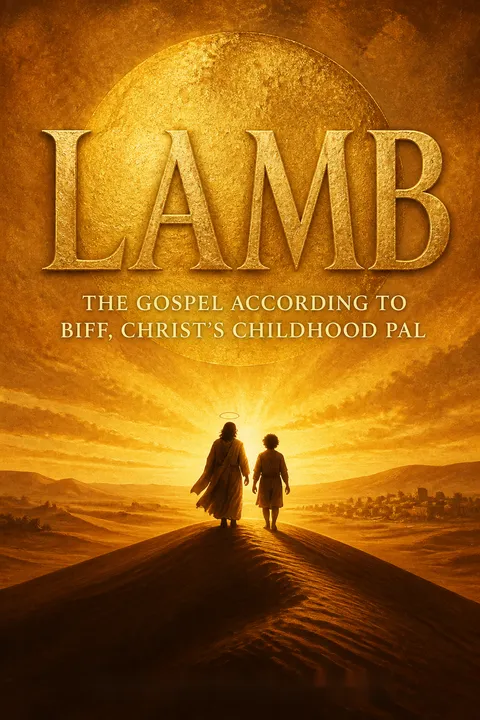


Plot Summary
Prologue
In modern Jerusalem, the angel Raziel is ordered to retrieve a long-forgotten witness and produce a new account of Joshua’s life. He raises Biff, Joshua’s childhood friend, from the dust after two thousand years and gives him the ability to understand every language.
Biff responds by punching the angel for arriving centuries late. Raziel takes him to a hotel room and insists he write down the story he remembers, beginning with the boy he first met beside a well in Nazareth.
The framing device makes testimony itself part of the adventure. Biff returns not as a reverent historian but as a bruised, bewildered man forced to confront a world he cannot understand and a past he has avoided. Raziel’s delay is comic, yet it establishes a serious imbalance: heaven assigns the task, while Biff must supply the human memory. His irreverence becomes a method of attention. He refuses to turn Joshua into an untouchable emblem because he remembers the child, friend, and difficult companion behind the sacred story.
The Lizard at Nazareth
At six, Levi, called Biff, finds Joshua beside the village well with a lizard in his mouth. Joshua’s younger brother kills it repeatedly, and Joshua brings it back each time. The boys become inseparable, playing at rabbis and heroes while Biff learns scripture partly to keep up with his friend.
Joshua’s small miracles remain private, but his nature already sets him apart: he treats wonder as ordinary and answers cruelty with curiosity. Biff, the practical stonecutter’s son, supplies jokes, schemes, and companionship. He knows nothing of a divine mission yet. He only knows that Joshua is fearless in a conquered village where most people have learned to live cautiously.
The lizard establishes the book’s central intimacy before it establishes doctrine. Biff’s first response to a miracle is not worship but the wish to join in, a child’s instinct to turn the inexplicable into shared play. Joshua’s power is introduced as bodily and casual, which keeps the extraordinary close to ordinary childhood. Their differences form a lasting partnership: Joshua reaches toward what ought to be possible, while Biff tests what can actually be done. The story’s emotional authority comes from that friendship, not from treating Biff as a distant commentator on holiness.
The Cobra and the Girl
Joshua leads a huge cobra through Nazareth, convinced it belongs to a prophecy. When Jakan, the Pharisee’s cruel young son, accuses Joshua and Biff of consorting with a demon, a newcomer from Magdala steps between the boys and the bullies. Mary, who asks to be called Maggie, calmly identifies the snake and exposes Jakan’s fear.
Biff is instantly smitten, while Joshua recognizes her courage without mistaking it for a miracle. Their friendship grows through stolen glimpses and shared errands. At the same time, Biff hears that Joshua’s mother Mary is considered mad and that Joseph is not Joshua’s biological father, leaving the boy’s identity mysterious even to his closest friend.
Maggie enters as a person who acts, not as an object of either boy’s fascination. Her composure interrupts the familiar chain of male threat and religious accusation, and her willingness to approach the cobra gives the children a different model of courage. Biff’s crush is comic, but it also exposes his longing for a future he can imagine and claim. Joshua’s distinction is already visible in his refusal to fit a simple category: he is both a child at play and someone whose presence makes others read prophecy into events.
Japhia’s Failed Miracle
At a funeral in Japhia, Joshua concentrates so intensely that the dead woman briefly rises and takes a few steps. The crowd panics, Joshua collapses in grief, and Biff and Maggie pull him away before the Romans identify him as the cause. The woman dies again, leaving Joshua convinced he has failed his father.
The next day, while Joshua prays in an olive grove, Raziel appears with the announcement that the Savior has been born. Biff points out that Joshua is already ten. The angel admits he missed the birth by years, then leaves Joshua with little guidance. Biff’s blunt humor steadies his friend, but neither boy knows what the miracles mean or what Joshua must become.
The failed resurrection makes power inseparable from uncertainty. Joshua does not experience a miracle as proof of mastery; he experiences it as evidence that he has not yet understood the task entrusted to him. Raziel’s late arrival sharpens that uncertainty by exposing the gap between divine messages and human timing. Biff’s jokes are not merely defiance. They are emotional first aid, giving Joshua a way to return from shame without pretending the failure did not matter. The scene sets a pattern: miracles can attract danger, but they do not automatically clarify what is right.
A Soldier Returns
In Sepphoris, Biff, Joshua, and Maggie catch the Sicarii rebel Jeremiah killing a Roman soldier. Jeremiah is Maggie’s uncle, and the Romans arrest Joshua’s stepfather Joseph because he was nearby. Joshua realizes that he can save Joseph only by bringing the soldier back to life. Biff draws the crowd’s attention with a funeral song while Joshua secretly touches the body.
The revived soldier identifies Jeremiah, and Centurion Gaius Justus Gallicus kills the assassin before he can attack the children. The Romans release Joseph, but their crackdown leaves Maggie’s family vulnerable. Soon her mother agrees to betroth Maggie to Jakan in exchange for the Pharisees’ help protecting the family.
The episode turns Joshua’s private gifts into public risks. Resurrection now has political consequences: it can expose a rebel, save one family, and provoke Roman retaliation against many others. Biff’s performance makes him an active moral partner, not simply a spectator beside Joshua. His improvisation protects people while concealing the truth from authorities. Maggie’s betrothal shows how little control a young woman has over the cost of political survival. The three friends encounter different forms of power at once: Roman force, religious influence, and the fragile authority of a child trying to do good.
The Road East
Maggie tells the boys she has been promised to Jakan, and Joshua refuses to harm him even when Biff wants revenge. At Passover, Joshua asks Rabbi Hillel whether he is the Messiah. Hillel will not confirm it, but directs him toward the three Magi who visited his birth. Joshua decides to find them, and Biff goes because his friend cannot manage the wider world alone.
The night before departure, Maggie embraces Biff believing him to be Joshua. When she realizes who he is, she accepts him without anger, though her love is still directed mainly toward Joshua. At dawn the friends leave Nazareth, carrying tools, a bowl, and the grief of leaving Maggie behind.
The journey begins in a tangle of care, jealousy, and mistaken identity. Biff loses the future he imagined with Maggie, yet chooses loyalty to Joshua rather than staying to watch her marry. His night with Maggie offers genuine intimacy, but it cannot resolve the unequal shape of their love. Hillel’s refusal to hand Joshua a simple answer is equally important: the quest begins because certainty is unavailable. Instead of receiving a ready-made role, Joshua must travel, learn, and risk being wrong. Biff joins him because friendship is the one commitment he can make without needing a prophecy.
Lessons in Strange Lands
The friends reach the coast and board a cargo ship with the Phoenician captain Titus. When Titus throws Biff overboard for admitting he cannot swim, Raziel appears in black wings and stills the sea until Biff can be pulled back aboard. On the journey, Biff tries to explain sex to Joshua, even hiring prostitutes to provide practical lessons.
Joshua remains more interested in understanding why pleasure and sin are supposed to be linked than in pursuing pleasure himself. In Antioch, he begins healing strangers in the crowded market, drawing a small, devoted following. A trader tells the boys that the Magus Balthasar has moved inland to Kabul, and offers to guide them there with his caravan.
The first leg of the quest tests the difference between information and understanding. Biff can arrange experiences, but he cannot make Joshua feel what he is trying to explain; Joshua keeps asking moral questions that practical instruction cannot answer. The near-drowning also reveals the limits of Biff’s confidence. He can joke about danger, but he is dependent on Joshua’s bond with Raziel and the angel’s intervention. In Antioch, healing becomes public and spontaneous. Joshua’s compassion crosses language and custom, while Biff sees that the world is too large for their village’s rules to explain.
Mercy in the Pass
Ahmad’s caravan carries the friends across the desert toward Kabul, but bandits attack in a narrow pass. The guards kill nearly all the raiders. Joshua rushes to one wounded man, heals him, and then blinds the guard who shoots the newly revived bandit. The violence leaves Joshua shaken, and the surviving guards fear him.
At Balthasar’s mountain fortress, the Magus welcomes Joshua but sees Biff as an extra burden. He is impressed by Joshua’s powers and sends the boys into a life of lessons in Chinese texts, alchemy, and the Tao. Balthasar’s wealth and influence seem to offer the guidance Joshua needs, but a forbidden iron door dominates the fortress and its secret is kept from them.
Joshua’s intervention in the pass gives compassion a cost. He refuses to treat an enemy as disposable, but his anger at the bandit’s death produces another injury. The episode complicates the idea that good intentions automatically yield good outcomes. Balthasar offers a new framework for interpreting that failure, yet his fortress is itself built around concealed danger. Knowledge arrives with conditions, and Biff’s curiosity becomes a counterweight to Joshua’s willingness to trust a teacher. Their different temperaments help them survive, but also make them vulnerable to the secrets each prefers to ignore.
The House of Doom
While Joshua travels with Balthasar, Biff and Joy, the fortress’s sharp-minded tutor, copy the key to the sealed room. They open it and release Catch, a giant demon who tears through the women’s quarters. Joy survives by luring the creature into a narrow passage and cutting the ladder behind them.
Joshua returns, takes control of Catch, grants him a moment of free will, then sends him back to hell. Balthasar’s immortality has depended on the demon remaining on earth, so the Magus immediately begins to age and dies ten days later. Joy inherits his library and treasure, but chooses a life in Kabul rather than continue alone in the fortress.
The sealed door gives curiosity its most literal consequence: what the characters want to know cannot be separated from the danger contained inside. Biff’s impatience and Joy’s confidence open the passage, but Joshua’s answer is not brute force. He recognizes Catch as a being shaped by a lack of choice and offers him a brief experience of agency before banishing him. Balthasar’s fate reveals the cost of organizing a life around the refusal to die. Joy’s grief, followed by her decision to leave, gives the aftermath human weight that the demon’s spectacle alone could not supply.
The Monastery’s Hard Lessons
After waiting through winter, Joshua and Biff travel to a remote monastery run by Gaspar, one of the Magi. Gaspar refuses to explain his teachings and assigns Joshua meditation while Biff must shave a hostile yak. Biff leaves after a beating and returns two days later, accepting the monastery’s harsh rules and a life of little food, cold stone, and constant practice.
The monks train the friends in stillness and kung fu, but Biff struggles to empty his mind. Joshua gradually learns to loosen his sense of self until he becomes invisible. Gaspar later explains that their training is meant to prepare Joshua to guide his people, though he still cannot tell him exactly what that role requires.
Gaspar’s teaching attacks the assumption that insight must arrive as a clear verbal answer. Joshua adapts to practice; Biff resists it, leaves, and then returns because his attachment to his friend outweighs his pride. The yak episode makes spiritual discipline bodily and comic, keeping the monastery from becoming an abstract retreat. Their different responses also reveal what each needs: Joshua must release the burden of being uniquely chosen, while Biff must learn that discipline is not the same as understanding. Neither brother can complete the other’s work.
The Yeti’s Last Friend
During a winter meditation, Biff wakes beside a huge, gentle yeti who has come to eat the monks’ food. The creature is the last of his kind, and the monks have quietly carried provisions into the mountains for years. Joshua forms a close bond with him, returning often to sit with him and learn how completely he gives affection.
When a fall of ice kills the yeti, Joshua mourns that he was absent and cannot understand why God allowed the creature’s kind to disappear. Gaspar sends the friends away, but Joshua recognizes that the abbot’s care for the yeti has already taught him what he sought: compassion practiced so naturally that it needs no reward or explanation.
The yeti gives Joshua a relationship outside human history, law, and religious identity. Its loneliness makes compassion concrete: care means bringing food, returning regularly, and accepting that the beloved may still die. Joshua’s grief is not a failure of enlightenment; it is evidence that connection has mattered. Gaspar’s years of service to the creature expose a truth he cannot reach through doctrine alone. The episode also quietly challenges the idea that innocence guarantees protection. The yeti is gentle, but gentleness does not shield it from extinction.
Kali’s Bloody Feast
In India, the Untouchable Rumi warns the travelers that his daughter Vitra and other children are being held for sacrifice to Kali. Biff rejects the caste system’s claim that suffering is deserved, then devises a rescue using the chemical knowledge he learned from Balthasar. Disguised as Kali, he ignites explosive decoys while Joshua frees the children from the wooden elephants.
The crowd flees, and the two bring Vitra back to Rumi. The families accept their children but remain frightened of having angered the goddess. Watching them worship the sunrise the next morning, Joshua concludes that divine life cannot belong only to Jews or any privileged caste. He decides his teaching must include everyone.
This rescue turns the friends’ accumulated education into action. Biff’s knowledge of alchemy, performance, and deception does not replace Joshua’s moral clarity; it gives that clarity a workable route through a violent crowd. The children’s rescue also forces Joshua to compare the systems he has known, rather than condemn only the unfamiliar one. His conclusion grows from what he sees: people can honor the divine and still enforce cruelty through inherited categories. The families’ fear after the rescue shows how difficult it is to leave a worldview that explains suffering as deserved.
The Word Comes Home
After months searching the southern peninsula, Joshua and Biff find Melchior, the last Magus, living as an ascetic by the sea. Melchior teaches Joshua that the divine presence is already within people, but that a teacher must find words others can understand. Biff, meanwhile, studies desire with Kashmir, a courtesan who becomes his companion, and earns money through trade and Joshua’s ability to multiply rice.
A stain on a temple wall resembles Joshua’s mother Mary, and Melchior takes it as a sign that the brothers should return to Israel. They stop in Kabul to reunite with Joy, then leave her palace with camels and supplies. At last, Joshua has a message, though not yet a public mission.
Melchior does not add another system for Joshua to obey; he shifts the question from what to believe toward how to make belief communicable. The word becomes a bridge between private insight and public life. Biff’s parallel education is less spiritual in appearance, but it develops the craft and confidence that will later protect Joshua. Kashmir’s relationship also shows Biff continuing to seek intimacy without mistaking it for a cure for old heartbreak. Mary’s image returns the journey to its beginning: wisdom gained abroad must now answer to the people and losses waiting at home.
Return to Nazareth
When the friends return to Nazareth, Joshua learns that Joseph died two months earlier, still asking for him. His brother James resents the years he spent caring for the family while Joshua traveled. Biff reunites with his own parents, then visits Maggie in Bethany, where she welcomes him but remains tied to Jakan. The friends find John the Baptist preaching in the wilderness.
At Joshua’s baptism, a bright bird descends and a voice from above identifies him as God’s son. Joshua then leaves to fast in the desert. Biff visits Maggie again, but she cannot leave her marriage. When Joshua returns, he is ready to preach, though he still needs the language and help to make his teaching understood.
Homecoming does not restore the life the friends left behind. Joseph’s death and James’s resentment make the cost of Joshua’s absence impossible to dismiss, while Maggie’s marriage confirms that time has not waited for Biff’s longing. The baptism supplies public confirmation, but not the practical instruction Joshua still lacks. He must learn to speak to people beyond his closest companions. Biff’s role changes as well: the friend who once used jokes to deflect painful truths now helps Joshua move toward responsibility without pretending that responsibility can undo the past.
The First Followers
At a wedding in Cana, Joshua turns water into wine, then joins Biff, Maggie, and a growing band of followers. He heals the sick in Capernaum and invites fishermen, a tax collector, and other outsiders to travel with him. When the group crosses the lake to preach among gentiles, Joshua calms a storm and drives a legion of demons from a tormented man into a herd of pigs.
The local people respond by chasing the visitors away. Back in Galilee, Joshua’s Sabbath healings anger the Pharisees, and Biff urges him to expand his work beyond their jurisdiction. The movement grows, but so does the danger: each miracle draws witnesses, while Joshua’s message challenges the boundaries that keep people in their assigned places.
The early ministry translates private formation into public practice, and its results are deliberately uneven. A wedding miracle brings delight; healing brings gratitude; the gentile mission ends in a frightened crowd driving the group away. Joshua’s compassion does not guarantee that people will welcome its consequences. Biff understands how quickly attention can become danger, so his logistical caution complements Joshua’s moral urgency. The conflict with the Pharisees is not simply belief against unbelief. It is a struggle over who may cross boundaries, who may interpret the Law, and whether mercy can interrupt the routines that protect authority.
The Sermon and the Twelve
Herod Antipas executes John the Baptist after his preaching angers the ruler’s household. Joshua mourns his cousin, then gathers John’s abandoned followers and prepares a sermon that makes his teaching plain: care for the poor, forgive, and welcome people beyond the Jewish community. He feeds thousands from a small supply of bread and fish, then appoints twelve apostles and sends seventy more to carry the message.
As Pharisees and Herod’s agents close in, Joshua withdraws with Maggie and Biff to the territory of Herod Philip. He tells his followers that he will eventually go to Jerusalem, be killed, and return. The prediction unsettles the group, while the new messengers spread his teachings farther than he can travel himself.
John’s death makes the cost of public speech immediate. Joshua responds not by retreating into private wisdom but by distributing the work among messengers, accepting that a movement must survive beyond his presence. The feeding miracle and the sermon address material hunger and moral exclusion together; the apostles turn those claims into a network of relationships. Yet Joshua’s prediction of his own death changes the emotional terms of the mission. His followers hear a future they cannot control, while he treats their fear as something they must carry alongside the message.
Lazarus Opens the Tomb
A wealthy supporter, Joseph of Arimathea, invites Joshua to Jerusalem after Maggie’s brother Simon Lazarus becomes gravely ill. By the time the group arrives, Simon has been buried for four days. Joshua calls him from the tomb, then restores his body and heals his leprosy. The witnesses spread the news through Bethany and Jerusalem.
Joseph urges Joshua to meet the Pharisees, hoping a direct explanation will calm them, but Jakan turns the dinner into an interrogation. Joshua refuses to deny his identity or his authority. The council condemns him for blasphemy, and Joseph advises him to leave Galilee. Joshua instead decides to gather his followers for one last public sermon before going to Jerusalem for Passover.
Simon’s return is the largest demonstration of Joshua’s power so far, but it does not persuade the authorities to trust him. Instead, the miracle makes their political problem more urgent: crowds may believe what they see, and the council cannot easily control the story. Joseph’s strategy assumes that explanation can reduce fear, while Joshua recognizes that his teaching has already challenged the interests behind the accusation. The scene joins personal grief to public escalation. Maggie gets her brother back, but his restoration also pushes Joshua closer to the confrontation he has long predicted.
The Temple Turns Hostile
Joshua enters Jerusalem during Passover and clears vendors and moneychangers from the Temple courts, attacking the commerce that supports the priests’ power. He publicly challenges the religious leaders, then escapes the crowd with help from his followers. At Joseph’s house, he shares a final meal and teaches that the divine presence is shared among them.
He predicts that his followers will deny him, while Judas leaves to guide the authorities to Gethsemane. Joshua goes there with the others and allows the Temple guards to arrest him. Biff had planned to stop him, even considering poison, but Joshua deliberately sent him away before the capture. By morning, the council has condemned him and delivered him to Roman power.
The Temple episode converts a long dispute into an open challenge to the institution’s material and political order. Joshua’s action is not only a sermon about corruption; it interrupts the system in front of its beneficiaries. The final meal offers his followers a way to understand what they share, but it cannot make them ready for what follows. Judas’s departure and Biff’s exclusion reveal Joshua’s control over the shape of his own arrest. He does not merely predict betrayal. He arranges circumstances so that his friends cannot protect him from the choice he has made.
The Cross and the Cliff
Pilate sends Joshua to Herod, then agrees to his execution after the crowd demands crucifixion. Biff persuades Justus to keep the punishment survivable and prepares poison, hoping Joshua can be taken down before his body is damaged. The poison works slowly. As Joshua hangs on the cross, a soldier pierces his side, and Joshua dies before Biff can reach him.
In the storm that follows, Biff sees Judas watching from the city wall and pursues him through Jerusalem. He hangs Judas from a tree above the tombs, then steps from the cliff himself. Biff’s final memory ends there. In the epilogue, Maggie reveals that Joshua returned from death, and the angels send the two friends onward together.
Biff’s plan embodies the limits of love when it becomes a demand to control another person’s choice. He can bargain with a centurion, prepare poison, and manipulate appearances, but he cannot make Joshua abandon the sacrifice he has accepted. The spear makes the failure irreversible in Biff’s eyes, and grief turns into violence against Judas before turning against himself. The epilogue does not erase these actions; it places them inside a larger continuation. Biff’s return to Maggie offers companionship, not a clean absolution, and preserves the book’s insistence that love can endure even when it cannot prevent loss.
Epilogue
After Biff finishes his account, Raziel brings him into a hallway where Maggie is waiting. She has completed her own Gospel and tells Biff that Joshua returned after the crucifixion. The angels send the two friends onward together.
Biff still fears that Maggie loves him only because she cannot have Joshua, and she confirms the complication rather than soothing it away. They leave the angels behind and walk toward their new life, carrying affection, old jealousy, and the knowledge that their shared story has not ended.
The ending grants Biff a future without pretending that his emotional history has been solved. Maggie does not offer an uncomplicated romance; she names the old triangle plainly, and Biff chooses to walk with her anyway. That choice feels earned because their relationship has always contained humor beside pain, tenderness beside rivalry. Joshua’s return is reported rather than staged, keeping the focus on what Biff can know: his friend’s story continued, and his own did too. The angels’ assignment gives way to a human decision to keep going together.
Analysis
Lamb builds its account of Joshua’s life around a productive mismatch: Joshua sees the world through compassion and spiritual possibility, while Biff sees it through appetite, danger, and practical consequence. Neither perspective is sufficient alone. Joshua can heal a stranger but cannot always anticipate the political response; Biff can devise a rescue but cannot make his schemes control the people he loves. Their friendship becomes the novel’s primary instrument of interpretation, allowing sacred events to remain intimate without making them trivial.
The journeys east turn religious learning into a sequence of encounters rather than a simple conversion. Balthasar’s pursuit of immortality, Gaspar’s disciplined but incomplete wisdom, and Melchior’s language of an indwelling divine presence each change what Joshua can understand. The yeti, the Untouchables, and the children marked for Kali’s sacrifice test whether compassion crosses the borders that communities defend. Joshua’s eventual insistence that the kingdom belongs to everyone grows from these specific experiences, not from abstract tolerance.
Biff’s humor performs psychological work. It gives him distance from fear, allows him to challenge authority, and preserves Joshua’s ordinary humanity. But comedy cannot dissolve grief: Joseph dies during the journey, Maggie’s life moves on without Biff, and the final execution defeats Biff’s attempt to manage events through cleverness. His last violence against Judas and himself reveals how loyalty can become destructive when it cannot accept another person’s choice.
The framing story complicates the idea of a definitive Gospel. Biff is not impartial, and the book does not pretend that he is. His account is valuable precisely because he admits jealousy, error, desire, and ignorance. The result is a story about how belief is transmitted: not only through doctrine or miracles, but through care, disagreement, memory, and the imperfect people who carry a teaching forward.
Review Summary
Lamb is a humorous and irreverent retelling of Jesus' life from the perspective of his childhood friend Biff. Many readers found it hilarious and creative, praising Moore's blend of comedy and thoughtful exploration of religion. Some appreciated the balance of humor and poignancy, while others felt the jokes became repetitive. A few readers were offended by the irreverent treatment of religious themes. Overall, most reviewers enjoyed the novel's unique take on a familiar story, though some found parts slow or juvenile.
People Also Read







Characters
Biff, or Levi
The irreverent witnessBiff is Joshua’s childhood friend and the narrator charged with recording the years missing from familiar accounts. A stonemason’s son, he is observant, sexually curious, inventive, and quick to use humor when fear or grief becomes difficult to bear. He is not a natural believer in rules, but his loyalty to Joshua repeatedly brings him into danger. Biff’s practical intelligence complements Joshua’s spiritual insight: he improvises disguises, schemes, and material solutions when compassion alone cannot move events. His attachment to Maggie exposes his jealousy and longing, while his friendship with Joshua remains the deepest commitment of his life. Biff sees holiness up close, with affection and frustration intact.
Joshua
The uncertain MessiahJoshua is Mary’s son, Joseph’s stepson, and Biff’s closest friend. As a child he performs quiet miracles without understanding what they mean; as he grows, he struggles to interpret the demands placed on him. His compassion is active rather than sentimental: he heals strangers, protects enemies, and questions systems that mark some people as unworthy. Joshua can also be stubborn, angry, and playful, especially with Biff and Maggie. He seeks guidance from the Magi and from spiritual teachers, but his deepest lessons come through relationships and loss. His central difficulty is not whether he can perform miracles, but how to use power without reproducing the exclusions and violence around him.
Maggie, Mary of Magdala
The fearless belovedMaggie is the girl from Magdala who first meets Joshua and Biff when she calmly faces down their bully and a cobra. She is perceptive, independent-minded, and more willing than either boy to act decisively when someone is in danger. Her affection for Joshua and Biff takes different forms, and she refuses to pretend that love makes those differences disappear. As an adult, she becomes a committed teacher and an important emotional counterweight to Joshua’s certainty and Biff’s self-protective humor. Maggie’s courage is not fearlessness alone; she understands the constraints around her and makes difficult choices within them. She values truth, loyalty, and the freedom to decide whom she will follow.
Raziel
The tardy angelRaziel is the angel assigned to recover Biff and oversee the writing of his Gospel. Beautiful, powerful, and astonishingly literal, he often misunderstands human customs and the purpose of the modern entertainment he watches. His late arrival in Joshua’s childhood becomes an early example of heaven’s imperfect communication. In the modern frame, he acts as Biff’s keeper, guide, and reluctant companion, alternately enforcing the assignment and learning about the world beside him. Raziel’s comic incompetence does not erase his capacity for intervention, but it makes divine authority look less like omniscient control than a baffling bureaucracy.
Mary, Joshua’s mother
The protective motherMary is Joshua’s mother, a young woman whose claim of divine conception makes some neighbors dismiss her as mad. She protects Joshua’s identity, understands his unusual nature, and remains devoted to her family amid the practical demands of village life. Her love for Joshua includes restraint: she does not explain everything to Biff simply because he is close to her son. Later, she recognizes that Joshua’s work cannot be reduced to domestic responsibility or kept safely within Nazareth. Mary combines tenderness with resolve, and her faith is expressed through daily care as much as through belief in prophecy.
Joseph of Nazareth
The steady stepfatherJoseph is Joshua’s stepfather and a respected carpenter who knows scripture, supports his household, and treats Biff with generous patience. His quiet authority comes from work and care rather than status. He understands that Joshua is not biologically his son, yet he accepts the responsibility of raising him and protects him from people who would misread his difference. Joseph’s warmth gives Joshua a model of human fatherhood that stands beside the harder-to-understand presence of God. He is also one of the few adults who can guide the boys without trying to make them less curious.
John the Baptist
The desert heraldJohn is Joshua’s cousin, a fervent preacher who calls people to repentance and baptizes them in the Jordan. His belief in his own prophetic calling is intense, but he is capable of recognizing Joshua’s greater role once he sees evidence of it. John’s blunt moral certainty attracts followers and alarms rulers, especially when he attacks Herod Antipas’s marriage. He teaches Joshua the public force of preaching, though his narrow focus on sin differs from Joshua’s wider insistence on compassion. John’s zeal is sincere, but its recklessness makes him vulnerable to the political power he openly condemns.
Bartholomew
The Cynic and dog keeperBartholomew is the apparently foolish, filthy beggar of Nazareth who reveals a sharp understanding of Cynic philosophy. He values simplicity, rejects possessions, and lives among dogs that become his loyal companions. His rough appearance makes others underestimate him, but he often sees through social pretenses more clearly than educated men do. Bartholomew follows Joshua with the same independence he brought to his earlier life, sometimes interpreting the Gospel in ways that frustrate its teacher. His presence gives the group a comic outsider and a reminder that wisdom may arrive without respectable clothing.
Balthasar
The worldly MagusBalthasar is the African Magus who came to see Joshua’s birth and later lives in a hidden mountain fortress. A gifted scholar of magic, alchemy, and Eastern traditions, he pursues knowledge with enormous confidence and treats time as a resource he can outlast. His humor and hospitality make the fortress appealing, but his lessons are shaped by private needs that Joshua and Biff do not initially understand. Balthasar values life intensely, perhaps too intensely, and his fascination with Joshua combines respect with a hope that the young man can answer questions no teacher has resolved.
Gaspar
The demanding abbotGaspar is a Magus who leads a remote monastery devoted to Buddhist practice, meditation, and physical discipline. He teaches by withholding explanations, assigning repetition, and allowing frustration to expose students’ assumptions. His severity can seem like needless cruelty, especially to Biff, yet his care for the monks and the solitary yeti is expressed through years of quiet work. Gaspar is not a flawless sage; he is still searching for what he teaches. His relationship with Joshua develops through shared practice, while Biff learns from him more slowly and with far more complaint.
Melchior
The ascetic teacherMelchior is the third Magus, a former prince who lives in austerity near the sea in southern India. He teaches Joshua that spiritual insight must be translated into words if it is to guide others. Melchior’s stillness and strange demonstrations can frustrate Biff, who prefers practical answers and visible results. He does not claim that he can give Joshua the divine presence he seeks; instead, he helps him recognize what is already within people. His restraint contrasts with Balthasar’s appetite for mastery and Gaspar’s demanding discipline.
Joy
The clever sorceressJoy is Balthasar’s most capable tutor, skilled in Chinese alchemy, poisons, martial arts, and practical deception. She is sharp, disciplined, and willing to make Biff learn through discomfort, including poisoning him to teach him caution. Her affection for Biff is real but never simple, and her loyalty to the fortress’s household complicates their friendship. Joy’s competence saves lives when danger arrives, while her grief reveals the cost of living among people who have become her family. She is a teacher who offers both knowledge and the freedom to choose what comes next.
Gaius Justus Gallicus
The Roman centurionJustus is a Roman officer who first encounters the boys during a funeral and later becomes an uneasy ally. He understands Rome’s demand for order and has enforced its power, yet he can recognize suffering and ask Joshua for help. Justus is practical, blunt, and more humane than his uniform suggests, though his authority remains part of the system that endangers the Jews. His relationship with Joshua and Biff tests the boundary between occupier and friend without pretending that one act of kindness erases political domination.
Jakan
The powerful PhariseeJakan begins as a bully in Nazareth and grows into a Pharisee with influence in the Sanhedrin. He is proud, vindictive, and skilled at turning religious rules into instruments of social control. His marriage to Maggie ties personal history to public power, while his rivalry with Joshua becomes increasingly dangerous as Joshua attracts followers. Jakan is not merely a childhood antagonist preserved unchanged: authority has made him more calculating. He represents the way old cruelty can acquire respectable language and institutional reach.
Judas Iscariot
The disappointed ZealotJudas joins Joshua’s followers as a politically committed Zealot, hoping the coming kingdom will free Israel from Roman rule. He is disciplined, capable, and drawn to the promise of decisive change. Joshua’s insistence that the kingdom is open to everyone, including Romans, conflicts with the liberation Judas expects. His frustration grows from a genuine desire to see his people free, but he interprets spiritual teaching through the language of political victory. Judas’s presence exposes the distance between Joshua’s message and the hopes his movement attracts.
Peter and Andrew
The fishing brothersPeter and Andrew are Galilean fishermen who leave their work to follow Joshua. Andrew is measured and observant, while Peter is impulsive, outspoken, and capable of acting before he has understood the lesson. Both brothers bring practical knowledge of boats, weather, and village life to the group. Peter’s desire to prove his faith often turns him into a comic example, but he is also willing to take responsibility when the others falter. Their loyalty is tested by the conflict between Joshua’s nonviolence and the political expectations surrounding the Messiah.
James and John, sons of Zebedee
The fishing partnersJames and John are brothers who work in the fishing trade and join Joshua’s circle with their boats and family ties. James is more restrained, while John struggles to perform a conventional toughness that does not quite fit him. Their mother’s ambitions for their place in the kingdom reveal the family’s hope for status through their sacrifice of a livelihood. As followers, the brothers contribute labor and loyalty, while their different temperaments make them part of the group’s affectionate, often chaotic character.
Matthew
The literate tax collectorMatthew is a young tax collector who can read, write, and calculate, skills that make him useful to a growing movement. Biff recruits him by promising a life among women, miracles, and good food, though Joshua’s teaching soon gives him a more serious purpose. Matthew brings organizational ability and a record keeper’s attention to detail. His enthusiasm is sincere, but he must learn that following Joshua means more than joining an exciting cause. He often helps translate spiritual claims into practical arrangements.
Philip and Nathaniel
The eager recruitsPhilip is a practical organizer who brings friends into the group and takes responsibility for shared resources. Nathaniel, his young companion, is impulsive and remarkably ready to believe, even when his conclusions are poorly reasoned. Together they show two kinds of useful faith: Philip’s ability to recruit and coordinate, and Nathaniel’s openness to possibility. Their good intentions can create complications, but Joshua values the trust beneath their mistakes. Biff often teases them while relying on their help.
Thomas
The twin-seeing discipleThomas believes he can see and speak with an invisible twin, whom the other disciples call Thomas Two. He is sensitive to being dismissed as mad and does not want Joshua to heal him if it means losing his companion. His unusual perception gives him a perspective the others cannot verify, but it also isolates him. Joshua treats Thomas with respect rather than forcing a cure. Thomas’s story asks whether companionship must be objectively visible to be emotionally real.
Simon the Canaanite
The restless ZealotSimon is a Zealot who follows Joshua while remaining drawn to the possibility of armed revolt. He admires power and imagines the wealth and authority a victorious Messiah might bring. Joshua’s refusal to build the kingdom through conquest unsettles him, but he stays close enough to hear the argument. Simon makes visible the tension between spiritual transformation and political liberation, especially among followers who have suffered under Rome and want a concrete reversal of power.
Simon Lazarus
Maggie’s leper brotherSimon Lazarus is Maggie’s brother, a serious and capable man whose illness separates him from ordinary community life. He and his sister Martha maintain a household in Bethany, where they offer shelter and support to the travelers. Simon’s relationship with Joshua is built on trust and directness rather than grand claims. His circumstances reveal how illness can isolate a person socially as well as physically, and how Maggie’s loyalties extend beyond her attachment to the central pair.
Martha
Maggie’s steadfast sisterMartha is Maggie’s younger sister, a practical woman who helps care for their family and offers a direct counterpoint to the drama surrounding Joshua. She is capable of affection but does not disguise her impatience with people who bring trouble to her household. Martha’s connection to Simon and Maggie gives her a clear stake in their choices, while her grounded nature makes her a useful observer of the men’s grand plans.
Rumi
The Untouchable fatherRumi is an Untouchable who lives in poverty and searches desperately for his daughter after she is taken for sacrifice. He saves Joshua and Biff from a mob, despite having little reason to trust strangers. Rumi’s beliefs are shaped by the caste system that confines him, and he explains its logic even as it condemns him to misery. His love for Vitra gives the rescue its urgency. Through him, Joshua confronts how religious ideas can be used to make inequality seem deserved.
Joseph of Arimathea
The influential believerJoseph of Arimathea is a wealthy merchant with connections among Jewish leaders and Roman officials. He believes Joshua’s teaching and tries to use his social position to protect the movement and create opportunities for conversation. His instincts are cautious and diplomatic, in contrast to Joshua’s willingness to confront authority directly. Joseph can open doors that ordinary followers cannot, but influence does not give him control over the outcome. He serves as a bridge between the movement’s radical message and the institutions it challenges.
Plot Devices
Biff’s Gospel frame
A witness returns to writeThe modern frame begins with Raziel resurrecting Biff and ordering him to record Joshua’s missing childhood and travels. Biff writes from a hotel room, where he must decode modern life while resisting the angel’s supervision. This device makes the story an act of memory rather than a neutral chronicle. Biff’s jokes, omissions, and emotional interruptions reveal both the limits of his knowledge and the intimacy that makes his account valuable. The framing also allows the narrative to end with Biff and Maggie receiving a future beyond the ancient story.
The three Magi
A quest for a usable callingJoshua seeks Balthasar, Gaspar, and Melchior because he does not know how to become the Messiah or interpret his powers. Each Magus introduces a different discipline: Balthasar’s alchemy and Taoist study, Gaspar’s Buddhist practice and compassion, and Melchior’s teaching about the divine presence within people. The journey gives Joshua ideas he can carry home, but no Magus supplies a complete answer. The quest also gives Biff practical skills and experiences that later help him protect Joshua and the children in India.
Joshua’s miracles
Power without certaintyJoshua heals people, revives the dead, drives out demons, multiplies food, and sometimes fails to control the result. The miracles attract followers and confirm his unusual nature, but they also draw Roman and religious scrutiny. Joshua repeatedly asks what his abilities mean and whether they serve his own will or God’s. By keeping the powers imperfect and morally demanding, the story prevents them from functioning as easy solutions. Each miracle creates a new problem of responsibility, interpretation, or public danger.
Balthasar’s sealed chamber
Curiosity releases hidden dangerThe locked iron room is marked by containment symbols, and Balthasar forbids the friends to open it until they are ready. Biff and Joy copy the key and disobey, releasing Catch, a demon whose presence has sustained Balthasar’s immortality. The chamber turns the story’s recurring appetite for knowledge into a physical hazard. Its consequences force Joshua to decide whether compassion can include a dangerous being and whether Balthasar’s desire to escape death is worth its cost.
Biff’s improvised craft
Practical tricks protect the vulnerableBiff learns alchemy, poison, disguise, sleight of hand, and martial arts during the journey. These skills let him divert Roman attention, deceive the priests of Kali, and attempt a plan to prevent Joshua’s suffering from becoming fatal. His methods are fallible and sometimes dangerous, but they fill a gap between Joshua’s moral purpose and the physical obstacles around him. The device also defines Biff’s role: where Joshua inspires change, Biff invents a way to get people through the next dangerous moment.
FAQ
Synopsis & Basic Details
What is Lamb: The Gospel According to Biff, Christ's Childhood Pal about?
- A Lost Gospel Account: The story is framed as a newly discovered gospel written by Levi, known as Biff, Jesus's (Joshua's) best friend from childhood. Resurrected in modern times by the angel Raziel, Biff is tasked with recounting the "lost years" of Jesus's life, from age 7 to 33, which are largely absent from the canonical gospels.
- Humanizing the Messiah: Through Biff's irreverent, funny, and deeply personal perspective, the novel explores Joshua's growth from a curious, miracle-performing boy in Nazareth to the man who would become the Messiah. It portrays his human struggles, doubts, and learning experiences alongside his divine nature.
- A Journey of Discovery: The narrative follows Joshua and Biff on an epic journey through the East, seeking wisdom from the Magi who visited Joshua at birth. This quest exposes them to diverse cultures, philosophies (Buddhism, Taoism, Hinduism), and challenges, shaping Joshua's understanding of his mission and the nature of God's love.
Why should I read Lamb: The Gospel According to Biff, Christ's Childhood Pal?
- Unique & Hilarious Perspective: The book offers a refreshingly funny and irreverent take on a familiar story, told through the eyes of a relatable, flawed, and deeply loyal best friend. Biff's modern voice and anachronistic observations provide constant humor.
- Deep Humanization of Jesus: It presents a compelling portrayal of Jesus as a young man grappling with his identity, learning about the world, experiencing friendship, and developing his understanding of compassion and divinity, making him incredibly relatable.
- Exploration of Faith and Doubt: Beyond the humor, the novel delves into profound questions about faith, doubt, the nature of God, the meaning of suffering, and the universality of spiritual truth, often contrasting different religious and philosophical viewpoints.
What is the background of Lamb: The Gospel According to Biff, Christ's Childhood Pal?
- Filling the "Lost Years": The novel is based on the historical gap in the canonical Gospels, which provide little detail about Jesus's life between his infancy and the start of his ministry around age 30. Moore creatively imagines what might have happened during these missing decades.
- Blend of History, Religion, and Comedy: Christopher Moore is known for blending historical or supernatural elements with absurd comedy. Lamb draws on biblical accounts, historical context of 1st-century Judea and the Roman Empire, and various Eastern philosophies, filtering it all through a comedic lens.
- Cultural and Philosophical Synthesis: The book incorporates elements from Judaism (Pharisees, Essenes, Temple practices), Roman culture, and Eastern traditions (Magi, Buddhism, Taoism, Hinduism, martial arts), suggesting a potential synthesis of spiritual ideas that could have influenced Jesus's later teachings.
What are the most memorable quotes in Lamb: The Gospel According to Biff, Christ's Childhood Pal?
- "God is a comedian playing to an audience that is afraid to laugh.": This quote, attributed to Voltaire at the start of Part I, encapsulates the novel's core theme of finding humor and humanity in the divine narrative, suggesting that perhaps God's plan is not as solemn or terrifying as some interpretations make it.
- "You know, I love all the little children of the world, you know? Green and yellow, black and white.": Joshua says this after the feeding of the multitude, expressing his universal love. Biff's immediate, deadpan response, "Good to know—Wait, green?", highlights Biff's grounding presence and the novel's use of humor to underscore profound statements about inclusivity.
- "I am light, now I fly, now I see myself beneath myself, now a god dances through me.": Attributed to Friedrich Nietzsche before Part V, this quote resonates with Joshua's journey of self-discovery and enlightenment, particularly his experiences with meditation and understanding the "Divine Spark" within himself and all beings, reflecting a transcendence of the physical self.
What writing style, narrative choices, and literary techniques does Christopher Moore use?
- First-Person, Anachronistic Narration: The story is told entirely from Biff's perspective, using a distinctly modern, informal, and often sarcastic voice ("Jeez," "doofus," "fuckstick"). This deliberate anachronism creates humor and makes the ancient world feel relatable and absurd.
- Blend of Humor and Pathos: Moore masterfully weaves laugh-out-loud comedy with moments of genuine emotional depth, suffering, and spiritual insight. The humor often serves to highlight the absurdity of human behavior and religious dogma, while the pathos underscores the characters' humanity and the seriousness of their journey.
- Counter-Parables and Literal Interpretations: Biff frequently misinterprets or creates his own crude "parables" (e.g., "Two Jews go into a bar..."), often taking Joshua's teachings or biblical stories literally for comedic effect. This technique both mocks rigid interpretation and sometimes accidentally reveals deeper truths.
Hidden Details & Subtle Connections
What are some minor details that add significant meaning?
- Biff's Name Origin: Biff explains his nickname comes from Aramaic slang for a smack upside the head ("something that my mother said I required at least daily"). This seemingly throwaway detail establishes his character's rough-and-tumble nature and sets the tone for his irreverent voice from the outset.
- The Smell of Romans: Biff notes that Romans could be smelled from thirty paces due to their olive oil baths and diet ("smelled like an invasion of pizza people"). This sensory detail grounds the historical setting in a visceral way and highlights the cultural differences perceived by the Jewish characters.
- The Yeti's Song: The abominable snowman's song is described as a sound of immense sadness, "the sound of a thousand hungry children crying... a chorus of angels singing the last dirge on the day of God's death." This detail elevates the yeti from a mere creature to a symbol of profound, universal suffering and loneliness, connecting it to the human condition and Joshua's mission.
What are some subtle foreshadowing and callbacks?
- The Lizard Miracle Echoes Resurrection: Joshua's first miracle, reviving a lizard repeatedly, subtly foreshadows his later power over death, including the more significant resurrections he performs and ultimately his own. It introduces his unique connection to life and death early on.
- Building on Sand vs. Rock: Joseph the carpenter's discussion about not building on sand foreshadows Joshua's later parable about building one's house (or faith) on rock versus sand (Matthew 7:24-27). It shows how everyday observations from his childhood influenced his later teachings.
- Mary's Face in Unexpected Places: Mary's face appearing on bread and later in elephant dung serves as a recurring, albeit sometimes crude, callback to her initial miraculous conception story and her continued, sometimes unexpected, presence or influence in Joshua's life, even from a distance.
What are some unexpected character connections?
- Bartholomew the Idiot as a Cynic Philosopher: The village idiot, Bartholomew, is revealed to be a student of Diogenes, a Greek Cynic philosopher. This unexpected connection challenges assumptions about wisdom and madness, suggesting that profound insights can come from the most unconventional sources and that perceived foolishness can hide deep thought.
- The Magi's Diverse Spiritual Paths: The three wise men are not just generic kings but practitioners of distinct spiritual disciplines: Balthasar (Egyptian/Chinese alchemy and magic), Gaspar (Indian Buddhism/Yoga/Kung Fu), and Melchior (Indian Hinduism/Yoga). Their connection to Joshua highlights the universality of the spiritual quest and suggests that different paths can lead to glimpses of the divine.
- Justus Gallicus's Unexpected Kindness: The Roman centurion, initially a symbol of Roman oppression and a threat to Joshua's family, later shows unexpected kindness by intervening on Biff and Joshua's behalf and even asking Joshua to heal his servant. This connection challenges the simple oppressor/oppressed dynamic and shows that compassion can exist across perceived divides.
Who are the most significant supporting characters?
- Mary Magdalene (Maggie): More than just a love interest, Maggie is portrayed as fiercely intelligent, courageous, and spiritually insightful. Her journey from a girl betrothed against her will to a dedicated disciple and preacher highlights the strength and potential of women in the early church, challenging traditional portrayals.
- The Magi (Balthasar, Gaspar, Melchior): These three figures are pivotal in Joshua's development, acting as his spiritual mentors during his "lost years." Their diverse wisdom traditions expose Joshua to different ways of understanding the divine and the self, profoundly shaping his later teachings on compassion, detachment, and the Divine Spark.
- Joseph of Arimathea: This wealthy merchant and member of the Sanhedrin provides crucial support and protection for Joshua in Jerusalem, particularly during his trial and after his death. His character represents the possibility of faith and belief existing even within the established power structures that ultimately condemn Joshua.
Psychological, Emotional, & Relational Analysis
What are some unspoken motivations of the characters?
- Biff's Need for Purpose: Beyond loyalty, Biff's relentless pursuit of Joshua's mission, even when confused or resentful, stems from an unspoken need for purpose and significance in his own life. Being the best friend of the Messiah gives his otherwise ordinary existence extraordinary meaning.
- Joshua's Search for Validation: While seeking wisdom from the Magi, Joshua is also subtly seeking validation for his divine identity and the confusing powers he possesses. His questions to his heavenly father often go unanswered, leaving him to rely on earthly mentors and his own intuition, revealing a vulnerability beneath his divine nature.
- Judas's Disillusionment: Judas's betrayal isn't solely about money; it's fueled by a deeper disillusionment with Joshua's message of a spiritual kingdom rather than a political one. As a Zealot, his unspoken motivation was likely the hope that Joshua would lead a rebellion against Rome, and his betrayal is a reaction to that hope being dashed.
What psychological complexities do the characters exhibit?
- Joshua's Dual Nature Conflict: Joshua constantly grapples with being both the Son of God and a human being. This creates internal conflict, seen in his moments of doubt ("What if I am not really the Messiah?"), frustration (driving out merchants), and struggle to reconcile divine will with human suffering (the bandit massacre, the yeti's death).
- Biff's Cynicism as a Defense Mechanism: Biff's humor and cynicism, particularly his sarcastic remarks and crude observations, function as a psychological defense mechanism. They help him cope with the overwhelming, often terrifying, and sometimes heartbreaking reality of traveling with a divine being and witnessing profound suffering and injustice.
- The Disciples' Varied Faith Journeys: The apostles exhibit a range of psychological responses to Joshua, from Nathaniel's immediate, unquestioning belief to Thomas's need for tangible proof, Peter's impulsive loyalty mixed with doubt, and the Zealots' struggle to reconcile their political goals with Joshua's spiritual message. Their individual complexities highlight the diverse paths to faith.
What are the major emotional turning points?
- The Bandit Massacre's Impact on Joshua: Witnessing the brutal efficiency of Ahmad's guards in killing the bandits deeply shakes Joshua, leading to his first uncontrolled divine action (blinding the guard) and a period of profound sadness and doubt about his purpose and the nature of violence.
- Maggie's Betrothal and Biff's Heartbreak: Maggie's forced betrothal to Jakan is a major emotional turning point for both her and Biff. It forces Maggie to confront harsh societal realities and sacrifice her desires, while Biff experiences his first significant heartbreak, shaping his understanding of love and loss.
- The Yeti's Death and Joshua's Grief: The death of the yeti, Joshua's unique friend and fellow solitary being, is a deeply emotional moment for Joshua. It forces him to confront the reality of loss and the limits of his power (he couldn't save him), leading to a period of intense prayer and a shift in his understanding of his mission and his relationship with his father.
How do relationship dynamics evolve?
- Biff and Joshua's Friendship Deepens: Their relationship evolves from childhood playmates to co-travelers, confidantes, and mutual protectors. Biff's loyalty is tested by Joshua's divine nature and sometimes baffling actions, while Joshua relies on Biff's grounding presence and unconventional wisdom, forging an unbreakable bond.
- Joshua's Relationship with His Earthly Family: Joshua's relationship with his mother remains loving but strained by his divine calling, while his relationship with his stepfather Joseph is marked by respect and affection despite the unspoken truth of his parentage. His reunion with his brother James highlights the resentment felt by those left behind to carry ordinary burdens.
- The Apostles' Transformation: The disciples' relationships with Joshua evolve from initial curiosity or skepticism to deep devotion, albeit sometimes flawed or misunderstood. They transition from followers to active participants in his mission, learning to rely on each other and carry the "Word" forward even after Joshua is gone.
Interpretation & Debate
Which parts of the story remain ambiguous or open-ended?
- The Exact Nature of Joshua's Powers: While Joshua performs clear miracles (healing, multiplying food, walking on water), the source and mechanism of these powers remain somewhat ambiguous. Are they innate divine abilities, skills learned from the Magi (like manipulating matter), or solely dependent on his connection to his father? The text suggests a blend, but the precise balance is unclear.
- The Fate of Supporting Characters: The ultimate fates of many significant supporting characters, such as Joy (Balthasar's head concubine), the healed lepers and blind men (did they truly integrate back into society?), and even some of the less prominent apostles, are left open-ended, focusing the narrative's conclusion primarily on Biff and Maggie.
- The Full Extent of the Magi's Knowledge: The Magi hint at profound secrets (Balthasar's pact with a demon, Gaspar's true enlightenment, Melchior's understanding of the Divine Spark), but their knowledge is only partially revealed through their teachings to Joshua. The deeper mysteries of their magic, philosophy, and origins remain largely unexplored.
What are some debatable, controversial scenes or moments in Lamb: The Gospel According to Biff, Christ's Childhood Pal?
- The Portrayal of Religious Practices: The book's depiction of certain religious practices, such as the Kali cult's human sacrifices, the strict legalism of the Pharisees, or the asceticism of the Essenes and Buddhist monks, can be seen as controversial or stereotypical, though often filtered through Biff's biased perspective.
- Biff's Actions and Morality: Biff's frequent lying, use of violence (popping the Pharisee, killing Judas), and sexual escapades (with harlots, concubines, the old woman, Maggie) are highly debatable from a traditional religious standpoint. The novel presents these actions as part of his flawed human nature, often contrasting them with Joshua's perfection, but without explicit condemnation from the narrative voice.
- The Humanization of Jesus: While central to the book's appeal, portraying Jesus as experiencing doubt, getting angry, making mistakes (like blinding the guard), or even getting drunk at a wedding can be controversial for readers with traditional theological views of Christ's nature.
Lamb: The Gospel According to Biff, Christ's Childhood Pal Ending Explained: How It Ends & What It Means
- Crucifixion and Biff's Despair: The narrative culminates in Joshua's crucifixion, which Biff witnesses from a distance, unable to intervene effectively despite his plan to minimize Joshua's suffering and retrieve his body. Biff's grief and rage lead him to kill Judas, whom he blames for the betrayal, before seemingly falling to his own death off a cliff. This section highlights themes of sacrifice, human failure, and the overwhelming nature of suffering.
- Resurrection and Biff's Exclusion: The Epilogue reveals Biff was resurrected again (though he doesn't remember it) and is reunited with Maggie, who was also resurrected. They learn that Joshua did rise from the dead, but Biff's actions (killing Judas) and his inability to fully embrace faith despite witnessing miracles led the other apostles to exclude him from their Gospels. This explores themes of forgiveness, judgment, and differing perspectives on faith and history.
- A New Beginning in the Modern World: Biff and Maggie are left together in the modern world, given money and the freedom to live their lives. Their reunion, though tinged with the lingering complexities of their past love triangle and Biff's flaws, offers a sense of hope and continuity. The final revelation of Jesus's middle name ("Hallowed") serves as a humorous, yet poignant, reminder of his divine connection, grounding the extraordinary narrative in a surprisingly simple, familial detail. The ending suggests that the story of faith and human experience is ongoing, messy, and open to multiple interpretations.
About the Author
Other books by Christopher Moore



Download PDF
Download EPUB
.epub digital book format is ideal for reading ebooks on phones, tablets, and e-readers.








