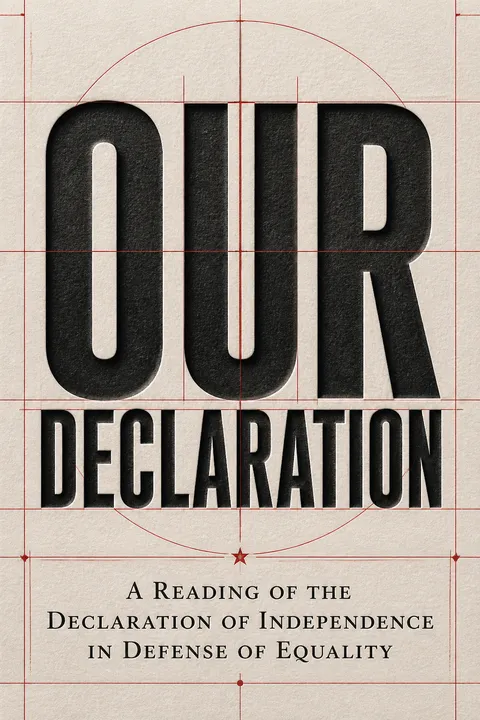


Key Takeaways
Make equality the infrastructure of freedom, not its rival
A text reclaimed. Danielle Allen’s argument begins in two classrooms at the University of Chicago. Her elite daytime students and her adult night students read the same demanding works, but brought different lives to them. The night students first saw the Declaration as a symbol of institutions that had failed them. Reading it closely, they found a political argument they could use: freedom depends on people being equal participants in shaping their shared world.
A living inheritance. Allen connects this insight to her own family history, including Black relatives who fought slavery and Jim Crow, and white relatives who campaigned for women’s rights. Their different struggles made equality and freedom a shared inheritance, not the property of the powerful. The book asks readers to claim that inheritance by learning how the Declaration reasons, not merely by repeating its famous phrases.
What's striking is the classroom as a test of the text’s democratic claim. Students with unequal resources can still bring distinct knowledge to a common argument, and the encounter changes both the reading and the readers. This resembles the idea of situated knowledge: experience can reveal features of a political system that abstract expertise misses. Yet access to a text is not the same as access to political power. The book’s invitation becomes most consequential when close reading is paired with institutions that let citizens act on what they understand.
Treat founding texts as arguments written by a people, not a hero
Many hands, one document. Thomas Jefferson drafted the Declaration, but Allen shows why calling him its sole author distorts the story. John Adams and Richard Henry Lee built support for independence and new governments. Benjamin Franklin and Adams revised Jefferson’s draft, Congress cut and reshaped it, and clerk Timothy Matlack gave the parchment version its formal appearance and interpretive emphases. The final text emerged from extended political work, not an isolated burst of genius.
Agreement took labor. Allen counts more than fifty separate occasions when delegates or colonial groups had to reach agreement, by consensus or vote. This process helped create the habits of cooperation that the new political union needed. Collective authorship did not eliminate conflict: Congress removed Jefferson’s denunciation of slavery. A democratic document can embody shared judgment while preserving compromises and silences that deserve scrutiny.
The account turns authorship into a political question: who gets to shape language that governs everyone? Distributed drafting can pool knowledge, expose weak arguments, and create broader ownership. It can also dilute moral clarity when a majority edits out a truth that threatens its interests. The deleted slavery passage makes that risk vivid. Group process is not automatically just; its democratic value depends on whose voices enter the room, who can contest decisions, and whether later readers may reopen what the original group settled.
Use public language to turn shared judgment into political action
A memo that changes reality. Allen asks readers to see the Declaration not only as philosophy or national scripture, but as a practical memorandum: it announces a decision and explains why a group should act. Its argument moves through four actions: the colonists state their reasons, submit evidence to an audience, declare independence, and pledge themselves to one another.
Words need backing. A declaration alone could not make thirteen colonies independent. The colonists built consent through debate, votes, signatures, and public rituals, then risked lives and property in support of their words. Allen compares the document’s break with Britain and new union among the colonies to divorce followed by remarriage. The analogy highlights that the text did not merely describe a political change. It helped perform one, because a community had prepared to recognize and defend the new reality.
This reading clarifies why political speech can be more than description. A promise, vote, or declaration changes social reality when recognized procedures and people’s commitments give it force. The same principle applies to constitutions, contracts, and public apologies: words matter because others are prepared to treat them as consequential. But no formula guarantees success. A declaration unsupported by institutions, trust, or capacity may remain aspiration. Allen’s account shows language as a tool of action, while keeping the necessary material support in view.
Judge equality by who can govern, not who resembles whom
Equality is a status. The Declaration’s opening claim that the colonies deserve a separate and equal place among nations did not mean they matched Britain in population, wealth, or military strength. Allen reads it as a claim to equal political standing: a people capable of organizing its own common life should not be ruled by another people. In this sense, equality is protection from domination.
Rights require access. The next claim about human equality extends the argument. People have equal standing as beings with rights to life, liberty, and the pursuit of happiness, and government is the instrument for securing those rights. The Declaration grounds this in nature and invokes a Creator, but Allen argues that belief in a specifically Christian God is not required. Readers do need a compelling reason to respect others’ survival and self-government. Equal rights mean little when access to government is unequal.
The distinction between equal status and identical circumstances prevents equality from collapsing into sameness. It also makes power, rather than personal resemblance, the central test: can a community shape its own rules, and can its members influence those rules? This connects political equality to the practical distribution of voice and institutional access. The framework is compelling, though formal access alone cannot erase disparities in time, money, or influence. Equality therefore requires both civic rights and attention to the conditions that make their use meaningful.
Build a civic dashboard from many people’s partial views
Citizens read direction. Allen interprets the Declaration’s image of the “course” of events as a call to notice where repeated actions are leading. The colonists argued that separate British policies formed a pattern of tyranny. Allen links this to John Locke’s image of passengers recognizing a ship’s destination from its repeated course, despite temporary turns. Political judgment is a kind of forecasting, not certainty: citizens use present evidence to assess likely futures.
Knowledge is shared work. The grievances drew on reports and conversations across the colonies, not only Jefferson’s observations. Allen calls this a “potluck” approach: people contribute different pieces of information, which can be organized into a fuller picture. The list also works like a dashboard, with questions about law, representation, justice, security, and prosperity. Individuals can misread events, so collective scrutiny improves the odds of seeing danger. Expertise matters, but it cannot replace local knowledge.
This is a strong account of democratic intelligence: broad participation is not a sentimental substitute for expertise, but a way to gather information that centralized observers may lack. The dashboard metaphor also makes political analysis operational, turning abstract values into recurring questions. Still, more contributions do not automatically produce better judgment. Information can be distorted, selectively shared, or interpreted through prejudice. A genuinely collective intelligence needs channels for verification, disagreement, and correction, not just a large crowd willing to speak.
Read grievances as a map of tyranny, not a list to memorize
Complaints reveal standards. The Declaration’s charges against King George are grouped around failures of government: neglecting the common good, weakening the rule of law and representation, obstructing courts, limiting prosperity, harassing the population, and making war on it. Together, they sketch what tyranny looks like and, by implication, what good government must protect.
Facts need interpretation. Allen shows how a complaint about lawmakers being forced to meet far from public records points beyond inconvenience. Public records help people know the rules and hold officials to them. Other complaints describe people pressed into service or exposed to military force. The text omits many names, dates, and places, so its readers can examine the general principles. But deciding whether its accusations against George were historically fair requires deeper historical knowledge. The grievances are also advocacy, sometimes sharpened by exaggeration, not neutral data.
The method offers a useful discipline for evaluating political claims: separate the event being alleged, the standard it supposedly violates, and the pattern formed by repeated events. That structure helps avoid both reflexive outrage and complacency. It also exposes how evidence is framed. The Declaration’s description of Native Americans and its removal of Jefferson’s anti-slavery passage reveal that its standards were applied selectively. A diagnostic map becomes trustworthy only when its authors and omissions are examined alongside the conduct it condemns.
Demand reciprocal listening before accepting power as legitimate
A petition tests a relationship. The colonists said they repeatedly asked the king to repair his abuses, but their appeals brought further injury. Allen treats this exchange as more than a failed negotiation. A free relationship requires responsiveness: each side must be able to raise a complaint and expect the other to take its interests seriously.
Agency must be balanced. Allen explains the idea through friendship. If one friend names a problem and the other refuses even to engage, the first is denied an equal role in the relationship. Political conversation serves a similar purpose. It lets people identify encroachments and adjust how power is used, preserving each person’s sphere of agency. The king’s refusal, in this reading, made him unfit to rule a free people. The colonists’ petitions also show that they tried peaceful redress before accepting separation as necessary.
Responsiveness is a more demanding standard than simply allowing people to speak. It asks whether their concerns can alter decisions, which is essential when power is unequal. The friendship analogy makes the moral logic accessible, but political authority cannot promise to grant every petition. A workable standard is meaningful consideration, public reasons, and procedures for appeal. Without those safeguards, “listening” can become performance, and a demand for responsiveness can be mistaken for a demand for agreement.
Give ideals practical scripts, or habit will defeat them
Principles do not act alone. The Declaration’s language asserts human equality, yet its authors lived with slavery and dispossession. Congress removed Jefferson’s denunciation of the slave trade, and the document’s promise did not itself remake daily relations. Allen argues that ideas need concrete practices to become real: people must learn what to do differently, and new habits must replace old ones.
Contradiction can still teach. The words provided a standard that abolitionists could invoke, even while many signers failed to live by it. Allen points to the slow movement from principle to practice and to enslaved people’s own escapes and military service as forces that compelled change. Attractive, repeatable alternatives matter, too. A moral claim gains force when people can picture new ways of organizing work, neighborhoods, or civic life, not only agree that the old arrangement is wrong.
The gap between ideals and conduct is not proof that ideals are meaningless; it is evidence that moral change has an implementation problem. Habits are reinforced by incentives, institutions, and social expectations, so exhortation alone rarely alters them. The idea of a practical script captures the missing middle between principle and behavior. Yet the burden should not fall only on those harmed by injustice to model better arrangements. Institutions and beneficiaries of the existing order must also change the routines that make inequality ordinary.
Make shared ownership visible through participation and mutual risk
A pledge makes a people. The Declaration ends with its signers committing their lives, property, and honor to one another. Allen reads this as equality through co-creation: each participant stakes something in the new political order and takes responsibility for what the group makes. The signatures make individual accountability visible, while the pledge binds those individuals into a common project.
Ownership needs renewal. Allen identifies five facets of equality: freedom from domination, access to government, shared development of knowledge, reciprocal agency, and co-creation of public life. The final facet asks citizens to be makers of their common world, not spectators. Even punctuation matters to this argument: Allen criticizes a period in a National Archives transcription that breaks the sentence linking individual rights to government and collective happiness. Reading closely is a civic practice because it reveals how individual freedom depends on shared institutions.
Co-ownership supplies a richer measure of citizenship than formal membership: people should have a credible role in shaping institutions and some accountability for their effects. Shared risk can strengthen commitment, but the founders’ pledge was not equally available to everyone affected by the new order. That exclusion sharpens the framework rather than invalidating it. The demand for inclusive co-creation must reach beyond the original signers, especially toward people whose labor and lives were governed without their consent.
Analysis
Allen’s central achievement is to read the Declaration as both an argument about equality and a demonstration of democratic judgment. The text asks readers to connect principles to evidence, infer a political pattern, and decide what action follows. Its form therefore enacts its claim that ordinary people can participate in judging their shared condition. This is more ambitious than treating the Declaration as a ceremonial statement of rights: the document becomes a civic exercise in learning how to assess power.
The book’s strongest conceptual move is to define equality relationally. Equality is not sameness of wealth or talent, but a protection against domination and an equal claim to participate in governing, interpreting evidence, correcting abuses, and constructing a common world. That makes liberty dependent on institutions and relationships rather than on mere noninterference. The account of petitioning is especially revealing: freedom requires not only a voice, but a political arrangement in which complaints can prompt a response.
The reading also benefits from a productive tension. Allen defends the Declaration’s universal language while confronting its authors’ exclusions, including slavery and violence against Native peoples. The text can furnish a standard for criticism even when its authors betray that standard. Yet this interpretive generosity requires care. A principle’s later usefulness does not erase the harm produced by its original limits, and the capacity to judge does not ensure that every judgment receives equal influence.
The book’s method, close reading, is itself political. Punctuation, revision, and omission expose how meaning is made collectively and contested over time. Its most practical implication is that civic ideals need more than repetition: they require habits, procedures, and material access that let people exercise them. Equality is not simply a sentence to admire. It is a continuing test of who can help write the rules and whose account of public life counts.
Review Summary
Our Declaration received mixed reviews, with praise for its close reading of the Declaration of Independence and exploration of equality as a foundational principle. Many appreciated Allen's accessible writing style and thought-provoking analysis. Critics found the book repetitive and overly detailed at times. Some disagreed with Allen's interpretations or felt she stretched meanings too far. Overall, readers valued the book's emphasis on the importance of understanding this crucial historical document and its relevance to modern democracy.
People Also Read

Glossary
Political equality
Equal power to shape public lifeAllen uses political equality to mean more than formal civic rights or identical treatment. It includes freedom from domination, meaningful access to government, equal participation in building shared knowledge, reciprocal agency in relationships, and a role in creating and owning public life. Equality, on this account, is the basis that makes individual and collective freedom possible.
Democratic writing
Collective authorship through public judgmentDemocratic writing is the process by which people develop language and arguments they can use to govern themselves. It includes drafting, debate, revision, negotiation, and decisions about which words a group will stand behind. The Declaration exemplifies this practice because its meaning emerged through many participants, not Jefferson alone, and because the process helped build habits of cooperation.
Self-evident
Understandable through reflectionIn Allen’s reading, a self-evident truth is not necessarily obvious at first glance. It is a claim that readers can affirm by examining its meaning and reasoning through its connections to other propositions, without relying solely on an authority’s revelation. The phrase invites readers to judge the argument for themselves, making it a democratic claim about how knowledge can be shared.
Epistemic egalitarianism
Equal standing in shared inquiryEpistemic egalitarianism is the idea that everyone can contribute some knowledge relevant to understanding a community’s situation, even though people do not contribute equally or possess identical expertise. By combining observations from many people with expert analysis, a community can build a fuller account of events than any isolated observer could produce.
Practical syllogism
Reasoning that concludes in actionA practical syllogism is an argument whose conclusion is a recommended action rather than a new belief. Allen describes the Declaration’s reasoning in this way: if a government systematically becomes tyrannical, and the king’s conduct demonstrates that pattern, then the colonists should end their political bond and establish a new government. The concluding declarations perform the action they justify.
Five facets of equality
A five-part account of equalityAllen’s framework identifies five connected dimensions in the Declaration: freedom from domination, equal access to government, shared development of collective knowledge, reciprocal agency, and co-creation of public life. Together, these dimensions describe political equality as both protection from arbitrary power and active participation in shaping the institutions and relationships through which people live.
Course of human events
The direction revealed by political patternsAllen treats this phrase as an invitation to interpret how repeated events may point toward a political future. Like passengers inferring a ship’s destination from its recurring course, citizens should examine patterns in leaders’ actions and consider where they lead. The future is not certain, but informed judgment can reveal dangers early enough for people to respond.
Candid world
Humanity as a judging audienceThe Declaration’s “candid world” is the audience asked to assess the colonists’ reasons and evidence. Allen emphasizes that this audience is not limited to people living in 1776 or to American citizens. The phrase treats people broadly as capable of moral judgment, while recognizing that a fair hearing depends on presenting reasons and evidence that others can examine.
FAQ
What is Our Declaration: A Reading of the Declaration of Independence in Defense of Equality by Danielle S. Allen about?
- Focus on equality and freedom: The book offers a close reading of the Declaration of Independence, arguing that equality is the foundation of freedom and democracy.
- Philosophical and practical analysis: Allen unpacks the Declaration sentence by sentence, revealing its philosophical depth and practical implications for political life.
- Democratic writing and empowerment: The book highlights the Declaration as a product of collective, democratic writing and shows how language empowers citizens.
- Personal and political transformation: Through teaching and analysis, Allen demonstrates how engaging with the Declaration can awaken political consciousness and a sense of shared ownership.
Why should I read Our Declaration by Danielle S. Allen?
- Reclaims equality’s importance: The book challenges the modern neglect of equality, arguing it is as vital as liberty for democracy’s survival.
- Deepens understanding of a foundational text: Allen’s slow, careful reading reveals philosophical and political insights often missed in casual readings.
- Empowers citizens: By unpacking the Declaration’s argument and writing process, the book equips readers to engage more thoughtfully in political life.
- Connects history to present: Allen links the Declaration’s ideals to ongoing struggles for equality and freedom, making it relevant for contemporary readers.
Who wrote the Declaration of Independence according to Our Declaration by Danielle S. Allen?
- Collective authorship: The Declaration was not solely Jefferson’s work but resulted from collaboration among the Committee of Five, the Continental Congress, and others.
- Democratic writing process: The text emerged through debate, editing, and consensus-building, illustrating the art of democratic writing.
- Jefferson as draftsman: Jefferson wrote the first draft, but it was heavily revised by Adams, Franklin, Congress, and others.
- Multiple layers of conversation: The creation involved formal and informal discussions, votes, and negotiations, emphasizing democratic deliberation.
What are the five facets of equality presented in Our Declaration by Danielle S. Allen?
- Freedom from domination: Equality means securing conditions free from domination by others, including rulers or other states.
- Equal access to government: All people must have equal access to government as a tool to secure their rights.
- Collective intelligence: Building a community’s shared understanding through the contributions of all members strengthens political judgment.
- Reciprocity and agency: Mutual responsiveness and conversational reciprocity maintain equal spheres of agency and secure freedom.
- Co-creation and co-ownership: Equal participation in creating and sustaining the political community is essential for mutual respect and accountability.
How does Danielle S. Allen in Our Declaration explain the relationship between equality and freedom?
- Equality as foundation: Allen argues that equality is not in tension with freedom but is its sole foundation; without equality, freedom cannot be securely achieved.
- Reciprocal responsiveness: Freedom grows from egalitarian commitments to mutual responsiveness, where individuals recalibrate relations to protect equal agency.
- Broad concept of political equality: Political equality includes access to government, collective knowledge, reciprocity, and shared ownership, not just formal rights.
- Freedom depends on equality: Only through equality can individuals and communities achieve meaningful and lasting freedom.
What is the significance of political equality in Our Declaration by Danielle S. Allen?
- Bedrock of freedom: Political equality enables citizens to protect themselves from domination and participate equally in shaping their community.
- Empowerment and co-creation: It is about the opportunity for all citizens to co-create their political world, maximizing individual and collective flourishing.
- Status and capacity: The Declaration’s claim to equality means equal status as political powers capable of self-organization, not just equality in wealth.
- Fragility and neglect: Allen warns that equality has become the "more frail twin" of liberty, urging renewed attention to its vital role in democracy.
How does Our Declaration by Danielle S. Allen describe the Declaration of Independence as a democratic memo?
- Organizational tool: The Declaration is characterized as a memo that announces a change and organizes collective action, similar to a modern interoffice memo but with profound consequences.
- Four key actions: It declares reasons, presents facts, declares independence, and makes pledges, collectively bringing a new political reality into existence.
- Language as action: The Declaration uses words to "do things," transforming colonies into independent states, much like how vows create new social statuses.
- Inclusive audience: It addresses a "candid world," inviting judgment from all humanity and reflecting a democratic spirit.
What is the structure and argument of the Declaration as explained in Our Declaration by Danielle S. Allen?
- Four-part structure: The Declaration includes declaring reasons for separation, presenting grievances, formally declaring independence, and pledging mutual support.
- Logical syllogism: It builds an argument: all people have rights; governments exist to secure those rights; when governments fail, people may alter or abolish them.
- Self-evident truths: The famous sentence "We hold these truths to be self-evident..." contains a complex argument about equality, rights, and government legitimacy.
- Invitation to judgment: The text assumes readers have the moral sense and capacity to judge facts and principles, reinforcing democratic reasoning.
How does Danielle S. Allen in Our Declaration interpret the list of grievances against King George III?
- Definition of tyranny: The grievances collectively define tyranny as undermining the common good, rule of law, sovereignty, justice, prosperity, and security.
- Dashboard for judgment: The list serves as a set of gauges for citizens to assess whether their government is moving toward good governance or tyranny.
- Collective knowledge: The grievances were compiled through extensive conversation and information sharing among colonists, exemplifying democratic knowledge production.
- Pattern recognition: Building collective intelligence allows communities to discern patterns and anticipate the future, essential for self-government.
What challenges and contradictions about equality does Our Declaration by Danielle S. Allen explore?
- Slavery and exclusion: The book confronts the contradiction that the Declaration’s authors wrote about equality while owning slaves and excluding Native Americans.
- Twisting of ideals: Allen traces how "separate and equal" was twisted into "separate but equal," enforcing inequality and domination.
- Self-interest and habit: The book discusses how self-interest and social conditioning often prevent people from living up to the Declaration’s ideals.
- Words vs. reality: Allen wrestles with the value of principles when they coexist with systemic injustice, concluding that ideals are a necessary starting point for change.
How does Our Declaration by Danielle S. Allen address the role of God and nature in the Declaration of Independence?
- Nature’s God as source: The Declaration invokes "the Laws of Nature and of Nature’s God" as the source of the colonists’ right to equal and separate status.
- Creator and rights: It states that all men are "endowed by their Creator with certain unalienable Rights," linking rights to a divine endowment, though the nature of God is left ambiguous.
- Inclusivity of belief: Allen explains that belief in God is not necessary to accept the Declaration’s argument; secular readers can ground rights in nature and mutual respect.
- Political and theological balance: The text balances religious language with democratic principles, inviting both theists and non-theists to a shared commitment to equality and rights.
What are the key takeaways and lessons from Our Declaration by Danielle S. Allen?
- Equality is essential: Democracy depends on political equality as much as liberty; without equality, freedom is fragile and incomplete.
- Democratic writing matters: The Declaration exemplifies democratic writing as a collective, deliberative process that creates shared political reality through language.
- Slow reading empowers: Careful, slow reading of foundational texts like the Declaration can awaken political consciousness and improve citizens’ capacity to engage in democracy.
- Language shapes politics: Words are powerful tools for political empowerment, and understanding their use is crucial for sustaining democratic communities.
- Historical complexity: The Declaration’s ideals coexist with historical contradictions, requiring ongoing reflection and struggle to realize its promises fully.
Download PDF
Download EPUB
.epub digital book format is ideal for reading ebooks on phones, tablets, and e-readers.








