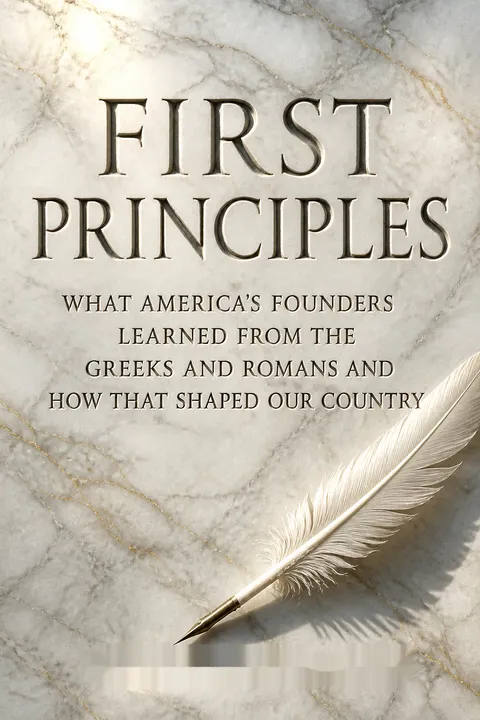


Key Takeaways
Read the founders through Rome, not just Locke, to understand their republic
Antiquity was everyday politics. Colonial classicism meant using Greek and Roman history, literature, and political ideas to interpret public life. It appeared in courtship letters, home design, place names, and the language of government. The Senate and Capitol carried Roman associations, while Cicero, Cato, and the fall of Rome supplied political examples. The founders’ attention focused more on Rome than on Athens, especially on the collapse of the Roman Republic.
Their reading was selective. The ancient world was not a blueprint so much as a store of warnings and models. The founders read it alongside English political thought and the Scottish Enlightenment, whose teachers brought skepticism and close observation into colonial colleges. Their classical knowledge shaped their hopes, fears, and vocabulary, but did not determine their choices.
What's striking is how intellectual inheritance becomes political infrastructure. Shared stories gave leaders in distant colonies a common language for discussing liberty, corruption, and power. The comparison resembles a profession's shared case history: it makes debate legible, but can also constrain what counts as a plausible solution. Ricks carefully treats classical influence as underappreciated rather than exclusive. That distinction matters. The founders did not simply copy Rome, and their inherited examples could illuminate some problems while obscuring others, especially when ancient authority was used to excuse slavery.
Put public virtue at the center, but never expect it to carry a nation alone
Virtue meant civic duty. In eighteenth-century political language, public virtue was not merely private morality. It meant placing the common good above personal advantage. The word appears thousands of times in the founders' writings, more often than freedom. Washington pursued honor through public service, while John Adams argued that a republic depended on citizens' commitment to the public interest.
War exposed the limit. Soldiers and officials could not indefinitely sacrifice pay, comfort, and safety for principle alone. Washington concluded during the Revolution that patriotism helped sustain the army, but lasting service also required practical incentives. The insight was not that virtue was worthless. It was that governments fail when they assume people can ignore their own interests forever.
This is an early argument about collective action: people may value a shared cause and still need institutions that make participation sustainable. Modern public administration faces the same design problem in volunteer services, military staffing, and civic organizations. Incentives need not corrupt public purpose; they can protect it from exhaustion. The harder question is how to reward contribution without letting money become the measure of citizenship. The book's account suggests that moral appeals work best when institutions recognize ordinary human limits rather than treating self-interest as a character defect.
Read Washington, Adams, Jefferson, and Madison as four different political educations
Their minds were formed differently. Washington lacked a college education, but the frontier taught him to read terrain, gather intelligence, and learn from defeat. Adams studied Cicero and pursued a career as an American orator and lawyer. Jefferson absorbed Greek philosophy, Epicurean ideas, and Scottish empiricism, which prized evidence from observation. Madison studied ancient governments systematically, especially to understand how republics and confederacies failed.
Ideas became action. These differences help explain why the four men did not respond to the same crisis in the same way. Washington learned through experience and adjusted his command. Adams trusted rhetorical leadership and civic virtue. Jefferson could articulate expansive principles while avoiding painful realities, including slavery. Madison turned historical comparison into a practical theory of political structure.
The comparison is valuable because it treats political ideas as learned habits, not free-floating doctrines. A frontier commander, an ambitious lawyer, a philosophical planter, and a systematic student each notice different evidence and risks. This resembles cognitive diversity in group decision-making: varied perspectives can improve diagnosis, though they can also generate friction. Biography cannot prove that education alone caused each man's politics. Family, wealth, region, and personal character mattered too. The book's strongest insight is the interplay between what each founder studied and what experience forced him to reconsider.
Use equality as a standard America must meet, not a claim it has earned
The Declaration made a demanding promise. Jefferson's draft stated that people are equal and have rights to life, liberty, and the pursuit of happiness. The phrase replaced Locke's emphasis on property with a broader ideal of human flourishing. Jefferson drew on classical and Enlightenment thought, but used plain language designed to reach beyond educated elites. The Declaration justified independence and set a principle against which the country's conduct could be judged.
Its force outlived its moment. The equality claim became a resource for later movements, including the women's rights declaration at Seneca Falls, Lincoln's Gettysburg Address, and Martin Luther King Jr.'s speech in Washington. The promise was never an accurate description of who enjoyed equal rights in 1776. Its enduring power comes partly from making that gap visible.
A founding text can function as more than a record of consensus. It can establish a public standard that excluded groups later use to challenge the institutions that excluded them. In that sense, the Declaration's influence depends on a productive tension between principle and practice. Its universal language helped make future claims possible, even though its authors lived within a society built on slavery and denied political equality to most people. The principle is potent, but it does not enforce itself. Interpretation, organization, and law determine whether aspiration changes lived conditions.
Preserve the army before chasing the victory that looks glorious
Washington learned to fight indirectly. A Fabian strategy is an approach that avoids risking everything in one decisive battle and instead wears down an opponent through maneuver, harassment, and attacks on vulnerable supplies. Washington did not begin with this plan. After defeats around New York in 1776, he tried defending fixed positions, then recognized that the inexperienced American forces could not reliably match British regulars in conventional battles.
Survival became the strategy. Washington increasingly used local militias to gather intelligence and harass British patrols, while keeping the Continental Army intact. The victories at Trenton and Princeton helped revive the cause, but the broader aim was to deny Britain a decisive win and make its distant supply demands costly. This patient strategy was politically difficult because it could look like inaction.
The military lesson is a classic distinction between tactics and strategy: winning an engagement is not the same as achieving the war's political purpose. An outmatched force can sometimes gain more from preserving its capacity than from gambling on spectacle. That logic applies beyond warfare whenever resources are asymmetric and time changes the balance. Yet patience carries a communication problem. Supporters may mistake restraint for weakness, and a strategy of delay can lose public confidence if people cannot see its purpose. Strategic endurance therefore needs both operational discipline and a credible explanation.
Design government around competing interests, not idealized virtuous leaders
Madison treated faction as permanent. In the founders' vocabulary, a faction was a group pursuing interests that might conflict with the rights of others. Classical republican thought often treated faction as a disease to eliminate. Madison argued instead that its causes could not be removed without destroying liberty. The answer was to control its effects through a larger republic, where many interests would make it harder for one majority to dominate.
Structure could do what virtue could not. The Constitution divided authority among branches and between national and state governments. Madison's argument in Federalist No. 10 made political competition part of the design, rather than a regrettable exception. The goal was not to make leaders selfless. It was to arrange power so that ambition and interest could restrain one another.
Madison's move is a shift from moral engineering to institutional engineering. Instead of requiring unusually good people, the design assumes ordinary motives and tries to make them mutually limiting. That insight aligns with pluralist theories of democracy, where competing groups prevent durable monopoly. But competition does not automatically produce fairness. Some interests possess greater money, organization, or access than others, so a system can balance power formally while distributing influence unevenly. Madison's logic is strongest as a defense against concentrated authority, not as proof that every interest receives an equal hearing.
Name the founding contradiction: liberty was declared while racial slavery was protected
Classical precedent became an excuse. Washington, Jefferson, and Madison enslaved people while helping establish a nation committed to liberty. At the Constitutional Convention, delegates invoked Greek and Roman slaveholding to defend the institution. Yet ancient slavery was not identical to American chattel slavery, which was racial, hereditary, and enforced through extreme violence. Ancient examples could not make the American system humane or just.
The compromise had a long cost. The Constitution protected slavery rather than resolving it, leaving the conflict to later generations. The founders' failure to confront the contradiction helped entrench a system that would divide the country and contribute to civil war. The book treats slavery not as a minor flaw beside the founding achievement, but as a structural injustice woven into the nation's original settlement.
The case exposes how intellectual traditions can be used selectively: an authority is persuasive when it legitimizes existing power, and conveniently ignored when it challenges it. The deeper issue is not simply hypocrisy by individuals, although that is present. It is institutional compromise that makes domination durable while allowing a society to describe itself through universal ideals. Historical explanation should neither flatten the founders into villains nor let their achievements cancel the harm. A full account keeps both facts in view, especially because inherited racial hierarchies can persist after the legal system that created them changes.
Protect political opposition before fear turns criticism into sedition
The founders lacked a language for dissent. Many initially saw political parties as dangerous factions, not as a normal feature of representative government. In the 1790s, Federalists often described opponents as conspirators in the mold of Catiline, the Roman figure associated with a plot against the republic. That framing made ordinary political competition look like treason.
The Sedition Act showed the danger. Under John Adams, the federal government prosecuted newspaper editors who criticized the administration. The backlash helped make the press and party conflict central to political life. The election of 1800 then brought a peaceful transfer of power from Adams to Jefferson, demonstrating that opposition could win office without ending the republic. The change was an important test of the constitutional system.
A democracy needs more than elections. It needs a shared expectation that losing power is temporary and criticism is not inherently disloyal. That expectation is a form of institutional trust, and it reduces the incentive to treat every contest as existential. Still, the distinction between dissent and genuine threats cannot be settled by labels alone. Governments must enforce laws against violence while resisting the temptation to criminalize embarrassment or disagreement. The founders' experience shows how fear can turn a republic's defenders into threats to its own political freedoms.
Treat the republic as an experiment, not a finished inheritance
The system requires citizens. Ricks presents the Constitution as durable but not self-sustaining. Its checks can restrain power, but voting, public debate, and active institutions are needed to keep them working. The book's final advice includes protecting the rights of people with unpopular views, strengthening Congress, limiting the dominance of money in politics, and treating education, health, infrastructure, and public safety as common concerns.
History is a practical warning. The founders built institutions that survived serious conflicts, but they also accepted slavery and misunderstood the legitimacy of party competition. Remembering both sides helps citizens avoid nostalgia and complacency. The American project is not simply the founders' design preserved intact. It is an ongoing effort to make the promise of equal standing more real while confronting exclusions inherited from the beginning.
The experiment metaphor captures a useful balance: constitutional durability matters, but so does revision when institutions exclude or fail people. Political scientists often distinguish regime stability from democratic quality; a system can endure while participation and accountability weaken. The book's appeal to civic attention is therefore not a call to venerate the founders, but to scrutinize the machinery they left. One tension remains: reforms can protect democracy, yet reforms designed by current majorities can entrench their advantage. Sustained public argument is necessary precisely because no generation has a final, neutral answer.
Analysis
The book's central achievement is to recast the founding not as a clean application of Enlightenment slogans, but as a long negotiation between inherited ancient models and American conditions. Its four protagonists embody different ways of learning: Washington converts defeat into practical judgment, Adams turns Cicero into a personal and political template, Jefferson translates philosophical hope into democratic language, and Madison tests ancient history against institutional experience. Their disagreements matter as much as their shared vocabulary. The republic emerges from imperfect, competing minds rather than from one coherent doctrine.
The most consequential shift is from virtue to structure. Early republican confidence required citizens to subordinate private interest to the common good. War, faction, and the failures of the Confederation showed the limits of that hope. Madison's constitutional thinking did not abandon morality, but refused to make good character the system's sole safeguard. Competition, divided authority, and a broad political sphere became ways to contain ordinary ambition. That is a durable contribution, though institutional balance cannot by itself correct unequal access to power.
The book also insists that classical learning had a double edge. Ancient examples helped the founders imagine resistance to tyranny, yet the same tradition supplied defenses of slavery and hierarchy. Their selective reading was not merely an intellectual quirk. It reveals how inherited frameworks can enlarge political imagination in one domain and narrow it in another. The founders' universal language and their exclusionary practices must therefore be read together.
The narrative's caution is especially useful today: neither reverence nor contempt provides an adequate history. The founding institutions have proved adaptable, but survival is not proof of justice, and the Constitution does not operate without public participation. The most faithful inheritance is not imitation of Roman virtue or founder worship. It is the willingness to examine political arrangements, recognize their failures, and keep widening the circle of people whose rights and voices count.
Review Summary
First Principles receives mixed reviews. Many praise its exploration of classical influences on America's founders, finding it insightful and thought-provoking. Readers appreciate Ricks' analysis of the first four presidents' educations and philosophies. However, some criticize the book for straying from its stated focus, injecting modern political views, and making tenuous connections. The epilogue is particularly divisive, with some finding it unnecessary and others seeing it as a valuable reflection on contemporary issues. Despite criticisms, many readers recommend the book for its fresh perspective on early American history.
People Also Read


Glossary
Colonial classicism
Ancient ideas in public lifeThe pervasive use of Greek and Roman history, literature, political thought, and imagery in colonial American culture. For the Revolutionary generation, antiquity supplied examples of civic duty, republican liberty, faction, and political decline. It appeared in education and political argument as well as architecture, names, and popular culture.
Public virtue
Commitment to common welfareThe eighteenth-century ideal that people, especially public leaders, should put the common good ahead of private advantage. It was central to classical republican thought and appeared frequently in the founders' political writing. The Revolution tested whether patriotism and self-restraint could sustain public institutions without practical incentives.
Classical republicanism
Republican rule through civic virtueA political tradition drawing on Greek and Roman republics that emphasized civic responsibility, public-minded leadership, and suspicion of corruption, luxury, and concentrated power. The founders used it to interpret independence and republican government, but its assumptions about suppressing faction and relying on virtue proved inadequate to the politics of a large, diverse nation.
Fabian strategy
Wear down a stronger opponentA military approach associated with the Roman general Fabius, who avoided decisive battle against Hannibal and instead harassed his forces and exhausted their resources. Washington gradually adapted this logic during the Revolution, using maneuver and militia attacks while protecting the Continental Army from a potentially fatal defeat.
Faction
A group pursuing shared interestsIn the founders' political vocabulary, a faction was a group united by interests or passions that could conflict with the rights of other citizens or the common good. Madison argued that factions arise naturally in free societies and cannot be eliminated without harming liberty. Government should therefore limit their harmful effects.
Epicureanism
Happiness through measured livingA Greek philosophical tradition associated with Epicurus that understood happiness as freedom from bodily pain and mental disturbance, rather than uncontrolled indulgence. Jefferson adopted a version centered on happiness, prudence, temperance, fortitude, and justice. Ricks identifies its influence in the Declaration's emphasis on pursuing happiness.
Amphictyonic League
Ancient Greek city confederationA confederation of Greek communities that served as a historical comparison in American debates about union and representation. Delegates invoked it while considering whether states should have equal votes regardless of size. Madison studied Greek confederacies to understand why weak alliances could fracture or fall under outside influence.
FAQ
What's First Principles about?
- Founding Influences: First Principles by Thomas E. Ricks explores how America's founders were influenced by ancient Greek and Roman thought, shaping their education and political philosophy.
- Key Figures: The book focuses on the first four presidents—George Washington, John Adams, Thomas Jefferson, and James Madison—and their classical influences.
- Modern Connections: Ricks connects these classical ideals to contemporary issues, examining their relevance in today's political landscape.
Why should I read First Principles?
- Historical Insight: The book offers a deep understanding of the intellectual foundations of American democracy, crucial for history enthusiasts.
- Unique Perspective: Ricks provides a fresh angle by emphasizing the classical education of the founders, often overlooked in traditional narratives.
- Relevance to Today: Readers will find parallels between the founders' ideals and modern political challenges, encouraging reflection on democracy's evolution.
What are the key takeaways of First Principles?
- Classical Education's Impact: The founders' education in classical literature and philosophy significantly influenced their political ideas and actions.
- Virtue in Governance: The concept of "virtue" is highlighted as essential for a republic's success, with Washington emphasizing public and private virtue.
- Political Thought Evolution: The book illustrates how the founders' reliance on classical models evolved as they faced governance realities.
How did classical education influence the founders in First Principles?
- Foundational Texts: The founders were influenced by classical texts like those of Aristotle and Cicero, shaping their governance and virtue understanding.
- Rhetorical Skills: Their education in rhetoric enabled them to articulate ideas effectively, evident in Jefferson's Declaration of Independence.
- Political Models: They used ancient republics as models for American governance, learning from their successes and failures.
What role did virtue play in the thinking of the founders according to First Principles?
- Central to Republicanism: Virtue was seen as crucial for a republic's survival, with Washington asserting its foundational role.
- Moral Responsibility: The founders believed citizens should prioritize the common good over personal interests, rooted in classical thought.
- Human Nature Challenges: Washington later acknowledged the limits of relying solely on virtue, recognizing self-interest as a governing principle.
How does First Principles address the issue of slavery?
- Moral Contradiction: Ricks highlights the founders' struggle with slavery, which contradicted their ideals of liberty and equality.
- Historical Context: Slavery is placed within the broader American history context, showing its deep-rooted presence from the nation's inception.
- Legacy of Division: The compromises made regarding slavery are linked to the Civil War, with future generations paying the moral debt.
What insights does First Principles provide about the Constitutional Convention?
- Debate and Compromise: The book details intense debates on representation and governance, emphasizing the necessity of compromise.
- Madison's Influence: Madison's pivotal role in drafting the Constitution is highlighted, with his classical education informing his arguments.
- Enduring Principles: The principles established, like checks and balances, remain relevant, setting the course for American democracy.
How does First Principles relate to modern American politics?
- Partisanship and Faction: Ricks draws parallels between the founders' challenges and contemporary political issues, like partisanship.
- Role of Money: The book critiques modern politics' money influence, echoing the founders' corruption concerns.
- Civic Responsibility: Emphasizing civic engagement and virtue, Ricks calls for a renewed focus on the public good.
What are the best quotes from First Principles and what do they mean?
- “The Revolution was in the Minds of the People”: John Adams highlights the ideological shift towards independence as a gradual public sentiment change.
- “Virtue, my young Friend, Virtue alone is or can be the Foundation of our new Governments”: Adams stresses moral integrity's necessity in governance.
- “We hold these truths to be self-evident, that all men are created equal”: Jefferson's line from the Declaration of Independence challenges hierarchical governance.
How did the founders' views on government evolve according to First Principles?
- From Idealism to Realism: Initially idealistic, the founders' views evolved to more pragmatic approaches due to governance realities.
- Madison's Insights: Madison's studies informed his belief in accommodating various interests, leading to a robust federal system.
- Constitutional Framework: The Constitution's drafting marked a shift from classical reliance on virtue to checks and balances.
What lessons can be learned from First Principles?
- Value of Historical Context: Understanding American democracy's historical context aids in navigating contemporary political issues.
- Importance of Compromise: The necessity of compromise in governance is illustrated, relevant in today's polarized climate.
- Ongoing Experiment: The American experiment requires vigilance to preserve its core principles, urging active democratic engagement.
What is the significance of the title First Principles?
- Return to Fundamentals: The title suggests revisiting foundational ideas, especially during crises or uncertainty.
- Guiding Philosophy: It reflects the belief that classical principles can guide current and future political challenges.
- Exploration of Origins: The title encapsulates the exploration of American political thought origins and their enduring impact.

Download PDF
Download EPUB
.epub digital book format is ideal for reading ebooks on phones, tablets, and e-readers.








