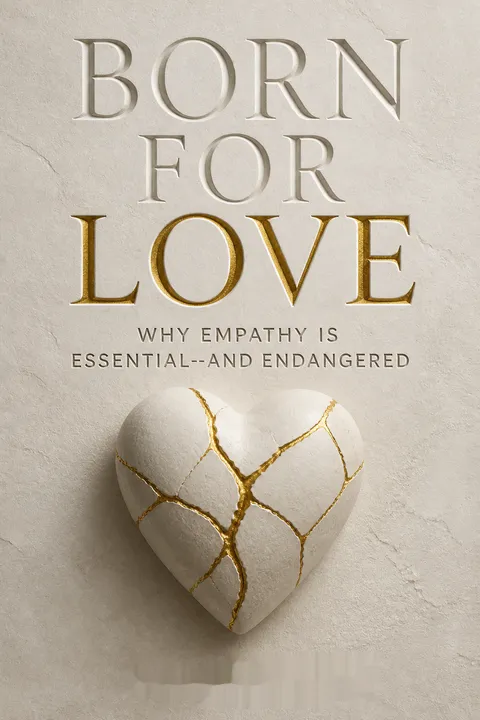


Key Takeaways
Empathy is built through repeated care, not installed at birth
A capacity, not a guarantee. The book opens with sixth graders studying Sophia, a baby whose small signals teach them to notice another person’s needs. Babies begin with rudimentary imitation and emotional contagion, when one person’s feeling spreads to another before either fully distinguishes self from other. The authors describe mirror neurons as brain cells that respond both to an action and, more weakly, to seeing someone else perform it. Such mirroring may help us feel another’s experience, but empathy also depends on how relationships develop around it.
Care has deep roots. Human children evolved in groups where several adults and older children helped care for the young. The book presents this cooperative upbringing as part of the foundation for our unusual capacity to read and respond to others. A predisposition to connect still needs repeated, responsive relationships to grow.
What's striking is the distinction between having a capacity and getting the experience needed to use it. That distinction helps explain why empathy is not simply a fixed personality trait or a lesson delivered in a classroom. Mirroring can make another person's distress vivid, but feeling is not the same as helping: interpretation, self-control, and a decision to respond still matter. The account is most persuasive when it treats early care as a developmental environment, not a magical ingredient. The proposed role of mirror neurons is suggestive, but the book's broader point does not depend on any single neural mechanism.
Give children manageable frustration, then reliable comfort
Stress can be practice. The stress response system monitors the body and surroundings for danger or need, then shifts attention and behavior to meet the moment. Infants rely on caregivers to help regulate it. The authors argue that repeated, manageable discomfort followed by soothing helps children gradually build their own ability to recover. This is not an argument for withholding comfort: a responsive caregiver is the safety that makes small challenges tolerable.
Jeremy needed small steps. His mother tried to shield him from the rejection she feared his facial birthmark would bring. She quickly solved frustrations and rarely let him practice separation. With a clinician’s guidance, the family began with brief, predictable absences and lengthened them as Jeremy managed. He eventually tolerated preschool and sleeping in his own room. The lesson is not to provoke distress, but to pair age-appropriate challenges with dependable reassurance.
The useful distinction here is between distress that can be recovered from and distress that overwhelms. That makes the story relevant beyond parenting: practice works best when people can attempt a challenge, receive feedback, and return to safety. Yet a child’s tolerance is not a universal dose that can be prescribed from a distance. Temperament, disability, and context change what counts as manageable. The book’s emphasis on gradual steps and predictable care helps guard against turning resilience into an excuse for exposing children to hardship.
Separate emotional resonance from perspective taking before judging empathy
Empathy has distinct parts. Emotional contagion is the spread of another person’s feeling into one’s own, before fully recognizing the other as separate. Theory of mind means understanding that other people have their own knowledge, thoughts, and perspectives; perspective taking uses that understanding to imagine their point of view. Neither ability alone guarantees compassionate action.
Different minds, different barriers. Sam, an autistic father, describes feeling deeply moved by music and other people’s distress, while struggling to read some social cues. His son Jonah could become absorbed in repetitive play and was sensitive to noise and touch. The book discusses the Intense World theory, a hypothesis that heightened sensory experience and fear can make social interaction overwhelming for some autistic people. By contrast, the con artist Danny and the callous teen Ryan could infer others’ perspectives but showed little concern for their suffering.
This framework is valuable because it resists treating empathy as a single score. A person can care intensely yet misread cues, or understand another person’s motives without caring about the harm they cause. That distinction also shifts the question from “Does this person have empathy?” to “Which part of this interaction is failing?” The Intense World account is a hypothesis, not a complete explanation of autism. Its practical emphasis on sensory needs and communication is strongest when it invites accommodation rather than making every autistic person fit one theory.
Treat neglect as a developmental injury, not a character flaw
Care shapes more than feelings. Eugenia spent her first years in a Russian orphanage where food, cleanliness, and supervision were available, but care was not individualized or consistent. A study of Romanian children described in the book found that children placed in foster care had higher average IQs at forty-two months than those who remained institutionalized. The younger children were moved, the better their outcomes tended to be.
Trauma echoes through the body. The Adverse Childhood Experiences (ACE) Study surveyed more than 17,000 adults and connected childhood abuse and household dysfunction with increased risks of later health problems. Compared with people reporting none, those reporting four or more ACEs had a 220 percent higher risk of ischemic heart disease in the study. The authors also discuss epigenetics: environmental experiences can influence which genes are expressed without changing the DNA sequence. Risk is not destiny, but early adversity can leave lasting effects.
The shift from moral judgment to developmental explanation can improve care: behavior that looks defiant or distant may be an adaptation to unreliable relationships or threat. The ACE findings also make a strong case for treating childhood adversity as a public health concern, not only a private family matter. Still, an ACE score summarizes exposure; it does not diagnose an individual or predict a specific life. Associations across a population cannot explain every person’s outcome. The most responsible use of the framework is to guide support without reducing people to their histories.
Resilience grows when someone notices you and gives you a role
Trauma does not dictate character. Trinity grew up amid drug addiction, violence, neglect, and the murder of her two-year-old sister. She became a caretaker to her younger siblings, but her survival was not simply a triumph of willpower. A neighbor named Myrna fed the children and watched the younger girls. At school, a counselor recognized Trinity’s strengths and made her a peer counselor, giving her a chance to help other students.
Connection opened choices. Trinity’s sensitivity and intelligence helped her understand what was happening around her, while caring adults and her relationships with her siblings gave her reasons to keep going. As a peer counselor, she learned to look for what mattered to a bully she was helping, and their relationship changed. Her story complicates the idea that suffering automatically makes people compassionate: trauma can injure, while empathy can also grow when people find support, purpose, and a chance to matter.
Trinity’s story makes resilience social rather than solitary. Her strengths count, but so do the people who notice them and offer practical help. A meaningful role can convert a young person’s sensitivity into agency, instead of leaving it as a burden. That is a more useful model than praising children for enduring what adults should have prevented. It also cautions against romanticizing parentification: caring for siblings helped Trinity find purpose, but children should not have to replace absent adults. Support should honor her resourcefulness while reducing the responsibilities imposed on her.
Choose groups carefully: belonging can override private moral judgment
Conformity can be quiet. Alyson repeatedly changed her style to fit new crowds. After losing her place among Goths and athletes, she joined a group of girls imitating a violent gang and took part in an assault. She later struggled to understand how she had acted against her own values. The book describes Solomon Asch’s line-judgment experiments: when a group unanimously gave an obviously wrong answer, participants often followed it; when even one person dissented, conformity dropped sharply.
Belonging shapes the boundary. Group identity can make people more generous toward insiders and less responsive to outsiders. Familiarity with people across racial or social lines can widen the circle of concern, while shared activities can strengthen solidarity. That solidarity can support cooperation, but it can also be directed toward harming others. Alyson’s experience shows why choosing a group with care is easier than relying on a lone person to resist its norms.
The sharpest insight is that harmful conformity need not begin with an explicit demand. People often copy the group’s cues because inclusion itself is rewarding and exclusion feels costly. This makes peer influence a design problem for schools and organizations, not merely a test of individual courage. A dissenting voice can change what the whole group regards as acceptable. At the same time, group pressure explains behavior without erasing responsibility. The aim is to make prosocial belonging available, so that loyalty and moral concern do not have to compete.
Replace screen time with responsive play, not simply more information
Language needs a partner. Brandon spent much of childhood watching television while his depressed mother struggled to care for him. He learned phrases from programs and advertisements, but a screen could not respond to his expressions or needs. His severe dental problems and developmental delays reflected a larger absence of attentive care, not television alone. The book reports a study linking each hour of some infant video viewing with fewer vocabulary words, and describes research connecting violent media exposure with more aggressive behavior in some children.
Interaction teaches reciprocity. Face-to-face play lets children practice turn-taking, reading expressions, negotiating rules, and repairing misunderstandings. A program cannot provide those exchanges simply by showing words and images. The authors do not argue that all screens are harmful: digital contact can support relationships when it adds to, rather than replaces, time with people. For young children especially, prioritize responsive conversation and unstructured play over passive exposure.
The central issue is not a competition between screens and books, but whether a child gets responsive interaction. A screen can deliver content; it cannot notice a child’s confusion and change course in the way a person can. That distinction is particularly important when discussing children whose behavior already raises concern, because the household conditions around media use may be part of the story. The evidence on specific media effects varies by content and context. The book is on firmer ground when it argues that screens should not displace the human exchanges development requires.
Build trust across class lines, because inequality makes strangers feel like enemies
Trust is social infrastructure. Social capital is the value created by relationships and trust. The book distinguishes bonding social capital, ties within family or familiar groups, from bridging social capital, trust across group boundaries. Without the latter, dealing with strangers becomes harder and every transaction needs more safeguards.
Status affects health and trust. In the Whitehall studies of British civil servants, men at the lowest rank were four times more likely to die from any cause than those at the top. The authors connect this gradient to control over daily life and chronic stress, not simply income or health-care access. They contrast that pattern with Iceland’s stronger safety net and high reported trust, while describing how insurer executive Wendell Potter changed his view after seeing uninsured people seek care in a rain-soaked field near his hometown. Inequality can make another person’s hardship feel remote.
The book usefully connects social trust to material arrangements: people are less likely to experience a shared society when their daily lives barely overlap. That insight makes class segregation a relational problem as well as an economic one. Still, Iceland is not a controlled experiment, and national trust can reflect many factors beyond inequality. The strongest argument is narrower: unequal power and limited control create chronic strain, while shared institutions can make cooperation feel credible. Policy cannot manufacture affection, but it can reduce the conditions that turn strangers into presumed rivals.
Give caregivers time, then let children practice empathy together
Care needs support. Roots of Empathy brings a baby and caregiver into classrooms so students can observe the child’s signals and discuss feelings, temperament, and caregiving. The program runs across a school year; the book reports nine independent evaluations, including two randomized trials, with reductions in bullying and aggression and increases in helping and inclusion. Some effects remained measurable three years later.
Build the conditions around families. The authors recommend consistent caregiving, support for new parents, reading together, unstructured play, and school climates that do not tolerate bullying. They also describe nurse home visits for vulnerable mothers, which offered guidance and practical support during pregnancy and early childhood. One study cited in the book found a 59 percent reduction in later teen arrests among children whose mothers received visits. Empathy is not only a private virtue: families, schools, and public services can make its practice easier.
These examples turn empathy from a vague aspiration into something institutions can cultivate. Roots of Empathy gives children a shared object of attention, then helps them interpret what they see; nurse visits support the caregiver who provides a child’s earliest relationships. Together, they suggest that teaching social skills works best when adults also receive support. Program results depend on implementation and local conditions, so replication matters as much as enthusiasm. The larger principle is practical: protect time for relationships, and create settings where children can practice care safely.
Analysis
Born for Love is an argument about development, but its scope reaches from the nursery to public policy. Its most effective move is narrative juxtaposition: Jeremy is overprotected, Eugenia receives too little individual care, and Ryan experiences repeated caregiver loss. Their different outcomes make the authors’ central point memorable: empathy depends on relationships and stress regulation, not on a simple measure of kindness or intelligence. Stories about Trinity, Alyson, and Terrell then show how family histories and group pressures shape, but do not fully determine, later behavior.
The book’s framework also benefits from scientific caution. It was published in 2009, and some explanations it presents as emerging possibilities, especially mirror-neuron accounts and the Intense World theory of autism, should not be mistaken for settled, comprehensive explanations. Oxytocin is not a simple switch for trust, and findings from rodents cannot be transferred directly to human relationships. The ACE Study identifies powerful population-level associations, but it cannot tell an individual exactly what caused a health condition or predict a future.
Those cautions do not undo the book’s strongest contribution. They sharpen it. The durable claim is that social experience is biologically consequential, and that children need consistent, responsive relationships, not merely adequate material provision. The societal argument follows: chronic insecurity, isolation, and steep power differences can undermine the trust on which cooperation depends. Yet empathy has limits. People can feel intensely and still misread, exclude, or exploit others. A useful application therefore pairs care with perspective taking, accountability, and institutions that reduce avoidable stress. The book is most compelling when it treats empathy not as a cure-all, but as a capacity societies can either cultivate or neglect.
Review Summary
Born for Love explores the importance of empathy in human development and society. Readers praise Perry's insights on child psychology, neuroscience, and the impact of early relationships on empathy. Many found the book enlightening and relevant to parenting and social issues. Some criticism focused on repetition, outdated information, and occasional lack of scientific rigor. Overall, reviewers appreciated the book's emphasis on human connection and its potential to improve lives, despite some flaws in presentation and structure.
People Also Read







Glossary
Emotional contagion
Feelings spreading between peopleA basic form of emotional sharing in which one person’s feeling triggers a similar feeling in another, without requiring a clear understanding that the other person has a separate mind. The book describes newborns crying in response to other babies’ cries as an early example. Emotional contagion can support empathy, but it is not the same as understanding or helping another person.
Mirror neurons
Cells responding to observed actionsNeurons described in the book as active when a person performs an action and also, less strongly, when that person sees someone else perform it. The authors present mirroring as one possible neural basis for sharing aspects of another person’s experience. They connect it to imitation and empathy, while noting that a felt response does not by itself determine how someone acts.
Theory of mind
Recognizing other minds as separateThe ability to understand that other people have thoughts, knowledge, feelings, and perspectives that may differ from one’s own. The book illustrates this with a test in which a child must predict where a character will search for an object after missing information about its movement. Theory of mind supports perspective taking, but does not guarantee emotional concern.
Arousal continuum
Stress states shaping thoughtThe book’s model of how emotional arousal shifts from calm and alert through alarm, fear, and terror. As perceived threat rises, attention narrows, reflective thought becomes harder, and concern may contract from the wider world toward immediate self-protection. The model is used to explain why safety and manageable stress support learning, self-control, and empathy.
Adverse Childhood Experiences (ACE) Study
Study linking childhood adversity and healthA large study of adults that examined relationships between harmful childhood experiences and later health. The listed experiences included abuse, neglect, and household problems such as addiction, mental illness, or domestic violence. Researchers counted exposures to create an ACE score and found that higher scores were associated with greater risks of many physical and mental health problems. The score describes risk, not destiny.
Epigenetics
Environment influencing gene activityThe study of how environmental conditions can affect whether genes are expressed, without changing the underlying DNA sequence. The book uses animal research on early caregiving to explain how experience may influence stress regulation and behavior across generations. It emphasizes that inherited genetic material is not the only influence on development, while also distinguishing changes in gene activity from changes to genes themselves.
Intense World theory
Autism as overwhelming experienceA hypothesis discussed in the book proposing that some autistic people experience heightened sensory processing and fear, making ordinary social environments overwhelming. Under this account, withdrawal or repetitive behavior may help manage overload rather than signal an absence of caring. The authors present the theory as a possible explanation, not a definitive account of autism or a description that applies to every autistic person.
Social capital
Value created by trust and tiesThe economic and social value associated with people’s relationships, networks, and willingness to trust one another. The book distinguishes bonding social capital, ties within a family or familiar group, from bridging social capital, trust that crosses group boundaries. Both can support cooperation, but a society relying only on close in-groups may struggle to work with strangers.
Roots of Empathy
Classroom program using a babyA school program founded by Mary Gordon in which a baby and caregiver visit a classroom over the school year. Students observe the baby’s behavior and feelings, discuss what the child may need, and consider the caregiver’s perspective. The program aims to build emotional understanding and reduce bullying by giving children repeated, concrete opportunities to notice and respond to another person.
Cooperative breeding
Shared care of youngA pattern of child-rearing in which care is provided by more people than the biological parents alone, including relatives and older children. Drawing on anthropological examples, the book argues that shared caregiving may have supported human survival and helped cultivate social sensitivity. It uses the concept to question the assumption that isolated nuclear families are the only natural setting for raising children.
Relational poverty
A shortage of meaningful connectionThe authors’ term for a lack of close, trusting, and repeated human relationships. It can coexist with material comfort or digital contact, because neither guarantees dependable face-to-face support. The book links relational poverty with reduced opportunities to practice empathy, less social trust, and greater vulnerability to stress. It contrasts this shortage with relational wealth: a broad, supportive network of meaningful ties.
FAQ
What is Born for Love: Why Empathy Is Essential—and Endangered by Bruce D. Perry and Maia Szalavitz about?
- Exploration of empathy’s role: The book investigates why empathy is fundamental to human development, health, and society, and how it is threatened by modern social and environmental changes.
- Interdisciplinary approach: It combines neuroscience, psychology, sociology, and evolutionary biology to explain empathy’s biological roots and social significance.
- Real-life stories: The authors use compelling case studies to illustrate how early experiences shape empathy and its impact on individuals and communities.
Why should I read Born for Love by Bruce D. Perry and Maia Szalavitz?
- Understand empathy’s importance: The book reveals how empathy underpins personal well-being, social trust, and the functioning of societies.
- Insight into modern challenges: It highlights trends like declining social trust, increased isolation, and cultural shifts that threaten empathy’s development.
- Practical implications: Readers gain knowledge about how early experiences, parenting, and social environments influence empathy, with actionable insights for improving relationships and policies.
What are the key takeaways from Born for Love about empathy?
- Empathy is biologically rooted: Early brain development and nurturing relationships are essential for empathy to flourish.
- Social environment matters: Experiences such as neglect, trauma, or supportive caregiving profoundly shape empathy throughout life.
- Empathy’s societal impact: Empathy reduces stress, fosters cooperation, and is linked to better health, while its erosion contributes to violence and mistrust.
How do Bruce D. Perry and Maia Szalavitz define empathy in Born for Love, and how is it different from sympathy?
- Empathy as “feeling with”: Empathy is the ability to stand in another’s shoes and share their emotional state, not just understand it.
- Sympathy as “feeling for”: Sympathy involves recognizing another’s feelings without necessarily experiencing them yourself.
- Why the distinction matters: Empathy’s emotional contagion and neural mirroring are foundational for compassionate action and social bonding, making it more powerful than sympathy.
How does Born for Love explain the biological and neurological basis of empathy?
- Mirror neurons: These brain cells fire both when we act and when we observe others, enabling us to “feel into” others’ experiences.
- Stress response system: Empathy and social connection regulate, and are regulated by, the brain’s stress systems, including hormones like oxytocin.
- Epigenetics: Early social experiences influence gene expression, affecting stress regulation and social behavior, showing how nurture shapes nature.
What role do early childhood experiences and caregiving play in empathy development according to Born for Love?
- Critical early bonding: Consistent, nurturing care from caregivers is essential for developing empathy and healthy stress regulation in infants.
- Impact of neglect and trauma: Children raised in neglectful environments often show impaired empathy, cognitive delays, and emotional difficulties.
- Epigenetic effects: Early experiences can alter gene expression related to stress and social behavior, influencing empathy capacity across generations.
How does Born for Love illustrate empathy through real-life stories and case studies?
- Roots of Empathy program: The book describes classroom programs where children observe and care for infants, reducing bullying and increasing prosocial behavior.
- Diverse case studies: Stories of children like Jeremy, Eugenia, and Ryan show how different environments and experiences can enhance, diminish, or distort empathy.
- Complex outcomes: These narratives highlight empathy’s vulnerability and the profound impact of early relationships and social context.
What does Born for Love say about empathy and autism spectrum conditions?
- Complex empathy profile: Autism often involves difficulties with cognitive empathy but may include heightened emotional empathy or sensory sensitivity.
- Intense world theory: The book discusses the idea that autism may stem from heightened sensory processing and fear, leading to social withdrawal rather than a lack of empathy.
- Technological aids: Devices are being developed to help autistic individuals read emotions and manage sensory overload, offering hope for improved social connection.
How does Born for Love explain the relationship between empathy, altruism, and social behavior?
- Evolutionary paradox: The book explores how empathy and altruism evolved despite natural selection favoring selfishness, using concepts like the prisoner’s dilemma.
- Group dynamics: Empathy is stronger toward “in-group” members, which can lead to exclusion or dehumanization of “out-groups.”
- Social consequences: Trust, cooperation, and punishment of cheaters maintain altruism, while failures in empathy contribute to crime, violence, and discrimination.
What impact do media, screen time, and social status have on empathy according to Born for Love?
- Media and screen time: Excessive TV and violent media exposure in children is linked to language delays, reduced empathy, and increased aggression.
- Parental involvement: Discussing media content and providing alternatives helps mitigate negative effects, while bans may backfire, especially with teens.
- Social status and inequality: Lower social status and greater inequality increase chronic stress, erode empathy, and reduce social trust and cooperation.
What solutions and programs does Born for Love propose to nurture empathy in society?
- Support early childhood: Programs like home nurse visits and Harlem Children’s Zone focus on nurturing parenting and enriched early environments.
- Promote social connectedness: Initiatives that foster extended family involvement, intergenerational relationships, and inclusive schools strengthen empathy networks.
- Policy changes: Paid parental leave, affordable childcare, and reducing economic inequality are critical for supporting empathy development at a societal level.
What practical parenting advice does Born for Love offer for fostering empathy in children?
- Care for mothers first: Supporting pregnant and new mothers with love and resources enables them to provide nurturing care essential for empathy development.
- Respond promptly and lovingly: Comforting infants when they cry builds trust and self-regulation, while ignoring cries can harm empathy growth.
- Encourage perspective-taking: Use reading, discussions about feelings, and reasoning-based discipline to teach empathy and self-control without harsh punishment.
About the Author

Download PDF
Download EPUB
.epub digital book format is ideal for reading ebooks on phones, tablets, and e-readers.








