

Key Takeaways
Look for simple rules beneath complexity, not a hidden master plan
Simple causes, rich effects. Gribbin’s central argument is that much of nature’s apparent disorder arises from a small set of familiar ingredients: physical laws, feedback, and sensitivity to starting conditions. Newton’s laws explain regular planetary motion, but when several bodies interact, their paths can become too complicated to calculate far ahead. The rules stay simple; the resulting behavior does not.
A new kind of limit. This view extends classical science rather than overturning it. A system can obey precise laws and still resist reliable prediction. The distinction matters: unpredictability does not automatically mean randomness, divine intervention, or a failure of science. It can emerge from the way lawful components interact.
The book’s most useful shift is from asking whether nature is orderly to asking what kind of order is present. A traffic jam, a population crash, and a turbulent flow may look unrelated, yet each can arise from simple local interactions. That is a powerful guide for inquiry: search for the mechanism before reaching for a grand explanation. The caution is that a simple rule is not necessarily the whole explanation. Models clarify selected relationships, but their usefulness depends on whether they capture the features that matter in the real system.
Separate deterministic rules from practical predictability
Small errors grow. In 1959, meteorologist Edward Lorenz restarted a weather simulation using numbers rounded to three decimal places, rather than the computer’s more precise values. The new run soon diverged sharply from the old one. In his simplified model, tiny differences in starting conditions grew until the simulated weather patterns no longer matched.
Forecasts have horizons. This sensitivity, often called the butterfly effect, helps explain why weather can be forecast usefully for a limited period but not indefinitely. Gribbin gives roughly 10 to 14 days as the practical limit for accurate forecasting. The system is not lawless. Rather, observations can never specify every relevant condition with perfect precision, and small uncertainties can magnify over time.
This distinction is valuable well beyond meteorology. A forecast can be scientifically grounded without being a promise, because knowledge of the rules and knowledge of the starting state are different things. Ensemble forecasting, in which many simulations begin with slightly varied observations, turns that insight into a practical method: agreement suggests confidence, while divergence signals risk. The limit is also important. Sensitivity does not mean every tiny cause controls every outcome, nor that useful prediction is impossible. It means forecasts need explicit horizons and uncertainty estimates.
Repeated simple rules can build fractal structure across scales
Patterns within patterns. A fractal is a structure whose details show similar patterns at more than one scale, often with a fractional rather than whole-number dimension. One example, the Sierpinski gasket, can be built by repeatedly removing smaller triangles from a larger one. It can also emerge through a random process: repeatedly choose one of a triangle’s corners and mark the point halfway toward it. A simple rule gradually reveals the same intricate shape.
Scale changes the measurement. Britain’s coastline appears longer when measured with a finer ruler, because smaller inlets and bends become visible. This is not just a quirk of maps. Fractal-like branching and roughness occur in natural forms, while repeated mathematical rules can generate complex shapes without a detailed blueprint.
Fractals offer a concrete way to understand how complexity can be compactly generated: a rule repeated at different scales can produce rich structure from sparse instructions. That idea is especially appealing in biology, where a short developmental program can produce elaborate branching forms. But resemblance across scales should not be mistaken for literal, infinite repetition. Real coastlines, plants, and organs have limits, and their apparent fractal character depends on the scale of observation. The concept is most powerful when paired with a clear account of what is repeating and where the repetition stops.
Let energy flow create local order without violating entropy
Order needs a supply. In a closed system, disorder tends to increase. But Earth is not closed: it receives energy from the Sun and releases heat back into space. This flow can support local organization while producing greater disorder elsewhere. A refrigerator, for example, cools its interior only by using energy and releasing more heat into its surroundings.
Patterns arise at thresholds. In a classic convection experiment, a uniformly heated thin layer of fluid suddenly breaks into organized cells once the temperature difference passes a critical point. The system is far from equilibrium, and its orderly pattern depends on energy continuously passing through it. The book argues that life belongs to this same broad category of open, energy-using systems.
The crucial move is to define the system boundary correctly. Local order can increase without contradicting thermodynamics if the larger surroundings absorb more disorder. This is a useful corrective to the intuition that life must be an exception to physical law. It also suggests a general research question: what flows through a system, and what structures does that flow sustain? The convection example is illuminating, though it is not a complete model of life. Similarities in energy flow do not erase the distinctive roles of chemistry, inheritance, and evolution.
Explain animal patterns with local chemistry before assuming genetic blueprints
Chemistry can mark a body. Alan Turing proposed that two interacting substances could create patterns in a developing embryo. One, an activator, encourages its own production and that of a second substance. The second, an inhibitor, suppresses the activator and diffuses more quickly. Their uneven spread can turn a uniform starting state into spots, stripes, or other patterns.
Shape depends on timing. Mathematical models based on this mechanism produce patterns resembling those on leopards, zebras, and giraffes. The pattern can depend on the embryo’s size and shape when the chemical process occurs. Different zebra stripe patterns, for example, may reflect different timing in development. This could require less genetic information than a literal map of every mark, though the proposed mechanism is not proof of how every animal pattern forms.
The strength of this explanation is its economy. It replaces a catalogue of separate instructions with a small number of interactions that can generate varied outcomes. This is a broader lesson in developmental biology: genes can specify processes, not just finished structures. Yet a compact model should not be confused with a complete account of development. The chemical ingredients, timing, tissue properties, and genetic regulation all matter. The Turing mechanism is most persuasive as a testable explanation for particular patterning processes, not as a universal answer to how bodies take shape.
Expect small triggers to unleash outsized changes in critical systems
Events span sizes. The Gutenberg-Richter law describes how earthquake frequency falls as magnitude rises: for roughly every 1,000 magnitude-5 earthquakes, there are about 100 of magnitude 6 and 10 of magnitude 7. A power law is a relationship in which quantities change according to a consistent mathematical scaling. Similar patterns appear in other systems, from coastlines to extinctions.
Avalanches need no giant push. In the sandpile model, grains added one at a time gradually bring the pile to a critical state. A single grain may do nothing, trigger a small slide, or set off a large avalanche. This is self-organized criticality: a driven system settles near a threshold where events of many sizes occur. The model helps explain why a small trigger can sometimes precede a major disruption.
Power laws challenge the comforting idea that a catastrophe must have a uniquely enormous cause. They also warn against assuming that a rare event is safely distant because it happened recently. Still, a power-law pattern does not prove that earthquakes, extinctions, and market shifts share one mechanism. The same statistical shape can emerge from different underlying processes. Its value is diagnostic: it directs attention to scale, frequency, and possible cascading effects, while leaving the causal explanation to be established separately.
Life may begin when chemistry closes into a self-sustaining network
Reactions can loop. Stuart Kauffman’s proposal begins with chemicals that catalyze other reactions. If A helps produce B, B helps produce C, and another compound helps regenerate A, the reactions form an autocatalytic network: a set of linked chemical processes that can sustain and expand themselves using available raw materials and energy.
Connection changes everything. Kauffman suggests that life could emerge when a chemical network becomes connected enough to maintain itself. The transition may be abrupt: below a certain level of connection, no self-sustaining system exists; with a few additional links, such a system becomes possible. This account offers an alternative to imagining life as the result of one long chain of extraordinarily unlikely steps. It remains a proposal, not a settled reconstruction of life’s actual origin.
The network idea provides a plausible bridge between ordinary chemistry and living organization. It also shifts attention from finding one miraculous molecule to understanding how interactions can create new system-level properties. This resembles phase transitions elsewhere, where a small change in connectivity produces a large change in behavior. The open question is empirical: a coherent model of catalytic closure is not the same as evidence that the early Earth followed that route. The proposal is strongest as a framework for identifying what origin-of-life experiments need to reproduce.
Track coevolution, because species alter one another’s fitness landscapes
Success is relational. In the Red Queen effect, interacting species must keep changing just to maintain their position relative to one another. A frog with a stickier tongue may catch more flies, but this selects for flies that are harder to catch. The apparent balance can remain steady even as both species evolve.
Ecosystems move together. When one species changes or disappears, connected species may be affected, altering the conditions for others in turn. Gribbin uses this network view to explain why evolution can produce long intervals of apparent stability punctuated by rapid ecological change. Extinction patterns, including the end-Permian crisis and the event that eliminated many species at the end of the Cretaceous, may reflect interacting pressures rather than a single universal trigger.
This perspective corrects a common simplification: a species is not adapting to a fixed backdrop. Other organisms help make up its environment, and their changes can shift what counts as advantageous. That insight connects evolutionary biology to network science, where local changes can propagate through indirect links. It also makes historical explanation harder. A mass extinction may combine external shocks, ecological dependencies, and pre-existing stresses, so one dramatic cause can be real without being the whole story.
Treat Earth as a feedback system, not a life-conscious organism
Life changes its surroundings. The Gaia hypothesis describes Earth’s living and nonliving components as interacting in ways that can help maintain conditions suitable for life. It does not require organisms to cooperate intentionally. In Daisyworld, black and white daisies affect how much heat the planet absorbs; as the star grows brighter, the balance between daisy types shifts and keeps the model’s temperature comparatively stable.
The real climate has links. Marine algae release dimethyl sulphide, which can help seed clouds. Those clouds affect sunlight and rainfall, while rain can carry nutrients back to the ocean. Ice-core evidence discussed in the book shows two to five times more methanesulphonic acid, a product associated with dimethyl sulphide, during the latest Ice Age than today. Such links suggest feedback between biology and climate, not conscious planetary control.
The value of Gaia is clearest when it is treated as a claim about coupled processes rather than planetary intention. Daisyworld demonstrates how regulation can arise from organisms pursuing only local survival, while the ocean-cloud example points toward measurable links in the real world. The model also sets a useful standard: a planetary feedback should make predictions that observations can test. Stability, however, should not be confused with guaranteed safety. A system can regulate itself over long periods and still undergo abrupt shifts.
Search distant planets for atmospheric disequilibrium, not familiar creatures
Look for chemical imbalance. Jim Lovelock argued that an atmosphere can reveal life without detecting organisms directly. A stable atmosphere dominated by unreactive gases may indicate chemical equilibrium; persistent reactive gases, such as oxygen or methane, can suggest that processes are continually replenishing them. The Martian atmosphere, dominated by carbon dioxide, contrasts with Earth’s oxygen-rich atmosphere, which depends on ongoing biological activity.
The ingredients may be widespread. Carbon, hydrogen, oxygen, and nitrogen are common cosmic elements, and amino acids have been found in interstellar material or produced in laboratory simulations of space conditions. The book therefore suggests that life elsewhere may use familiar chemistry. Atmospheric disequilibrium is a promising clue, not definitive proof: it identifies a planet worth investigating, rather than showing exactly what produced the imbalance.
This search strategy is powerful because it targets a planetary-scale consequence of life instead of assuming that distant organisms will resemble terrestrial ones. It also links astronomy to ecology: the signal comes from persistent interactions between organisms and their environment. The central discipline is restraint. A biosignature is evidence to interpret, not a verdict; its meaning depends on whether nonliving processes could produce a similar atmospheric pattern. The method is strongest when several independent atmospheric clues converge and when the planet’s context is understood.
Analysis
The book’s unifying achievement is not simply to celebrate complexity, but to distinguish several kinds of it. A system may be deterministic yet practically unpredictable; locally ordered yet globally consistent with entropy increase; stable in its broad behavior while continually changing in detail. These distinctions turn chaos from a synonym for disorder into a way to ask how interactions constrain possible outcomes.
Its most persuasive examples move between levels without claiming that every level is identical. Lorenz’s model shows how sensitivity limits forecasts. Fractals show how repeated rules can generate intricate forms. Convection, chemical patterning, and ecological networks show how energy and interaction can create structures that are not specified piece by piece. The argument is cumulative: each model makes emergence imaginable, while the next supplies a richer setting in which to test the intuition.
The chief interpretive risk is over-unification. A shared power law or a visually similar pattern does not establish a shared cause. A mathematical model can reveal a mechanism that is possible and clarify its consequences, but it does not by itself show that nature uses that mechanism. The book recognizes this boundary in its treatment of life’s origin and planetary self-regulation, though its broad synthesis can make speculative links feel more settled than they are.
The most durable lesson is methodological. Simplify enough to expose a mechanism, then return to the real system and ask what the model leaves out. This avoids both extremes: treating complexity as irreducible mystery, and treating an elegant equation as a complete explanation. The result is a compelling account of emergence that remains strongest when its claims are held at different levels of confidence: established physical principle, demonstrated model behavior, and open biological hypothesis.
Review Summary
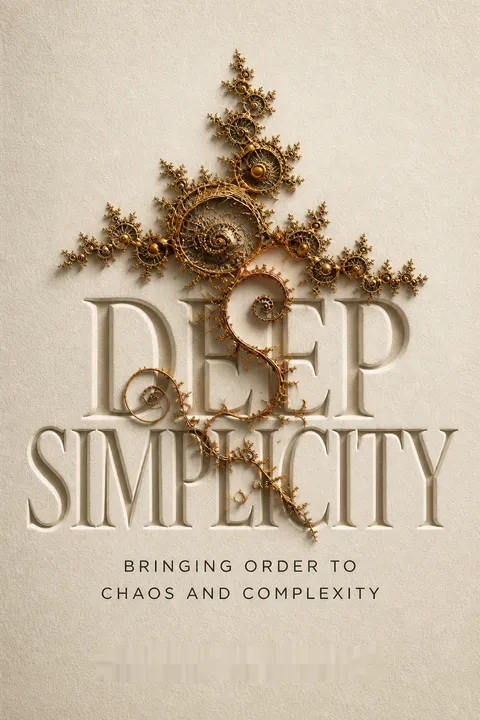
Deep Simplicity explores how complex systems arise from simple rules, covering topics like chaos theory, evolution, and the origins of life. Readers appreciate Gribbin's ability to explain difficult concepts, though some find parts challenging. The book's interdisciplinary approach and insights into phenomena like weather patterns and extinction events are praised. While some reviewers note dense mathematical sections, most find the overall content fascinating and perspective-altering. The book is recommended for those interested in complexity science, though prior knowledge in math and physics may be helpful.
People Also Read









Glossary
Chaos
Sensitive deterministic behaviorIn this book, chaos is irregular behavior produced by deterministic rules when a system is highly sensitive to its starting conditions. Tiny differences in the initial state can grow until outcomes diverge dramatically. The process is not random in its underlying laws, but long-range prediction can become impossible because initial conditions cannot be measured with perfect precision.
Strange attractor
A patterned destination in phase spaceA strange attractor is a set of states toward which a system tends while continuing to behave nonperiodically. Unlike a simple resting point or repeating cycle, it can have a complicated, often fractal structure. In the book’s examples, a system’s trajectory remains within the attractor’s bounded region but does not repeat the same path.
Fractal
A structure with fractional dimensionA fractal is a geometric structure whose irregular detail can recur across selected scales and whose dimension is not necessarily a whole number. The coastline and the Koch curve illustrate how measured length can depend on the scale of measurement. Fractals can also arise through repeated simple rules, including processes that produce elaborate patterns.
Power law
A scaling relationshipA power law describes how one quantity changes in relation to a power of another. In the book, it appears in the distribution of earthquake magnitudes, extinction sizes, and other phenomena. A straight line on a logarithmic plot can reveal this scaling. Power-law behavior indicates a pattern across scales, but does not by itself identify the process causing it.
Self-organized criticality
A system near an avalanche thresholdSelf-organized criticality describes a system that is driven gradually and settles near a threshold where disturbances can produce events of many sizes. In the sandpile model, grains added one at a time create a critical slope. A new grain may cause no slide, a small avalanche, or a much larger rearrangement, without requiring a uniquely large trigger.
Turing mechanism
Chemical pattern formationThe Turing mechanism is a proposed way for interacting chemicals to create patterns from a uniform starting state. An activator promotes its own production and that of an inhibitor; the inhibitor spreads faster and suppresses activator production farther away. Under suitable conditions, the uneven interaction can generate spots, stripes, or other stable patterns.
Autocatalytic network
A self-sustaining reaction webAn autocatalytic network is a set of chemical reactions in which some products help catalyze reactions that produce other members of the set, eventually supporting the production of the original catalysts. With access to raw materials and energy, such a network could sustain itself. Stuart Kauffman proposed that sufficiently connected networks may offer a route from chemistry toward life.
Red Queen effect
Reciprocal evolutionary pressureThe Red Queen effect describes coevolution in which interacting species continually adapt to one another. A change that improves one species’ success can create selection pressure on another, which then changes the conditions again. The overall relationship may appear stable even while both populations evolve, each needing continued adaptation simply to maintain its relative position.
Gaia hypothesis
Life-environment feedback on EarthThe Gaia hypothesis treats Earth’s living and nonliving components as parts of an interacting system whose feedbacks can help maintain conditions suitable for life. It does not require organisms to act consciously or sacrifice themselves for the planet. The claim is about coupled biological, atmospheric, oceanic, and geological processes that can produce self-regulation.
Daisyworld
A model of planetary temperature feedbackDaisyworld is a simplified model planet populated by dark and light daisies that absorb or reflect different amounts of heat. As the model’s star brightens, the relative success of the two daisy types changes, helping keep the planet’s temperature within a range favorable to their growth. The model shows how environmental regulation can emerge without planning.
Lovelock test
Search for atmospheric disequilibriumThe Lovelock test looks for signs of life by examining a planet’s atmosphere for persistent chemical imbalance. A chemically stable atmosphere may be near equilibrium, while reactive gases that require continual replenishment can indicate ongoing processes. The test is designed to detect broad consequences of life, rather than organisms based on familiar terrestrial biology.
FAQ
What's Deep Simplicity about?
- Exploration of Chaos and Complexity: Deep Simplicity by John Gribbin explores the relationship between chaos, complexity, and the emergence of life, arguing that simple laws govern complex systems.
- Interdisciplinary Approach: Gribbin combines insights from physics, biology, and mathematics to explain how order can emerge from chaos, emphasizing the importance of these concepts in understanding life and the universe.
- Real-World Examples: The book uses examples like weather patterns, stock market fluctuations, and biological systems to illustrate chaos and complexity principles, making them accessible and relatable.
Why should I read Deep Simplicity?
- Understanding Complex Systems: The book provides a framework for understanding complex systems, which is increasingly relevant today, helping readers appreciate the underlying simplicity in complex phenomena.
- Engaging Writing Style: Gribbin's clear and engaging writing makes complex scientific ideas accessible to a general audience, enhancing the reading experience.
- Interconnectedness of Science: It highlights the interconnectedness of scientific disciplines, encouraging critical thinking about reality and fostering appreciation for the scientific method.
What are the key takeaways of Deep Simplicity?
- Simplicity Underpins Complexity: Complex behaviors and systems can emerge from simple rules and laws, crucial for comprehending the universe.
- Chaos Theory and Sensitivity: The book emphasizes systems' sensitivity to initial conditions, leading to unpredictable outcomes and challenging long-term predictions.
- Emergence of Life: Gribbin explores how life may have emerged from non-life through chaos and complexity, suggesting these processes could explain life's origin.
How does Deep Simplicity explain the emergence of life?
- Life from Non-Life: Gribbin discusses theories on life emerging from non-living matter through chaos and complexity, suggesting simple chemical reactions led to complex structures.
- Role of Energy Flow: The book emphasizes energy flow's importance in maintaining systems far from equilibrium, essential for life, with solar energy driving Earth's biological processes.
- Self-Organization: Gribbin highlights self-organization, where complex patterns arise spontaneously from simple rules, crucial for understanding biological development and evolution.
What is chaos theory as defined in Deep Simplicity?
- Definition of Chaos Theory: Chaos theory studies how small changes in initial conditions can lead to vastly different outcomes in complex systems, revealing deterministic systems' unpredictable behavior.
- Real-World Applications: The theory applies to fields like meteorology, economics, and biology, improving predictions despite inherent uncertainties.
- Key Characteristics: Chaos is characterized by sensitivity to initial conditions, feedback loops, and non-linear interactions, making chaotic systems fascinating and challenging to study.
What is the "butterfly effect" mentioned in Deep Simplicity?
- Definition of the Butterfly Effect: The butterfly effect refers to small changes in initial conditions leading to significant and unpredictable outcomes in complex systems, illustrating chaotic systems' sensitivity.
- Example in Weather: Gribbin uses weather forecasting as an example, where minor atmospheric variations can drastically alter weather patterns, posing challenges for meteorologists.
- Implications for Prediction: The butterfly effect underscores chaotic systems' long-term prediction limitations, suggesting outcomes can diverge significantly over time even with precise initial data.
What are fractals, and how are they related to chaos in Deep Simplicity?
- Definition of Fractals: Fractals are complex geometric shapes that can be split into parts, each a reduced-scale copy of the whole, exhibiting self-similarity and often found in nature.
- Connection to Chaos: Gribbin explains that fractals arise from iterative processes and are associated with chaotic systems, with patterns described using fractal geometry.
- Examples in Nature: The book provides examples of fractals in natural phenomena like coastlines, clouds, and plant growth, illustrating complexity emerging from simple iterative processes.
How does John Gribbin explain the emergence of life in Deep Simplicity?
- Autocatalytic Networks: Gribbin suggests life emerged from networks of chemical reactions that catalyze each other, sustaining themselves and leading to more complex life forms.
- Role of Environmental Conditions: Specific conditions like temperature and nutrient availability influence life's emergence, creating "warm little ponds" where life can thrive.
- Evolutionary Processes: Gribbin connects life's emergence to evolutionary mechanisms, highlighting species' adaptation to environments driven by natural selection and ecological interactions.
What mathematical models are used in Deep Simplicity?
- Sandpile Model: This model illustrates how small changes can lead to significant outcomes, like avalanches, demonstrating self-organized criticality in complex systems.
- Daisyworld Model: This theoretical model shows species regulating their environment through feedback mechanisms, exemplifying life maintaining stable conditions despite external changes.
- Turing Patterns: Gribbin discusses mathematical models explaining patterns in animal coats and other phenomena, revealing underlying processes generating complexity from simple rules.
What is the Gaia hypothesis discussed in Deep Simplicity?
- Life Regulates the Environment: The Gaia hypothesis posits that living organisms interact with their inorganic surroundings to maintain life-conducive conditions, crucial for Earth's stability.
- Feedback Mechanisms: The hypothesis emphasizes feedback loops, where changes in one system component affect others, like biological activity altering atmospheric composition and climate.
- Interconnectedness of Life and Earth: Gribbin argues life and the physical environment form a single network, essential for understanding ecosystem function and evolution.
How does Deep Simplicity relate chaos theory to real-world phenomena?
- Weather Patterns: Gribbin uses chaos theory to explain weather systems' unpredictability, illustrating small changes leading to vastly different outcomes, emphasizing chaos theory's practical implications.
- Stock Market Fluctuations: The book discusses chaos theory's application to stock market behavior, where small events trigger significant shifts, highlighting chaos's relevance in economics.
- Biological Systems: Gribbin explores chaos theory's application to biological processes like population dynamics and organism development, underscoring chaos's importance in understanding life.
What role do feedback mechanisms play in Deep Simplicity?
- Stability and Change: Feedback mechanisms maintain stability in complex systems while allowing change, enabling adaptation to new conditions and equilibrium maintenance.
- Interconnectedness of Species: Gribbin emphasizes feedback loops among species influencing evolution and survival, with changes in one species affecting others.
- Self-Regulation: Feedback mechanisms contribute to ecosystems' self-regulating nature, crucial for understanding life's persistence and evolution on Earth.
About the Author



Download PDF
Download EPUB
.epub digital book format is ideal for reading ebooks on phones, tablets, and e-readers.








