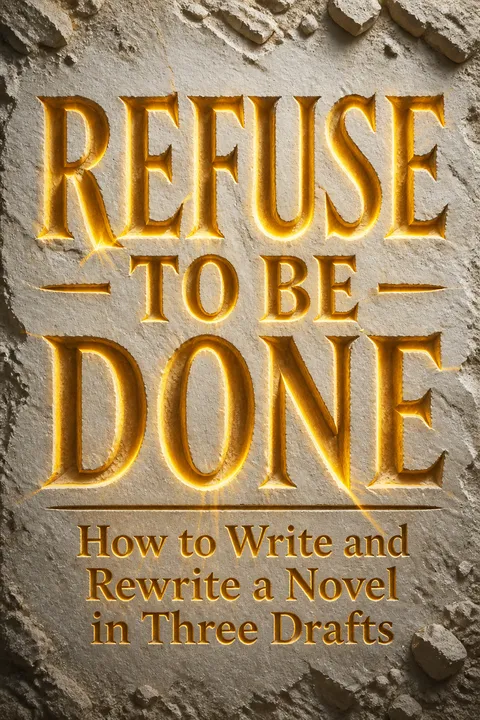


Key Takeaways
Treat a novel as three different jobs, not one endless draft
Separate the work by purpose. Matt Bell organizes novel-making into three flexible stages. The first is exploratory: generate material and discover the story. The second is structural: identify the strongest version of the plot and rewrite toward it. The third is editorial: refine scenes, sentences, and the reader’s experience. These are not rigid passes. Writers can revisit a stage, overlap them, or spend far longer on one than another. The point is to stop asking one draft to invent, organize, and perfect everything at once.
Each stage solves a different problem. Early uncertainty calls for play, not polish. A sprawling manuscript calls for decisions about events and structure. A coherent book calls for close attention to language and clarity. Bell’s own experience is that most of writing happens through rewriting, not in the first rush of inspiration.
The staged approach resembles a useful distinction in design: first generate possibilities, then select and organize, then test and refine. Mixing all three modes can make a writer censor ideas before they exist or polish scenes that later disappear. The stages also reduce the emotional fog of a large project by turning “write a novel” into a more answerable question about the current task. The caution is that creative work rarely behaves like a clean production line. Bell’s flexibility matters: the stages are best used as lenses, not as rules that penalize a writer whose process loops.
Let the first draft discover the book you could not outline
Write to find out. Bell favors an exploratory draft, meaning a provisional version written to uncover characters, events, and the story’s real interests. He often begins without a formal outline because too much advance certainty can crowd out surprise. In writing Scrapper, he spent about a month drafting before learning his protagonist’s name. He knew the character worked in Detroit’s illegal metal-scrapping trade, but scenes of that work gradually revealed what the protagonist cared about and led Bell to a kidnapped child who became the story’s true catalyst.
Keep plans permeable. An outline, scene list, or set of cards can help, provided it remains a prompt rather than a contract. Bell’s first draft is not a test of whether the initial idea was correct. It is a way to discover which parts of that idea have energy, and what more compelling story is taking shape on the page.
This is a case for productive uncertainty, not for rejecting planning. In creative problem-solving, a fixed brief can narrow the search space before useful options appear; exploratory drafting lets the writer encounter options that could not be reasoned out in advance. Bell’s example shows how action can generate character knowledge rather than merely display it. Still, discovery has costs: a writer with limited time or a plot-heavy genre may benefit from more scaffolding. The practical test is whether planning enables the next page or postpones it.
When the story stalls, write toward the page’s strongest live wire
Follow the available energy. Bell recommends writing the scene that currently feels vivid, even if it belongs far ahead in the story. He calls these known destinations “islands ”: once the major scenes exist, the writer can build the bridges between them. A novel need not narrate every uneventful transition. A journey can move from one consequential stop to the next, skipping smooth stretches that add no tension.
Let existing pages propose new ones. Read what you have, notice its most charged image or unresolved conflict, and extend it. Bell compares this to improvisation: accept an unexpected element from the manuscript and add to it rather than rejecting it because it was not in the original plan. Predict what a character might do next, then complicate that choice. A modest writing target can preserve the habit: Bell’s class goal of 500 words a day, five days a week, produces 30,000 words over twelve weeks.
The method treats a draft as a feedback system. Each new passage supplies information that changes the next decision, so the writer is not merely executing a plan but learning from the artifact in progress. This resembles iterative design, where rough prototypes expose needs that a speculative plan misses. The emphasis on excitement is useful because attention is a scarce resource, but excitement alone can reward novelty over coherence. The bridge scenes still have to make the islands feel causally connected, and a daily target should be adjusted to fit the writer’s actual life.
Outline the manuscript you wrote before planning the book you want
Map the real draft. After finishing the first version, Bell recommends taking a break, then outlining what is actually on the page. His narrative outline summarizes the main action in a voice close to the novel’s own. It focuses on events, meaning actions that move narrative time forward, rather than interior reflection, digression, or backstory. This makes it easier to see cause and effect, missing turning points, repeated events, and stretches where the plot stops moving.
Revise the map first. Once the outline describes the draft accurately, reshape it into a plan for the next version. Ask when the central disruption occurs, when characters begin acting on the resulting problems, and whether conflicts and revelations gain force. For a novel with several timelines, Bell may outline each strand separately before braiding them together. His outline for Appleseed took three months, but the planning helped him manage three intersecting timelines.
The outline functions like a model of the manuscript, allowing structural experiments at low cost. A writer can move a plot event in a paragraph before rebuilding dozens of scenes around it. This is also a defense against sunk-cost thinking: pages already written do not automatically deserve to stay. The method is especially strong for stories whose effects depend on causality and timing. Its limit is that an event-only map can flatten novels powered by voice, atmosphere, or associative movement. Those qualities still need protection while the plot is being reorganized.
Retype the second draft so every scene serves what you now know
Rewrite with hindsight. Bell’s central second-draft practice is to start a blank document and retype the novel, using the first version as a guide while following the revised outline. Retyping is deliberate: copying and pasting makes it too easy to preserve sentences created before the writer understood the story. By the end of the first draft, the writer knows more about the characters, the plot, and the novel’s voice. The second version can use that knowledge from its opening page.
Let the old version shrink. Bell calls the first manuscript a “diminishing draft.” As material is rewritten into the new document, it is crossed out or removed from the old one. This creates room to change scenes and make structural decisions without treating every earlier sentence as precious. The process is demanding and may take as long as the first draft, but it turns revision into the making of a new book, not merely the repair of old prose.
Retyping creates friction in a productive place. It forces a writer to make fresh choices, while a polished-looking old sentence can otherwise exert authority simply because it already exists. The practice also resembles retrieval and reconstruction: remembered material is rebuilt in light of new understanding rather than copied intact. It is not universally efficient. Writers who work with accessibility needs, tight deadlines, or highly modular forms may prefer selective rewriting. The deeper principle is to make the new draft answer to the story’s current needs, not to the sunk labor of its earlier wording.
Make repeated scenes change when characters return to familiar places
Build story through contrast. A scene becomes meaningful when its conditions change. Bell suggests revisiting settings rather than inventing a new location for every event. A character who returns to a childhood home may find the rooms unchanged but see them differently as an adult. In Blade Runner, many key encounters return to a small group of settings; each return carries new information and changes the balance between characters.
Give scenes a job. A scene can introduce a discovery, complication, reversal, or resolution. Repeating an action can make change visible, as in Gattaca, where two brothers’ swimming contest recurs across their lives and reverses who rescues whom. Bell also recommends compressing uneventful transitions, setting a clear time limit when useful, and identifying the expected scenes of a genre. A mystery usually needs a body or crime, an investigation, and some form of answer, even when the writer chooses to subvert convention.
Repetition gives readers a built-in comparison. The setting or action stays recognizable, so a changed character becomes easier to perceive without explanation. This is closely related to variation in music: a returning motif gathers meaning because it is heard under new conditions. Genre expectations work similarly, offering a shared structure that a writer can fulfill or deliberately frustrate. The danger is mechanical repetition, where a recurring scene merely checks a box. A return earns its place when new pressure, knowledge, or power changes what the familiar setting means.
Revise one layer at a time, and use your ears to catch what eyes miss
Make the task small. In the third stage, Bell recommends layered revision: work on one kind of problem at a time instead of trying to improve every feature simultaneously. Print the manuscript or change its digital appearance to make it feel unfamiliar. Read passages aloud, because speaking forces attention to each word and exposes awkward rhythm or unclear syntax. Break a difficult chapter into separate scenes, paragraphs, or even sentences, then test their order and remove pieces that cannot stand.
Tune the language after structure. Bell advises checking verbs for precision, reducing unnecessary thought and sensory tags, and varying sentence and paragraph lengths. He also suggests examining dialogue for what each speaker wants, and cutting exchanges that repeat information. The aim is not to decorate every line. It is to make the scene easier to follow and the prose’s sound more intentional.
Layered editing is a form of attention management. A reader cannot reliably assess plot logic, sentence music, and punctuation all at once, just as a musician practices rhythm separately from intonation before combining them. Reading aloud adds a second channel of feedback: the body encounters breath, stress, and stumbling where silent reading may glide past familiar wording. Yet sound is not a substitute for meaning. A lyrical sentence can still obscure the action, so the best test pairs the ear’s judgment with a clear account of what the sentence makes the reader understand.
Remove explanations that prevent readers from making their own connections
Separate story from scaffolding. Writers often explain a character’s motive or clarify a symbol because they needed that explanation while inventing the scene. Bell argues that readers should not inherit every step of the writer’s private reasoning. Highlight explanations and backstory, then ask whether each passage clarifies an essential fact or merely repeats what the action already conveys. Backstory that complicates a character can deepen the novel; backstory that neatly explains every behavior can make the character feel predetermined.
Leave useful gaps. In Toni Morrison’s Sula, a character’s return to town coincides with a strange visitation of robins. The novel places the events together without providing a simple explanation linking them. That space invites the reader to interpret. Bell suggests searching for logical signposts such as “because” and “therefore,” then testing whether the connection can be left implicit. A reader’s effort to connect images and events is part of the pleasure, not a problem to eliminate.
This advice is about distributing interpretive work. When a novel supplies evidence without closing every inference, readers actively build a model of the story, which can make the experience more involving and memorable. Ambiguity, however, is not the same as confusion. A reader needs enough concrete information to form plausible interpretations, and an unexplained connection can feel arbitrary if the surrounding details provide no pattern. The useful question is not whether a passage explains, but whether its explanation adds necessary understanding or takes away an inference the scene has already earned.
Keep cutting until every surviving sentence earns its place
Save what you remove. Bell writes expansively, then trims. He recommends keeping a separate file for cuts so that deletion feels reversible and useful material can be retrieved. One severe exercise is to identify and remove the weakest sentence in every paragraph, then write a replacement only where the remaining paragraph needs one. Another is to search for overused words and interrogate each instance. While revising Scrapper, Bell deleted about 800 uses of “that.” On Appleseed, late searches removed hundreds of repeated words and phrases.
Use arbitrary limits to find slack. Pam Houston’s “widow” exercise asks writers to tighten paragraphs so that a word dangling onto the next line is pulled back up. The layout is arbitrary, but the constraint forces another look at sentences assumed to be finished. Bell’s larger point is that discarded pages are not necessarily wasted effort. A draft of his first novel shrank from 123,000 words to 63,000 in print.
Cutting is easier when it is treated as diagnosis rather than punishment. The cut file lowers the psychological cost of experimentation, while word searches reveal habits invisible during ordinary reading. The widow exercise uses a deliberately artificial constraint to prompt real decisions, much like editing to a word limit. But compression is not inherently quality. A sentence may be necessary because it creates pace, texture, or an intentional echo. The goal is not the shortest manuscript; it is a manuscript where retained material contributes more than its alternatives.
Analysis
Bell’s most useful contribution is not a universal formula for plot or prose. It is a sequence of working attitudes that meet different kinds of uncertainty. Early on, the writer needs permission to make material before knowing what it means. Once the material exists, the writer needs distance and a structural view. When the story holds together, attention can narrow to sound, clarity, and excess. This progression explains why the book’s advice can seem contradictory: improvise, then outline; write freely, then rewrite every page; cherish the prose, then cut it. The contradictions are productive because each belongs to a different problem.
The method also reframes revision from correction into discovery. A first draft is not a failed version of the finished novel. It is evidence about what the novel might become. Outlining that evidence, and then rewriting from scratch, makes large changes psychologically and practically possible. The repeated emphasis on retaining cut material matters for the same reason: reversibility encourages experimentation. Bell’s techniques are strongest when they protect momentum while increasing the writer’s willingness to make consequential choices.
The central limitation is the time investment. A second draft that takes as long as the first, followed by many focused editing passes, is not feasible for every writer or every project. Nor does every novel need a linear plot, escalating conflict, or conventional genre landmarks. Bell acknowledges variation, and that flexibility is essential. His methods are best treated as diagnostic tools: use them when a manuscript is stuck, shapeless, overexplained, or dull to its maker. The deeper principle is to match the revision method to the draft’s current failure, rather than apply every technique by habit.
Review Summary
Refuse to Be Done receives high praise for its practical advice on novel writing. Reviewers appreciate its concise structure, encouraging tone, and actionable strategies for drafting and revising. Many find it useful for both beginners and experienced writers, highlighting its focus on the rewriting process. Some readers note that certain techniques may not suit everyone's writing style. Overall, the book is commended for its motivational approach and valuable insights into the novel-writing journey, with many readers planning to apply its methods to their own work.
People Also Read


Glossary
Exploratory draft
Discovery-focused first versionA provisional first version written to uncover the novel’s characters, scenes, and underlying story. The writer may work out of order, use fragments, or begin without a detailed outline. Its purpose is to generate material and learn what the book could become, not to produce polished, publishable prose.
Generative revision
Revision that creates materialBell’s term for rewriting during the first-draft stage in ways that help the writer continue inventing the novel. It includes revisiting existing pages for new ideas, writing distant scenes before their transitions, and changing a scene or storytelling mode to restore momentum. The revision is generative because it produces new story material rather than only correcting old text.
Narrative revision
Reshaping plot and eventsThe second-stage work of reorganizing and rewriting a novel’s dramatic material. The writer maps the events of the completed first draft, studies their cause and effect, and revises that map into a plan for a stronger story. The focus is the novel’s structure, conflict, and sequence, rather than sentence-level polish.
Diminishing draft
First draft being replacedBell’s name for the first manuscript as it is rewritten into a new second-draft document. Instead of copying and pasting passages, the writer retypes and reshapes them, then marks the old material as transferred. The first version gradually empties as the new version grows, making it easier to depart from sentences written before the story was fully understood.
Writing the islands
Drafting key scenes firstA drafting technique in which the writer writes major scenes already known, even when they occur far apart in the story. These scenes are the islands. The writer can then create connecting material between them, or discover that some transitions are unnecessary. The technique helps overcome uncertainty about what comes next and prioritizes consequential events over uneventful connective passages.
Time narrated versus time of narration
Story time versus telling timeA distinction between the period when a story’s events occur and the moment from which those events are being told. A child might narrate an event as it happens, while an older version of the same character might recount it years later. The choice changes what the narrator can know, remember, interpret, or withhold.
Weasel words
Words that weaken proseBell’s label for frequently used words that can make sentences vague, padded, or less forceful. Examples include unnecessary instances of “that,” “just,” or “seemed,” along with repeated intensifiers and habitual dialogue gestures. A search can locate possible instances, but each one should be judged in context rather than automatically deleted.
FAQ
1. What is "Refuse to Be Done" by Matt Bell about?
- Comprehensive guide to novel writing: The book is a practical, step-by-step manual for writing and rewriting a novel, structured around a three-draft process.
- Focus on revision and rewriting: Matt Bell emphasizes that most of good writing is actually rewriting, and he provides detailed strategies for each stage.
- Actionable advice for all stages: The book covers everything from starting with a blank page to final edits, offering tactics for generating, shaping, and polishing a manuscript.
- Encouragement and mindset: Bell also addresses the psychological challenges of novel writing, encouraging writers to claim their work and persist through doubt.
2. Why should I read "Refuse to Be Done" by Matt Bell?
- Practical, actionable strategies: The book is filled with concrete techniques and exercises that can be immediately applied to your writing process.
- Applicable to all writers: Whether you’re a beginner or a seasoned novelist, Bell’s advice is designed to be adaptable to different genres, styles, and experience levels.
- Focus on process, not formula: Bell avoids prescriptive formulas, instead helping writers discover and refine their own unique process.
- Inspiration and motivation: The book is praised for its encouraging tone and for demystifying the daunting task of writing a novel.
3. What are the key takeaways from "Refuse to Be Done"?
- Three-draft structure: Writing a novel is best approached in three major drafts: exploratory (first), narrative revision (second), and polishing (third).
- Revision is essential: The majority of novel writing is revision and rewriting, not just initial inspiration or drafting.
- Embrace discovery: The first draft should be exploratory and open to surprise, rather than rigidly planned.
- Layered, focused revision: Later drafts should break revision into manageable, focused tasks, improving the manuscript in layers.
4. How does Matt Bell’s three-draft method work in "Refuse to Be Done"?
- First Draft – Exploratory: Focus on generating material, discovering the story, and writing without overplanning or self-censorship.
- Second Draft – Narrative Revision: After a break, outline what you have, analyze structure, and rewrite the novel from scratch, guided by a new, improved plan.
- Third Draft – Polishing: Conduct layered, targeted revisions, focusing on prose, scene structure, dialogue, and cutting unnecessary material.
- Iterative and flexible: Bell notes that these “drafts” are really stages, and writers may move back and forth between them as needed.
5. What specific advice does Matt Bell give for starting a novel in "Refuse to Be Done"?
- Claim your project: Affirm to yourself that you are writing a novel, and give it a working title early to make it feel real.
- Write an exploratory draft: Begin without a rigid outline, allowing the story, characters, and world to emerge through writing.
- Set manageable goals: Use daily or weekly word count or time-based goals to build momentum and confidence.
- Embrace imperfection: Don’t worry about writing perfect sentences or scenes in the first draft; focus on generating material.
6. How does "Refuse to Be Done" recommend handling revision and rewriting?
- Rewrite, don’t just revise: For the second draft, Bell advocates retyping the entire manuscript from scratch, using the first draft as a guide.
- Outline after drafting: Only after the first draft is complete should you outline what you have, to see the story’s structure and identify what needs changing.
- Focus on big-picture changes: Use the second draft to address plot, character arcs, and structure, not just line edits.
- Break revision into layers: In the third draft, tackle one aspect at a time—such as dialogue, prose style, or scene order—to avoid overwhelm.
7. What are some of the most useful generative and revision tactics in "Refuse to Be Done"?
- Writing the islands: Write the big, exciting scenes you know, then connect them later, rather than writing strictly in order.
- Yes, and approach: Build on what’s already on the page, treating your draft as an improv partner to generate new material.
- Remove the boring bits: Regularly cut or rewrite any passages that bore you, and keep a “cut file” for discarded material.
- Use highlighting and color-coding: Print out your manuscript and use highlighters to identify explanations, backstory, weak sentences, and strong sentences for targeted revision.
8. How does Matt Bell address the psychological challenges of novel writing in "Refuse to Be Done"?
- Normalize doubt and perseverance: Bell acknowledges that oscillating between confidence and doubt is normal for novelists.
- Encourages self-kindness: He stresses the importance of forgiving yourself for imperfect drafts and focusing on progress over perfection.
- Celebrate milestones: The book recommends celebrating the completion of each draft and taking breaks to gain perspective.
- Refuse to be done: Bell’s core philosophy is to persist through fatigue and resistance, pushing the novel as far as it can go before declaring it finished.
9. What are Matt Bell’s recommendations for improving prose style in "Refuse to Be Done"?
- Work the verbs: Replace generic verbs with more precise, vivid ones, except in dialogue tags where “said” and “asked” are usually best.
- Reduce thought and sensory tags: Cut unnecessary “I thought,” “I saw,” and similar phrases to make prose more immediate.
- Vary sentence and paragraph length: Create rhythm and drama by mixing short and long sentences and paragraphs.
- Eliminate weasel words: Search for and remove filler words like “just,” “really,” “suddenly,” and others that weaken prose.
10. How does "Refuse to Be Done" suggest handling structure, scenes, and chapters?
- Scene-level focus: Break the manuscript into scenes and revise each for clarity, tension, and efficiency.
- Cut openings and closings: Try removing the first and last paragraphs of scenes to see if the scene starts or ends more strongly.
- Rearrange for tension: Experiment with the order of scenes and chapters to maximize suspense and narrative drive.
- Flexible chaptering: There’s no ideal chapter length; instead, consider the needs of your story, pacing, and reader experience.
11. What are the best quotes from "Refuse to Be Done" and what do they mean?
- “Refuse to be done.” – The book’s central mantra, urging writers to persist in revision and not settle for “good enough.”
- “Writing a novel is kind of like scaling Mt. Everest and passing by your own bones on the way.” (Karen Russell, quoted) – Highlights the endurance and challenge of novel writing.
- “When in doubt, rewrite instead of revise.” – Bell’s advice to favor rewriting whole sections over tinkering with existing text.
- “You write your way through a field of pebbles, looking for seeds.” (Jane Smiley, quoted) – Encourages writers to accept that not every sentence will be great, but some will grow into the heart of the novel.
12. What makes "Refuse to Be Done" by Matt Bell different from other writing craft books?
- Revision-centered approach: Unlike many craft books that focus on inspiration or outlining, Bell’s is built around the reality that most of writing is rewriting.
- Step-by-step, layered process: The book offers a clear, repeatable method for moving from draft to draft, with specific tactics for each stage.
- Adaptable to any genre or style: Bell’s advice is not prescriptive; he encourages writers to take only what’s useful and adapt it to their own process.
- Focus on the writer’s growth: The book emphasizes that the process of writing and revising a novel changes the writer, not just the manuscript.
Download PDF
Download EPUB
.epub digital book format is ideal for reading ebooks on phones, tablets, and e-readers.








