

Key Takeaways
Audit whether inertia comes from comfort, fear, or refusing self-knowledge.
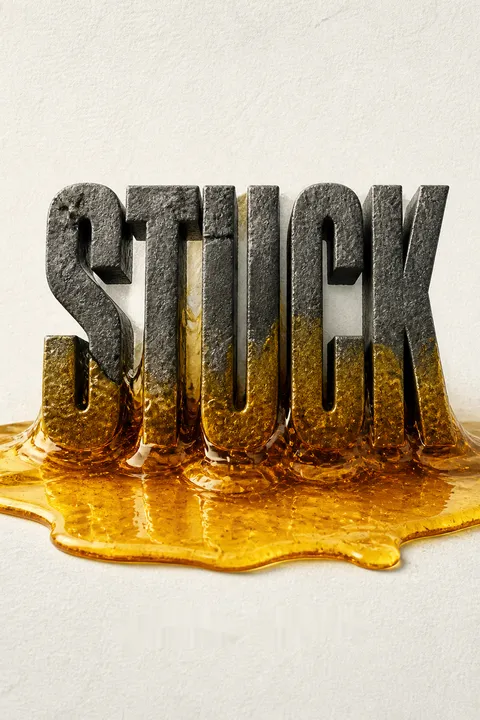
Three forces keep people stuck. Rufus groups the main causes as choosing ease over effort, fearing the risks of change, and avoiding an honest look at oneself. Habits can make repetition automatic, but recognizing a pattern does not mean it is harmless. The author opens by admitting her own sense of being emotionally twelve despite her adult life, making self-scrutiny part of the argument rather than a lesson aimed only at others.
Separate limits from excuses. Getting unstuck, in her account, requires energy, courage, and enough self-knowledge to choose differently. But not every constraint is self-created: other people, institutions, illness, and financial circumstances can restrict real options. The useful first question is not simply why someone has failed to move, but what is keeping movement difficult and what choices remain.
The three-part lens is memorable because it turns a vague feeling into questions about effort, fear, and avoidance. It also risks making hardship sound like a character flaw. Depression, disability, poverty, coercion, and caregiving can limit action without reflecting laziness or dishonesty. A stronger application preserves the book's emphasis on agency while distinguishing blame from responsibility: identify the choices available, then locate the support or resources needed to act on them.
Let the past inform you, not monopolize your present.
Memory can become a refuge. Rufus uses Amanda Wingfield, the mother in Tennessee Williams's The Glass Menagerie, to show how nostalgia can turn a vanished youth into a permanent stage set. The past may feel safer than an uncertain present, whether the memories are glorious or painful. In her own story, the author recalls traveling through Europe with her future husband while repeatedly recounting childhood injuries instead of attending to the trip and the person beside her.
Remembrance has a cost. Revisiting the past can teach, grieve, and preserve what matters. The danger comes when replaying it crowds out present relationships and future plans. Rufus compares this to repeatedly retracing a journey to visit a grave while leaving the people and purpose of the journey behind.
The distinction between remembering and inhabiting memory is useful in grief work, family history, and ordinary regret. A past event can remain important without dictating every present interpretation. Still, the metaphor of choosing to turn away has limits: intrusive memories and trauma responses are not always under voluntary control. The point is best applied as an invitation to notice what memory is doing, not as a demand that painful history be dismissed.
Defend your attention from a culture that sells immediacy.
Convenience reshapes expectations. Rufus traces modern impatience to a mix of consumer marketing, labor-saving technology, and pop culture that celebrates getting what one wants now. She argues that some Beat writers presented a selective, pleasure-focused version of Zen as permission for instant gratification, far removed from disciplined practice. The postwar boom in products such as television remotes and credit cards made waiting less necessary and ease more ordinary.
Speed has tradeoffs. The book cites a 2007 estimate that young people aged eight to eighteen spent an average of six and a half hours daily with electronic media. It also discusses a chocolate-choice experiment: people offered six options were more satisfied than those offered thirty. Rufus's point is that abundant options and instant access can produce passivity and dissatisfaction, not just freedom.
This argument anticipates a useful distinction from behavioral economics: immediate rewards often outweigh distant benefits, especially when environments make the immediate option effortless. Attention is shaped by defaults, interfaces, and business incentives, not just individual discipline. The book's historical story is less tidy than its thesis suggests, and convenience also creates genuine access and freedom. The practical insight is not to reject technology, but to decide deliberately which delays and limits protect attention and long-term aims.
Ask what your habit supplies before demanding that it disappear.
A habit often fills a gap. Rufus describes a software designer who nibbled chocolate truffles through the workday until she gained weight and faced a family risk of diabetes. Replacing the truffles with dried cranberries and tea helped because the new routine still met her need to nibble while reducing the harm. The book argues that habits can soothe anxiety, relieve boredom, or provide a concrete sense of reward when other sources of fulfillment feel distant.
Labels can help or hinder. Rufus challenges the disease theory, the idea that addictions and destructive habits are illnesses outside personal control. She argues that this framing can weaken accountability, while acknowledging that addiction can be devastating and hard to stop. Her account is deliberately provocative, not a settled clinical guide.
Looking for a habit's function is a strong behavioral strategy: removing a coping behavior without addressing the need it serves often leaves the need intact. The replacement example makes that practical. The book's challenge to disease language raises an important question about agency, but its choice-versus-illness framing is too stark. Addiction can involve biological vulnerability, learning, social context, and constrained control. Compassionate treatment and personal accountability can coexist; neither requires pretending the behavior is easy to change.
Tell trauma honestly, but don't let retelling become your only identity.
A story can begin recovery. Rufus criticizes a culture that turns trauma into spectacle and rewards people for repeatedly performing pain. Yet she does not argue that every survivor can simply move on. The book describes how traumatic memories can remain intensely reactive, and cites psychologist Boris Cyrulnik's view that speaking about an experience can help break its hold when the story is shared and given meaning.
Make room for what follows. Cyrulnik's example of women in war-ravaged Kosovo being helped to develop businesses illustrates a shift from recounting harm to imagining and building a future. Rufus also uses Hans Christian Andersen, who transformed childhood humiliation and hardship into stories. The lesson is not to hide suffering, but to let expression become one part of life rather than its sole destination.
The distinction between testimony and spectacle matters. Repeated telling can support recognition and justice, while pressure to make suffering entertaining can exploit the person telling it. Creative work and practical projects may help restore agency, but they are not universal cures. Trauma can require safety, community, and professional care, and some effects endure. The section is strongest when it asks whether a story is opening choices, rather than treating continued pain as a failure to heal.
Treat dependence as a relationship to negotiate, not a personal disgrace.
Everyone relies on others. Human beings begin life completely dependent, and adult life remains full of reliance on family, institutions, and shared systems. Rufus contrasts a toddler welcomed at a family gathering with her thirty-two-year-old uncle Tyler, who lives with his parents, contributes little, and is privately called a sponge by his brothers. His parents love him, but the support drains their savings and leaves everyone resentful or ashamed.
Ask who carries the cost. The book distinguishes temporary or mutual help from a pattern that consumes more than it gives. It also describes public policies that can unintentionally discourage marriage or work. These examples make dependence a practical and social question, not only a moral one: what support is needed, who provides it, and does the arrangement help people regain capacity?
The focus on reciprocity helps make invisible labor visible. Support can empower someone, but a one-sided arrangement may quietly burden caregivers and prevent the supported person from practicing independence. At the same time, the uncle's situation cannot establish that dependence is simply a choice. Housing costs, disability, unemployment, and weak social services shape what options exist. A fair assessment asks both what an individual can contribute and whether the surrounding system makes contribution realistically possible.
Judge a relationship by its lived reality, not the market's fantasy.
Comparison can manufacture doubt. Rufus argues that advertising and popular culture profit from dissatisfaction, encouraging people to treat a stable partner as an obstacle to excitement or better options. She contrasts that pressure with the real work of deciding whether a relationship is caring, safe, and fulfilling. Her friend Megan, drawn to unavailable married men and convinced that steady partnership would be dull, repeatedly chose a painful arrangement over available alternatives.
Not every bond deserves saving. Rufus's point is not that commitment is always healthy. Some relationships are abusive or frightening, and leaving may be essential. But feeling restless is not, by itself, proof that a good relationship is a trap. The book urges readers to assess the actual partnership rather than accept either romantic advertising or an ideology that labels fidelity as confinement.
The warning about comparison is persuasive in a media environment that displays idealized alternatives without their ordinary costs. Yet the claim that commercial or political forces broadly aim to break couples apart is more polemical than demonstrated. Relationship quality depends on safety, reciprocity, and shared values, not duration alone. The useful question is less whether commitment is fashionable or rebellious, and more whether the people involved can be honest, respected, and themselves within the relationship.
Evaluate work by fit and meaning, not status or imagined alternatives.
The same job can mean different things. Janine, an office manager who once worked in film, lists the security, colleagues, benefits, convenient hours, and free movie screenings that keep her in a job she considers a professional step down. Rufus recommends a Deathbed Test: imagine looking back on the work from the end of life and ask whether it was worth doing. The exercise makes values more visible than job titles do.
Compare options honestly. Researcher Amy Wrzesniewski found that hospital janitors doing similar work could see it as a job, a career, or a calling. Rufus also cites a 2007 survey in which fewer than half of Americans said they were satisfied with work, down from 61 percent in 1987. Dissatisfaction may signal a need to change, but it can also reflect status comparisons, debt, or unrealistic expectations.
The job, career, and calling distinction helps explain why salary and prestige cannot capture the meaning of work. A deathbed perspective can reveal whether security is a chosen value or merely an excuse to avoid risk. But reflection cannot erase material constraints: benefits, debt, caregiving, and labor-market conditions are real. The best career decision combines subjective fit with an honest account of costs, skills, and options, rather than treating either passion or resignation as automatically wise.
Treat agency as a next step, not a promise that every ending is safe.
Small changes can redirect a story. Writer Michael Chabon abandoned a sprawling, stalled novel and used his experience with the project as material for Wonder Boys, a novel about a writer trapped by his own unfinished manuscript. The example shows that a blockage can contain insight, even when the original goal must be left behind.
Change is not a guarantee. The epilogue returns to Megan, whose affair, debt, and repeated moves never resolved her distress. She later died after an overdose; she left no note, so her intent cannot be known with certainty. Rufus presents the loss as a warning against assuming that advice or determination will rescue everyone. Choices matter, but so do support, circumstance, and the limits of what any one person can control.
The contrast between Chabon and Megan gives the book a more honest ending than a simple triumph story would. A blocked project can become useful material, but a person's suffering is not merely raw material awaiting a clever reframing. Agency is most humane when paired with connection and practical help, especially in crisis. The section's lasting lesson is modest: a different response may create an opening, but no single choice guarantees recovery or safety.
Analysis
Stuck is a hybrid of memoir, cultural criticism, and self-help. Its structure moves across the past, the present, habits, trauma, relationships, and work, but its recurring subject is repetition: a familiar pattern may feel safer than uncertainty even when it is costly. Rufus's most effective method is to move between cultural examples and intimate confession. Her own tendency to retreat into childhood memories complicates the voice of judgment, while stories such as Megan's reveal that insight does not reliably produce change.
The book is strongest as a diagnostic prompt, not as a universal causal theory. Asking what a behavior protects, what it costs, and what alternatives remain can expose the hidden rewards of nostalgia, compulsive consumption, or a dead-end job. Its account of choice overload and consumer pressure also encourages readers to examine how environments shape desire, rather than treating every impulse as purely private.
Its weaknesses come from the same boldness. The labels of laziness and self-deception can flatten depression, trauma, addiction, disability, and economic constraint into failures of will. The challenge to the disease model is a useful warning against treating diagnosis as a complete explanation, but agency and illness are not mutually exclusive. Likewise, the book's broad claims about political movements, religion, and forces undermining relationships are interpretations, not neutral findings. Because it was published in 2008, some statistics and examples describe that moment rather than current conditions.
The clearest way to use the book is to combine its demand for self-honesty with a wider account of context. Ask what the pattern provides, who else bears its consequences, what constraints are real, and what small change is both possible and safe. This preserves the book's insistence that choices matter without pretending that every person has equal freedom or that every effort ends in a neat recovery.
Review Summary
Stuck received mixed reviews, with an average rating of 3.02 out of 5. Some readers found it insightful and thought-provoking, praising its exploration of various forms of "stuckness" in society. Others criticized it as rambling, judgmental, and lacking concrete advice. Many appreciated the author's personal anecdotes and cultural observations, while some felt the book was too anecdotal and lacked scientific backing. Critics noted the book's tendency to oversimplify complex issues and its occasional bias. Overall, readers were divided on whether the book offered valuable insights or fell short of expectations.
People Also Read




Glossary
Stuckness
repetition that limits movementRufus uses stuckness for being unable or unwilling to move on from a pattern, place, relationship, belief, or period of life. It can look like immobility, such as remaining in a painful situation, or activity without progress, such as repeating the same choices. The term does not automatically mean that commitment or stability is unhealthy.
Mirror, Mirror Syndrome
inflated self-assessmentRufus's term for a gap between a person's self-image and actual abilities, especially when praise from parents or teachers encourages unrealistic expectations. The name alludes to the fairy-tale queen who trusts a flattering mirror. The book applies the idea to career ambitions: without accurate feedback, people may pursue goals that their current skills and circumstances cannot support.
disease theory
habit framed as illnessRufus uses this term for the view that addiction and other destructive habits are diseases that eventually remove voluntary control. She argues that the label can reduce shame and encourage treatment, but may also make people feel powerless or avoid examining the choices and circumstances involved. The book's critique is a position in a contested debate, not a clinical consensus.
choice overload
too many options, less satisfactionA term used for the difficulty and dissatisfaction that can arise when people face an excessive number of choices. Rufus discusses an experiment comparing chocolate assortments of different sizes, in which participants offered many options reported more regret than those offered a smaller selection. The concept helps explain why abundant choices can encourage people to retreat to familiar habits.
trauma narrative
a story of traumatic experienceRufus uses this phrase for an account that organizes painful experience into a story, whether personal, collective, or presented through media. Such narratives can give survivors recognition and help make events intelligible. The book also examines how repeated public retelling can turn pain into spectacle or a fixed identity, while emphasizing that trauma does not affect everyone in the same way.
Deathbed Test
a work-life perspective exerciseA reflection exercise Rufus proposes for assessing work. A person imagines looking back on their working life from a deathbed and asks whether the job or career was worth the time and sacrifices it required. The exercise is meant to clarify values beyond status or salary, not to erase practical constraints such as income, benefits, or family obligations.
WAGER OFTEN
gambling-disorder symptom mnemonicA mnemonic presented in the book to summarize symptoms associated with Pathologic Gambling Disorder. Its letters represent withdrawal, relationship effects, chasing losses, gambling to escape, reliance on financial rescue, illegal acts, failed control, increased tolerance, evasion of truth, and preoccupation with future gambling. Rufus questions whether this checklist describes a disease or behavioral patterns and their consequences.
About the Author
Other books by Anneli Rufus
Download PDF
Download EPUB
.epub digital book format is ideal for reading ebooks on phones, tablets, and e-readers.








